Tag: group

  • Group or Private Lessons; Or Just Stick with Solo Riding?

    There’s one question I get asked at least once a week, by both ‘in-person’ riders, and online riders I’ve connected with. And just yesterday, I realised that, somehow, I’ve never actually answered it here! The question goes something like this:- “Should I have lessons? And if so, what kind; private or group?”.   Some riders will also enquire about my thoughts on DIYing it!

    And my answer, as with so many things in horse riding, is “It depends.”  Because the truth is, where you are right now in your riding journey will determine what type of lessons, or combination of lessons, will help you move forward the fastest.

    So today, let’s unpack the pros and cons of private lessons versus group lessons, and where they fit in your journey.

    Beginners & Riders Rebuilding Confidence

    If you’re at the beginning of your riding journey, or if your confidence has taken a tumble, my answer is easy.
    Start with short, focused, and consistent private lessons.  Private lessons give you time, space, and focused attention. You’re not worrying about someone trotting up behind you or cutting across your path. You can breathe, learn, and actually absorb what’s happening.  Plus, by keeping them on the shorter side (I would say no longer than 30 minutes), you’re doing both yourself and the horse a favour.

    Most beginner riders (and those returning after a break) aren’t “riding fit” yet. Thirty minutes of focused, one-to-one instruction will take you further than an hour of chaos and confusion in a group.

    But I’d add a twist that most riders never think about… Watching lessons.  Yes, really.  Find a good instructor and sit with them during another rider’s lesson.  The other rider that you’re watching should be ‘slightly’ further along than you are in their riding skills and abilities. This type of lesson is so valuable because your instructor will get to point out things that are often hard to ‘feel’ or comprehend when in the saddle as a beginner. Things like:-

          • The difference between sitting and posting to the trot
          • How the diagonals work in the trot
          • What “bend” or flexion actually looks like, etc.

    Watching someone else do the things, and learning from their mistakes makes it so much easier to understand when it’s your turn in the saddle. 

    And for nervous riders, watching can also help to calm your mind. You see that other riders can ride safely, happily, and confidently, which allows your brain to begin to accept that maybe you can, too.  And that opens the doors to different possibilities.

    Whoa, Go, & Steer Riders

    If you can comfortably go, whoa, and turn without ending up in a collision, congratulations! I would say that this is the point where you can graduate to the group lesson phase.  And this is really where group lessons become priceless.  You get to both ‘see’ and ‘do’.   You’ll see another rider perhaps make a mistake, and then you get to learn from it when your instructor explains why it happened. So often, you’ll have these ‘light bulb moments’. And all without having to actually make the mistake yourself!

    Another benefit to group lessons are the breaks between when you’re actively doing the work. Because, let’s face it, if your not riding fit, your body and mind will need a chance to catch it’s breath – and mentally reset! 

    There’s also the motivation factor. A good group lesson creates momentum.  Everyone’s cheering each other on and celebrating small wins together.  These group lessons are fun, energizing, and inspiring, everything a mid-level rider needs to keep growing.

    Happy Hackers

    I know this is not a name all riders like to identify themselves by, but I feel it fits the bill here. You’re pretty good at handling yourself when riding in the arena – and equally as good at keeping the conversation with your horse safe and working forward outside of the arena. You’ve got the basics down.  You’re competent, capable, and comfortable. But, you’re not quite sure what’s next.

    That’s where the blended approach comes in.  Group lessons and/or clinics help you stay connected, motivated, and learning from others. And when coupled with private lessons; you’re onto a winner! 

    The private lessons (even once or twice a month) give you targeted feedback on your specific goals; contact, canter transitions, or that sticky confidence moment that still lingers.

    My one word of advice here is regarding mixing instructors. Maybe you have a local instructor you meet up with once a month with 3 other riders for a group lesson. And then a private instructor that you meet up with once a month online… Make sure they’re on the same page with your basics and your goals. They don’t need to agree on everything (few ever do!), but conflicting methods will only slow you down.

    Finding Your Balance

    At some point, every rider wonders:  “Do I really need lessons? Can’t I just figure this out myself?”  And of course, yes, you can ride on your own! But if you never get feedback, your training bubble starts to shrink. You and your horse get comfortable, too comfortable, and before you know it, you’re wandering instead of progressing.

    Even a monthly check-in with a coach can make a world of difference. It keeps you accountable, motivated, and aware of what’s really happening in your riding.

    Riding alone can be wonderful. But riding alone forever can make you stuck.

    Connection

    Inside Connection, we blend all of this together intentionally.  Each month, we have a live virtual group lesson, where riders from around the world join in real time. Some are in the saddle; others watch and take notes.

    Everyone learns something valuable, especially when we’re working on foundational topics like half halts (our focus for the next three months).

    Then, there’s Connection VIP and Restart & Reschool Private Coaching. Both of these are built around the private one-to-one online riding lessons where we dig deep into your exact challenges, refine your aids, and build your confidence.  This blended model, group learning plus private feedback, gives riders the best of both worlds.

    So, Which One’s Right for You?

    Ask yourself a few questions…  Is it space, time, and quiet focus that you’re craving? If so, go private. However, if you want motivation, community, and new challenges… Group lessons are probably the way forward. And if you want the best of both worlds, then begin experimenting today with finding your blended rhythm.

    Whichever you choose, make it intentional.  And remember: the best riders in the world still have trainers.

    Not because they’re not good enough.  But because they know growth happens faster when someone helps you see what you can’t see yourself.  Join the Connection membership today for monthly group lessons, live reviews, and ongoing support.  Or explore Connection VIP and Restart & Reschool Private Coaching if you’re craving focused, one-to-one guidance.

    Happy Riding
    Lorna

    Online Training & Coaching

    Connect with Lorna online:-

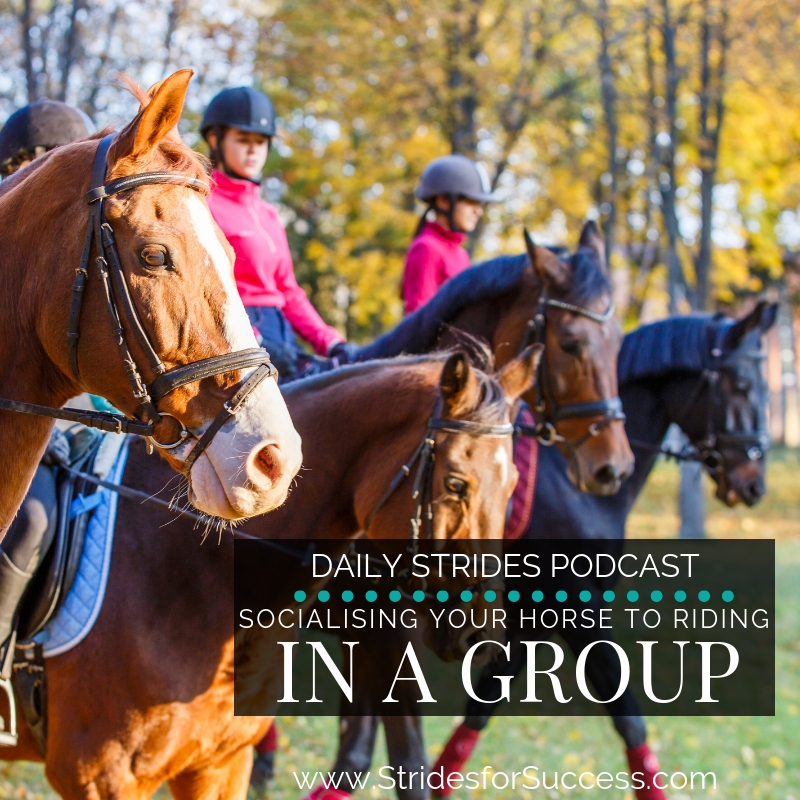
  • Socialising Your Horse to Riding in a Group

    Socialising Your Horse to Riding in a Group

    Socialising Your Horse to Riding in a Group

    What this episode is all about & how it can help you:-

    • Realise how important it is to choose your friends wisely
    • Figure out how to initially ‘practice’ with your horse
    • Not worry about ‘where’ you are in the group
    • Keep things slow and steady initially

    [smart_track_player url=”https://op3.dev/e/traffic.libsyn.com/dailystridespodcast/1078-Socialising-Your-Horse-To-Riding-In-a-Group.mp3″ title=”Socializing Your Horse to Riding in a Group” social_linkedin=”true” social_pinterest=”true” social_email=”true” tweet_text=”Do you want to ride with your friends, but worry how your horse will react? This episode of the Daily Strides Podcast will help you create a plan…” hashtag=”hacking” “equestrian” twitter_username=”strides_success” ]

    Most things in life are better when shared with friends.  Riding on the trail or hacking out is no different.  However, for many riders, the uncertainty of how their horse will respond ‘out in the world’ with other horses can be enough to stop them from experiencing this.

    In this episode of the Daily Strides Podcast I want to chat about how you can begin to prepare yourself and your horse for hacking out in company.  A few simple ‘dos’ and ‘don’ts’ will make all the difference when it comes to enjoying your time out of the arena.

    Getting out of the arena with a group of friends is often one of the top things on their ‘must do’ lists concerning their riding.  We dream about going for leisurely, fun and enjoyable rides with our friends – humans and horses 

    However, for many riders the reality is filled with more anxiety than anticipation.  How will my horse react?  How will my horse react to the other horses reactions?

    The good news is that, with a couple of simple steps, you can help ensure a positive experience for all involved, so that your ‘social ride’ is all that you dreamed it would be.

    Choose Your Friends Wisely

    Who you choose to ride out with on those first few rides has the potential to leave a lasting impact on you and your horse for years to come.  Choose wisely!  This pertains to the horses and the riders.

    Look for horse and rider combinations who are confidence, self-assured, relaxed and remain calm under pressure.

    Pay attention to how the rider and the horse respond to situations.  Respond rather than react.  Being on a ride with a group of other equestrians who are just reacting to everything that shows up is no fun and often a recipe for disaster!

    Practice in an Enclosed Space Initially

    When we think of enclosed spaces, we think of arenas.  However when practicing for riding in a group you can also practice in fields and paddocks.  I am going to suggest that you begin in an arena if you can at the very beginning. 

    Get into the arena with your horse and a few others who, again, you have chosen wisely.  What your horse needs to learn is that while the other horses are there, he must listen to you – the rider – for instructions.

    Often horses, particularly younger horses or OTTBs, will look to the other horses to feel safe and confident.  The ‘herd’ instinct.  Rather begin training your horse to look to you and to respond to you. 

    When riding in a group, anything can happen.  Being on a horse who will spook or bolt because the horse in front of him did, is no fun.  Your horse needs to begin to build confidence in you.  Yes, they are aware that the other horses are there and that they are riding in a group.  But they are responding to you, the rider and team leader. 

    Developing his Response to You – Not to the Herd

    I suggest working with the other horses in the arena, but doing so in a way that your horse is never dependent on them.  Practice riding two or three a breast.  You can also ride in a line, single formation.  What is important here is that you are all the time changing and he begins to become comfortable with the changes.

    From here, practice having the other horses walk, trot and even canter past you while in the arena.  Again, your horse must learn to respond – and wait – for you.  Don’t allow him to merely follow the herd. 

    Once you are both happy and confident in the arena, try the same exercises with some grass under his hooves!  An enclosed field or paddock works well.  Very often horses react differently when they feel grass under their hooves, rather than sand from the arena!

    Keep It Simple – and Make Sure It Is A Non-Event

    In my experience, this is a rider issue; not a horse issue.  When preparing to go out riding in a group, riders can ‘dilly dally’ before they ever get going.  Try not to procrastinate about actually setting off on the ride.

    ‘Hanging around’ leads to jumpy, over excited horses.  Talk and plan as you walk – but get walking as soon as you can!  

    Lay out all of your plans before you begin.  Know exactly where you are going, who is going, when you are going etc.  Don’t allow ‘fuffing and faffing’ to start a chain of events that, if left unchecked, will lead to unhappy horses and riders.

    Where Is He Comfortable While Riding in a Group?

    Horses, just like us, have different comfort zones.  Some like to lead.  Others prefer to follow.  A good example of this which often occurs is when a new horse is with the group and he wants to lead.  The rider, for whatever reason, is not confident with him being out in front and a battle of wills begins.  

    Forcing a horse to ride in a position where he is uncomfortable will lead to a frustrated and tense horse.  This also leads to a nervous and unhappy rider!  Allow the horse to go where he feels comfortable within the group for the first few rides (if it is safe to do so, obviously!)

    Wherever your horse is happy, let him stay there for the first few rides.  After those initial rides, you can then focus on re-schooling your horse to ride where you want him to ride.

    The whole aim of those first few rides with the group should be to settle and socialize your horse to riding in a group. These are ‘his’ rides.  Allow him to be where he is comfortable. 

    If you’re not sure where your horse is most comfortable, I’m going to suggest riding in the middle of the group.  Behind a horse who doesn’t mind others riding up his ‘backside’ a little.  Also, in front of a horse who won’t run up your horses backside.

    Slow & Steady Wins the Day

    Once you get going on the ride, there is often a temptation to ‘test things out’ a little.  Especially if things are going well.  I’m going to strongly suggest that you rein this in for those first few rides!  

    Try to keep those first few rides as ‘non-events’.  They won’t be the sort of rides that will be spoken about in years to come.  However, they will be the foundation for those more thrilling rides later.

    This, again, comes back as well to choosing your friends wisely.  The last thing you want is the horse in front or behind you being egged on into a gallop by a rider who is just overly excited to see an open patch of ground!

    The riders who are with you should realise that you need to keep things slow and steady for those first few rides.  When both you and your horse are feeling more confident later, then you can all have that thrilling canter across the country.  However I advise to makes sure that comes later…

    Happy Riding

    Lorna

    Other Posts and Episodes that Relate to This Topic:-