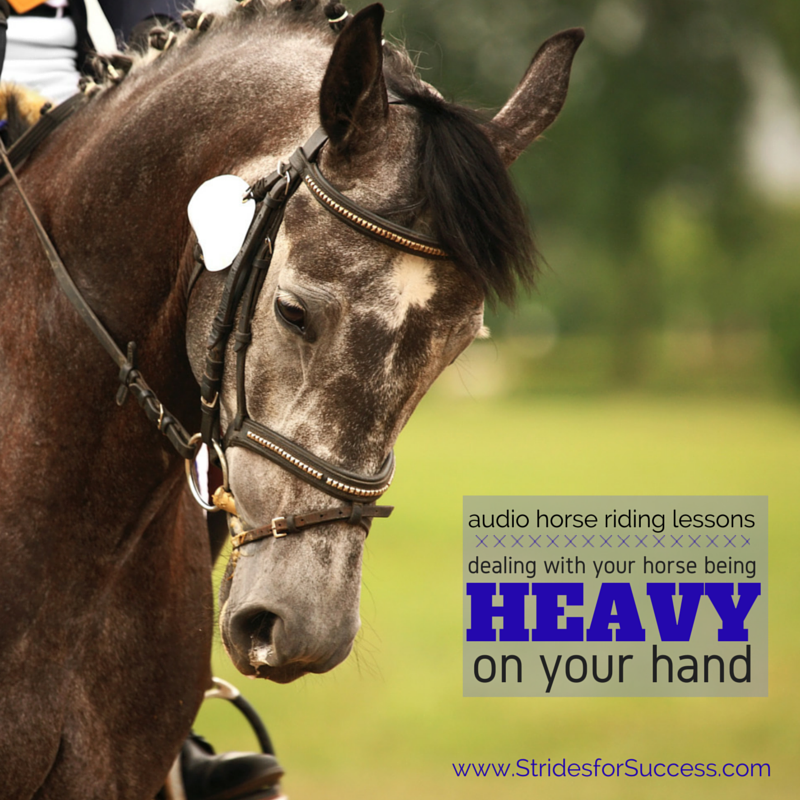
Have you ever had the experience of riding a horse who was so heavy on the forehand, it felt as though your arms were a couple of inches longer by the time you dismounted?!
[smart_track_player url=”https://op3.dev/e/traffic.libsyn.com/dailystridespodcast/SFA436-Dealing-with-Your-Horse-being-Heavy-on-Your-Hand.mp3″ title=”Retraining a Horse who is Heavy on Your Hand” social_linkedin=”true” social_pinterest=”true” social_email=”true” tweet_text=”Does your horse tend to get a little heavy in the hand? This may help…” hashtag=”equestrian #podcast #makeeveryridegreat” twitter_username=”strides_success” ]
The whole experience is exhausting! It feels as though you are literally carrying the horse’s head and neck by bracing your shoulders and arms against him the whole time… Not a fun ride!
Horses that are heavy or lean on your hands are unfortunately more common than not. It is usually the result of the horse not been thought to yield to the pressure of the bit. Or a horse who has been wrongly trained or retrained by a rider to lean on the bit.
Why This Doesn’t Work for Your Horse Either
When your horse is heavy in front, he will find it difficult to perform correct, balanced transitions. He will have trouble bending consistently throughout his body. His lateral work will usually be stiff and ‘jerky’ and his jumping abilities will also suffer as more weight than usual is on the forehand and shoulders.
You will also find it difficult to engage the hind quarters and bring them ‘underneath’ your horse.
In fact, when you are riding, it will feel as though all the energy is falling out the front end of your horses body. Plus the fact remains that no amount of pulling on your part will actually go towards fixing the problem!
The lack of balance that is a result of this leaning will become even more evident later, when more difficult questions are asked of your horse. ‘Heavy’ horses, generally, end up beginning to rely on the riders hands for support and balance throughout the ride. This, of course, just exaggerates the problem even further!
Is it a Bit Problem? Nope, Not Usually!
Most riders will try to remedy the problem by shoving a stronger bit into the horse’s mouth. The thinking is that it will give them more ‘leverage’ to haul on the horse even further…
However, this will generally will only worsen the problem as the true cause for the leaning has not been dealt with.
The Most Common Reason for This Happening
Horses being heavy or leaning on the hand often become like because of their rider. More specifically being ridden by a rider who lacks an independent seat or lacks confidence. The unstable rider will use the horse’s mouth for balance and support. This then trains the horse to firstly ignore the rein aids and, even worse, lean into in the contact.
Anxious or nervous riders will tend to hang on to the reins often as reassurance that they are ‘in control’ of the situation.
Again, this leads to the horse’s mouth becoming hardened to the hand aid. The result often being that the horse moving more and more onto the forehand.
Very often the stiffness and dependency of the rider carries through and is passed to the horse. This creates a similar stiffness and co-dependency in the horse. The horse begins to use the riders hands for physical and mental support.
The Never Ending Battle
After being ridden like this for a while, the horse will learn to begin to ride into the pressure. This will soon transition to pulling against it. Which is what makes this such an exhausting experience for the rider who encounters a horse like this… The rider will never win against a 600kg horse!
The cycle is self-perpetuating. The heavier the horse becomes, the more the rider hangs on trying to bring their head and neck up. Which causes the horse to pull more; causing the rider to haul more…
Other Reasons for this Occurring
Heaviness can also manifest itself in the horse becoming over bent through the poll. This causes the horse to become ‘locked’ in an unnatural frame, behind the vertical. This is often the result of too harsh a bit having been applied to the mouth.
It can also be due to a rider who is obsessive about being ‘on the bit’ without actually using their legs and seat correctly to first engage the hind quarters.
A horse that moves like this may ‘look pretty’ to an uneducated eye. But really they are just forced into, and learn to hold, a shape which inhibits their natural movement. This results in their training stalling and going stagnant.
Due to horse being fixed in this unnatural shape, he learns to brace against his riders hands to hold himself there.
Starting Your Re-Schooling of Your Heavy Horse
Re-schooling a horse to lighten up in front takes time and consistency from a rider.
Before you begin focusing on your horse, make sure your seat is indeed truly independent. Especially that you are not dependent on the reins for support or confidence. Also, begin paying more attention to your aids. The ‘how, when and where’ you are applying them.
Confusion on either you or your horses part will almost always result in a loss of balance. This will only ‘tip’ your horse further onto his forehand.
Working With All of Your Aids
Each time when you are asking your horse for something, begin to apply and use your aids in a sequence. Seat, then legs and finally hands… There are many different situations and circumstances that we find ourselves in while riding.
Doing things this way will allow you to prepare both yourself and your horse in a way that will interfere the least with the natural flow of energy and balance.
Schooling Using the Walk to Halt Transition
Start by working in walk and begin asking for halt using your seat and core muscles. Then use your legs to support your horse and make him ‘close’ the halt with his hind quarters.
Your horse must step into a halt, not fall into one!
Finally, close your ring fingers on the rein, resist with your hand. Many riders will have been advised at some point to lift up their hand as they give the rein aid. Rather think about closing your ring finger and as you do, allowing a little movement in your wrist which will bring your finger nails ‘up’ more.
As soon as the horse responds, even a step, reward by softening the rein. Softening does not mean throwing the reins at your horse or dropping the contact. It merely has you softening the pressure by relaxing your ring finger again and ‘allowing’ a little with your arm.
Understanding the Balance of Your Aids
If your horse insists on walking through your hand and ignoring you, apply a stronger aid, asking for a very firm ‘stop’. Be sure to reward as soon as he does so. Sometimes you will have to be quite stern on your horse, particularly if he has become quite good at ignoring you!
Make sure that while you are being firm, you are also holding your correct position and asking correctly for the halt – just applying more pressure as you do so.
Once your horse has halted, ask him to stand for a few seconds. Use this time to reevaluate your position and correct it if necessary. Your horse should not need you to keep applying the ‘hand brake’ while he is halted. He should merely wait patiently for your next question and then respond accordingly in a timely fashion. No dilly dallying!!
Repeat as Necessary
When you are satisfied that you are sitting correctly, ask him to walk on again, using your seat and legs. Make sure that although you have a contact, you are allowing him to step into the walk, not resisting with hard hands or arms… Soft, Soft, Soft.
Walk for 5 strides and again, using sequence of the seat, then legs and finally hands, ask for halt again.
Be firm if necessary, but make sure that you are not leaning back and hauling. Let the firmness come from your core, with your legs underneath you, rather than having a tug of war leaning backwards and hauling for all your worth!
Working on Suppleness
Once you have established a good baseline for halt, using the seat, legs then hands sequence, ask for halt again. Once there, open your right hand away from your horse’s neck and ask him to bend his head and neck a little to the right by ‘having a conversation’ with your ring finger. You can do this by squeezing the ring finger two or three times.
As soon as your horse yields to the pressure and bends the head and neck reward him. Do this softening the rein and using the voice if necessary to reward.
Repeat to this same exercise to the left. If you horse is more hesitant one way or the other, make a note of this. I suggest working some suppling exercises into his schooling sessions to begin remedying the problem. Also, some horses can become so stiff through their heads and necks because they are leaning so much that only the slightest of ‘gives’ is all you will see.
Reward any small step in the correct direction. Then use this as your measuring stick to gauge how much progress you are both achieving over time.
Balance in the Halt Itself
Your horse should continue to remain in a square halt while he does the above exercises. You may find that he wants to move his shoulders to try counter balance himself. Use your legs to hold him in a square halt. Again, remember to only ask for small movement in the head and neck to begin with.
You can also begin to add some trot in to the schooling, particularly transitioning between walk and trot. Choose an amount of trot strides you want to ride, perhaps 5 or 6, each time and make sure it is an active working trot that you are riding. Use the same downward aids that you applied in asking for halt to ask for the walk. Walk for 5 or 6 strides and then forward to trot.
Consistency and Time are Essential
Continue to move up and down between the gaits, focusing all the time on not participating in any tug of wars or leaning matches.
It will take time to retrain your horse and also you the rider, however it is essential if you want to move forward and progress with your training. A horse that resembles an arrow aiming for the ground while being ridden will never achieve the lightness and self carriage in front that is essential to them becoming the best version of themselves.
Happy Riding
Lorna
Links to Related Articles & Freebies Which You May Find Useful:-