Tag: no trainer

  • Essential Equipment When Training Your Horse

    Essential Equipment When Training Your Horse

    [fusebox_track_player url=”https://op3.dev/e/traffic.libsyn.com/dailystridespodcast/1291_The_Essential_EQuipment_Needed_to_Work_With_Your_Horse.mp3″ title=”Essential Equipment You Will Need when Working with Your Horse” social_linkedin=”true” social_pinterest=”true” social_email=”true” ]
    Have you ever begun following a recipe and it’s all going great, until… You realize that you are missing an ingredient.  And whether it is an absolutely key ingredient or a more ‘supporting’ ingredient, it matters.
    Because at the end of the process, what you’ve made is not exactly what you had in mind when you began…
    Training your horse at home can sometimes feel like this.  You get a few days or weeks into it, only to find your momentum grinds to a halt when you don’t have access to a key piece of equipment.
    Today, I want to help you identify what you will need (the basics) to get started and what you might like to add further down the line. After all, the equipment when training your horse is almost as important as the plan.

    The Key Pieces of Equipment

    As mentioned, I am really focusing on the absolutely essential equipment when training your horse today.  There are many ways we could go with this, but I am going to assume that you are working towards training your horse correctly and as a ‘riding horse’.  Meaning that your horse is an allrounder that you can then decide to dedicate more time to pursuing a specific discipline if you want to.
    So, in my experience, these key elements are essential:-
      • 40m x 20m flat (ish) space to work in
      • A boundary for that space
      • Markers (such as dressage letters)
      • Access to a safe riding trail or field to ride in
      • 4 to 6 (or more) poles
      • 4 to 6 uprights or ‘blocks’ to raise the poles off the ground
      • Sheltered, safe, and quiet place to tack up/groom, etc.
      • Good fitting and suitable saddle and bridle
      • Lunging rope and lunging whip
      • Helmet, gloves, and (ideally) body protector
    I want to divide these into two categories and go into a little more detail.  As you can probably see, the first 7 items on the list have to do with ‘where’ you will ride. The second 3 are actual things you can use on yourself and your horse.

    “Riding Area Equipment”

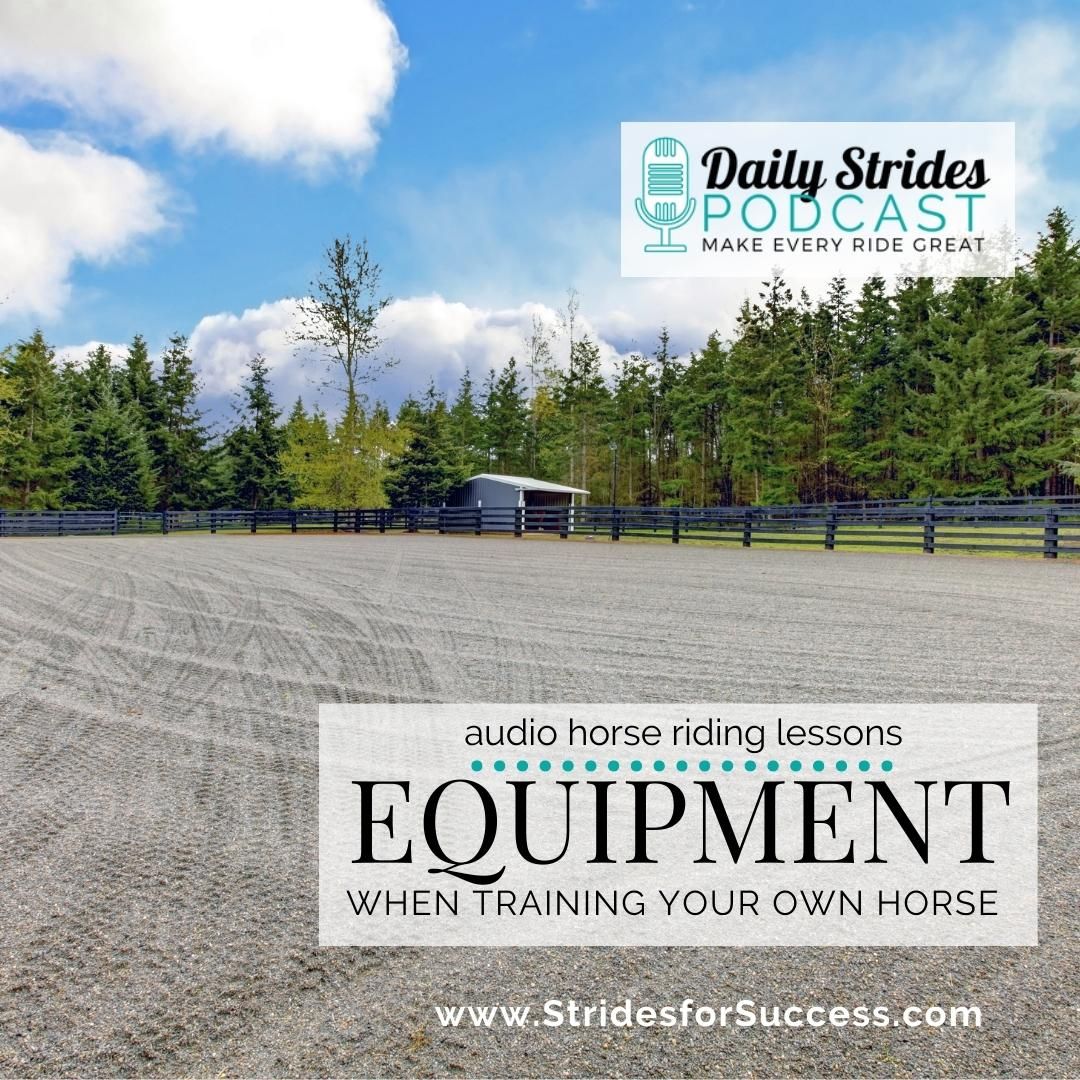
    • 40m x 20m flat (ish) space to work in

    I’m going to start here with the most obvious item on the list; a flat space to work in.  Now, to be fair, a 20m x 20 m space will also work initially.  However, as you begin to ‘do more’ with your horse, you will require a larger area.  And, personally speaking, anything smaller than 20m x 40m is almost a little too restrictive and small.  A ‘good sized’ flat space with good footing is definitely part of the essential equipment when training your horse!
    This space does not have to be an actual arena.  A flattish area in a field is also suitable.  However, this can become a little ‘muddy’ or ‘hard’ during different seasons. But, if you need to get started, it will work.  It’s what I personally had access to as a little person, and while not perfect, it did the job🙂
    • A boundary for that space

    Many riders overlook this aspect of their space.  Is a solid railing or tape line even considered a piece of equipment when training your horse? Yes, oh yes, it is! Especially if they are working in an open field or a very large open arena.  But remember, the boundary of the area you are riding and working your horse in is an artificial aid.  It will help you to reinforce your aids (particularly the outside ones initially) and help with accuracy.
    If you are riding in a field, invest in a roll of white 40mm ‘horse tape’ and as many ‘stakes’ for that tape as you need.  This way you can erect and dismantle your ‘arena’ easily when necessary.  It will also allow you to move it if the ground becomes unsuitable for riding.
    If you are riding in a very large arena, you can either use the same tape or you can use poles and uprights to demarcate a smaller riding space.  Again, this is not a permanent ‘arena’; you will be riding in a larger space soon and then the poles or tape can be moved.
    • Markers (such as dressage letters)

    Whether or not you want to learn true dressage, having the markers is really handy when training your horse. I simply message the dressage letters because they are easy to obtain or to make if necessary.
    If you do want to make your own, find 8 bucket lids and simply paint one of the letters A,K,E,H,C,M,B,F onto each lid.  Then cable tie, nail, or screw the bucket lids to a pole or something suitable where the markers should be.  The measurement of the markers is important.
    • Access to a safe riding trail or field to ride in

    Riders and horses who only work in one space all of the time tend to become sour.  They also don’t learn to increase both their confidence and their trust in each other.  This is why I feel it is important to have access to an alternative riding area that you can use for simply relaxing and enjoying each other’s company – or training!
    A horse trail or quiet country lane is perfect.  An open field will also suffice if the footing is safe and suitable. The more safe riding areas you have access to, the more options you have when it comes to equipment when training your horse.
    • 4 to 6 (or more) poles

    I do think that a few poles are ‘essential’ equipment when training your horse.  Especially when you are serious about the work being done.  They are for going over, going through, on the ground, and raising them up as well.
    They do not have to be fancy or 14′ in length. In fact, shorter ‘thicker’ poles will help encourage more accuracy🙂
    • 4 to 6 uprights or ‘blocks’ to raise the poles off the ground

    Okay, so the poles are great.  And I am a firm believer in the power of a great groundpole exercise.  But being able to raise the poles is also great and can add a whole new perspective to your training exercises. And the ‘blocks’ do not have to be fancy.  Tyres or short logs will work if you don’t have anything else initially!
    • Sheltered, safe, and quiet place to tack up/groom, etc.

    There is nothing more frustrating than trying to prepare to ride and being at the mercy of the elements! It tends to start the whole ride off on the wrong foot.  I believe that the tone for each conversation or ride is established during the preparation phase, so it makes sense to create a space where you can enjoy and relax with your horse.
    It does not have to be fancy. However, once you have your space, maybe look at upgrading it each month.  Things should be easy to reach, on hand, and easy to use.  And, again, comfortable for you and your horse.

    “Horse & Rider Equipment”

    • Good fitting and suitable saddle and bridle

    This one goes without saying.  If the tack you are using is not right for your horse, it will negatively impact your training.  Many horses simply ‘inherit’ tack from other horses. Or they get sold on with a set of tack that is never questioned.
    Make sure you regularly fit your tack, especially when training as your horse may change shape.  And, also, make sure you regularly assess if the equipment (bits and nosebands especially) is the right one for the job at hand.
    • Lunging rope and lunging whip

    Both are necessary for working your horse correctly while on the lunge.  The lunge line is to help provide ‘contact’.  Not to ‘steer’ the horse or keep him on a circle.  The lunging whip is to ‘back up’ your natural driving aids. Not to ‘whip’ the horse.
    Used correctly, they really help your horse to understand your aids as they add clarity.
    • Helmet, gloves, and (ideally) body protector

    Okay, the helmet goes without saying.  The gloves, I feel, are important. Especially for lunging and some groundwork.  And the body protector… I realize many riders are against wearing one.  But remember, if you are training your horse alone, you will probably be alone for a lot of the training! Anything that can help prevent further risk to you or your horse is a win.  And a body protector falls into this category.  I feel it is well worth the investment.
    So there you have it. A list of things that I believe you will need when you begin working and training your own horse.  By getting a few basics in place, you will be able to create more consistency and momentum in your training.
    And when you couple this with good, correct training – well it’s a winning formula.
    Happy Riding
    Lorna

    Seeking Founding Riders…

    If you are considering training your horse at home or alone (boarding at a barn, but don’t have a regular coach or trainer), make sure you check out the details of my upcoming brand-new program.

    I’m looking for a limited number of riders to work in-depth with me and my team as we go through this program for the first time.  Get on the waitlist to be the first to find out all of the information… We start in early September. Join the Waitlist HERE (no obligation to join the program, just be the first to know all of the details :) )

    More Training On This:-

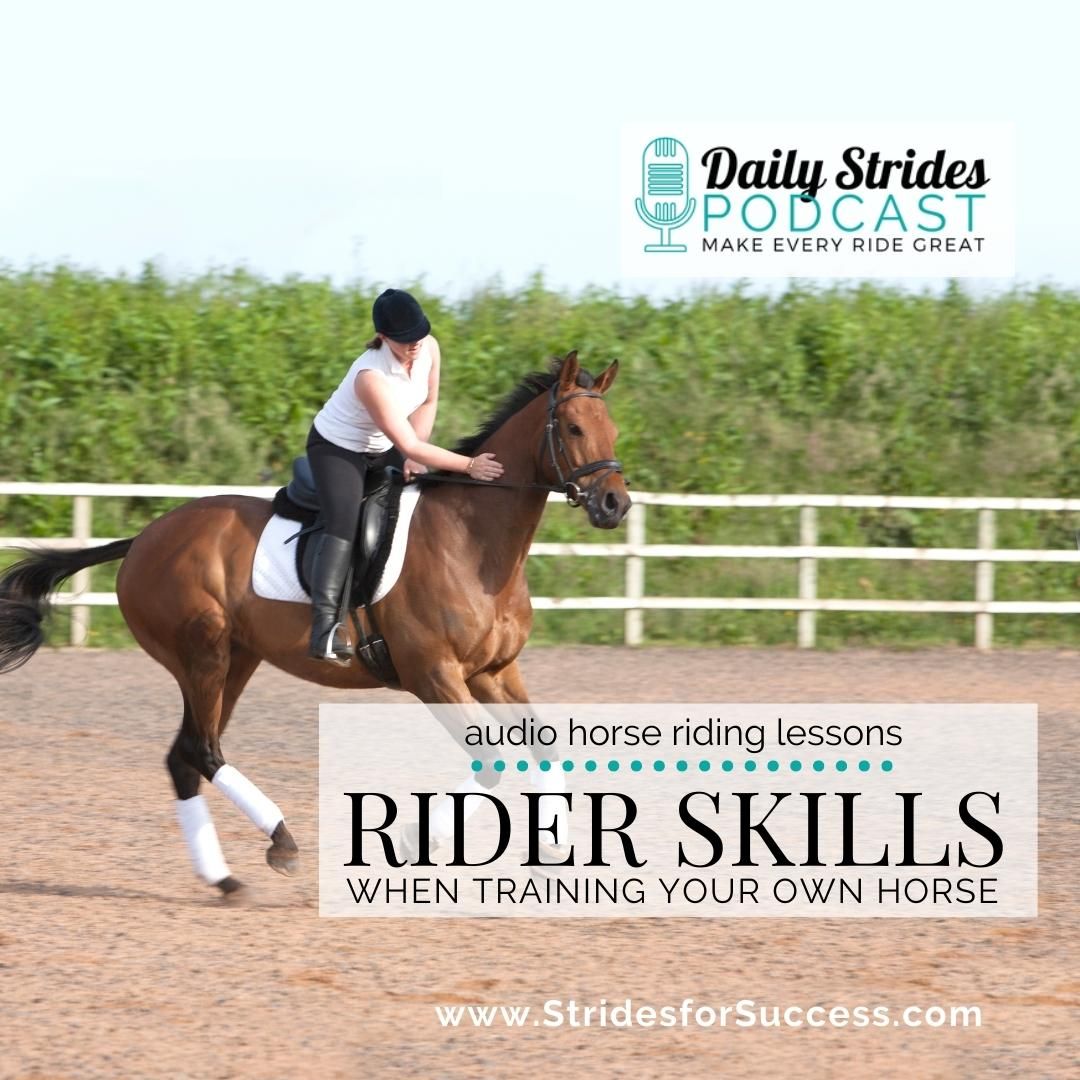
  • Rider Skills Necessary to Train or Retrain Your Horse

    Rider Skills Necessary to Train or Retrain Your Horse

    [fusebox_track_player url=”https://op3.dev/e/traffic.libsyn.com/dailystridespodcast/1290_Do_You_Have_What_it_Takes_to_Train_Your_Horse.mp3″ title=”Rider Skills Necessary to Train or Retrain Your Horse” social_linkedin=”true” social_pinterest=”true” social_email=”true” ]

    It’s one of those things that, initially, can sound both amazing and terrifying at the same time.  Training your own horse. And maybe you have been thinking about undertaking this journey yourself, yet feel a little apprehensive about what’s required.  Because let’s face it, it can be a daunting goal to set.  Not only do you have to be ‘able’ to do it.  You also have to commit to following it through…

    In this episode of the Daily Strides Podcast, I will lay out exactly what you need to be able and ready for if you do decide to train or retrain your horse. To decide if you truly have both the rider and trainer skills to make this work for you both.

     1. Basic Independent Aids

    Okay, the most obvious – yet often overlooked!  Now, I am not suggesting that you are the world’s greatest rider… However, for many ‘newbie’ riders, there can be an all-consuming ‘enthusiasm’ when it comes to what they realistically can do!

    I would say a good rule of thumb is that you can ‘hold’ your own posture, position, and balance ‘most’ of the time… And that you can regain any of the above quickly and quietly when you do have a ‘whoops’ moment. 

    Let’s be honest, having independent aids makes it so much easier for you to communicate.  And for your horse to actually understand your communication.  This is a huge part of training.  If you are still moving your hands when you use your legs. Or you’re losing your balance through transitions or around corners, I would say your aids and basics are in need of a little more attention before you begin working on your horse.

     2. Humility, Patience, & Compassion

    We are all going to feel frustrated or irritated along the way when it comes to developing ourselves as riders. This can become amplified when we are also training our horses. And there’s nothing wrong with those feelings if, or maybe when, they show up.  What is important is how we respond to them.

    When you can approach your training ‘challenges’ from a place of compassion and practice patience, it will almost always result in a quicker long-term positive outcome for the situation. 

    Adding a great big dash of humility in there will also keep you open to the fact that you may not be asking or responding in a way your horse understands.  Remember, training is a conversation.  It’s a two-way street.  It will take both of you being on the same page for it to truly resonate and ‘stick’.

     3. Self Awareness

    This is being able to catch yourself in a situation and question what you are doing, how you’re doing it, and why you’re doing it.  As riders who step into the role of full-time trainer, it can be so easy to just focus on the horse.  What the horse needs in their training, and what exercises will help develop the horse.

    It’s important to remember that you too are on a journey.  You are also learning, developing, and growing as a rider. And your horse’s overall development will be very much tied to your own development as a rider…

    Being able to see both perspectives is part of this.  And the ability to ‘pause’ for a moment and simply ‘feel’ or ‘experience’ what you are doing is also something we must learn to do. The more self-awareness you can bring to each situation, the better you will understand and ‘feel into’ your horse’s responses.  And this is what true ‘training’ is built on…

     4. Facilities & Resources

    Now, I know the whole topic is ‘rider skills’… However, I honestly feel that ignoring this part of the equation will negate most, if not all, of the above-mentioned aspects.  Let’s be frank; you NEED somewhere suitable to actually work your horse.  The best riders in the world will become frustrated if they are trying to work their horse in a space that doesn’t facilitate the training.

    A ‘flatish’ space with good footing is essential.  How big the space is can be debated.  Good fitting, comfortable, and safe tack and equipment are also essential.  As is time… 

    I often think that the idea of keeping a horse at home or saving money by boarding at a barn with few facilities can cloud some rider’s judgments.  You need the proper tools to train your horse.  Facilities and resources (time or money) are part of those ‘tools’.  Be realistic and honest with yourself here.

     5. Commitment

    Finally, if you have all of the above in order, you need to make the commitment!  It sounds like the easiest thing in the world.  And yet, it’s the ability to show up when you don’t feel like it that will often determine your results in the long run!

    I would suggest that all riders who are considering ‘training their own horse’ start off with a 3-month or 90-day commitment.  This is long enough to see results, but short enough to change track if necessary. 

    Training alone is not for everyone.  It can be hard to continue to show up consistently, especially when things are not going your way! However, it is also part of the journey. Showing up will not only help you to build trust in yourself and confidence in your skills, but it will also allow your horse to begin doing the same.  And this is a vital part of the skills necessary for training your own horse.

    Happy Riding
    Lorna

    Seeking Founding Riders…

    If you are considering training your horse at home or alone (boarding at a barn, but don’t have a regular coach or trainer), make sure you check out the details of my upcoming brand-new program.

    I’m looking for a limited number of riders to work in-depth with me and my team as we go through this program for the first time.  Get on the waitlist to be the first to find out all of the information… We start in early September. Join the Waitlist HERE (no obligation to join the program, just be the first to know all of the details :) )

    More Training On This:-

  • Time or Money; Which is a Better Investment for You and Your Horse?

    Time or Money; Which is a Better Investment for You and Your Horse?

    [fusebox_track_player url=”https://op3.dev/e/traffic.libsyn.com/dailystridespodcast/1289_Time_or_Money_Which_is_the_better_Investment_for_You_and_Your_Horse.mp3″ title=”Time or Money; Which is a Better Investment for You and Your Horse?” social_linkedin=”true” social_pinterest=”true” social_email=”true” ]
    Your time or your money; it’s an age-old toss-up!  For the most part, most things can be improved, strengthened, corrected, or achieved when we invest either time or money towards it. And, for the most part, you can excel in the progression if you are able to invest both.  And training your horse is no different.
    And while many will argue that training a horse requires both time and money, for many riders it’s possible, or necessary, to offset one with the other.  It will simply depend on your unique situation.
    Like everything else, there are pros and cons to consider with each approach.  In this episode, I want to help you understand which choice may be better for you.  Investing your time or investing your money when it comes to training your horse.

    Investing Your Time: The Pros

    Training your horse when you can input a significant amount of time offers several advantages.  For many riders, the investment of their time will be the obvious choice based on their current circumstances.  However, there are many ‘hard-to-overlook’ advantages to this approach – whatever the reason for your choice to take this route.

     1. Developing the Bond:-

    Spending time with your horse during the training process can strengthen the bond between you. Building a foundation of trust and understanding is crucial for successful training and a harmonious partnership. So by you taking your own time when it comes to training, it allows you both to really develop that strong foundation that will stand for you.  Especially when working through any challenges that show up.  And, when working with horses, let’s be honest, the challenges will almost always show up!

     2. Unique & Personal Approach:-

    When you invest your own time in training your horse, you have the freedom to tailor the training sessions to suit your horse’s individual needs. This personalized approach allows you to experiment with different techniques and adapt to your horse’s unique temperament.  It also allows you to tailor the training program to suit your individual schedule and needs.  You get to choose what to work on, and when to work on it when it comes to your horse and your training program.

     3. Developing Your Skills:-

    The opportunity to work so closely and so consistently with your own horse will inevitably enhance your own riding and horsemanship skills.  The awareness that is an essential part of showing up as a ‘trainer’ for your horse will allow you to begin to tweak or improve your approach to different things. And with your horse providing feedback all the way, you can really develop your feel for riding and training.

    Investing Your Time; The Cons

    Now, let’s be clear… While there are many advantages to investing your own time into training your own horse, there are also a few drawbacks.

     1. Lack of Knowledge

    Experts are experts for a reason.  They have developed their expertise over time and through experience.  When you are choosing to invest your time to train your own horse, it can be difficult to identify, and later correct, any mistakes or training issues.  This also goes for behavioral issues. Training without an experienced trainer or coach may limit your progress and prevent you from reaching your full potential as a rider.  And this can also result in limiting your horse’s career or progress long term as well.

     2. Time Constraints:

    Yes, we have said that you are choosing the time over money scenario here.  However, so many riders fail to actually realize how much time it takes when working with and training a horse.  It requires a significant investment of time, and this may not be feasible for everyone.  Remember, you will be doing this while also juggling other commitments such as work, family, or studies.  Being consistent with your approach is essential with this method and many riders find it really difficult to dedicate sufficient time for effective training.

    Investing Your Money: The Pros

    When we are using the term ‘investing your money’ in relation to training your horse, this usually means that you will invest in professional training at a professional barn or yard.  This, obviously, can have many advantages over the ‘time’ investment.

     1. Expert Guidance

    You are now enlisting the help of a qualified or experienced trainer or coach who is doing this on a daily basis.  Their experience and expertise will allow you to avoid many of the pitfalls or potential challenges along the way.  Going this route also means that you get to ‘tap into’ their valuable ‘knowledge & experience bank’.  This is especially useful when it comes to correcting mistakes, and ensures your horse is introduced to effective, practical, and proven training techniques from the start.

     2. Time Efficiency

    When you hire someone who has successfully achieved a specific outcome numerous times before, it can be a little like taking a little-known but much faster ‘shortcut’.  They can help accelerate your horse’s progress at a rate that would be pretty difficult for you to match doing this for the first time.  And they can also, usually, overcome challenges more quickly as well.

     3. Safety & Confidence

    Professional equestrian trainers and coaches are equipped to handle difficult situations as they occur.  This means that both your horse’s safety and your own safety are maximized during the training process.  Couple this with the fact that most riders feel more confident when they have a trainer in the arena with them; you will usually ‘ride better’ in their presence. This is especially useful when working with a young, green, or challenging horse.

    Investing Your Money: The Cons

    And just like before, this too has its downsides.  Here are a few considerations when it comes to investing your money, rather than your time when training your horse.

     1. Financial Constraints

    Yep, it’s the whole time versus money thing again.  In order for you to save on time, you will almost definitely have to invest your money.  Remember, professional horse training can be expensive and costly.  This is especially true if you are on a limited budget.  Before you commit to this route it is really important to assess your current financial situation and determine whether the, often high, expense aligns with your current resources and priorities.

     2. Lack of Independence

    While a professional trainer or coach might be able to move your horse’s training along, can you then realistically continue to do this when your horse comes ‘home’ or back to you? Relying on a trainer means you may become dependent on their availability. There may be scheduling conflicts while the initial training is ongoing.
    And then the potential need for ongoing support might require adjustments to your training plans in the future…  Basically, it is difficult to really and truly learn how to figure things out for yourself when paying a professional to do the work for you.

    Time or Money; Which Will Suit You Best?

    I honestly believe that there is no real right or wrong answer to this challenge.  At the end of the day, it is a personal choice that will usually be dependent on personal circumstances.  Both approaches have their benefits and limitations.
    Investing your time allows for a deeper bond, more time and schedule flexibility, and faster development and growth of your abilities as a rider and trainer. However, this can often be countered by a lack of expertise and other commitments in your already busy life.
    On the other hand, investing money in your horse’s training introduces expert guidance, a ‘fast track’ time efficiency, and added safety and confidence. You can literally borrow it from them in the arena initially.  But it comes with often great financial considerations and, ultimately, a level of dependency on the trainer in the long term.
    For many riders, a blend of both is the way to truly make this work for them.  A balance that aligns with your goals, resources, and circumstances is key.
    Whether you choose to invest your time, your money, or a combination of both, the most important thing is to prioritize your horse’s well-being, your enjoyment, and the ultimate long-term partnership that will result from working with your horse.
    Happy Riding
    Lorna

    Seeking Founding Riders…

    If you are considering training your horse at home or alone (boarding at a barn, but don’t have a regular coach or trainer), make sure you check out the details of my upcoming brand-new program.

    I’m looking for a limited number of riders to work in-depth with me and my team as we go through this program for the first time.  Get on the waitlist to be the first to find out all of the information… We start in early September. Get All the Details HERE (no obligation to join the program, just be the first to know all of the details :) )

    More Training On This:-