Author: Eleanore Dodd

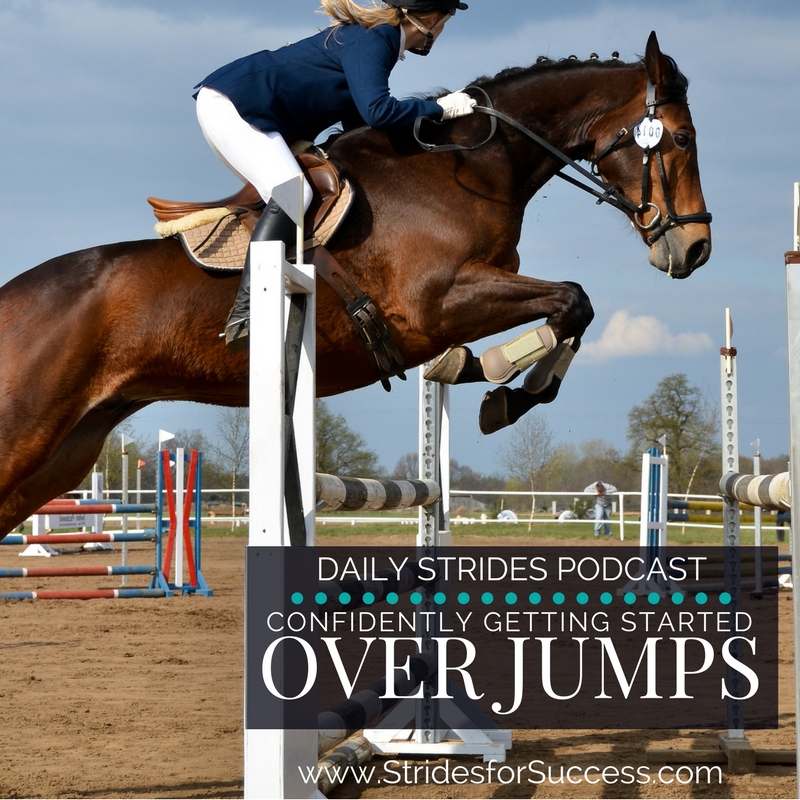
  • Confidently Getting Started Over Jumps

    Confidently Getting Started Over Jumps

    Confidently getting Started Over Jumps

    What this episode is all about & how it can help you:-

    • Why the basics still apply
    • Why balance is essential; for both you and your horse
    • Think of helping your horse, rather than hindering
    • How to begin perfecting over small jumps first

    [smart_track_player url=”https://op3.dev/e/traffic.libsyn.com/dailystridespodcast/1038-Getting-Started-Over-Jumps.mp3″ title=”Confidently Getting Started Over Jumps” social_linkedin=”true” social_pinterest=”true” social_email=”true” tweet_text=”Thinking about jumping but feeling a little overwhelmed about the ‘up and over’? Here is how to confidently get started over jumps” hashtag=”equestrian” twitter_username=”strides_success” ]

    Does the thought of jumping with your horse fill you with excitement?  Is that excitement mixed with a dash of fear?  Like most riders, you probably have thought about jumps and jumping.  And yet thoughts of the ‘up and over’ tends to keep you, and them, away from it.

    This episode is all about jumps and, more specifically, getting you started over jumps in your riding.

    Working over jumps can be beneficial for both you, the rider, and horse.  It helps to keep things fresh and interesting.  It works both the brain and the body in a slightly different way.  But there can be the limiting perception of a ‘barrier to entry’ for many riders.  A very high barrier that perhaps you feel that you cannot get over in order to make it happen.

    I’m here today to tell you that you can not only get over the barrier, but enjoy yourself along the way as well.

    Jumping is really and truly just like riding a very big canter stride.  I am basing todays training on the prerequisite that you have a fair working knowledge of the canter;  how it works, what’s happening, what you should be doing and what your horse should be doing.

    From canter, beginning to jump is simply placing a pole underneath that canter stride.  I know this sounds like a very simplified description, but bear with me here.   My goal is to lower your anxiety towards jumps and jumping by at least a couple of notches!

    The Basics Apply Still – Especially Rhythm & Relaxation

    Successful jumping is built on the basics of good flatwork, with principles such as relaxation and rhythm being extremely important when it comes to jumping.  One of the most obvious ways riders start off on the wrong track when it comes to working over jumps is the tendency to confuse speed with impulsion.  Bounding towards a jump at great speed becomes scary for all involved; the rider, the horse and even the spectators.  It is definitely not how it should be done.

    Jumping is all about relaxation and rhythm, and that is why you should try to eliminate any anxiety as it shows up.

    Balance is Essential; Both You and Your Horse

    Start by cantering over a single pole.  Focus on your on balance as you do this.  Balance between and over the jumps is essential for both you and your horse.  Where many riders tend to fall short in the balance department, is that they depend on the horse to balance them.

    A good basic jumping position will help you to remain balanced using your own body.  You can practice this on the flat, before trying it out over a pole or, later, a fence.   

    It is important that you keep the weight into your heels, keep your leg underneath you, and you use your bum to basically balance the upper half of your body – a little like a weighing scale effect.  Lastly, your horse must be given enough freedom through his head and neck, for him to stretch out and make it over the canter pole, or whatever you are doing.

    Allowing does not mean that you throw everything at him and with a ‘best of luck’ attitude.  Remember, think about balance here.  Your horse also needs to remain in balance.  It is no good you being balanced, if your horse is not.  Your job as rider is to help your horse remain balanced as well.  You can practice all of this while cantering over a single pole on the ground.

    Think of Helping Your Horse, Rather than Hindering

    This is a largely misunderstood principle in jumping.  Many riders, when they start jumping, think only of themselves.  They launch themselves forward towards the horse’s head, without a single consideration for how this will feel for their horse.

    If you have ever jumped anything yourself (on your two legs) with a backpack on your back, you are going to understand what I mean here.  Imagine yourself with your backpack on your back and some things inside.  This particular backpack is loose and is moving around – meaning it’s not very secure.  Jumping anything in this set of circumstances is hard work!

    However, let’s now change that backpack for a more professional type of backpack that hikers would use  One that is stabilised at the front as well as the back, where it fits correctly, and is shaped to suit the body of the person wearing it.  Everything is snugly packed inside and is not moving around, it is balanced and secure.  It now becomes a whole lot easier to jump something, with that on your back.  That is how you need to become for your horse.

    You need to become balanced and secure over the fence, rather than loose and floppy.  I know, simple words – but sometimes simple is easiest to understand!

    Your horse needs to lift his front legs to get over the fence.  If you launch yourself in the general direction of the horse’s head, you are make it very difficult for your horse to truly lift and use himself correctly.

    Resisting the Temptation to Throw Yourself Forward!

    Throwing yourself at your horse’s head means you are no longer balancing yourself, simply because your legs are no longer underneath you!  Your legs will be left behind in the saddle with the rest of your body on the horse’s neck.   Your weight is now being added to his own body weight that he has to lift in order to clear the fence.

    I think this happens because a lot of riders want to model their position on top show jumpers. However there is one big difference between a lot of riders and the top showjumpers – the height of the jumps! 

    You don’t really have to do a whole lot at all going over a small pole, the bigger factor here is that you are remaining balanced.  Balanced will help your horse, launching yourself will hinder.

    Make Perfect Over Small Jumps First

    Finally, I am strongly suggesting that you perfect things over the little jumps, even the pole on the ground, before you start building up.  If you can get it right over the smaller ones, you are inevitably going to get it right over the bigger ones.

    This way you will also get to build your confidence.  In building your confidence, you build the relaxation.   When you build the relaxation, you will also find that the rhythm becomes more natural as well. 

    The result will be an approach that feels good, a correct take off and you and your horse feeling balanced and ‘a team’ as you are going over the fence. Everything is in balance, relaxed and rhythmic.  From there you are perfectly poised to either go on to your next fence, or whatever you want to do.

    The Benefits of Starting Working Over Jumps

    Unfortunately a lot of riders may feel that working over jumps is not for them.  However, if shown the value of including this in their schooling, a lot reconsider.  Values such as engaging a different sets of muscles within the horse and the rider.  Being prepared on the trail or a hack to pop over something you meet.

    Jumping also gives you a greater sense of this balance and this communication.  It is a real feeling of teamwork between the horse and the rider, that they must work together to get over this obstacle that is in the way.

    I suppose the important thing to remember is to take it slow and steady.  Work over smaller jumps initially before building to bigger, higher and more complex.   This way, you and your horse can successfully work out jumping, and get it working for both of you.

    Happy riding

    Lorna

    Links mentioned in the episode:

  • Reschooling a Horse that is Dead to Your Leg

    Reschooling a Horse that is Dead to Your Leg

    Reschooling a Horse that is Dead to the Leg

    What this episode is all about & how it can help you:-

    • Figuring out why your horse is dead to the leg
    • Committing to consistency going forward
    • Creating a ‘rule’
    • Refining your ‘rule’

    We have all been there.   You are in the saddle on your horse, you are riding away – you apply your leg, and … NOTHING.  He is just completely ignoring everything, and you must resort to these huge kicks.  Oh yes, the horse that is dead to the leg.

    It is extremely frustrating, because you know the key to everything is forwardness, but you just cannot get into first gear to get any forwardness happening.  Why does this happen?

    Figuring out why your horse is like this

    There are a couple of reasons, and today I want to touch on the three main ones that I see happening time when dealing with a horse who is dead to the leg.

    1.  Some horses are just more ‘docile’ than others.  They are laid back and not really concerned about how fast they can go or how high they can jump.  They like to take life nice and easy, and take you the rider with them!  Of the three we are going to talk about today, this is probably the smallest group of horses.
    2. Lack of Consistency.  By this I mean the lack of consistency as a rider.  One day the rider is in the saddle and focused on schooling and responsiveness.  They have expectations of their horse based on what they are doing that day.   The ‘lack’ comes in when the next day, they just take it easy and let the horse do whatever they want.  Not really caring what is going on with the legs or any other aid.  This can lead the horse to become a little confused, or rather he thinks the rider is confused!  He then just decides to ignore all further directions coming from the legs of the rider in the saddle.  This is how a lack of consistency can cause a horse to be dead to the leg.
    3. Consistently doing the ‘wrong things’ in the saddle.   I am referring to a rider who is consistently banging and moving about in the saddle.  Many riders are up there and have no control over their body.  They are slapping their legs, and moving and wiggling and shaking…  The horse just never knows if that was a speed wobble from the rider, or if it was an actual aid.  So again, the horse decides to do nothing.  I personally think that this is the most common cause of horses to become dead to the leg.   It is also worth keep in mind that it may not have been you that has trained the horse this way.  This potentially happened long before you met or rode your horse, when somebody else was riding your horse.

    The third point is seen a lot in riding school ponies – bless their souls!  Because there is that consistent nagging (slap slap, bang bang, slap slap) going on from rider’s legs on their sides, which they have learned to ignore.

    However, when you get a rider who wants to communicate, well, they ignore it as well unless the rider makes it quite clear that they are open to having a real conversation, rather than just banging and shouting at the horse.

    This not only happens with riding school ponies, but you also get all sorts of horses that just over time have been exposed to riding in that way, and therefore their default method of ‘staying sane’, is to ignore the rider.

    Whatever the reason is – and I think it is important to understand what the reason is with your horse – we now must start looking at how we can turn things around.

    Committing to consistency going forward

    Firstly, we should commit to consistency going forward, but it must be doing the right kind of things consistently in order for this to work .  What we are looking for here, is that every time you are on your horse, you are consistent in how you are ask or communicate.

    Gone are the days where one day you are so strict and you want everything to be so refined and perfect, and then the next day you just let your horse do whatever he wants.  There must be a consistency from you the rider, to improve your horses responsiveness. This is particularly true when to reschool a horse to listen and respond to the leg aids again.

    Creating a ‘rule’

    In order for you and your horse to know where you stand with each other, you need ‘rules’.  The way I would go about creating a rule in this situation, is using a schooling whip.  I prefer a schooling whip over perhaps a jumping crop or a shorter whip, so that when you apply the aid, your hands do not have to come off the reins and break the contact.

    The reason we would use our stick is to remind our horse that, “Yes, I just used my leg, and that means please respect my leg and respond”. 

    How I would use this is that when you put your leg on and your horse ignores it, immediately give just a tap behind your leg.  The timing is everything here, it must be immediate so your horse begins to see the connection.

    The schooling while is almost like the way a teacher would use a pointer in the classroom, to point something out on the board. Or bring the classes attention to something specific.

    You are going to use the stick to tap behind your leg.  This is key.  Not the shoulder, not the hindquarters, not behind your thigh, it must be behind your lower leg where you are applying the aid that he has just ignored.

    It is also important that you always give the option of the leg first, otherwise it does become like ‘beating’ the horse.  By doing this you are saying to your horse, “Excuse me, I just said something and you ignored me – can you please answer me”.

    In my experience, it usually takes no more than three to four times before the horse starts to listen to the leg.  He realises there is a consequence.  A direct reaction to their inaction.  This is where the consistency on your part comes in.

    You say leg, he doesn’t respond, you respond straight away with the tap with the schooling stick.  That is how you create the rule.

    Refining Your ‘Rule’

    Over time, you will obviously need to start refining the rule.  It is not practical to have a schooling whip with you all the time, reminding, reminding, reminding!

    How you will begin doing this is by again applying the leg but initially asking with a slightly stronger leg aid than what you would normally do.  This could be applying more pressure, or it could be an actual kick with your leg.

    Over time as you are refining it, you are more using the muscles in your leg, and it becomes about varying amounts of pressure.  More of where you want it to be.  The secret conversation, as opposed to Pony Club.

    Remember, as you are refining it, it is going to become softer and gentler.

    Allowing Your Horse To Respond

    The final piece when reschooling a horse who is dead to your leg, is that when you ask your horse to go forward, you must allow your horse to then go forward.  So many people will ask for forward, and as soon as the horse goes forward, they then shut the whole thing down.

    This could be a conscious (I don’t want him to ‘run’) or a subconscious (I don’t want to be run away with) reaction.  Whatever the reason, if you keep asking and then changing your mind, your horse will begin ignoring you again.

    Because we are reschooling here, and he must respect what you are saying, you must then follow through with allowing him to complete whatever task you asked him to do.  This comes into not only forwardness, but if you are asking for lateral work or whatever else you may be asking.

    You must allow and facilitate that happening underneath your saddle, for it to become a new, and better way of you and your horse talking to each other.

    Happy Riding

    Lorna

    Links mentioned in the episode:-