Tag: Aids

  • Could Poor Posture be Ruining Your Transitions to Canter?

    Could Poor Posture be Ruining Your Transitions to Canter?

    [fusebox_track_player url=”https://op3.dev/e/traffic.libsyn.com/dailystridespodcast/1255_Is_Poor_Posture_Ruining_Your_Transitions_Into_Canter.mp3″ title=”Could Poor Posture Be Ruining Your Transitions into Canter?” social_linkedin=”true” social_pinterest=”true” social_email=”true” tweet_text=”Here’s how to get better transitions into canter…” hashtag=”horsepodcast” twitter_username=”strides_success” ]

    The transition into canter is one that always gives us opportunities to develop and improve as riders. And it can do the same for our horses as well. And yet, for many riders, improvement is frustratingly slow! The good news is that it doesn’t have to be this way.

    Canter and transitions into the canter are one aspect of horse riding that can improve quickly, often with just the smallest of tweaks applied.

    The key is to be strategic about what you are tweaking. And be willing to look out for the effect it has on yourself, your horse, and the transition in general. One of the simplest ‘tweaks’ you can apply is around improving your posture when you ride.  By simply ‘sitting differently’ you can transform the transition for the better.

    Self-Carriage as a Rider

    Self-carriage is a big topic when it comes to horse riding. It’s something we are always trying to cultivate and improve in our horses.  And rightly so, as when your horse develops both the understanding and the ability to carry himself a little better, it opens doors to so many new opportunities for you both to work together.

    I think that if you are asking your horse to carry you, and he obliges. Well, the least we can do as a rider is to take responsibility for making that as easy as possible for him to do. Carry ourselves. 

    Unfortunately, terms like ‘shoulders back’ have been shouted for so long to so many riders, that true self-carriage has become a little, well, confused in our heads!  Rather than thinking about ‘shoulders back’, I suggest visualizing ‘opening your chest’.  So from the point of your one shoulder across the front of your chest to the point of your other shoulder. Open this space up.

    Couple this with the feeling of creating ‘space’ between your ribs and your hips.  Elongating your body. This is self-carriage (and engagement) through your body as a rider and it will help your transitions to canter.

    Poor Posture & Its Results…

    When you are in true self-carriage, coordinating and using. your aids become so much easier.  Meaning when we are heavy, slouched, and too relaxed (not enough engagement or tension) through our bodies, things can become muddled up very quickly!

    Your body becomes harder to move. Some aids are impossible to move independently.  And you can no longer move with the energy your horse is creating. 

    When riding, especially transitions to canter, you are either working with the energy or working against it. If your horse, because he is the kind soul that he is, does actually canter when you ‘ask’ we need to be in self-carriage. When we are not, by blocking this energy, you are telling your horse that his response to your ‘ask’ for the canter was the wrong one!

    Horses become confused very quickly when riders say ‘go’ only to quickly follow it with a ‘no’! Poor posture causes your body to say ‘no’ to his doing what you asked him to do… Not a good result! 

    1255 Could Poor Posture be Ruining Your Transitions to Canter

    Lack of Independence

    The other downside to poor posture, especially as you ask for transitions to canter is your lack of independence. This means that you are dependent on either your other aids for balance or support. Or your horse.  Either way, it will cause issues as your horse moves from the walk or the trot into the canter.

    If you are using your hands to balance in the saddle, this will make true contact impossible.  As well as stop the forward flow of energy your horse needs when performing transitions to canter.

    If you are dependent on your horse for support and balance, the upward energy created through transitions to canter will throw you off balance.  Both of these situations will cause both the transition and the canter that happens afterward to become tense for the horse and rider.

    Relaxation is the foundation of everything when riding. Creating excess tension due to a lack of independence through seat and aids will ruin your transitions to canter. 

    Light Transitions to Canter

    Begin by modeling, through your body, what you want your horse to do.  In the transitions to canter focus on carrying yourself. By doing this you will both communicate with clearer aids and create the space and balance necessary for the transition to happen.

    The transitions to canter are ‘upward’.  They feel like a step up into the new gait. If we block that upward movement of the energy, our horses cannot respond as we would like them to. 

    As your horse ‘steps up’ into the canter, allow your seat to follow first. Then your hands, and finally the rest of your body.  Work on strengthening the connection between your seat and your hands.  Whatever your seat does through the transition, and in the canter itself, let your hands do the same.

    By practicing this consistently and preparing your transitions to canter beforehand, you will find that you will not only have a better transition. But you will also your canter will improve as well.

    Happy Riding
    Lorna

    Improve Your Canter

    Improve Your Canter is a 4-week program you can use to help develop both you and your horse in the canter. It is suitable for riders working alone without a trainer or coach. In there you will learn what is happening underneath you and why. You will also put this into practice using audio horse riding lessons. tailored for each day of the program, with your horse.

    CLICK HERE TO JOIN TODAY

    More About Canter Transitions:-

    Get Support & Guidance in Your Riding

  • Becoming More Balanced without Stirrups

    Becoming More Balanced without Stirrups

    [fusebox_track_player url=”https://op3.dev/e/traffic.libsyn.com/dailystridespodcast/1250_Becoming_More_Balanced_Without_Stirrups.mp3″ title=”Becoming More Balanced without Stirrups” social_linkedin=”true” social_pinterest=”true” social_email=”true” tweet_text=”Here’s how to become more balanced without your stirrups while riding” hashtag=”horsepodcast” twitter_username=”strides_success” ]

    There is a point in every rider’s journey where balance becomes less about staying on and more about increasing overall effectiveness. However, in order to positively influence the horse, the rider needs to begin working on developing better balance.

    I feel that one of the best ways to do this is by developing independent aids.  Independent from both the influence of each other’s movement.  And independent from any potential ‘speed wobbles’ our horse might experience when working together.

    So, all of that being said, becoming more independent through your body will encourage better balance overall; for you and your horse. For the month of August 2022 inside of Connection, we are focusing on “Developing Independent Aids While Riding”. If you want step-by-step riding plans to help you achieve this, make sure you join Connection and check out August 2022’s training

    Working Without Stirrups

    For many riders having a conversation around balance can often turn to riding without stirrups.  And yes, I do think that this can be beneficial… However, riding for the sake of riding without your stirrups is not going to improve you or your horse.

    It is only by becoming aware of what you are doing and intentional about what you plan to do that you can genuinely benefit from riding without your stirrups.

    Focus on being symmetrical in the saddle.  Keep equal amounts of your body on the right and left sides of your horse.  Pay attention to your lines that help you remain ‘in position’ and ready to communicate using your aids.  The ‘head, shoulder, hip, heel’ line and the ‘elbow, wrist, thumb, rein, bit’ line.

    Riding without stirrups, especially when energy is added, can very quickly shine a spotlight on any minor habits that not serving you in your riding…  Rather than complaining – do something to change it!

    Be Intentional About Balance

    I don’t recommend that riders work for hours on end without stirrups.  This sort of ‘push on through’ work ethic rarely helps anyone to improve. And, it often can negatively impact both horses and riders.  Rather focus on short 10 to 20-minute sessions that are focused and have a specific intention behind them.

    By riding for too long without your stirrups, you allow tiredness to set in.  Over time, this will cause you to develop more unhelpful habits, which will work against your goal of ‘better balance’.

    A great exercise to ride is one that allows you to see possible differences in how your body responds on each rein.  My personal favorite for this is the serpentine.  By noticing where there is a lack of independence through your aids between the left bend and the right bend, you have definite things to work on and improve in your later sessions with your horse.

    Lacking Independence of Aids

    One of the biggest reasons we are not positively influencing our horses is due to a lack of independence between aids.  Things like being unaware that each time you engage your inside leg, you also twist your outside shoulder.  Or every time you ask for ‘more’ while on a circle, you also grip up with your inside thigh.

    Devote time in each riding session to working on really becoming truly independent with each of your aids.  Especially the ones that you have already put on ‘autopilot’ in your riding.

    Things we tend to do without thinking about them are the perfect places for bad habits to creep in.  They are also places where, if you are not regularly revisiting and upgrading, can be holding the rest of your skills as a rider back.  This could be the half halt, the transition from walk to trot, or trot to walk.  Maybe it is the transition into the canter.

    Some riders, when they feel their horse becoming crooked, react by trying to pull or push the horse back to where they want… Riding is not about moving your horse, it’s about asking your horse to move.

    Again, working without your stirrups can help you to begin to discover the parts of your riding that need attention, upgrading, changing, or replacing.

    Bouncing To Balanced

    So, all of that being said, riding without stirrups can really help your riding – if it is done right.  This is the focus for August 2022 inside of Connection, my online membership for equestrians working alone without a trainer or coach.

    The first group of new audio horse riding lessons is called “From Bouncing to Balanced Without Stirrups” and it will help you do just that…

    All of the lessons are created to be listened to while riding your horse so that you can work and improve in real-time.  Your own horse, your own arena, your own time; join Connection today and see if you can truly improve your independence and balance.

    Happy Riding
    Lorna

    Get Support & Guidance in Your Riding

    Additional Links to Help You:-

  • How Flexion can Transform Your Riding

    How Flexion can Transform Your Riding

    [fusebox_track_player url=”https://op3.dev/e/traffic.libsyn.com/dailystridespodcast/1248_How_Flexion_Can_Transform_Your_Riding.mp3″ title=”How Flexion Can Transform Training for You and Your Horse” social_linkedin=”true” social_pinterest=”true” social_email=”true” tweet_text=”Check out this episode on Flexion while riding your horse… ” hashtag=”equestrianpodcast” twitter_username=”strides_success” ]

    I find it a little mind-boggling how, the longer we spend developing ourselves as riders, the more we need to unlearn. Especially when it comes to those first one or two initial horse riding lessons!

    Using your hands and arms to ‘steer’ the horse is one of those things. And, flexion is often one of the best concepts to help riders become clearer on this. And more open to other possibilities when it comes to their aids, their riding, and steering their horse.

    Flexion versus Bending

    Flexion is bending. In the truest definition of the word, it is often attributed to the bending of a limb; an arm or leg. And when we are talking horses, this can also be true. Many vets will do a flexion test to assess soundness.

    However, flexion when riding is a little more subtle. instead of it being a bend, it is more like a suggestion towards a bend…

    I often describe it to my younger riders as being like the indicator lights on a car (also called blinkers, or turn signals). The point is that the indicator merely suggests to other drivers that you’re about to go a certain way, but they don’t actually steer the car.

    I feel that ‘bending’ while riding is more about the channel of the energy. Where the energy flows as the horse and rider move together.

    When Do We Use Flexion

    As I said, flexion can often suggest or indicate to your horse other things. So, for example, if you were preparing to track to the left, you could ask for a slight flexion to the left first. Or if you were preparing to ask for canter on the right lead, you could ask for flexion to the right first.

    When I’m in the saddle, I like to think of flexion as being a very subtle ‘nod’ in the right direction. Like a little prompt or cue for your horse to follow.

    Flexion is also how we determine ‘outside and inside’ when it comes to our aids. Flexion to the right will result in your right side becoming your inside. And therefore your left side becomes your outside.

    So rather than using your position in the arena to determine inside and outside aids, the flexion of the horse will dictate what’s what 🙂

    [convertkit form=3477209]

    Flexion for Suppleness

    Finally, flexion can be introduced to your daily riding work in order to increase suppleness throughout your horse’s body. And I think this is the key defining element when it comes to really understanding flexion and its true meaning when we are working, training, and developing horses.

    As riders, we can use slight but very intentional flexion as a tool to help develop suppleness and increase elasticity throughout our horse’s bodies

    This brings me to go a little deeper into the word ‘slight’. I’ve already mentioned that bending is more of a way to channel the energy through a turn, on a circle, or around a corner.

    Flexion, when riding, is often far more subtle than bending, and can be achieved anywhere in the ride; riding on the straight or through a bend

    True Suppleness = Flow & Ease

    And what makes flexion so important is that, for many horses, this slight shift in how they carry themselves can allow new pathways to open. Both in how they ‘think’ they can work. And in how their body actually can work.

    Flexion is often the key to softening something that has become hard or rigid – and this is because true flexion allows the energy to continue to flow

    So in instances where a true bend is difficult for the horse and rhythm or relaxation is lost, flexion can be a great introduction to the whole ‘idea’.  This is while still moving forward in relaxation and rhythm. A good example of this is introducing shoulder-fore before riding true shoulder-in.

    Also, because flexion is ‘slight’ and merely an indicator, the horse learns to continue to move forward until another aid or another question is asked

    By working on developing true flexion, even the slightest incline towards it, the horse will begin to create new ways of using his body.  And continuing to implement previous training principles.

    Start on the Ground

    So, like so many things to do with horses, the best place to begin your work with flexion is on the ground. Beside, not on, your horse. I will do a follow-up training on this which you can get delivered to your phone by ENTERING YOUR DETAILS HERE.

    Begin Implementing Flexion into Your Riding

    From here, you can begin to work on this principle with your horse using a simple technique that I will talk about in a step-by-step audio training. This training will be delivered a day after the first one for groundwork. Make sure you DOWNLOAD THE FREE TRAINING HERE

    This is a key concept that can literally transform both you and your horse.  From being hollow and wooden to becoming more ‘loosey goosey’, supple, and ‘able’ in your work together.

    Happy Riding
    Lorna

    Get Support & Guidance in Your Riding

    More on this Topic

  • The Best Question to Ask Yourself when You’re in the Saddle…

    The Best Question to Ask Yourself when You’re in the Saddle…

    [fusebox_track_player url=”https://op3.dev/e/traffic.libsyn.com/dailystridespodcast/1247_Best_Question_To_Ask_Yourself_When_Youre_In_The_Saddle.mp3″ title=”Best Question to Ask Yourself when In the Saddle” social_linkedin=”true” social_pinterest=”true” social_email=”true” tweet_text=”Try asking yourself this the next time your in the saddle” hashtag=”audiohorseridinglessons” twitter_username=”strides_success” ]

    Have you noticed how, for many people, the longer they spend in the saddle, the less curious they become about a lot of things ‘riding related’? Now, other riders are the exact opposite, they want to go deeper and further in all aspects of riding. Which is fantastic.

    If you have found yourself doing something for the sake of just doing something with your horse, I want to challenge you today.

    I want to give you a simple, extremely powerful way to both gain clarity, and assess yourself while you ride.

    Becoming Self Aware

    I believe that improving as a rider starts with becoming more self-aware. Being present with all of the things that contribute to your conversation with your horse. Your thoughts, your beliefs, your weight, your aids, your energy, attitude, mood… All of the things.

    1. One of the best ways to really assess your level of self-awareness while riding is to ask yourself ‘Why’…

    When you begin to develop this habit for yourself, you will start seeing patterns, actions, habits, and beliefs that are no longer serving you. In fact, many of these things will be actively holding you back from reaching the next level in your riding.

    Ask “Why?” and then Ask “Why?” Again…

    So, let’s pretend you are mounted up and about to ask your horse to step forward into the walk. If you start by asking yourself ‘why’, you will force your mind to become a little clearer on the purpose or intention of the transition.

    Once you are clear on why you want the transition to take place, think about how you will ask for the walk. Again, ask yourself ‘why?’. Why those aids in that sequence? Why that amount of pressure? And why do you assume your horse will respond the way that you hope he will?

    There are no right or wrong answers to the questions; the purpose of the exercise is to simply help you to become more self-aware as a rider.

    Problem Solving with “Why?”

    One of the most powerful ways you can use the question ‘why’ is to help overcome a challenge or issue while riding. When you are asking your horse for something and getting something very different from what you wanted in reply, it can feel frustrating.

    By asking ‘why’ your horse is responding like he is, you can begin to see things from a different perspective – his.

    Often we can become so fixated on the outcome we want that we fail to see it from the other person’s point of view. Maybe your horse doesn’t understand. Perhaps he is fearful or doubtful and needs more time to develop emotionally and mentally. It could be that there is something physically holding him back. You will often unmask these things by asking ‘why’.

    I will also usually follow this up by asking ‘why’ to how I am actually doing the asking. This often allows me to see where the lines are becoming crossed inside of the communication itself.

    “Why?” when Learning New Things

    Probably the most obvious place to ask ‘why?’ is when you’re learning something new. Maybe it’s how to ride a flying change. Or how to transition into the canter. Following instructions is all well and good to get you going and to get initial wins when in the saddle.

    Becoming a responsible, intuitive, and effective rider demands that you know ‘why’ you are doing anything you’re doing in the saddle.

    And this is only possible if you approach riding with a curious mind. And be open to all sorts of possibilities occurring.

    So, next time you’re in the saddle, remember to ask yourself ‘why?’ and keep asking it. You’ll be amazed at what you will potentially discover about yourself and your horse.

    Happy Riding
    Lorna

    Get Support & Guidance in Your Riding

    More on this Topic


  • Improve Your Riding Skills Today With This Simple Exercise…

    Improve Your Riding Skills Today With This Simple Exercise…

    [fusebox_track_player url=”https://op3.dev/e/traffic.libsyn.com/dailystridespodcast/1246_Improve_Your_Riding_Skills_Today_With_One_Simple_Exercise.mp3″ title=”Improve Your Riding Today with One Simple Exercise” social_linkedin=”true” social_pinterest=”true” social_email=”true” tweet_text=”Try this the next time you ride your horse…” hashtag=”audiohorseridinglessons” twitter_username=”strides_success” ]

    Can changing one thing really help you to improve your riding? I think so, and the great news is that regardless of how well you ride, you can begin to implement this the very next time you’re in the saddle.

    This exercise is suitable for you to ride in walk, trot, and canter. It is also something you can use for lateral work and even grids and jumping.

    Begin by Assessing How ‘Straight’ You Are

    Your posture and position are important when you ride. When they are working for you, they allow a clearer use of your aids. So, first and foremost check both and make any corrections.  Take note of what you are having to correct here as well; chances are that the parts which are not working for you have become a habit and will need diligent, consistent attention if they are to work for you and support you.

    Also, assess how ‘equal’ or ‘symmetrical’ you are as you ride. Ideally, you will want to have an equal amount of your body on the left side of the horse as is on the right.

    Any tilting, leaning, collapsing, or crookedness will cause you to incorrectly use your weight aids. And this has the potential to confuse the whole conversation with your horse!

    Your Aids Are the Banks of a River

    From here, begin seeing your aids as being like the banks of a river. The more consistent, symmetrical, and effective they are, the easier it will become to keep the water in the river.

    Notice in particular what happens when you ask something different. Maybe a transition, or a half halt. It could be riding around a bend or riding in a circle. It is easy enough to keep things equal and symmetrical when riding on the straight and doing one thing. It can become a whole different ball game when you add something different to the mix.

    Developing your different aids, independently of each other, will improve your riding.

    Again, take note of areas where you drop something (maybe a hand). Or where you grip with something (like an inside leg?).  Maybe where your seat migrates to somewhere it shouldn’t (hello corners, we’re speaking specifically about you here!).

    Put ‘Water’ Into the River (Energy)

    Once you are pretty aware of your straightness, your symmetry, and your use of all your aids, begin experimenting with putting more ‘water’ into your river. Basically, put more energy into the container that is created by you and your horse.

    When you ask for ‘more’, what notice what happens to that energy… Is there somewhere in particular where it leaks out? Maybe an outside shoulder for example. Or, is the energy simply flowing out too fast; maybe it’s all running out of the front end?

    When you create more energy and actively look for the weak points in your ‘river banks’, you can begin to identify where to focus your development and work in your riding.

    Keep Energy Flowing & Inside of the Banks

    Finally, the goal of all of this is to be consistent with allowing the energy to flow inside of the banks you have created using your aids. Notice if your seat is blocking the flow of energy? Or if your inside hand and arm are blocking your horse from ‘stepping into’ the energy more.

    Once you are aware of the energy contained and channeled by your aids, you can begin to experiment with this energy to produce different results.

    You can ask for your horse to restrict the flow momentarily with the half halt. Also, you can ask for the flow to take a different course or track through turning and bends. And, you can ask for lateral work, lengthening, shortening, half halts, transitions, and everything else in between.

    If you start, today, working on this concept every time you’re in the saddle, you can have a huge positive input on how you ride.

    And to how your horse ‘goes’ as well.

    Happy Riding
    Lorna

    Get Support & Guidance in Your Riding

    More, More, More… To Help You :)

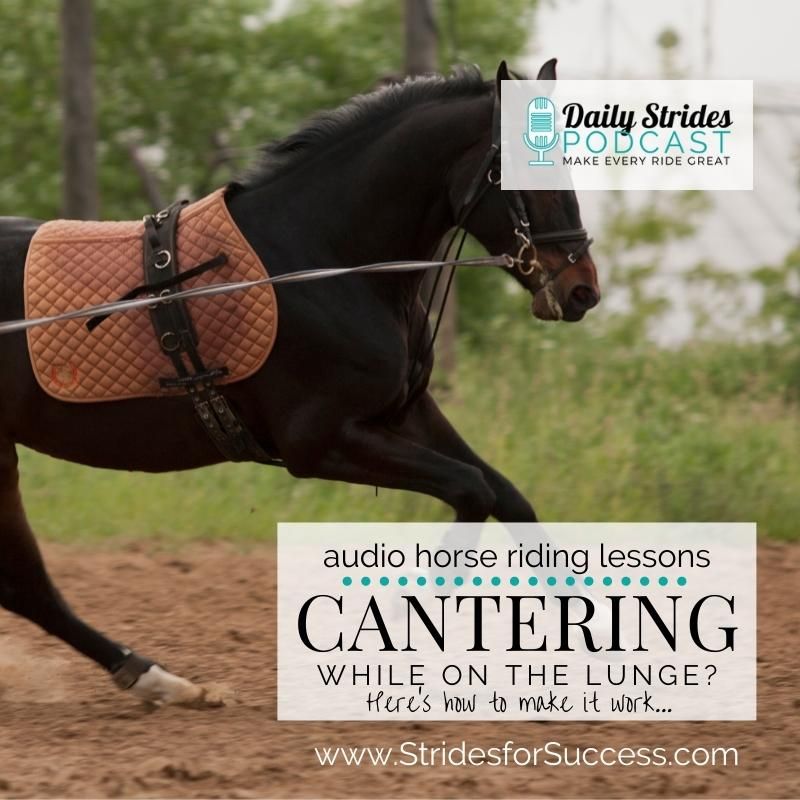
  • Cantering on the Lunge? Here’s How to Make it Work…

    Cantering on the Lunge? Here’s How to Make it Work…

    [fusebox_track_player url=”https://op3.dev/e/traffic.libsyn.com/dailystridespodcast/1237_Cantering_on_the_Lunge_How_To_Make_it_Work.mp3″ title=”Cantering on the Lunge Line? Here’s How To Make it Work…” social_linkedin=”true” social_pinterest=”true” social_email=”true” ]

    Here’s a confession; for years I used to think of cantering while on the lunge as just something I did to ‘finish the session’. It was like something that I could check off a list. There was no intention behind it (only to get it done),

    And with any cantering happening while on the lunge, there was definitely no thought put into using the time or gait to develop the horse.

    Which, now, seems so bizarre! Why would I have even bothered with it when there was no set focus or intention?! It really does seem like madness; except for one thing…

    Every week, I see so many riders making the same mistake. Cantering endless circles while on the lunge – without a single thought about why and what it might achieve or work towards…

    Transitioning Into the Canter

    Let’s start at the beginning with this one. I love thinking about the similarities between what happens when riding and what happens when lunging. Meaning, if you were to ride a ‘good’ transition from trot to canter, what would you consider before ‘asking’?

    The transition into canter will only be as good as the quality of the trot asking for it – and the quality of the preparations for the ‘ask’.

    Meaning that the trot must be moving forwards, not running. And the rider (the lunger) must invest a little time, energy, and focus in preparation for the transition itself.

    Become comfortable with your half-halt while on the lunge – yes it is a thing – and spend time on coordinating and balancing your aids to ask for the transition.

    Starting to Canter

    When your horse does transition into the canter – resist the urge to panic! If you are not used to lunging on a consistent basis, the canter can seem very, well, fast! It is almost like a rider who is learning to canter for the first time. It can seem like things are, literally, flying by! They’re probably not!

    And if your horse is ‘running’ in the canter, check out this episode HERE to help you with that.

    Watching your horse canter while on the lunge often requires you to feel a little mentally uncomfortable for a time. This is due to a perceived ‘lack of control’.

    Keep in mind that you have the same level of influence you had while in the trot, it is just that you may need to say things a little louder (using all of your aids) in order to be initially heard. This is a training process.

    Your job will be to refine the aids and increase responsiveness so that you can be heard by your horse while in canter on the lunge.

    Improving the Canter

    From here, you can begin to actually work on the canter. See your aids, both natural and artificial, as being a channel for energy. Use your outside boundary to help you channel things a little more.

    Become aware of the rhythm of the canter itself. Is there a distinctive 1,2,3..1,2,3.?
    How can you, using your aids, help define this further?

    From here, think about straightness. Are you using the lunge line to ‘slow your horse down’? Or are you using it to keep your horse while on the circle? In both cases, this will cause the energy to fall out. And, any leaks in energy will result in a canter that is far less than what it could be.

    Just like when you ride, your lunge line should be used to create contact. Not steer the horse (keep it on the circle) or slow the horse down (pulling on it like an anchor).

    Assess your aids, and be honest with yourself. Are you using all of the aids at your disposal in order to positively encourage a better canter from your horse, or are you just relying on the, unfortunately, obvious lunge line to ease your mental discomfort and make you feel more in control?

    Be Consistent with Your Actions

    Just like when you began cantering in the saddle, cantering on the lunge is probably not going to look pretty the first few times you try. It might consist of rushing and funning in wild circles. It could turn into a situation where any sort of request for a more balanced canter is met with a transition back to trot!

    The key to developing your influence in the canter is to keep trying. Notice what works. And change what doesn’t.

    Over time, if you can consistent with your approach, you will begin to see moments of ‘good’ canter on the lunge. Build on these. Give yourself a challenge of trying to prolong those moments just a little. And watch your efforts begin to produce real and lasting results.

    Happy Lunging
    Lorna

    More on this Topic:-