Tag: audio horse riding lessons

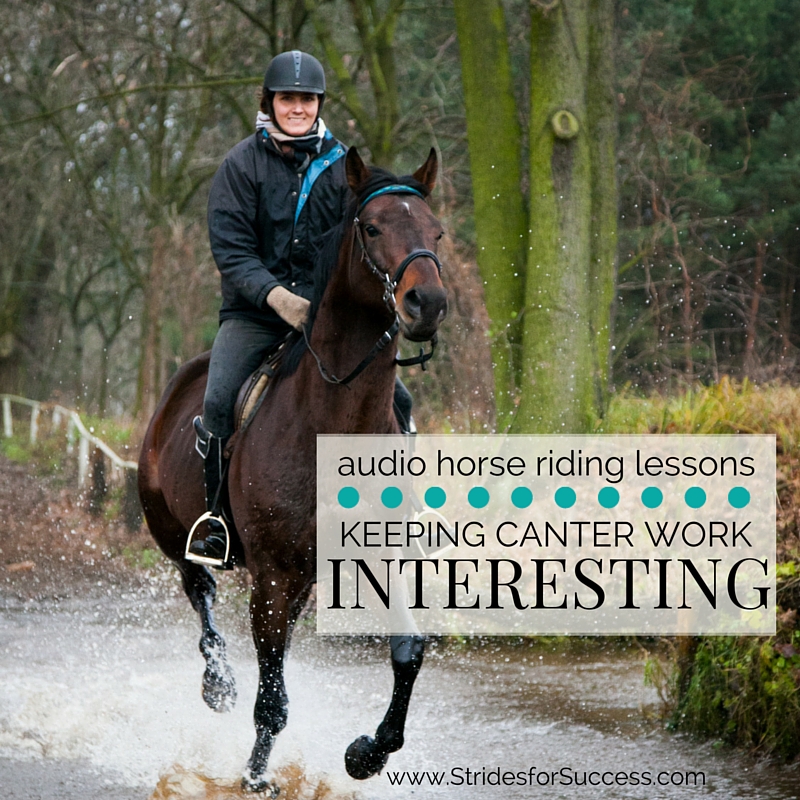
  • Keeping Canter Work Interesting

    Keeping Canter Work Interesting

    [fusebox_track_player url=”https://op3.dev/e/traffic.libsyn.com/dailystridespodcast/SFA316-Keeping-Canter-Work-Interesting.mp3″ title=”Keeping Canter Work Interesting” social_linkedin=”true” social_pinterest=”true” social_email=”true” ]

    I’ve often wondered what it is about the canter that makes riders almost seem to ignore it when schooling in the arena.  I see riders put so much time, care, and attention into the trot and to a lesser degree, the walk…

    But the canter is more often than not relegated to a few ‘laps’ of the arena and then back to more of the same with walking and trotting…

    In this week’s episode of the Daily Strides Podcast, we are focusing on some ways you can incorporate more canter work into your schooling sessions…

    Lateral Movement; Leg Yielding | Audio Horse Riding Lessons

    Canter work can require some serious work from both you and your horse.  It is easy to become tired while we are cantering and with tiredness comes a sense of complacency with the quality of the gait.   During this episode, we are covering four main points that will help keep you on track with your cantering and allow you and your horse to perform at your best.


    1. Establish Rhythm in Your Canter

    When you begin cantering initially I strongly suggest focusing on establishing a rhythm.  From here begin to notice when that rhythm and, later, tempo change and what may be causing this to happen.

    Pay particular attention to when ‘changes’ happen, such as a corner, a pole, or a jump.

    Being able to keep a consistent rhythm and tempo is vital to  good quality canter work.

    Ride a Rectangle or Square (not an oval)

    The second point we cover is when you initially begin canter work, rather than riding a large oval shape around the arena, ride a rectangle. This is obviously when you are going large.

    By making a dedicated effort to ride a rectangle (or whatever shape your arena is), you will use your corners and straight lines on the ‘long and short sides’.  

    This will give you the opportunity to use your half-halt before each ‘corner’.  And also work on your aids to help your horse remain balanced around each bend.

    3. Pay Attention to Your Body Riding Canter Work

    The third focus point is what your body is doing while your horse is cantering.  The fact of the matter is that the bounding feeling that we can get while we canter invites us to get slightly ahead of the movement…

    And as always, we cannot ride our horse while sitting on the neck.  

    So make a consistent effort to keep your position while you are working in the canter.

    4. Your Posture when Cantering

    The final point that we touch on today and to take into consideration is the position of your shoulders, seat bones, and legs while your horse is working in the canter.

    This is particularly important when you are beginning to feel tired…  

    This is when our lower legs can begin to swing backward and forwards.  It is also when we are more prone to collapsing our bodies and becoming ‘heavy’ in the saddle.

    I have included links to other more detailed blog posts and Daily Strides Podcast episodes to help you in your canter. You can also download a FREE EXERCISE to use with your horse HERE

    Happy Riding

    Lorna

    Additional Resources to Help with This Topic

  • Lateral Movement; Leg Yielding

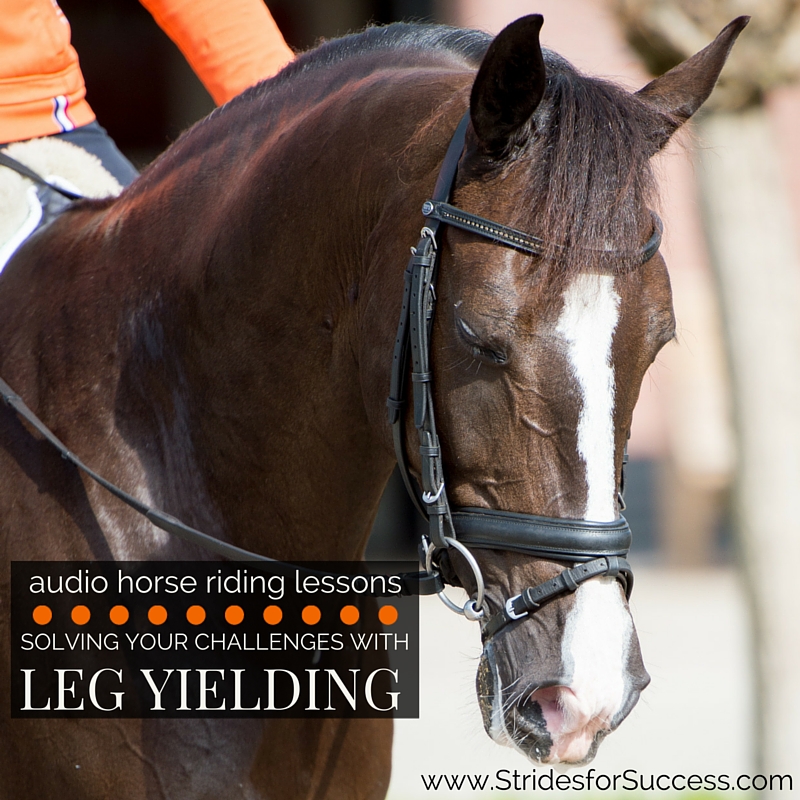
    Lateral Movement; Leg Yielding

    Leg yielding is generally most riders’ first introduction to lateral movement.  Lateral moving, when we’re talking horses, means sideways.  It is a great movement to ride as it allows you to work your horse’s body in a different, yet equally beneficial way.

    Leg yielding, and lateral movements in general, are a test of our abilities as riders to move each individual limb independently at the same time.  

    Think of it like this; each part has it’s own equally important job which when applied together, give your horse the directions and support he needs to perform the movement.

    Leg Yielding and Shoulder In

    Become Clear on What You Want…

    To ask your horse to leg yield, you must first become clear in your mind as to what you want your horse to do and where you want him to do it.

    With regards to the ‘where’, I suggest coming in from the outside track to perhaps the quarter line. This is the line halfway between the center line and the outside track on the long side of the arena.

    This way you are using your horses natural tendency to want to return to the outside track to your favor.

    Setting up the Movement

    The next part is setting the movement up.  Your horse needs to be straight, meaning that his hips are following directly behind his shoulders.  This will remain a key part of correctly performing the leg yield.

    Ask for a slight flexion in the poll area (perhaps where you can just see the inside eyelid) but his body should remain straight.

    The final part of setting up the movement is the all-important half halt.  It will help to balance things, but also give your horse the heads up and that you are about to ask for something different.  Don’t limit your half-halt to just one.   In fact, usually, 3 or 4 or more will be necessary to give you the desired results.

    Make sure you keep your leg on throughout the half halt.

    Asking your horse to yield to your leg

    So the word ‘Yield’ means to give way to, in this case, pressure.  You must create pressure with your inside leg. This is the leg your horse must move away from.  Where you place your leg to ask will depend on your horse’s level of training.

    Younger or greener horses will require your lower leg to be slightly behind the girth, as they will often have the tendency to move over with their shoulders and leave their hindquarters trailing or following behind.

    Remember, in order to perform the movement correctly, your horse’s hips and shoulders must remain straight… Not one trailing diagonally across the arena after the other.

    Your outside leg will help to maintain consistent impulsion and also act as a ‘blocker’ should either your horse’s hips or shoulders get ahead of the other.  Your outside leg will also help to ‘end’ the leg yielding movement when you have reached your desired destination and asking your horse to go straight forward again.

    Asking for Flexion

     Begin with flexion.  Use your inside hand to ask for the slight flexion in your horse’s poll area. This must remain soft and all the while aware that you’re not asking for too much bend.

    Your outside hand, as always, holds everything together. It also helps to prevent too much bend in the head and neck of your horse.

    Also, your outside hand can also be ‘opened’ slightly away from your horse’s neck which may encourage your horse to move over into the rein.

    Remain Light and Soft…

    One of the biggest mistakes I see riders doing when first attempting this movement is an over-enthusiastic ‘shoving’ movement with their hips and seat…  This will not help!   In fact, sitting tall and quietly is vital to your horse being able to move in this manner.

    Your ‘pushing’ motion with your hips will only unbalance your horse and cause him to be unable to successfully yield to your leg.

    I have written (and recorded Daily Strides Podcast Episodes) in far more detail on this topic HERE and HERE. I will also link to more resources to help with this below.

    Happy Riding

    Lorna

    Additional Resources on this Topic

  • Trotting Without Running

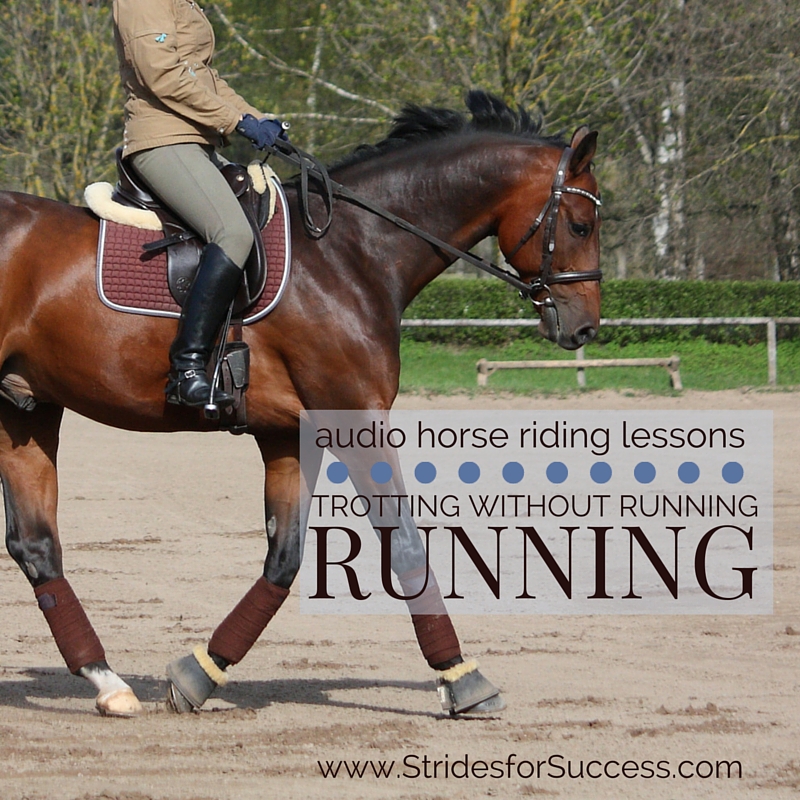
    Trotting Without Running


    Do you find that when you ask your horse for a more expressive trot, he just seems to begin running onto his forehand with you, becoming heavier and heavier with each stride? You’re not alone!

    Many riders set out looking to achieve an active, working trot… But due to lots of different factors, this can end up just ‘running’ around the arena. The horse resembling an arrow of sorts!

    The front end getting lower and lower with each passing stride, while the back end is getting completely left behind!

    Unfortunately, what usually happens next is the one thing that exasperates this ‘effect’ even further and that is hauling on the reins; dropping an anchor if you will.

    The reason this just makes the whole situation worse is by doing this, you and your horse begin to engage in a ‘tug of war’ of sorts. And, quite frankly, being involved in such a game with a 600 kg animal is an exhausting endeavor!

    Trotting Without Running | Audio Horse Riding Lessons


    Speed Versus Impulsion

    Often, as riders, we can confuse speed with impulsion…  We think that by asking for the trot to go 100 mph around the arena, we are really working our horses… Pushing forward with each passing stride.  The truth however is that while we may be creating energy, we are letting it all ‘fall’ out the front end of our horse, never contained and put to use in any form conductive ‘good’ work.

    The first part of mastering trotting without running is imagining in your mind that your horse’s back end is coming more and more underneath him… While his front end is becoming slightly higher and more elevated, as well as light in your hand.

    This is the picture you should work towards continually as you ride.  What is important to remember with this picture, is the ‘lightness in the hand’ part.  This cannot be achieved by hauling on the reins in the eternal tug of war.

    I challenge you to not only change how you think of working trot but also what you are physically doing with your body to ask your horse to begin using himself more.

    Happy Riding
    Lorna

    Additional Links to Help You:-

  • The Trot to Canter Transition

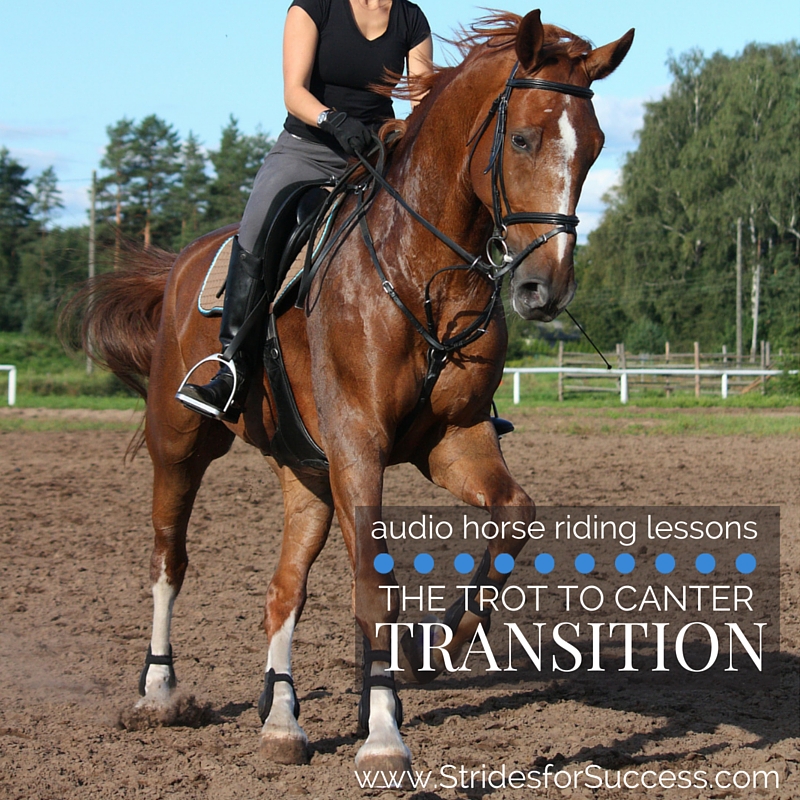
    The Trot to Canter Transition

    [smart_track_player url=”https://op3.dev/e/traffic.libsyn.com/dailystridespodcast/SFA296-The-Trot-To-Canter-Transition.mp3″ title=”The Trot to Canter Transition” social_linkedin=”true” social_pinterest=”true” social_email=”true” tweet_text=”A better trot to canter transition with your horse” hashtag=”horseriding #transitions” twitter_username=”strides_success” ]

    Do you manage to perform a ‘clean’ trot to canter transition every time?  This transition is often one of the most difficult to maintain balance and rhythm.  And this is true for both horse and rider.

    The potential for your horse to run into the canter, instead of actually ‘striking’ the canter when asked is quite high.

    In this episode of the Daily Strides Podcast, we cover an exercise that will help you become more clear with giving your horse the aids to canter.  It will also help to place your horse into a situation where he can transition from trot to canter more easily.

    Trot to Canter Transition

    Perfect this Transition?

    I want you to begin by riding a 20-meter circle, paying close attention to the quality of your trot.  Make sure you have a nice, active working trot; your horse moving forward from your leg.

    As you are trotting, notice how responsive your horse is to your aids…

    Are you having to ask two or three times for a specific movement or response? Use the initial trot on the circle to secure your horse’s undivided attention.  And to develop his willingness to do as you ask.

    Riding a Smaller Circle

    Once you have the trot moving forward as you want it, begin gradually leg yielding on to a smaller circle.  I say slowly, as I would like you to do this over a few rotations of the circle.  Continue to decrease the size until you are eventually riding an approximately 12m circle.

    Again, spend some time here re-balancing and establishing an active trot.  Pay close attention to your position.  Don’t lean or tip forward onto your horses neck. I also want you to be mindful of your aids.  Are your legs where they should be?  Are you asking the right questions?

    Trot to Canter Transition

    After 3 to 4 circuits of the smaller circle, you can begin leg yielding back out to your original bigger circle.  This is where you will ask for the trot to canter transition.  It is an ideal place to ask as firstly your horse is naturally flexed correctly.  And secondly, you are using a strong inside leg, riding into your outside rein, which you will use to balance the actual transition and the canter itself.

    As you near the ‘outside’ circle again, I want you to have a quick check of your position and after half halting your horse, you can ask for the canter.

    If your horse ‘runs’, bring him back, re-balance the trot, and then try again.  If your horse transitions into the canter, but then breaks back to trot after only two or three strides, you know that your inside leg is not being used effectively.

    You can continue this exercise a few times, paying attention to what you are asking, how you are asking and how your horse responds.  From there, you can try the trot to canter transition on the circle alone and see how you get on.

    Happy Riding
    Lorna

    Additional Resources To Help Equestrians:-