Tag: boundaries

  • Developing More Patience as a Rider

    Developing More Patience as a Rider

    [fusebox_track_player url=”https://op3.dev/e/traffic.libsyn.com/dailystridespodcast/1275-Developing-More-Patience-as-a-Rider.mp3″ title=”Developing More Patience as a Rider” social_linkedin=”true” social_pinterest=”true” social_email=”true” tweet_text=”Increase your patience with yourself and your horse…” hashtag=”horseriding #patience” twitter_username=”strides_success” ]
    A lack of patience is something that many riders feel shame about. I was one of those riders for many years, so I know full well how it feels. The initial frustration, the following swift judgment or potential explosion, and then the guilt that happens afterward. Let’s be honest, coming out the other side from losing your patience is rarely a good place to be!
    And yet, for years I simply believed that I was not a patient person. Like it was something that you are either born with – or not
    Now, I do think that some people have naturally more tolerance and more patience than others. However, I also now believe that patience can be developed – in all riders. It is simply a matter of believing you can, and then committing to doing the work required.

    Developing More Patience is Work

    I say this because let’s be honest, it probably won’t be easy initially. If you’re a rider who struggles with patience, there’s a good chance that there is a pretty well-formed habit or reaction that occurs each time you feel impatient! This is different for all riders.
    Lack of patience can show up as anything from excess tension through the jaw, right the way to becoming physically aggressive with your horse or those around you
    I think many riders also lack patience with themselves. When I’m working with riders in the arena, I often see this play out. The rider is ‘trying’ to do something. And they are trying and trying… Each attempt is with more tension through the body – which usually results in the rider moving further away from where they need to be in order to ‘ask the question’ with clarity.
    As you work on developing more patience, keep in mind that it’s really worthwhile developing it for both yourself and your horse
    And that this will take both time, consistency, and accepting that there will be a lot of speed wobbles along the way. Times where you don’t respond as you would like. But, unfortunately, find yourself playing out the old, learned, reaction or habit… It’s going to happen, accepting it before you begin the journey will make things much more enjoyable for you :)

    1 . Have You Set Clear Boundaries?

    So, before we begin working on your patience levels, I think that it’s worth noting what you are currently allowing. And what you’re not. These are your boundaries. So often, it is a lack of numerous boundaries that eventually leads to the rider losing patience.
    Remember, if you have not specifically communicated with your horse about what’s allowed and what’s not… It is essentially your own fault when things don’t go as you would like
    Another issue I often see is a rider who has not established firm and supportive boundaries on the ground. The horse will keep overstepping the mark while being groomed and tacked up, resulting in the rider’s patience becoming ‘worn down’ before they ever even make it into the saddle.
    Part of developing more patience as a rider is knowing what you want and what you don’t. What’s acceptable and what’s not? Then let your horse know – and enforcing where necessary

    2 . Set Clearly Defined Goals

    Once you know what you want, you can now begin to shape or mold each interaction with your horse to work towards that. Meaning you will now have a clear picture of ‘where we are right now’ in relation to ‘where we want to be’. This gives you both acceptable ‘wiggle room’.
    Knowing the differences between ‘here’ and ‘there’ will clearly define what is still acceptable as far as training, manners, skills, etc. are concerned. This gives you space – and removes pressure
    So, for example, if your goal is to canter a 20m circle on the left rein, but you are both still struggling to pick up the left lead on the transition into the canter. A good ‘expectation’ for your next ride would be to begin developing flexion to the left. Even if it’s only in the walk for now. By doing this, you will have taken the pressure off; allowing space for more patience with that process.
    Or if your horse is currently walking in circles and pushing you around when grooming and tacking up, your end goal might be that he stands still. However, in your next interaction with each other, you will decide ahead of time what your response will be to correct him each time he pushes you around or over. Implement this first… And you will soon be working towards the real goal, standing still. And, this way, your horse will also be more likely to work with you as he will respect you a little more.

    3 . Become More Self Aware

    This was a key step to developing more patience for me. I simply began to notice myself more. Initially, I was only able to do this after the fact. So after I had ‘lost my patience’. But over time, I was able to do it mid ‘patience losing’! And now, thank goodness, I can catch myself right at the thought that triggers the whole avalanche!
    Where ever you can, simply stop focusing on your horse, and really – REALLY – feel what’s going on in your body. Where is there excessive tension lurking; and how does it physically feel?
    And then just sit with it. It can feel REALLY mentally uncomfortable to notice and then simply allow the feeling of excess tension in the body. However, this will actually result in it dissipating. Meaning you can get back to ‘true calm’ much more quickly – and without doing or saying anything you may regret.
    When we ignore the feeling of excess tension in our bodies or pretend it’s not there, we simply mask it for a while. However, it will usually pop up again, with even more ‘vuma’ soon after
    Another way I have found to be really effective in becoming ‘self-aware’ is to imagine that I am being videoed. And thinking about, at that moment, what I look like in that video. It almost instantly causes me to ‘drop’ the tension and relax. It also causes my mind to think about something else. To move away from the initial thought that was triggering the lack of patience.

    4 . Remind Yourself Of Why You’re Doing It

    So, in the spirit of honesty, sometimes implementing self-awareness is not enough to reverse the feelings and thoughts inside of your body and your mind. Sometimes, you may feel ‘justified’ in reacting the way you either are, did or want to. And this is where I find giving myself a reality check works well.
    Simply answer the following question; “why did I decide to do this in the first place?” Usually, the answer is ‘to have fun’ or ‘feel good’. Then, ask a second question, ” How can I begin to turn this current situation into that?”
    Again, it’s at this point I often just laugh at myself! Laughing is a great way to allow the excess tension to work its way out, and cause no harm (emotional or physical) to yourself or those around you! Realizing that you are busy with a reaction that in no way aligns with your purpose for being there is usually pretty sobering. A great wake-up call.
    Another way I find really useful to turn the situation around is to ask “How is my horse/the rider/my instructor possibly feeling right now? Are they confused, tired, frustrated, or fearful… If so, how can I help change that to something more positive?”
    When you can intentionally put yourself into the other person’s (or your horses’) shoes, the different perspective is often enough to change the energy of the situation

    5 . Be Willing To Fail – A Lot!

    Finally, when you are on the road and committed to developing more patience as a rider, there will be speed wobbles. Lots of them! You’ll have days where your physical feelings will get in the way. Tiredness and hunger are two of the big ones for many riders! You’ll also have days where you will feel pushed for time. And then there are the days when other people will have an influence over how you’re showing up and feeling.
    The key to consistently growing and developing your patience is to catch yourself, as close as possible, to the original thought that triggers it all. Some days you’ll have more success than others
    One of the biggest challenges we have as riders (humans) is gaining authority over our own minds. Being able to notice thoughts, and not emotionally respond or react to them is the first step.
    Being able to cultivate thoughts that produce more desirable feelings and outcomes is the next step, and this will take time and commitment
    Remember, no matter how many times you find yourself on the other side of another ‘lost my patience speed wobble’, remind yourself that’s all it was. A momentary speed wobble.
    Then pick yourself up, apologize to whoever may have been affected, and continue trying. Some days it might be better to call it a day, for that day. And there’s also no shame in that either.
    In the beginning, it can feel almost impossible, but over time, trust me, it becomes so much easier.
    Happy Riding
    Lorna
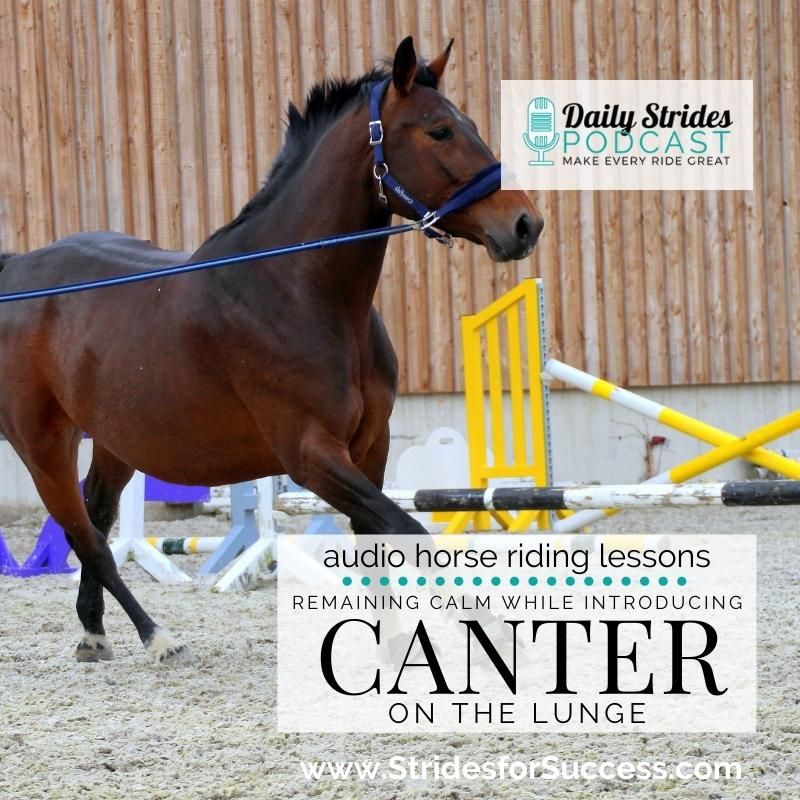
  • Remaining Calm While Introducing Canter on the Lunge

    Remaining Calm While Introducing Canter on the Lunge

    [fusebox_track_player url=”https://op3.dev/e/traffic.libsyn.com/dailystridespodcast/1235_Calmly_Introducing_Canter_While_on_the_Lunge.mp3″ title=”Calmly Introducing Canter on the Lunge” social_linkedin=”true” social_pinterest=”true” social_email=”true” tweet_text=”How to canter on the lunge – without racing and running in circles! ” hashtag=”horsepodcast #horseproblems” twitter_username=”strides_success” ]
    If you have even been at the other end of a lunge line to a horse who is adamant to show you exactly how fast he can go on a circle… You will know all about ‘that’ feeling!  The one where every fiber of your being is screaming at you to ‘stop the horse’.  And yet, it feels like there is absolutely nothing you can do!
    Intentionally mixing cantering and lunging together is not for the faint of heart!  It often requires nerves of steel – especially at the beginning of the journey…
    The good news is that, for those who persist and persevere, the reward is being able to truly use lunging as a tool to develop the canter.  And being able to do so from this wonderful, and unique, vantage point of ‘trainer’.

    Why Canter on the Lunge?

    Well, why not?!  Okay, I realize that many riders will answer that with “Because my horse turns into a lunatic!”, or “Because I value my horse’s soundness and my own life!”.  And versions of these scenarios do feel really within the realm of possibility.

    However, that is a key point.  They ‘feel’ real – but are they really? Or is there a story going on in your mind that is simply telling you cantering on the lunge is a no-no for you and your horse?

    I think that if you are working on a canter when riding your horse, there is a pretty good chance that you can also work on a canter while on the lunge.  And reap the benefits.
    I am a firm believer that most of the things you can do while in the saddle when it comes to training, can also be worked on while lunging.  And because lunging is so versatile regarding time, facilities, weather, equipment, etc.  It makes sense to use this tool to help you improve the canter…

    Notice Your Feelings First

    When I first began to really ‘work’ on the canter while on the lunge, I realized that a lot of the work was actually mine to do.  And, the vast majority of that work was mental, rather than physical.  I noticed that, when I began intentionally introducing canter on the lunge, my mind had a whole lot of stories about it all.

    Just the thoughts of canter produced excess tension in my body which, obviously enough, the horse must have picked up on. Couple this with changes in breathing, body language, and just aids in general…

    Looking back, I am certain that any excess energy the horse displayed was probably a reflection of what I was feeling and communicating.  

    However, once I realized this, I began working on it.  Why did the thoughts of canter make me respond so differently?  Was it true, all the doom and gloom outcomes I was prophetizing for us?

    Or were my feelings of discomfort simply because I was doing something new – and that felt challenging to my mind?

    A Few Pre-Requisites Before Introducing Canter

    Okay, so along with doing the work regarding your thoughts and the feelings they produce, there are other things that also need to be in place before you can safely, and successfully begin introducing canter on the lunge.  The first is responsiveness.  Your horse must be able to understand what it is you’re asking. And respond appropriately.

    Invest time developing your aids and responsiveness in halt, walk, and trot before even thinking about canter. Make sure that both the ‘go’ and the ‘whoa’ aids work well :)

    I also firmly believe that the setting can either help or hinder your progress.  Taking the time to set up an enclosed area, around 20m x20m to lunge in can help so much in the future.  It will allow you to use the lunge line for contact, rather than trying to stop the horse or slow him down.

    Introducing the canter on the lunge in an enclosed area also helps the rider to remain a little more relaxed and calm…

    I also think it is important that you can easily work the lunge line and ‘keep up’ with your horse.  Physical fitness is not just for horses.  And working the line correctly will help to prevent tangles and knots.

    Not Just a ‘Check List Item’

    It is also worth keeping in mind that intention is important.  Meaning that cantering for the sake of cantering is neither helpful nor productive.  The canter can really help with the training and the development of your horse, but only if you put intention and focus behind it.  Why do you want to canter?  What are you hoping to achieve from the canter?

    Creating a specific focus for your canter work while on the lunge will allow you to make each circle count; rather than just running in circles!

    I would suggest starting with rhythm and going on from there.  Accuracy and responsiveness are also really helpful filters when working in the canter.  Can you maintain the correct levels of tension; relaxation?  And, later, use the filters of suppleness and straightness to really develop strength and responsibility.

    Canter on the lunge is also a great way to work on the contact; especially if your horse has a tendency to become heavy on the forehand when being ridden in the canter. 

     Introducing Canter on the Lunge

    Start with asking for a good quality trot.  Spend a few minutes ‘tuning’ things up a little more so that you are sure your horse is listening to you and responsive.  From here, see if you can find a way to ask for the canter that your horse already understands.

    Using verbal cues is often helpful, especially if you can use the same cues while you ride. Find a ‘common ground’ where aids are concerned and build from there. 

    Just like when riding, reward (verbally and ‘softening with the contact’) any step in the right direction from your horse.  Keep in mind that your horse may initially seem to fall into the canter. This is normal.  If he has only ever been ridden into the canter, he may be a little dependant on the rider for balance.

    Asking for canter on the lunge requires your horse to ‘step into it’ himself.  No balancing effect from the rider.  This means things may look unbalanced, rushed, or heavy the first few times. 

    Just like when riding, it will take time to develop straight, clean, relaxed, forward, and light transitions into the canter on the lunge. It requires your horse to being to take more responsibility for his role in the transition and the gait.  And it requires the rider to learn to balance the aids for clarity.

    Introducing canter on the lunge is not an easy thing.  Correct preparation is required.  However, it is such a useful tool in your training toolkit that it is well worth the effort and time.

    Happy Lunging
    Lorna

    More on this Topic

  • Why Enforcing Your Boundaries on the Ground will Improve Your Riding

    Why Enforcing Your Boundaries on the Ground will Improve Your Riding

    Are you a pushover? So many riders describe themselves this way. And this is unfortunate because what’s happening between you and your horse on the ground, is a good reflection of whats going on in the saddle.

    [fusebox_track_player url=”https://op3.dev/e/traffic.libsyn.com/dailystridespodcast/1164-Why-Enforcing-Your-Boundaries-on-the-Ground-will-Improve-Your-Riding.mp3″ title=”Why Enforcing Your Boundaries on the Ground will Improve Your Riding” social_linkedin=”true” social_pinterest=”true” social_email=”true” tweet_text=”Have you rules when it comes to your horse?” hashtag=”equestrianpodcast” twitter_username=”strides_success” ]

    Groundwork is so important. Every single conversation you have with your horse starts and ends on the ground. Failing to pay attention to what is happening there is simply setting you both up for frustration and maybe even anxiety.

    Why Enforcing Your Boundaries on the Ground will Improve Your Riding

    What Are Boundaries

    Boundaries are the rule book between you and your horse. They are where you define what’s ‘okay’ and what’s not. And it is the lack of a boundary that causes issues when the arise between horses and their riders.

    Often you won’t even recognize you have a boundary until your horse has overstepped it.

    Think back to the last time you felt a ‘negative’ or less than desirable emotion when working with your horse. I can bet it was because he either did something or didn’t do something, you expected of him. You see, you had a rule. A boundary. And your horse broke it.

    The good news is that once you begin noticing your boundaries, or your rules, you can begin actively enforcing them.

    Your Electric Fence System…

    Imagine having an electric fence around you. I say this because most horse owners and riders understand how effective this is when managing horses in paddocks and fields. If someone was to push up against your fence, your boundary, would they be shocked? Or would they be able to continue pushing until maybe the fence breaks?

    It is really important to realize that it is your responsibility to turn your electric fence on

    This is enforcing your boundary. There is a clear and definite point where you won’t tolerate the other person (or your horse’s) pushing. And what’s nice is that once they know where the fence is and that it is turned on, they begin respecting it.

    Are Boundaries Boring?

    It can feel that way initially, especially if you are used to the ‘free to do what you want when you want it’ style of horsemanship that many people now tout as being ‘natural’. However, I’m going to go out on a limb here and say that if you have read this far, you’re having issues with your horse. So, maybe it is time to try tweaking things a little?

    Riders who have strong and clear boundaries can truly enjoy their time with their horse.

    They don’t experience the anxiety, nerves, worry, or trepidation that other riders do on a daily basis. This is because they are not always wondering what their horse will do if a ‘mood’ takes him. They are also very aware that these boundaries are first put in place when on the ground with their horse. They are then later carried over to when they are in the saddle. It all begins on the ground.

    Knowing The Limits

    Think about your horse in his usual paddock or field. He knows where those boundaries are. He feels safe when inside of those boundaries. Now, think about when he is put into a strange place he’s never been before. Often the very first thing he will do is figure out the new boundaries.

    Horses like to know where they can and cannot go. They thrive when the ‘limit’ or the boundary has been clearly defined for them.  This allows them to settle in and really begin to get to know the space they are in.

    Your job, as ‘team leader/trainer/rider’ for your horse, is to clearly define your boundaries. Then explain and show them to your horse. From here, you must enforce them. A boundary is not a boundary until it is enforced.

    Knowing the limits allows your horse the space to step into his own confidence and begin taking responsibility for part of the teamwork

    Clear Expectations & Rules

    A boundary is basically a rule. If there is anything in your riding, or in your interactions with your horse on the ground that is causing you to feel frustration, anxiety, or any other negative feels, it is because a rule is being broken. There is something there that you would like to happen differently.

    Noticing what we don’t want is often the first step to begin inning to define what we do want.

    Every time you ask your horse something, you have the desired outcome already imagined or mapped out in your head. It is when you don’t get this outcome that the negative feelings begin to show up. For example, if you put your outside leg back and expect canter, but your horse turns in or bucks. Or if you stop while leading your horse and he doesn’t. He runs you over as he walks on past you. It could be that you want him to lift his foot when you tap it in a certain place or a certain way. But he stubbornly refuses to budge, maybe even leans over onto said foot!

    Next time you feel yourself tensing up over something your horse did or did not do, celebrate! You have now been given a clear opportunity to begin redefining your rules and your boundaries

    Horses Have Boundaries Too…

    Think of a horse who become anxious or nervous. This is probably happening because a boundary he believes exists has been broken…

    Your horse also has his own set of rules. “If I feel or sense this, I must do that”. Or “if my ‘person’ does this, it means I must do that”. The trouble begins when the rules don’t align! Which is really common when you get a new horse or a horse that has been worked with by someone else.

    Re-training or re-schooling horses is simply redefining the rules or the boundaries to where you want them.

    A lot of negative feelings that are expressed by horses happen when the horse’s boundaries have been crossed. When the horse’s expectations of the rules have not been met or been broken. A conversation is two ways. Meaning that your horse must also have input and a say.

    When your horse feels comfortable, heard, and understood regarding boundaries, he will begin to express this in how he shows up. His confidence will grow and this results in a physical change in his way of going.

    Being Consistent and Fair

    Boundaries require consistency in order to be fair. I have helped so many riders transform their relationship with their horse by simply applying consistency to their rules. Rules on the ground and when in the saddle.

    It is unfair to the horse when the rider allows their current mood to dictate the rules.

    They flip from one day being absolutely hell-bent on doing ‘the thing’ the ‘right’ way. No wiggle room at all in their approach. It must be this – nothing else is acceptable. There is nothing wrong with this approach until the rider ‘flips’. Maybe they are tired or feeling rushed. Either way, this ’thing’ that they so diligently enforced the previous day is now no longer important. The rules change with their mood.

    In order for a boundary to be fair, it must be consistent. Even when it is uncomfortable or awkward to do so.

    If you do want to change the goalposts, I’m going to suggest creating a different playing field for you and your horse. A different arena. Or different tack. Maybe it’s the time of day. Things can change, but there must be a definition of the change.

    Clearer Boundaries = Better

    So many riders want to become ‘better’ when working with their horse. A better rider, or a better leader. You can do this today by becoming clearer on your boundaries. By simply showing up and deciding what is allowed and what’s not, you are already better than the last time you worked with your horse.

    And if you’re unsure of where to begin… Think about the last time you felt frustrated, angry, nervous, anxious when with your horse.

    Negative feelings are a clear indicator that a boundary has been either pushed up against or crossed. You might not have actually defined the boundary yet, but the feeling you are experiencing is telling you it is there and it needs reinforcing.

    Happy Riding
    Lorna

    Additional Resources on this Topic:-

  • Accepting the ‘Messy Middle’ in Your Horse Riding

    Accepting the ‘Messy Middle’ in Your Horse Riding

    Accepting the Messy Middle in Your Horse Riding
    Have you ever begun sorting something out, a room or a wardrobe perhaps?  Halfway through, you find yourself in the middle of a bigger mess than when you began the process.  In fact, it is usually at this point that you begin asking yourself why, in the name of all that is good in the world, did you begin in the first place!
    Your riding is similar.  Often, as riders, we need to actually realize that things are going to get messier, sometimes quite a bit messier before they begin turning into what actually wants to see in our riding. 
    When I am working with riders, I often see them cling onto certain elements in their riding.  Things that they feel they have ‘mastered’ already.  Unfortunately, often when we find ourselves overly attached to a certain thing or way of doing something, that is the very reason we need to let it go.
    [smart_track_player url=”http://traffic.libsyn.com/dailystridespodcast/1136-The-Messy-Middle-in-Horse-Riding.mp3″ title=”The ‘Messy Middle’ in Your Horse Riding” social_linkedin=”true” social_pinterest=”true” social_email=”true” tweet_text=”Here’s why your having trouble keeping things tidy while making progress in your riding…” hashtag=”equestrian” twitter_username=”strides_success” ]
    The thing we are so proud of or attached to becomes the very reason we stop moving forward and stop seeing progress with whatever we are doing.

    ‘Letting Go’ of Certain Things

    There is a process that most things in life adhere to when it comes to learning and growing.  This process involves things regularly being cast aside or ‘put down’.  This is in order to create space for new things to show up.
    Holding onto old things and old ways of doing things is very often what is blocking you from reaching the next level when it comes to your riding. 
    Take a halt for example.  I can bet that how you halt today with your horse looks very different from the very first halt you ever asked for with a horse.  Most rider’s first halt involves an embarrassingly over-reliance on the rein aids – and not much else!  Whereas now, yes, your rein aids are still part of the process, however, you have let go of the sole reliance on them and rather begun including other aids in there as well.
    It is important to recognize that what got you to where you are right now in your riding is not what is going to take you to the next level of being a rider. 
    You will have to ‘let go’ of certain ways you’re currently doing things.  This can be aids or habits.  It can also be a way of thinking about things.  And then, you must find new things to begin picking up…

    ‘Picking up’ New Things

    What is important to remember when it comes to collecting new methods and skills is that they must serve you where you are right now.  Learning to discern the ‘right’ things you need at this exact point in your riding is a skill many riders overlook.  In fact, a lot of riders don’t even realize it is something that they must learn to do!
    In order to get to the next level in your riding development, you will have to begin leveraging new skills and ways of thinking in your riding. 
    Again, if we take the halt example from earlier, it was not that you simply stopped using your reins too much to ask for a halt.  It was rather that you began learning new ways to ask the same question.  New skills.  And while someone probably told you this, you also had to get your mind to ‘buy-in’ to the fact that this was possible for you to achieve.
    I think that the issue begins when we reach a new level and get really excited and proud by how things ‘look’ at this new place.  We are reluctant to then ‘break it down’ again in order to go further… But breaking it down is what is usually essential if we want to move forward with our horse and our riding.

    Accepting it will feel Uncomfortable!

    Change is uncomfortable for our minds to process and handle.  Your mind is designed to keep you safe.  And the old adage ‘better the devil you know’ is how your mind really works here.  When it knows it, even if it is not positively serving you, your mind is happier.  Even thinking about doing things differently can often be uncomfortable for the mind.
    “Everything you’ve ever wanted is at the other side of your comfort zone” is so true.  I would love if you could, right this moment, accept that getting comfortable with getting uncomfortable is the way forward for you and your riding. 
    It will almost always feel uncomfortable to leave something behind.  Remember, what you have right now feels comfortable for ‘right now’.  But you want to move forward.  So putting a few things down, and picking up a different few things, is necessary to do this.

    Some Boundaries Must Be Moved

    We all have boundaries in our lives and in our riding.  Boundaries are there because they have served us in some way in the past.  However, we regularly outgrow our current boundaries; and reaching the next level in your riding is a great example of this.
    In order to grow as a rider, you will often have to mindfully move the boundaries you have put in place in your riding. 
    I go into far more detail about this inside of Groundwork For Riding, however, let me quickly explain this here and now for you.  A boundary is like an agreement.  Sometimes it can be an agreement between you and someone else, maybe your horse.  Or sometimes it is an agreement you have made with yourself.
    Often we create boundaries without even realizing it. However, they are easy to recognize once you begin to apply mindfulness to how you are feeling as you ride.  Each time you begin feeling mentally uncomfortable, you are getting close to an existing boundary. 
    Pay attention and notice your feelings. They will allow you to identify where you have created boundaries; and what boundaries are no longer serving you in your riding.  Remember, they served you at some point, but to grow or expand, they are actually now what is holding you back.

    Learning to Coordinate New Things

    So as you begin ‘letting go’ of some ways of doing things or ways of thinking in your riding, you pick up new things.  And, just like if you actually fill your arms with new items, it will take you a while to find a comfortable way of making these things fit together and serve you in your riding.
    Many riders expect to learn something new and for it to automatically fit in with all the other things they are already doing in their riding.  It won’t.  
    You will either have to create space for it, by putting something down.  Or coordinate it with the existing things you are doing or carrying.  This new ‘learning to coordinate’ is what makes progress seem and feel messy for riders.  However, it is an essential process for you to go through in your riding.
    It is also a process that you will revisit again and again, as you begin to approach each new level with your skills and development as a rider. 
    This is why I personally enjoy the training scale method for developing horses and riders.  It allows you to revisit the same principles, but through the filter of something new depending on where you are in your journey.

    Plateaus in Your Riding

    Regardless of what you put down or pick up, there will come a point where you will begin to feel comfortable and coordinated carrying the ‘stuff’ you have acquired at this point in your riding journey.
    It is when we stay at this level of comfort for too long, that we begin to feel like we are on a plateau as far as progress is concerned. 
    I believe it is important to celebrate your ‘wins’ and reaching the next level in your riding.  But I also think that it is equally as important to begin looking at the next level in your riding.  Identifying what the next level is for you and your riding will allow you to begin figuring out what needs to stay and what needs to go in order for you to get there.
    There is a limited number of things you can coordinate when in the saddle.  This is because some things working against or being counterproductive to other methods and ways.  Clarity is required if you are to really succeed in moving forward.
    And if you do find yourself knee-deep in the ‘messy middle’ right now, in your riding, celebrate it.  It simply means that you are well on your way to reaching a new level – and a new comfort zone – soon. 
    Horse riding will always challenge us, mentally and physically.  Don’t allow an emotional discomfort to hold you back from having better conversations with your horse going forward.
    Happy Riding
    Lorna

    Resources that Will Help with This Topic

  • Boundaries; How They Work for You In Your Riding

    Boundaries; How They Work for You In Your Riding

    Boundaries; How they work for you in your riding
    Have you ever had a horse step on your heel while you were leading them?  Or maybe it was your toe while tacking up or grooming?  These are pretty memorable experiences due to the amount of pain they cause!
    Horses are great at being really transparent around the consequences of doing something, or not doing something.  And if you have experienced some version of the above, it is due to ‘not’ doing something… Laying down boundaries with your horse.
    [smart_track_player url=”http://traffic.libsyn.com/dailystridespodcast/1130-Do-You-Have-Boundaries-In-Your-Riding.mp3″ title=”Boundaries; How They Work for You In Your Riding” social_linkedin=”true” social_pinterest=”true” social_email=”true” tweet_text=”How strong are your boundaries in your riding?” hashtag=”equestrian” twitter_username=”strides_success” ]
    Boundaries are so important when it comes to making progress as a rider. In fact, I have seen a marked difference between the results riders get in the saddle boil down to whether or not they have, and then actively enforce their boundaries.

    Start with your ‘Non-Negotiables’

    There are lots of different areas you can have boundaries when it comes to riding and horses. In order to make progress, you need to have some ‘non- negotiables in place.  These create the rules that you follow when it comes to what will happen, and therefore what won’t happen, in your riding.
    A non-negotiable can be that you ride 4 days a week.  It doesn’t matter what else happens, you are riding 4 days a week.  Or it could be that you have a focused outline for a particular ride.  It doesn’t matter what happens before or during that ride, you stay with your outline and intention.
    Something I see happening a lot with novice riders is that they ‘jump ship’ as soon as a better offer appears.  
    The better offer could be an invitation from another rider to do something different that day.  ‘Let’s go for a hack instead, the weather is fantastic for it today”.  Another version of ‘jumping ship’ is allowing themselves to become distracted by ‘shiny things’.  Maybe a magazine article that focuses on a specific exercise.  Or a blog or Instagram post from someone they follow.
    Remember, consistency is essential when working with horses.  It can be applied either way and how you apply it will dictate your results…

    So What Is a Boundary?

    A boundary is when you decide on something specific happening or not happening.  It is like drawing a line in the sand and then beginning to build something along that line, so everyone can see the line is there.  And therein lies one of the most important things about your boundaries…
    You must clearly communicate your boundaries to those they impact or affect. 
    What will you allow to happen?  Or, maybe it’s a case of what won’t you allow to happen?  What is okay?  Or a case of knowing what is not ok… The only way that you can begin to actively create boundaries is to get clear about them first.  Know what you want.
    One of the easiest ways to discover when a boundary has been crossed is by becoming aware of how you feel.  
    Very often, feeling anxious, frustrated, resentful, annoyed, angry, afraid or most other negative feelings associated with horse riding, is due to someone (or some horse) crossing one of your boundaries.  The issue is that most riders just don’t know it, to begin with…

    Creating Your Boundaries

    If I was to ask you what are you willing to do to become a better rider, you would probably tell me a whole list of things.  Great.  Now, the same applies if I was to ask you what you are not willing to do.  It may initially leave you feeling a little ‘stumped’, but slowly you will begin identifying things that, for you, are not worth negotiating with to become better.  The value does not add up.
          • The time it requires from you each week
          • How you train
          • Who you train with
          • What you are willing to do
          • What you are not willing to do
          • Training methods
          • Training aids
          • Artificial aids
          • How much money you will invest
          • Your safety
          • The horse you work with…
    These are all things you should have clear boundaries on.  ‘I am willing to carry a schooling whip, however, I am not willing to apply it as a ‘whip’ to the horse’. Or it could be ‘I am willing to jump 90cm however, I am not willing to jump 120cm’.   Maybe it is that you are willing to get extra lessons two afternoons a week, however, you are not willing to invest more than $150 per week.  This will all depend on your unique situation and beliefs.

    Setting Boundaries with Your Horse

    Your horse needs to know what is acceptable and what is not.  When you, the rider, are ‘wishy-washy’ on your boundaries there is a direct negative impact on the relationship with the horse.  Both on the ground and in the saddle.
          • Standing still
          • Leading
          • Catching from the field or paddock
          • Grooming
          • Tacking up
          • Mounting up
          • Dismounting
          • Walk
          • Trot
          • Canter
          • Transitions between gaits
          • Bending
          • Lateral work
          • Your aids…

    Boundaries affect everything when it comes to riding and showing up as a trainer for your horse.  Do you allow your horse to walk or turn while you mount up?  The keyword here is ‘allow’.  What you let happen, over and over, is what you tell your horse is okay to do.

    Your horse’s behavior, both on the ground and in the saddle, is because of the boundaries he has been taught. 
    This is hard for many riders to hear.  It is easier to complain about how your horse is doing (or not doing) things, than it is to step up and realize what is happening is due to weak leadership on your part…  Ouch!  But usually true!  And please, I am sharing this with you from a place of love and compassion; you can change this in your riding!

    Boundaries to Develop Your Riding (and Your Horse)

    This is often the easier one to address for riders as most riders are willing and open to learning how to improve in the saddle.  Your boundaries in your riding will often depend on how far you and your horse are in your riding journey.  They will also depend on whether or not you have allowed your horse to begin taking responsibility for how he is showing up in the ride.
    As a rider, one of your greatest responsibilities is to allow your horse to being ‘owning’ his part of the performance or the ride. 
    When your horse is green, it can feel like you are having to constantly correct and hold it all together.  Any softening or easing off from you will usually result in your horse losing what he is doing.  This can be straightness, shape, contact, relaxation, rhythm, suppleness…
    However, the only way your horse can begin to develop is by you setting the boundary and then stepping away from it.  As he ‘crosses’ it, you step back in and reinforce the boundary through a timely and correct correction. Then you step away again.
    Slowly overtime, your boundaries will become his boundaries.  Your boundaries will the how he strengthens himself and develops himself, physically and mentally. 

    Boundaries on the Ground with Your Horse

    We can use a different word for boundaries here; it’s Manners.  If you have ever watched two riders, one with clearly defined boundaries and the other without, working side by side – the benefits of boundaries become blatantly obvious.
    Riders who have clearly defined boundaries on the ground with their horses are, well, happier and more content!  Things are easier. Life at the barn runs smoother.  There are less or often no ‘power struggles’ between horse and rider. They are mindful of what they are doing.  Their horse is also usually more engaged in the process.
    Clearly defined and enforced boundaries allow horse and rider to truly work as a team, together. 
    Put this side by side with the rider who lacks consistent boundaries.  They are stressed, anxious, often even fearful.  The horse is literally pulling them around.  They are constantly ‘herding cats’ and ‘putting out fires’.  In fact, often just watching them is exhausting!
    How your horse is showing up at the yard is a reflection of how you are showing up.  

    Communicating Your Boundaries

    The final piece to successfully using boundaries in your riding is to actually communicate and tell those involved that you have that boundary.  The people in your life need to know and your horse needs to know.
    The success of boundaries depends on how well they are enforced. 
    Let your horse know what is allowed and what is desired.  Give him constant opportunities to work within your boundaries by allowing him to make mistakes.  Timely correction of mistakes is how he learns where the line is.
    Over time, he will know and respect your boundaries.  This also grows his confidence in you as a leader.
    Happy Riding
    Lorna