Tag: canter to trot

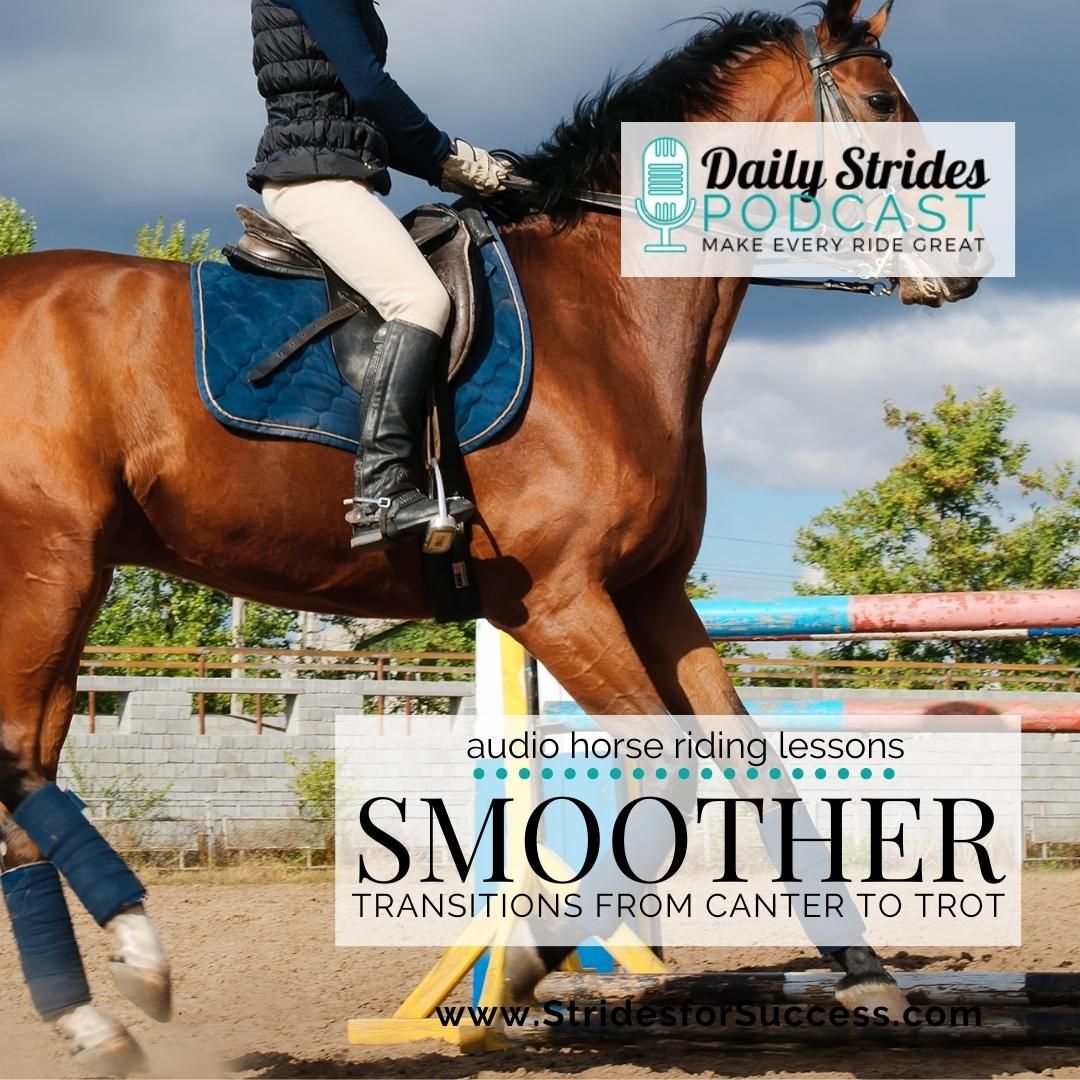
  • Smoother Transitions from Canter to Trot

    Smoother Transitions from Canter to Trot

    [fusebox_track_player url=”https://op3.dev/e/traffic.libsyn.com/dailystridespodcast/1287_Smoother_Transitions_From_Canter_to_Trot.mp3″ title=”Smoother Transitions from Canter to Trot” social_linkedin=”true” social_pinterest=”true” social_email=”true” ]

    What goes up, must come down; apparently. And this certainly applies to the gaits when you’re riding your horse. For many riders, successfully riding the transition into the canter and then staying with the movement in the canter itself is a great achievement. However, the next piece of the puzzle is returning to the trot.

    For many riders, no matter how good the canter is and how well they can ride it; the bumpy, uneven, and unbalanced return to trot puts a damper on the whole experience.

    And, yes, the transition from canter to trot can be tough to ride; but it is definitely ‘doable’. Here’s how you can improve this for you and your horse.

     1. Prepare Yourself and Your Horse

    I know, it seems a little ‘Captain Obvious’.  However, when we have to do something that we struggle with, we can approach it with a ‘get this over with as quickly as possible’ type of energy!  So rather than ‘just doing it’, remember to first take the time to set both yourself and your horse up for the upcoming canter to trot transition.

    As you are cantering and preparing for the downward transition, make sure your horse is balanced and responsive to your aids. Also, work on maintaining a consistent rhythm in the canter

    Another part of the preparation is to make sure you are in the best place to both ask for trot and allow the transition to happen.  I will chat more about this later in the article.

     2. Use Your Half-Halt

    So many riders think of half halt as being a once and done thing.  The truth is that, more often than not, the half halt is a ‘more the merrier’ aid to use when riding.  A few good quality half-halts will help to rebalance your horse before the transition. And let him know something is happening so he can be on the lookout for your eventual ‘ask’.

    The half halt will not only balance and steady the energy in the canter, it’ll also help your horse to lighten the front end a little more; essential for a smooth canter to trot transition.

    Use your full body in the halt halt.  Your seat, your legs, and your hands.  And remember that the ‘squeeze’ or resistance is only for a split second.  One beat of the stride.  Then release.  The goal is to engage your horse’s hindquarters and bring them back onto their haunches.

     3. Sit up and Engage Your Core

    And the required self carriage is not just for your horse.  It also applies to you.  Make sure that you prepare your body for the transition by sitting up tall and engaging your core muscles. This will help you maintain your balance and give clear cues to your horse.

    If you are in the right position to give the canter to trot aids, there is a much better chance your horse will understand – and then respond – to those aids. 

    This also allows you to follow the transition from the canter into the trot.  Collapsing through your seat will only result in a bumpy experience as the transition happens! And it will also leave you in the wrong place to ride the trot after the transition.

     4. Coordinate Your Aids

    Asking for the transition can be tricky for some riders. There is a struggle with how to truly balance the aids so that you ask the ‘right’ way for your horse to understand.  Focus on your seat first.  The ‘swing’ or ‘roll’ of the canter.  With canter, your inside seat bone is always leading your outside seat bone.  Part of the aids to ask for trot is to signal the change using your seat.

    Once you have engaged your seat bones, you can also your voice as an aid to support your other aids. Saying something like ‘woah’, ‘steady’ or “trot” or can be a big help for your horse to understand what your physical aids are asking.  From here, close your legs and squeeze lightly to encourage your horse to move forward into the trot.

    It’s really important that you are ready to follow your horse into the trot. This is really how you can ‘smooth’ the tension. 


    5. Allow in the Trot

    This is a key piece to any downward transition.  You MUST allow the horse to move forward into the new gait.  So many riders hold on too long with their aids.  This will only cause the trot to become jerky, hollow, or flat. Allowing involves your body moving in a way that works with the horse, rather than against.

    Practice identifying the very first step of the trot. As your horse takes that step, allow through your seat and your hands (your elbows, really). This will soften the contact – and smooth the tension.

    From here, move with the horse in the trot.  Think about keeping steady contact with the reins while allowing your horse to find their balance in the new gait.  It is usually easier to post or rise when first in the trot.  If you find that your horse is becoming hollow, this is especially important.  Often it is a bouncy rider trying to ride sitting trot that causes that hollowness!

    Practice the Canter to Trot

    It goes without saying, in order to improve you will have to do the work.  Regular practice will help you and your horse become more familiar with the transition.  It will also improve your timing and communication. Gradually work on refining the aids and asking for smoother transitions over time.

    Remember, transitions require coordination and communication between you and your horse. Be patient, and try to remain balanced.  Work on asking your horse with clear and consistent aids to achieve a smooth canter to trot transition.

    Happy Riding
    Lorna

    Improve Your Canter

    The canter is a big topic for riders. There can be so much pleasure and joy found there. And, often, an equal amount of bumps, flatness, and non-starts! If you are keen on improving your canter in just 4 weeks, make sure you take a look at my program Improve Your Canter.

    You will learn what is happening and how you can best time your aids so that your canter will go from being hit-and-miss to smooth and connected.

    With audio horse riding lessons to listen to 4 days a week while you ride, all filled with different exercises for you to practice, Improve your Canter will help you finally ride the canter the way you want.  Every single time.

    More on This Topic:-

    Training For Riders:-

  • Developing a Light, Balanced Downward Transition Every Time

    Developing a Light, Balanced Downward Transition Every Time

    [fusebox_track_player url=”https://op3.dev/e/traffic.libsyn.com/secure/dailystridespodcast/1218_Riding_Consistent_Balanced_Smooth_Downward_Transitions.mp3″ title=”Riding Balanced, Smooth, & Light Downward Transitions” social_linkedin=”true” social_pinterest=”true” social_email=”true” tweet_text=”Here’s how to ride smoother, lighter downward transitions – starting today :)” hashtag=”horselovers #equestrian” twitter_username=”strides_success” ]

    What goes up, must come down.  For every upward transition you ride with your horse, you will follow it, at some point, with a downward transition.  For many riders, these can prove a little more complex to balance.

    Having to prepare and then guide both yourself and your horse ‘downwards’, while continuing to maintain forwardness, tension, and energy… It can feel more like falling into, rather than stepping into, the new gait!

    However, as with all things riding-related, there are things you can do to really begin improving each downward transition that you ride.  Implementing these changes can begin today, with the very next downward transition you ride with your horse.

    What is a Downward Transition?

    One of the easiest ways to think of this transition is moving from a higher gear to a lower gear while on your horse.  It can be as simple as the walk to a halt.  Or your downward transition could be something more complex such as a canter to walk.

    There are also downward transitions that happen within the gait itself, where you transition from covering more ground each stride to covering less.  

    There are lots of different ways to make this sort of transition happen and, therefore, there is a whole wide range of possible outcomes to each transition that you ride.  The key is to begin working on creating a good quality transition, rather than simply hauling your horse back each time you ride one.

    Light, Smooth & Balanced

    So, rather than your horse ‘falling’ into the new gait, we want the opposite to happen.  We want him to literally, maintain composure and balance, to step into it.  If the transition was from the walk into the halt, the good quality transition would result in your horse arriving at the halt in a way that allows the energy to be maintained in his body.  This is so that he can simply step out of it again.  If we use the canter to walk, it is often helpful to think can-ter, can-ter, can-ter, can-walk, w.a.l.k.   The canter is literally a stepping stone into the walk.

    The horse can only achieve a light transition if he is engaged and carrying himself throughout his body.  This is where self-carriage comes into the conversation.  

    In order for your horse to ‘step’ into the downward transition with confidence and grace, he must believe that he can carry himself while maintaining forwardness.  This takes training, development, consistency, and time to achieve.

    Often, the horse’s abilities to remain balanced through the downward transition are actually hampered by the rider. 

    This is where a lack of composure, balance, and self-carriage in the rider can have an obvious negative influence on the horse’s performance.

    Preparing a Downward Transition

    Just like the upward transition, the amount of preparation you put into the movement before you ride it will become clear as you ride the movement. I think one of the first, key things to think about is what you want to ask for, and where you want it to happen.  Once you are clear on this, you can begin thinking about how to most effectively communicate this to your horse in order to get the outcome you want.

    Your half halt will be a key factor to riding a good quality movement.  You will initially use it to bring your horse’s attention and focus back to you. From there, you can use it to balance and prepare both of you. 

    Each half halt, I recommend riding quite a few, will help you to begin ‘gathering’ the energy that is coming through from your horse’s hindquarters.  The half halt is also a great way to really connect with your horse’s hindquarters.

    It allows you to begin ‘syncing’ your seat bones with your horse’s corresponding hind feet. This will help you to know when to actually ask for the transition; your all-important timing. 

    The Rider’s Self Carriage

    When you feel that you are both ready to actually make the transition happen, focus on yourself for a moment.  What you do next can influence everything else going forward.  Think about how you want your horse to use his body throughout the transition, and work on modeling it first.

    Your job is to ‘ask’ your horse to perform the transition.  It is not to ‘make’ your horse transition. 

    As you work on developing your skills, pay attention to responsiveness.  The more responsive your horse is to your aids, the more smooth and clean any transitions will become over time. However, this is only assuming that you are carrying yourself!  So many riders throw their body about in the saddle in some misguided attempt to ‘ride’ the downward transition. 

    Remember, once you’ve asked for it, you must simply be in the best position to allow the transition to happen. 

    Resisting Forwards; Not Pulling Backwards

    A great way to think of how to really remain balanced and best placed to allow for a successful transition is to think of a tug of war…  If your body feels in any way like you’re in one with your horse – you’re pulling!  This can range from pushing your heels down, pulling with your hands, or leaning backwards.

    You rather want to simply stop moving forward with your horse.  It can help to think of yourself as being ‘still’. Not moving ‘against’ your horse (maybe pulling?), but also not moving ‘with’ him (resisting). 

    Things to look out for is your lower leg swinging back.  Standing up (or feeling like you are going to stand up) in your stirrups is another indicator that you’re pulling.  And any movement in your hands is also a no-no. Finally, leaning will look (and feel) like your shoulders coming behind your hips.

    I am a firm believer that whatever you want to achieve from your horse, the key is to align with that first throughout your body. 

    Meaning that if you are trotting and want to walk, think and then act ‘walk’.  And if you are cantering, rather than allowing your seat to ‘rock’ with your horse, think of the more ‘equal all over’ feeling of trot.   This leads me to the next important thing you need to work on to improve every downward transition; your rein aids.

    Your Rein Aids

    Okay, so I have mentioned not to pull… And yet, that is the very first thing most riders are thought when they get on a horse and begin to ride!  “Pull the reins to stop”.

    Let’s be honest here; at the end of the day you do not want to get into a tug of war with another ‘being’ who is equally as opinionated as yourself… Particularly when that ‘being’ outweighs you by about 10 to 1… 

    I use the word ‘being’ in the above few sentences to hammer home the fact that your horse has a mind of his own.  Whatever you believe about the abilites of your skills as a rider; it is absolutly essential that you take into account your horses presence in every single downward transition.

    A steady ‘this is it’ goes a lot further than a furious ‘reining in’ or ‘hauling out the back teeth’.  And yet, if your horse only knows ‘reining it in’, I strongly suggest beginning his retraining in a fairly confined area…!

    All horses have been thought different things when it comes to contact and rein aids. One of your biggest responsibilities as a rider and trainer for your horse is to be consistent, true, and kind with yours.

    Riding the Downward Transition

    So, once you have your horse’s attention, and gathered the energy, you can begin thinking about the transition itself.  Understanding that each transition is different is important.  This will allow you to use the all-important ‘feel’ in your riding.

    Feel is when you almost intutivly know what is needed in order to communicate your desires with your horse

    Choose the place and then begin to ‘ask’ for the downward transition.  Remember to keep your legs on.  Downward, even if it’s all the way back to halt, should still have you both thinking and working forward.  Your legs will help to maintain the creation of energy throughout the transition.

    As you feel your horse taking that very first step inot the new gait, it is important to release for just a moment. This will allow the tension to smooth out, producing a better result in the new gait. 

    Once your horse has transitioned, the focus will be on establishing a good quality movement within that gait.  This may take time.  However, the better the quality of the downward transition that was ridden, the easier this will be.

    The lightness will develop over time as your horse develops.  Being able to carry himself requires training.  And, as mentioned, a rider who is doing the same thing!  I will link to more episodes below in the resources section on specific transitions that you can work on with your horse.

    Happy Riding
    Lorna

    Additional Resources:-