Tag: falling off

  • Getting Back in the Saddle After a Fall

    Getting Back in the Saddle After a Fall

    [fusebox_track_player url=”https://op3.dev/e/traffic.libsyn.com/dailystridespodcast/1301_Getting_Back_in_the_Saddle_after_a_Fall.mp3″ title=”Getting Back in the Saddle After a FAll” social_linkedin=”true” social_pinterest=”true” social_email=”true” ]

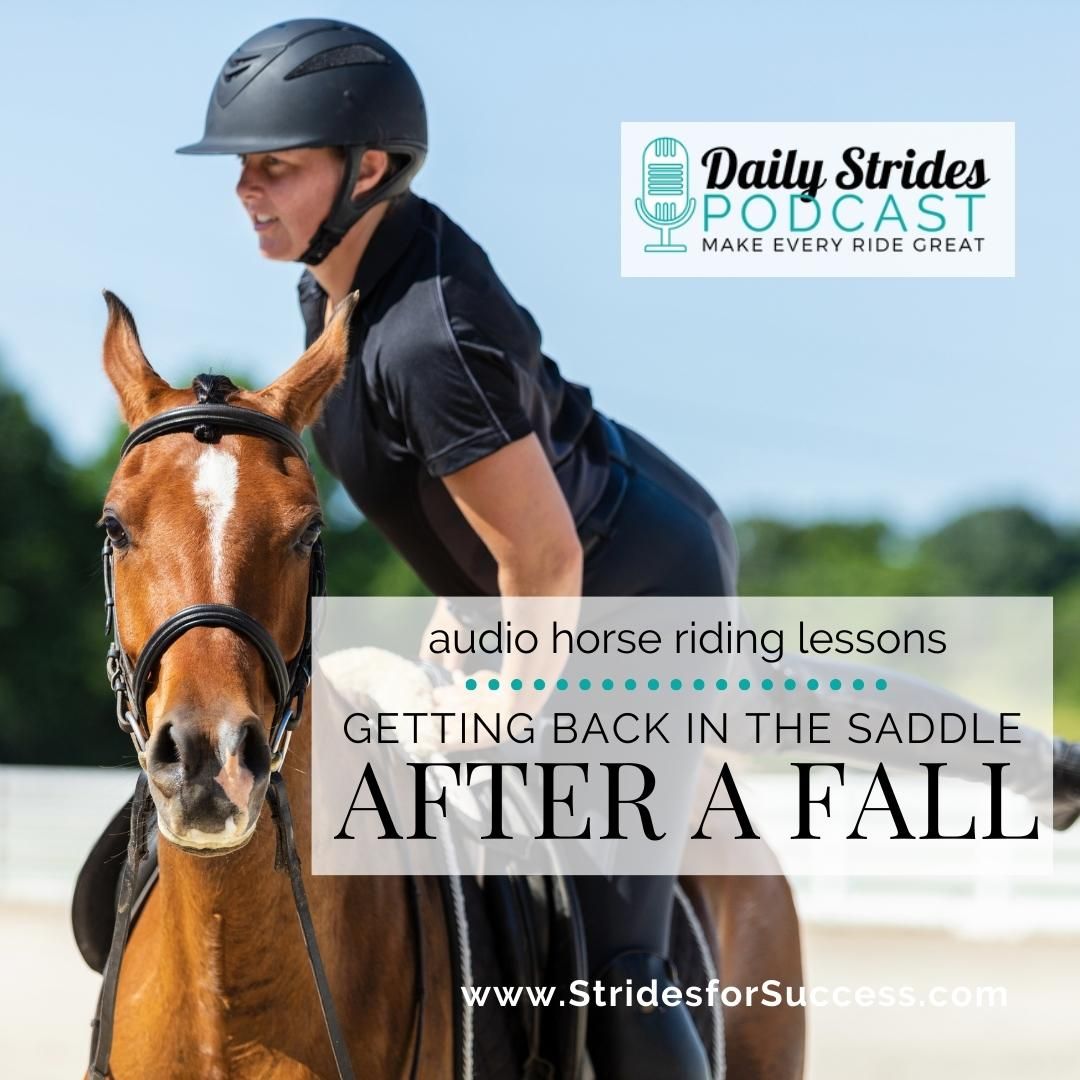
    As riders, we all know that falls are part and parcel of the whole riding experience. However, getting back in the saddle after a fall can be a sticking point for many riders. This can be due to fear, a lack of understanding, or just the realization that falls can and will happen!

    In this episode of the Daily Strides Podcast, I will lay out short actionable steps you can take to get you back in the saddle after a fall from your horse.

    Why Did You Fall?

    Understanding why you fell in the first place is usually pretty important. And it can also be a moment of truth for many riders. Especially those who want to lay the blame squarely at their horse’s hooves! Now, let’s be honest, sometimes it can be something that the horse did that caused the fall, such as tripping or losing balance.  However, even then, there are usually ways that you can improve your chances of staying on.

    Identifying the reasons for the fall, both internal and external, will allow you to begin to make changes so that the chances of you coming off again are less.

    If the reason was more external, such as a bag blowing in the wind and spooking your horse, you can begin to make changes to lessen the chances of this happening again.  Not riding on a windy day.  Cleaning up around the arena or riding space.  Riding a different route, etc.

    And you can work on increasing your own balance, posture, position, suppleness, independent aids, and response when in the saddle as well. All of these will help increase your chances of staying on next time.

    Groundwork is Your Friend

    Before getting back in the saddle after a fall it can be helpful to spend time working with your horse on the ground. Especially if you are experiencing anxiety about mounting up again.  Groom, lead, and engage in groundwork exercises to rebuild trust and establish a strong connection with your horse.

    Following a groundwork plan will allow you to increase your confidence in your own abilities and in your horse as well.

    And, if done correctly, will set the two of you up for better communication and aids when you do eventually mount up again.  Make sure you check out my Groundwork for Riding Program where we go deep into all of this. From here, when you are ready to get back in the saddle again, there are a few key considerations and steps.

    Select the Right Horse

    Choose a calm, well-trained, and reliable horse for your first few rides back. A horse with a willing and gentle temperament; and a history of being safe for riders! This can play such an important role in boosting your confidence.  Now, I get that you might be limited here by location, however, if necessary, maybe research a riding school that can really give you this type of horse for your first time back in the saddle.

    I also think having a ‘helper’ on the ground can lower your stress levels all around in this situation.  When you have someone who is considerate, knowledgeable, and trustworthy, it can boost your confidence a little more.

    This helper doesn’t necessarily have to be a ‘horsey person’.  Just someone who is willing to be there for you, keep the conversation flowing and borrow you a little of their more relaxed feelings when you need them.

    Short & Sweet

    For your first time back in the saddle, keep it short and sweet.  3 to 5 minutes is perfect.  Enough time for you to get on, feel the discomfort, and then also feel it dissipate a little.  This is important when we think of changing your current ‘go to’ feeling of anxiety or fear.

    From there, begin making each ride a little longer until you have built up to 15 or 20 minutes riding time.  This is long enough to begin ‘working’, but not so long that you end up exhausted (mentally or physically). 

    I also think that it is really important to be consistent with your riding.  The more of a rhythm you can create with how often you are getting back into the saddle, the more positive momentum you will create.  Even if it’s just a couple of minutes at a time.

    Get Back to Basics

    Once you can begin to actually mount up without feeling paralyzed by anxiety, I would strongly suggest getting back to the basics of your riding. Focus on really developing and correcting your seat, position, and posture.  From here, your aids and timing your aids will be important to creating better communication with your horse.

    A big part of building confidence as a rider is to believe in your own abilities when it comes to your riding.  How well you can effectively communicate with your horse is a big part of this.

    By getting all of your basics working for you (so being correct) and then putting them onto autopilot, you will begin to feel more and more at ease in the saddle.  And soon, getting back on after a fall will no longer be a worry for you. Because, I think this is important to keep in mind, you will most likely fall again in the future.  It really is just part and parcel of riding horses.

    Returning to Riding

    Remember that rebuilding confidence after a fall takes time and patience. And every rider’s journey is unique.  It’s important to listen to your body and emotions.  Don’t simply disregard your fears as being ‘stupid or silly’.  You feel that way for a reason.

    Understanding why you feel that way will have a far longer-lasting effect on your overall success with getting back into the saddle.  

    And, if at any point you feel overwhelmed or unsafe, it’s okay to take a step back.  Find the place you feel comfortable and begin again from there.  I realize that telling you to get ‘professional help’ in the form of a trainer or instructor is also correct.  However, I also know that so many riders simply cannot do this due to location or time challenges.

    You can get back in the saddle after a fall.  It is definitely do-able.  The question is, are you willing to invest the time and feel all of the uncomfortable feelings to make it a reality for you?  I hope so! 

    If you would like some step-by-step help and training with this, make sure you check out Returning to Riding.

    Happy Riding

    Lorna

    Back in the Saddle After a Fall

  • Stop Leaning to the Outside Round Corners when Cantering

    Stop Leaning to the Outside Round Corners when Cantering

    [fusebox_track_player url=”https://op3.dev/e/traffic.libsyn.com/dailystridespodcast/1286_How_to_Stop_Being_Pulled_to_the_Outside_in_the_Canter.mp3″ title=”Stop Leaning to the Outside Around Corners when Cantering” social_linkedin=”true” social_pinterest=”true” social_email=”true” ]

    The challenge is real… And, unfortunately, the momentum is as well! For so many riders, cantering is all well and good until the point where you have to turn! Cantering around corners can be so challenging for many riders for a lot of reasons. Here are 3 points to focus on to help you maintain your alignment and balance.

    1. Understand Momentum

    When cantering around corners, there are certain laws of physics at play!  One of the easiest ways to think about this is to use the example of a children’s merry-go-round.  When the merry-go-round is moving, it is much easier to remain balanced the closer you are to the center of the platform.  The closer you are to the edge, the stronger the force or momentum that feels like it is sucking or pulling you off the merry-go-round. Cantering on your horse is the same.

    If you are not actively positioning your body and your weight to help balance yourself, momentum will ‘suck’ you to the outside.  And with your horse moving to the ‘inside’ – that is not going to end well!

    2. Assess Any Potential Crookedness in Your Body

    If you have a tendency to lean or collapse through your body, this will become more amplified the more energy your horse creates when you ride.  Especially in the canter. Many riders don’t realize how much they collapse or they lean when they ride. Until they are asked to canter. And, even then, it is only really when they find themselves leaning to the outside around corners and through bends that it becomes a problem that urgently needs fixing!

    Start by assessing yourself in the walk. From here move into the trot, and then canter. Notice any height differences between your hands or shoulders.  Your knees as well. And also, how ‘equal’ you are sitting in the saddle…

    3. Correct Your Weight Aids & Position

    Once you have ‘straightened yourself out’ and really worked on developing symmetry through your body as you ride, now is the time to begin putting correct position and weight aids into practice.  So many riders have heard that they must ‘weight the inside seat bone’.  And this is not wrong.  It’s just how they are doing it that’s wrong.  They ‘lean’ to the inside using their shoulders – which only causes their inside seat bone to migrate to the outside of the saddle. Nope!

    Weighting the inside seat bone requires you to elongate and engage the inside of your body. Think of lengthening the inside leg and then, by positioning your upper body to ride through the corner, engaging your core.

    Leaning to the Outside in the Canter

    It is not an enjoyable experience.  However, it is one that can be corrected pretty easily if you are consistent with your approach.  By looking at the overall position of your body as you ride through any corner, in walk, trot, or canter, you will begin to do this without any thought.

    And when you can put the basics of position, weight, and straightness on autopilot, that is when you will find yourself, someday soon, not even thinking about this anymore in your riding.

    Happy Riding
    Lorna

    More on This Topic:-

    Improve Your Canter

    The canter is a big topic for riders. There can be so much pleasure and joy found there. And, often, an equal amount of bumps, flatness, and non-starts! If you are keen on improving your canter in just 4 weeks, make sure you take a look at my program Improve Your Canter.

    You will learn what is happening and how you can best time your aids so that your canter will go from being hit-and-miss to smooth and connected.

    With audio horse riding lessons to listen to 4 days a week while you ride, all filled with different exercises for you to practice, Improve your Canter will help you finally ride the canter the way you want.  Every single time.

    Training For Riders:-