Tag: hollowness

  • Why Your Horse Is Hollow and How to Start Fixing It

    Why Your Horse Is Hollow and How to Start Fixing It

    [fusebox_track_player url=”https://dts.podtrac.com/redirect.mp3/pdcn.co/e/traffic.libsyn.com/dailystridespodcast/1384_Why_Your_Horse_is_Hollow_And_How_To_Fix_It1.mp3″ title=”Why Your Horse is Hollow and How to Begin Fixing It” social_linkedin=”true” social_pinterest=”true” social_email=”true” ]

    There’s a particular feeling most riders learn to identify pretty quickly, even if they don’t have the words for it! You know the one where, the one moment, you and your horse are moving along fairly happily together.  Until the next moment, it’s as if the whole arse has fallen out of everything!  You go from being carried to being ‘deflated’.

    Instead of feeling supported and connected, everything becomes jarring, bumpy, and even chaotic! Say a big hello to hollowness!

    The point in the ride when your horse’s back disappears from underneath you, the front end pops up, and you find yourself wondering where, exactly, it all went wrong.  And, rightly so, many riders respond by trying to “fix” the issue. Unfortunately, they tend to focus on their horse’s outline, usually through the reins… But, unfortunately, that only makes things worse – and even creates a bigger training issue further down the line! Let’s take this apart properly, so you can begin changing things in a way that will actually work.

    What “Your Horse is Hollow” Means

    Okay, let’s shift our minds a little here. I want you to begin to imagine that, in an ideal world, your horse’s back is a rainbow. When you’re riding, you’re up there ‘on top of the rainbow’. Connected and supported. Now, I want you to flip that rainbow (so it looks like a ‘smile’). This represents your horse’s back when he becomes hollow.  Instead of being supported, you feel like you’re sitting at the lowest point of a trough or an inverted curve.

    The Hind end trails, the back drops away, & the neck & head lift. The energy that should travel forward through the back simply never arrives. Nothing flows or connects

    The result is that everything begins to unravel. The steps get short and choppy. Transitions fall apart. There’s no gathering or connecting of the energy, because the energy is no longer there to connect! This is why your half-halts usually don’t feel helpful. It feels as though you and your horse are working against each other rather than as a team.

    And the longer your horse travels around like this, the more normal it becomes for him. Hollowness reinforces itself; which is why, so often ,this is a retraining issue

    Hollowness in Young Green Horses

    Okay, before we go any further, I want to first mention something that will show up for young or green horses. They can become hollow purely because they are just that! They lack the strength and the training to ‘carry’ for long periods. That is not what I am talking about today.

    However, if you suspect this is what’s going on for you, I’m going to suggest lots of groundwork. Especially over groundpoles. Be consistent with short and focused sessions and allow your horse time to develop.

    Hollowness in Other Horses

    So, before we go anywhere, I am going to assume (and if not, strongly suggest) that you have had your horse seen by the relevant professionals if this is a constant issue. And, only after you get the all clear that all is okay, then proceed  :) Okay, so let’s say that your horse is not young or green, but you are still feeling that hollowness show up. There are lots of reasons that lead to the ‘horse is hollow’ outcome. However, in my experience, there are 3 big points that show up again and again. And yes, I’m going to begin with you – the rider – not because you’re doing anything “wrong,” but because you’re half of the conversation.

    1. Hollowness Caused By the Rider

    Very often, hollowness begins with a small loss of balance. A little ‘speed wobble’ of sorts. This could be just you or you and your horse. But in that moment of tension or uncertainty, your body instinctively tries to catch itself.  The lower leg slips forward; your seat tips back toward your tailbone; the pelvis tucks; and suddenly, you’re using the reins for support. From the horse’s perspective, this is uncomfortable.

    His natural response is to avoid the pressure underneath your seat by dropping away from it. Then he braces his head and neck to try get away from your hands and to keep himself upright, leading to that ‘camel moment!

    Ironically, the more you try to ‘balance’ things with your horse, the more your horse hollows to get away from you! It’s a cycle that is hard to break. Especially because you have no control over your own balance or support.

    2. Lack of Forwardness

    Forwardness, or the lack of it, is the second big reason I see for horses becoming hollow. It is an absolutely ESSENTIAL ingredient when it comes to working with and training your horse. Without forward thinking, your horse will struggle to remain focused or have a sense of purpose. Without physical forwardness, there is no energy to gather or connect.

    A horse working and thinking “forward” isn’t rushing around like a mad thing; forwardness is simply the willingness to go somewhere with a sense of purpose. It’s the partnership or team element. 

    When it’s missing, the hindquarters disengage, the front end begins pulling rather than the hind end pushing, and the neck becomes a lever to hold everything together. The horse is, quite literally, running in front wheel drive. No amount of fiddling with the reins will change that. What has to change is where the energy is coming from and how it’s focused.

    3. Riding What You Can See

    The third and perhaps most common reason horses go hollow is that riders focus on the part of the horse they can see, the head and neck, rather than thinking about the horse as a whole. This is where some riders will sit up there, sawing the mouth off the horse in some misguided attempt at ‘on the bit.’ The constant see-sawing, pushing, pulling, and rearranging just causes the horse to ‘bottom’ out and hollow out.

    As a rider, it is so important to understand the mechanics of how your horse works. Chasing an outline or frame, rather than developing strength and balance, will get you nowhere in the long run (and probably cause your horse to break down!).

    An outline is never the starting point; it is the end result of many smaller agreements happening underneath you. Connection doesn’t begin in the mouth. Trying to “put a horse on the bit” from the front end only guarantees that the back will stay hollow, because none of the foundational elements are addressed. Pulling or sawing with your hands won’t fix hollowness.

    The simple truth is that if your horse isn’t using his back end to ‘step through’, he’s not engaging his back. And if he’s not engaging his back, the energy cannot connect to produce ‘contact’ or ‘connection. 

    Retraining Hollowness

    The good news is that you 100% can absolutely help your horse move away from hollowness.  You simply need to start in the right place.  And, for me, that place is walk.  In the walk, work on priority one first: Forwardness. And that is not more speed! Just a lovely shared sense of purpose. Picture a video where two people are walking down a street together. One is half-asleep and being dragged along by the other, who is engaged, alert, and ready! That is not what you want!  You want your horse to be a willing team member.

    So begin in walk, with the intention of moving somewhere together. And model what it is you’re looking for from your horse. No slouching and also no rushing. Just a quiet ‘sense of purpose’. 

    Once you have forwardness, begin developing rhythm. Rhythm provides the scaffolding the body needs to organize. Without rhythm, your horse is working with spaghetti legs; with rhythm, he can begin to connect one step to the next.

    The Rider’s Alignment

    From here, bring some awareness to your own alignment. One of my favourite questions to give riders is simple: if your horse suddenly vanished from underneath you, would you land on your feet? If the answer is no, meaning you’d land on your backside or on your face, something is wrong and could just be contributing to the hollowness.

    A balanced and aligned rider gives the horse the space to connect through is back. A rider who is tipping, bracing, or hanging on makes it much harder for the horse’s energy to flow through.

    Follow Up with a Half-Halt

    Many riders only use the half-halt to prevent disaster. They feel something falling apart, and they clamp down, hoping to hold the picture together. Unfortunately, that often creates more hollowness, not less.  The half halt is a split second, never a brace or hold! And it’s when you use it like that, your horse follows suit and does the same!

    So, instead of just ‘minding’ your horse, start at the beginning with the half halt. Use it to first get your horse’s attention. Then, apply it to reorganize or rebalance.

    And only after these two pieces are in place, can you then allow it to help support you and your horse. A helpful place to start is the transition from walk to halt. It’s simple, but it gives you the opportunity to gather your horse’s attention, rebalance, and keep the hind back end stepping underneath you both as you ask for the halt. A simple but effective way to begin rebuilding the conversation.

    Training & Retraining

    Horses that become hollow are not being ‘bold’ or naughty. They are usually doing it because something else is off. Either they don’t understand, haven’t the physical strength, are trying to get away from something (usually the rider), or they have been trained that way!

    Unfortunately, retraining often takes longer than teaching something fresh, because you must first understand what the horse believes is being asked. Then, over time and through consistency, gradually replace that understanding with a clearer, more helpful version. Short, thoughtful sessions will always beat long, exhausting ones for this type of work.

    The goal is simple: to flip that smiley face back into a rainbow. To create a way for your horse to connect the energy being generated from the back end with the contact in the front end…

    If your horse is hollow, it’s not the end of the world. This is 100% something you can work together to overcome in your riding and training together. It will take consistency, time, and ‘showing up’ from both of you. But it is well worth the effort to build that solid foundation.

    Happy Riding
    Lorna

    Connection & The Half Halt

    October, November, and December 2025 are dedicated to the half halt inside of Connection, my online membership for equestrians. We will be revisiting (or visiting for the first time) the half-halt from the foundation up, so it becomes a reliable aid rather than a mysterious one.

    We do this through step-by-step audio horse riding lessons, live group lessons, riding plans you can take straight into the saddle, eview & planning sessions, and live Q&As that help you understand what’s working and why. 

    If hollowness is something you’re experiencing, or if your half-halt feels like it’s not doing anything useful, this would be an excellent time to join us. You can find the details at https://stridesforsuccess.com/join.

    The Your Signature Ride Challenge

    Here’s the idea: you use only your seat and leg aids to “write” your name in the arena. Sounds simple, right? But what it really does is sharpen your awareness of timing and clarity.  You’ll learn when your aids actually make a difference.  And you’ll have fun doing it.  All while creating a pattern that’s uniquely yours!

    You can sign up by CLICKING HERE

    It’s free to join, and every rider who participates gets access to a guided audio lesson to help them through the challenge. Plus, you’ll have a chance to win 3 months inside Connection (a $66 value)

    Restart & Reschool

    And if you would like a little more 1-to-1 coaching, explore Restart & Reschool Private Coaching. It is perfect if you’re starting your practice – or if you’re looking to turn your existing practice into something ‘real’ for you and your horse. I’ll guide you step by step on the way! You’ll not only get the full ‘OTTB; From Racetrack to Ready Program’, but also fornightly private lessons with me to move you forward in your riding.

    We can work on anything you would like; from groundwork, to lunging, to riding, to jumping… With the virtual private lessons, we can do all of these things – and more.  If you would like to find out me, you can let me know a little more about you HERE and I will then reach back out and we can chat!

    This is the support, training, and accountability you’ve been missing to finally follow through and start seeing progress. No fluff. No overwhelm. And as flexible as you need for your lifestyle. 

    Online Training & Coaching

    Connect with Lorna online:-

  • Riding a Horse who is Tossing or Throwing his Head

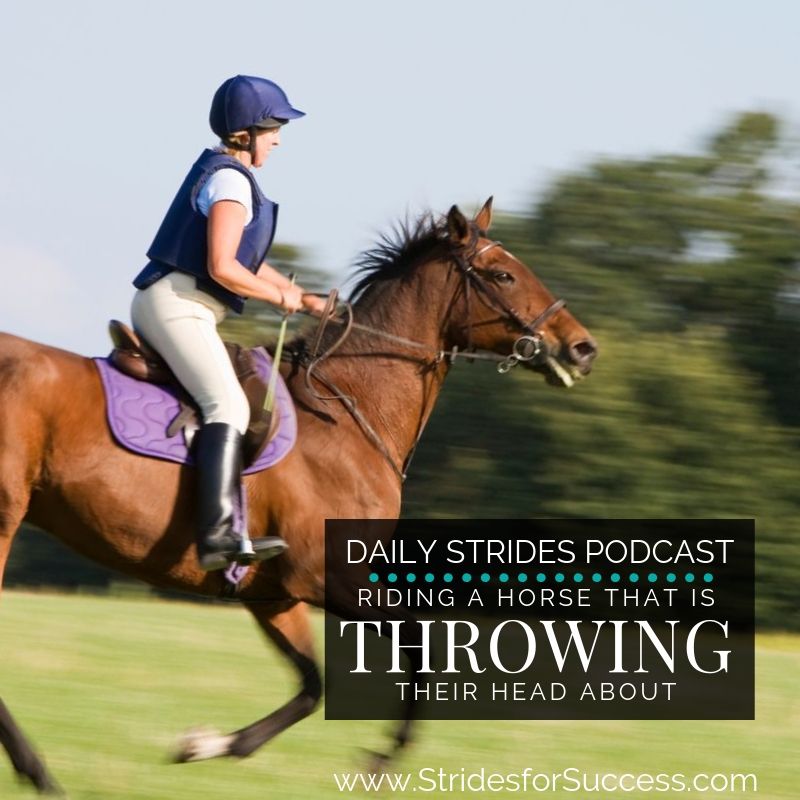
    Riding a Horse who is Tossing or Throwing his Head

    [fusebox_track_player url=”https://op3.dev/e/traffic.libsyn.com/dailystridespodcast/1117-Riding-a-Horse-that-Tosses-or-Throws-his-Head.mp3″ title=”Riding a Horse that Tosses or Throws His Head” social_linkedin=”true” social_pinterest=”true” social_email=”true” tweet_text=”To retrain a horse that tosses or throws his head…” hashtag=”horsepodcast” twitter_username=”strides_success” ]

    Setting goals and making plans can feel like a waste of time when your horse is continuously tossing or throwing his head about. If you have a horse who reacts this way when being ridden, you will agree with me. It seems that no matter what you do, this issue is going to taint everything else in your riding. And it will.

    Horse riding is about the conversation between horse and rider. A big part of that conversation is the contact and the connection.  Tossing or throwing of the head makes consistency in both of these things pretty impossible.

    I do want to preface this by stating the obvious. If you are struggling with this issue, get your horse checked first and foremost by a vet. Rule out any health issues or other issues that may be leading to this behavior. I am also going to strongly suggest having a chiropractor, dentist and qualified saddler come out and assess or work with your horse.

    With head tossing or throwing, the details are important. Rule out every possible outside interference first. From there, you can begin to work on things that you can influence when it comes to changing this behaviour.

    Consider Your BIt

    I know, I have already said about a saddler. But having a look at the actual bit can sometimes help to clear this problem up from the get-go. As riders, we tend to have a couple of favorites or go to bits. One that we have had success with over the years and we find most horses enjoy being ridden in. However, we often forget the one really important thing

    Horses change. What worked for the past 5 years, or 5 weeks, might no longer work that well anymore. As your horse develops, the contact will change. It stands to reason that pmaybe the bit may need to change as well.

    It is always important to remember that all horses are unique individuals. What works for one might not work for another. It is easy to assume everything is training related. However, sometimes, the horse is just not comfortable with a particular piece of equipment. All the training in the world won’t change that.

    Keep in mind that this may also be the noseband or even the shape or type of bridle. Assess all the equipment regularly and make changes as necessary

    Is it a Training Issue…?

    A horse who is continuously sticking his nose in the air is going to have developed differently from a horse who engages through its back. Simply put, where the energy goes will decide how the horse physically develops. Hollowness seems to almost always accompany a horse who is tossing or throwing his head about.

    Correct training is using specific principles in order to allow the horse to use his body to the best of his natural ability.

    A horse who is traveling with his nose in the air is definitely not doing this. Now, whether the training caused the tossing or the tossing caused the incorrect training will depend on each situation. What is important to note is that most horses who are regularly tossing or throwing their heads about will need some form of re-training or re-schooling.

    A simple way to imagine this is by thinking of your horse’s back like a stick. His ears are one end of the stick, his tail the other. When you put something really heavy in the middle of the stick, it will break. Now, and this is the important part, look where the ‘ears’ of the stick go when the stick breaks. Up in the air.

    The Rider’s Influence

    Now, you might be thinking that having his nose in the air and tossing or throwing his head about are two different things. And they are. However, it is the rider’s reaction to the nose in the air that can lead to the horse beginning to toss or throw its head about.

    Hollowness occurs when the energy is not connecting through from the back to the front. The energy channel is broken. Correct training can repair or strengthen that channel

    And yet, most riders will focus on what they can see. What is right in front of them… Their horse’s nose. A ‘war’ begins. The rider tries to force the horse’s head down. The horse resists, because of the hollowness, and tries to keep its nose up.

    The riders focus should be on what is happening underneath them, rather than what they can see in-front of them. The ‘in front’ is usually the result of what is going on both behind and under the rider at any given time.

    Re-Training Takes Time…

    If your horse has been tossing or throwing his head about for any length of time, his body will have developed in a way that best supports this behavior. For the most part, this is not the ideal way a horse should develop! Particularly if we want to go on and ‘do something’ with the horse where we are asking bigger questions of his abilities.

    Muscles take time to develop. Which means that your horses retraining will take time.

    I would suggest setting up an initial 12-week or three-month plan to really begin working from the beginning again with your horse. I personally believe that the traditional training scale is a great way of really allowing your horse’s natural abilities to shine while developing him physically and mentally.

    I have a step-by-step program HERE that gives riders the exact tools and exercises they need to begin working on this the right way.

    Quick fixes are not going to ‘cure’ this particular issue. They are a band-aid, which when pressure is applied, is going to come off. Time, correct training, and consistency are really the only way to re-training or re-school this issue if it does stem from incorrect training. This is also true if some other issue has caused the horse to develop incorrectly.

    Head Tossing due to Anxiety

    Increased anxiety in the horse often results in head tossing. I find that this often is the result of the rider asking questions that the horse simply cannot answer. Why they can’t answer can be down to either being unable to answer the question. This is often called ‘over-facing’ a horse.

    Asking too much too soon. The horse is just not physically, mentally or emotionally able, at that point, to do what is being asked of them.

    Anxiety can also come from simply not understanding the question. This can be down to two reasons. Lack of training, in which case, I will again suggest the traditional training scale. Not understanding the question can also be due to the rider not asking correctly. Rider error…

    The Rider…

    So many horses are tossing or throwing their heads about as a direct result of something a rider is, or isn’t, doing. If you have a horse who is doing this particular behavior, I feel that it is really important to put your riding under the spotlight.

    Piano fingers can often be the culprit. Riders who are allowing the reins to get long. And then, realize this and shorten them back up again. Their fingers are in almost constant motion up and down the reins! Piano fingers!

    You have a huge influence over your horse. Particular over your horses head seeing as you have a literal direct line to it in your hands.

    Another way a rider can be the issue is when they, intentionally or not, are asking the horse to create more energy. But then blocking or holding that energy and not allowing it forward. It can be a driving seat. A tapping or swinging leg. A whip that is literally animated with each stride the horse takes.

    Pressure & Release

    The final suggestion I am going to make when it comes to working with a horse who is tossing or throwing their head about is to work on refining pressure and release. This is the way we really and truly communicate what we want to our horse. We apply pressure and then, as soon as the horse begins to make a move the way we want him to, we release the pressure. The release is the reward.

    Pressure and release is so important when it comes how we train or re-train our horses. It can also help to begin working with a horse who is feeling anxious or who is not responsive to aids.

    It is important to realize that this particular challenge will usually require a more long-term approach to correctly retraining the behavior. It will take time. It will take consistency. However, it can most certainly be done.

    Happy Riding
    Lorna

    Other resources to help with this topic:-

    Other Episodes on Similar Topics