Tag: influence

  • You Can’t Control Your Horse – But You Can Influence

    You Can’t Control Your Horse – But You Can Influence

    [fusebox_track_player url=”https://dts.podtrac.com/redirect.mp3/pdcn.co/e/traffic.libsyn.com/dailystridespodcast/1392-You_Cant_Control_Your_Horse_But_You_Can_Influence.mp3″ title=”You Can’t Control Your Horse – But You Can Influence…” ]

    You pick up trot and feel your horse getting a little quick. You can feel a speed wobble coming! So you shorten the reins, maybe squeeze a tad more, hold a little, fix a little, manage a little more… And before you know it, you’re trying to control every second of the ride. Sound familiar? If so, you’re not alone! And, as you probaly know, it’s usually a good feeling to help someone…

    As riders, the temptation is very real to be consistent when helping your horse. But what if all of your help is actually hindering your horse’s training and progress?

    And what would happen if you began to take a step back and see your ‘help’ for what it really is – a need for absolute control!  But, you see, control – when it comes to horses in training and being ridden – is a pipe dream! It is not possible because your horse has a mind of its own, with thoughts that produce emotions and feelings of its own. So, how about we begin calling out this need for absolute control in a way that will actually help you and your horse…

    Instead of micro-managing every little nuance, what if you trusted your horse enough to begin allowing them to take responsibility for their role in your work together? 

    In this episode, I want to help you begin to identify where you may be trying too hard to control. And I will give you some concrete starting points to begin relinquishing the idea of ‘control’, and strengthening your ability to positively influence. Let’s dive in…

    Why Do We Control?

    So before we go any further, let’s chat a little about control and what it can mean for you and your horse. Control can look different depending on where the desire for it is coming from. If you are very fearful, how you will try to ‘control’ your horse will look vastly different to if you are fiercely competitive and want everything ‘perfect’.

    But the key point I want to make here is that we rarely ever actually realise that control is our desired outcome… So often we tell ourselves a different story that sounds better to ourselves and others. 

    I have to support him when he’s training to help keep him going forward. Or I need to protect him from hurting himself or another horse! He struggles to maintain in the canter, so I have to help him. All of these can be true – but are they really? Or is it an absolute need and desire to ‘control’ more about keeping your own brain and mind feeling regulated?! And that is often the key point…

    Control is sometimes more about helping us to feel better in the short term than it is about helping our horses to develop, strengthen, and grow in the longer term – and can completely stop this from happening!

    What Don’t You Trust?

    A few years ago now, I listened to an audiobook that has nothing at all to do with horses, but led me to a big ‘aha’ moment. In the book, Untamed by Glennon Doyle, what really struck me was this one quote:-

    We Only Control What We Don’t Trust – Glennon Doyle (Untamed)

    And I thought – YES! That is exactly it. From years and years of working with riders, it is the lack of trust that seems to lead to this endless desire to control. Some riders don’t trust themselves. They have little to no confidence or faith in their own abilities, and so never really leave the safety of their comfort zone. Other riders don’t trust their horse. And this can come from both a fear (my horse might throw me off) mindset, or a training (my horse can’t do this, so I’ll help him) mindset.

    So, next time you feel the need to control something when working with your horse, instead ask yourself, “What am I not trusting right now?”.

          • Do I not trust my horse to stay balanced?
          • Do I not trust my aids to be clear or coordinated enough?
          • Do I not trust myself to handle it if things go sideways?
          • Do I not trust the process enough to allow for the ‘messy middle’ while learning happens?

    I think one of the biggest breakthroughs you can have in your training and riding is to begin naming what you’re not trusting – and then digging deeper into ‘why’ that is so…

    What Can You Control?

    Now, I am not saying that you simply leave it all up to chance and hack on. We’re talking about working with animals who often outweigh us 10 to 1! But, if you can’t control your horse, what can you control? The answer is you. You are the only thing that you can have any hope of controlling. And, for many riders, that can seem like an impossible task!

    Your thoughts, your emotions, and your actions. They are all, potentially, within the realm of your control – but as riders, we also know that this can be easier said than done! 

    This is why I really do believe that checking yourself at the gate is so important for riders. Before you ever greet your horse, I highly suggest having a quiet moment with yourself just to see how things are. A little personal ‘check in’. And then, from there, some intentional grounding and self-awareness work. I am not suggesting long rituals or meditations. Just a few seconds to yourself so that you can see how you’re about to show up. The more you practice this, the quicker and easier it will become.

    And when you then approach your horse from this more grounded, self-aware place, the chances are that you will actually have more success in controlling the things you can:-

          • your preparation
          • your awareness
          • your intention
          • your timing
          • your emotional state
          • your body
          • your response

    Working Towards Influence…

    So, let’s flip this concept of ‘control’ for a moment. What if, instead of constantly trying to micro-manage every little movement and every single second, you began looking for ways to have a more positive influence? What if you swapped the need to control with a desire to guide or shape the outcome to a more positive one? Without you having to do all of the work.

    Deciding to relinquish the need to ‘control’ and rather committing to being a positive influence requires a certain level of trust. Trust that those you want to influence have the right foundation in place so that they decide to follow your lead. 

    It’s a bit like deciding that you’re happy with free will – and then meeting your horse at that place. Now, we can talk all day about ‘the right foundation’. I do think that so much of this comes from the rider or whoever has been working with the horse. What has been ‘allowed’ (or not), and what is being ‘mirrored’. And, it is when we commit to becoming a more positive influence, I believe, we can then begin to really build and strengthen our horses – physically, mentally, and emotionally.

    Control and the Lunge

    Lunging is such an interesting place to explore this! Even to this day, I can remember how it felt to want to control everything when lunging my horses. If they cantered a little too enthusiastically, my desire to ‘control’ would kick in – and I would 100% react instead of respond. I’ll be the first to put my hand up and tell you that it was not pretty! And, sure, in the moment I would be able to ‘bring’ my horse back to trot (the place where I felt good). But, let’s be honest here, this in no way helped my horses and their training!

    To this day, when I’m lunging, and my horse becomes a little too enthusiastic, I have to remind myself that this is okay – and to trust my horse and myself that things will be okay.

    Once I relax mentally and then physically, I can then guide my horse back to a more balanced way of working. Not by forcing or ‘controlling’, but by becoming self-aware, and then using my presence to gently influence my horse to join me there.  I do feel that this is a self-trust. And I also believe that riders need to develop this before they can then begin guiding their horse to a similar place.

    Being a Positive Influence

    From here, you can then begin to help your horse to do the same. That even on the days when things go sideways, or he loses the run of himself, he can get himself back to balance again. And each time with less and less guidance from you. Helicopter riding and training do not work in the long term. In fact, I am 100% willing to bet that if you are practising this, you will hit a plateau and remain stuck there.

    With lunging, you can begin where you are now – probably more trying to control things. But as your self-awareness grows, so too will your influence. The obvious aids become more subtle – and your horse begins to take more responsibility for himself. 

    That is where the magic lies, and that is where your horse can begin letting go of control and developing the trust that is necessary. Trust in yourself, and trust in your horse. And vice versa. As the trust and confidence grow, so too will the levels of ‘self-control’ or ‘self-carriage’ – one of the things we are always looking to grow when riding and training.

    Happy Riding
    Lorna

    Want Support While You Do This?

    Inside Connection, we are dedicated to working on the 5 essentials, the keys to refining all the training elements we just talked about.  It’s exactly where your progress begins again.

    If this episode made you squirm a little and wonder, “Is she talking about me?”, then Connection will help you put all of this into practice. Join us inside today:- https://stridesforsuccess.com/join

    Online Training & Coaching

    Connect with Lorna online:-

  • 3 Ways You Are Ruining Your Transitions from Trot to Canter

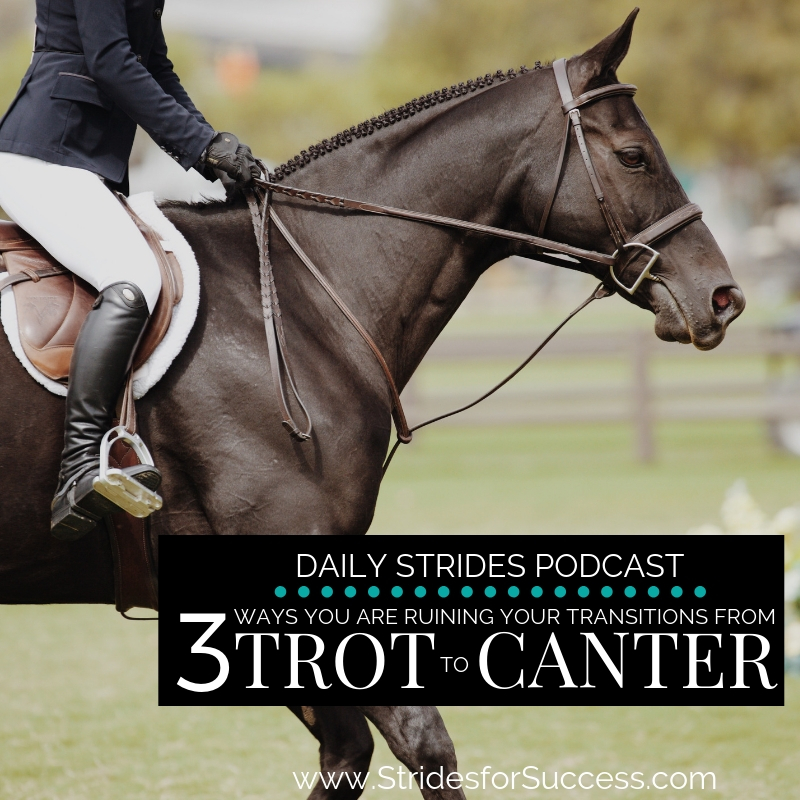
    3 Ways You Are Ruining Your Transitions from Trot to Canter

    3 Ways You Are Ruining Your Transitions from Trot to Canter

    What this episode is all about & how it can help you:-

    • Understand why a good transition means a better canter all round
    • Begin working on better timing of the ‘ask’
    • Realise how gripping with your legs is negatively impacting the transition
    • Ride smoother, more responsive trot to canter transitions

    [smart_track_player url=”https://op3.dev/e/traffic.libsyn.com/dailystridespodcast/1090-3-Ways-You-Are-Ruining-Your-Transitions-From-Trot-to-Canter.mp3″ title=”3 Ways You Are Ruining Your Transitions from Trot to Canter” social_linkedin=”true” social_pinterest=”true” social_email=”true” tweet_text=”Canter is great; it’s just that getting there can be a massive issue for so many riders…” hashtag=”equestrian #trotting” twitter_username=”strides_success” ]

    Cantering; maybe one of the most enjoyable things to do on a horse. However, for many riders the transition from trot to canter is one that rarely goes smoothly!

    If you are feeling a little more than a little unbalanced by the time you actually get into the canter.  Or if your transitions from trot to canter are a little ‘hit and miss’, this is for you.

    In this episode of the Daily Strides Podcast I focus on three different mistakes riders make when riding the trot to canter transition.  Identifying what is going wrong with your transitions, will help you improve them and have a better canter all round.

    A Good Transition Means a Better Canter

    So often I see riders literally throwing all their hard work away due to riding a bad transition. They will have established and maintained a good quality trot.  The basic elements are there for a good transition, but somewhere it all goes wrong. 

    A good transition from trot to canter will help you to establish a good quality canter much earlier in the gait

    It is easy to lose sight of why you are cantering in the first place.  It is rarely just to canter.  Most often it is because you are leading up to something else.

    The sooner you can establish and maintain a good quality canter, the better change you have of successfully transitioning in to the next part of your ride. 

    This could be a jump or a bend or circle.  You may have plans to transition back into trot.  Or even just to canter on a straight line.  Whatever the reason for you asking for the canter, the better you can set up the transition into the canter, the more success you will have in the canter itself.

    Mistake No. 1 – Failing to Consider Your Timing of the ‘Ask’

    The conversation you have with your horse from the saddle is a little different to a verbal conversation you have with another person.  There, you can ask and they can immediately respond.  When riding, your horses response will depend a lot on how much of an opportunity you have actually given him to respond!

    You need to time your ‘ask’ to coincide with when your horse is in a position to make any necessary changes, thereby responding to you. 

    This requires, amongst other things, knowledge of how your horse moves and the sequences of foot falls for each gait.  The trouble with trotting is that many riders struggle to feel which leg is moving where underneath them!

    How Your Horse Moves from Trot to Canter

    When asking for the transition from trot to canter, there is a ‘optimum time’ as your horse moves. This is when his outside back leg is just about to come up and move forwards underneath him. The outside back leg is important, as it is the leg that ‘strikes’ the canter.

    However, as mentioned, feeling which hind leg is moving when in the trot can be challenging for many riders.  This is where I suggest taking advantage of your knowledge of the sequence of footfalls.  When your horse is trotting, his legs move in diagonal pairs.

    This allows you to know where the hind legs are by glancing down and noticing where the front legs are.  I have a post about diagonals HERE that will help you figure this out.

    Simply put, when your horses outside shoulder is forwards, his outside hind leg is back, getting ready to move forwards. This is the point where you can ‘ask’ and he has enough time to ‘respond’.

    By asking at the right time, he can then set that outside hind leg down, with the intention of using it to propel him into the first stride of the canter.  Ask at any other point in the stride, and your horse will either take longer to respond.  Or he will become flustered and ‘rush’ into the canter.

    Mistake No. 2 – Gripping for Balance with Your Thighs and Legs

    Oh, this is a biggie!  So many riders have an effective leg position and application.  That is, right up until the moment comes when they ask their horse to transition from trot to canter!  Rather than allowing their leg to reach down and be effective, they draw their legs up and ‘pinch’ with their thighs.

    Squeezing with your thighs is the equivalent of becoming a clothes peg on your horses back! It is not comfortable, enjoyable or effective for you or your horse!

    When you are using your leg aids to ask your horse to transition from trot to canter, your whole leg plays a part.  By squeezing or pinching with the tops of your legs, you stop your lower leg from working.  An ineffective lower leg means a confused aid.

    Gripping with your thighs also affects your overall balance and position. Riders don’t grip to apply a leg aid.  They grip in a misguided attempt to ‘stay on’.  It usually has the opposite effect!

    Mistake No. 3 – Failing to Follow Through with the Canter

    The final ‘mistake’ I see riders make all the time when it comes to the transition from trot to canter is not allowing the canter to actually happen!  It sounds crazy, but it looks a little like this; the rider asks for the canter.  The horse responds and begins to canter.  Only to be ‘blocked’ by the rider from cantering correctly onwards!

    When your horse positively responds to your request for the canter, it is important that you then respond by following him in the canter. 

    This can often be the result of nerves or anxiety on the riders part.  However, it can also be due to a simple case of the rider being ‘stiff’.  Suppleness is not just for the horse!  It is equally as important for the rider, especially when the horse begins to demonstrate ‘bigger’ movements or energy.

    Allowing your horse to canter means that you are moving with him.  Your seat, your hands and reins.  Your thoughts.  All thinking and moving forwards.

    Positively Influencing the Canter Going Forwards

    When you can successfully negotiate a better transition from trot to canter, you can then turn your sights to improving the canter itself.  Very often when there is a poor transition into the canter, the canter itself is left ‘wanting’.

    Poor transitions into the canter result in choppy and unbalanced or rushed and flat canters.  

    Realising that you might just be the cause of the transition is great.  This means that you now have the power to change it for the better for you and your horse.

    Happy Riding

    Lorna

    Other posts, episodes and resources that relate to this topic:-

    Better transitions from the trot to the canter is the theme inside of Daily Strides Premium for April 2019.  In there we look at what you are potentially doing that is having a negative effect on the transition.

    There are also some simple ways you can easily and effectively replace any hindering habits you may have acquired where the canter is concerned!

    All the trainings are easily accessed using your phone, meaning that you can take them with you where ever you are going.  These trainings and so much more are available for you immediately when you join Daily Strides Premium. Find out more HERE

  • Crookedness in the Saddle; Identifying Yours

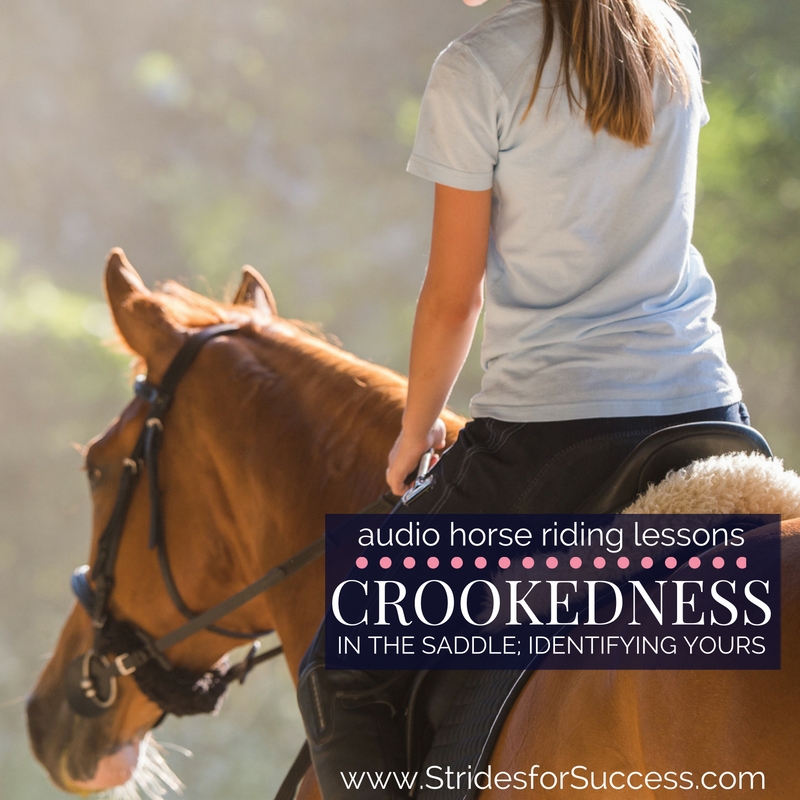
    Crookedness in the Saddle; Identifying Yours

    Crookedness – it is a word and a concept that is continuously showing up when we talk about horses, riding and training… It is also a little like the ‘chicken and the egg’ – which comes first?  Many riders make the mistake of thinking it is only the horse we are speaking about. Meanwhile, riders can be just as crooked, if not more so, than their horses – and because of the relationship, one will always affect the other.

    When was the last time you honestly assess how straight or crooked you are when you are riding? Perhaps it all looks good when you are actually riding on the straight; but things become a little twisted when any change (either in direction, gait, tempo) happens.

    Crookedness in riders shows up in lots of different ways.  Sometimes it is very obvious, the stirrups are different lengths, or the rider is leaning.  But other times it can be very subtle; perhaps the horse becomes disunited in the canter, or a hand or arm tends to dip on a corner.

    Regardless of the degree of crookedness, what is almost agreed upon by all riders is that unless a conscious effort is made to practice symmetry in the saddle, crookedness will creep into your riding in some form or other.  This is simply because all people have a dominant side, which will compensate for the weaker side – particularly when the going gets tough.

    So, this being said, what can we do as riders to become more straight and, how can we then influence our horses to follow suit with us?

    Assessing your horse & saddle

    What many riders don’t realise is that crookedness is sometimes created by the horse itself or the saddle.  Horses, just like us, have a dominant side.  Why this is so has been the topic of many debates and there are many schools of thought on it – however what is important is that your horse favours one side or the other.  Taking this into account and depending on the work or training a horse does, this can sometimes lead to the horse becoming unevenly muscled.  One side of the body will become disproportionately stronger – and therefore larger – than the other.  If the shoulder or back muscles are involved, this will then affect how the rider sits on the horse.

    Crookedness in the Saddle - Identifying Yours

    The other consideration before you even mount up is the flocking or padding in your saddle.  Over time saddles become worn, just like a shoe would on your foot.  This ‘shape’ can be influenced by a few different things, the rider, the horse or the quality of the saddle in general.  The result is that the saddle is no longer symmetrical.  This lack of symmetry can often be the cause of the uneven stirrups, or one seat bone being more forward or dropped than the other.

    I suggest having a good look at both your horse and your saddle and stirrup leathers.  See if there are any noticeable differences between the right and left side.  If there are, have an appropriate professional assess ad make changes where necessary.  Once that is done, you can then turn your attention to yourself.

    Assess your reflection

    Unfortunately not all riders are blessed to have mirrors in their arena, however this does not mean that they cannot make use of other ways to assess their crookedness when they are riding.  There are windows that you can use as mirrors.  You can also use your shadow on the ground.  Both of those suggestions definitely require a little more effort on your part, but if needs must…

    Begin by halting in front of the mirror / window / shadow.  Square your horses shoulders to it, so you can see exactly how ‘equal’ you are on either side of your horse.  Assuming that you have already checked your equipment and horse to make sure the issue is not stemming from there, check are your stirrups the same length?  Are your shoulders the same height?  If you and your horse could be safely chopped in half, head to tail, would both sides be an exact copy of each other?

    Keep in mind that, if your head is also ‘straight’, your eyes won’t lie to you.  Many riders spend so long being crooked that it feels ‘normal’ .  In fact, when they are corrected, it feels so unusual and different, your brain tells you that it couldn’t possibly be right.

    If you have been harbouring a certain crookedness in your riding for any length of time, you may very well have to retrain your brain to what is actually straight again. 

    If you do notice any crookedness here, look at ways you can measure this quickly when you move away from the mirror.  Maybe it will involve looking if your knees are symmetrical.  Or perhaps it you can place stickers on your clothes, marking your left and right point of shoulder, or hip.  There are lots of ways you can get creative, but what is important is that you know what actual straight feels like and keep correcting things back to there.

    Finding Straight when Riding

    Once you have a good idea of what straight looks and feels like at the halt, you can begin accessing your position when riding.  This is where your dominant side plays a big part, and where your markers or stickers will really help you if you don’t have mirrors in your arena.

    Crookedness in the Saddle - Identifying yours

    Start off in walk on the straight.  Notice if you are remaining symmetrical.  Try focus your attention on your seat bones in particular, and the way your weight is distributed between them.  It should be equally or evenly balanced between both seat bones.

    Confusingly for many riders, ‘weighting’ your seat bone does not involved shifting your weight or lifting your weight off your other seat bone.  It rather involves the muscles in your pelvic and core areas.

    Keep in mind that regardless of what you are doing, their should be an equal amount of your body on either side of the horse.  The left will not visit the right and vice versa.  If you find yourself leaning or shifting over, bring it back to centre and straight before trying again.

    Becoming a positive influence

    It is only through continuous correction that you will overcome any crookedness in your riding.  Once you are truly straight, you may find that a lot of your horses ‘crookedness’ will also vanish.  As riders our relationship with our horse is a unique and special one.  We are directly influencing each other all the time when riding.

    Let your influence on your horse be a truly positive and straight one

    Happy Riding
    Lorna

    There are 4 audio programs of step by step instructions on this topic waiting for you inside of Daily Strides Premium.  You can simply download them to your phone and listen while you ride.  You can find out more about Daily Strides Premium HERE

    [wp-tiles post_type=”post” orderby=”date” order=”DESC” grids=”Simple”]