Tag: laid back

  • Is your Horse Ignoring You? Or Naturally Laid-Back? Find Out…

    Is your Horse Ignoring You? Or Naturally Laid-Back? Find Out…

    [fusebox_track_player url=”https://op3.dev/e/traffic.libsyn.com/dailystridespodcast/1336_Is_Your_Horse_Ignoring_You_Or_Naturally_Laid_Back.mp3″ title=”Is Your Horse Ignoring You? Or Just Naturally Laid Back?” social_linkedin=”true” social_pinterest=”true” social_email=”true” ]

    There are a number of things that, when we speak about working with our horses, can feel almost impossible for some riders. This is especially true if your horse is very ‘laid-back’ or ‘lazy’.  Other riders are working on channeling energy, etc. and you feel like if you could just ignite a little enthusiasm in your horse, it would be a win!

    It’s always worth remembering that all horses are different. And some will be naturally less enthusiastic than others. However, this does not have to mean that you must give up your hopes and dreams of ever having a willing partner. But you may need to begin varying your approach or moving the goalposts a little when it comes to your expectations and desired outcomes.

    Deciding how to proceed forward with a horse who does not seem to have as much enthusiasm or interest will require you to answer this question first:- Is my horse naturally laid back or is he simply ignoring me and being unresponsive? 

    Today, I want to help you begin to decide which of these two is true for your horse – especially if it feels like both of you are going nowhere slowly!

    Laid-back and Unresponsive Are NOT the Same

    It is important to recognize that being laid back is not the same as being unresponsive. Yes, you absolutely do get laid-back horses who are also unresponsive.  However, they are different things and, therefore, should be worked on separately.  The key is to figure out which your horse is first and foremost…

    Laid-back is your horse’s natural way of being. He’s chilled, and relaxed, and doesn’t let much bother him in almost everything he does. Being unresponsive is a learned behaviour. They are very different! 

    And because lack of responsiveness is learned, it can be changed. It is not your horse’s ‘natural’ way of being. Rather a mechanism he has developed to cope or deal with something. Whereas being ‘laid back’ is more about your horse’s personality. This, in my opinion, should rather be worked ‘with’. It’s your responsibility to work with your horse’s strengths to help him in his training and riding.

    But more on that later. Let’s first look at ways you can distinguish between the two…

    Ways To Evaluate for Laid-Back Vs Unresponsive

    Your Horse’s Energy Needs

    Naturally Laid-Back: Your horse will remain calm, relaxed, and easygoing in almost all situations. Especially when asked for ‘more’ when working. He will usually always respond to you, but just a tad slower and less ‘keen’ than other horses.

    Lacking Responsiveness: If your horse lacks responsiveness, he will often feel ‘stuck in the mud’ and unmotivated. You’ll find yourself having to reapply aids over and over again to initiate any sort of response. This will be all through the ride or session. Remember, a tired horse can also seem ‘unresponsive’ 20 or 30 minutes into a training session.  This is not that.  The lack of enthusiasm will be consistent throughout.

    Test Your Aids and The Response

    Naturally Laid-Back: When you ask a question using an aid, say leg or seat, if your horse is naturally laid-back he will respond.  It’s just a slower response than you may want. You’re not being ignored. It’s more like it takes him a second or two to compute what you’re saying and then take action on it.

    Lacking Responsiveness: If your horse is ignoring you, he will continue to do so! Or it might take much stronger aids from you, think of more pressure or use of artificial aids, to achieve the results you want.  Again, this is usually a training issue. But it can also signal discomfort or a lack of enthusiasm for the job.

    Groundwork Versus Riding

    Naturally Laid-Back: Even when on the ground, your horse might be a little slower to ‘move’, but is usually responsive and cooperative. You can see that being ‘relaxed’ or ‘chilled’ is the general way of being, whether on the ground or being ridden.

    Lacking Responsiveness: If your horse is unresponsive, it will feel like you’re constantly ‘chasing’ or ‘dragging’ him around. He will look sluggish, uncooperative, and possibly even dragging his feet or hesitating with basic commands and aids.

    Summing it Up for You

    To sum it up, if your horse is naturally laid-back, he will respond – just often a little slower than others. He will keep his cool and remain relaxed most of the time. And he will look to please, albeit often at a slower pace!  If your horse is unresponsive, he will ignore you. Often your stronger application of the aids will be met with resistance and maybe even a tantrum!

    What’s important to keep in mind is that neither is ‘wrong’ or ‘right’.  They simply are. And as a rider, it’s important that you figure out which category your horse falls into and then work with him based on that. 

    I also want to mention here that, again, unresponsiveness is a learned behaviour. This can be down to a lack of training or understanding, pain and discomfort, or bad riding! The key is ‘learned’; meaning that it can be unlearned. It can be changed. And this will require correct training, consistency, time, and compassion.

    Look at the Advantages…

    However, maybe you’ve identified that your horse is more naturally ‘laid back’.  That no amount of training or retraining in the world is going to turn him into something he’s not… Remember, these types of horses are both great for a lot of reasons AND priceless in certain situations.

    When you have a horse who is a little more on the naturally laid-back side, but whom you can trust 100% to be as rock solid and ‘steady’ as they come, you can really focus on your own riding and making small changes to improve it.

    Focusing on you is always going to be a little more difficult when riding a horse that is a little over-enthusiastic. Often they will need your attention to help them maintain their balance and energy. So rather than accepting defeat when it comes to your horse, let’s look at reframing both of your mindsets on this topic.

    Partnerships Change…

    The final point I will add here is that things change all of the time.  And if you do figure out that your horse just does not want to be the “Number 1 World Beater” at whatever you want him to be… It’s your responsibility to accept that.  Similarly, if you’re horse is more naturally suited to a different discipline, you must accept that.

    Horse riding is a team sport… If your horse does not want to participate in some of the activities – you may need to find a new and willing partner who does. 

    This can sometimes mean that a heartbreaking decision has to be made. Or perhaps you’re in a situation where you can keep your initial ‘naturally laid back horse for activities he likes. And then find a second partner for those other, more ambitious activities.

    The important thing is to always consider your horse in the equation… It’s never fun being forced day after day to do something that you don’t like and that does not suit your specific set of talents.

    Happy Riding
    Lorna

    Similar Episodes on This Topic:-

    [fusebox_track_player url=”https://op3.dev/e/traffic.libsyn.com/dailystridespodcast/1336_Is_Your_Horse_Ignoring_You_Or_Naturally_Laid_Back.mp3″ title=”Is Your Horse Ignoring You? Or Simply Naturally Laid-Back?” social_linkedin=”true” social_pinterest=”true” social_email=”true” ]

  • Riding a Laid Back or Lazy Horse

    Riding a Laid Back or Lazy Horse

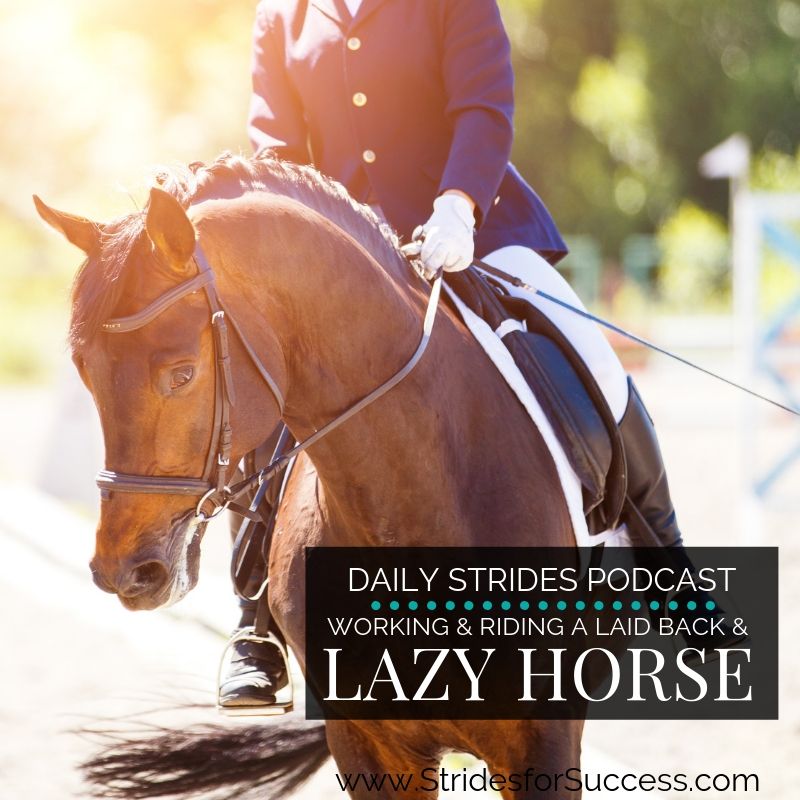
    Working and Riding a Lazy or Laid Back Horse

    Some days does it feel like a mammoth task just to get your horse to put one foot in front of the other? He has no motivation whatsoever to do anything with any hint of enthusiasm or energy…

    [smart_track_player url=”https://op3.dev/e/traffic.libsyn.com/dailystridespodcast/1110-Riding-a-Laid-Back-or-Lazy-Horse.mp3″ title=”Working & Riding a Laid Back or Lazy Horse” social_linkedin=”true” social_pinterest=”true” social_email=”true” tweet_text=”Is your lazy horse leaving you feeling exhausted after every ride? Here are a few helpful ideas to get things moving forwards…” hashtag=”equestrian #horseriding” twitter_username=”strides_success” ]

    But first, I want to be clear; the term ‘lazy’ is not one that I enjoy using when it comes to horses. I believe that there are horses out there who are just more laid back than others. Lazy always sounds so derogatory. And often, those ‘lazy’ horses are actually wonderful trusty steeds.

    We need all sorts of horses in the world to suit all sorts of riders…

    However, if your horse is more laid back than most, I also understand how you may just want him to show a little more enthusiasm where his work is concerned.

    Lazy or Unresponsive?

    First, let’s look at the difference between a ‘lazy’ horse (yes, there is that word – again!) and an unresponsive horse. Often these two terms are used interchangeably. People feel that they are the same thing. I don’t agree. Yes, often there is a cross over, however, for the most part, they are different. Figuring out which your horse is is the first thing I would suggest you get clear on.  The reason being that one can be ‘changed’ and one has to be worked with or around. 

    An unresponsive horse is, in my opinion, often created or trained that way due to rider error. 

    I have spoken a lot about this before HERE and the great news is that, with a lot of mindful riding, it can be undone.  The simple truth of the matter is that your reactions or responses are always training your horse.  For good or for bad.  It is a good concept to keep in mind as you work with and ride your horse. 

    A laid back horse, on the other hand, is usually just that way inclined.  His personality and temperament is such that he tends to naturally just take all situations as they come.

    Once you are clear that your horse is indeed just a laid back soul, you can begin being mindful of how you can work ‘with’ him in each ride…

    It All Starts with Your Position

    I know, I know; it seems like a bit of a cheap tip – work on your position – but it is so important! Remember, if your horse’s natural inclination is to do as little as possible, he will look for ways to make that happen.  He will look for ways out!  

    He will also, when feeling confused or conflicted, rather stop and wait than take action and hope it is the right action!

    A good position will ensure that you are clear on what you are communicating in the first place.  This is the first hurdle when it comes to motivating him to go forwards. There is a direct correlation between how frustrated a rider becomes and how well (or badly!) they ride.

    Pay Attention to Lower Leg

    In my experience, riders who are becoming a little frustrated with a lazy horse tend to have ‘wandering’ lower legs. Their lower leg can end up too far back. Almost close to the flank somewhere; okay that is a slight exaggeration, but you get the picture! Either way, if we snapped our fingers and made the horse vanish, the rider would land on their face!

    The other extreme is the lower being too far forward; up at the horse’s elbow and shoulder.

    This is often caused by the rider trying to push and shove the horse forward using their seat.

    Whatever the reason, again, if we snapped our fingers and made the horse vanish, the rider would land on their bum!

    The ‘Click Your Fingers Rule’ is always a good way to access how well your position is at any point in the ride.

    Being in the Right Place Consistently

    While being lazy (that word again!) and being unresponsive is different, if you are riding a ‘laid back’ horse you will have to up your game where responsiveness is concerned.

    You have to first improve your riding and how you are showing up before your horse will improve his performance.

    Showing up means being in the right place to ask the right questions. Having a solid position means that you will be clear when you apply your aids.

    There is less chance of your horse becoming confused about what you are asking; or how he should respond to each question.

    Be Prepared for the ‘Skip’

    If you have ever ridden a lazy or laid back horse, you will know exactly what I am talking about here. Imagine that you are on your wonderfully chilled steed. By some miracle, you actually get him to move forward; to put more energy into his way of going.

    Rather than transitioning smoothly from one gait to the next, he ‘skips’ or hops into the new gait. If there was a sound to describe it, it would ‘Hup’!

    If you are not prepared for this ‘skip’ it can be very unbalancing. To the point where you end up falling backward and then stopping or blocking the forward energy.

    The big issue when the rider becomes unbalanced is that the contact is often lost. Either the rider pulls on the reins in order to try and re-balance themselves. Or the rider throws the contact at the horse in an attempt to avoid catching him in the mouth.

    Either way, as soon as the contact is lost, the forwardness is also lost. Which means returning back to square one.

    Riding into Downward Transitions

    The final key element of riding a lazy or laid back horse is being able to actually work through a downward transition. Horses who are inclined not to really go forward, to begin with, are surprisingly quick to change down gears!

    Your job is, again, to remain balanced by having and maintaining a good position all the way through the transition. This good position will help you to keep your leg on, therefore keep the energy flowing,

    Allowing your horse to fall into downward transitions will make the next gait also lack forwardness and energy.

    Make sure you are setting each transition up correctly and then riding the horse through it. Ask bigger questions and expect more from him.

    Shift Expectations & Have Patience

    I really think that it all comes down to your position first and foremost. I also feel that as the ‘team leader’ you are all the time looking for new ways to keep your horse inspired.

    Simple things like getting out of the arena and riding out with others are often enough to begin seeing the energy move.

    Keep in mind that in order to move forwards, in the true sense of the word, your horse must engage his core. His core is going to take time to develop, so have patience and look for a few strides at a time initially.

    Using natural slopes is a great way to help him get started. However, once again, you being in the right position is essential in order for you both to then capitalize on this.

    Happy Riding

    Lorna

    Some other resources to help with this topic:-