Tag: Mistakes

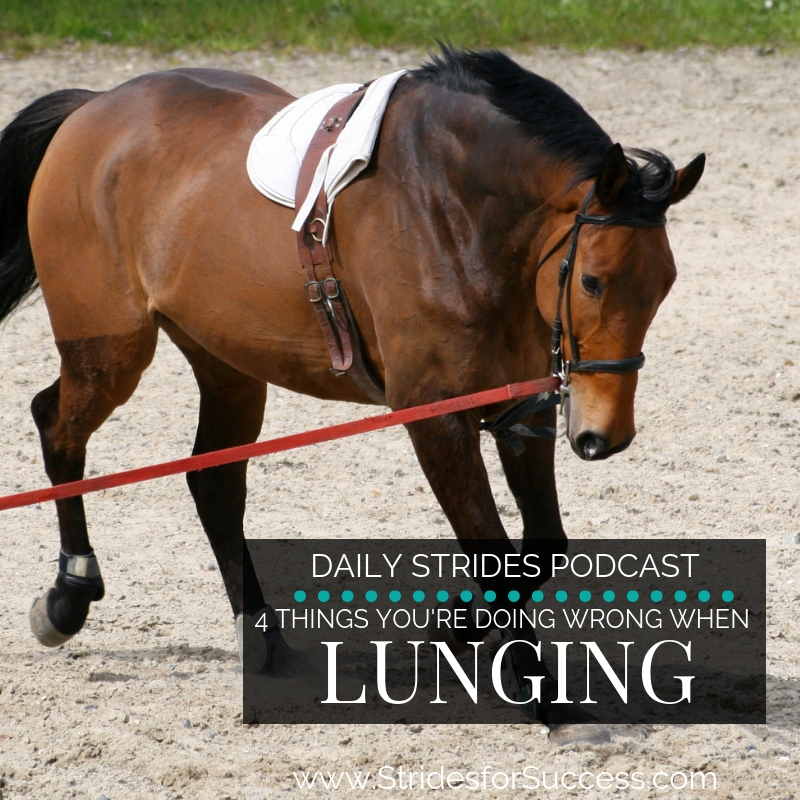
  • 4 Things You’re Doing Wrong When Lunging

    4 Things You’re Doing Wrong When Lunging

    4 Things You're Doing Wrong when Lunging

    What this episode is all about & how it can help you:-

    • The problem with assuming your horse knows how to lunge
    • Understand why not using your lunging whip can stall your progress
    • Realise that you might just be blocking or stopping your horse
    • See that consistency is essential to successful lunging

    [smart_track_player url=”https://op3.dev/e/traffic.libsyn.com/dailystridespodcast/1075-4-Things-You’re-Doing-Wrong-When-Lunging.mp3″ title=”4 Things You are Doing Wrong when Lunging” social_linkedin=”true” social_pinterest=”true” social_email=”true” tweet_text=”Struggling to achieve success on the lunge? You might be doing one of these 4 mistakes… Daily Strides Podcast episode” hashtag=”equestrianblogger” twitter_username=”strides_success” ]

    Have you been struggling to make lunging ‘work’ for you and your horse?  You’re not alone!  What if I was to tell you that, maybe, if you just changed a couple of key things you’re potentially doing wrong, it might all change for you and your horse where lunging is concerned.

    In this episode of the Daily Strides Podcast I give you the run down of the top 4 mistakes I see riders (or ‘lungers’) make all the time when in the lunge arena with their horse.  They might seem like little things, however, they have to potential to derail the best of intentions where lunging is concerned.

    My hope is that if you are struggling to make lunging an active part of your training schedule, this episode will help you straighten out a few important kinks.

    1. Assuming Your Horse Knows How to Lunge

    Years ago, I was guilty of this assumption myself.  When I first came to South Africa I just automatically assumed that if the horse was backed, he had been lunged.  How very wrong I was!  Luckily, horses have a great way of pointing out the obvious and I now approach all horses with the complete opposite assumption; they don’t know how to lunge!

    If you don’t know your horses history, or if he seems a little confused or unsure as to what to do, rather start at the beginning where explaining how to work on the lunge is concerned. 

     Standing ‘chest to chest’, facing your horse and cracking a whip in the hope that he gets the idea is not the best course of action to take!  Rather find a confident, reliable helper and have them lead the horse out on the circle while you remain in ‘lunging’ position.

    It is also worth remembering that your horse might have been thought some bad practices by past riders.  Again, a reliable helper can assist you both in getting off on the right foot with your lunging.  I have a post on Getting Started with Lunging that goes into more details to help you.

    2. Not Using Your Lunging Whip (Or Using it Incorrectly)

    Ohhh, it’s a touchy subject for many riders.  Using a whip where their horses training is concerned.  However, before you click the ‘x’, let me explain…  The whip is not a negative thing.  There is a mindset surrounding whips that we, as riders, need to change.

    Whether the whip is positive or negative depends solely on how you use it. I’m going to assume here that we are all committed to it being a positive training aid ;) 

    Your whip takes the place of your leg aids while you are lunging. And your leg aids can be positive or negative depending on how you are using them while riding.  Cracking the whip above your head as though you’re the ring master in your own little circus is not correct!

    The whip should remain below hock height and be used in a ‘snakelike’ movement on the ground behind your horse to encourage him forward.  That is all.  

    Just like riding, you are balancing your whip aids with your other aids in order to have a full conversation.  The balance of aids is just as real when lunging as it is when riding.

    3. Blocking or Stopping Your Horse Going Forwards

    This happens a lot when horses are unsure and hesitant about going forward while being lunged.  They are literally looking for an excuse to ‘stop’ and very often the rider (or lunger) hands them one on a silver platter by blocking or stopping them with their body.

    When you are not confidently encouraging your horse forwards, the result is often that your horse will spin around on the lunge – which leads to a whole host of problems for both horse and rider (lunger). 

    Your job is to become really aware of where you are, at any given time, while lunging your horse.  If you are experiencing this issue, firstly be glad.  This is something that is easily remedied.  I have written a blog post all about Why Your Position While Lunging is So Important that you can have a read and listen of.

    Lunging, like riding, is an ongoing conversation between you and your horse.  Become really aware of what you are expressing physically to your horse when lunging him.  It will make things a lot easier where communication is concerned.

    4. A Lack of Consistency

    Lunging, like riding, requires good practice in order to improve at it.  You will only become better at lunging if you are consistently practicing it while lunging your horse!

    In riding we all want to develop ‘feel’.  Feel is just as important when lunging and requires just as much dedication and consistency on your part to achieve.   

    Lunging is a really worthwhile use of your time where schooling your horse is concerned.  It allows your horse to figure things out for himself without the rider hindering or influencing the outcome.

    If you would like to learn more about lunging, we have a whole month dedicated to and waiting for you inside of Daily Strides Premium.  You can find out more about becoming a member HERE

    Happy Riding

    Lorna

    CLICK HERE TO BEGIN SUCCESSFUL LUNGING OF YOUR HORSE TODAY

    Other Posts and Episodes that Relate to This Topic:-
    For more information visit the links below

  • Top 3 Mistakes when it Comes to Groundpoles

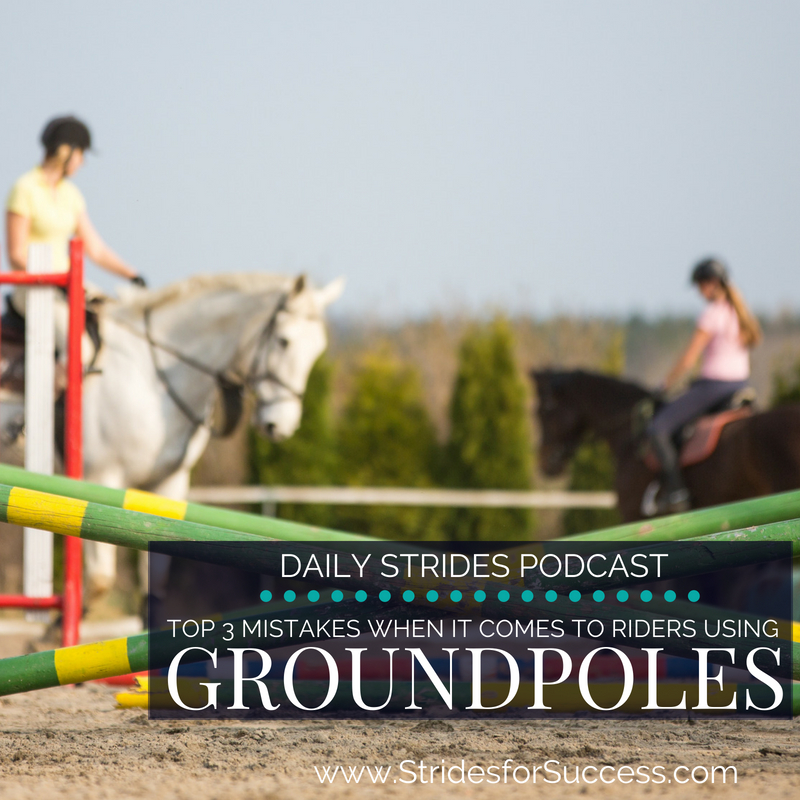
    Top 3 Mistakes when it Comes to Groundpoles

    Top 3 Mistakes when it comes to Groundpoles

    What this episode is all about:-

    • Mistake 1:- Overestimating the amount of poles and complexity of exercise
    • Mistake 2:- Incorrectly mapping the distance or adjustments
    • Mistake 3:- Not realising how much influence you have over your horse

    [smart_track_player url=”https://op3.dev/e/traffic.libsyn.com/dailystridespodcast/1054-Top-3-Mistakes-when-it-Comes-to-Groundpoles.mp3″ title=”Top 3 Mistakes Riders Make when it Comes to Groundpoles” social_linkedin=”true” social_pinterest=”true” social_email=”true” tweet_text=”Are you making any of these 3 mistakes when it comes to your groundpoles in your schooling? ” hashtag=”Equestrian #Podcast #groundpoles” twitter_username=”Strides_Success” ]

    If you have been riding for any length of time, you are probably well versed on the benefits of groundpoles.  In fact, I would bet that you have tried them a few times…However, there are a few basic mistakes riders make when it comes to groundpoles in their riding and I want to address them today.

    This episode of the Daily Strides Podcast is specifically about the top three mistakes that riders make when it comes to groundpoles. These are the things that show up time and again when schooling horses using poles.

    Fortunately, they are easily ‘fixable’, so you can really make your groundpoles exercises work for you and your horse.

    Mistake 1:- Overestimating the amount of poles & complexity of exercise

    Many riders fail to ever get started on their groundpoles journey due to this misconception regarding working with the poles. They believe that they need a lot (read 20+) poles laid out in complicated shapes.  Couple this with needing a massive, undisturbed or private arena to do this in…

    I think this belief comes from seeing the beautiful pieces of art many trainers share on Instagram, Pinterest and similar…  I say ‘art’ because this is really what these types of grids are.

    Groundpoles do not have to be complicated. You can do just as much with three to five poles, and get so many wonderful benefits as well.

    Couple this with the fact that your poles don’t have to be long jumping poles.  Shorter and ‘sturdier’ poles can work just as well.  In fact, the shorter poles will encourage more accuracy.  Also, the less poles you have, the more ‘outside the box’ you need to be and the more specific you need to be.

    Limiting yourself to what you have really can work in your favour.  You will find that you will spend more time mastering those basic exercises you are working through – which will benefit you over time.

    Mistake 2:- Incorrectly Mapping the Distance or Adjustments

    The second area where riders tend to get all caught up is when it comes to working with the distance between their groundpoles.   Many riders feel a little unsure about the distance – usually because it looks so much bigger (or smaller) than they think it can be – that they stick to ‘what it said in the book’.

    Remember, books, blog posts and videos are just guidelines. All horses are different, and when you are going to set up your groundpoles, let the distances from the books, videos and blog posts be your guidelines – not your ‘exacts’.

    The ‘correct’ distance is important, however it is equally important that you make sure to then adjust the distance further to suit your horse.

    Later, when you and your horse become more experienced and when your horse is more developed, you can both make the necessary adjustments to suit the ‘correct’ distance.

    When you are starting out, try to make your horse and yourself as comfortable as possible. We want it to be fun and enjoyable. Be flexible, rather than rigid, in the beginning.

    The other added advantage to making these adjustments along the way, is that you can almost measure your progress. As the Team (you and your horse) become more put together, you will be able to see your progress by the way you are moving, or adjusting, the groundpoles.

    Mistake 3:- Not Realising How Much Influence You Have Over Your Horse

    Many riders will go out there.  Set up their groundpoles.   ‘Roll the pole’ to suit their horse.  But then become upset that their horse is not doing things quite the way they want them to do it.   This is most likely a rider issue.  Figuring out if this is the case, or not, if paramount here.  Firstly, you can get off your horse and rather lunge your horse over the poles.  Allow your horse figure it out for himself.

    This is particularly  valuable when it comes to your horse developing his own balance, and just figuring out, in general, where to put his feet and how his body works.

    Remember that groundpoles are a little like gymnastics for horses. Many riders think that gridwork is the ‘gymnastics’, and yet groundpoles are the basics, the bones, for gridwork.  You can definitely allow your horse to discover how he is able to use his body over the poles by lunging him.

    Secondly, back in the saddle remember that every movement that you make can influence your horse. Some influences are positive and some are negatively.

    When things are not working out as you would like, consider for a moment that it could be you.

    The ‘Loose Backpack’ Analogy

    A good way of explaining this, and one I use regularly in the arena with riders is the ‘loose backpack’.  There is it, is just bobbing about on their backs – the riders back.

    It is heavy, loose-fitting and, in general, is knocking the balance of stride.  This leads to knocking the rhythm; which leads to a lack of relaxation due to the knock on effect of increased frustration.

    Sometimes we can be that backpack for our horses.

    Now,  I want you to think about doing that same exercise with a well fitted backpack.  It moves with you, it is not bouncing about all over the place and it is so much easier to find your own balance.

    Groundpoles & Applying This to Your Riding

    Think about this when you are riding over the poles. Focus on getting out of your horses way, but also not just throwing the reins him. The contact and connection are still really important, and in order for you to have that contact and connection you need to develop a certain amount of suppleness around your body, while working on increasing your horses suppleness.

    I have a past episode of the Daily Strides Podcast which includes ‘contact over groundpoles’  HERE which you can have a look at.

    Here at Strides for Success, we are working on horse riding being a ‘Team Sport”.  You need to play your part by being supple in order to help your horse – and your team.

    1. Understand and recognise when you are balanced
    2. Understand contact and connection – and how it affect every day riding

    Connection Through the Whole Line

    Issues with connection, for a lot of riders, appears after the poles.  Riding the poles is easy enough using the basic light seat.  The trouble comes in when the poles are finished and the rider wants to go back to their more upright normal seat.

    The ‘reconnection’ of your seat must be a lovely and smooth reconnection

    Riders forget this and just plug their bum in to the saddle.  The result is that they become heavy and, well,  not so nice for the horse. Remember that you are always trying to cultivate that connection with your horse, and the connection is the conversation.

    A conversation never just ends.  There is a lovely ‘flow’ to things, and it is this flow that you should be working on as a rider when working over groundpoles.

    July 2018 is dedicated to Groundpoles inside of Daily Strides Premium.   All past themes are available for you inside of there when you become a Daily Strides Premium Member.

    Happy Riding

    Lorna

    Links mentioned in the episode:-