Tag: reins

  • Simple Tips to Improve Your Hands & ‘Fixes’ for Those Habits…

    Simple Tips to Improve Your Hands & ‘Fixes’ for Those Habits…

    [fusebox_track_player url=”https://op3.dev/e/traffic.libsyn.com/dailystridespodcast/1271_Simple_Tips_To_Improve_Hands_and_Fixes_for_Bad_Habits.mp3″ title=”Simple Tips to Improve Your Hand Aids and Correct Bad Habits” social_linkedin=”true” social_pinterest=”true” social_email=”true” tweet_text=”Better hand aids for riding with this podcast episode” hashtag=”horsepodcast” twitter_username=”strides_success” ]
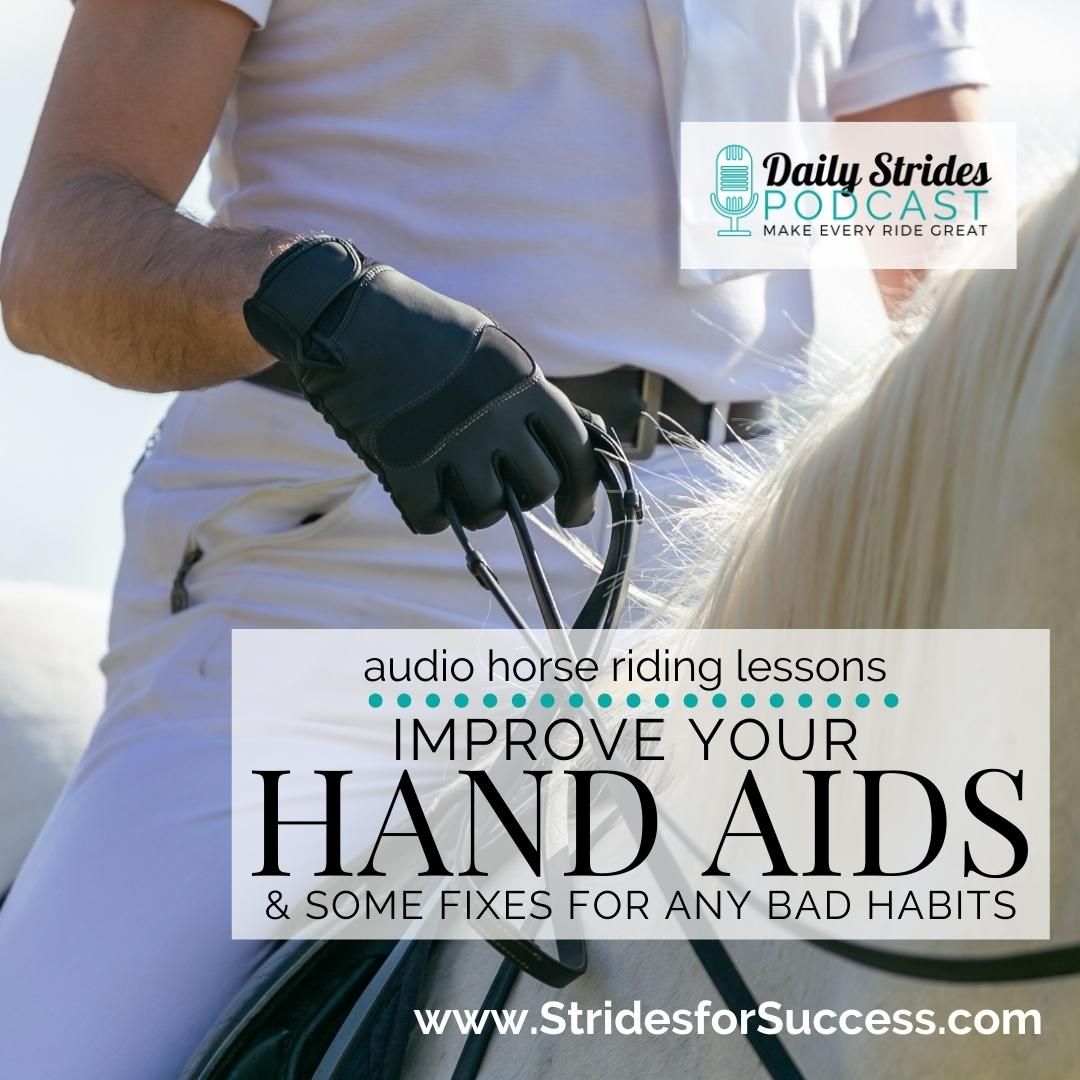
    Your hands are an aid in your riding. So understanding why the way you hold your reins and how to judge the height of your hands when riding is important. And realizing how much your hand aids are impacting and affecting your riding can change everything.
    As riders, one of the first things we learn is how to ‘hold’ the reins.  However, often the ‘why’ behind all of this is never really explained to us.

    Your Hands Connect

    So, it’s obvious that your hands are the connection between you and your horse’s mouth through the reins.  And it would be an awful pity if that connection ended there! As riders, one of our greatest responsibilities is to refine communication.
    When you refine your hands and how you use them with your horse, you can truly help to enhance the whole conversation between you and your horse.
    So just like with all of your aids, a great place to begin when refining your hands is their position. Being in the ‘right place’ will allow you to give more precise aids to your horse. And when we can create more clarity in our communication, it shows in our riding.

    What to Aim for with Your Hands

    Before we go any further it is worth mentioning that each horse and rider combination is a unique and individual blend.  However, there are a number of basic guidelines you can follow to really begin refining your hand aids.  And of course, develop better contact and connection with your horse.

    Thumbs on Top

    This is one of those really small details that makes a MASSIVE difference to your riding.  Holding the reins while in the saddle should feel like carrying two cups of tea (or coffee, hot chocolate, etc.).  If you were to carry the cups or mugs with your knuckles on top, there wouldn’t be anything left to drink when you finally go to take a sip.

    A great experiment is to literally pretend you’re riding and both carry your hands with your thumbs on top. Your hands will be around your belly button height in front of you.  Now, from this place, turn your wrists so that your knuckles are on top.  And feel the difference down and through your arms.

    Turning your hands so that your knuckles or the back of your hand is on top will create instant tension down through your arms.  When riding, this tension is passed through the reins to your horse’s mouth.  Not good! 

    Side View – Elbow, Wrist, Thumb, Rein, Mouth

    The first thing to look for is a relatively straight line from your elbow to your horse’s mouth when viewed from the side.  Now, I get that this can be difficult to really ‘see’ when you’re the one riding the horse!  However, if you don’t have mirrors, there are other options available.  Review some photos or videos of yourself while riding.
    The important thing to note here is that this ‘line’ should be there regardless of what gait you’re working in, or what moment of that gait your horse is currently in when the photo was captured. 
    This will indicate if your hands are truly fluid, elastic, and supple.  Your ability to ‘follow’ your horse or ‘stay with’ your horse through your hand aids is vital to really developing true and lasting contact.

    Overhead View – Wrist, Thumb, Rein, Mouth

    This second ‘view’ is one you can do all the time when riding.  The key is to ‘glance’.  Not LOOK! Looking will create a whole host of other habits that you don’t want to fall into habits with! Okay, so to check this you will, as you ride your horse, glance down at your hands.

    Notice how straight the line is from your wrist through to your thumb and then on down the reins to your horse’s mouth.  If you notice any ‘curling’ or ‘twisting’ simply straighten things out. 

    This particular ‘line’ is very much dependent on your thumbs being ‘on top’ as you ride.  If your hands have turned so that your knuckles are on top (like riding a motorbike) or your fingernails are on top, revert back to thumbs on top.  It will look and feel like you’re carrying two cups of tea :)

    If Your Hands Are Too Low

    This is the most common challenge I see with riders when it comes to their hands. Riders are trying to work their horses and improve the overall way of going, but literally ‘blocking’ their success!  Riding with your hands too low can be caused by a few different things.  Often it is a habit that was created due to holding onto the pommel or a neck strap.
    Another reason riders tend to carry their hands too low comes down to a lack of understanding regarding contact and ‘on the bit’.
    Many riders feel that when they lower their hands and then apply pressure quickly from each alternative rein, their horse will magically go ‘on the bit’.  And yes, the horse might tuck their head in to try and get away from the discomfort of the rider’s hands.  But this is definitely not being ‘on the bit!’.
    Hands that are too low can be corrected by simply bending the elbows and ‘carrying’ the hands more. Doing this will allow for greater elasticity and suppleness. Both are essential for correct contact. 

    If Your Hands Are Too High

    This is, thankfully, not as common as the low hands. And I say thankfully because this particular habit can often lead to a lot of needless discomfort for the horse.  High hands really change how the bit interacts with your horse’s mouth – and usually not in a great way.  Especially if not intentionally done.
    I think the big reason riders can develop this habit is due to a lack of balance. Very often, when the rider carries their hands too high to be effective as an aid, they are doing so to try to either remain balanced – or stay on!
    Excess tension in the rider’s body due to nerves or fear can cause them to raise their hands higher than what would be normal when riding.  The irony of doing this is that the horse usually becomes hollow through the back, which causes the rider to experience more bumps, wobbles, and bangs as the horse moves.

    If Your Wrists Are ‘Twisted’

    This is when you ‘glance down’ (important to emphasize – we are not LOOKING; just glancing) and you see that the line from your lower arm to the rein is not straight.  This lack of straightness can vary from anything like a slight ‘kink’ to a complete ‘lightning bolt’ shape!  True story!  The key to changing this is to first identify it.
    If you glance down and things are less than straight, focus on thinking about your lower arm (hand to elbow) as being an extension of the rein. Then just ‘straighten’ that rein out. 

    By creating that ‘straightness’ from the elbow, through the wrist and thumb, and then onto the rein, you create clarity with your questions. Clarity with your aids. This issue often comes up when a rider doesn’t want to necessarily ‘pull’, but they still feel the need to apply a lot of pressure with their hands. It can be a difficult habit to break, but one that is worth persevering with.

    If Your Knuckles Are On Top

    Ohhhh, this is something I personally resonate with.  I spent a couple of years doing ‘work riding’ for a racing yard.  This was coupled with teaching and actively eventing.  It did not all blend well.  I’m pretty sure that there are so many riders who can make this work – and let’s be honest, I did at the time.  But if I knew then what I know now… A completely different approach would have been taken!
    For me, this particular habit developed in my left hand.  I’m right dominant, so perhaps this was the reason? Either way, it became a MASSIVE issue for me later in my riding. 
    My left hand would just, on its own, revert to ‘knuckles on top’ when riding.  This, obviously, affected the contact between me and, well, any horse! And yet, it took me quite a few ‘seasons’ in my riding for this to be noticed. And a far few longer for it to be corrected!
    Trust me; knuckles on top changes EVERYTHING between you and your horse when riding. From how you move your arm, to how it feels in his mouth… EVERYTHING 
    If you find yourself with this habit, one or both hands (mind was just the left hand), focus on this first.  Think of carrying cups of tea and not allowing an ounce to fall… There is a certain way we move our bodies when we’re carrying cups of tea (or whatever). If we put that same fluidness into our riding… #Winning!

    Your Hands as Your Aids

    We connect with our horses on so many levels.  Our legs, our seats, our hands, our mood, our attitude, our intentions, our focus… And on and on it goes.  Yet, if we don’t develop our hand aids past what we learn in that very first lesson, we are doing both ourselves and our horse a disservice
    Your hands are your connection to something your horse NEEDS; his mouth
    His mouth is an absolutely essential part of his health, life, and experience every single day.  So it makes sense to spend time refining this aid… Maybe to the point where it becomes ‘feather light’ and ‘feather soft’.
    And in between, do all you can to remove any excess tension will definitely help :)
    Happy Riding
    Lorna

    More on This Topic:-

    More Training & Support

  • 3 Keys To More Consistent Contact

    3 Keys To More Consistent Contact

    [fusebox_track_player url=”https://op3.dev/e/traffic.libsyn.com/dailystridespodcast/1258_3_Keys_to_Consistent_Contact.mp3″ title=”3 Keys to Consistent Contact” social_linkedin=”true” social_pinterest=”true” social_email=”true” tweet_text=”Hi, you might enjoy this podcast episode about contact with your horse…” twitter_username=”strides_success” ]

    Contact can often look effortless for some horses and riders. And yet, for many other riders, consistent contact can seem like an enigma. Any efforts at consistency tend to lead to heaviness. Or a complete lack of any contact!  So where is this fine line between consistent, quality contact and washing lines?

    In order to develop contact with your horse, I feel that you must first understand what a ‘good’ contact is. This can often be confusing for many riders, so let’s start there…

    What’s Needed for Consistent Contact?

    Contact, for many riders, has to do with the reins.  And, yes, the reins do play a part in the contact conversation.  However, a good quality consistent contact is more than just the two strips of leather between your hand and your horse’s mouth.

    Contact is really the result of a lot of other things successfully working together first in your riding. Relaxation, rhythm, and suppleness are the obvious ones.

    As you begin to put all of the parts of your training together, over a period of time, you will see that contact begins to happen.  And this can be the challenge initially, maintaining contact.  Because, as you know, maintaining all of the other steps of the training scale that occurred before it, can also be a challenge! Especially when a bigger question is asked.

    Along with the obvious prerequisites for good consistent contact, are some more overlooked necessities. Things like your position, timing, and aids. And then your horse’s acceptance, and ability to take responsibility also need to be present.

    Click here for Free Half Halt Audio Lesson

    How It All Works Together

    Imagine being in a good position to ask a well-timed question and then allow the answer to happen.  There is the right amount of energy entering the channel that you and your horse create together (the container). Your horse is responsive and wants to work with you.

    You can feel the energy being created in his hindquarters and travel underneath you, along his back. As it does so, you can feel the lightness of the shoulders, head, and neck. The energy connects through to the ‘contact’ and then is harnessed to be reused again going forward. 

    The self-carriage you feel from both yourself and your horse is a key element to true, sustainable contact.  This self-carriage will only develop over time through correct and consistent practice. And this is a responsibility that both you and your horse share.  Each of you committed to carrying yourself so that the other ‘team member’ can do what they must do in order for you to both works together. That is true contact.

    True contact is an agreement that you both mutually respect and work towards sustaining as you develop together as a team. It’s the connection between horse and rider. 

    You can begin working towards this today by making sure that you are consistent with these three elements in your riding. This will allow your horse to begin working in a more consistent way as well.

     1. Hold with Thumbs, Not Fingers…

    It often amazes me how many riders have never been shown how to hold the reins properly.  They simply grab them with their hands and off they go. I’ve seen reins being held ‘backward’. Reins that are only connecting with the very tips of the rider’s index finger and thumb, almost yoga-like.  And I’ve seen other riders with their thumb wrapped around white knuckle fingers in an attempt to ‘keep’ the rein.

    While there are many ways to ‘use’ the rein, there really is only one effective way to hold it. And that is by passing it over the index finger and then ‘pinching it’ or ‘pressing it’ with the pad of your thumb. 

    The knuckles of your thumbs will be slightly bent, like a ‘roof’. And it is the thumb that holds the rein in place in your hand, not your fingers. By holding the reins this way, your fingers are instantly free to be used as a variation of the rein aids.  A squeeze.  Maybe a wiggle.  Often a vibration.  All are able to happen because they are not holding the rein.  Your thumb is.

     2. Your Hand is Not Yours…

    This can sound like an odd one!  But if you can begin to see everything below your elbow a little differently, it will help you and your horse create a softer, more consistent contact. I’ve already mentioned that self-carriage is one of the prerequisites for creating good quality, sustainable contact.  And this applies just as much to the rider as it does to the horse.

    By focusing on bending your elbows and carrying your hands, you allow a straight line to exist from each elbow to your horse’s mouth.  These are the true ‘reins’. Your elbows, all the way to your horse’s mouth. A straight channel. 

    This is the all-important second line that creates a position where you can be effective and allowing when riding your horse. When you drop your hands too low, this line will become a v shape.  If you lift your hands too high, the line will become an upside-down V.  Both will create a ‘break’ in the flow of the energy, which will result in energy either falling out or becoming blocked.

     3. Engage Your Other Aids

    It pains me to continue to see horses’ mouths being sawed left and right by misguided riders trying to get horses ‘on the bit’. If contact truly is an agreement, a mutually beneficial agreement, then sawing your horse’s mouth so that he moves away from the pressure (pain) cannot be part of it.

    Click here for Free Half Halt Audio Lesson

    Remember, contact is the RESULT of other things being present and having an influence. Contact is not your horse running around with his head ‘tucked in’ or your horse being ‘in a frame’. 

    One of the biggest parts riders misses when it comes to creating sustainable, consistent contact is the fact that energy must be both present and be replaced with new energy as it is being used. Meaning your horse must be going forwards. Forward does not just mean moving. It means thinking, being engaged, and moving with purpose.

    There is an essential relationship between your legs, seat, and hands that needs to be created and maintained as a rider. It will also need regular ‘upgrades’ and ‘tweaks’ as you develop. 

    Failing to take your legs and seat into account when it comes to successfully creating consistent contact will result in a heavy, dull, and lifeless pulling on the horse’s mouth. This is not true contact.

    Creating Consistent Contact

    As you begin working on this with your horse the next time you ride, remember that contact must be developed over time. Both you and your horse must have the necessary strength and development physically and mentally in order to maintain true contact.

    There are numerous audio horse riding lessons available to you inside of Connection that you can use to create this with your horse. Get started working on this today by joining HERE

    Happy Riding
    Lorna

    Click here for Free Half Halt Audio Lesson

    More on This Topic

    More Training & Support

  • The Evolution of Your Aids in the Saddle

    The Evolution of Your Aids in the Saddle

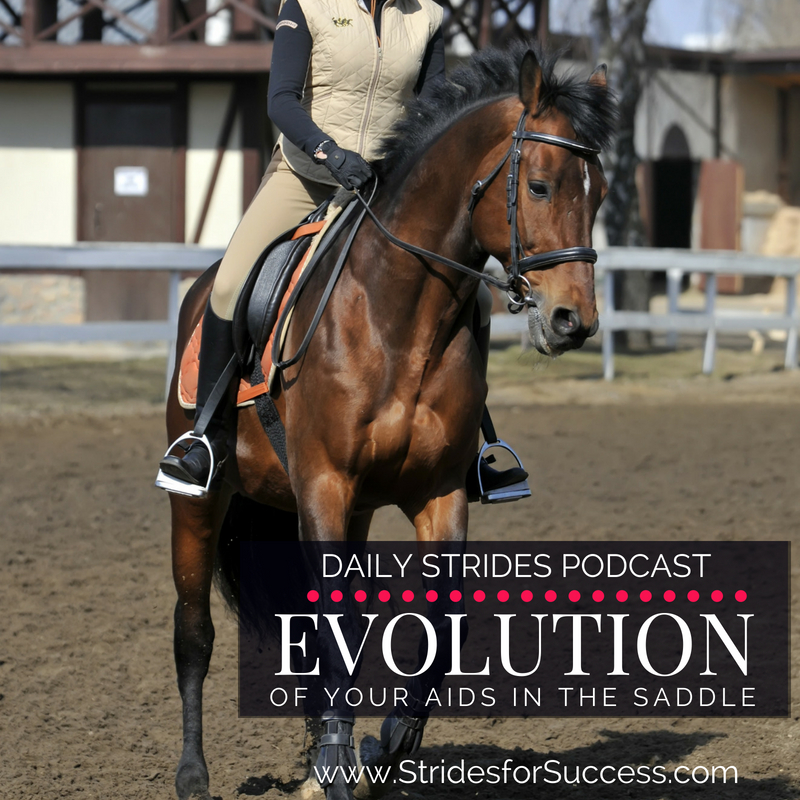
    The Evolution of Your Aids in the Saddle for Better Conversation with Your Horse

    What this episode is all about & how it can help you:-

    • Understand why your aids are always a work in progress
    • Start on the ground and work up
    • Transitioning groundwork to under the saddle
    • Application, pressure, timing and sequence

    [smart_track_player url=”https://op3.dev/e/traffic.libsyn.com/dailystridespodcast/1049-The-Evolution-of-Your-Aids-in-the-Saddle.mp3″ title=”The Evolution of Your Aids in the Saddle” social_linkedin=”true” social_pinterest=”true” social_email=”true” tweet_text=”The always evolving conversation between you and your horse… Find out how to improve it on this episode of the Daily Strides Podcast ” hashtag=”#horseriding #equestrian #lovinghorses” twitter_username=”strides_success” ]

    Have you ever noticed how you feel when you walk away after participating in a good conversation with someone?  There was a natural flow to it. Both of you were present and interested. Both open to hearing what the other person said.

    Good conversations more often than not result in both participants walking away feeling great. Which brings us to the topic of this episode of the Daily Strides Podcast. The evolution of your aids in the saddle and the impact it has on your conversations with your horse.

    Your Aids are Always a Work in Progress

    One of your greatest responsibilities, as a rider, is to try and ensure that you are refining your aids.  A consistent ‘bettering’ of how you are showing up in the saddle.  For many riders, the seeming lack of any ‘quick wins’ can make this process often feel a little tedious.

    However, just like becoming a great conversationalist, improving your aids requires practice in order to make perfect. 

    But the thing is, that when it comes to riding, there never really is such a thing as ‘perfect’.  Your aids are a constant work in progress.  A constant evolution as you change as a person, as a rider.  

    It is also worth remembering that the same is true of your horse as well.  A conversation is a two way street.  Both sides have to be as committed to it in order for it to really work.  Your horse must also be constantly learning.  Willing.  Open to how the conversation will evolve between both of you in the saddle.

    Start on the Ground and Working Up

    Starting today, become more mindful about what and how you are communicating with your horse before you ever get into the saddle.  The mundane, general day to day routine you and your horse go through before, and after, each ride.

    One of your more useful, but unfortunately most overlooked, aids is your voice.  You can use it anywhere, at any time and it can convey a lot of different things to your horse.  It can also be really helpful for you, the rider, as well.

    I feel it is important to recognise is the versatility of your voice as an aid.  This is especially true in the early days of your relationship with your horse.

    Begin by experimenting how your horse listens to you.  How he responds to you.  Different tones, different words, different rhythms. 

    Many riders worry about the impact of using the voice aids if they have their sights set on dressage.  I honestly don’t believe this will cause any harm.  As your aids and the conversation evolves, you can slowly make your voice less and less a part of it.

    Working with Rein Aids on the Ground

    Rein aids work on the ‘pressure and release’ principle.  You can begin refining this today, on the ground, with your horse whether green or more experienced.    You can use either a head collar and lead rope and use the lead rope to apply the pressure and the release.

    You can also use an actual bridle and lead the horse using your reins.  Again, pressure and release.  This is also a great way of seeing how the bit actually ‘works’ in and around your horses mouth.

    When coupled with your voice, such as ‘woah’ with applied pressure to slow down, steady or stop, it now becomes easier to see how it can transfer over into the saddle. 

    In fact, the more ‘subtle’ aids in the saddle, such as your seat, can then be refined by adding them to the reins and voice which were learned from the ground. 

    Your Seat and Your Legs

    Your rein and voice aids, when worked on from the ground, also help open the conversation using your legs in the saddle.   Unfortunately many riders make the mistake of starting with the seat, rather than the legs when it comes to this.

    While starting with your seat is not ‘wrong’… Very often riders are a little too ‘busy’ with their seat without realising it.  It leads to a lot of confusion between horse and rider.  Hence my suggestion of starting with your legs first.

    Work on refining the conversation you are having with your horse with your legs first.  Where your legs are positioned.  How you are applying the aids.  The passive and active leg aids.  Becoming quiet through your legs when you want to…

    When you become more mindful about your legs and how you are communicating with them, the seat will naturally join the conversation. 

    Focusing on your seat before it is truly independent will only cause the lines of communication between you and your horse to become, well, twisted. Rather pay attention to your hands and your legs and allowing them to then influence your seat position.

    If your hands are level, chances are your shoulders are level.  If your legs are where they should be, chances are your seat bones will be where you want them to be.  This is the beginning of building that all important feel.

    Focus on first refining the more obvious aids and then later, shift across to the more subtle aids. 

    Sometimes ‘Exaggerated’ Communication is Necessary…

    Think of a time when you spoke with someone you didn’t understand.  A person who spoke a different language.  Once you both, quickly, figured out that language was not going to help either of you communicate, you would have begun looking for alternative ways.  Those alternative ways were probably not very subtle!  Hand gestures, grunts, exaggerated facial expressions…

    Your conversation with your horse may be, or have been, a little like this initially.  Obvious.  ‘Loud’.  There may have been a lot of back tracking due to miscommunication.  It was not fluent.

    However, over time and by consistently committing to improving the conversation with your horse, things improved, or will improve.

    Application, Pressure, Timing and Sequence

    There are four different ‘filters’ you can view the use of your aids through.  When they are all put together, you will get the overall feel of the ride for both you and your horse.

    The application of your aids is all about the ‘how’ and they ‘why’.  If you can get clear on those, you will be able to apply your aids in a more clear way for your horse to understand.

    The varying degrees of pressure create different outcomes with your horse.  It works like the tone in your voice when speaking to a person.  Soft. Hard. Gentle. Urgent. 

    Timing is important in any good conversation.  It allows things to flow.  It means not butting in, or speaking over the other person.  It also means warming the conversation up before asking more probing or difficult questions.

    The sequence is simply how you put it all together.  For example, perhaps the more ‘expressive’ or ‘obvious’ aids are necessary at the beginning.  They lead the more subtle aids.

    You have to start with the end in mind; but you cannot start at the end!

    The piece in the middle is the ongoing evolution of your aids in the saddle so that both you and your horse can have better conversations together.

    Happy Riding

    Lorna

    Links mentioned in the episode:-


  • Applying the Rein Aids while Riding

    Applying the Rein Aids while Riding

    .. This[fusebox_track_player url=”https://op3.dev/e/traffic.libsyn.com/dailystridespodcast/SFA471-Applying-the-Rein-Aids-as-You-Ride.mp3″ title=”Applying the Rein Aids as You Ride” social_linkedin=”true” social_pinterest=”true” social_email=”true” ]

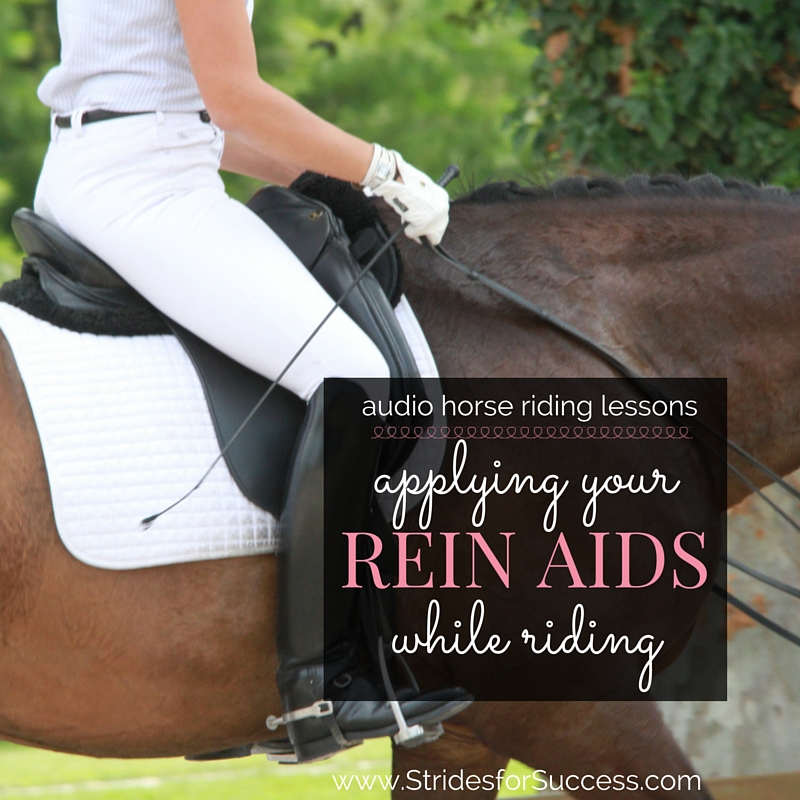
    Do you find yourself becoming confused and frustrated about how you are supposed to be using your rein aids while riding?  Do terms such as soften your rein, fill up your rein, hold with the rein, lighten the rein leave you baffled?  Not to mention how much pressure is good and how much is too much?!

    I want you to take a quick trip down memory lane and back to your first ride on a horse…  Chances are that back then, before you knew any different, you thought of your reins as the means to steer and stop your horse.

     However, you soon began to realize that while your reins make up part of the system to do this, in order to really have a happy contact with your horse, you needed to reframe how you think of your reins. And what you use them for.

    Applying Your Rein Aids while Riding

    What are Rein Aids For?

    Your reins are, first and foremost, the way that you collect the energy your horse creates in his hindquarters and back, so you can then channel it where you want it to go.

    This is done through you have a consistent contact on the rein. This allows your horse to build trust in you that you won’t catch him or drop him while he is working into that contact.

    However, before you can even begin thinking about this, we must first discuss how your hand will come to meet the rein and the effect this has on you and your horse.

    An Extension of Your Core

    While your hands are holding the actual reins, it is good to keep in mind that they are merely acting on behalf of your body.  

    This means that any aids happening through your core are connected to the conversation you are having with your horse down the rein with your hands.

    A practical example of this is a pony trying to eat grass while being ridden.  Riders that depend on the strength of their arms to apply rein aids will be pulled forward out of the saddle when the horse puts his head down.  However, a rider that is connected through their seat and core, merely using their arms and hands as an extension of this, will sit tight as their core will come into play rather than their arms.

    Your Hands and Arms

    It amazes me that so many riders still believe they are strong enough through their arms to ‘win’ a pulling match against their horse.  The sad part is that the pulling match should never happen to begin with.

    Your hands have an important job of gathering up the energy created by your horse, however, this can only be achieved if your horse trusts your hands enough to connect that energy with them

    Next time you are in the saddle, become aware of the fall of your arms as you ride.  Is it a natural fall?  Are you perhaps overarching your back? Is this resulting in your elbows being slightly behind your body?  Or maybe you are collapsing your upper body causing your elbows to be in front of your body?  How supple and flexible are your elbows?

    Your arms should fall from your shoulders in a natural position.  

    Being supple and soft means that there will be little tension in them, just enough to carry your hands, which should be on a straight line between your elbow and your horse’s mouth along the rein.  Your wrists should be straight, never clawed or bent.  In fact, if you have to claw your wrist to ‘activate’ the rein, your reins are too long!

    Your fingers and hands should also be soft and supple.  Try not to clench your fingers into a fist.  Rather use your thumb as a ‘clamp’ to hold the reins which will allow your fingers to follow and communicate with the rein and your horse’s mouth.  Keep the pads of your finger tips as the touch point with the palm of your hand.


    Suppleness Through Your Body

    If your horse trusts you to be consistent and considerate with the rein, he will ‘seek’ the rein by moving his poll forward and down into the contact.  A horse trying to evade or get away from a sharp hand will rather move his head up and back, causing his back to hollow.

    Focus on keeping your hand and elbow supple and elastic.  Move with your horse

    So often horses that have been labeled as lazy or not very forward are this way because of a rider that failed to follow with their hand.  Turning your knuckles on top, rather than your thumb, causes a similar scenario.

    When you think of giving with your hand, think of allowing through your fingers first and then, if necessary through your elbows.  It should be a slight, subtle communication with your horse.  Work on how you can ‘allow’ using your fingers and next time you ride see if your horse responds to this more subtle direction.

    The same applies when you think of taking or restraining; imagine moving the pads of your fingers closer to your wrist or ball of your thumb, gently closing your fingers rather than stiffening or clamping your fist.

    Building Responsiveness

    As you are practicing this, pay attention to how much pressure you are applying and how your horse responds.  This can be a confusing principle for many riders.  And it is often compounded by the fact that their horse may have already become a little hard or unfeeling through his mouth due to being ridden with hard hands before.

    I suggest that rather than thinking about applying pressure, reframe that into what is necessary to ride your horse at that time in order to achieve or maintain the desired outcome.  Then, over time, make adjustments and refine how you are applying the aid

    The amount of pressure in your hand will directly correlate to how your horse is going. From the hindquarters through the back. And then resulting in where his head and neck are positioned due to this way of going.

    Rein Aids & Self Carriage

    The more true collection your horse has achieved, the lighter he will be in your hand. This is because he is now carrying himself. The result is that his poll having lifted up and is now situated closer to your hand.  When working in a more relaxed outline, there will be a more consistent pressure.

    Your job, as the rider, is to maintain that balance between your hand and your horse’s mouth through the rein.

    However, if your horse is heavy on the forehand or leaning, you will feel a distinctly heavy and uncomfortable amount of pressure or weight down the rein.  This is due to your ‘carrying’ him, rather than, as we just mentioned with the collection example, him carrying himself.

    Consistent Contact (versus ‘Piano Fingers’)

    The final point I want to talk about is ‘piano fingers’!  Many riders think that by opening their fingers completely on the reins, they are somehow being nicer to their horse.  Bear in mind that contact through the rein is a conversation.  And conversations are a two-way street…  Opening your fingers stops you from hold up your end of the chat!  Rather work on being more supple and following through your hand, elbow and shoulder.

    From there, when your horse learns to trust your contact, you can begin refining the pressure and movements in your communication.

    I also feel it is important to note that this consideration of your horse’s mouth should colour all aspects of your time in the saddle.  From gathering up the reins initially. To shortening and lengthening the reins (which we have a video on). And even to rewarding your horse by softening or giving with your inside rein.

    Subtlety is the key to success where your horse’s mouth is concerned…  Be gentle, soft and kind at all times.

    Your Responsibility…

    It is worth repeating again that in order for your horse to truly accept the contact you are providing down the rein, you must first guarantee him that you are going to provide a steady, soft, consistent contact to begin with.

    And just like your horse having to strengthen himself in order to build up to a more collected way of going, you will too.  This means finding ways to develop an independent seat. And practicing on making changes and adjustments gently and softly

    Happy Riding
    Lorna

    Additional Resources for Equestrians:-

    Applying Your Rein Aids while Riding