Tag: Reschooling

  • Reforming a Horse with a Habit of Running Out

    Reforming a Horse with a Habit of Running Out

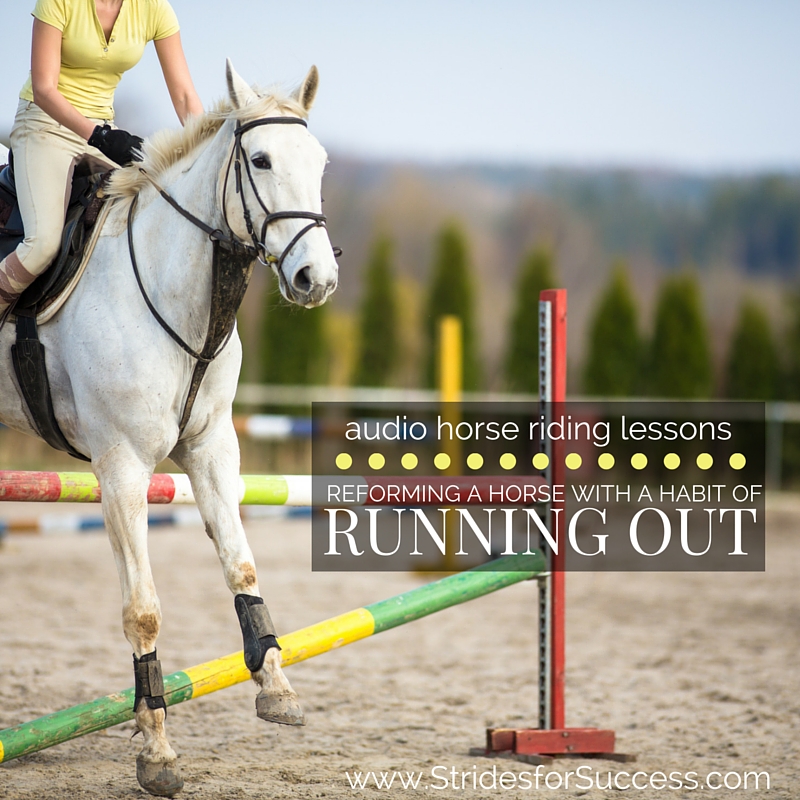
    Reforming a Horse with a Habit of Running Out You’re cantering along, the jump firmly in your sights, getting ready for your horse to take off…  When all of a sudden he begins to ‘veer’ a little off course.  Before you know it, the jump flies past you, to one side…  Your horse has, once again, proven that he is the master of running out at a fence! [smart_track_player url=”https://op3.dev/e/traffic.libsyn.com/dailystridespodcast/656-Reforming-a-Horse-with-a-Habit-of-Running-Out.mp3″ title=”Reforming a Horse with a Habit of Running Out” social_linkedin=”true” social_pinterest=”true” social_email=”true” tweet_text=”Is your horse pretty special at jumping; in that he is special at dropping the shoulder and ducking?! Here’s what to do…” hashtag=”equestrian #horseriding” twitter_username=”strides_success” ] Frustrating, right?  Particularly when it seems to happen regardless of what you do.  Or how you do it.  In fact for many riders, it feels like they spend more time running out at fences than actually jumping any at all!
    The unfortunate side of this is that the more confident your horse becomes with being able to sidestep a jump, the more often he will do it.
    And the more he does it, the better he becomes at dropping that shoulder and ducking to the side.

    Running Out…

    Running out is a common problem many riders face when they begin jumping more demanding fences.  Now, more demanding can mean 50cm to one person and 1m to another.
    Horses who have learned to employ the running out technique rarely discriminate on fence heights and types!  
    However, what is important to note is that it generally happens when there is an actual jumping effort required.
    For the rest of this blog post we are going to assume that you have eliminated all the obvious reasons that your horse might not want to jump; teeth, back, tack, soreness, sickness, being overfaced, tiredness etc.  This blog post is about horses who have learned to use running out as an easier alternative to jumping the actual fence.

    How Running Out is Different to a Refusal

    Many riders confuse running out with refusals.  Perhaps this is because they are penalised similarly.  However it is good to remember that running out and refusing a jump are two very different things.
    When your horse refuses, he generally stops in front of the fence.  Think of a grinding, sliding halt.
    Refusals can have many causes and reasons; many of which are to do with a horse not feeling confident or comfortable jumping the fence.
    Running out, on the other hand, is when your horse maintains his forward momentum, however he changes course in front of the fence and simply canters or trots past the fence to one side.  
    It can sometimes also be caused by overfacing the horse, however I have found that most horses who become skilled at running out, do so because the rider is allowing it to happen…

    Running Out and The Rider…

    “What?!”, you say.  “I do not ‘allow’ him to run out!  He just does it himself and there is nothing I can do to stop him!!”
    And that there is probably the biggest stumbling block most riders meet when trying to reform a horse who has mastered the art of running out. They try to fix it by working over fences or jumps
    Almost all cases of running out can actually find their roots way back in the basic flatwork schooling, or lack of, in the horse.  What generally tends to happen is the horse has been jumping quite happily, popping fences without question.  But one day, for whatever reason, he takes a chance and dives out the side door… The mere fact he was able to change course like that, usually without repercussions, is enough to plant a seed that perhaps – if the right opportunity presents itself – he can do it again!

    The Path of Least Resistance

    Sounds devious, but don’t worry, I am not suggesting your horse has some evil or mischievous tendencies; he has just found the path of least resistance and has decided to take it!
    The downside to having a horse who has a talent for running out is that reforming him is often a long journey.  This is particularly true if the rider he runs out with is the one accompanying him on this journey. Again, this is because very often it is the rider’s lack of ‘riding’ that has given him the opportunity to take the side door to begin with.  But, it can be done.  It will just take a lot of consistency, time, firmness and pure concentration from the rider to get there.

    Correcting the Rider First

    So, as mentioned earlier, the rider makes all the difference when dealing with a horse who has developed a knack for spotting a side door and running out.  It may be due to the rider getting into their jumping position too early.  This is essentially dropping the contact.  When the contact is dropped, your horse is left to his own devices.  Again, if so inclined, he will take the path of least resistance or the easiest route!
    Running out may also be caused by the rider not using their legs, seat and hands to correctly ‘channel’ the horse’s energy and direct it where they want.  
    Just like if the banks of a river are weak and the water runs out, so too will your horse if your legs are not being used to shut down those tendencies and keep him moving forward to where you want him to go

    Riding a Line

    The third most common reason I see horses running out is due to their riders taking a less than straight approach to the fence or jump.
    There is no ‘line’ to the fence.  Nothing connecting the approach to the getaway. 
    This often results in the horse meeting the fence at an odd angle.  Which essentially opens a door and allows him to simply canter on past.

    Approaching with Too Much Speed

    The final reason I want to mention, before we begin talking about solutions is that the horse is allowed to become too fast to the fence.  Due to the speed of the approach, the rider has no control over the horse.
    All the energy is running out the front like a freight train.  And just like that freight train; once it begins to derail, a whole army would find it difficult to get it back on track.

    Working on ‘Over’ Rather Than ‘Around’…

    So, now that we have placed the cause of the running out squarely in the riders court, we can begin working on how to re-school and reform the horse, so he goes over rather than around. When we ride, we often hear the term between leg and hand.  Put simply this means that the energy you are creating with your legs, is being directed to where and how you want it used with your hand.  Now, obviously things are a little more complicated that that, however, the basic principle is true when riding.
    When you’re dealing with a horse who likes to take the side door, the connection between your leg and hand is not a very strong one.  
    Simply put, there are holes there that your horse, if so inclined, can take advantage of.  Begin by practicing how you channel this forwardness and movement in your horse.

    Strengthening Your ‘Channel’

    Focus on straightness throughout his body when being ridden, and on the level of responsiveness to your aids
    Your horse should remain straight and true when being worked on the flat.  If you find him becoming crooked or ‘veering’ when working, quickly and quietly correct him.  He should then be responsive enough to your aids, particularly your leg in this situation.
    I also find that working on the centre or quarter lines is a good test of this straightness. 
    From here, you can also begin working on implementing better half halts.  This will help you to ‘steady’ things a little when you approach the fence.

    Gathering Energy on the Approach

    As I mentioned above, sometimes the approach to the fence is just too long, fast and strung out for you to keep the connection between leg and hand.   The energy is all running out the front.  This allows your horse to take advantage of this lack of direction. Practice applying the half halt, while continuing to move forward where you want to go.  It will help to ensure you gather the energy, rather than allow it to run out.
    You may find that as you begin closing those ‘side exits’ that once existed for your horse and his energy, there is a lot more energy there underneath you which needs to be directed.  
    This is another reason why working on perfecting your half halts is vitally important, otherwise your horse may begin to run…

    Using Ground Poles

    Another thing you can begin practicing, before you attempt jumping again, is working over ground poles.  This is good for both you and your horse.  You get to learn how to ‘wait’ for your horse to go over the pole, before following him over.
    Your horse has the opportunity to become familiar with the concept of working over the centre of the pole.  Ride a perfectly straight line on the approach, over the jump and continuing on with the getaway on landing
    Because you are channelling him between your leg and hand, all side exits have been shut.  The only way forward is the one which you present by riding him straight to where you want him to go. Running out is a frustrating and often costly habit where penalties are concerned.  However, before you lay the blame at your horse’s door, it is one of those challenges that very often has its roots in the rider’s own tendencies. This may be a bitter pill to swallow, however knowing that you may just be the reason also means that you are the key to banishing those pesky side dives and running out into the past; for good! Happy Riding Lorna This podcast episode and blog post is an overview of this weeks topic, running out.   The other four audio programs are step by step exercises and instructions you can listen to while in the saddle.  They help you to begin working through this problem with your horse.
    You can purchase the full 5 audio trainings for this topic HERE
    It is like having a riding instructor with you in the arena.  The lessons are simply downloaded to your phone and are then ready to listen to while you are in the saddle.
    You can listen to the over and over again, until both you and your horse are popping the centre of those jumps; every time!

    Daily Strides Premium

    Daily Strides Premium is packed full of audio trainings you can listen to anywhere you can bring your phone (including on your horse).  They will help you work towards your goal of having better conversations with your horse, both in and out of the saddle. You will also be able to create a plan for your rides and review what has happened when you join in on the monthly ‘Review and Planning’ call.  In there, you will go step by step through the month that was.  You then take that information and begin planning out the coming month.  When you will ride.  What you will work on.  And of course all aligned with your goals for you and your horse.
    Do you need to be competing? No!  Do you need to have competitive goals or ambitions? No again!
    In fact, I love working with riders who just ‘enjoy’ their horse; helping them to build and strengthen their relationship.  No competitions necessary ;) 
    Couple this with the live Q&As and the members only private group ~ we are here to help you remain accountable as team leader for you and your horse.
    All of the trainings are easily accessed using your phone, meaning that you can take them with you where ever you are going.  These trainings and so much more are available for you immediately when you join Daily Strides Premium. Find out more HERE
  • Riding a Horse with a ‘Chip In’ Habit at Take Off to a Jump

    Riding a Horse with a ‘Chip In’ Habit at Take Off to a Jump

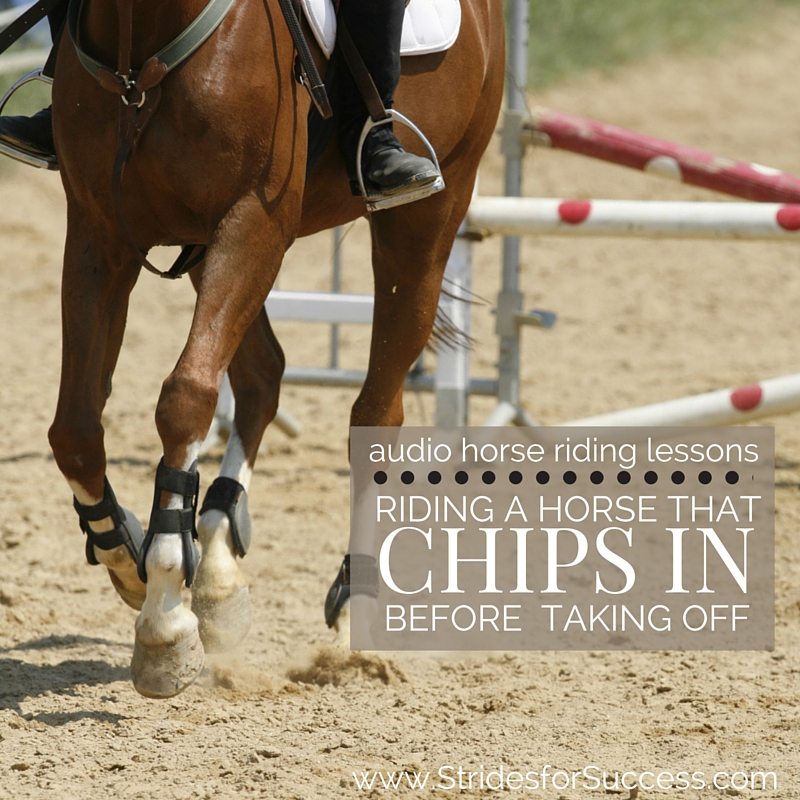
    You are cantering towards the jump… 3… 2… 1… But instead of the ‘Jump’ that should have followed the 1; you get a chip in.  A moment where your usually trusty horse decides to test both of you by inserting a little ‘half stride’ in there before takeoff!

    The result is you do a great Thelwell impression and your horse does his best helicopter move; straight up and straight down…  Not a good feeling for anyone!

    Riding a horse that regularly includes a chip in or three is not enjoyable for anyone; the rider, the person watching, or the horse.  Of course, it can happen to anyone, we call have days where we get the stride to the fence wrong. However, for some horses, it becomes a habit that can seem almost impossible to break. That extra little half stride…

    [fusebox_track_player url=”https://op3.dev/e/traffic.libsyn.com/dailystridespodcast/636-Ridig-a-Horse-that-Chips-In-Before-Take-Off.mp3″ title=”Riding a Horse That Chips in Before Take Off” social_linkedin=”true” social_pinterest=”true” social_email=”true” ]

    What A Chip In Looks & Feels Like

    This habit is uncomfortable and does little for building confidence to clear a course of fences safely.  However, before we look at how to begin working with a horse who adds a little stride here and there, let’s back up. It is important to first realize what this is and why it might be happening.

    When a horse chips in before a fence, he has literally fitted an extra stride into a space. A space that there was really not enough room for that stride…

    He decided that, rather than taking off where he initially met the base of the fence, he would get creative.  He would add a quick little half stride in there and then take off.  It often results in a ‘cat jump’ which is all four legs really taking off and touching down at the same time, due to the loss of impulsion or energy.  It can also result in a ‘helicopter jump’, which is a jumping effort, but with an extremely steep up followed by an extremely steep down, with just the width of the fence in the middle!

    In both these situations, the horse is not using his back or body to the best of his abilities and it feels really uncomfortable for the rider.   Because of the loss of ‘flow’ in the stride, the rider very often ends up either too far ahead of the movement or left behind.  Both scenarios will usually result in both horse and rider not being correctly prepared for the next, upcoming jump.

    Why Your Horse Might Chip In

    There are lots of reasons your horse may chip in before a jump or fence.  It is also worth remembering that most horses will do this at some point in their training.  However, we are dealing today with a ‘chip in addict’, or a horse that does it more times than not.  In order to identify why we must first look at the horse’s approach to the fence…

    Is it rushed?  Maybe he leaning or pulling on the reins and being heavy on the forehand?  Or is he moving forward? Perhaps are you literally scrubbing and kicking every stride just to get to the base of the fence?  

    With regards to the rushing or leaning, this may be due to a lack of training.  This will often result in a lack of confidence in your horse.  He may be off the mindset that he must ‘just get it done’ as quickly as physically possible.  Unfortunately when this happens, the rider’s reaction and how they deal with it plays a big part in not only the result for that particular fence but also the long-term as well.

    Retracing some basic steps in his training is very often the way to begin overcoming this challenge

    If your horse is on the other side of this coin, he is not taking you to the fence at all, this can also be a training issue.  However, again, it may also show signs of a lack of confidence in his abilities.  I strongly suggest that, whatever the cause, take things back to basics.  It truly is the key to building and developing correctly.  And to show your horse that he can indeed successfully make it from A to B over a fence.

    Could It Be You?

    Sometimes, a horse that chips in is doing so because of how he is being ridden by the rider…  A nervous rider often tends to throw themselves into their jumping position a little early.  This will encourage the horse to ‘chip in’ before the fence.  Unfortunately, this is often a difficult and vicious cycle to break.

    The rider is nervous because the horse is rushing, the horse begins to chip and rush even more because the rider collapses before the fence and ‘drops him’, both emotionally and physically. This causes the horse to rush even more.  And so it goes on and on…

    If you feel that this is the issue, I would strongly suggest working over a single pole and practicing your timing and your balance.  The light seat is wonderful and will help you do this.

    Riding a Horse that Chip In before Take Off at Jumps

    Begin By Improving Flatwork

    So, once we have discovered why your horse chips in before a fence, we can then look at how to begin working through it so we can get a good take-off point and reach each fence in the best possible way.

    A good place to start working with your horse on the flat and improving his general responsiveness and understanding of your aids in the saddle.  Does he listen when you half halt?   Or do you find yourself pulling and hauling to get him to ‘steady’ a little?

    Does he move forward when asked to do so from your leg?  Or do you have to kick and click like a crazy person to get any sort of movement happening?!  These are basic training issues and need to be addressed before we even think of turning our hoof to jumping.  It sounds repetitive, but this is because it is true… You have to have the basics mastered before you can move on to more ‘exciting’ things in the saddle!

    Your ability to balance things with a half halt while keeping your horse moving forwarding is vital to being able to approach any fence successfully.  Keep in mind that a horse who chips in every now and then is a horse who is not so confident in jumping.  He needs a rider who can allow him to build his confidence in a controlled, systematic and patient environment

    Figure Things Out for Himself

    So, once you have the basics working, I suggest beginning to allowing your horse to figure things out on his own, without a rider, in a controlled environment.  This can either be lunging or loose schooling, but the word controlled is the important one in the previous sentence!

    Loose schooling or lunging a horse over fences does not mean chasing them into a frenzy around the arena at dizzying speeds.  

    It is simply creating a situation that is conducive to an optimum jumping effort, either one or two fences.  Then allowing your horse to approach and work things out himself.

    The benefit of loose schooling is that you can have two jumping efforts, 2 measured and correct stride lengths apart from each other.  The first jump, a cross pole, is to set your horse up correctly for the second fence, which can also be a cross pole or an upright or parallel. Due to consistently meeting the second fence at the correct distance, your horse will begin to figure things out himself.

    Distance & Spacing of Poles & Jumps

    It is also important to remember that the ‘correct distance’ is what is correct for him, not trying to force him into a standard jumping distance.  Rather allow him to first build his confidence in his own abilities using a distance that suits his current way of going or current stride.

    Once he is able to begin ‘picking’ a correct take off point, without any anxiety, you can then slowly begin working over adjusted distances

    Also, don’t see the loose schooling or lunging as a once-off occurrence.  Rather, try to incorporate them into his training for as long as necessary.  Very often with horses, it is a lack of balance that causes them to be unsure of the jump, leading to a chip in here and there.  The rider will definitely affect this balance or lack of, so allow him time and space to work it out alone before then adding a rider into the equation.

    Using Groundpoles while Riding

    As well as the above, you can begin working over ground poles in the saddle with your horse.  Laying out a single ground pole and cantering over it can be a helpful exercise for both horse and rider.  With regards to the horse, we are looking for a balanced and rhythmic approach and also, a canter that is taking you to the fence, rather than you having to ask and push for every stride.  Try to keep the rhythm as consistent as possible, and the hindquarters underneath the horse.

    You can also use this to begin training yourself to see a better stride before the fence.  Simply counting backwards from where you think there will be three strides before take off is a fantastic exercise to get you in rhythm with your horse and begin seeing the stride.  Only when you can actually see the stride can you then look at adjusting the stride.  Before that it is just the luck of the draw – never a good idea when there are jumps involved!

    As you canter in on your ‘approach’ to the fence start 3…  2…  1…  Jump.   If you get in wrong the first few times, don’t worry.  Just keep trying to gauge that point where you are three strides away.  Later you can make things a little more difficult for yourself with 5…  4…  3…  2…  1…  Jump.  You will find that the more you ‘tune’ your eye into the approach, the further out you will be able to see if the take-off point is a good one or is a little too far away or close.  This will give you time to adjust the strides in between which will, in turn, allow you to arrive at the jump in a better position to clear it comfortably.

    Related Distances

    From here you can add more poles on the ground at ‘related distances’ to each other.  Work at maintaining the forwardness of the canter while keeping the rhythm and balance all the way through.  Also, work on your timing of the jumping position.  As I mentioned earlier, it is tempting to get into it a little early if your horse is rushing, but this will only make the problem worse.

    Try to use your 3…  2…  1… to steady yourself and only allowing your body to follow your horse at the ‘Jump’ part

    Once both you and your horse are more comfortable and have stopped any added strides or half strides before the pole, you can begin to build some small fences where the poles are.  Remember that if your horse chips in,  a lot of the time it is a confidence issue, so don’t be tempted to push him further than he is comfortable.  Just because he is ‘able’ does not mean he is comfortable doing it!

    Your horse’s ability to see a stride takes time to establish, just like yours.  Give him that time and it will pay dividends later when you are out on the track.  Count yourself down to the base of each fence, 3… 2… 1… at all times initially (in your head when in the company of others if you want!), but use it as a way to balance both of you on the approach to the fence.

    Happy Riding
    Lorna

    Connection for Equestrians

    If you are interested in finding out more about how you can begin re-schooling your horse in all aspects of riding, Connection might just be what you are looking for. Each week you will receive 5 audio ‘lessons’, where I give you step by step instructions.  You can listen using a free app on your phone, on your computer, or via your favorite podcast app.

    This makes it really handy to use and listen to while riding your horse; in the saddle.

    We cover loose schooling, working over single poles, related distances, and also working on improving your eye to see a stride. There are also diagrams with the actual distances for you to replicate in your arena.

    Find out more over at https://stridesforsuccess.com/join

  • Basic Exercises for your OTTB (Off the Track Thoroughbred)

    Basic Exercises for your OTTB (Off the Track Thoroughbred)

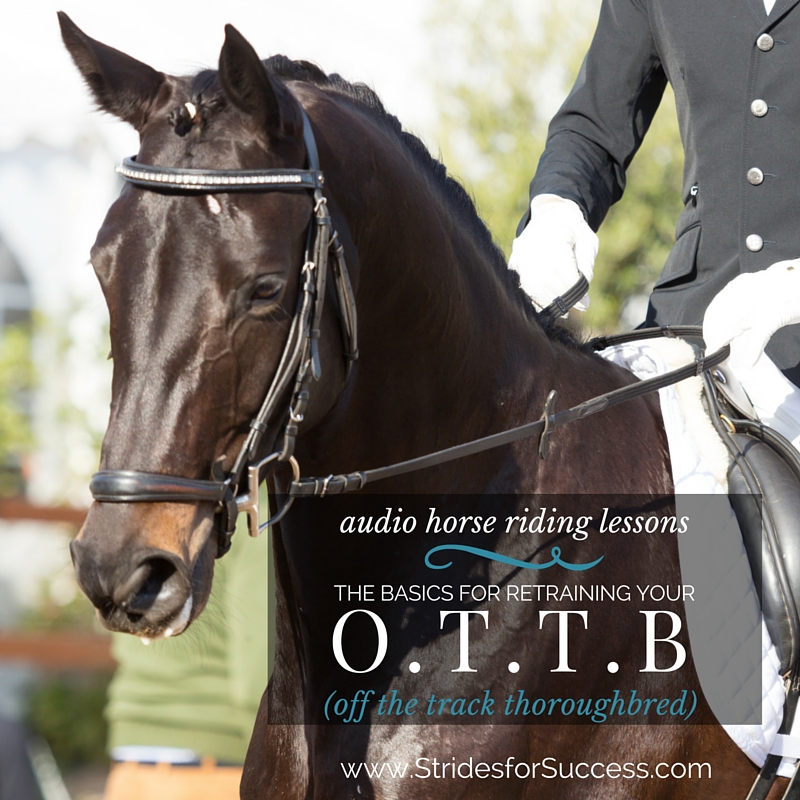
    There seems to be two types of riders in the world, those that love an OTTB and those that don’t!  I am squarely in the former category and if you are also there, well make yourself comfortable because this week on Daily Strides we are focusing on basic exercises you can begin implementing with your OTTB today that will help lay a solid foundation for future schooling, regardless of the discipline.

    [smart_track_player url=”https://op3.dev/e/traffic.libsyn.com/dailystridespodcast/SFA366-The-Basics-for-Reschooling-Your-OTTB.mp3″ title=”Basic Exercises for Reschooling Your OTTB” social_linkedin=”true” social_pinterest=”true” social_email=”true” tweet_text=”Lucky enough to have an OTTB in your life? Here’s a few exercises to help smooth the transition..” hashtag=”OTTB #RetiredRacehorse” twitter_username=”strides_success” ]

    An OTTB, or off the track thoroughbred or retired racehorse, are athletes whom are bred with a specific purpose in mind; to get from A to B as fast as possible while remaining sound.  They also, through years of selective breeding, mature earlier, have quicker reaction times and have a winning attitude which can sometimes be difficult to work with if you do not understand how to use this to further the horses training.

    However, for all their wonderful attributes,  OTTBs are often looked down on by many pleasure riders and competitive riders in specific disciplines alike, which is a shame because a quick flick through the history books will soon highlight numerous thoroughbreds who, once finished their careers on the racetrack, achieved glory in both dressage, jumping and eventing.

    Reschooling Your OTTB

    The OTTB has a sensitive and quick mind and because of this, they do will under the guidance of riders who are careful and mindful of what they ask and how they ask for it.    The thoroughbred also has fantastic athletic ability and are wonderful animals to train because of how well they can use their body and brain.

    Of course, it goes without saying that initially choosing the correct horse is vital, with emphasis on the horses age, confirmation, temperament, racing history, soundness, to a lesser extent breeding and the all important condition and shape of the hooves.

    Being such a highly prized and bred animal, the OTTB may need extra care which might just equate to extra financial implications and while purchasing an OTTB may be cheaper initially, he may just cost you in other areas in the long run.

    When your horse first retires from the track, you can either ‘allow him to be a horse for a while’ and after roughing him off correctly, turn him out for a few months into some nice pasture, or you can start him in work straight away.  It seems to depend on the horse and if he is not happy and needs more time ‘away’ he will let you know!  Of course before starting any training program, ensure all the necessary health checks are performed; teeth, back, dewormer, inoculations etc.

     Begin With Training Your OTTB to Lunge Correctly

    Your initial goal in your training program should be to achieve a level of relaxation from your horse.  Keep in mind that his life up to now was very ‘busy’ and he will need a transition period where he can start enjoying his new career.  Lunging is a super aid to begin both building a bond with your horse and achieve that goal of relaxation.

    Use the time on the lunge to train your horse to your voice.  Simple commands such as Walk, Trot, Canter, Steady and Whoa, will go a long way to helping him understand your new seat and leg aids when you do mount up on him.

    Lunging also helps divide his past life and his new life.  It works as a transitioning tool from one to the other and allows your horse to  ‘let down’ and realize that life is now very different, as is the work expected of him.

    Once your horse has a good grasp of the voice commands, you can begin to incorporate some loose schooling into his training program as well, particularly if he will be going forward to a jumping career (whether pleasure or competitive).  Beginning over poles on the ground and building up smaller fences as his confidence grows will allow him to perform the all important task of figuring things out for himself.

    Transitioning to a New Career Can be Difficult!

    When you do begin to work your OTTB under the saddle, use a general purpose or jumping saddle initially, not a dressage saddle.  Your horse is used to having his rider do most work in a 2 point seat, not the deep seat that a dressage saddle encourages.

    Begin with being very mindful about what you are asking and how you are going about asking for it.  Remember your horse was asked to ‘go’ and ‘stop’ very differently in his past career and it will take time and consistent aids applied with patience and kindness to show him what you want when you apply your aids.

    Consistency is the key to retraining your OTTB and building a strong bond  forged in trust will ensure you have a willing partner with whom to have wonderful adventures for many years to come.  

    Another piece of information to bear in mind is that while your retired racehorse may rush and want to run on initially, this may not so much be caused by him being unbalanced, more that he just doesn’t understand what is being asked of him and old habits, as we can all attest to when put in stressful situations, die-hard!  This is a horse who has possibly years of training in him and who knows how to do a job…  Just not the job you want!
    Reschooling Your OTTB

    Establishing Halt

    Focus on asking for halt first, using all the correct aids and not worrying about anything else, just the fact that the horse ceased moving, if only for a second or two initially.  Your horse may not initially understand what you are asking, as using the seat and legs is probably a whole new experience for him, but with patient repetition and having your voice aids back up your seat, leg and rein aids, you will slowly begin to convey what the aids to Halt are.

    Make sure you reward every small step forward.  Thoroughbreds are often sensitive by nature and telling him that he is doing well, no matter how small the progress is, will go a long way to keeping him relaxed and happy in his job, rather than anxious and nervous.  As with all horses, as soon as he stops or yields to your aids, release the pressure and reward with your voice as well, so he begins to understand the reward system.

    You may find that initially he might jog and crab sideways, step backwards, shake his head, paw the ground and just behave like an impatient, overly wound up ball of tension; Ignore these behaviors and continue to ask for him to stop and when he does, no matter how far from where you initially asked, reward him.

    Once you have established the ‘rules’ for asking him to stop, you can then begin polishing and disciplining the stop a little more so it begins to resemble a halt in the true sense of the word.

    Moving Forward From Your Leg

    Same principles applies when training your horse to move forward from your leg.  Ask with your voice and leg initially (this is where the work on the lunge is a huge aid) and keep in mind that he does not know what your legs are, or what they are for; let alone that he must move forward from them.

    Be gentle with your legs and offer no resistance with your hand.  Don’t worry about how straight he walks, or even if he trots, just reward the fact that he moved forward and slowly begin to place more emphasis on the leg and less on your voice.  It will take time to establish this and, again, patience and consistency coupled with compassion and lots of rewarding will get you both there eventually.

    What is also important to note here is that once he moves forward from your leg, he must also accept your leg being there as he is going forward.  Don’t take your leg off if he ‘shoots’ forward, rather let him learn that your leg is something that will be a constant part of his new career, so best he gets used to it from the beginning.

    Thoroughbreds like a contact and I have found it can often settle them, so don’t have your reins loose, maintain a contact, but make sure you are soft enough through your hands and arms to allow his forward movement.

    Continue to work through the halt and forward aids until they become fluid and the desired response is achieved all the time and make sure you implement them both outside the arena as well as inside.

    Teaching Your OTTB to Straightness

    Once your horse as a pretty good understanding of what is expected when you apply the aids to halt and then again, to move forward, you can begin tidying things up by asking more questions and expecting better results with regards to where he is putting his legs.

    Place two poles paralleled on the ground about  3 meters apart, I suggest on the quarter line, and begin asking for the halt between the poles.  As he becomes more responsive to standing ‘straight’ and responding to your leg to maintain straightness in the halt, you can begin moving the poles closer together.

    It is important to remember that while he may be getting used to your legs when asked to go forward, he initially most probably won’t understand your legs in moving laterally or sideways.  However he may understand rein aids, including neck reining, to move over and so you can use this to your advantage when introducing him to moving over.

    To introduce him to your legs in relation to being straight, begin in the stable with ground work done while grooming or cleaning.  Place your hand where your leg will be and asking for a very clearly spoken ‘OVER’ while applying pressure with your hand.  When he moves away, again release the pressure and reward using  your voice and softening of the ‘rein’ or whatever you are using to control him in the stable.  Over time, he will begin to understand that pressure in that area, coupled with the ‘OVER’ means just that and you can begin using your leg from the saddle, instead of your hand from the ground, to achieve similar results while riding.

    You can also place a second pair of parallel poles further up the quarter line and as you move forward from the halt, begin encouraging him to stay ‘straight’ between the poles.  You can alternate between halting between the poles and just continuing straight between the pole.  AS he becomes more accurate with where he places his feet, you can roll the poles closer together, leaving him less space to play with in terms of stepping and jiggling.


    As always, do all exercises first from walk and then from trot.  You may find in trot that he drifts over, particularly to the outside and again, you can use your ‘neck reining’ aid to back up your outside leg in communicating with him where you would prefer him to go

    Rome wasn’t built in a day and often when he may begin to get frustrated, old habits may revert.  By changing what is being asked and not allowing his schooling sessions to become boring for his sharp mind, you will probably find it is enough to nip any bad habits in the bud, and when you return to the ‘problem area’ again, either another day or later in the schooling session, he will willingly oblige you.

    In finishing, I just want to stress that patience is essential when working with this quick and finely tuned animal, however it is well worth the time invested and you will soon have a wonderful horse who really wants to please you and is ready to turn his hoof to almost anything as well!

    Happy Riding
    Lorna

    Have you joined in the FREE 30 Day Rider Fitness Challenge yet? Condition yourself better, so you can be the best for your horse that you can be. Click below to join us today…

    This topic makes up one of over 100 full weeks of audio horse riding lessons inside of Daily Strides Premium.  In this specific group of lessons we are focusing on working with your OTTB to retrain and re-school him for his new career as you’re riding horse.  There is also a lessons on halting & moving forward from your leg and another on exercises you can do to start polishing his movements and begin asking for more accurate responses.  The final lesson of the group is focused on bending correctly, with the foundation being straight through the bend.  You can find out more about Daily Strides Premium HERE >>
    DAily STrides