Tag: responsive

  • Using Artificial Aids in Your Riding

    Using Artificial Aids in Your Riding

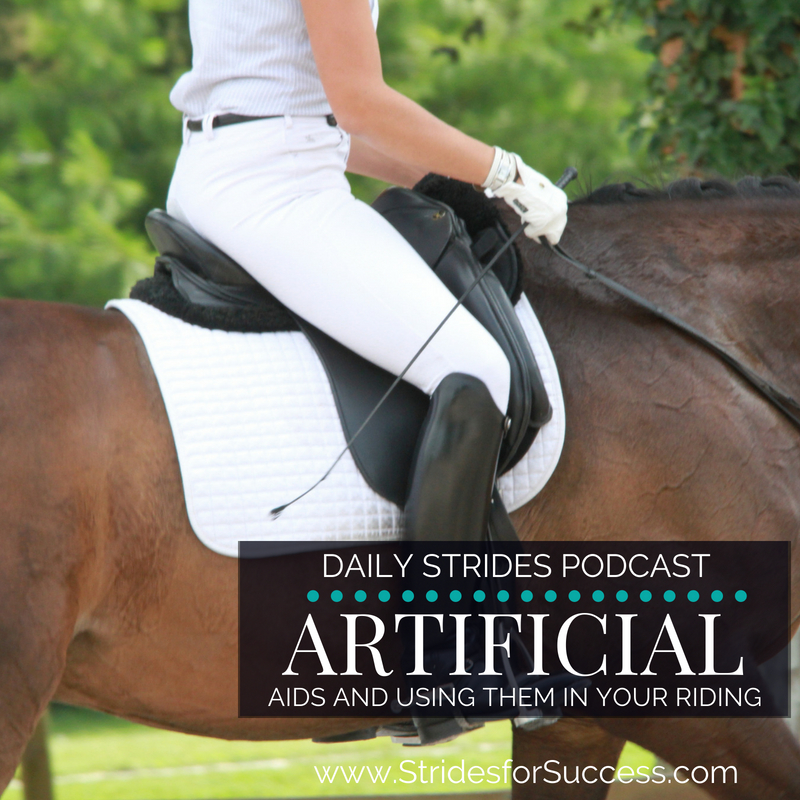
    Artificial Aids and Using Them in Your Riding

    What this episode is all about & how it can help you:-

    • Identify the types of artificial aids
    • Know when you need to back up your natural aids
    • Understand the relationship between your inside leg and inside hand when using a whip
    • Follow through and allow your horse to respond

    [smart_track_player url=”https://op3.dev/e/traffic.libsyn.com/dailystridespodcast/1059-Using-Artificial-Aids-in-Your-Riding.mp3″ title=”Using Artificial Aids in Your Riding” social_linkedin=”true” social_pinterest=”true” social_email=”true” tweet_text=”Unsure about using a whip or crop when riding? Here is a way to use it that will only add to your overall conversation with your horse…” hashtag=”Podcast #Equestrian” twitter_username=”strides_success” ]

    Hands up if your communication with your horse, using your natural aids, leaves you feeling like there’s quite a bit being lost along the way?  Your hand is one of a sea of hands, so don’t feel too alone!  Many riders become frustrated over time due to the lack of effectiveness of their aids.  Luckily it is something that can be worked on, starting with the next time you are in the saddle.

    Using artificial aids are one of the ways you can begin improving your overall communication with your horse.  They work by drawing attention to those missed or ignored natural aids. 

    I realise that this is a topic that has the potential to divide riders; some are on the fence, some are in the ‘yes, use them’ camp and others are in the ‘no, they’re cruel’ camp.

    I personally feel that artificial aids are a great resource if used responsibly and carefully.  They can definitely add to the overall conversation with your horse

    In this weeks episode of the Daily Strides Podcast I will help you to feel more confident about using your artificial aids to improve the overall conversation with your horse.  I will explain how to use these additional tools responsibly and in a way that can only add to the overall ride.

    The Types of Artificial Aids…

    Artificial aids are anything that you carry or wear which will add or enhance how you can communicate with your horse. Your ‘riding’ artificial aids are whips and spurs. There are many other aids, or ‘gadgets’ which can be used, more by the horse wearing them.

    In this episode I want to focus on the artificial aids available to you in your riding, ones you can use in the saddle to back up your natural aids. Specifically whips or crops.  I feel that spurs are the next level up when it comes to artificial aids and should only be used by competent, ‘quiet’ riders who have already refined their aids.

    There are two types of whips, a jumping whip or crop which is shorter and a schooling or dressage whip which is longer. The lengths will vary, but are around 60cm and 90cm respectively. 

    A Jumping Crop Versus a Schooling Whip

    As well as there being a difference in length, there is often also a difference in thickness and weight as well.  The jumping whip is shorter and ‘sturdier’.  The dressage or schooling whip is longer, thinner and more elegant looking.

    The reason I am going to suggest that you begin with a schooling whip is due to your hand being able to remain on the rein while you are applying the aid.  

    A jumping crop requires you to place both reins into one hand first and then apply the aid.  The schooling whip only requires a simple ‘flick of the wrist’ to activate it.  This allows you to remain consistent with your contact while using the aid to back up your leg.

    Because your artificial aids are used to back up your natural aids, it is important to remain as consistent as possible when applying them

    Backing Up Your Natural Aids

    The only reason you use artificial aids is to back up your existing natural aids.  Your whip should never be used on its own or independently.

    Natural aids often require ‘backing up’ due to the horse either ignoring them, or not being as responsive as you want or need him to be. 

    Before you begin using your whip, it is important to make sure that your horse is not either of the above because of how you trained him.  Continuous nagging with your legs will often result in a horse who ‘zones out’ from the rider.  Similarly, inconsistent use of the aids will also cause confusion and a ‘lag’ in the horses overall responsiveness.

    Your whip should only ever be used responsibly, which means you are being clear and fair in how you are communicating and asking your horse to do things.

    Your Inside Leg & Your Inside Hand

    Hmmm… We always hear about the relationship between our inside leg and our outside rein, not the inside and the inside!  However, when it comes to whips and crops, this is the relationship we want to focus and become clear on.

    Your inside leg a bit like your ‘go’ button when riding.  Therefore in most (not all, but most) circumstances, your crop or whip should be carried in your inside hand to back up your inside leg. 

    This means that when you change rein or direction, your whip or crop will change hand to the ‘new’ inside hand.  Now, obviously there are times when you will actually need to back up your outside leg.  However, when getting started with using a whip, work on always carrying it in your inside hand ready to be applied when needed.  

    Applying Artificial Aids Responsibly

    I want you to think about how your artificial aid is only ever there to back up your natural aid.  It should not be used alone or independently.

    Simply put, you must always first ‘ask’ with your natural aid.  If your ‘ask’ is ignored or the response is slow, then you can immediately use your whip to back up your leg.

    Coupling the ask with correct timing is essential.  Your horse must associate the tap – an important word – of the whip to your ignored leg aid. Which is why ‘where’ you ask is also so important when applying the artificial aids.

    Your whip will ‘tap’ your horse directly behind your inside leg immediately after your original leg aid was ignored. 

    The whip is only to bring his attention to your leg aid.  It is like a pointer on a blackboard.  The pointer in and of itself is not the lesson.. It is just a way of turning the student’s attention to what really is important on the black board.

    Adding to the Conversation

    One of the side effects of refining your aids is how the overall communication becomes quieter between rider and horse.  You will begin to see how much of the ‘stuff’ being said, particularly by your aids, is actually taking away rather than adding to the conversation.

    Make sure that, before you go backing up an ignored natural aid, that it was indeed a necessary aid in the first place

    In order for your horse to respect your leg, your leg has to be worth respecting. The more responsible you are in how you use your leg aids, the more responsive your horse will become to your leg aids. 

    It all starts with you and how you are leading the team that is you and your horse. 

    Other Uses for Your Whip or Crop

    There are other uses for your crop or whip, other than just ‘going forward’.  Very often a tap on the shoulder can encourage a horse to remain straight if they are running out through the shoulder at a fence.  Or a tap can bring the attention to the outside leg.

    What is important is that the whip or crop is never used to substitute the natural aids.  Only when the horse is ignoring or failing to respond to the natural aid.  

    My biggest fear when giving riders a whip is that they start to become a little lazy in the saddle.  It is much easier to ‘flick the wrist’ than it is to truly engage your core and your seat.  It is easier to use the whip to keep the horse moving forward towards and over the fence than it is to truly channel the direction using your natural aids.

    When the whip is used correctly, it is a fantastic aid.  A tap that brings your attention to something is far nicer than being kicked hard repeatedly. 

    Allowing the Horse to Follow Through

    The final piece of using a whip, or any artificial aid really, is to make sure you are allowing the horse to respond and do what you have asked.  If you asked him to go forward; allow him to go forward.

    Keep in mind that your horse might be a little ‘over responsive’ initially to your tap – meaning he shoots forward.  Allow him to go forward and then slowly and gently bring him back. 

    Make sure you are not confusing your horse by blocking him going forward, and therefore giving him conflicting aids.  Your job is to allow your horse to respond to whatever you have asked him to do.

    The ‘balance of aids’ applies here just as much as when only using your natural aids.  It is only through time and constant adjusting will you be able to successfully find the balance that best suits you and your horse.

    Happy Riding

    Lorna

    Links mentioned in the episode:-


  • Increasing Your Horses General Responsiveness

    Increasing Your Horses General Responsiveness

    Are your horse’s response times a little dismal?  Do find yourself asking… and then waiting… and maybe asking again…  and maybe, just maybe, on the fourth or fifth request you are lucky enough to get a response?!  Responsiveness is the factor which can make all the difference with you and your horse when working together.

    Riding is a little like day-to-day life in this regard; a quick response to something will often set the tone for how the relationship will proceed from that point.  Slow or non-existent response times lead to frustration, hold ups, loss of attention and energy.  They leave an overall bad taste in your mouth.

    [smart_track_player url=”https://op3.dev/e/traffic.libsyn.com/dailystridespodcast/706-Increasing-Your-Horses-General-Responsiveness.mp3″ title=”Increasing Your Horses General Responsiveness” social_linkedin=”true” social_pinterest=”true” social_email=”true” tweet_text=”Increasing Your Horses General Responsiveness” hashtag=”horseriding #equestrian #aids” twitter_username=”strides_success” ]

    Riding a horse who is less than responsive to your aids is a frustrating place to be.  It results in the quality of the overall ride or performance to deteriorate. Accuracy, energy, balance, rhythm, transitions, straightness and just plain old enjoyment all diminish when your horse seemingly ignores you.

    Many riders will also notice that their progress stagnates; after all it becomes rather difficult to improve things when the basics are missing to begin with.

    But before we get into how you can begin ‘fixing’ your horses responsiveness, it is first important to figure out why your horse is indeed ignoring you.

    Many riders believe that horses who lack good responsiveness are lazy, unwilling and perhaps a little too laid back.  This can be true in certain situations, however, it is my experience that many horses are rather trained to ignore their riders. 

    This ‘training’ is usually unintentional, but it happens none the less.  When we speak about riding, it is good to remember that horses only learn what we teach them.  We teach what we do repeatedly or consistently… If you are doing the wrong things consistently in the saddle, your horse will begin to think that is the correct way of doing things.  I know, a bitter pill to swallow for many riders!

    Focus on ‘how’ you are asking your questions

    A good example of this is the walk to halt transition.  When riders are ‘training’ or ‘schooling’ in the arena, special attention is given to the quality of this transition.  The aids are timed to perfection, the coordination, the balance, the straightness, the rhythm – all beautifully carried out in the correct time and sequence to produce a wonderfully balance, square halt.

    However – on leaving the arena, perhaps to cool down on a short hack or the walk back to the stalls, both horse and rider seem to switch to ‘relax mode’.  While the relaxing itself it not wrong, very often the consistency of how things are done when in that mood is.  Horse and rider arrive at the barn and rather than the wonderful, well planned transition which happened 10 minutes earlier in the arena being repeated – the rider simply ‘hauls’ on the reins, the horse ‘falls’ into a standstill, legs everywhere, and the rider slides off…

    The next time they get into the arena, the same rider will complain and moan about the fact that their horse is ‘unresponsive’ to their aids.  Meanwhile they told, no – asked, their horse to be just that on arrival at the barn the previous ride.  Do you see the connection?

    The same applies with all elements and aspects of riding.  Your horses responsiveness is often a direct reflection of your consistency when asking

    Pay attention to what you are doing ‘between’ questions

    So once you become clear on how you are asking different questions, you need to also start focusing on what you are doing between those questions.

    We often hear the term ‘quiet’ used when describing riders.  It is a confusing term for many, but I suggest you begin associating the term with how the horse hears things, rather than us riders.

    When we are in the saddle, we are communicating all the time with our horse.  Understanding this simple concept is the first step to developing this ‘quietness’ in the saddle.  Can you turn up or down the volume of your aids?  Are you perhaps shouting at your horse, without even realising it?

    Shuffling, moving, shifting, driving, leaning, nudging, swinging, banging, fidgeting, collapsing, wriggling, pulling, tugging – the list is endless – all result in you speaking with your horse.   Is it any wonder that he begins to tune out and ignore everything.

    Riders who have little or no control over their movements in the saddle are like the chatty 3-year-old child…  You soon train your brain to ‘ignore’ the chatter, only paying attention when the tone / noise levels change.  Unfortunately, many horses who practice non-responsiveness are treating you just like that 3-year-old chatter box!  They only pay attention when you ‘shout’ at them, perhaps using your crop or an extra forceful kick…

    Improving Your Horses General Responsiveness

    Tweaking the conversation to improve responsiveness

    All good conversations have a purpose.  The reason you being to filter out the 3 year olds babbling, is just that, its nonsensical babbling!  There is no purpose to it.  The same applies to your aids.

    You need to begin thinking about every move you make in the saddle, and filtering out those that are only there for the sake of being there.  Become intentional about every single aid – regardless of where you are riding or what part of the ride you are on.

    I find that one of the easiest ways to begin this process is to firstly correct your position and posture in the saddle.  The correct position is hammered home by trainers and instructors the world over for a reason – it places you in the best place to be most effective with your aids

    From here, begin doing your homework regarding how best to use your body to communicate different questions to your horse.  Spend time learning about what aids are required the half halt for example.  Then start working on in-graining that sequence of correct aids into your riding, so as you don’t have to consciously think about them every time.  Put the basics on autopilot.

    Let Your Horse Know the Conversation Has Changed

    The final piece to the responsiveness puzzle is retraining your horse to understand and respond to your newfound clarity in the saddle.  This may take a while and can only be attempted once you have streamlined your aids / chatter / conversation first.

    Remember, by moving and ‘talking’ all the time, you have trained your horse to ignore you.  Now, you need to retrain him to the mindset that anything you ‘say’ from here on out will be of value and will only add to your conversation

    I suggest having a crop or riding whip for this.  Ideally we want your horse to respond to your seat, but those aids need to be refined first, before he can differentiate between a ‘speed wobble’ and an actual ‘aid’ coming from your body in the saddle.  Start with the simple lesson of ’cause and effect’ – you put your leg on, he responds to it.

    Cause and Effect

    The reason I say to carry the whip is because initially you may have to back your leg up with your stick.  Leg –  no response – leg and stick – response – reward.   The next time you can try again; Leg – response – reward.  It may take a few tries for your horse to realise that your leg is now a quality part of the conversation that must be listened to.  In my experience usually 2 to 3 repetitions is enough to get the point across.

    It is also important to remember that your stick / whip / crop is only there to back up your leg.  Not to be used alone at any point in the ride

    It should be used directly behind your calf muscle / lower leg / heel area, not on the shoulder or hind quarters.  To use it anywhere else in this situation is, in my opinion, confusing and cruel towards your horse.  It should also not be used with undue force.  A simple tap – a reminder of sorts – is enough to draw attention to your leg and get the desired result.

    Make sure that when you ask your horse to move forward, you are then ‘positioned’ correctly to ALLOW him to move forward.  Otherwise, again, it becomes confusing for your horse. 

    Re-schooling your horse to become more responsive is a challenge, however once you have your position and aids streamlined, progress can be achieved quite quickly.  Keep in mind that responsiveness is trained – unresponsiveness is also trained.  Make sure that what you are saying to your horse is worth listening to and from there, set the basics on autopilot.

    Happy Riding

    Lorna

    If you are finding that your horse is unresponsiveness to your aids, take responsibility and begin working on your coordination in the saddle.  Your ability to control your body results in your being able to have more ‘meaningful conversations’ with your horse, through your aids, when riding.  Join the 100% free 30 Day Rider Fitness Challenge today to begin reining in your ‘non-stop chatter’ when riding!

    This topic is the introduction to 4 more audio programs specifically focused on improving your horses responsiveness when being ridden.  The rest of the programs are created to be listened to while actually riding your horse.  You simply download the programs to your phone, pop your phone in your pocket and work through the exercises while you ride your horse.

    If you are interested in finding out more about these programs and all the lessons inside of Daily Strides Premium, you can visit HERE >> for more information.