Tag: seat aids

  • Weight Aids & using them with Intention & Focus

    Weight Aids & using them with Intention & Focus

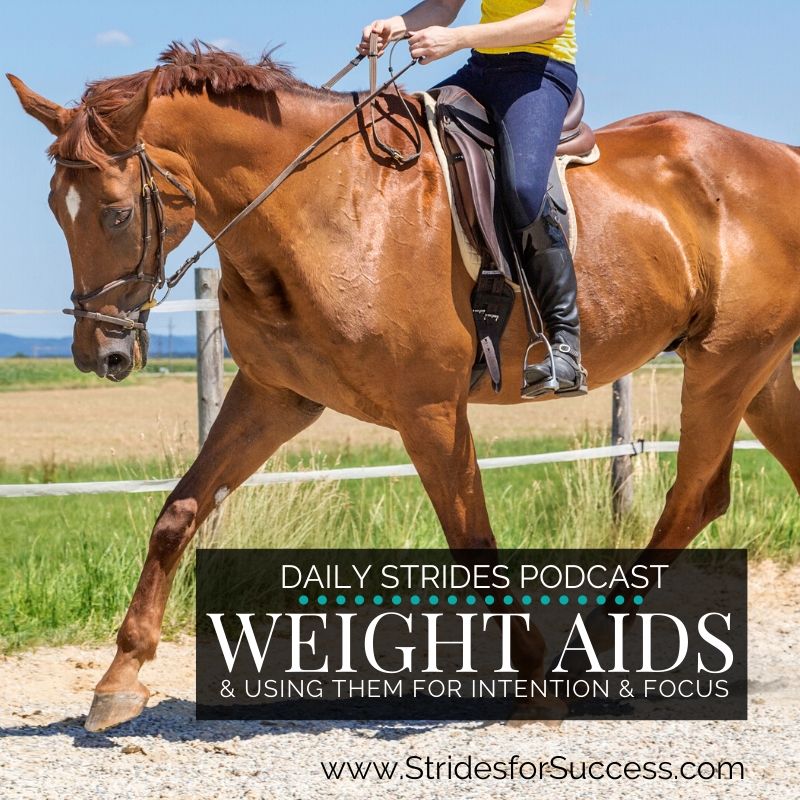
    Weight aids are often overlooked and underused by many riders.  I want to help you begin to see how powerful your weight aids have the potential to be in your riding.  I also want to use your weight aids to see demonstrate how power intention and focus have on your goals as well.
    Less is more where your weight aids are concerned.  Unfortunately, many riders seem to throw everything they have behind a weigh aid when they think they should apply one.  All this serves to do is unbalance both horse and rider.
    [smart_track_player url=”http://traffic.libsyn.com/dailystridespodcast/1126-Weight-Aids-Intention-and-Focus.mp3″ title=”Weight Aids and Using them with Intention and Focus” social_linkedin=”true” social_pinterest=”true” social_email=”true” tweet_text=”I’m going to challenge you here; I want you to see the connection between how you approach your weight aids in the saddle & how you approach your goals…” hashtag=”Equestrian” twitter_username=”Strides_Success” ]
    Your goals are similar.  If you put all your focus and attention on a single goal, you will soon find that life, in general, will become unbalanced.  And this can go against how many of us feel when we set goals.  We get all caught up in the initial enthusiasm of the potential outcome, often to our own detriment.

    Finding Balance

    Balance means that you have a center point where you feel happy.  As everything is moving and you are moving with it, you will make continuous small adjustments to make sure that you return to ‘balanced’ all the time.  Small little ‘course corrects’ that helps everything work together.
    In riding, I call this the ‘balance of aids’.  Yes, there may be a ‘leading aid’, however, all the other aids have supporting roles in order to keep the balance.
    Life is the same.  If you choose a single goal and decide to just focus all of your intention and energy on it, the rest of your life will suffer.  It may be able to sustain for a while, but sooner or later, things will begin to show the strain of this unbalance.

    How Most Riders Apply Their Weight Aids

    Next time you’re in the saddle I want you to do a little experiment…  I want you to ‘weight your inside seat bone’.  This is something most riders will have heard and tried to do at least once or twice in the saddle before.  What usually happens is riders go about weighting that inside seat bone with great gusto!  They literally throw everything they have onto the one seat bone.
    The result is that the now completely disregarded and ignored ’ non-weighted’ seat bone is just that – bearing absolutely no weight at all.
    In fact, I have seen where the ‘unweighted’ side of the riders ‘bum’ has daylight between it and the saddle…  This is definitely not a ‘balance’ of aids.  It is applying too much focus and directing too much attention at one aid.  Resulting in all the others being ignored – until they can’t be ignored anymore…
    The lack of balance caused by this overweighting of the seat bone also usually results in the rider twisting their body in order to remain upright and in the saddle.  They have lost alignment.  Their body will, automatically and without conscious thought, work at keeping them in the saddle and off the ground!

    Versus How You Can Apply Your Weight Aids…

    Okay, once you have experienced the thrown everything bar the kitchen sink approach to your weight aids, I want you to now try the opposite.  Sit back up straight in your seat.  Make sure there is an equal amount of your body either side of the center of the saddle; meaning you’re not crooked or leaning.
    Become aware of how your seat is in contact with your horse.
    Use this to shift your awareness to your core. Pay attention to how, if you engage your core, you can begin having a subtle, but real, effect over your seat bones. Bring your attention to your shoulders and hips.  Keep them aligned and focused on where you are going.  You can also think about your legs and heels.  Feel how the weight is distributed.
    Invest some time playing with how, by engaging specific areas of your body in a conscious, yet subtle way, you can weight your seat bones while still allowing the rest of your aids to play their roles.

    Approach Your Goals the Same Way

    Enthusiasm is great and will often help you gain momentum on specific goals, especially more difficult ones.  However, just focusing on one thing for any prolonged period of time will enviably result in you ignoring or neglecting other areas of your life.  I see this happen with many riders; particularly when the new year rolls around.
    Riders create goals that demand too much of their time, attention and resources if they are to be achieved when and where they want them to be
    This ‘lopsided’ approach ends up in the riders being unable to maintain their focus for any real length of time.  And this is where riders complain that they are not able to ‘make progress’ or ‘reach their riding goals’.  It is important that the goals you are setting are goals that both support and will be supported by the rest of your life. Your current lifestyle, resources, and schedule.
    The key to creating successful goals as a rider is to choose your equestrian goals so that they work with the rest of your life.  Rather than compete with the rest of your life…

    Go Find a Swing to Practice On…

    Here at Strides for Success and on the Daily Strides Podcast, I devote a lot of time helping riders to understand how to channel energy in the saddle.  How to direct the energy they are creating with their horse in a way that gives them the outcome they desire.  It is a pretty basic element of riding and one that must be refined if you are to make progress with your horse.
    Your weight aids are a great way you can begin to more effectively ‘channel’ the energy you and your horse are creating when you ride.
    I would love it if, sometime in the next 24 to 48 hours, you can go sit and ‘play’ on a swing.  A real-life ‘seat with two ropes tied out of something high’ swing. Notice how, first of all, you don’t actually need to ever put your feet on the ground to get you going, stopping or just swinging.  Your body, and more importantly, your weight, can do all of that if used effectively and correctly.
    Also notice how, if you ‘weight’ one of your seat bones, you can twist the swing.  The twist can be a little or a lot depending on how much weight you’re throwing on that seat bone and when you are doing it.  Once you have noticed all of this and you experience firsthand how powerful your weight and focus can be, begin ‘playing’.  Engage your core.  Make the movements more subtle.  Work with energy.  Then work against it.

    Take This Knowledge Back With You In the Saddle

    All of this can also be achieved by you in the saddle.  You just have to first believe it and then actively begin practicing and working on it.   When you’re on the swing, pay attention to how you are using your body to make those changes happen.  What muscles you are engaging in and in what sequence and combinations.
    Play and experiment with how much change you can have over the swing and the energy by just mindfully using your intention and your weight.
    Then do the same thing the next time you are in the saddle.  Play with your intention.  Experiment with your weight.  Notice how your horse responds and look for ways you can refine things with each ride.  Also, keep in mind that if you have been ‘throwing your weight around’ up to this point, your horse might just ignore those more subtle requests initially from you.  He simply won’t know he is supposed to pay attention to them. This is, again, where your balance of aids is so important.
    Use your other aids to tell your horse that the conversation has changed and that you are now focusing on being a little more responsible where your weight aids are concerned!

    Responsible Goal Setting for Your Riding

    My goal with this episode is to show you how, sometimes, being a little too enthusiastic with our riding goals is actually the reason we fail to achieve them.  I want you to think about your weight aids and how less is more.  Apply this same approach to your riding goals and see what happens.
    Maybe you can ‘stretch’ the timeline a little further.  Or it might look like setting a goal of riding 3 days a week, rather than 5.  It could even be a goal for spending one day a week just enjoying your horse’s company.
    Whatever your goals are for the coming year and beyond with your horse, I hope that this will help you to set ones that you enjoy working towards as well.
    Happy Riding
    Lorna
    Resources to help you with this topic

  • Improving Your Riding with Your Light Seat

    Improving Your Riding with Your Light Seat

    Have you ever considered how much you are either helping or hindering your horse when you’re riding?  Do you wonder what you could do, today, to begin improving your influence in the saddle?  Well, I am going to give you something fun to do in the saddle that will improve your riding – and put a smile on your face as well.
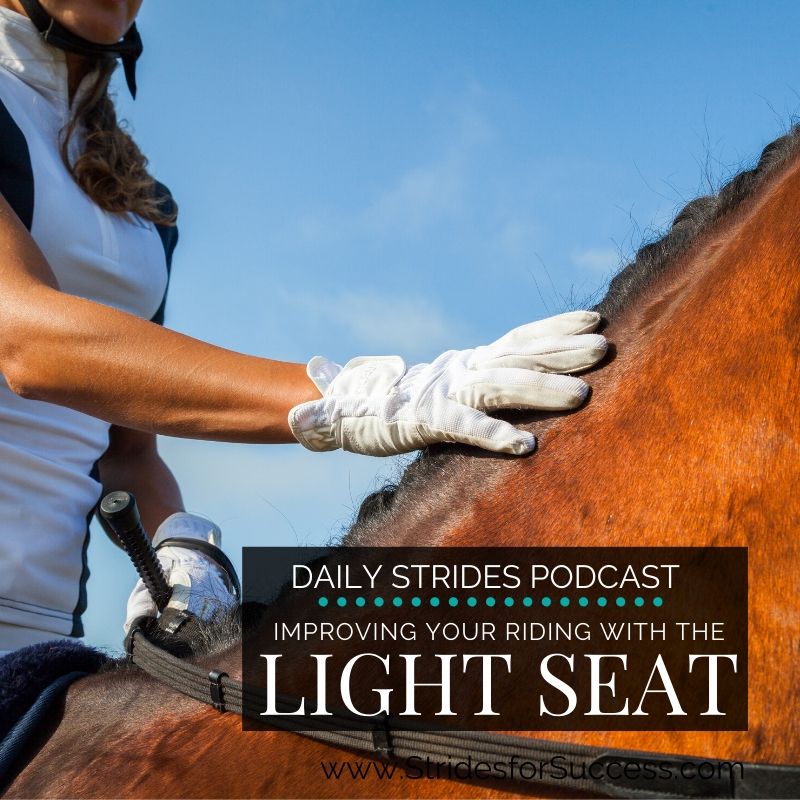
    I want you to begin figuring out how independent you are in the saddle when riding. You are going to do this by riding the light seat or two-point seat.  Your bum out of the saddle as you ride.  Some lovely daylight between the arse of your trousers and the seat of your saddle.
    [smart_track_player url=”http://traffic.libsyn.com/dailystridespodcast/1125-Improving-Your-Riding-with-Your-Light-Seat.mp3″ title=”Improving Your Riding with Your Light Seat” social_linkedin=”true” social_pinterest=”true” social_email=”true” tweet_text=”Something fun and different that will help you to improve your balance in the saddle…” hashtag=”equestrian #podcast” twitter_username=”Strides_Success” ]
    I already know that many riders will have clicked away by now, but if you are still here; good on you!  This exercise is for ALL riders.  Improving your balance will always improve the overall conversation with your horse, regardless of the discipline that conversation occurs in.

    What Is the Light Seat?

    The light seat happens when you are riding.  It involves you actually ‘standing’ on your own two feet while working your horse.  It requires you to balance yourself.  This means no leaning, holding on or crouching down on your horse’s neck, a neck strap or breastplate, or the pommel of the saddle.  Also, no holding onto the mane.
    Your stirrups will have to be short enough so that you can support your weight into your heels while having that all-important clearance between your bum and the saddle. 
    From here, you simply ride like you would normally do, but with your bum no longer putting weight on your horses back.  There are varying degrees of how much ‘daylight’ you have between your bum and the saddle.  However, I usually recommend a good amount of daylight when riders are starting off working in the light seat and this is due to it being a little more difficult to ‘cheat’ that way!

    Why the Light Seat?

    There are lots of reasons to use the light seat in your riding.  Probably the most commonly used one is when cantering or galloping in open spaces.  Sitting in your normal upright seat can get a little tiring and, well, bumpy!  The light seat allows the horse to move underneath you – and allows you to enjoy the experience.
    The light seat is also really useful when working over ground poles or small raised poles with your horse.  It allows your horses back to engage, without the rider being heavy and working against it. 
    The light seat is also useful when you find yourself partnering with a horse who is feeling enthusiastic and excited about working!  It lets the horse ‘work off’ some of the energy without fighting against him.  It also allows the energy to flow out if necessary to dissipate any excess energy that the horse may be carrying.
    Finally, the light seat is an excellent way to improve rider balance, fitness and overall coordination.  It allows riders to ‘test’ themselves and their abilities in the saddle, and have fun while doing so. 

    Your Base of Support

    So the first thing you want to do before you transition into the light seat is to make sure the weight is in your heels.  You will be ‘standing’ on your heels in the light seat. In order for this to happen your lower leg must be underneath you.  Not in front of you, or behind you.
    Simply put, if I was with you in the arena and I clicked my fingers and made your horse vanish – you would land on your feet. 
    Your foot must also be correctly positioned in your stirrup.  So many riders ‘square’ the iron with their foot.  However, the iron must rather be diagonally under your foot.  From the ball of your foot, diagonally across to the nail on your little toe is a good basic way of thinking about this. When your foot is correctly positioned in the stirrup, it allows your ankles, knees, and hips to become effective ‘shock absorbers’.
    Put differently, correct stirrup placement allows you to move with the energy of your horse, rather than bouncing against it. 
    As you move in and out of the light seat, remember to continuously check and improve your base of support.  Weight into your heels.  Lower leg underneath you and foot correctly placed in the stirrup iron.  If anyone of these three elements is missing or ‘off’, you will have problems with the light seat.

    Lifting Your Bum Out of the Saddle. 

    The big moment.  Liftoff!  And for so many riders this is one of those ‘easier said than done’ moments! However, there are a few things you can do which will help make it easier for you.  Firstly, think about engaging your core.  Your abdominal muscles.  Also, your back, both upper and lower.
    For many riders, engaging their upper back becomes easier when they focus on opening their chest.  Imagine if we held a measuring tape on your one shoulder and we wanted to measure the distance, across your chest, to your other shoulder. Make that distance as wide as you can by opening your chest.  This will help you engage your upper back.
    It will also help you to ‘open’ your arms, thereby becoming a whole lot clearer with your aids when communicating with your horse. Big deep breaths in and out.  Feel the expansion in your chest area.

    Straightening Your Back

    When you engage your back, it will become more straight.  This is important as it allows the energy to flow through your body.  Many riders, when they initially transition into the light seat, ride with an almost C shape through their back.  They curl their shoulders.  Which effectively collapses their upper body.
    When you focus on remaining engaged and straight through your back, you are committing to carrying yourself.  Your own weight, your own arms and hands.  It also allows you to carry your head – and focus on where you’re going. 
    If you are finding it difficult to straighten your back in the light seat, think about ‘sticking your bum out’ behind you. I know, it sounds so odd and, well, irrelevant.  But trust me, if your back keeps going into full ‘hamster mode’ and curling or collapsing, sticking your bum out behind you will help engage your lower back.
    When in the light seat, your lower back provides important support to your upper back.  Your core is fully engaged and working in order to help you remain balanced and moving with your horse.

    Independent Hands and Reins

    The negative effect of ‘leaning on’ or using your horse’s neck for balance cannot be overstated here.  in order to ride a true light seat, your hands and arms must be independent.  This is so you can continue to engage in the contact with your horse.
    There seems to be a misconception surrounding the light seat which many riders believe there is no contact when in it.  This couldn’t be further from the truth…
    Contact is just as important in the light seat as it is throughout the whole ride. 
    If your hands are touching anything except the leather of your two reins, you are leaning or depending on your horse for support.  Also, be careful that you are not leaning on the reins themselves for support.  You should be supporting you because you have a solid base.  You should not be relying on your horse for your balance.
    If you are struggling to balance, go back and reassess your base of support. Your heels, your lower leg and your foot in the stirrup.  Then asses your back and shoulders.  If they are all correct, you have a fitness issue – not a support issue!

    What Should Your Hands Be Doing?

    Your hands should be engaging in the conversation with your horse.  They should be ready to establish the contact from the energy that is now flowing more freely through your horses back.  This is where so many riders become confused with the light seat.
    They believe that their horse will ‘take off’.  Or that there is no real benefit because their horse is not working. However, I am going to challenge you to think a little differently about this.
    You can do almost everything you can do in your normal ‘upright, from a good quality light seat. 
    But you MUST balance yourself first if your light seat is to become an effective tool in your riding.  If you keep dropping your contact, every time you transition into the light seat, your horse won’t ‘work’ when you are in it.  Couple this with the fact that the reason most riders are dropping the contact is that they are leaning on the horse’s neck.
    One of the great things about the light seat is you allow your horse to truly engage his back, without hindrance from the rider. If you are leaning on his neck, this becomes impossible for the horse.
    Leaning puts a whole human worth of extra weight on the area of your horses body you are actually asking him to lighten…

    Transitioning In and Out of the Light Seat

    You go in and then you go out… In and out… Out and in…  This requires suppleness from the rider.  Strenght to support themselves through the transition and then suppleness to allow the flow of energy while they ‘hold’ the position.
    Practice moving in and out of your light seat while maintaining the contact and gently redistributing your weight.  
    You can also play with the amount of fold you are allowing through your hips.  More ‘fold’ will result in your chest moving closer to your horse’s withers. Remember, your back will remain straight.  Curling your back is very different from folding your hips!
    Also, when working your horse, realize that you probably don’t need as much fold as you think in order to be effective.  The light seat is so versatile, you can really experiment and see what suits you and your horse best.
    Happy Riding
    Lorna

    Other Resources to Help You With This Topic:-

  • 3 Mistakes Riders Makes when Riding the Sitting Trot

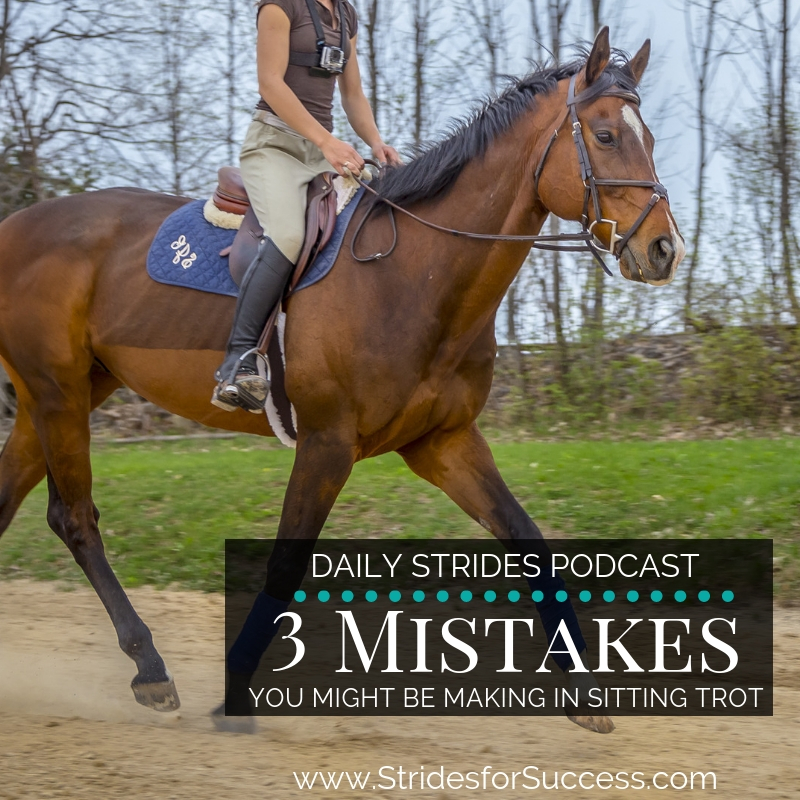
    3 Mistakes Riders Makes when Riding the Sitting Trot

    3 Mistakes Riders Make when Riding the Sitting Trot

    What this episode is all about & how it can help you:-

    • Think different words which will help you to move differently
    • Stop holding on in the sitting trot
    • Understand how to balance rather than ‘grip’ with your legs

    [smart_track_player url=”https://op3.dev/e/traffic.libsyn.com/dailystridespodcast/1072-The-3-Mistakes-Riders-Make-when-Riding-the-Sitting-Trot.mp3″ title=”3 Mistakes Riders Make when Riding the Sitting Trot” social_linkedin=”true” social_pinterest=”true” social_email=”true” tweet_text=”What not to do when riding the sitting trot with your horse… Daily Strides Podcast episode” hashtag=”horseriding” twitter_username=”strides_success” ]

    The sitting trot can be a challenge for many riders.  Being told how to ‘absorb the movement’ which can leave you scratching your head.  Or just move ‘with the horse’.  Another confusing term, especially when you have never managed it before.  This is going to be a little different…

    Have you ever noticed how it is often easier if you’re told what not to do, rather than what to do.  Sometimes the ‘don’t do this’ are easier to follow along with.  You can identify yourself better in those situations, possibly because they are already happening to you!

    In this episode of the Daily Strides Podcast I want to tell you what not to do in the sitting trot.  I hope that by hearing at least one of these things, you can have an ‘aha’ moment.  Knowing what you are doing wrong is one of the easiest ways to begin swapping out those habits for ones that better serve you.

    I believe that one of the reasons you might be struggling so much with the sitting trot, is because of how you are thinking about it.  Your mindset around the sitting trot.  The words you are using to describe it, which are influencing how you ride it. 

    Changing the Words Around the Sitting Trot

    If I asked you to think of the sitting trot or describe the sitting trot in one word, what would that word be?   For many riders the words bouncy or uncomfortable are top of the list.  Those types of words create a resistance in your mind, and therefore your body, when it comes to riding the sitting trot.

    Another common way riders make the sitting trot difficult for themselves is by thinking that they must ‘stay still’. No, you must move with your horse! In fact, ‘staying still’ will only cause you to work against your horse…

    If you can begin to reframe the words you are using to describe the sitting trot, you will begin to respond differently in the sitting trot.  ‘Moving with’ rather than ‘bouncing’.  Begin thinking about what you are telling yourself the sitting trot is, or is not.  Using different words will allow you to feel differently about how you approach the movement.

    Stop Holding On!

    One of the things that really drives me a little crazy when it comes to riders and the sitting trot is holding on.  Why do so many riders want to grab the pommel of the saddle, or the neck strap, when riding sitting trot?

    Holding on with your hands to something in front of you will NOT help you to ride a better sitting trot.  Your arms are simply not long enough! 

    What you will find is that holding on will cause you to either tip forwards into a fork seat, or close your chest and slouch your shoulders.  Both of those position faults lead to unbalanced riders, so rather don’t do either!

    Why This Affects Your Sitting Trot

    If you put a measuring tape from the point of your shoulder, across your chest to the point of your other shoulder, we want this to be wide.  When you hold on, it causes you to literally close or shorten your chest, which means you are no longer carrying yourself in the saddle.

    This ‘slouching’ and heaviness caused by not carrying yourself through the top half of your body stops your hips and seat from moving.  It shuts down your ability to follow your horse.  

    Disengaging your core, and therefore your seat, interferes with your overall balance, your ability to communicate with your horse and your effectiveness as a rider. It changes you from being a rider to being a passenger in the saddle.

    The result is that your movements, which will happen as the horse moves underneath you, will be too slow and stiff.  This leads to you moving against the horse, which leads to the ‘bounce’ or discomfort many riders experience in the sitting trot.

    How Lessons on the Lunge Can Help You

    I am a huge fan of riders taking lessons on the lunge.  You are on the horse, while a trainer or instructor is lunging the horse and giving you a lesson.

    It allows you, the rider being lunged, to not have to focus on the horse, and just focus on yourself and your habits.  

    One of the ways that I find it really helps riders to become more natural when riding the sitting trot is due to them being able to ride without reins.  Holding their arms out, or just ‘pretending’ they are holding the reins helps the rider to carry themselves.

    Lunging allows you to truly build your position and correct your posture in the saddle. Keeping your chest nice and open.  Keeping your chin up. All to allow your hips to move with your horse.

    Stop Gripping with Your Knees

    So many riders believe that if they grip hard enough, their legs are going to keep them in the saddle.  Unless you have legs of steel, your legs are not going to keep you in the saddle.

    Your legs are for communicating with your horse, not holding you in place when you ride!  

    In my experience, children don’t do this.  For the most part, their legs do not come far enough down their horses sides to be an effective ‘grip’.  However, adult riders are different.  I have met so many riders who are exhausted after each ride, purely from the effort required to ‘stay on’. Horse riding should not be that difficult!

    If you are gripping with your legs in the sitting trot, it can be a difficult habit to break…  Try thinking about how it is negatively impacting both you and your horse…

    For your horse, the gripping acts like a vice-grip on the horses back and most (maybe all) horses really don’t like that feeling.  They will try to get out from underneath it by hollowing or ‘running away’.

    The Clothes Peg Effect…

    For you, the gripping is closing down any supple movement through your body.  It is this movement that allows you to ride a smooth sitting trot.  Think of your legs, when they are gripping, as being like a clothes peg.  They are ‘tight’ and squeezing on your horses sides.

    Every bounce, and each stride will become a bounce when you are gripping, you take will ‘push’ you up higher in the saddle.  The ‘clothes peg’ will begin to slip off the horse – meaning you will begin to slip off the horse!

    Rather try to ‘drape’ your legs.  Like curtains. In constant contact with your horses sides so you can communicate. 

    Riding the sitting trot does not have to be difficult or hard.  If you can identify with any of the above, chances are that you are making this harder on yourself, and your horse, than it needs to be.

    Remember the ‘hinge’ movement and rather try to practice that in your sitting trot.

    Happy Riding

    Lorna

    I am hosting a free live online training on “The 6 Basics to Focus On in Your Riding” and I would love for you to join me there…  If you’re interested, you can register for your seat by CLICKING HERE

    CLICK HERE to save your seat in the free live online training

    Links mentioned in the episode:-


  • Building Your Riding Fitness

    Building Your Riding Fitness

    [fusebox_track_player url=”https://op3.dev/e/traffic.libsyn.com/dailystridespodcast/SFA421-Building-Your-Riding-Fitness-While-in-the-Saddle.mp3″ title=”Building Rider Fitness in the Saddle” social_linkedin=”true” social_pinterest=”true” social_email=”true” ]

    Do you find yourself huffing and puffing after a few strides of canter?  Have you been riding less recently and find that now your back in the saddle, you’re less effective than before?  Are you spending hours schooling your horse but seeing little to no difference in his way of going…

    It often amazes me how much time, effort, planning, and work riders put into conditioning and increasing the fitness levels of their horses. And yet completely fail to invest even a little of that towards their own fitness levels!

    Contrary to popular belief, riding is a team sport… You and your horse!  So it leads us to the fact that, as with any team sports, it is essential that all members of the team are doing their best to contribute to the team’s success.

    How Will Increasing Your Riding Fitness Help?

    Increasing your level of fitness with regard to horse riding has numerous positive consequences on your overall performance in the saddle.

    You will find that you become increasingly better able to communicate with your horse. And your aids will become easier to apply and clearer for your horse to understand

    You will also develop a more independent seat as your core strength grows. This, again, will increase your effectiveness in the saddle. Another huge positive result is that any stiffness and rigidness that you are holding within your body will begin to dissipate as you both physically and mentally begin to have more faith in your abilities. And, of course, your stamina levels will increase too…

    Meaning you can enjoy your more canters and for longer periods!

    Building Your Riding Fitness while in the Saddle

    Setting Yourself Up for Success

    Before we go any further, it is important that in order to ride these exercises, you are on a trustworthy horse. I also strongly suggest riding in a safe or enclosed area.  A young horse or a strange place is not the best time to try out new exercises. Especially ones that will test your balance and strength!

    If your horse tends to ‘wander’ when you are not directing him, perhaps creating a small chute in the arena using jumping uprights and poles will help. This will allow you to focus on what you are doing. And ensure that you get the most out of the exercises.

    These exercises are also excellent to do while warming up or cooling your horse down.  It is you that must do the work, not your horse!  

    Getting Started; Your Position

    I suggest beginning with giving your position a quick once over, and check that you are in a correct alignment.  Simply put, you’re sitting correctly in the saddle.

    Take your feet out of the stirrups, and start with some light stretches.

    After this, you can begin the first exercise. This involves drawing up your knees, one at a time, to your horse’s withers.  While you are doing this, pay close attention that your upper body remains straight and upright.  It is tempting to ‘curl’ your lower back and shoulders when performing this exercise but don’t.

    Focus on identifying your legs individually and then lifting them using only your leg to do so.  

    Use your core muscles to help you keep your balance while your knee is raised.  Hold it for a few seconds and then gently replace your leg and repeat on the other leg.  If you are feeling brave, you can raise both knees at the same time (jockey style), however again, make sure you are not crouching with your back and shoulders.

    Legs & Core Strength & Fitness

    This is a super exercise not only for your legs and core muscles, but also to help you make sure you are indeed sitting on your seat bones.  It also helps to relax the pelvis which will help with the other exercises and your riding in general.

    If you find that you are feeling unbalanced or concerned about ‘tipping over’ out of the saddle, rather ask your horse to halt and, having someone hold him still if necessary, complete the exercises while your horse is standing still.  

    With your feet still out of your stirrups, begin stretching your legs down nice and long.  Then one at a time lift your leg away from your horse’s side. There should be daylight between your leg and the saddle.

    Try to lift your lower and upper leg. But, make sure that while you lift, you are not leaning your body weight to the opposite side to lift your leg for you!

    The lift must come from the muscles on the outside of your hips and the sides of your torso.  Pay attention that your body remains upright and not collapsing down.  

    After you have managed to lift each leg individually, you can then try lifting both legs together.  Again, it is tempting to lean forward and curl your upper body. But try to continue carrying yourself as you perform the exercise.

    Introducing Sitting Trot

    You can also incorporate some sitting trot work into this initial warm-up.  Pay attention that you are keeping your pelvis and thighs open. Not gripping up, but rather stretching your leg down around your horse.

    Focus on allowing your lower body to move with your horse in almost a back and forward motion rather than an up and down motion.  You can also work some circles into your school movements, all the while maintaining a good basic position.

    Posting in the Walk

    Another great exercise you can work on to increase your fitness levels is posting in the walk.  Obviously you will need to take your stirrups back for this exercise, and once your feet are in…  Yes, you guessed it; Check your position!

    Posting or performing the up-down movement from the rising trot while walking can be quite a challenge. This is due to the fact that your horse’s natural momentum in the trot is not there to help you.

    Keep in mind that when you post or stand, you are doing so on your heel, not your toes.  

    Also, that your lower leg remains underneath you.  Many riders will try to use their upper bodies to ‘pull’ themselves up and whether or not they use the reins, this is incorrect.  Rather think of pushing yourself up using your legs.

    Once up, it will require your core muscles to help you maintain your balance and lower yourself back into the saddle with the sufficient ‘grace’ that is required!!  Do not allow your body to fall back into the saddle as you come down as it will be uncomfortable, and may even hurt, your horse’s back.

    FREE 30 Day Rider Fitness Challenge

    Standing in the Stirrups

    Developing on from the highest point of this exercise, you can begin to ‘stand’ in your stirrups as you walk around the arena.  When standing, keep in mind that your knees will have to keep a slight bend in them in order to help you absorb the movement of your horse underneath you.

    It is, again, worth mentioning that you should not use your reins for support and balance while performing this exercise…  

    Rather hold a martingale strap or even a stirrup leather that is secured around your horse’s neck for support if necessary.  Also, make sure you do not collapse down into the saddle when you have finished.  Gently lower yourself into the saddle…

    Or remain ‘standing’ in to the trot and even the canter.  This will use your legs and also your core muscles to achieve it correctly.  Start off slow and for short bursts, working over time to longer periods at faster paces.  

    Additional Exercises to Increase Fitness

    Other exercises you can use, which we cover step by step in this week’s Daily Strides Premium are changing the variation of your posting while trotting.  Rather than the usual up, down, up, down, up, down; rather begin sitting or posting/rising for an extra beat.

    This would look like up, up, down, up, up, down, up, up, down, or the other way around; down, down up, down, down, up.

    All variations of this will firstly create mindfulness around what you are doing while you post or rise. And, secondly, require your core muscles to shift from sitting to the rising trot more frequently than your normal up, down, up, down does.

    You can also work in the two-point seat…

    In fact, this is a great way to initially test your riding fitness levels by seeing how long you can hold the position, independently, before sitting down.  Work at increasing this time period on a weekly basis.  Make sure, again, that the weight is down in your heel and that your back is straight, not rounded or arched.

    Your Riding Fitness Is Your Responsibility

    As you can see there are numerous ways to incorporate a mini-workout into your everyday riding and schooling.

    Very often with adult riders, time is the greatest challenge when it comes to fitness, however as before, all these exercises can be performed while you are warming up and cooling down.

    Happy Riding
    Lorna

    Additional Resources for Equestrians