Tag: sensitive

  • Relaxation when Riding a Hot Horse

    Relaxation when Riding a Hot Horse

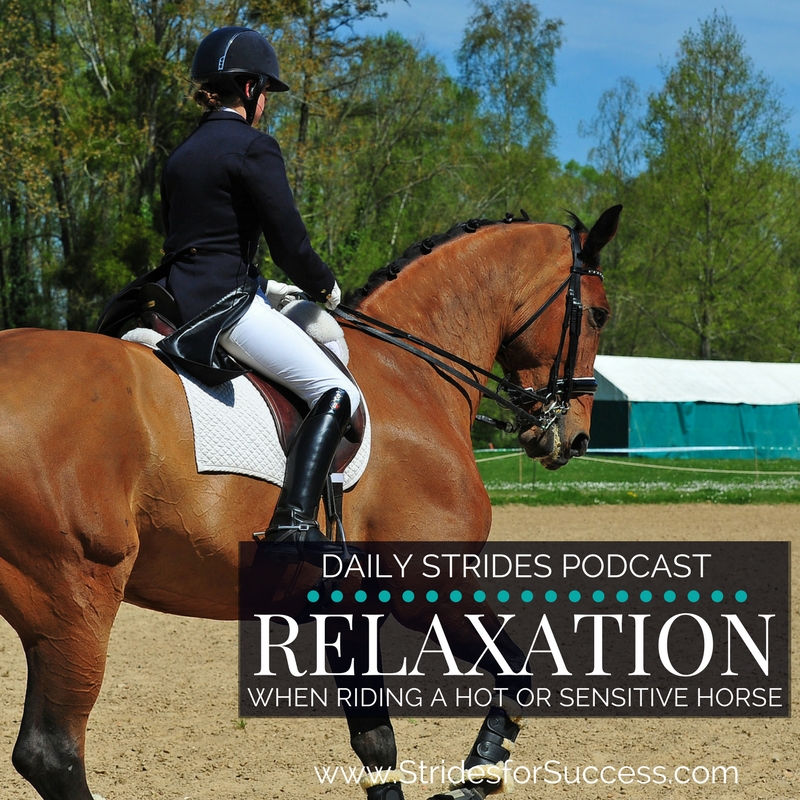
    Relaxation when Riding a Hot or Sensitive Horse

    What this episode is all about & how it can help you:-

    • Set an intention or baseline for each ride and encounter
    • Confidence and its direct link to relaxation
    • Becoming comfortable in the discomfort
    • What the ‘rinse and repeat’ looks like for relaxation

    [smart_track_player url=”https://op3.dev/e/traffic.libsyn.com/dailystridespodcast/1043-Relaxation-when-Riding-a-Hot-Horse.mp3″ title=”Relaxation when Riding a Hot or Sensitive Horse” social_linkedin=”true” social_pinterest=”true” social_email=”true” tweet_text=”Does relaxation seem like a far off distant ‘wish’ on your sensitive horse? This will help…” hashtag=”equestrian #podcast #relaxation #HotHorse” twitter_username=”strides_success” ]

    Have you been trying to work on relaxation when riding? However, your horse is just a little too ‘hot’ to relax. It seem the more you try to make him ‘relax’, the hotter and hotter he comes.  You’re not alone, it is a frustrating experience for many riders.

    This episode is focused how you can start to cultivate more relaxation when riding a hot or sensitive horse. I say sensitive because often the word ‘hot’ can bring up negative ideas. However, looking at your horse as rather being more sensitive means we can look at the situation with more compassion and less ‘heat’!

    Set an Intention for Each Interaction and Ride

    Before we go any further, relaxation is simply a lack of excess tension when the horse is being ridden.  Relaxation is also relative depending on the specifics of each unique situation.

    Relaxation is almost always accompanied by rhythm.  They are not the same, however it is very rare to have one without the other.  With this in mind, I believe that relaxation begins before you even interact with your horse each day.  Very often riders will arrive at the barn, and bring all their outside stresses with them.  The job, the dinner, the finances etc.

    What they fail to realise is this energy and frame of mind really and truly sets the tone for the interaction they have with their horse.  It sets the rhythm, which in turn will directly impact the relaxation.

    Becoming Aware of the Voice in Your Head!

    Why or how does this happen?  I’m not 100% sure, perhaps it is telepathy, perhaps not… What I personally think is that whatever you are subconsciously thinking about, the internal dialogue, is then being played out in your physical body.  The tension, frustration, anger, nerves etc.

    Because you then are in direct contact with your horse, and when riding you are actually using your body to communicate with your horse, this has a direct impact. 

    Setting a clear intention for each ride or interaction helps to prevent this from happening.  It helps you to get in the correct place mentally and emotionally in order to then interact, and therefore, influence your horse.

    Confidence and It’s Direct Impact on Relaxation

    This ‘head chatter’ can also have a direct impact on your confidence and your horses confidence.  I want you to think about something you do, which you are good at.  You have a level of confidence about it, which leads to a physical ‘ease’.  The task itself might not be easy, however you are almost flowing with it.

    The fact remains that very often the confidence issue can often be introduced by the rider.  Perhaps you are thinking about yesterdays ride.  Or maybe you are thinking about what ‘could’ go wrong.  Every time you get into the saddle, it is a whole new ride.  A clean slate.  Keep your focus on that fact and allow it to help you build confidence.

    Confidence is Equally as Important for Your Horse

    I also want you think about the fact that clarity leads to confidence.  When your horse understands what he is supposed to be doing.  When you are telling him ‘Yes, that is what I wanted, well done’, his confidence will grow exponentially.

    Confidence also comes when you build trust in your relationship with your horse

    As always, I am going to suggest starting on the ground, with basic groundwork to build that trust.  Create a rhythm on the ground.  Be compassionate in how you interact with your horse.  Build on it every day, routine and rhythm, routine and rhythm which will lead to a great trust when you are in the saddle.

    Groundwork builds your horses confidence, which will result in him being able to relax more through his body while being ridden

    Becoming Comfortable in the Discomfort

    Let’s take a different example this time to explain this concept… Imagine you are on a mare, she is a sensitive soul, and you can feel that the energy levels are definitely rising.  That feeling.  Most riders first reaction is to ‘rein her in’; literally using the reins to try to shut things down.  This rarely helps and often has the opposite desired effect by increasing the excess tension.

    Hmmm… Put yourself in the horses shoes here.  This is basically the equivalent of telling a highly stressed or excited human to ‘please relax’ or, even better, ‘calm down’.  It never works!  In fact, it has the opposite effect of making the person feel like they are not being heard or not being taken seriously.  It adds fuel to an already volatile situation.

    If you are beginning to feel frustrated, anxious, fearful in a situation, you are really only adding to the excess tension of the situation.  Rather feel your way a little through the discomfort.

    What does this discomfort look like?  It it almost an allowing of things to unfold, rather than jumping in to ‘control’ everything.  It is letting it ride for a few strides, rather than reining it in.  It is going with horse and learning to trust that all will be well.

    If you can become mindful enough to sit in the emotional or mental discomfort for a few seconds longer, the energy will begin to dissipate from that situation.  

    The result is almost always that your horse will also begin to feel more comfortable, which leads to increased confidence, which leads to greater ease, which leads to greater relaxation.

    If you stop ‘fighting’ it, the excess energy or tensions has nothing to fight and therefore nowhere to contain itself.  Obviously this is all within the confines of a safe and enclosed area.  Somewhere you feel confidence starting off.

    This Is Not a Physical Discomfort

    It goes without saying, but just for the record let’s say it anyway – this is an emotional or mental discomfort.  It is the voice in your head triggering feelings throughout your body.  There is no physical pain involved.

    The same principles apply for your horse.  Asking and allowing him to stay with the discomfort a little until it eases.  For many sensitive horses, this can be something as basic as having the riders legs in contact with their sides.

    Many riders with ‘hot’ horses, over time, learn to ride with their lower leg a little too far forward.  They see their leg as a ‘trigger’ for the horses tension levels.  However, in order to truly move forward in their training, those horses must learn that the leg is okay.

    It is an emotional discomfort for the horse, which can be eased if the rider is compassionate and consistent with letting it become the new ‘normal’.

    Yes, there will be moments of tension and anxiety, but you can learn to remain calm, confident and compassionate, your horse will soon become comfortable and relaxed in a previously stressful situation.

    How to Apply this when Riding?

    Let’s go back to our example of the mare who was beginning to feel a little excited or anxious underneath you.  Your job as the rider is to remain calm, be the energy you want her to mirror.

    Hold it out a little longer than you would have previously done.  This is you remaining in the ‘discomfort’.  Try to control where your mental and emotional energy is going.

    From here, you are then going to ask your mare to become a little uncomfortable with the situation.  Again, this is mental or emotional discomfort, never physical.  This can be when you begin to apply a little pressure through the half halt.  Keep in mind that the half halt is not an anchor thrown behind you in the sand, it is more of a suggestion to your horse.  A ‘heads up’.

    As soon as she begins to respond, you release the pressure, the discomfort.  It is as simple as that! Of course, it is also one of those often ‘easier said than done’ scenarios!

    Let’s be honest, it will take time and a consistent approach to really cultivate relaxation throughout your ride when in this situation.  However, it can be done.  You must be mentally and emotionally strong enough to lead the way for your horse.

    Happy Riding

    Lorna

    Links mentioned in the episode:-

  • Riding a Hot Horse

    Riding a Hot Horse

    Have you ever found yourself riding a hot horse where the slightest touch of your leg sends them shooting forward with the speed of a snake strike?  Even worse, once they start on that forward trajectory, they get heavier and heavier on your hand.

    It becomes more and more unbalanced until, eventually, there is an epic tug of war happening.  Horse and rider pitted against each other, often at speeds, which for the space you are currently occupying, are breakneck

    [smart_track_player url=”https://op3.dev/e/traffic.libsyn.com/dailystridespodcast/SFA346-Riding-a-Hot-or-Sensitive-Horse.mp3″ title=”Riding a Hot or Sensitive Horse” social_linkedin=”true” social_pinterest=”true” social_email=”true” tweet_text=”Is your horse a little too ‘hot to trot’?! Here is what to do:-” hashtag=”HottoTrot #equestrian #hothorse” twitter_username=”strides_success” ]

    Think ‘Increase Relaxation’ rather than ‘Slow Down’

    Horses become like this as the result of many different factors and influences.  It may be that they experienced pain or anxiety in a similar past situation.  Some horses are just a naturally more anxious or sensitive by nature.

    What’s important to remember is that rather than slow your horse down, you are instead looking for more relaxation.   This is both when he is being ridden and when he responds to your aids, particularly your leg and seat.

    Understanding Excess Tension

    Often when horses run away from the leg, they become tense all over.  They hollow their back, they raise their head, their muscles become stiff and taunt.  They also invite you to ride really badly… which is why the first part of retraining your horse is to make sure you are asking the correct questions in the correct, timely manner.   Also, that you are responding to your horse correctly.

    This takes consistent ongoing effort and rewiring if your horse is to accept your leg and seat aids.  Ongoing meaning months, if not years.  However, the effort is always worthwhile, for both you as the rider and the horse.

    Ruling Out the Obvious Culprits

    The first part of this is making sure your horse is not running away from anything causing him discomfort or pain.  This means checking him thoroughly for any medical or health issues as well as back or muscular problems.  Then ask a professional to check your tack and of course, have his teeth seen to on a regular basis.

    Riding a Hot Horse


    Correcting Your Position and Leg Aids

    Once you have covered all possible outside influences, we can begin to look at what you can actively do to retrain your horse to happily accept your leg.  To do this, I think it bears mentioning that you must have an independent seat and knowledge of how your legs must be correctly applied and the correct result or outcome to this application.

    So, once you are clear that your position in the saddle is correct and you have a sound knowledge of how to apply your leg and seat aids, I suggest investing some time developing your often overlooked voice aid. I really believe for horses like this, the voice is a tool you can use to begin reprogramming their reactions in a calm controlled way.

    Spend Time with Groundwork

    You can begin doing this by lunging your horse and observing their behaviour and their way of going.   Notice things that trigger a reaction.  Then, slowly, using your voice along with your other lunging equipment begin to ask more demanding questions of your horse.  Of course, all the while backing every question and response up with your voice.

    This time spent working correctly on the lunge will also allow your horse to experience how comfortable and enjoyable things can be if he relaxes and uses himself correctly… Without the interference of the rider.  Remember, often our horses are running away from us, whether we like it or not and sometimes the key to retraining is by taking us out of the equation initially!

    Training  to the voice first on the lunge gives you a ‘back up’ for your legs as you are riding.  It allows your horse to begin understand when he has indeed taken a step in the correct direction.  This is especially true when used in conjunction with an ‘offering’ of the inside rein to reward while riding.

    Your Actions Affect Your Horses Relaxation

    Talking also keeps you breathing while in the saddle.  This simply means you are less likely to tense up and become stiff, which your horse will inevitably pick up on and perhaps be affected by.  Your voice also focuses your horse on you and calms them.

    As I mentioned, the other great advantage of lunging is the fact that you can spot other influences that are causing certain reactions.  We had a particularly ‘sensitive & hot’ mare here a few years ago.  She was an OTTB and quite ‘goey’ as well as ticklish.  We noticed that when she was wearing a square saddle pad, rather than a shaped numnah, the her attitude changed and she became more difficult to work with.  We figured out that this was due to the corner of the pad ‘tickling’ her close to her sensitive flank areas.  We changed the saddle pad and while she was not ‘cured’, she was certainly easier to work with afterwards.

    Changing Things Up and Getting Out of the Arena

    The second suggestion I have is getting out of the arena.  Often sensitive horses over think things a little and begin to anticipate.  We then, in response to this anticipation, begin to tense up and a vicious cycle is born.  In these cases riding on roads, lanes or trails works well to relax a sensitive or hot horse.  It also demonstrates what you are actually looking for when you do venture back into the arena and how you are going to ask for that in future.

    You can begin this by focusing on regulating the tempo in trot while on the trail.  You are initially looking for a long, relaxed and low, if necessary, shape to begin setting a new ‘normal’ which you can work on improving in the arena.  Regulating the tempo has a calming effect and being out, perhaps with a friend, often relaxes horses and allows them to be more open to suggestions.

    I have to stress the importance here of consistent use of your leg.  Your horse has to begin to realize that you leg on their side is normal and not something to run away from and often the trail is a good place to start this due to the more relaxed feel of the ride.

    The Importance of Understanding How To Use your Leg Aids

    Remember keeping your legs off and only using when absolutely necessary, while initially will seem like it’s helping, will only prolong an already irritating situation.  He may initially rush or run away, however by keeping your legs there, quietly he will begin to relax and the tempo may slow, while the stride becomes longer.

    All the while I urge you to keep your leg on, gently..  Not gripping, not nagging, just there and asking questions when needed, such as inside leg for impulsion, outside leg to balance and straighten etc.  Once you have mastered this on the trail, you can then begin to look for similar results in the arena, using your voice in a similar manner to when being lunged and the same leg and seat aids from the trail.

    Ignoring the Invitation to ‘Ride Badly’!

    When you do begin working in the arena, or an enclosed space you may find that your horse will again speed up, fall onto the forehand and lose balance…  In order to end this tug of war, it is extremely tempting to take your leg off, however only reinforces in the horse that the leg means go and only go.

    You must essentially ignore all his invitations asking you to join in to that tug of war and rather stick with consistently applying your leg aids in a correct and also using the half halt to balance and regain his attention.  When you get a positive reaction, no matter how small, be sure to acknowledge it by rewarding with inside rein and allowing him to move forward again

    Do not allow him to rush, pull on your reins or lean on your reins and also do not stop using your leg.  Rather gently insist with half halt, remembering that so much of the half halt is your legs and seat, that he comes back and when he does so, rewarding with voice and a softening of the inside rein.

    Focus on Consistent Rhythm and Tempo

    When in the arena, work on regulating tempo but be careful of horse becoming stiff and tense though their back.  They sometimes lock against the rider, resulting in a horse that is noticeably ‘slower’ but that is stiff throughout their body and not using themselves to their full potential.

    Keep you leg in contact with the horse at all times, not gripping, but in contact.  If you need to desensitise him you can, beginning at walk, gently ‘rub’ or ‘swing’ your legs against your horse’s side.  Each time he tries to run forward, use your half halt, again including your leg, to let him know that it does not always mean rush forward.  However, I must caution you that I personally think desensitising him will open another can of worms later down the line, but I do know of people who have had success with this so it bears mentioning.

    The final point I want to make is that very often being sensitive to the leg means being sensitive all over, and horses like this pick up on the rider being tense and stiff.  I mentioned earlier the benefit of the voice, and from this point I believe it works both ways.

    Retraining a horse that runs away from your leg takes months of consistent work; paying attention to asking correctly and then rewarding when small progress is made.  Keep in mind that there is a big difference between allowing him to go forward and asking him to go forward; meaning that you must be prepared for the response to the questions you ask.

    Happy Riding
    Lorna

    Related Topics:-