Tag: Sitting Trot

  • 3 Mistakes Riders Makes when Riding the Sitting Trot

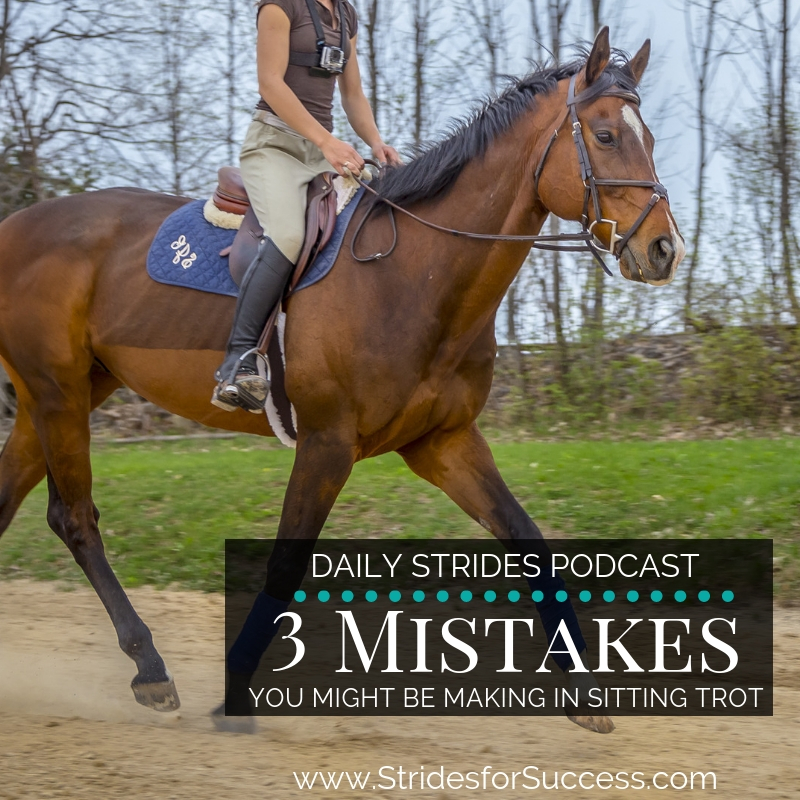
    3 Mistakes Riders Makes when Riding the Sitting Trot

    3 Mistakes Riders Make when Riding the Sitting Trot

    What this episode is all about & how it can help you:-

    • Think different words which will help you to move differently
    • Stop holding on in the sitting trot
    • Understand how to balance rather than ‘grip’ with your legs

    [smart_track_player url=”https://op3.dev/e/traffic.libsyn.com/dailystridespodcast/1072-The-3-Mistakes-Riders-Make-when-Riding-the-Sitting-Trot.mp3″ title=”3 Mistakes Riders Make when Riding the Sitting Trot” social_linkedin=”true” social_pinterest=”true” social_email=”true” tweet_text=”What not to do when riding the sitting trot with your horse… Daily Strides Podcast episode” hashtag=”horseriding” twitter_username=”strides_success” ]

    The sitting trot can be a challenge for many riders.  Being told how to ‘absorb the movement’ which can leave you scratching your head.  Or just move ‘with the horse’.  Another confusing term, especially when you have never managed it before.  This is going to be a little different…

    Have you ever noticed how it is often easier if you’re told what not to do, rather than what to do.  Sometimes the ‘don’t do this’ are easier to follow along with.  You can identify yourself better in those situations, possibly because they are already happening to you!

    In this episode of the Daily Strides Podcast I want to tell you what not to do in the sitting trot.  I hope that by hearing at least one of these things, you can have an ‘aha’ moment.  Knowing what you are doing wrong is one of the easiest ways to begin swapping out those habits for ones that better serve you.

    I believe that one of the reasons you might be struggling so much with the sitting trot, is because of how you are thinking about it.  Your mindset around the sitting trot.  The words you are using to describe it, which are influencing how you ride it. 

    Changing the Words Around the Sitting Trot

    If I asked you to think of the sitting trot or describe the sitting trot in one word, what would that word be?   For many riders the words bouncy or uncomfortable are top of the list.  Those types of words create a resistance in your mind, and therefore your body, when it comes to riding the sitting trot.

    Another common way riders make the sitting trot difficult for themselves is by thinking that they must ‘stay still’. No, you must move with your horse! In fact, ‘staying still’ will only cause you to work against your horse…

    If you can begin to reframe the words you are using to describe the sitting trot, you will begin to respond differently in the sitting trot.  ‘Moving with’ rather than ‘bouncing’.  Begin thinking about what you are telling yourself the sitting trot is, or is not.  Using different words will allow you to feel differently about how you approach the movement.

    Stop Holding On!

    One of the things that really drives me a little crazy when it comes to riders and the sitting trot is holding on.  Why do so many riders want to grab the pommel of the saddle, or the neck strap, when riding sitting trot?

    Holding on with your hands to something in front of you will NOT help you to ride a better sitting trot.  Your arms are simply not long enough! 

    What you will find is that holding on will cause you to either tip forwards into a fork seat, or close your chest and slouch your shoulders.  Both of those position faults lead to unbalanced riders, so rather don’t do either!

    Why This Affects Your Sitting Trot

    If you put a measuring tape from the point of your shoulder, across your chest to the point of your other shoulder, we want this to be wide.  When you hold on, it causes you to literally close or shorten your chest, which means you are no longer carrying yourself in the saddle.

    This ‘slouching’ and heaviness caused by not carrying yourself through the top half of your body stops your hips and seat from moving.  It shuts down your ability to follow your horse.  

    Disengaging your core, and therefore your seat, interferes with your overall balance, your ability to communicate with your horse and your effectiveness as a rider. It changes you from being a rider to being a passenger in the saddle.

    The result is that your movements, which will happen as the horse moves underneath you, will be too slow and stiff.  This leads to you moving against the horse, which leads to the ‘bounce’ or discomfort many riders experience in the sitting trot.

    How Lessons on the Lunge Can Help You

    I am a huge fan of riders taking lessons on the lunge.  You are on the horse, while a trainer or instructor is lunging the horse and giving you a lesson.

    It allows you, the rider being lunged, to not have to focus on the horse, and just focus on yourself and your habits.  

    One of the ways that I find it really helps riders to become more natural when riding the sitting trot is due to them being able to ride without reins.  Holding their arms out, or just ‘pretending’ they are holding the reins helps the rider to carry themselves.

    Lunging allows you to truly build your position and correct your posture in the saddle. Keeping your chest nice and open.  Keeping your chin up. All to allow your hips to move with your horse.

    Stop Gripping with Your Knees

    So many riders believe that if they grip hard enough, their legs are going to keep them in the saddle.  Unless you have legs of steel, your legs are not going to keep you in the saddle.

    Your legs are for communicating with your horse, not holding you in place when you ride!  

    In my experience, children don’t do this.  For the most part, their legs do not come far enough down their horses sides to be an effective ‘grip’.  However, adult riders are different.  I have met so many riders who are exhausted after each ride, purely from the effort required to ‘stay on’. Horse riding should not be that difficult!

    If you are gripping with your legs in the sitting trot, it can be a difficult habit to break…  Try thinking about how it is negatively impacting both you and your horse…

    For your horse, the gripping acts like a vice-grip on the horses back and most (maybe all) horses really don’t like that feeling.  They will try to get out from underneath it by hollowing or ‘running away’.

    The Clothes Peg Effect…

    For you, the gripping is closing down any supple movement through your body.  It is this movement that allows you to ride a smooth sitting trot.  Think of your legs, when they are gripping, as being like a clothes peg.  They are ‘tight’ and squeezing on your horses sides.

    Every bounce, and each stride will become a bounce when you are gripping, you take will ‘push’ you up higher in the saddle.  The ‘clothes peg’ will begin to slip off the horse – meaning you will begin to slip off the horse!

    Rather try to ‘drape’ your legs.  Like curtains. In constant contact with your horses sides so you can communicate. 

    Riding the sitting trot does not have to be difficult or hard.  If you can identify with any of the above, chances are that you are making this harder on yourself, and your horse, than it needs to be.

    Remember the ‘hinge’ movement and rather try to practice that in your sitting trot.

    Happy Riding

    Lorna

    I am hosting a free live online training on “The 6 Basics to Focus On in Your Riding” and I would love for you to join me there…  If you’re interested, you can register for your seat by CLICKING HERE

    CLICK HERE to save your seat in the free live online training

    Links mentioned in the episode:-


  • Avoiding the Trampoline Effect in the Sitting Trot

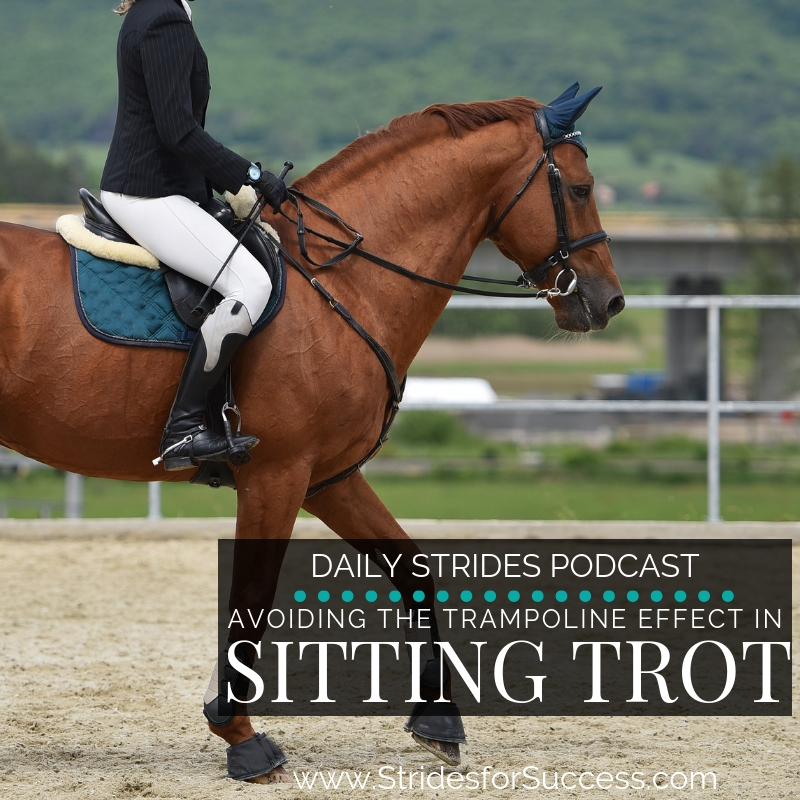
    Avoiding the Trampoline Effect in the Sitting Trot

    Avoiding the Trampoline Effect in the Sitting Trot

    What this episode is all about & how it can help you:-

    • Recognise the ‘trampoline effect’ in sitting trot
    • Understand why it’s not up and down, but rather forwards and back
    • Learn what the ‘hinge line’ is
    • Get started with practicing a smoother sitting trot

    [smart_track_player url=”https://op3.dev/e/traffic.libsyn.com/dailystridespodcast/1069-Avoiding-the-Trampoline-Effect-in-the-Sitting-Trot.mp3″ title=”Avoiding the Trampoline Effect in Sitting Trot” social_linkedin=”true” social_pinterest=”true” social_email=”true” tweet_text=”Are you experiencing the ‘trampoline effect’ in the sitting trot? Daily Strides Podcast episode” hashtag=”equestrian” twitter_username=”strides_success” ]

    Have you resigned yourself to the fact that you are never going to be great at riding it?  You’ve taken on an approach of ‘what is the point of working on it when I can get by without it’?  You might have even convinced yourself that you are actually doing both yourself and your horse a favour in not working on the sitting trot; the alternative being to prolong both of your discomfort!

    If it’s the last reason, you can go ahead and give yourself a little pat on the back… I really believe that for every rider who is miserable riding the sitting trot, there is a horse feeling equally as miserable having to carry them!

    In this episode of the Daily Strides Podcast I want to firstly explain why you may be experiencing the discomfort and bouncing when riding the movement.  I also want to give you some ideas on how you can begin working on it, in a more comfortable way.

    What is the Sitting Trot?

    The sitting trot is when your horse is trotting and you are not moving your seat in and out of the saddle, as you would with rising trot or posting to the trot.  It is riding a trot with no ‘up downs’. 

    What I have found really interesting is the reactions of beginner or novice riders…  Those who have no idea that there is a rising or posting in the trot, they have far less issues with riding a sitting trot.

    They have not attached any stories in their mind around riding the sitting trot, such as it being bumpy or uncomfortable. And, amazingly, it usually is not any of those things for them!

    Many riders have an issue surrounding the sitting trot because they have been told it is the ‘bumpy trot’.  Or that they will have a black and blue backside afterwards.  But this could not be further from the truth.

    A well ridden sitting trot feels ‘expansive’ and ‘spacious’.  It flows and moves, horse and rider working together in perfect harmony.  It is also not that hard to achieve…

    Suppleness & Up Downs…

    One of the most spoken about and worked on principles when it comes to horses is suppleness.  However, I believe that suppleness is just as important for the rider as well.  A lack of suppleness in the rider will become very obvious, very quickly, when riding the sitting trot.

    The bounce in the sitting trot happens when the rider cannot move with the horse…  The rider lacks the suppleness to follow the horses movement.

    I think one of the big issues is that riders think of the trot in terms of ‘up and downs’.  Even when they are speaking about the sitting trot, it is again in terms of ‘up downs’.  That is essentially what bouncing is; an up and down movement. 

    However the sitting trot is not an up down, it is a ‘hinge like’ movement through your hips and pelvis.  A ‘forwards and back’ rather than the up and down.  

    I have a free resource here for you that contains quick stretches you can do before you mount up that will help you become more supple through your body. You can get it HERE

    What is the ‘Trampoline Effect’ in the Sitting Trot?

    When we don’t allow that hinge like movement through our body, or we can’t allow it to happen due to a lack of suppleness, the trampoline effect occurs.  This is when you and your horse fall out of sync.

    I love trampolines.  I tell you this, because I know exactly how a bouncy sitting trot and an unfortunate lack of coordination on the trampoline have the same effect on people.

    Imagine you are jumping on a trampoline with a friend.  This person is of a similar weight to you, or heavier.  They are a second or two ahead of your movement on the trampoline.  Meaning that they are touching down on the base or mat of the trampoline a second before you.

    They touch down, the mat gives way underneath them.  They both go down. Then the springs come into play and the mat begins to push them back up.

    Unfortunately this happens to be when you are touching down and instead of the mat going down with you, you meet it with an equal and opposite force.  It feels like a ‘knock’ or a ‘jolt’ underneath you.

    While your body is ready for going down, you rather find yourself being pushed up, which results in a lost balance and rhythm.  This is, unfortunately, what happens to many riders a couple of strides into the sitting trot.

    The Trampoline Effect when Riding

    In the sitting trot there is an opening and closing of the angle between the front of your upper thigh and the flat of your tummy.  Basic terms, I know, but it is a whole lot easier for you to visualise if I put it like that!

    This opening and closing, forwards and back, must synchronise with your horses movement.

    However, as the angle opens more and the movement becomes ‘bigger’ many riders are just not supple or fit enough to keep up with the rhythm which is set by the horses trot. 

    They find themselves getting left behind, which causes the trampoline effect to happen between their seat and the saddle.  They are going down, or back, as the saddle is going up or forwards.

    Feeling the ‘Hinge’ Movement

    I am going to suggest that you go right back to basics when beginning to work on your sitting trot.  All the way back to walk.  As you are walking with your horse, I want you to imagine drawing a line from hip to hip, through your belly button.

    This is your ‘hinge line’.  This is where the swing, the forwards and back movement, happens and can also be felt through your body. 

    The hinge line is just like a hinge for a door, except instead of being horizontal it will be vertical.  When you are allowing the ‘hinge line’ to work, you are essentially changing the angle between the front of your thigh and the front of your torso, or tummy.

    Riding the Sitting Trot

    Once you have identified the movement and how you are opening and closing that angle with each stride, I am going to suggest picking up a slow trot.

    This is perhaps one of the few times I will suggest you to not pay attention to the quality of your horses trot.  In fact, the slower the better is true initially as you begin working on this!

    Slowing it down will mean that you will be able to keep up with your horse and the movement that is happening underneath you.  I recommend continuing to ride in this less active version of your horses normal trot until you have truly mastered the sitting trot here.

    More Energy Means More Movement

    Once you have done this, you can begin to work on improving the quality of your horses trot as well.  The reason I suggest not doing this when starting off, is due to how much more suppleness is required as your horses trot improves.

    Your suppleness must be able to keep up with your horses expanded movements when the trot begins to increase in quality and energy. 

    As more energy is created in your horses hind quarters, and as this energy is flowing through the horses body and connecting to the front, more movement will happen.  It might not necessarily be faster, but rather a more ‘extravagant’ use of the horses body with each stride.

    Focus on allowing yourself to be led first and then later you can begin influencing your horse in the sitting trot.  Like most things, you must first learn to be led before you can lead. 

    Work on Straight Lines Initially

    The final ‘tip’ I am going to leave you with is to work on a straight line initially before attempting the sitting trot through bends, corners or circles. 

    The reason for this is due to so many riders struggling with balance when riding a bend.  Balance and the sitting trot go hand in hand together.  Build confidence in your abilities by working where you have the most balance in the arena.  This will usually be down the long sides.

    The good news is that your sitting trot can definitely be improved.  It can become more enjoyable for not only you but your horse as well.  However, it will require a lot of suppleness and good practice from you.

    Happy Riding

    Lorna

    I am hosting a free live online training on “The 6 Basics to Focus On in Your Riding” and I would love for you to join me there…  If you’re interested, you can register for your seat by CLICKING HERE

    CLICK HERE to save your seat in the free live online training

    Links mentioned in the episode:-


  • A Smooth Sitting Trot

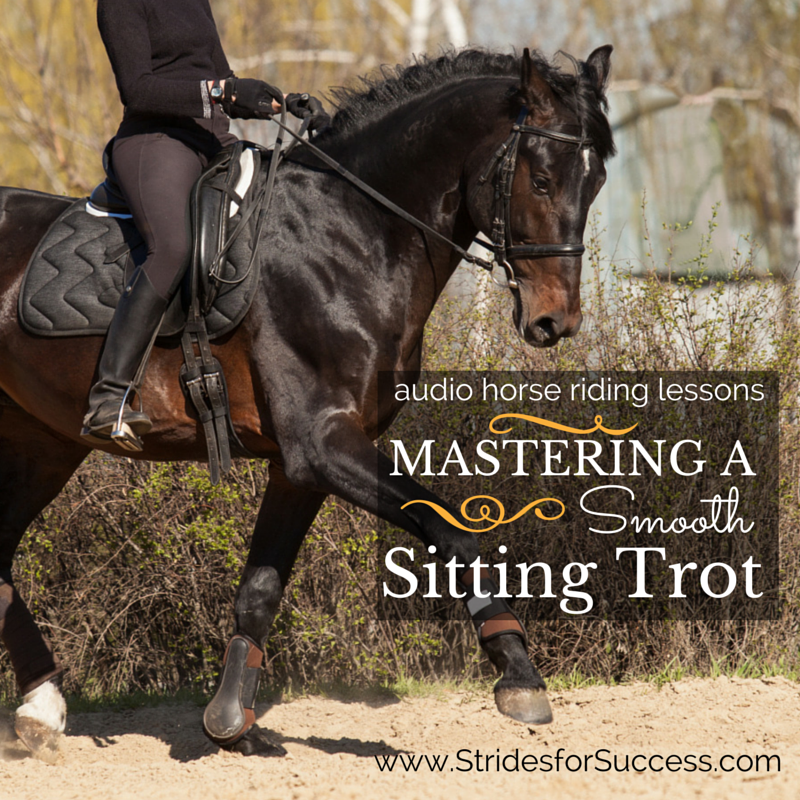
    A Smooth Sitting Trot

    [fusebox_track_player url=”https://op3.dev/e/traffic.libsyn.com/dailystridespodcast/SFA381-Mastering-a-Smooth-Sitting-Trot.mp3″ title=”Riding a Smooth Sitting Trot” social_linkedin=”true” social_pinterest=”true” social_email=”true” ]

    Does the thought of any sort of prolonged periods of sitting trot fill both you, your bum, and your horse’s back with a sense of dread?!  Perhaps the find the more you try not to bounce; the higher you appear to go?!

    Sitting trot is probably one of the most confounding things to master when you first begin riding. And often enough time is not invested at the beginning of your training to understanding the sitting trot. This leaves riders to their own devices, of which there are many, in trying to stay in the saddle and not bounce around like a gummy bear!

    Ideally, the sitting trot should be thought before the rising or posting to the trot, however, because sitting trot has gotten a bad name over the past few years, this is rarely the case.

    This leads most novice riders to think of it as difficult or hard, which does not have to be the case.

    Challenges with the Sitting Trot

    Riding a good sitting trot involves staying in the saddle and moving with your horse.  No bouncing and no daylight between your backside and your horse’s back.  However, this is often easier said than done.  What happens is when your horse’s back moves up on the first stride of the trot, you move up with it.

    However as your horse’s back moves back down, you are not quite quick enough to move with your horse and your ‘coming down’ is now a fraction of a second behind your horse’s movement.  

    This can be due to a number of reasons and the problems begin to present themselves when your horse’s back moves up again, while you are still on your way down.  The saddle or your horse’s back will ‘bump’ you and this causes the bounce, of which two or three in a row is usually enough to put most riders off balance and results in them clinging on by any means possible!

    The Trampoline Effect

    The same effect is experienced when on a trampoline with another person. If they touch down on the trampoline before you do… Their bounce coming back up meets your legs coming down… And results in a huge bounce, knocking you completely off balance and sometimes off the trampoline itself!

    When the bouncing begins, so do all reactive actions that riders take to try make the bouncing stop, all of which only make the bouncing worse and get the rider further and further away from their correct position, which is essential to correctly move with the horse and stop the cycle.

    What Not to Do…

    Common faults include gripping with upper thighs to stay in the saddle or using your reins to balance yourself.  Collapsing your upper body and rolling into an almost fetal position is also popular!

    Gripping with knees and/or holding the arch at the pommel of the saddle is another common occurrence. And, of course, flapping the legs. I have even seen riders hanging on around their horses neck!!  Not good folks, not good!!!

    Sitting Trot; the Right Way…

    A smooth sitting trot begins with being relaxed enough to move with your horse.  

    However many riders confuse a relaxed body with a floppy body.  Relaxed means that while you are still carrying yourself.  You have simply released all the excess tension from your muscles.  There is the right amout of tension there.  This allows you to be pliable and flexible enough to allow that movement.

    Your hips and pelvis will certainly move up and down in the sitting trot.  However, there is also a slight backward and forwards movement happening as well.

    Becoming Like Jelly…

    The strange thing about initially riding a sitting trot is that often the best way to learn how to actually begin moving with your horse is to ride a little incorrectly.  This is just so you can begin to really feel what is happening under you.

    You can then begin ‘polishing’ things up and holding a correct position for longer each time.

    Firstly, make sure your legs are long and not gripping upwards.  Focus on keeping your toes up, which for some reason seems easier to think of than weight into the heel in this particular situation.  Also, keep your knee off the saddle.

    By ‘off’ I mean no gripping or squeezing, just a very relaxed knee laying gently against the saddle.

    Next, look at opening your pelvis.  Do this by allowing your thighs to relax and open up.  Again, no gripping, or pressing…  Just gently draped down over your saddle and relaxed all the time.  As you ‘open your pelvis’, allow your body to sink down, so you are no longer really carrying yourself in the saddle and are actually becoming heavy.

    Again, I have to stress, this is not the correct way to ride, however often when riders are stiff or tense, ‘over relaxing’ is the key to allowing them to feel for the first time, what it is like to move with their horse instead of tensing against each stride.

    Move With Your Horse

    Once you have relaxed everything, you will probably feel almost like you are leaning back a little and are quite low in the saddle.  Don’t hold this position for too long and it is uncomfortable for your horse, not to mention bad for your back. However, while there try to notice how your horse’s back is moving underneath you.  I

    f you feel confident, you can try a few strides of a very slow trot and see how, in this ‘jelly-like’ position, you stay on the saddle, not bouncing off it.

    Self Carriage for the Rider

    Once you can master the sitting trot in a completely relaxed position, you can begin to carry yourself again.  Do this by engaging your core muscles, in particular your abdominal muscles.  Notice how, when you engage the muscles in your tummy, you lift your body up.  You are still relaxed, however now you are beginning to carry yourself.

    Again, ask for slow, short trots, making sure not to spend too long in the gait as, until you can master carrying yourself and allowing your pelvis to follow. Otherwise you will feel very heavy on your horses back and may cause him discomfort.

    As you use your core to carry yourself, pay attention to how you are sitting up through your body. Almost as though you don’t want your rib-cage to squash the organs underneath.  Work on keeping your chest open. The points of your shoulders opened out and no ‘creases’ on the front of your tummy.   Try not to arch your back or pull your shoulders back, as this will only cause you to tense your lower back again. This will lead to straight back to bouncing.  You must carry your upper body so your pelvis, hips, and seat can indeed move with your horse

    Sitting Trot is Like Dancing…

    Sometimes we hear that we must try and absorb the energy. However, this is often difficult to visualize or understand for many riders.  If this is the case for you, rather think of moving with your horse. Like a dancing partner.

    Each of you is responsible for carrying and supporting your own body and all the while, you move together.

    Another exercise you can try is to put both reins into one hand and, bending your elbow, place your other arm behind you with your hand flat on your back.  This works in two ways; you can feel what is happening with your back as you ride, but also, your elbow is now slightly behind your shoulder, which will help keep your upper body and chest area open.

    Lastly, remember to keep on relaxing through your legs so you do not grip up.  A ground pointing toe is often the result of gripping up with the legs, so pay attention that legs are hanging down, with the weight going into your heel.

    Start with a Few Strides of Trot

    Again, begin by trotting 5 to 10 strides and then back to walk.  Repeat until you can really begin to understand what is happening to your body as your horse trots. But, also, that you don’t have to concentrate on not gripping or curling forward.

    If you do run into trouble and feel like you are about to fall off at any time, lean back, push your heels down, and bring your lower leg forward.  Once you have regained your balance, begin working on ‘fixing’ your position again.

    As I mentioned earlier allowing yourself to become heavy and completely relaxed in the saddle is not correct. However sometimes as riders, we make such an issue out of our bouncing in the sitting trot, that we train ourselves to tense up in order to try to prevent it.

    Often the easiest way to untrain this is to feel what the movement is actually like with a totally relaxed body. Then begin to control your core so that it can support you and, most importantly, can move with your horse in the trot.

    Once you have mastered carrying yourself and not bouncing for the shorter, slower periods of trot, you can then begin to ride longer pieces of sitting trot as you are now moving with your horse, not against him.

    And, trust me, when this happens both you and him will be happier for it!

    Happy Riding
    Lorna

    Additional Resources for Equestrians

    Mastering a Smooth Sitting Trot