Tag: turn on the forehand

  • Turn on the Forehand; A Basic to Revisit This Week

    Turn on the Forehand; A Basic to Revisit This Week

    Forward and sideways. And yet, without leaving the spot you’re in… It can feel so contradictory and, maybe even asking for the impossible! But no, It is all possible. And pretty simple to get started with. You’re simply beginning to really work on turn on the forehand with your horse. So many riders fail to include the ‘forward’ part of the equation when working on this basic movement.

    And the power really does lie in the ‘forward’ aspect of this, especially when you take the time to revisit it from a more developed and more progressed place in your riding journey.

    If you are at a loose end with your horse this week, I am going to suggest incorporating turn on the forehand into your training somewhere. Whether it is on the ground, in groundwork. Or on the trail at a gate or fence. Maybe you’ll go the traditional route and practice in the arena. Whatever you decide, this versatile movement can help you and your horse at all stages in your development and work together.

    [fusebox_track_player url=”https://op3.dev/e/traffic.libsyn.com/dailystridespodcast/1162_Turn_on_the_Forehand3B_a_Basic_to_revist_this_week.mp3″ title=”Turn on the Forehand; A Basic to Revisit This Week” social_linkedin=”true” social_pinterest=”true” social_email=”true” tweet_text=”Looking for a basic to revisit this week with your horse? Try this…” hashtag=”horseriding #equestrianpodcast ” twitter_username=”strides_success” ]
    Turn on the Forehand; A Basic to Revisit This Week

    What is Turn on the Forehand?

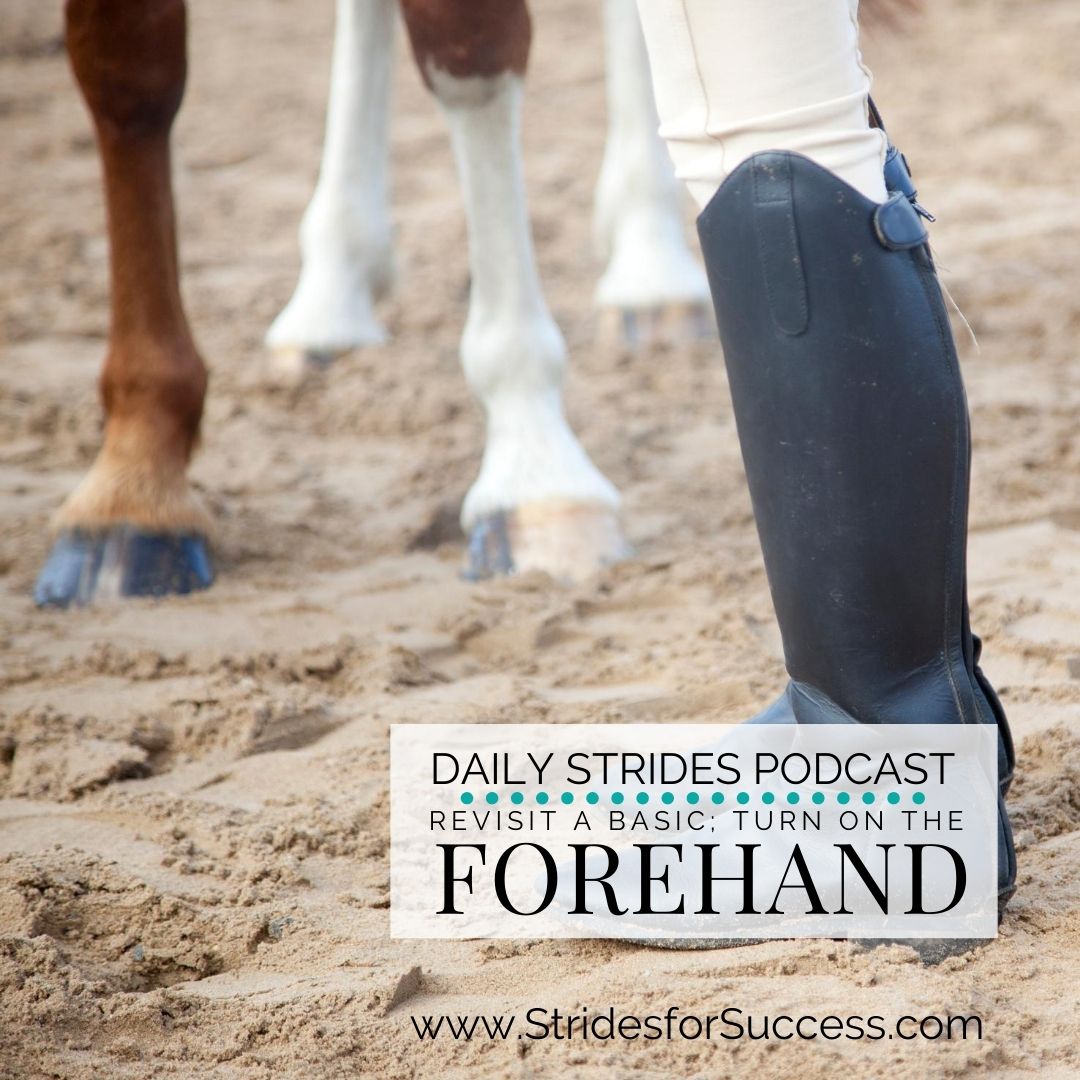
    Simply put, turn on the forehand is when your horse moves his back legs in an arc around his front legs, which remain stationary in one place. Obviously, in order to do this, your horse must turn his front feet as he is moving around so that his body remains aligned.

    And alignment is one of the keys to a good quality turn on the forehand; the energy must remain inside of the container of horse and rider.

    Imagine you are riding on the right rein around your arena. You halt on the track, by the rail; so your horse’s body is parallel to the rail or arena fence. Now, from this place, your horse will move his hindquarters to the right, towards the center of the arena. For the sake of this example, I want you to imagine that his hindquarters do a full semi-circle. A half-circle. This will mean that when he has finished he will, again, be parallel to the rail of your arena. But now you will be on the left rein, facing the opposite direction. And all without his front hooves moving too far from the original place they began from the initial halt.

    I have another post all about the mechanics of turn on the forehand HERE

    Thinking Forward ‘and’ Sideways

    One of the confusing elements of a turn on the forehand for many riders is how to incorporate the forwards into the movement. Forwards while really not going anywhere can be a difficult concept for many riders. However, this is really what makes the turn on the forehand so valuable to have as a basic you revisit and improve over time.

    Forwards begins in the heads of both horse and rider. Both must think forward first. Turn on the forehand, while not technically moving forward, requires forwardness in order to maintain rhythm.

    As the horse moves through the turn on the forehand, he moves in the sequence of the walk. His feet should follow the same pattern of movement that would happen if he was walking forward. Left hind, left front, right hind, right front, left hind, left front, right hind, right front…

    The goal is to maintain the sequence and rhythm of the walk. Except instead of moving forward, his back hooves move sideways. And his front lift up, rotate slightly and are put down as close a possible from where they lifted from.

    This requires ‘forwardness’, even if you never technically leave the spot you are working from…

    An Arc Inside of an Arc

    So, with the end goal being the front feet remaining ‘stationary’ while the back end moves around them, this is definitely something to work towards in your riding. Initially, you will probably find that your horses front feet do move a little. They will form their own smaller arc inside of the bigger arc created by the back feet.

    Part of the work of revisiting this basic movement in your training is to begin introducing the principle of collection to both yourself and your horse.

    Yes, the basic turn on the forehand is one of the simplest ways you can begin introducing this concept to your horse. Collection is a big topic. There is a reason it is at the top of the traditional training scale; it requires a lot of development from both horse and rider in order to correctly achieve. And yet, when you think about turn on the forehand, the movement of the front legs, if done right, requires collection.

    Collection is when the energy moves more ‘up’ than ‘out’. The front feet in a correctly performed turn on the forehand do just this; up not out.

    So look for an arc within the arc initially. However, as you revisit this movement again and again over the coming months and years, begin thinking about collection. Forwardness while staying in the same place. The up rather than the out.

    You Ask Your Horse To Move

    Another great benefit to incorporating turn on the forehand into your regular revisiting of the basics is that you fine-tune your ‘asking’ skills. So many riders try to move their horse using their aids. It is exhausting and distracting to both horse and rider.

    Your aids were never created to move an animal that outweighs you 10 to 1. Your aids simply ask your horse to move. You ask. He moves.

    And yet, riders want to literally shove their horse across the arena. Turn on the forehand really gets you thinking about the true work of your aids. To clearly communicate what it is that you want your horse to do.

    As a rider, you can only ever hope to better influence your horse. You cannot and should not try to physically move your horse!

    The Concept of Inside and Outside

    The final reason I love turn on the forehand is that it gets riders thinking differently. For most riders, up to the point where turn on the forehand is introduced, inside and outside is dictated by the horse’s position in the arena. The side closest to the railing is the outside. And the side closest to the center of the arena is the inside.

    Turn on the forehand requires the rider to think in terms of the flexion in order to identify inside and outside

    And this thinking about flexion and bend is the basis for clearer communication regarding suppleness, aids, channel, contact and so much more for the rider. It forces a new perspective in order to achieve a simple result. Over.

    Revisiting This Basic Regularly

    I am a big believer in the basics. They are the foundation for all the fancy and complicated ‘stuff’ that riders want to achieve later in their riding. However, they must be revisited from each new level you reach as a rider. From each new perspective.

    I am going to suggest getting turn on the forehand into your training with your horse on a regular basis. And doing so from the new perspective each time.

    Turn on the forehand can seem basic. It can seem like a means to an end. The end being more complicated and fancy lateral movements. however, this humble movement is important in its own right. And it is often simple enough to give you and your horse a quick win while moving the whole conversation forward.

    Happy Riding
    Lorna

    Additional Resources on This Topic:-

  • Turn on the Forehand; How to Ride a Balanced One

    Turn on the Forehand; How to Ride a Balanced One

    Have you ever found yourself halfway through a turn on the forehand; either purposely or not?  Perhaps you were out hacking and there was a gate… You tried a little turn on the forehand, just like you had heard about, to open it, but ended up dismounting!  Or maybe your instructor or trainer mentioned it, you tried it with the best of intentions, but the final result looked nothing like how they explained it?!

    Turn on the forehand is often seen as the very first introduction to lateral work for you and your horse.  It is a great movement to begin introducing the concept of ‘yielding’ to your horse and because of this, is one of the best ways to set your horse up for leg yielding.  It requires discipline, balance, and coordination from your horse and it is a wonderful way of assessing those same qualities; discipline, a balanced seat, and coordination of aids, in the rider too.

    [fusebox_track_player url=”https://op3.dev/e/traffic.libsyn.com/dailystridespodcast/571-A-Balanced-Turn-on-the-Forehand.mp3″ title=”Riding a Balanced Turn on the Forehand” social_linkedin=”true” social_pinterest=”true” social_email=”true” hashtag=”equestrianpodcast” twitter_username=”strides_success” ]

    More Than ‘Entry Level’

    However, because it is seen as the ‘entry-level’ lateral movement, most riders do not spend enough time really mastering this movement before moving onto other, ‘more exciting’ things in the saddle!  In fact, because the turn on the forehand has been ridden so badly for so long by so many riders, a lot of instructors and trainers no longer use this tool when training riders and horses.

    This is a pity because while turn on the forehand might only be the beginning or first step of the lateral ladder, it does not mean that it is the easiest movement in the book to master.  

    In fact, the mere fact that you are introducing something new to your horse and then will use the same principles to build your further lateral movements should dictate that the ability to ask for and then ride a turn on the forehand should be of much greater importance when training riders and horses.

    I have found that the reasons many riders struggle with turn on the forehand is due to a lack of understanding about setting it up, confusion regarding the aids to work through it and also, lack of clarity on exactly what the horse should be doing with his body and feet to correctly perform the movement

    What is Turn on the Forehand?

    So, what is turn on the forehand?  Well, the simple explanation is that the horse’s hindquarters or back legs move in an arc or circular shape around the front legs, which remain very close to where they started for the duration of the movement.  So imagine your horse has halted square and you prepare to ask a turn on the forehand to the left.  Using your left leg, your horse will begin to move his hindquarters away, yielding, to your requests.  All the while, his front feet will remain in the same area as he moves his hindquarters around them.

    Picture the face of a clock and then the center of the clock, where the arms are attached to the clock face.  Your horse is the ‘clock arm’ and his front feet in the halt are exactly at the point, in the center of your clock, where the arms are secured. 

    Now, pick a place on the actual arc of the clock itself (where the numbers are on the clock face).  This is where the hindquarters are currently positioned at the halt.  The turn on the forehand is simply moving the hindquarters mark further around the circle, perhaps from the 9 o’clock mark, around to the 12 o’clock mark and even on to the 3 o’clock mark.  The front legs stay at the center of the clock at all times.

    Encouraging Flexion

    Your horse’s back should remain straight throughout the movement, so no curving or bending.  However, he will have a slight flexion at the poll to the inside, which he will maintain throughout the movement.  He will also step with all four feet, in sequence to walking, but with only the hind feet really covering any ground.   The front feet will merely march or keep time on the spot for all of their steps.

    A BALANCED TURN ON THE FOREHAND

    The rider must remain balanced throughout the movement.  They must ask for the flexion with the inside hand, weight the inside seat bone slightly, ask for ‘over’ with the inside leg, and then use the outside rein to balance that movement.  The outside leg will act as a ‘barrier’ of sorts, but also will help to keep the activity in the ‘steps’ as the horse moves across in turn on the forehand.

    When written in black and white, this all sounds simple enough, but such a simple explanation leaves the door wide open for a lot of different variations and wrong practices within the movement itself.

    Left or Right? Depends on Flexion

    The first part that can be confusing for many riders is the actual direction of the turn on the forehand itself.  If you are asked to ride a turn on the forehand to the left, your horse’s poll will flex slightly to the left – making this the inside -, his head will travel to the left during the movement and this, in turn, means the hindquarters will actually swing to the right (hence the confusion).

    So the named direction of the turn is the same as the flexion of you horse while he is performing the turn.  Your horse will be flexed to the inside, which is the leg you will ask your horse to move away from or yield to. So a turn on the forehand to the left will see your horse flexing through his poll to the left while moving to the right off your inside (left) leg

    Front Legs; Stationary or Not?

    Many riders are concerned that teaching their horse the turn on the forehand, with the front legs remain almost stationary, will surely mean that there is no forward movement happening – and this goes against everything they learn about riding.  However, I think this misconception comes from the fact that many riders think of turn on the forehand as just the back legs moving, the inside across in front of the outside, as the horse turns, with the front legs twisting along afterward, and forced to eventually move.  This is incorrect.  A true turn on the forehand will keep the rhythm and footfalls of the walk while it is happening.

    Think of it like the inside hind leg moves across in front of the outside hind leg, and in order to maintain alignment with the direction of the body, each of the other feet will step up, straighten out and put down, where they realign with a ‘square’ and also so as to keep the horse and rider balanced.

    So, while the horse is certainly not moving forward in the true sense of the word, the activity should be maintained throughout the movement

    Inside Leg to Outside Rein

    Another way to think about creating forward energy is by emphasizing the relationship between your inside leg, your horse’s inside hind leg, and the outside rein while the horse is performing the movement.

    Your inside leg will ask for the sideways movement, the horse will lift his inside hind leg and as he swings it across in front of his outside hind leg, your outside hand will subtly connect with that energy and tell him where to put it down.  

    Your outside leg will help to maintain the forwardness by reminding your horse, if necessary, to straighten up or align his outside back foot with the new position of the body.

    Balance of Aids

    I also want to highlight how the riders balanced seat and coordinated aids play a big part in successfully riding a turn on the forehand.  Many riders try to shove and push their horse around in this movement.  They collapse their inside shoulder and, consequently, their core muscles on that same side.  This causes their weight to shift to the outside of the saddle and is often the cause of the horse scrambling to get back under the weight of the rider to try to maintain balance for both.

    Remember to sit up through your body and ask for your horse to yield to your leg, not force.  

    I suggest that all horses are thought to yield to his pressure on the ground first, whether it be in the stable or through groundwork exercises in the arena.  Then, if your horse still struggles to understand, ask a person on the ground to help you.  Keep in mind that if your horse is confused, the chances of him doing the correct thing and, importantly, realizing what that was are very slim!

    Also, think of sitting up through your body and carrying yourself, so that when your horse does move sideways you are giving your body the best possible chance of, gracefully and subtly, following him there.

    Happy Riding

    Lorna

    Additional Resources on This Topic:-