Tag: Young Horse

  • Exercises to Improve Your Horses Coordination

    Exercises to Improve Your Horses Coordination

    Have you ever experienced moments when ‘lack of coordination’ seems to be the best description for you while in riding  your horse?  It often leads to feelings of clumsiness and a general lack of confidence in your abilities, right?  Well, imagine how it feels when your horse suffers a similar lack of coordination; lack of balance leading to an uncomfortable ride for both of you.

    This lack of coordination in horses is often associated with fitness and general conditioning, and this is partly true.  Your horse’s general fitness levels, or lack thereof, can play a large part in his overall ability to remain in a balanced way of going.  However, there are other factors that also play a large part in how well your horse can use his body, particularly when in a different or unfamiliar situation.

    [fusebox_track_player url=”https://op3.dev/e/traffic.libsyn.com/dailystridespodcast/646-Exercises-to-Improve-Your-Horses-Coordination.mp3″ title=”Exercises to Improve Your Horses Coordination” social_linkedin=”true” social_pinterest=”true” social_email=”true” ]

    Take your own coordination as an example; if you were to do a task that you do regularly, such as making a cup of tea or coffee in your own kitchen, you would find that your actions happen as though your body is on autopilot.  However, if I asked you over to my house to make some tea; you would find it much more difficult to do pretty simple tasks.

    The same principles apply to your horse, if it is something he does a day in and day out, his body has already figured out the best and most effective way for it to do that particular movement or task.  It is smooth and probably looks graceful and simple because it is done in balance in a way he feels comfortable.   However, just like your own tea making capabilities, when you begin to add different factors to your horse’s schooling, or change scenarios, things can become rather wobbly quite quickly!

    You have to agree that most young horses look wonderfully coordinated while in the field however, as soon as a rider is placed on their back it suddenly seems becomes a rather large effort to continue with one foot in front of the other without falling over!  This is the horse having to learn or adapt to a different situation – this particular one being having a rider on board

    We also see older horses struggling with coordination.  Particularly when they are ridden all the time in a beautifully manicured and maintained arena.  They are used to having perfect footing underneath.  But if you take them out of the arena, maybe on the trail or into an appropriate paddock or field; well things are very different.  The rhythm and balance are suddenly lost and it almost feels like the horse has forgotten all his past training.  Sure, you will have moments where it feels good, but for the most part, it is a disjointed effort that pales in comparison to when he is working in his comfort zone.

    When we are in the saddle, it is always a great advantage when your horse can adapt immediately to different situations you may find yourself in, quickly and without a break in balance or rhythm

    So the first step in improving your horse’s coordination is highlighting the quality of your transitions. This is something you can begin working on immediately when riding your horse the next time.  Focus on the balance and consistent rhythm of each individual transition.  Pay attention that your horse is not speeding up the tempo of the gait he is in before the transition.  Also, work on establishing the new gait as quickly as possible after the transition.   By becoming more concise and specific about how you prepare, and then ride each individual transition, you can begin conditioning your horse to balance himself better and adapt to different situations with greater ease.

    Don’t make the mistake of only working in the more exciting transitions, such as trot to canter and canter to trot.  Transitions that include halt, walk, and trot are equally as beneficial and often easier for the rider to be more consistent through.  Again, focus on the quality of the gait leading up to the transition, maintain that gait right the way until the transition occurs.  The transition itself should be coordinated, straight and smooth, and then followed by a good quality gait afterward as well.
    Imrpoving Your Horses Coordination

    The second thing you can do is working some lateral movement into his schooling routines.  Think of the transitions as really working him while moving in a straight line, tail to head.  The lateral movement then works him sideways, so working his body differently and forcing him to balance differently.  Very often horses that can adapt and who have good coordination are able to remain in balance while moving sideways.  Practicing this in the arena will begin to develop your horse’s ability to do this as well, with you on his back.

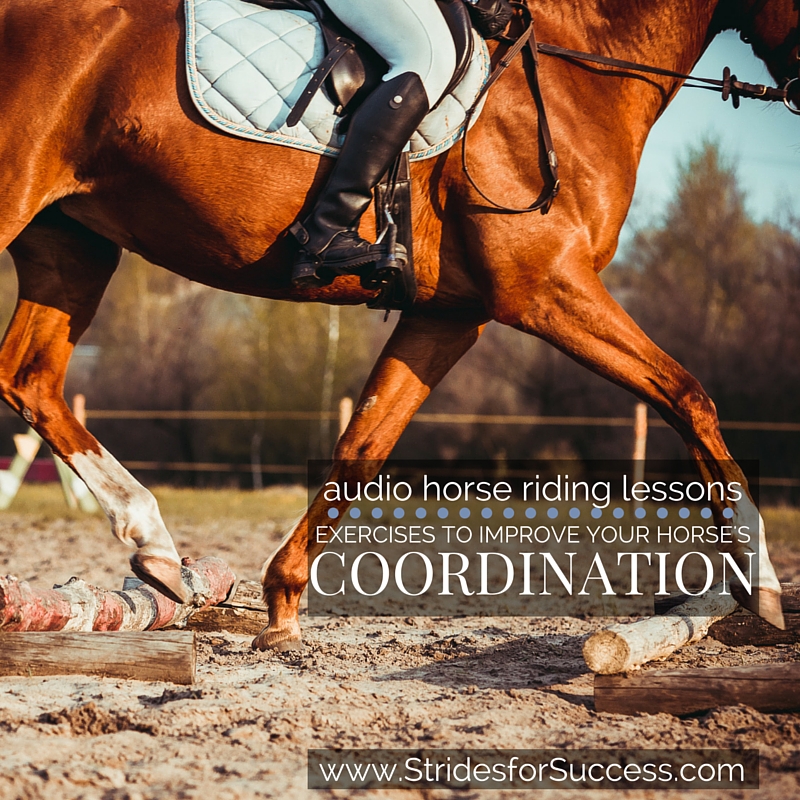
    One of the other ways to improve your horse’s coordination is to work him over ground poles.  He must become very aware of how he is moving his body and where he is placing his hooves.  Groundpoles also helps coordination by improving the physical strength of your horse’s back.  They ask more of his joints, his back, and his whole topline in general.  All this while remaining balanced and moving forward in a rhythmic manner is excellent for him.

    You can use single groundpoles placed randomly around the arena, with your horse having to ride different shapes to reach.  You can also use basic trotting poles, either flat on the ground or raised, and later you can build simple grids.

    Regardless of how you use the poles, they will definitely help your horse to become more aware of his feet and legs while being worked in the arena and build muscle and strength while doing so

    The final suggestion I have for you to begin improving your horse’s coordination is hill work.  I am not talking about steep, grueling inclines that exhaust your horse; rather mild inclines that ask him to use himself slightly differently, but in doing so, strengthen and condition his body.   You can work up and down the hills, and later once you are both happily walking and trotting up and down, you can begin asking different questions by introducing transitions into his hill work.

    Maintaining the rhythm of the gait while working and down hills is difficult for many horses.  It is also different because most hills will be either on the trail or in a paddock or field, making the footing or terrain a little less accommodating as well

    So improving your horse’s coordination won’t happen overnight, it will take time.  By working some of these exercises into your daily schooling, or warming up and cooling down, you will help your horse reach a greater level of coordination throughout his body, which will make riding more enjoyable for both of you in the long run.

    Happy Riding
    Lorna

    This blog post and podcast episode is an introduction to 5 audio programs on this specific topic, taking you step by step through exercises you can ride that will improve your horse’s coordination. The other programs are created with riding in mind and listening to them is literally like having a riding instructor with you while you school your horse. The lessons are easy to download onto your phone and then use when in the arena.

    To find out more about how you can get this week’s lessons, as well as over 600 others, you can visit www.stridesforsuccess.com/join/.
     

    [wp-tiles post_type=”post” orderby=”date” order=”DESC” grids=”News”]
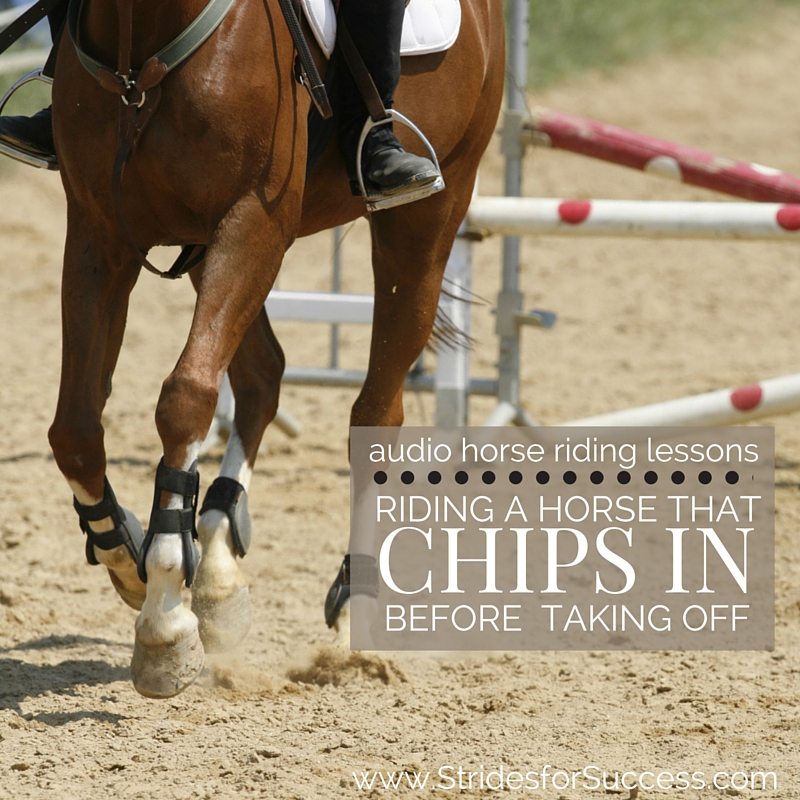
  • Riding a Horse with a ‘Chip In’ Habit at Take Off to a Jump

    Riding a Horse with a ‘Chip In’ Habit at Take Off to a Jump

    You are cantering towards the jump… 3… 2… 1… But instead of the ‘Jump’ that should have followed the 1; you get a chip in.  A moment where your usually trusty horse decides to test both of you by inserting a little ‘half stride’ in there before takeoff!

    The result is you do a great Thelwell impression and your horse does his best helicopter move; straight up and straight down…  Not a good feeling for anyone!

    Riding a horse that regularly includes a chip in or three is not enjoyable for anyone; the rider, the person watching, or the horse.  Of course, it can happen to anyone, we call have days where we get the stride to the fence wrong. However, for some horses, it becomes a habit that can seem almost impossible to break. That extra little half stride…

    [fusebox_track_player url=”https://op3.dev/e/traffic.libsyn.com/dailystridespodcast/636-Ridig-a-Horse-that-Chips-In-Before-Take-Off.mp3″ title=”Riding a Horse That Chips in Before Take Off” social_linkedin=”true” social_pinterest=”true” social_email=”true” ]

    What A Chip In Looks & Feels Like

    This habit is uncomfortable and does little for building confidence to clear a course of fences safely.  However, before we look at how to begin working with a horse who adds a little stride here and there, let’s back up. It is important to first realize what this is and why it might be happening.

    When a horse chips in before a fence, he has literally fitted an extra stride into a space. A space that there was really not enough room for that stride…

    He decided that, rather than taking off where he initially met the base of the fence, he would get creative.  He would add a quick little half stride in there and then take off.  It often results in a ‘cat jump’ which is all four legs really taking off and touching down at the same time, due to the loss of impulsion or energy.  It can also result in a ‘helicopter jump’, which is a jumping effort, but with an extremely steep up followed by an extremely steep down, with just the width of the fence in the middle!

    In both these situations, the horse is not using his back or body to the best of his abilities and it feels really uncomfortable for the rider.   Because of the loss of ‘flow’ in the stride, the rider very often ends up either too far ahead of the movement or left behind.  Both scenarios will usually result in both horse and rider not being correctly prepared for the next, upcoming jump.

    Why Your Horse Might Chip In

    There are lots of reasons your horse may chip in before a jump or fence.  It is also worth remembering that most horses will do this at some point in their training.  However, we are dealing today with a ‘chip in addict’, or a horse that does it more times than not.  In order to identify why we must first look at the horse’s approach to the fence…

    Is it rushed?  Maybe he leaning or pulling on the reins and being heavy on the forehand?  Or is he moving forward? Perhaps are you literally scrubbing and kicking every stride just to get to the base of the fence?  

    With regards to the rushing or leaning, this may be due to a lack of training.  This will often result in a lack of confidence in your horse.  He may be off the mindset that he must ‘just get it done’ as quickly as physically possible.  Unfortunately when this happens, the rider’s reaction and how they deal with it plays a big part in not only the result for that particular fence but also the long-term as well.

    Retracing some basic steps in his training is very often the way to begin overcoming this challenge

    If your horse is on the other side of this coin, he is not taking you to the fence at all, this can also be a training issue.  However, again, it may also show signs of a lack of confidence in his abilities.  I strongly suggest that, whatever the cause, take things back to basics.  It truly is the key to building and developing correctly.  And to show your horse that he can indeed successfully make it from A to B over a fence.

    Could It Be You?

    Sometimes, a horse that chips in is doing so because of how he is being ridden by the rider…  A nervous rider often tends to throw themselves into their jumping position a little early.  This will encourage the horse to ‘chip in’ before the fence.  Unfortunately, this is often a difficult and vicious cycle to break.

    The rider is nervous because the horse is rushing, the horse begins to chip and rush even more because the rider collapses before the fence and ‘drops him’, both emotionally and physically. This causes the horse to rush even more.  And so it goes on and on…

    If you feel that this is the issue, I would strongly suggest working over a single pole and practicing your timing and your balance.  The light seat is wonderful and will help you do this.

    Riding a Horse that Chip In before Take Off at Jumps

    Begin By Improving Flatwork

    So, once we have discovered why your horse chips in before a fence, we can then look at how to begin working through it so we can get a good take-off point and reach each fence in the best possible way.

    A good place to start working with your horse on the flat and improving his general responsiveness and understanding of your aids in the saddle.  Does he listen when you half halt?   Or do you find yourself pulling and hauling to get him to ‘steady’ a little?

    Does he move forward when asked to do so from your leg?  Or do you have to kick and click like a crazy person to get any sort of movement happening?!  These are basic training issues and need to be addressed before we even think of turning our hoof to jumping.  It sounds repetitive, but this is because it is true… You have to have the basics mastered before you can move on to more ‘exciting’ things in the saddle!

    Your ability to balance things with a half halt while keeping your horse moving forwarding is vital to being able to approach any fence successfully.  Keep in mind that a horse who chips in every now and then is a horse who is not so confident in jumping.  He needs a rider who can allow him to build his confidence in a controlled, systematic and patient environment

    Figure Things Out for Himself

    So, once you have the basics working, I suggest beginning to allowing your horse to figure things out on his own, without a rider, in a controlled environment.  This can either be lunging or loose schooling, but the word controlled is the important one in the previous sentence!

    Loose schooling or lunging a horse over fences does not mean chasing them into a frenzy around the arena at dizzying speeds.  

    It is simply creating a situation that is conducive to an optimum jumping effort, either one or two fences.  Then allowing your horse to approach and work things out himself.

    The benefit of loose schooling is that you can have two jumping efforts, 2 measured and correct stride lengths apart from each other.  The first jump, a cross pole, is to set your horse up correctly for the second fence, which can also be a cross pole or an upright or parallel. Due to consistently meeting the second fence at the correct distance, your horse will begin to figure things out himself.

    Distance & Spacing of Poles & Jumps

    It is also important to remember that the ‘correct distance’ is what is correct for him, not trying to force him into a standard jumping distance.  Rather allow him to first build his confidence in his own abilities using a distance that suits his current way of going or current stride.

    Once he is able to begin ‘picking’ a correct take off point, without any anxiety, you can then slowly begin working over adjusted distances

    Also, don’t see the loose schooling or lunging as a once-off occurrence.  Rather, try to incorporate them into his training for as long as necessary.  Very often with horses, it is a lack of balance that causes them to be unsure of the jump, leading to a chip in here and there.  The rider will definitely affect this balance or lack of, so allow him time and space to work it out alone before then adding a rider into the equation.

    Using Groundpoles while Riding

    As well as the above, you can begin working over ground poles in the saddle with your horse.  Laying out a single ground pole and cantering over it can be a helpful exercise for both horse and rider.  With regards to the horse, we are looking for a balanced and rhythmic approach and also, a canter that is taking you to the fence, rather than you having to ask and push for every stride.  Try to keep the rhythm as consistent as possible, and the hindquarters underneath the horse.

    You can also use this to begin training yourself to see a better stride before the fence.  Simply counting backwards from where you think there will be three strides before take off is a fantastic exercise to get you in rhythm with your horse and begin seeing the stride.  Only when you can actually see the stride can you then look at adjusting the stride.  Before that it is just the luck of the draw – never a good idea when there are jumps involved!

    As you canter in on your ‘approach’ to the fence start 3…  2…  1…  Jump.   If you get in wrong the first few times, don’t worry.  Just keep trying to gauge that point where you are three strides away.  Later you can make things a little more difficult for yourself with 5…  4…  3…  2…  1…  Jump.  You will find that the more you ‘tune’ your eye into the approach, the further out you will be able to see if the take-off point is a good one or is a little too far away or close.  This will give you time to adjust the strides in between which will, in turn, allow you to arrive at the jump in a better position to clear it comfortably.

    Related Distances

    From here you can add more poles on the ground at ‘related distances’ to each other.  Work at maintaining the forwardness of the canter while keeping the rhythm and balance all the way through.  Also, work on your timing of the jumping position.  As I mentioned earlier, it is tempting to get into it a little early if your horse is rushing, but this will only make the problem worse.

    Try to use your 3…  2…  1… to steady yourself and only allowing your body to follow your horse at the ‘Jump’ part

    Once both you and your horse are more comfortable and have stopped any added strides or half strides before the pole, you can begin to build some small fences where the poles are.  Remember that if your horse chips in,  a lot of the time it is a confidence issue, so don’t be tempted to push him further than he is comfortable.  Just because he is ‘able’ does not mean he is comfortable doing it!

    Your horse’s ability to see a stride takes time to establish, just like yours.  Give him that time and it will pay dividends later when you are out on the track.  Count yourself down to the base of each fence, 3… 2… 1… at all times initially (in your head when in the company of others if you want!), but use it as a way to balance both of you on the approach to the fence.

    Happy Riding
    Lorna

    Connection for Equestrians

    If you are interested in finding out more about how you can begin re-schooling your horse in all aspects of riding, Connection might just be what you are looking for. Each week you will receive 5 audio ‘lessons’, where I give you step by step instructions.  You can listen using a free app on your phone, on your computer, or via your favorite podcast app.

    This makes it really handy to use and listen to while riding your horse; in the saddle.

    We cover loose schooling, working over single poles, related distances, and also working on improving your eye to see a stride. There are also diagrams with the actual distances for you to replicate in your arena.

    Find out more over at https://stridesforsuccess.com/join

  • More Advanced Exercises for a Young Horse

    More Advanced Exercises for a Young Horse

    [fusebox_track_player url=”https://op3.dev/e/traffic.libsyn.com/dailystridespodcast/586-More-Advanced-Exercises-for-a-Young-Horse.mp3″ title=”More Advanced Exercises for a Young Horse” social_linkedin=”true” social_pinterest=”true” social_email=”true” ]

    You have spent the past few months diligently improving your young horse’s standard of education. A lot of time invested on the basics of moving forward in a balanced rhythmic way.  He is happy, you are happy and the next natural progression is to ask for the canter.

    However, it seems all those carefully cultivated hours in the arena fly out the door as soon as you ask for the upward transition.

    Your horse begins running on his forehand, each trot stride becoming longer and faster… He eventually breaks into a canter of sorts, but nothing like what you imagined it to be!  Unbalanced, uncoordinated, and no rhythm whatsoever!

    Introducing ‘New’ To Your Young Horse

    Often it seems that no matter how much preparation we put into preparing our young horse for his first departure from a trot into a canter, the canter falls a little flat and well below our expectations.   But rather than becoming frustrated and demoralized with your horse’s apparent lack of understanding, see this as being the next step of the ladder with regards to your horse’s education. And one that, if he graduates from, will see him in a great position to really begin working from.

    Just like when you first began riding your young horse in walk and trot, your horse is going to feel very unbalanced and unsure of himself when you do ask for the canter when in the saddle.  

    This is due to the canter having a three-timed beat which depends on your horse’s outside back leg starting and propelling the rest of his footfalls and body forward in each stride.  In the trot, it is far easier to remain balanced. This is due to the effect the diagonals have on balancing him with each stride. However, the canter is almost one-sided and extra strength and development are required of your horse in order to really ‘power’ into.  Power into it and then remain balanced through each stride.

    Preparing the Transition

    As with most things concerning riding, the preparation that leads up to the transition will have a massive outcome on the success of the transition itself

    See the trot as now being the foundation for setting up the canter.  Not only from a rhythm and balance point of view. But also with regards to developing strength through his body.  Use your half halts in the trot to begin asking for his hind legs to engage a little more. This may only be for a stride or two each time. However, it will allow him to begin building the muscles necessary for a good canter later.

    More Advanced Exercises for Your Young Horse

    Be Patient Through the Transition

    When you feel that you have prepared the trot enough, you can start thinking about the canter transition itself.  It is tempting to ‘push’ your horse into the canter at first. Using your upper body in particular.  However, throwing your upper body forward will only serve to unbalance him even further.

    Rather think of sitting up tall. 

    Then asking with the correct aids.  Including, perhaps most importantly, your voice and seat.  And, from here, allowing him to break into the canter himself.

    He may run for the first few strides of trot before then almost falling into the canter, but this is to be expected initially.  Your job is to remain balanced and ‘quiet’ throughout. This will help to build his confidence in his ability to actually move into the canter under the saddle.

    Make sure you follow through your body and also your hands and arms.  Catching him in the mouth or bouncing on his back, particularly in the first few transitions, will only serve to punish him. It may also cause him to associate the canter with anxiety and tension

    Once in the Canter

    Once he has actually transitioned into the canter, remain quiet but keep him moving forward.  Very often with a young horse, the canter may be a little ‘fast’ at first if forwardness is to be maintained.  This, again, is to be expected and rather allow him this. It will help him to begin to settle into this new gait and find his balance and rhythm himself.

    The canter requires quite a bit more effort from him than the trot, so he will probably tire quickly.

    Try to ask for the downward transition into a trot before he naturally breaks into trot himself.  

    You will usually feel the lack of energy in the canter, it will seem to become more strung out, rather than bounding forward.  Again, make sure you are balanced and quiet through the transition, using your voice and seat first.

    Re-Establish, Rinse & Repeat!

    As soon as he has come back into trot, begin the work of re-establishing a balanced rhythmic trot.  It may take quite a few strides initially, particularly after the first few canter to trot transitions… However, keep in mind that working forward in a balanced and rhythmic trot is something that your young horse knows how to do. So insist on it!

    Working in and out of the canter initially is a great way to begin developing your young horse for more prolonged and balanced canters.  

    Be sure that the trot is balanced and working before asking for the canter again each time.  Also, try to be consistent and regular with your aids both into the canter, while cantering, and then back into the trot.

    Developing Over Time

    Over time, your horse will begin to strengthen up and carry himself for longer periods, in a more balanced and rhythmic canter. The lenght of time will depend on many things.

    However, how mature your horse is and/or how much time you have spent working on the more foundational aspects of his schooling, will play a big role in how quickly he progresses, both physically, mentally & emotionally

    Continue to use the walk, trot, and halt to reinforce the aids and responsiveness.  Only when he has truly mastered the canter for longer periods can you then begin thinking about making adjustments within the canter itself.

    Initially, you will only ask for short canter periods each time, perhaps 5 or 6 strides of a better quality canter rather than laps of ‘racing’ and running around the arena, which will only serve to teach him how to incorrectly maintain the canter when being ridden.  Then slowly you can begin to apply the half halt in the canter itself, so to shorten the canter strides.

    Remember that forwardness is the foundation to all his gaits, so make sure that you keep him moving actively and with energy regardless of what you are asking.

    Schooling your young horse in the canter takes time and consistency. However, all the initial investment will pay off handsomely when your horse is able to maintain a balanced, forward-moving canter from which you can begin to make adjustments.

    Happy Riding
    Lorna

    Additional Resources for Equestrians

    Are you looking for step by step instructions to listen to as you ride your young horse? I have created 5 audio horse riding programs specifically focusing on this topic. To find out how you can get these lessons (and hundreds more) visit https://stridesforsuccess.com/join/

  • Exercises for a Young Horse

    Exercises for a Young Horse

    Young horses!  It is such an honour as a rider to be one of the first people they get to work with, however can sometimes feel like you are riding an eel!  They are moving up and down in the rhythm and if there is a dance that you are both moving to, it quickly becomes evident that no one is really sure of the correct moves or steps!

    Horses need to be allowed the time and space to begin working out how they can carry themselves, with all this new equipment and also, how they can then carry the added weight of a rider on board their backs as well.  When given the necessary time and when the correct guidelines are there to help, your horse will soon become more confident in his abilities to carry you and confidence is key for balance.

    The reason the ‘dance’ seems so staggered is due to the lack of true balance.  So, in saying this, balance is first and foremost for young horses.  However very often riders try to do this job for their horse, rather than allowing the horse to figure it out on their own.  This usually results in a horse that insists on holding on to or grabbing the contact and being unable to relax enough through their backs to truly use themselves correctly.  This, as I am sure you can imagine, will inevitably lead to all sorts of trouble and problems further down the line.

    [smart_track_player url=”https://op3.dev/e/traffic.libsyn.com/dailystridespodcast/541-Exercises-for-Working-with-a-Young-Horse.mp3″ title=”Exercises for a Young Horse” social_linkedin=”true” social_pinterest=”true” social_email=”true” tweet_text=”Do you have a young horse? Here’s a couple of useful exercises to try today ” hashtag=”horseriding #younghorse” twitter_username=”strides_success” ]

    Before we go any further, it is important to stress that the rider must be experienced, sympathetic and patient. Young horses should not be ridden by riders who lack a balanced and independent seat.  It will only make the horse’s job much more difficult and very often results in a loss of confidence, that will have repercussions all through their riding career.

    When working with a young horse, remember it is the quality of the work, rather than the quantity that is important.  Ride for shorter periods and rest often throughout each ride

    Many factors will influence how quickly your horse progresses, such as age, breed, build, confirmation, groundwork, consistency and even his upbringing.  Remember, even if your horse is the ‘ideal age’ to start, he may still not be physically or mentally ready to begin work.  Again, slow and steady will win out over pushing your horse to do things he is not ready for.

    So assuming that you have assessed the situation and have deemed it the right time in your horse’s life to begin introducing him to a more ‘structured’ training program, I suggest by starting off on a long rein.  You can begin teaching your horse this on the lunge initially and then, when you’re on his back.  The long rein will allow him to stretch out his back muscles and overall body, which will encourage relaxation and rid him of any excess tension

    Start at the lunge.  This will allow your horse to loosen up, and also work out any excess energy that he might be ‘storing up’.  It also gives you a great opportunity to assess him further which will then help you to create a more structured plan.  Which gait is the most balanced and comfortable for him?  Which rein, if any, does he prefer?  You can then use this information when you mount up to help relax him and start by doing something he enjoys and working on the side he goes better on.

    Keep in mind that lunging is not just chasing him around the ring; he must begin with relaxing, just like he would if on a long rein and then slowly beginning to work into a contact, with emphasis on moving forward at all times.  You can also use the time on the lunge to reinforce the voice aids.

    Exercises for a Young Horse

    When riding a young horse, the focus should begin on rhythm and balance within that rhythm.  As I mentioned before, you as the rider must be balanced in your seat and able to move with your horse as he works forward.  At no point should you begin trying to ‘shorten’ him or force him into a ‘frame’.  If he is to develop correctly he must learn to balance himself and from there, then look for your contact and accept it happily while moving forward all the time.

    Another thing to keep in mind when riding a young horse is that he will be naturally a little ‘downhill’.  His body must strengthen, over time, before he can begin to transfer that weight back onto his hind quarters, and during this period it is your responsibility as the rider not to add to the weight being carried by his front end by leaning or slouching

    When working in the arena, vary the work and sprinkle breaks or rest periods throughout the ride, which will allow him to relax and stretch out on a long rein again.  This will help to make sure he does not become stiff or tense which will in turn, ruin the work you are trying to achieve.

    Work on basic school figures such as large circles, all the time trying to establish the rhythm in the gait.  You can also work in some transitions, however I find that it is better to work in a chosen gait for a few minutes, allowing him to become confident in his balance and rhythm, rather than chopping and changing gaits.  Transitions are a wonderful tool when schooling horses but I have found that if too many are incorporated into the early rides, the horse can tend to become a little choppy, short and tense through his work, rather than moving forward in a relaxed  and loose fashion.

    Keep in mind that you are there to guide; he must learn to balance himself.  So correcting him is important, but it should be only that, a correction, rather than a constant support or aid

    After a few weeks or months, depending on your horse, and once he is happily carrying you around the arena you can begin introducing ground poles into his schooling sessions.  You will know the time is right when he has found a certain rhythm and balance to his way of going, which he can adjust in and out of with ease.  Like everything else, incorporating the poles too early will only serve to do more harm than good, so proceed with caution and only when you are confident that he is confident!

    Start with a single pole on the ground, which you can allow him to walk over.  Walk over it, from both directions quite a few times until it becomes a non-event in your horse’s head.  Keep in mind that your horse might just jump the pole on the first few occasions and take the precautions to avoid any discomfort for him or you if this happens!  Make sure that you do not punish him when he successfully navigates the pole by catching him in the mouth or becoming heavy on his back.

    Once he is happily walking over the single pole, you can then begin trotting up to and over the pole.  Again, we want him working over the poles happily and relaxed before you move on to anything more complicated.  This may take a few rides, however your patience while he is finding his way here will be worth it later.

    Poles can be used in all sorts of ways when riding a young horse, as both obstacles to navigate over and also guiding rails to ride between or around.  Depending on your horse, you can use them to help reinforce a concept and also, to ask for more flexion and a way of asking him to ‘use’ himself more.

    Riding young horses can be a challenge, but when done with patience and kindness as well as consistently, it pays off as both a rewarding for the rider and it sets the horse up for a happier, healthier working life as well.

    Happy Riding!

    Exercises for Riding a Young Horse