Author: Lorna Leeson

  • Dealing with a Horse who Spooks & Spins

    Dealing with a Horse who Spooks & Spins

    Dealing with a horse who Spooks and Spins
    There are you, enjoying your ride with your horse; when suddenly your horse performs the sort of spin around that would put a figure skating champion to shame.  Without a word of warning he is off and running in the opposite direction, leaving you either hanging on for dear life, or wondering what just happened as you crash to the ground!

    [smart_track_player url=”https://op3.dev/e/traffic.libsyn.com/dailystridespodcast/856-Dealing-with-a-Horse-that-Spins.mp3″ title=”Dealing with a Horse that Spooks and Spins” social_linkedin=”true” social_pinterest=”true” social_email=”true” tweet_text=”Struggling with a horse that spooks or spins? Here’s the answer…” hashtag=”Equestrian #spooky” twitter_username=”strides_success” ]

    It is one of those things in riding that really catches you completely by surprise, and not in a good way!  It is also one of those things what, once you realise that the horse you are on does this on a pretty regular basis, makes it almost impossible to relax and enjoy the ride.

    Modifying Your Approach and Mindset to the Spin

    Overcoming this challenge requires a certain approach and mindset.  I feel it is really important to tackle this in a sympathetic, consistent manner.  We know that some horses are more ‘spooky’ than others, so creating more fear around this type of situation for a horse who is already fearful will not provide any positive long-term results.

    And this is exactly what we are looking for, long-term results.  Unfortunately, it generally takes quite a bit of time in order to really get those results.  There is no real lasting ‘overnight cure’ for this type of thing.

    Yes, you can keep the horse going forward – but what I would aim for is that the horse continues to go forward itself, without you having to ‘guard’ him from spinning the whole ride… Far more enjoyable, right?!

    Creating a New Law when a Spin Feels Inevitable

    So, first and foremost, we need to lay down the law when it comes to the spinning.  Your horse needs to begin realising that while spinning around and running away worked a few times up to now, those days are over – and he must just trust you that everything is okay going forward.

    Sounds so simple, doesn’t it!  But as we all know, trust is not something which can happen overnight.  This is why there must be a long-term approach when it comes to eradicating this behaviour from our horses habits. 

    However, while there are ways you can begin today to build that trust, and I will chat more about that just now. But first and foremost, you must put an end to the spinning around.  This will be done through really becoming ‘strict’ on channelling where your horse goes and the direction he travels.

    Shut and lock all the exits

    So when a horse spins around, it is because he has found a ‘side door’ which was open and easy to duck out through.  The rider must make sure that all those ‘side doors’ are shut and locked – all through the ride.

    This takes a great amount of consistent effort from the rider.  It means that as soon as the horse even thinks about spinning, that ‘exit’ is shut tight, and the only way out is forward (or wherever the rider wants the horse to go).

    At the beginning the horse may get through the door, meaning that he might spin around.  Perhaps initially the full 180•, but as you become more aware of his triggers, he may only get to the 90• mark, and later only a few degrees either way.  What is important is that when the ‘spin’ begins, he is immediately turned back the direction he came from, and directed forward.

    Attitude & Consistency will get you Everywhere

    Now, earlier I mentioned that I feel a sympathetic approach is necessary for this sort of re-schooling.  This is because there is a good chance that your horse has learned to ‘spin’ due to the fact that, at some point in his life, he did just that and it put space between him and something that really bothered him.

    Said another way?  He was afraid at some point and bolted.

    Working through an issue like this with a heavy-handed approach will never truly give you lasting results.  Yes, you can push the horse on and get past the ‘spinning point’, but would it not be far nicer to have your horse develop confidence in you and later himself, so that both of you can relax on your rides?

    Dealing with a horse who spooks and spins

    Sometimes a more experienced rider may be necessary in order to ‘shut down’ those escape doors effectively.  Again, make sure you choose wisely regarding who you ask to do this for you, as it can have far-reaching consequences.

    Noticing the Triggers

    But back to the running away from feelings of discomfort; the downside to this, from the riders point of view, is that whenever he feels uncomfortable, either physically, mentally or emotionally, he thinks the best approach is to, once again, put distance between himself and that feeling, or whatever is causing the discomfort.

    Maybe it is a signpost.  Or a tree that looks a little ‘odd’.  It could be a strange-looking gate.  Or a shadow.  It may even be a smell or noise… Either way, your horse does not enjoy how he feels and thinks the best way to handle this is to get out of there – as quickly as possible.

    Begin to look at what triggers this behaviour for your horse.  Is there a particular place he does this?  Or is it a certain noise or occurrence that does it?  Is he perhaps reacting to feelings of tension and stress in the rider’s body?

    Whatever the reason, figuring it out is important.  From here you can begin to set up ‘controlled’ introductions to that scenario, in order to give your horse some ‘wins’ under his belt.  You will allow him to slowly realise that he doesn’t need to run away in order to feel better.

    A Long-Term Approach

    Developing his trust in you, the rider, is how to truly get to the bottom of this issue and see long-term results.  You can do this through groundwork exercises, retraining him to relax and trust you when you say that things are okay.

    You can also create small ‘courses’ in a safe enclosed area which you can initially lead your horse through, and later when he feels more confident, ride him through as well.  Time invested in desensitizing your horse will pay dividends in this situation.  As will approaching the matter with a firm, yet gentle and compassionate frame of mind.

    And finally, using your horses herd instinct can also work.  However, I would caution against only using this method.  Ideally you want your horse to feel confident on his own and in company.  But, it can definitely work if you are in a situation where there seems no other alternative.

    Riding a horse who is known to spin on a sixpence and head for home with no warning signs can be a daunting experience.  However with patience, compassion and a well thought out game plan, it is definitely a challenge which can be overcome.

    Stick with it and keep in mind that it will be easier if your horse trusts you first before learning to trust himself later.

    Happy Riding
    Lorna

    This topic is just one of whole range of titles on ‘re-schooling’, inside the Reschooling Collection in Daily Strides Premium.

    If you are interested in finding out more, you can sign up HERE and I will send you all the information.

  • Basic Exercises Using Ground Poles

    Basic Exercises Using Ground Poles

    Basic Exercises Using Ground Poles

    Do you find yourself shying away from using ground poles in your riding because you think they are ‘only for jumping’?  Perhaps you know all the benefits of using ground poles, but are completely unsure about how to use them effectively?

    Many riders want to include ground poles in their schooling, but are unsure about how to get started in a way that is safe for both them and their horse.

    This blog post is Part 2 of the initial Using Ground Poles in Schooling post which you can read HERE.  The first post contains more detailed instructions on how to get started with ground poles for the first time. I strongly suggest you pop over and have a read of it, before you jump into the exercises mentioned in this post.

    Building up to a Number of Trotting Poles

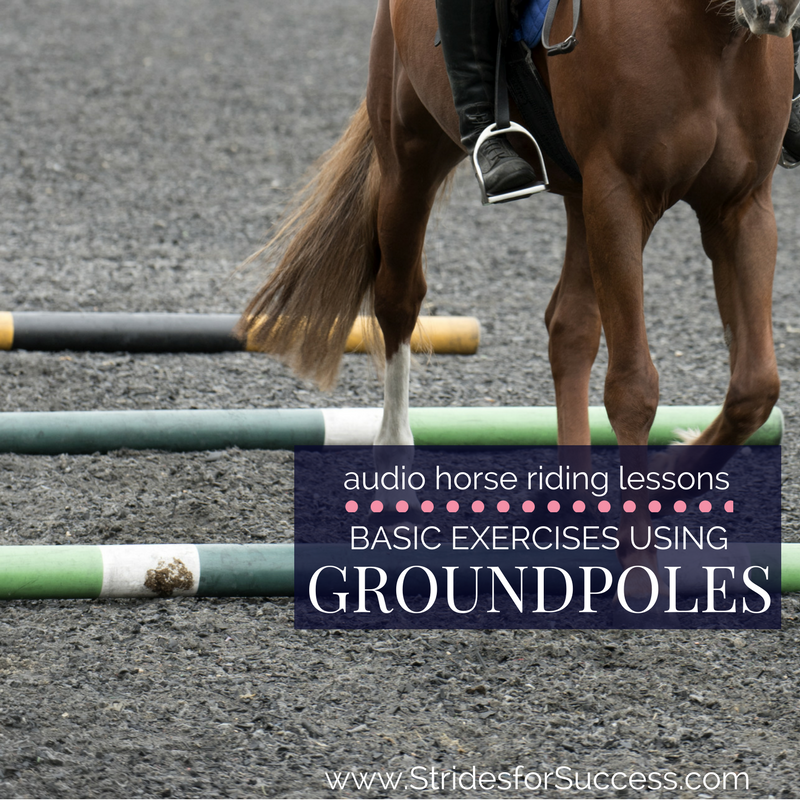
    Once both you and your horse feel comfortable riding over a single pole, you can begin to expand the number of poles.  This is where you can add more poles to build a line of trotting poles.

    Start with 1 extra pole, and then 2, and then 3 and then 4 and so on and so forth.  The poles should be a comfortable distance for your horse and this is generally around 4’6″ or 1.35m apart from each other.

    I suggest that when trotting over a set of trotting poles for the first time rather get off your horses back into the light seat, so he can use his back more.  

    However it is important to note that you must not shift all your weight forward onto his withers or front end… He has to lift those to clear the poles!  There is a full description of how to successfully do this HERE and HERE

    [smart_track_player url=”https://op3.dev/e/traffic.libsyn.com/dailystridespodcast/861-Basic-Exercises-Using-Groundpoles.mp3″ title=”Basic Exercises Using Groundpoles” social_linkedin=”true” social_pinterest=”true” social_email=”true” tweet_text=”Do you use groundpoles in your riding? Here is an awesome freebie to get started…” hashtag=”equestrian #makeeveryridegreat” twitter_username=”strides_success” ]

    So assuming that you are nicely balanced and allowing your horse to use himself over the poles, you will probably find that your horse will easily navigate 2 or 3 poles in a row.  Sometimes he might misjudge and get the striding wrong, but allowing him the space to figure it out is vitally important.

    Introducing Additional Poles

    I suggest only adding a fourth or fifth pole once he can confidently navigate the three poles.   This is because he may have to make minor adjustments through the poles in order to successfully navigate the exercise.  Allowing him to think for himself through the more basic exercises will enable him to confidently make adjustments where necessary.

    This is why your balanced, independent seat is vitally important.  Remaining balanced and poised rather than bouncing around on his back will enable him to focus on using himself correctly through the poles…  Rather than trying to get out from under your backside hammering away on his back

    Later, as you both of your strenght and balance increased, you will find it easier to move with and follow your horses ‘exaggerated’ movement through the poles.  When this happens you can actually begin to navigate the poles in rising trot, or posting.

    In fact, eventually you may even be able to stay in sitting trot as you move through the poles, but this will require a truly independent seat and a strong, balanced, developed horse.

    Raised Trotting Poles or Caveletti

    When both you and your horse feel confident and comfortable working through the trotting poles, you can begin to introduce raised trotting poles or caveletti to the schooling session.

    Raised poles are great for teaching horses to go straight, keep regular tempo and introduce more suspension, which means they have to use themselves more.  

    That raised suspension is also superb at allowing you, the rider, to experience that extra energy underneath you and begin focusing your riding on being able to move with the energy, rather than bouncing against it.

    This exercise also encourages your horse to really use his back.  It also can contribute to greater development of the topline, more flex in joints as the legs must be raised or lifted higher to get through the sequence and also, more thinking and responsiveness from your horse.

    However… This will require a much greater effort from your horse, so don’t over do.  Asking too much can result in the muscles can becoming strained rather than strengthened.

    It is also worth keeping in mind that this exercise will also require more effort from you, the rider! Keep the weight dropped into your heel and keep your shoulders square and chest opened.  Make sure your hands are soft and following and that you are allowing your horse to move both his head and neck, but also to use his back.

    Try not to fall backwards behind the movement while riding over the poles.  Make sure you are using your body to carry yourself.  I often suggest pinching some mane or a neck-strap if it is the first venture for a rider over the raised poles.

    Use the same trotting poles that you are comfortably working through and begin by raising alternatives sides on each of the poles in the sequence.  The poles are only raised by 3 or 4 inches.

    I find that raising just one side, lets say the left side, of the first pole, and then the right side of the second pole and so on, builds a ‘funnel’ which you can also use to encourage straightness in your horse through the sequence.  Later, once you are both comfortable, you can also raise both sides of each pole if you want.

    Start initially with raising 1 and then build up from there.  You may need to shorten the distance between poles initially ( again inch by inch) as often horses don’t have the necessary strength and co-ordination to both maintain the stride and lift their legs higher to clear the poles.  But you will feel this as you go.

    Progress Must be Slow & Steady

    Don’t stress your horse.. All changes must be gradually done to ensure your horse is confident and happy in his ability.  You also want to ensure that he continues to use himself correctly through the exercise.  Often if he begins to tire, the quality of the work will lower and mistakes will be made.

    You may find your horse will try to run through the poles, as he feels uncomfortable and not so confident with this new exercise.  If this happens, take things back a step or two.

    Slow and steady will build both of your confidence.  It is also important to use your half halt throughout.  Let him realise that it is better to wait, engage his back end and then power through slowly and concisely, rather than rushing forward.

    But again, if you sense any anxiety or nervousness on your horses part, take things back a step or two to where he is comfortable and ask again from there.

    Click here to subscribe

    Ground Poles in Canter

    Ground poles can also be used in the canter.  Once again, it is important that you focus on where you are going, rather than looking down.  It is also important to work over the pole in a simple light seat.

    Focus on establishing a rhythm and then maintaining the tempo and balance while working over the poles in the canter.

    I suggest setting up a 20m circle with 4 poles at each of the quarter markers of the circle.  If the circle was a clock the poles would be at 12,3,6 and9 o’clock.  Choose 1 pole to start over initially, bypassing the others as you complete each circuit of the circle in canter.

    Pay attention that your horse is balanced both over the pole and throughout the circle, using his hind quarters and keeping a consistent tempo in the canter all the way through.  

    Lack of balance will result in changes to the tempo or rhythm.  Loss of balance may also result in flying changes or breaking back into trot.

    Focus also on your position that you are moving with him and asking for the bend to the inside without leaning or tipping your body.  Keep in mind that your horse will be able to better navigate the poles if you remain balanced and quiet in the saddle.

    As he becomes better at just the 1 pole, introduce a second pole – the one directly opposite the first one ( the 6 for the 12 or the 9 for the 3 on a clock).  Pay attention to reaching the centre of all the poles when you reach them on every circuit you ride.

    Adding more poles to your circle

    As both of your confidence increases, you can introduce the 3rd pole and work up including all 4 poles in your circle.  However, this may take some time to build up to and rather get 1 pole correct before moving on.

    For a second exercise in the canter, I suggest building the cantering equivalent of trotting poles.  Again, begin with just 2 poles, about 3.3m apart and then make any minor adjustments to the distance to suit what your horse is comfortable with.

    Once you are both happy over 2 poles, begin adding additional poles in a straight line and you can also begin to raise the poles, again alternating the sides between each following pole to create a funnel of sorts through the poles for your horse to canter through.

    As always, try not to pull or interfere and pay close attention to being as light in the saddle as possible.  Allow your hose to figure it out!

    Imagine every canter pole is a jump and ride it accordingly, which is a super exercise without the stresses of actually jumping.  Fine tune your riding and your horses going bit by bit, pole by pole without jumping the legs off your horse.

    Regardless of how you begin to incorporate ground poles into your riding, remember to try and finish on a good note.  It is also worth repeating that when your horse becomes tired – stop.  Working a tired horse, mentally or physically, over poles is a recipe for disaster.  

    Slow and steady is the way to proceed in order to build both of your strenght, balance and confidence. 

    Happy Riding
    Lorna

    Have you taken the challenge yet? Join thousands of riders all over the world in the 30 Day Rider Fitness Challenge – your horse will thank you!

  • Returning to Riding – Choosing Your Mindset

    Returning to Riding – Choosing Your Mindset

    Returning to Riding - Choosing Your Mindset
    Have you ever noticed the feelings that come up when you return to a place which you have not visited since childhood.  There is almost always that feeling of familiarity, blended with the realisation that things have changed.  Somethings are gone, somethings are new, and yet the essence of your original memory remains.

    Returning to riding is a little like this.  It all feels familiar, but at the same time it also feels different.  You know how things should feel, and they do still feel that way, but at the same time, there are subtle differences.

    The question is, does this mean that riding itself has changed?  Or is the riding the one constant and its rather everything else surrounding it that is different?

    Now, and this may be a little controversial, I believe riding is riding, is riding, is riding…

    Meaning that I think the riding remains the constant, it is everything else that can change.  I will explain more about this a little later, but here are a few ways to ease your transition back into the saddle.

    1.  Be open to new things

    I truly believe that the type of mindset at which you approach getting back into the saddle will very often dictate the experience, and later success, you have.

    One of the biggest ways that your mindset can hold you back when you do get back in the saddle is by being closed.  Expecting things to be ‘just as they were’ when you initially stopped riding.  But remember, life has gone on, for you and also for your horse, the riding school, even the tracks and trails that you ride on.

    2.  Realise there are ‘Cycles’ at play

    Assuming everything will be just as it was before you left is only going to set you up for a fall.  It is also worth remembering that, not only has time passed, but different ideas and ways have now cycled around.

    Equestrian sport, like all sports, has cycles.  Methods of doing things are tweaked over the years, different equipment comes in and out of fashion.  Different ideas get to have their 15 minutes of fame, so to speak…

    However, regardless of the changes, keep in mind that the basics will remain the same.  The foundation itself does not change, it is just the exterior that gets a little ‘update’ from time to time.

    If you are open to the changes that naturally happen and occur, you won’t become frustrated and will be able to see the bigger picture.
    Returning to Riding - Choosing Your Mindset

    This is comforting to keep in mind as it is easy to lose sight of the fact that the same foundation still exists.  Very often riders believe they ‘know nothing’ anymore…  This is simply not true at all.

    3.  Prepare to Learn

    Depending on how long you have been out of the saddle, you may feel a little like your knowledge is now ‘dated’ or ‘irrelevant’.  Horses have been horses long before you began riding and they will continue to be long after you have hung up your boots.

    The fact that you have ridden before means that you know something about horses and how to ride. The ‘bells and whistles’ may have changed, but the ‘nuts and bolts’ remain the same

    Take what you already know and build on it.  Be open to new suggestions, ways and ideas.  This is where doing your homework beforehand is important.  Find a community of riders who are interested in similar riding styles as you are and allow yourself to become reacquainted with all things horse.

    4.  Be clear on your values & your goals

    Finally, the group of people you choose will depend on where you want to go with your equestrian journey this time.  Do you want to return to the same discipline?  Or are you looking to try something new?  Do you wish to compete, or remain a ‘pleasure rider’?  Is there a particular style of horsemanship you enjoy and want to use?

    And also consider the financial and time aspects…  How much are you willing to invest of both in your horse riding this time around?  Very often the community of people you surround yourself with will influence this as well.

    So, Riding is Riding, is Riding, is Riding…

    Back to where we originally started.  Would you agree with me now that the riding has not changed.  It is all the other little things which have changed.  I think this is good news for riders who are returning for one simple reason:-

    No matter where you are when you do get back into the saddle, you have been at this place before, and therefore it is simply a matter of reacquainting yourself with the landscape again.

    The choices you make with regards to training methods, trainers, disciplines, community and all the other different ‘exterior updates’ will all dictate how you move forward from the decision to return to riding again.

    However, this is your journey, your landscape, your ‘place’ and you can make it exactly what you want. 

    Returning to riding is like revisiting that place from your childhood and things being changed… But depending on whether you choose to see the differences with a sense of loss, or with an open-minded curiosity – an adventure of sorts – will very often dictate your end results.

    Happy Riding
    Lorna

    Read the post Returning to Riding – Great Expectations HERE>>

    Returning to Riding VIP List

    Are you returning to riding?  Are you feeling a little overwhelmed with it all?  I may just have the thing to help you get back into the saddle – and enjoying yourself there again!

    Click here to subscribe

    Created to help you narrow your focus in the saddle, the live training will help you get more clear on what you are doing – so you can begin focusing more on how both you are your horse are working together.

    Save your seat for the next live training by CLICKING HERE

    Here’s to making your ‘Returning to Riding’ as enjoyable and successful as you dreamed it would be :)


  • Returning to Riding – Step by Step

    Returning to Riding – Step by Step

    Returning to riding - step by step

    So you have made the decision to get back into the saddle.  You feel great about it.  Making a decision, one way or another, often has a way of settling us a little, even if the road ahead is less than smooth.

    But there you are, big girl pants on; all mounted up, bum gently lowered into the seat of your saddle…  And to your absolute dismay, you have absolutely no idea of what to do now that you are up there!

    What many riders forget to take into account once they are back in the saddle is that things are very much changed from when they were there last.

    Your body is not as ‘responsive’ as it once was.  Your mind is not as focused as before.  Your plan is not so clear.  No, rather let’s just come clean with the stark truth that you have no idea of what to even plan for.  

    It’s a little overwhelming, isn’t it?  Figuring out what to focus on first.   However starting with the basics and easing into it is always the best approach; for your body and mind!

    I am going to suggest a little more of an unconventional, but realistic and simple way to ensure you spend your first few rides laying a solid foundation.  Invest the time upfront, in the beginning, and you will see the results of this later when even more difficult things are tackled with ease.

    1. Knowing what is moving, and when

    So first and foremost, as you settle back into the familiar feel of your horses walk, take the time to really know what is going on underneath you.  When you are returning to riding it is inevitable that you will spend quite a bit of time initially in the walk.  Put this time to good use by studying your horse’s movements – and how this affects your own movements in the saddle.

    Your seat is one of the greatest methods you have of communicating with your horse.  However, regardless of how well you can control your core and seat, it is only truly effective if used at the correct time and place.  

    To do this you have to know, eventually without even consciously thinking about it, what your horse is doing at any given time underneath you.

    Master this in walk initially, and then from here work on your ‘feeling’ skills in trot and, later once you are fitter, canter.   This is a skill well worth investing in.

    2. Moving Forward

    It sounds so simple, but you would be surprised at how many riders think that merely moving constitutes moving forward.

    When we speak about forwardness in riding, simply put, it means that your horse is going somewhere with a sense of purpose.  This is regardless of whether he is in walk, trot or canter.

    Now, it is also worthwhile noting that forwardness is not rushing.  If he looks or feels like he is late and trying to make up time, you are no longer moving forward, but rather running.

    Confusing, I know, but think about soldiers marching.  They are going somewhere with a sense of purpose.  Their stride is full of energy, but they are not rushing, they are not racing and while they have a sense of purpose, they have freedom of movement to ‘swing’.

    When it comes to horses, moving or going forward is essential for everything, so spend a little time knowing how it feels and ensuring that your horse is doing it when you ride.

    Returning to Riding - Step by step

    3. Your Half Halt

    So once you have your horse moving with a sense of purpose, it is important that you can direct this ‘purpose’ or energy where you want it to go.   All channeling or directing of energy when it comes to horses really does come back to the rider’s ability to perform a smooth, fluid half halt.

    Returning to riding is actually perfect for mastering your half-halt, especially during earlier rides.

    It helps ‘retune’ your horse to your, most probably less than perfect, aids again and it allows you to become intimate with your core; how it works and how it influences your horse.

    Your half-halt is essential to all things in your riding, so invest time in refining yours.

    4.  Rhythm and Balance

    The final piece of the ‘where do I begin puzzle’ is becoming acquainted with your horse’s natural rhythm again.  Couple this with the ability to feel when things are balanced, and when they are not, it is a valuable lesson to recap when initially getting back into the saddle.

    Later, when you begin to change gears a little, the ability to maintain a steady rhythm will serve you well.  Of course, knowing how your horse feels when he is beginning to lose his balance will ensure you can rebalance, using your trusty half halt, before things go too far and the energy or forwardness is lost.

    Keep Things Simple

    Unfortunately one of the downsides to not having a plan is trying to do everything at once – resulting in you achieving little in the long run, and becoming extremely frustrated about your lack of progress!

    Remember to keep things simple for at least the first week or two.  Master the above basic steps and skills while you and your body become familiar once again with the feel, movement, and sensations of your horse underneath you.

    Returning to riding is a big, often scary, step for many riders.  Give yourself a little head-start by having a plan of action from the moment your bum makes that long-awaited, keenly anticipated, contact with the saddle.

    Happy Riding

    Lorna

    Read the post Returning to Riding – Great Expectations HERE>>

    Returning to Riding

    Are you returning to riding?  Are you feeling a little overwhelmed with it all?  I may just have the thing to help you get back into the saddle – and enjoying yourself there again!

    The Original Returning to Riding Plan is a complete step by step audio program that takes you from ‘not riding’ to regularly riding and enjoying yourself again.  The plan is laid out over 6 weeks, however, you have lifetime access to go over it again and again as you want in the coming weeks, months, and years.

    You can find all the details HERE.  And I wish you all the best in making your ‘Returning to Riding’ as enjoyable and successful as you dreamed it would be :)

  • Returning to Riding – Great Expectations…

    Returning to Riding – Great Expectations…

    Returning to Riding - Great Expectations

    They say absence makes the heart grow fonder – and riding horses is no exception to this.  Unfortunately, this ‘fondness’ is one of the big reasons many riders, on returning to riding, end up feeling quite underwhelmed very quickly when back in the saddle.

    If you have ever had to take a break from riding, planned or not, you will know all about the whole range of feelings and emotions that surface when the time comes to get back into the saddle…

    Excitement, joy, and sheer unabated happiness tinged with a little anxiety, apprehension and lack of confidence.  The good and the not so good emotions mixing together to result in a high of sorts, which usually begins to dissipate quite quickly when your bum actually touches the saddle.

    Realizing things have changed…

    Why?  Well, because most riders think they can go straight back to the way things were before.  Pick up the reins and just carry on where they left off as though not a day has passed in between.

    They fail to allow for the very real fact that they have changed; physically, mentally, emotionally, as a rider – as a person.

    Seeing the opportunity…

    So, if we cannot ‘go back’ to how things were before, is there any point in continuing on?  And is there any hope of recapturing the initial feelings that caused you to become addicted to riding in the first place?

    Yes of course  there is!  In fact, returning to riding might just be the golden opportunity you need to really make the lasting changes you are after in your riding.

    So we mentioned the whole ‘absence makes the heart grow fonder’, but equally as true is ‘out of sight, out of mind’ – particularly where your body is concerned.

    Returning to Riding - Great Expectations

    Muscle memory and ‘feel’ are very important and necessary tools when it comes to horse riding.  Knowing instinctively what to do, and when, is what we are after when it comes to our skills in the saddle.

    But very often our ‘muscle memory and feel are, well quite frankly, wrong!  We develop bad habits over time.  These habits become ingrained in how we ride, sometimes regardless of what we do to try iron them out.

    However, when you take a break from riding and then return, your body has literally had the ‘out of sight; out of mind’ experience with what you do in the saddle.  

    Unfortunately, many riders focus on the lack of control of their body when back in the saddle; rather than being motivated by the options which have suddenly opened up for them…

    Becoming a better version of before…

    What if those same riders began to see this as their opportunity to restart?  Relearn all the aids.  Become better at knowing what to do and when.  Recommit to learning to ride – and make sure that those old kinks do not appear back in the fabric of their riding.

    Returning to riding is daunting for many riders.  This is often regardless of how long they have been out of the saddle, or the reasons behind their break in the first place.  Nevertheless, rather than becoming frustrated with what you no longer can do, see this as your golden opportunity to iron out any kinks.  Then maybe, just maybe, you will finally become the rider you wanted to be.

    So, should we have ‘great expectations’ when returning to riding?

    Yes, definitely!  Though sometimes a slight shift in those expectations is in order – before we frustrate ourselves trying to be the rider we no longer are.

    Happy Riding

    Lorna

    Returning to Riding

    Are you returning to riding?  Are you feeling a little overwhelmed with it all?  I may just have the thing to help you get back into the saddle – and enjoying yourself there again!

    The Original Returning to Riding Plan is a complete step by step audio program that takes you from ‘not riding’ to regularly riding and enjoying yourself again.  The plan is laid out over 6 weeks, however, you have lifetime access to go over it again and again as you want in the coming weeks, months, and years.

    You can find all the details HERE.  And I wish you all the best in making your ‘Returning to Riding’ as enjoyable and successful as you dreamed it would be :)

  • Conscious Transitions Between Walk & Trot

    Conscious Transitions Between Walk & Trot

    [smart_track_player url=”https://op3.dev/e/traffic.libsyn.com/dailystridespodcast/521-Concious-Transitions-Between-Walk-and-Trot.mp3″ title=”Conscious Transitions Between Walk and Trot” social_linkedin=”true” social_pinterest=”true” social_email=”true” tweet_text=”Working on Walk with your Horse? This will help :) Walk and trot – the most overlooked transition in horse riding!” hashtag=”focusonthebasics #equestrian” twitter_username=”strides_success” ]

    So there you are, walking along and at some point or another, you find yourself having to ask for trot.  You might walk a little faster, perhaps include a little jig jog or two until, 4 or 5 seconds later, you are finally trotting.

    This is not ideal at all!  But what is it about transitions between walk and trot, and not just walk to trot, but also trot to walk, that has a lot of us think they are not so important?

    Is it because it is the first real transition up the gears that we usually get to grips with when learning to ride? Most riders will have experienced going from walk to trot within the first lesson or three.  Or is it because we become so used to the trot being a wee bit bouncy to begin with that we are less than careful about trying to create a smooth transition into it?

    Whatever the reason, the transitions between walk and trot are some of the most overlooked by riders and it’s a pity because it is a transition that when given the attention it deserves, it can really and truly change your whole experience in the saddle and help you create that seamless communication between rider and horse.

    Begin where you are – the walk

    As with most things, the quality of the transition will only be as good as the gait leading up to it. invest time in establishing and maintaining a good quality walk with your horse.  Your horse should walk on and use himself correctly.

    Next time you are on your horse in walk begin to question the quality of the walk.

          • Is your horse responsive and listening to you?
          • Are you having to force him forward?
          • Are your connections with your horse equal?
          • Do you have an actual plan for what you want to happen?!

    Assess your past attempts at transitions

    Next, turn your attention to your past transitions and how they were…

          • Does it take your horse 4 or 5 ‘asks’ to eventually fall into a trot?
          • Or perhaps he is the opposite and shoots forward into the trot
          • Does your horse hollow his back as he picks up trot?
          • Does your horse ‘fall’ a little to one side or the other as he steps into the trot

    Most of the time our horse is responding to what we have allowed to continue, either with our lack of consistency or our ignoring the smaller, but essential details.

    One of the biggest reasons for poor transitions between walk and trot is a lack of responsiveness from both horse and rider.  Responsiveness is something that is mirrored in horse and rider – meaning that it is generally both parties at fault when it is less than ideal…

    Fine-tuning the responsiveness

    If your horse is a little dead to your leg, have a schooling whip on hand to back up your leg. You will probably find that 2 or 3 well-timed taps with the schooling whip is enough to send a message that your leg is something he should listen to.

    You may find that initially, he will run forward when you apply the whip, he will soon learn that there is no need to run away and charge forward.  The whip is merely a signal that he must pay attention to your leg and, therefore, begin to ‘step’ into the trot from your leg.

    Of course, the opposite of this is being a little too sensitive to the leg. If you experience this,  I suggest rethinking a little about how you are riding your horse. Are you teaching him that your leg is only used when he must go faster?

    If so, you need to begin reintroducing him to the fact that your leg is not something to run away from.  You can do this by being consistent with how and when you use your leg.  It is also good to be aware of what your leg is doing when it’s supposed to be relaxed (hint; this does not mean daylight between it and your horse’s sides!)

    You can also evaluate at your seat. Perhaps your horse is sensitive enough to begin reading your seat aids to move forward. If this is the case, you need to begin being more mindful about how and when you are applying them.

    Putting effort into your Preparation

    Preparing to trot from a walk requires just that; preparation. You need to begin to think about how you are signaling to your horse with your seat that he must move into a trot.

    Think about ‘allowing’ the energy to begin flowing underneath the saddle a little more.

    Practice how using your seat and weight aids can communicate either a whoa or a go to your horse and becoming consistent with applying them each and every time.

    Conscious Transitions Between Walk and Trot

    Understanding and Correcting Bad Habits

    Very often the hollowness which is generally accompanied by short, pottery or choppy strides is because we are simply not allowing our horses to trot. We often think of ‘allowing’ as being everything to do with our reins and hands, however, keep in mind that your rein aids are connected to your seat aids, so you must also allow through the seat.

    Rather than becoming a close peg and clamping down with your pelvis and thighs on your horses back when he begins to trot, think about opening up and allowing that energy to flow through your legs.

    Very often the reason people ‘clamp’ is because they are worried about the bounce they will experience when their horse takes the first few strides of trot. The irony of this is that the trot is far more uncomfortable when your horse is taking those short, choppy pottery steps – which a lot of the time is happening because your seat, legs, and upper body are like a vice grip on him!

    If you can relax and think about ‘carrying’ yourself into the trot, your horse will then be able to get his back legs underneath himself and push himself forward, rather than pull himself forward.

    A Good Transition – Every Transition

    Finally, I have mentioned consistency in cultivating a better transition a few times now, but it is important to stress that you must be consistent EVERY TIME you go from walk to trot, not just in the arena.

    Picture your horse actively walking around, and then beginning to push off into the trot correctly using his hindquarters. He will continue to carry himself, his shoulders will be free to swing along in the trot and you will experience a wonderful rhythmic trot from the word go.

    The Downward Transition

    The same thought and effort must also go into the reverse transitions, the trot to walk. All too often a nice trot is ruined by a rider literally dropping an anchor and hauling their horse back into walk.

    Just like you had to think about allowing the energy to flow while still continuing to move with it going up a gear, you must now begin to think about containing that energy, while still moving with it – more influencing it than controlling it – to get a wonderfully smooth transition that sets up a great walk.

    A lot of horses will fall into the walk.  Others will raise their head and neck and pull against their riders as they are asked to walk.  Another common sight is the horse that will hollow their back, hold their ‘head carriage’, but the whole hindquarters disengages.  All of these are usually rider faults.

    Horses that pull against their riders, generally do so as a result of riders pulling against their horse! Think of your reins as an influence, not a hand-break!

    It is important to set the transition up with lots of half halts. It signals to your horse something is going to happen and it shifts the hindquarters a little more underneath your horse.  This allows the horse to use their body more correctly as they ‘gear down’, carrying and balancing themselves better.  It also ensures that the is forward energy is maintained into the walk.

    Taking Responsibility for Your Body

    Lastly, don’t mistake hunkering down with your body for using your seat when asking for a downward transition. Very often the hollowness in the horse’s back is from a rider that simply makes themselves heavy in the saddle, which results in the horse moving away from underneath them.

    Be sure to continue to carry yourself, and be prepared to then immediately follow your horse into the walk as he steps into it. This is with seat and hand.

    I challenge you over the coming week to really focus on the quality of your walk to trot and trot to walk transitions. Not only will you see an overall improvement in how you and your horse communicate with each other, but also an improvement in both gaits, walk and trot, as a result of this as well.

    Happy Riding
    Lorna

    Finding the Gaps in Your Horses Training

    And, finally, if you would like to go further with your riding I highly suggest you give my free training series a go…Find the Gaps in Your Horses Training using this free audio series available for you to listen to in a private podcast feed – so just as easy as listening to the Daily Strides Podcast :) You can sign up for free HERE or visit https://stridesforsuccess.com/free

    Get Support & Guidance in Your Riding

    Get Audio Horse Riding Lessons and Begin Training Your HorseToday!

    Right now, there are so many lessons, on all different topics, available for you on a Private Podcast Feed that delivers them straight to your phone, so you can listen as you ride your horse. Your own time, your own arena, your own horse… More Details HERE

    Connection is an online membership for equestrians working alone to train their horse without a coach or trainer.