Tag: Aids

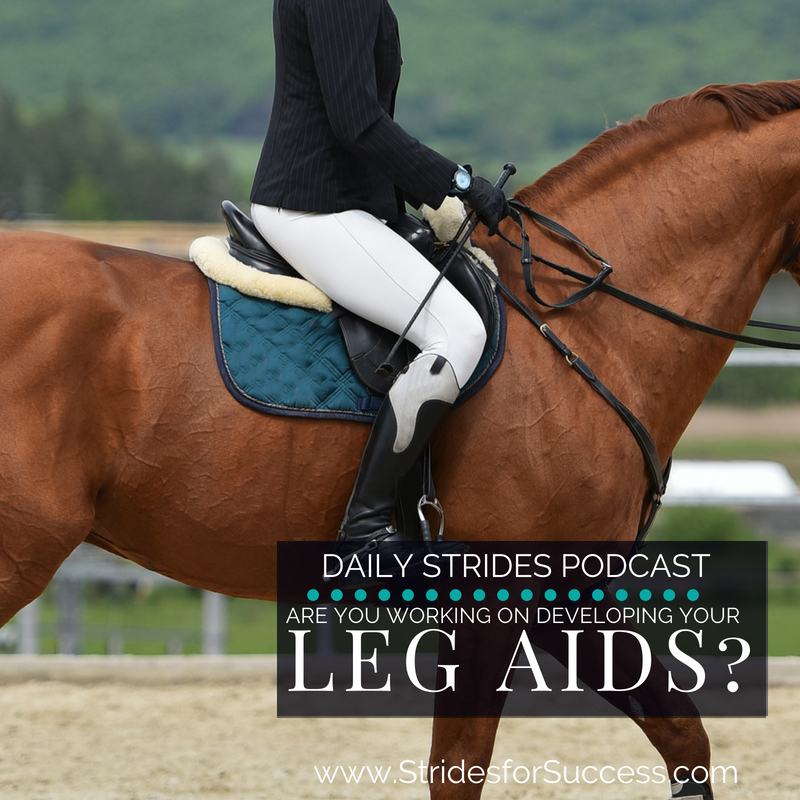
  • Are You Working on Developing Your Leg Aids?

    Are You Working on Developing Your Leg Aids?

    Are you working on Developing Your Leg Aids?

    What this episode is all about & how it can help you:-

    • Become more respectful with your legs & how it will help the overall conversation
    • Understand why how you apply the aid is so important
    • The difference between ‘loud aids’ and ‘quiet aids’
    • Develop your leg aids as a guide – not a crutch

    [smart_track_player url=”https://op3.dev/e/traffic.libsyn.com/dailystridespodcast/1058-Are-You-Working-on-Developing-Your-Leg-Aids.mp3″ title=”Are You Working on Developing Your Leg Aids?” social_linkedin=”true” social_pinterest=”true” social_email=”true” tweet_text=”How much time do you devote to improving how you communicate with your horse using your legs while riding? This will inspire you to invest more…” hashtag=”Podcast #Equestrian” twitter_username=”strides_success” ]

    Your legs make up such a huge part of the active conversation that happens between you and your horse when you’re in the saddle.  You can use them to ask questions.  They can be used to guide or direct your horse.

    Yet, so many riders fail to recognise how important their legs are to the whole conversation; and how improving your overall control of your legs, can have a huge positive effect on everything else.

    In this episode of the Daily Strides Podcast I will give you some ideas on how you can begin improving your leg aids, starting the very next time you are in the saddle.

    “My horse is not responsive”…

    One of the first statements riders say when we are working on their leg aids usually sounds a little like this.  They bemoan the fact that their horse is either a little slow to respond to their leg aids – or blatantly disregards them!

    I truly believe that responsiveness begins with the rider – and it begins when the rider shows respect to the horse in how they communicate with their aids. 

    Becoming more Respectful of Your Leg Aids

    I feel it is really important as the rider that you show up as the team leader.  Are you being respectful with your leg aids to begin with?  Or are you using them to stay in the saddle (the vice grip effect!).

    Or perhaps you are nagging.  On and on and on and on.  Horses, just like us, tend to begin ignoring the ‘dripping tap’ after a while.  The ongoing ‘drone’ that never really has anything constructive to add to the conversation.  This can often be described as ‘dead to the leg’.

    I also respectful means becoming more thoughtful about how you are applying the aid.  Huge kicks are not enjoyable for anyone involved.  

    If you horse is ignoring your leg aids, I suggest using a schooling whip directly behind the ‘ignored aid’ (your leg).  It will help bring your horses attention to the missed aid, without the unpleasantness of big, awkward, rhythm breaking kicks!  A simple ‘tap’ is a lot nicer than a huge kick.

    Respectful also means only speaking when you have something to add to the conversation.  Think of this next time you are in the saddle with regards to how you are using your leg aids. 

    How You are Applying Your Leg Aids

    There are a lot of different ways you can communicate with your horse using your legs.  If we think of asking your horse to move forward, it will almost feel like wrapping your legs around your horses tummy and lifting it up using your legs. 

    It is a ‘lift’ motion, which means that you also need to create space for that lift.  This is where your seat aid connects with your leg aids.  An allowing seat will create the space for your horse move into as he responds to your legs. 

    Turning your horse requires a different leg aid.  Think of your legs rather being the guide as to where you would like your horse to go.  The parameters that your horse can work within.

    Loud Aids Versus Quiet Aids

    I personally think that all aids can either be described as being loud or quiet.  Some can fall into both categories depending on how they are used and who uses them.

    Loud aids are the equivalent of ‘shouting’ at your horse.  They are obvious – to the point where they are visible to people who are watching from the ground.

    Quiet aids are the whispers.  The secret conversation that goes on between horse and rider.  Your seat is a good example of this – it should only really be ‘felt’ by you and your horse – not seen by other.

    Overtime the conversation between you and your horse will become more refined and more quiet.  Your leg aids will become quieter as your seat plays a bigger role. They will become more subtle.

    The Relationship Will Change as You Both Develop

    As you and your horse practice the conversation more and more together, it will improve.  It has to.  

    It is just like the people in your life.  The more time and energy you invest in building and developing the relationship, the more subtle you can communicate with those people.  A glance or a shrug can mean so much if the person knows you and your way of communicating with them.

    As you and your horse become more familiar and comfortable with each other, the conversation will develop further.

    Your Legs as a Guide Rather than a Crutch

    I really think that horses who ‘need’ the riders legs are created by riders who lack confidence to begin with.  The rider feels that they can and have to control every little thing when it comes to riding and being in the saddle.

    Please realise that as a rider, the only thing you can truly work on controlling is yourself.  The greater control you have over yourself, the greater influence you will have over your horse. 

    Gripping with your legs in order to stay on, or to ‘keep the horse going’ or anything else for that matter is not what your legs are for as a rider.  Focus on remaining balanced and equal in teh saddle and then ‘draping’ your legs around your horse.

    Riders who want to control will end up literally holding the horse up, using their inside leg, through corners, bends, turns – and even on the straight.

    Your Leg Aids Can Be Training Wheels Initially

    Training wheels, or stabilizers as we called them, are the two additions put on the back wheel of a bicycle when someone is initially learning to cycle.

    They only come into play when the bike leans or tips to a point where it is no longer stable and balanced.  They force the bike back to centre, and allow the new cyclist to continue cycling.

    Your legs should initially be the training wheels for your horse.  They don’t keep him upright or balanced – but when he wanders off track a little, they help bring things back to where they should be.

    Use your leg aids to ask the question.  Then allow your horse to respond and only when he goes a little off track, rejoin the conversation again to bring things back where they should be.

    This is how your horse learns to take responsibility for himself – and that is one of your biggest responsibilities as team leader :)

    Next Time You Are in the Saddle…

    Think about how you are using your legs to communicate with your horse.

    • Are you being respectful?
    • What about how you are adding to the conversation?
    • Are you applying the aids themselves correctly?
    • What about the timing, are you asking the right questions at the right time?
    • Finally, are you consistently working on developing and refining your leg aids to take them from being ‘loud’ to subtle and quiet?

    If you are interested in working with me further on this topic, here is your invitation to join me inside of Daily Strides Premium.  You can begin today for just $19 and get instant access to a whole collection of lessons focusing on your leg aids.

    Happy Riding

    Lorna

    Links mentioned in the episode:-
    

  • The Evolution of Your Aids in the Saddle

    The Evolution of Your Aids in the Saddle

    The Evolution of Your Aids in the Saddle for Better Conversation with Your Horse

    What this episode is all about & how it can help you:-

    • Understand why your aids are always a work in progress
    • Start on the ground and work up
    • Transitioning groundwork to under the saddle
    • Application, pressure, timing and sequence

    [smart_track_player url=”https://op3.dev/e/traffic.libsyn.com/dailystridespodcast/1049-The-Evolution-of-Your-Aids-in-the-Saddle.mp3″ title=”The Evolution of Your Aids in the Saddle” social_linkedin=”true” social_pinterest=”true” social_email=”true” tweet_text=”The always evolving conversation between you and your horse… Find out how to improve it on this episode of the Daily Strides Podcast ” hashtag=”#horseriding #equestrian #lovinghorses” twitter_username=”strides_success” ]

    Have you ever noticed how you feel when you walk away after participating in a good conversation with someone?  There was a natural flow to it. Both of you were present and interested. Both open to hearing what the other person said.

    Good conversations more often than not result in both participants walking away feeling great. Which brings us to the topic of this episode of the Daily Strides Podcast. The evolution of your aids in the saddle and the impact it has on your conversations with your horse.

    Your Aids are Always a Work in Progress

    One of your greatest responsibilities, as a rider, is to try and ensure that you are refining your aids.  A consistent ‘bettering’ of how you are showing up in the saddle.  For many riders, the seeming lack of any ‘quick wins’ can make this process often feel a little tedious.

    However, just like becoming a great conversationalist, improving your aids requires practice in order to make perfect. 

    But the thing is, that when it comes to riding, there never really is such a thing as ‘perfect’.  Your aids are a constant work in progress.  A constant evolution as you change as a person, as a rider.  

    It is also worth remembering that the same is true of your horse as well.  A conversation is a two way street.  Both sides have to be as committed to it in order for it to really work.  Your horse must also be constantly learning.  Willing.  Open to how the conversation will evolve between both of you in the saddle.

    Start on the Ground and Working Up

    Starting today, become more mindful about what and how you are communicating with your horse before you ever get into the saddle.  The mundane, general day to day routine you and your horse go through before, and after, each ride.

    One of your more useful, but unfortunately most overlooked, aids is your voice.  You can use it anywhere, at any time and it can convey a lot of different things to your horse.  It can also be really helpful for you, the rider, as well.

    I feel it is important to recognise is the versatility of your voice as an aid.  This is especially true in the early days of your relationship with your horse.

    Begin by experimenting how your horse listens to you.  How he responds to you.  Different tones, different words, different rhythms. 

    Many riders worry about the impact of using the voice aids if they have their sights set on dressage.  I honestly don’t believe this will cause any harm.  As your aids and the conversation evolves, you can slowly make your voice less and less a part of it.

    Working with Rein Aids on the Ground

    Rein aids work on the ‘pressure and release’ principle.  You can begin refining this today, on the ground, with your horse whether green or more experienced.    You can use either a head collar and lead rope and use the lead rope to apply the pressure and the release.

    You can also use an actual bridle and lead the horse using your reins.  Again, pressure and release.  This is also a great way of seeing how the bit actually ‘works’ in and around your horses mouth.

    When coupled with your voice, such as ‘woah’ with applied pressure to slow down, steady or stop, it now becomes easier to see how it can transfer over into the saddle. 

    In fact, the more ‘subtle’ aids in the saddle, such as your seat, can then be refined by adding them to the reins and voice which were learned from the ground. 

    Your Seat and Your Legs

    Your rein and voice aids, when worked on from the ground, also help open the conversation using your legs in the saddle.   Unfortunately many riders make the mistake of starting with the seat, rather than the legs when it comes to this.

    While starting with your seat is not ‘wrong’… Very often riders are a little too ‘busy’ with their seat without realising it.  It leads to a lot of confusion between horse and rider.  Hence my suggestion of starting with your legs first.

    Work on refining the conversation you are having with your horse with your legs first.  Where your legs are positioned.  How you are applying the aids.  The passive and active leg aids.  Becoming quiet through your legs when you want to…

    When you become more mindful about your legs and how you are communicating with them, the seat will naturally join the conversation. 

    Focusing on your seat before it is truly independent will only cause the lines of communication between you and your horse to become, well, twisted. Rather pay attention to your hands and your legs and allowing them to then influence your seat position.

    If your hands are level, chances are your shoulders are level.  If your legs are where they should be, chances are your seat bones will be where you want them to be.  This is the beginning of building that all important feel.

    Focus on first refining the more obvious aids and then later, shift across to the more subtle aids. 

    Sometimes ‘Exaggerated’ Communication is Necessary…

    Think of a time when you spoke with someone you didn’t understand.  A person who spoke a different language.  Once you both, quickly, figured out that language was not going to help either of you communicate, you would have begun looking for alternative ways.  Those alternative ways were probably not very subtle!  Hand gestures, grunts, exaggerated facial expressions…

    Your conversation with your horse may be, or have been, a little like this initially.  Obvious.  ‘Loud’.  There may have been a lot of back tracking due to miscommunication.  It was not fluent.

    However, over time and by consistently committing to improving the conversation with your horse, things improved, or will improve.

    Application, Pressure, Timing and Sequence

    There are four different ‘filters’ you can view the use of your aids through.  When they are all put together, you will get the overall feel of the ride for both you and your horse.

    The application of your aids is all about the ‘how’ and they ‘why’.  If you can get clear on those, you will be able to apply your aids in a more clear way for your horse to understand.

    The varying degrees of pressure create different outcomes with your horse.  It works like the tone in your voice when speaking to a person.  Soft. Hard. Gentle. Urgent. 

    Timing is important in any good conversation.  It allows things to flow.  It means not butting in, or speaking over the other person.  It also means warming the conversation up before asking more probing or difficult questions.

    The sequence is simply how you put it all together.  For example, perhaps the more ‘expressive’ or ‘obvious’ aids are necessary at the beginning.  They lead the more subtle aids.

    You have to start with the end in mind; but you cannot start at the end!

    The piece in the middle is the ongoing evolution of your aids in the saddle so that both you and your horse can have better conversations together.

    Happy Riding

    Lorna

    Links mentioned in the episode:-


  • Smoothing Out the Ups and Downs in Your Riding

    Smoothing Out the Ups and Downs in Your Riding

    Smoothing Out the Ups and Downs in Your Riding

    What this episode is all about & how it can help you:-

    • Begin noticing where the ups and downs are happening
    • Take responsibility, rather than looking for a quick fix
    • Learn to Balance Your Aids Correctly
    • Using a Split Second to Smooth Out Your Riding

    [smart_track_player url=”https://op3.dev/e/traffic.libsyn.com/dailystridespodcast/1045-Smoothing-Out-the-Ups-and-Downs-in-Your-Riding.mp3″ title=”Smoothing Out the Ups and Downs in Your Riding” social_linkedin=”true” social_pinterest=”true” social_email=”true” tweet_text=”Are your rides a little to ‘turbulent’ for your liking? Here is how you can begin smoothing things out today…” hashtag=”equestrian #podcast #transitions #smoothsailing” twitter_username=”strides_success” ]

    Do things feel a little ‘touch and go’ when it comes to your riding?  You touch on how you want it to feel, but that feeling is all too brief.  It’s there for a few strides and then it is gone again.  Would you like to maintain that feeling for longer?  Smooth out your riding?

    This episode is focused on learning how to influence your horse more to create a more balanced, smoother ride for both of you.  A more polished finished to your riding.

    Horse Riding is Never ‘Done’

    I want to begin by warning you of a trap that so many riders make the mistake of falling into.  They finally ‘get’ something in their riding; and they then think that their work regarding that topic is done.

    Horse riding, by its very nature, is never ‘done’.  It is ever evolving.  There are challenges at every level that will lead to us having to re-navigate past topics from your new perspective or where you are now.

    Very often the key to overcoming new challenges in horse riding is going back to the basics – and applying those to the new challenge.

    Begin by Noticing Where the Ups and Downs are Happening

    You can do this by paying close attention to your rhythm and tempo.  Notice where they are lacking.  Can you maintain both consistently through a movement?  Can you maintain them through a transition?  At what point are they changing?  Is this every time, or only in a certain place or on a certain rein etc.

    A second way you can become more mindful about the basic quality of your rhythm and relaxation is by ‘testing’ your riding on a straight line.  When you are riding a longer straight line, perhaps on the road or trail, how well can you maintain? Do things tend to become faster, or slower.  Is there more or less tension the further you travel.  Or, is there a greater sense of ease?

    You can also pay attention to your aids and you in general in the saddle. What influence are you having with your riding?  Is it positive or negative. 

    Remember, you are always influencing your horse, regardless of if you are intentional about it or not.  Therefore, it makes good sense to become mindful on what you are doing – and making that influence a positive one.

    Taking Responsibility, Rather than Searching for the Quick Fix

    When you do begin to notice where things are not being well maintained, the second trap a lot of riders fall into is thinking that there is a ‘quick fix’.  A different bit, or a new noseband.  A change of martingale, or feeding plan…

    Keep in mind that often the easiest thing to ‘fix’ is the most obvious.  You, the rider! 

    Showing up and claiming ownership of your riding, faults and all, is an important part of becoming a responsible rider.  It is also the one thing that you truly have control over when communicating with your horse.

    Looking in and taking ownership of the fact that you are consistently either positively or negatively influencing your horse will go a long way to smoothing things out.  Keep in mind that your thoughts are also influencing your horse, so be mindful.

    Yes, sometimes you may have to change the bit, or martingale, the fact of the matter is that you are the single greatest influence.  So my advice to you is to check in with yourself first!

    Learning to Balance Your Aids in Your Riding

    Each of your individual aids, the ways that you communicate with your horse, are part of the bigger picture of an overall conversation.  No aid should be used alone, and as a whole, the proportions are always changing as well.

    Balance, by definition, is ever shifting.  The balance of your aids in your riding is an ever-changing way of maintaining the conversation with your horse. 

    What worked for one transition may have to be refined and ‘tweaked’ a little for the next.  What goes into each transition with you and your horse is different and what comes out of each transition is different.  Your aids need to be applied with this in mind.

    Think of it as being a large pie or pizza.  The ‘My Ways of Communicating with My Horse’ Pie.  Each aid has a slice.  These slices are continuously changing in size and proportion depending on the circumstances of each movement or transition.  If every thing you do on your horse was shown on one of these pies, you will see that very rarely are any two pies the exact same.

    Your responsibility as the rider is to tailor each communication with your horse so as your aids are balanced for what he needs at that exact moment.  This will happen all through the ride. 

    Using a ‘Split Second’ to Smooth Our Your Riding

    As a rider, I am sure that you are familiar with how important your half halt is.  It is the rebalancing of both you and your horse, throughout your ride. But, another place we can have a huge influence over the smoothness of the overall ride is within the transition itself.

    You are riding transitions the whole time in your riding.  A transition is simply a change.  Straight to bend, long to short, trot to walk…  Everywhere.  

    So, it makes sense to work on smoothing out the transitions themselves in order to even out the whole ride, doesn’t it?

    Inside of every single transition, there is a split second where you have the power to begin smoothing things out.

    Every change needs a catalyst to make it happen.  In riding, this can often be described as pressure or tension.  Your job through the transition is to find that ‘split second’ where you can smooth out what was needed, the catalyst, in order to make the whole transition appear relaxed.

    Start thinking about and looking for that door of opportunity within each transition as you go forward.  If you want to find out more, you can join me on the 2nd of June 2018 in my upcoming workshop on Relaxation in Your Riding.

    Happy Riding

    Lorna

    Links mentioned in the episode:-


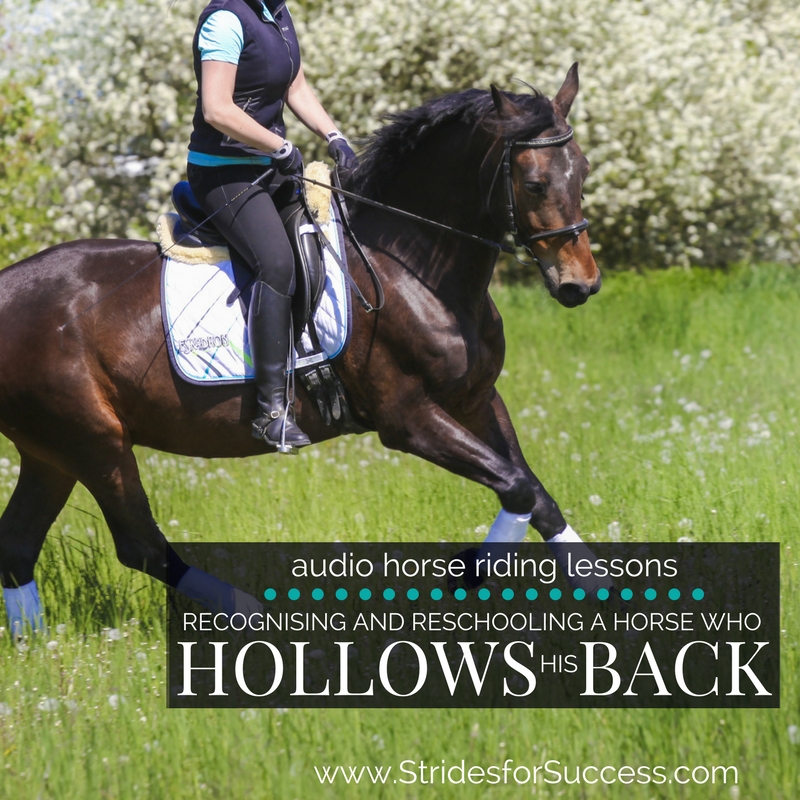
  • Recognising and Reschooling a Horse who Hollows His Back

    Recognising and Reschooling a Horse who Hollows His Back

    Recognising and Reschooling a Horse who is hollow through his Back

    What this episode is all about & how it can help you:-

    • Knowing what a hollow back looks and feels like
    • Realising you may be playing a big part in what is happening
    • Understanding the role your own self carriage plays in your horses self carriage
    • Beginning to build on a correct way of going in your rides

    [smart_track_player url=”https://op3.dev/e/traffic.libsyn.com/dailystridespodcast/1035-Recognising-and-Reschooling-a-Horse-Who-Hollows-His-Back.mp3″ title=”Recognising and Reschooling a Horse Who Hollows His Back” social_linkedin=”true” social_pinterest=”true” social_email=”true” tweet_text=”Is your horse a little ‘hollow’ through his back and are you maybe causing it… ” hashtag=”Equestrian #horseriding #selfcarriage” twitter_username=”strides_success” ]

    There you are, happily riding along.  Feeling all those good feelings we feel as riders; until you ask for something different.  Suddenly, it feels like everything has just ‘deflated’ and, to be honest, it has a little because your horse just went hollow through his back. 

    You see, it is not just you the rider who should ‘carry themselves’ and work at having a strong and connected back.  Your horse also needs to work on carrying himself in order to avoid becoming hollow through is back as well.

    Knowing What a Hollow Back Looks and Feels Like

    Being able to pinpoint and feel when your horse begins to hollow his back, and then later take steps to avoid it happening, is key to reschooling through this problem.  When your horse begins to hollow his back, it really feels as though his back is not supporting you any more.

    Think about this, when his hind legs (hind quarters) are engaged and working underneath him, they support you on his back.  When they get ‘left behind’ that support goes away…

    Couple this with the fact that most horses will also raise their head and neck and become resistant to the rein aids as well.  The result is your horse literally hollowing his back from underneath you and you experiencing that ‘sinking feeling’.

    Because the head and neck will usually ‘come up’, the rider can literally feel the horses shoulders brace against the contact and seat.

    This resistance is one of the most obvious signs that your horse has begun to become hollow thorough his back; and should send a few warning bells off in your head regarding what you can do to get things back on track.

    Realising That You May be Playing a Big Part in What is Happening

    Riders the world over tend to get into the saddle with the sole intention of making the horse ‘do’ something.  A good example of this is the all important ‘on the bit’ goal so many riders have, but either way, when we become so concerned with just one ‘goal’, it can be a little like putting blinkers on!

    Riders end up focusing on what they can see in front of them; the horse’s head and neck.  They also ‘see’ their hands and arms…  You must switch your focus from what you can see – to what you can feel, both in your horse and in your aids. 

    Just focusing on one part of the whole picture often results in your position suffering.  It is all the gripping, the squeezing, the twisting the shoving that you are doing to get things ‘looking’ like you think they should look. 

    But remember, from where you are sitting, you are only seeing a third of the picture.  This third should be the ‘result’ rather than the cause part of the overall picture!  When we start to make the front end the ’cause’, the result is never good!

    So, I mentioned that very often when riders get into this mindset and way of riding, they are moving – a lot!  All of this movement only serves to move your position further and further from where it should be. 

    The further you move away from where you should be, the less clear your communication becomes.  The less effective your aids are.  And the less you can balance yourself. 

    Understanding The Role of Your Self Carriage in Your Horses Self Carriage

    It is this lack of balance that causes you to become heavy in the saddle, which in turn can lead to your horse becoming hollow through his back.  He is literally trying to get out from under your unbalanced, ineffective position!  Harsh, but true!

    Instead of carrying yourself, you have become a ‘dead weight’ in the saddle.   Rather than thinking ‘light’ and ‘refined’, you are scrubbing and having to over do the communication through your seat.

    Many riders at this point become frustrated because their horse is not really listening or being responsive to their ‘seat aids’.  So rather than taking things back to basics and allowing their other aids to apply any extra pressure if necessary, they try to knuckle down even more on the already ineffective seat aid.

    It is a vicious cycle that usually leads to all parties becoming frustrated by the lack of understanding and progress!  An overly excited (heavy) seat will also effect the rest of your body and the rest of your aids.

    As the team leader for you and your horse, you need to lead by example when it comes to self carriage.   Learn to first carry yourself in order to feel what is going on underneath you.  It is only by carrying yourself that you can create the space your horse needs to carry himself.


    Beginning to Build on a Correct Way of Going in Your Rides

    Start with the basics, the walk to halt transition.  Work on setting it up correctly and allowing your horse to ‘close’ the halt.  Simply put, allow his space to ‘park’ his back-end underneath his body.

    Think of creating a space that he can easily close the lid of the box that all four of his legs should create when he is in a square halt.  

    Notice any tension through your lower back.  Notice if you are leaning, or becoming heavy.  Start to ‘feel’ if you are indeed creating that space for your horse; and then inviting him to step into it.

    Make a point of thinking light through the transition.  Go over it again and again, making small adjustments each time until you begin to ‘feel’ a difference underneath you.

    From here, start to look for this feeling throughout the other movements in your ride.

    Happy Riding

    Lorna

    Links mentioned in the episode:-

  • Position Faults that are Potentially Holding You Back in Your Riding

    Position Faults that are Potentially Holding You Back in Your Riding

    Position Faults that could be holding you back in your riding

    What this episode is all about & how it can help you:-

    • Understanding the importance of a good position
    • Your seat and where it should be
    • Your legs and heels and how they affect your stability
    • Your head, shoulders and arms and how they affect your position

    [smart_track_player url=”https://op3.dev/e/traffic.libsyn.com/dailystridespodcast/1026-Position-Faults-that-Could-Be-Holding-You-Back-In-Your-Riding.mp3″ title=”Position Faults the Could be Holding You Back in Your Riding” social_linkedin=”true” social_pinterest=”true” social_email=”true” tweet_text=”How good is your position in the saddle? Could a simple ‘tweak’ change everything for you?” hashtag=”Horseriding #Equestrian” twitter_username=”Strides_Success” ]

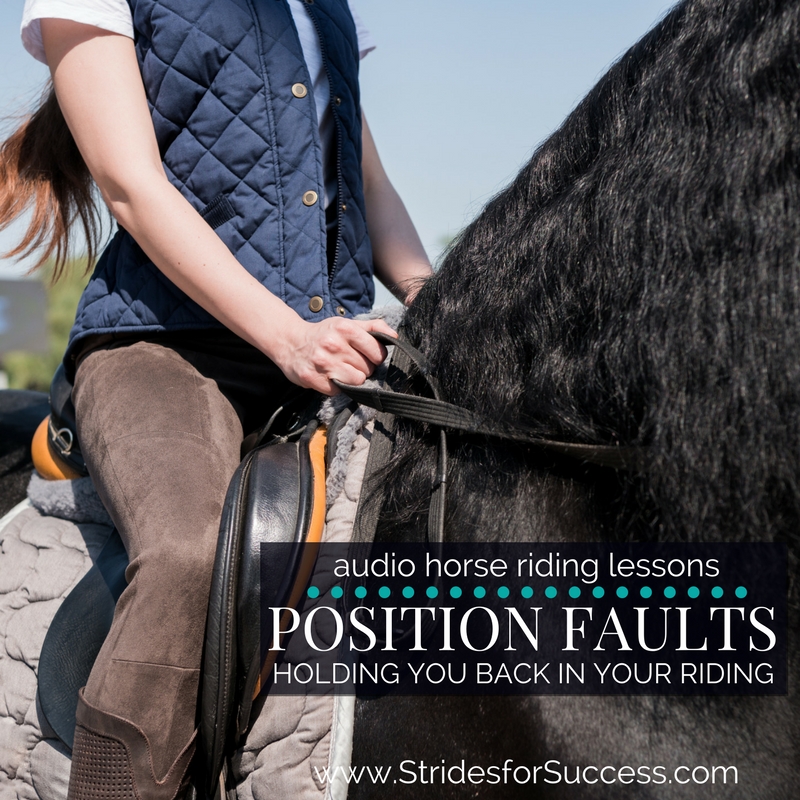
    If you were to mark your position in the saddle out of 10, how would you score?  Would you make the perfect 10?  Or would a few simple position faults undo everything for you?  These basic position faults have the potential to put a halt to your progress as a rider.  Yes, they can have that much impact on your overall riding performance.

    The reality of the situation is that without a correct position in the saddle, you tend not to make a whole lot of sense to your horse.

    Your position in the saddle is something that riding instructors the world over focus on daily during lessons.  A lot of riders sadly don’t realise how important their position is to their overall riding, because if they did more effort would go into correcting it.

    Why is Your Position so Important?

    Simply put, a good position puts you in the right place to be able to communicate most effectively with your horse.

    Another advantage of a good position is the dramatic decrease in your risk of unexpected dismounts (falls) because you are more secure in the saddle.  So, if you are working towards an independent seat, it makes sense to devote some time to perfecting your position.

    I want to visit a few areas where your position might be letting you down, and give you a few ideas on how to improve your overall position – and in doing so, improve your riding.

    Your seat and where it should be

    Are you guilty of sometimes treating the saddle as a place to sit, rather than a place to communicate from?  Your seat is probably your most important tool when it comes to communicating with your horse.

    If your seat is not correctly positioned in the saddle, the result is you talking gibberish to your horse! 

    It sounds a little harsh, but it is true.  The right position where your seat is concerned is essential from the first ride.   As you develop as a rider, your seat becomes more and more important to your communication with your horse.

    If your seat position is incorrect, or if you have been allowed to ride one way (which is the wrong way), your seat will be ineffective from the beginning.  These position faults will become amplified further down the line.

    What is ‘Good’?

    That being said, what is a good position when it comes to your seat?  Basically, you should be sitting on your seat bones.  They should not be sticking out behind you, nor should you be leaning back on your tailbone.

    If you could imagine your seat bones being two flashlights.  A good position will see those beams of lights pointing straight now to the ground below where you are sitting in the saddle.  They would not point backwards towards your horse’s hind hooves, and they would do if you were sitting a little forward, or perched in the saddle with your bum sticking out behind you.  Nor would they point towards your horse’s front hooves, which would happen if you were rolled back on your tailbone.

    Your seat affects the rest of your body. When your seat is plugged in correctly it has an almost domino like effect.  Everything else will have a greater success rate of maintaining its position as well. 

    How a Faulty Seat Position Affects Your Legs in the Saddle

    Many riders immediately notice how, once they have corrected their seat position, the their legs feel different.  Your legs cannot function to the best of their ability while riding if your seat is faulty.  The biggest cause for concern is gripping with your thighs and knees due to being perched in the saddle (your bum will be sticking out behind you and your back arched).

    When you are sitting correctly on your seat bones and carrying your body using your core, it allows your pelvis to open.  This, in turn, allows your legs to drape down around your horse’s sides.  This is important, regardless of what discipline you are doing.

    A closed pelvis creates a clothes-peg effect on your horse using your legs.  They become similar to a vice-grip; clamped closed in a bid to keep you in the saddle.    Rather think of actual drapes, material.  Your legs should be in contact with your horses sides, but not gripping or clamping.

    Your Ideal Leg Position

    One of the markers of a good position is the visible line from your head, through your shoulders, through your hip to your heel.   When that line is present in your position you are balanced.

    If you are struggling to imagine this line, try this:-   The next time you are in the saddle imagine you can click your fingers and, like magic, make your horse vanish.  If the line is present, you will land on your feet.  It it is not, you will either land on your face or on your bum.

    The head, shoulder, hip, heel line is the start of learning to become a balanced rider.  It puts you in the best position to use your own body for balance, rather than relying on your horse.

    The Ever Important “Heels Down”

    Oh, it may just be the most uttered phrase in arenas the world over.  But it really is an essential part of developing a good position which will lead to your independent seat.

    How much weight you are going to have in your heels will vary depending on your discipline.  Jumping generally requires a little more than dressage.  What is important here is to recognize that by dropping the weight into your heel, you elongate your leg.

    How a Relaxed Knee Improves the Overall Use of Your Leg

    The final position fault to do with riders legs is squeezing with the knee.  Next time you are in the saddle, I want you to try something.  Slip your hand between your knee and the knee roll of the saddle.  You should be able to swing your knee away from the saddle with very little resistance.

    Notice how, when you do this, your leg remains in contact with your horse.  It remains ‘on’ while your knee can stay relaxed.  

    Why do you not want your knees on?  Two reasons.  Firstly, you certainly don’t want to pivot on them because you would be a little top-heavy, increasing your chances of toppling off!      Secondly, your knees act, along with and ankles, as your shock absorbers.  If they are fixed in any way, this will result in bouncing, loss of position and ineffectiveness in the saddle.

    Your head, shoulders and arms and how they affect your position

    One of the most common position faults in this area is failure to carry the head.  It sounds strange, but a simple way of ensuring this is not the case in your riding is by focusing on creating and maintaining the space between your chin and your chest.

    However, your head can also influence your overall position through the direction it is facing.  Look where you are going and you will find that your head positively influences the position of your shoulders.  This of course will have a domino effect on your arms as well.

    Opening Your Chest and Shoulders

    I personally do not like the term ‘shoulders back’.  I find that it encourages riders to needlessly arch their back, which causes excess tension in both horse and rider. 

    Rather start with a correct seat position.  Then imagine opening or stretching the distance across your chest from point of shoulder to point of shoulder.  This will naturally encourage you to sit a little taller, focus on where you are going and, open your chest up.

    The Elbow, Wrist, Hand, Rein, Mouth Line

    The final part of your position I want to touch on today are your arms.  There is a second line that, when applied, makes all the difference in smoothing out the communication between horse and rider.

    That second line is from the elbow, down through your hand, through the rein to the horse’s mouth.  It should be straight at all times.  No Vs or kinks in it.  Neither the rein or the hand should deviate off that line between the elbow and the bit.

    Riders who work on mastering all of these potential position faults find that their communication with their horse improves dramatically. It is truly amazing how effective a few small changes can be.

    Your Physical Fitness and its Impact on Your Position

    Riding is a Team Sport – you and your horse.   Just like your horse, the stronger and more developed you become physically; the more fluid your movements and “self carriage” become in the saddle.

    Creating a detailed exercise program for your horse, while failing to take your own fitness into account will result in, at best, mediocre results in your riding. 

    Establishing and then maintaining an effective position in the saddle requires strength, suppleness and discipline.  Taking responsibility for your fitness is just as important as assuming responsibility for your horses fitness.

    We are starting a new round of the free 30 Day Rider Fitness Challenge on 1st of February.  This will be different to anything that has gone before; you choose what you want to do based on your unique circumstances. You can sign up HERE

    Happy Riding

    Lorna

    Links mentioned in the episode:-


  • The Importance of Timing in Your Riding

    The Importance of Timing in Your Riding

    The Importance of Timing in Your Riding

    What this episode is all about & how it can help you:-

    • Timing – the big picture view
    • How to make the best use of your time in each ride
    • Using short bursts of time to focus you when you are in the saddle
    • Understanding the importance timing when it comes to your aids

    [smart_track_player url=”https://op3.dev/e/traffic.libsyn.com/dailystridespodcast/1022-The-Importance-of-Timing-in-Your-Riding.mp3″ title=”The Importance of Timing in Your Riding” social_linkedin=”true” social_pinterest=”true” social_email=”true” tweet_text=”Timing has a lot to do with if you will succeed or not in your riding… ” hashtag=”Equestrian #Horseriding #ticktock” twitter_username=”strides_success” ]

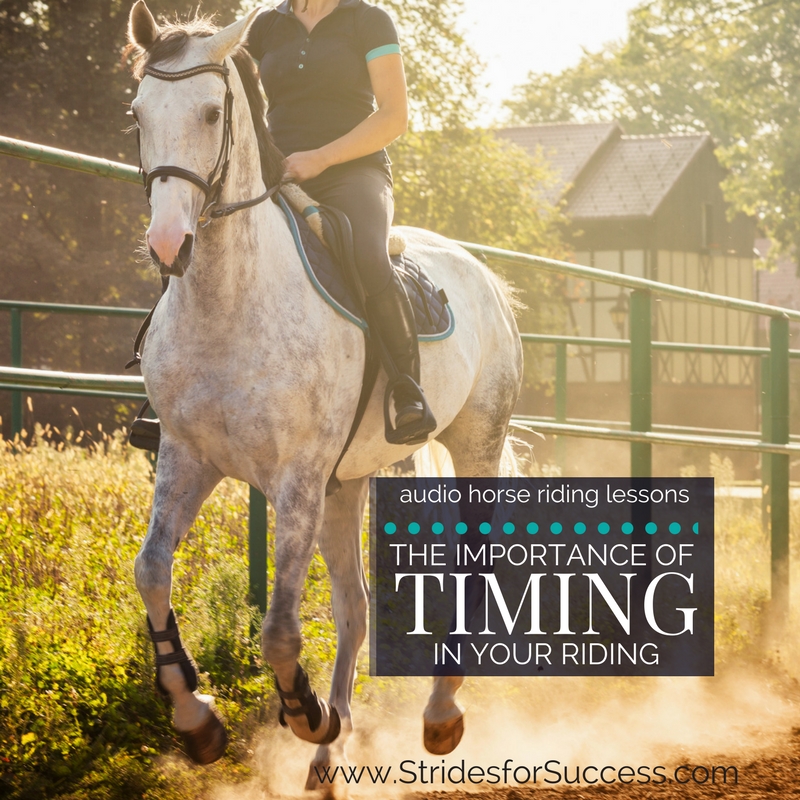
    Correct timing in your riding is essential to communication, both on the ground and in the saddle, with your horse.  In this episode we are going to take a look at timing from the ‘big picture view’ and also the closer, more intricate detail orientated, view.

    Timing when Working Towards your Goals

    I believe the most realistic and successful way of planning out goals when it comes to horses and riding is working in 90 day (or three month) chunks of time.  I think if we look further than that, especially with horses, it can tend to become a little hypothetical.

    That being said, it is clearly important to have a realistic picture of what you want things to look like a year from now.  Each of your 90 day chunks should be with that ‘year’ goal in mind.   Start with the coming 90 days and working backwards from that goal to where you are right now.  This is your beginning and the place you will measure your time from.

    Timing when Riding Your Horse

    Timing is important when you think about the ride itself.  From how long you are warming up, to how long you are schooling your horse and then your cool down time.

    Rhythm is another way of measuring time and rhythm can be worked on while preparing the horse to be ridden, of course the rhythm while actually riding your horse and also putting the horse away afterwards.

    If you plan to have an even, steady rhythm to all the above parts of each individual ride, you will minimise those feelings of being rushed, overwhelmed or frazzled. 

    Knowing how much time you have before each ride and allocating it out into flexible portions will give you a framework to plug your actual schooling into.

    You can also pay attention to the time of day you ride and how that influences both you and your horses way of going.  Perhaps there is a time of day when your horse is more responsive or he listens better,  more focused and less likely to spook or become distracted. Timing is all about finding what works best for you and your horse.

    Timing the Segments of Each Ride

    So we have already mentioned allocating time for your warm up, time for the actual schooling, then giving time for the cooling off.  However, we can go a little deeper here by focusing on the exercises themselves and what we want to achieve in that ride.

    Concerning exercises, many riders are of the opinion that they must simply ride through each exercise a couple of times in order for them to have benefit.  I want you to think about if you were to allocate a certain amount of focused time on working through each exercise.

    Let’s use the example of 20 minutes for actual schooling work.  This 20 minutes of time can be divided up into 6 minutes, 6 minutes and 6 minutes, and I am going to put a minute between the two as well.  I realise this is an extreme example, but by giving your horse and yourself a focused 6 minutes and then a minute just to relax and unwind, you will find the quality of the work improves.

    This method is proven to work because it stops the exercise from becoming monotonous and never ending.  Also, when we give ourselves an end point, it helps us become a lot more focused on what we are doing between now and then. 

    It helps us assess the quality of the work we are doing.  Noticing what you want to work on, and what you want to have made happen when you get to the end point will help you become more consistent and disciplined in the saddle.

    Timing of the Aids

    Timing can also be used on a very precise split second level in riding with the timing of the aids.  Specific aids given at an exact moment in order for your horse to take that direction and make the necessary changes happen regarding his movement.

    As riders, it is this type of timing that we look to refine every time we get into the saddle.  This is where you should be working every single day.  This is what you can focus and concentrate on in those timed schooling sessions.   The practiced refinement of the timing of your aids.

    This begins when you start working on what is moving when underneath you.  Your aim is to feel your way here, not peek over the side!

    Knowing what is moving when beneath you, is the foundation for knowing when to apply your aids to get a specific result.

    You should ask with your aid at the moment when the horse can respond to your aid.  Otherwise your horse may not be physically in a position to respond your aid, resulting in frustrations about a lack of responsiveness. 

    Start working on developing this skill next time you are in the saddle.  Take note of what is moving, when it is moving, how is it moving and where would be the best point for you to act and influence that movement to get the desired result that you are after.

    Begin Working on Your Timing Today

    It is important to understand the importance of timing when it comes to riding.  Taking it from the big picture, 90 day goal view, all the way down to the split second application of your aids in the saddle.

    Happy Riding

    Lorna

    Links mentioned in the episode:-