Tag: Aids

  • Understanding Inside and Outside in Your Riding

    Understanding Inside and Outside in Your Riding

    Understanding What Inside and outside means in your Riding

    What this episode is all about & how it can help you:-

    • Understand what inside and outside are when it comes to your aids
    • Take the confusion out of applying your aids correctly
    • Get started reframing how you think and apply your aids
    • Think and ride with your horse…

    There is one thing that I notice time and again when working with riders in the arena…  The confusion that shows up regarding left and right.  Now, bear with me here; of course these riders understand and know their left from their right. Most riders over the age of 6 can do that.

    However, the confusion seems to occur when coupling left and right with a specific aid.  Such as left leg, or right hand.  Even ‘track right’ or ‘ask for flexion to the left’ seems to throw many riders off their game.

    [smart_track_player url=”https://op3.dev/e/traffic.libsyn.com/dailystridespodcast/1101-Understanding-Your-Inside-and-Outside-while-in-the-Saddle.mp3″ title=”Understand Inside and Outside in Your Riding” social_linkedin=”true” social_pinterest=”true” social_email=”true” tweet_text=”Are you struggling to coordinate your aids? Here is a simple way to think about them that relates to your horse…” hashtag=”equestrian #horseriding” twitter_username=”strides_success” ]

    I have found that using the terms ‘inside’ and ‘outside’ so much easier for all involved.  But in order to successfully do this, the rider must first understand those terms and how they relate to their horses.

    In this episode of the Daily Strides Podcast I will explain ‘inside’ and ‘outside’ with regards to your horse, rather than where you are in the arena. This concept is not only useful for smoothing out those pesky directional issues in the arena. 

    It is essential for you to really understand and apply your aids when on your horse. 

    Begin By Using Your Location in the Arena

    If you are new to these terms, the easiest way for me to explain outside and inside is to use the arena or space you’re working in.  Your outside is the side of your body closest to the rail or fence of the arena.  Your inside is the side of your body closest to the middle or centre of the arena.

    If using your location in the arena to determine outside and inside, remember to ‘swap’ each time you change rein.  Your inside will become your outside and your outside will become your inside.

    Practice thinking of your aids as being ‘outside’ or ‘inside’, rather than right or left.  Once you have become comfortable using this, you can take the next step in your riding.

    Using Your Position on Movements & School Figures

    The next step to correctly using the concept of outside or inside in your riding is to be aware of where you are at any given point in a movement or figure.  This is regardless of where the shape or movement is being ridden in the arena.

    A circle is simple enough to understand.  The outside is the side closest to the edge of the circle.  The inside is the side closest to the centre of your circle.  This is regardless of where your circle is being ridden in the arena.

    For example, your inside leg is the one closest to the middle of your circle.  Your inside leg is the one your horse is bending around. 

    Sometimes you have to ‘break’ or divide shapes up in order to identify inside and outside.  For example if you are riding a serpentine.  Think of it as being a series of semi-circles connected by short straight lines.

    Your Horses Flexion Determines Inside and Outside

    The aim of starting off using your position in the arena or during an exercise is to become familiar with thinking inside and outside.  However, it is only a stepping stone on the way to the real ‘meaning’ of inside and outside in your riding.

    Inside and outside is truly dictated by our horse and the flexion present through your horse. 

    If your horse is flexed or bending to the left, your left becomes your inside. The same applies to the right.  Flexion to the right means the right side is the inside.

    This is important as there are many exercises that have your horse flexing differently to the ‘shape’ you are riding.  Counter canter is a good example of this.  Leg yielding is another example of where it is important to understand that it is your horses flexion, rather than where you are in the arena that decides inside and outside.

    Start Today – And Say Goodbye to ‘Right’ and ‘Left’

    I really believe that you must begin thinking this way in order to move your riding forward.  It is confusing to continue to think in terms of left and right when in the saddle.

    Thinking inside and outside really connects you to what you are doing and what your horse is doing at any given time.  It helps you to work with your horse. 

    Take time to allow yourself to feel confident thinking about your aids as being inside and outside.  Every time you apply an aid, ask yourself is this inside or outside?  Question what makes it one or the other.

    Soon, inside and outside will become second nature to you in the saddle.  And you can banish any confusion of right and left forever!

    Happy Riding

    Lorna

    Other posts, episodes and resources that relate to this topic:-

    Daily Strides Premium

    If you want to learn more about your aids and the application of your aids, Daily Strides Premium is packed full of trainings you can use.  With specific sections on leg, rein and seat aids and then also schooling, you can begin becoming clearer on your aids immediately.

    Couple this with the live Q&As, the monthly review and planning live calls and the members only private group ~ we are here to help you remain accountable as team leader for you and your horse.

    All of the trainings are easily accessed using your phone, meaning that you can take them with you where ever you are going.  These trainings and so much more are available for you immediately when you join Daily Strides Premium. Find out more HERE

  • Using Your Voice as an Effective Aid in Your Riding

    Using Your Voice as an Effective Aid in Your Riding

    Your Voice as an Effective Aid in Your Riding

    What this episode is all about & how it can help you:-

    • Understand why your voice works, regardless of discipline
    • Begin using tone to help convey your message
    • Use your voice to reward your horse
    • Understand how to ‘wean’ your horse off of your voice

    Imagine if you could use your voice as an effective, accurate aid when communicating to your horse from the saddle…  I’m going to assume that you, just like most other riders in the world, talk to your horse regularly.  Actual words.  And that is great…

    But there is a big difference between just babbling on and your voice becoming an actual effective aid in your riding communication.

    [smart_track_player url=”https://op3.dev/e/traffic.libsyn.com/dailystridespodcast/1096-Using-Your-Voice-as-an-Effective-Aid-in-Your-Riding.mp3″ title=”Using Your Voice as an Effective Aid in Your Riding” social_linkedin=”true” social_pinterest=”true” social_email=”true” tweet_text=”We all talk to our horses… But your voice can become a solid aid to help you communicate when riding as well…” hashtag=”equestrian #horseriding” twitter_username=”strides_success” ]

    In this episode of the Daily Strides Podcast I want to explain how I suggest you can begin using your voice to actively ‘talk’ to your horse in a way that he understands.  Your voice can become a great asset in moving your conversation forward. 

    Your Voice Works for Your Horse

    A lot of riders shy away from using their voice as an active aid.  This is often due to either misunderstanding how and when to use the voice aid.  But also, it is due to certain disciplines penalizing riders for using a voice aid; dressage for example.

    However, your voice is something you can use to communicate with your horse from Day 1 of your conversation together. It doesn’t involve much practicing and it can be both the pressure and the release in your communication

    I suggest that riders begin using their voice on the ground.  So you will use it when you are grooming, tacking up, actively working on groundwork and, of course, lunging and long lining.

    Your voice is particularly useful as an aid to bring your horses attention back to you at any given time.  Especially if you find that his attention is wandering to something other than you and what you are both trying to achieve!

    It can be the gentle reminder, “Excuse me, we were working on this together” that is often needed to help your horse focus on the job at hand. Your intention and your goals.

    Your Voice Works for You, the Rider

    When it comes to you, the rider, the voice works equally as well.  Again, if we take the situation that your horse is not concentrating or focusing on you, it can lead to you feeling vulnerable in the saddle.  It is easy to allow worry and excessive tension to creep into your body when your horse suddenly stops listening to you!

    When you use your voice to bring your horses attention back to you, you have to breath.  It sounds so simple, but your breathing helps to dissipate excess tension in your body.

    Your voice also helps you to remain focused on the goal or your intention.  By ‘reminding’ your horse, literally speaking to him and telling him what you are trying to achieve, you remind yourself.  

    “Hey there Buddy, we are actually trying to work on a balanced trot on this 20 meter circle.  I need you to focus on moving around the track on our circle.  Come on, keep moving forwards.  1… 2… 1… 2… 1… 2…  Good Boy, remain focused…”

    So, just from the outset, before we even get into using it as an active ‘riding aid’ your voice has its benefits.  It allows your body to work better, and it helps you both to focus on the job at hand.  I think that is an aid worth improving.  What do you think?

    It’s Not What You’re Saying, It’s How You Say It

    Many riders make the mistake of getting too caught up in ‘talking’ to their horse.  They expect their horse to understand their words, and therefore the meaning behind them.  Horses don’t really seem to care about language!  I have experienced this first hand on the farm in South Africa; it doesn’t matter if the words are English, Afrikaans or Xhosa!

    What matters is HOW the words are spoken.  The tone of the riders voice.  Soft and gentle?  Slow and steady?  Low and slow? Loud and quick?  Short and loud?  Or monotone?

    A good example of riders getting confused between what they are saying and how they are saying it is when a horse is going too fast. “Whoa…, whoa.., whoa, WHOA!, WOO!, WO!” Hmmmm…..

    The trouble with whoa is that it sounds a lot like go, doesn’t it?!  And the trouble with roaring whoa at the top of your lungs in short bursts is that it sounds very much like you want things to go faster.  You want an increase in energy.  

    Your Tone Must Match the Desired Energy Level

    Think of how what you are saying would be understood by someone who cannot speak the same language as you.  Is your tone urgent and quick; a sharp tone?  Or is it relaxed and slow; a comforting tone?  This is what is important when using your voice aids with your horse.

    When you can begin to control the tone of your voice effectively, you can then begin to use your voice aid to communicate with your horse from the saddle. 

    An easy way to begin is by experimenting with the pitch of your voice.  A higher pitch for reward, for example, is often effective.  ‘Good boy” or “Good girl” said in a high pitch voice.  A lower pitch to ask your horse to become or remain steadier.  “S.t.e.a.d.y….”  “W.h.o.a.   b.o.y…”

    You can also use the rhythm of your voice to help convey what you are looking for.  I find a simple ‘1…2…1…2…1…2’ said out loud in a sharp tone is often enough to help a horse to balance in the trot.  Your ‘clicking’ can be used in the same manner.

    Getting Started with Your Voice Aids is Simple

    So, hopefully by now, you understand a little more about how your voice can be used as an aid.  However, for many riders the trouble is to actually get started, effectively.  Meaning your voice becoming something your horse actually understands!

    And this is where I am going to suggest start with what feels good.  A reward. 

    From the very first time you meet your horse, you will have probably told him on numerous occasions how ‘good’ he is.  This is usually accompanied by a rub on the neck or shoulder.  Maybe a scratch but almost always some sort of physical contact.

    By becoming consistent with the tone of your voice as you are dishing out these frequent words of love, you can begin to make your voice work for you in the saddle.

    Your Voice, There From The Very Beginning

    When I am starting horses or ponies, the ‘reward’ is one of the first things that I make sure the horse is clear on.  I want him to know every single time he takes any step in the direction I am looking for him to step into.  

    This begins on the ground, usually in the stable.  A simple ‘over’ when I am grooming accompanied by a gentle pressure on his side.  A pressure that will later be felt by a rider’s leg asking a similar question.

    Then, when he yields to the pressure, accompanied by my consistent voice aids, he is rewarded.  The physical pressure is released and this coincides with a high-pitched ‘Good Boy’.  I often use the scratch or rub as well if I can to really get the point across.

    What counts is how consistent I show up with my voice and how I am using it.  Also, just like all my other aids, timing is vitally important.  The reward must be instant.  There must be a direct association between him taking action and the release of the pressure accompanied by my voice.

    Transitioning from Ground to Saddle

    From here, I will usually start lunging the horse.  Again, my voice is a vitally important tool in how I communicate to the horse.  Especially when the time comes for a rider to mount up.

    When starting young horses, your voice can work as ‘dual controls’ for both the person on the ground and the rider. 

    The same high-pitched, well-timed ‘Good Boy’ accompanied with the release of whatever pressure was applied will convey the message to the horse.  It will tell the horse ‘Yes, that is the correct way to respond to that particular aid”.

    Weaning Your Horse Off Your Voice in the Saddle

    The final point I want to touch on is specifically for dressage riders worried about being penalised for using their voice.  You can use your voice in your initial training.  In fact, I highly recommend it.  For all the reasons I have already spoken about.

    However, you need to find a way for your horse to get the same message, without you having to verbally communicate this to him.

    If you are consistent with the application and timing of your aids, this will naturally occur.  Remember, you are using your voice to convey to your horse that he has responded correctly to your aid.  Your aid is actual physical pressure.  Overtime, the release of the physical pressure itself will be enough to be the ‘reward’.

    The ‘Lightbulb’ Moment

    As your horse becomes more and more clear on specific physical aids meaning specific actions must be taken, your voice will become less necessary.  It is often not needed later in your training…

    Keep in mind that your horse, like everyone, enjoys being spoken to.  He likes to be acknowledged. 

    Using your voice, if you can, in your day-to-day riding will add an extra layer to your communication and overall conversation.  So I think, if you can, go do it :)

    Happy Riding

    Lorna

    Other posts, episodes and resources that relate to this topic:-

    Daily Strides Premium

    If you are interested in learning how I suggest using your voice more in your riding, join me today inside of Daily Strides Premium.  I have created a 6 week series in there which will take you through the whole process I use to ‘start’ young, unbacked horses.

    The voice aids are a vitally important piece of this starting process.

    Couple This with Built In Accountability…

    Also, when you join a Daily Strides Premium Member you will get built-in accountability.  A real person from our team will be reaching out to you on a fortnightly basis to help you build and then maintain momentum with your progress in the saddle.

    Couple this with the live Q&As, the monthly review and planning live calls and the members only private group ~ we are here to help you remain accountable as team leader for you and your horse.

    Daily Strides Premium is packed full of step by step trainings for you to use on the ground and in the saddle. All the trainings are easily accessed using your phone, meaning that you can take them with you where ever you are going.  These trainings and so much more are available for you immediately when you join Daily Strides Premium. Find out more HERE

  • The Link Between Your Coordination & Your Horses Responsiveness

    The Link Between Your Coordination & Your Horses Responsiveness

    The Link Between Your Coordination and Your Horses Responsiveness

    What this episode is all about & how it can help you:-

    • Understand how to become more ‘quiet’ in the saddle
    • See the link between independent aids and an independent seat
    • Begin being more mindful about your aids and how you are communicating with your horse
    • Start working on increasing your coordination in the saddle

    [smart_track_player url=”https://op3.dev/e/traffic.libsyn.com/dailystridespodcast/1082-The-Link-Between-Your-Coordination-and-Your-Horses-Responsiveness.mp3″ title=”The Link Between Your Coordination & Your Horses Responsiveness” social_linkedin=”true” social_pinterest=”true” social_email=”true” tweet_text=”Increased coordination leads to more independent aids in the saddle… A better conversation between Horse & Rider” hashtag=”equestrian” twitter_username=”strides_success” ]

    When was the last time you applied your leg aid, only to have your hand do something as well, completely of its own accord?!  Your coordination has a direct impact on how you are communicating with your horse. There is a direct link between it and your horses responsiveness.

    Actively working on improving your overall coordination will have an almost immediate positive impact on your aids.

    In this episode of the Daily Strides Podcast we are going to look at the relationship between your coordination and your independent aids.  Improving them will lead to a more responsive conversation between rider and horse.

    I am going to suggest sitting down somewhere quiet once a month, sipping on something nice and really deep diving into what worked and what did not where your riding was concerned. 

    Along with the ideas that I will share with you in this blog post today, I have also created a free resource for you to use.  The Equestrian Fitness Challenge is ready and waiting for you. You can join by clicking HERE

    Awareness of How ‘Quiet’ You Are in the Saddle

    Most riders have a role model.  A rider who they aspire to eventually equal or surpass where skills are concerned.  Chances are that this rider makes it all look so effortless. It is a pleasure to watch them in the saddle because they really make it ‘look’ so easy.

    Being ‘quiet’ simply means that the rider is using their more subtle aids when communicating with their horse, rather than their obvious aids.   

    ‘Quiet’ is when you have refined your aids so much, that it looks like you are ‘thinking it’ and your horse is telepathically listening and responding. The secret conversation. This begins by working on becoming more ‘quiet’.

    Are you shuffling or shoving in the saddle? Do you find yourself continuously adjusting the length of your reins; a case of ‘piano fingers’?

    Improving your overall coordination begins when you become more aware of what you are ‘saying’ when in the saddle.  You notice what you are saying and then you start to omit the ‘non-essential’ babble.

    Your Independent Aids

    Much of the ‘babble’ comes from your aids being dependent on each other.  Your leg can only move if your shoulder moves as well.  Or your hand can only ‘work’ if your other hand moves at the same time.

    Independent aids are when you can apply one aid, let’s say inside leg, without your other aids being impacted or moved. 

    Over time, improving your independent aids will lead to you developing an independent seat.  The reason we are all after the independent seat is because it plays a big part to that effortless communication we spoke about earlier in the post.

    If your aids are not yet independent, the result is that when you ask one question of your horse, you will probably ask another conflicting or contradictory question at the same time… Confusing for the horse and frustrating for the rider!

    Very often when horses become confused, they become anxious and overly tense.  This just leads to the rider displaying even less coordination with their aids, which inevitably further exaggerates the issue.

    Mindfulness Will Develop Greater Coordination

    The answer to this problem is to become more mindful.  Think of what you want to achieve first, the outcome.  Then begin piecing together the best way that you can easily explain this to your horse.  

    It is only when you become aware of exactly how you are applying your aids, that you can then look at ways of improving the application.

    If your horse is not responding the way you would like, or as quickly as you would like, turn the focus back to yourself.  How could you be more ‘clear’ with how you are directing your horse?  What could you potentially do to make your riding more ‘quiet’, so that the question can be heard? 

    Taking responsibility for what you are knowingly and unknowingly contributing to the conversation is how you can actively begin increasing your coordination skills in the saddle.  

    Asking the same way but ‘harder’ or with more ‘pressure’ rarely does anything to move the conversation forward.  ‘Harder’ means that you have to ‘shout’ to be heard.  Shouting louder is not a long-term solution or answer. 

    Rather turn the volume down so that you can actually be heard to begin with. 

    Practical Steps to Improving Your Coordination in the Saddle

    Start by noticing how you are showing up in the conversation.  I am going to suggest beginning with your hands or rein aids.  The reason I say start here is because you can actually ‘glance’ down and have a look at what you’re doing.

    It is difficult to really ‘see’ what you are doing in the saddle.  Often we think we are doing one thing, only to later see a video or ride with mirrors and realise we are actually doing something completely different! 

    Dropping your inside hand as you ride through corners, bends or circles is a good example of this.  The lowered inside hand is really only a symptom of something bigger, usually a collapsed inside shoulder.  However, being able to glance down and see you are doing it will make you aware that you are doing it.

    When you become aware of your ‘bad habits’ where your coordination is concerned, you can then begin making the necessary adjustments to replace them.  You can only consciously change what you are aware of to begin with. 

    Developing Your Independent Aids

    As you become more mindful, you will find that you will naturally begin to have more control over your aids.  Thinking each aid through before you apply it will also help.

    At the end of the day, your horse will be the best sounding board for you when it comes to developing your independent aids.  Does he understand or are you confusing him?

    Focus on becoming quieter and quieter.  Only contributing to the conversation when you have something to say.  Over time, as your individual aids become more independent, you too will have a ‘secret conversation’ other riders will aspire to as well.

    Happy Riding

    Lorna

    Other Posts and Episodes that Relate to This Topic:-

  • Overcoming Resistance in Your Horse While Riding

    Overcoming Resistance in Your Horse While Riding

    Overcoming Resistance While Riding

    What this episode is all about & how it can help you:-

    • Understand what resistance is in your horse
    • Start with taking steps back to simple
    • Realise the importance of rewarding every little positive element
    • Know how far to take each ride

    [smart_track_player url=”https://op3.dev/e/traffic.libsyn.com/dailystridespodcast/1070-Overcoming-Resistance-while-Riding.mp3″ title=”Overcoming Resistance in Your Horse While Riding” social_linkedin=”true” social_pinterest=”true” social_email=”true” tweet_text=”Do you often feel like your horse would rather be somewhere else than in the arena with you? This episode of the Daily Strides Podcast might help…” hashtag=”horseriding” twitter_username=”strides_success” ]

    Most riders have been there, some more regularly than others… You are mounted up, in the arena with your horse.  Your plans are all laid out in your head for the upcoming schooling session or ride.  And you are feeling positive and ready to get it done.

    However, you sense that your horse is, well, not feeling the same way.  In fact, you get the distinct feeling that he would much rather be somewhere else, doing something else.  It’s not that he is being naughty, but rather uninterested and there is definitely resistance to what you are asking.

    In this episode of the Daily Strides Podcast I want to chat about how, very often, when this happens ‘pushing on through’ is not the best way of approaching your horse.  I want to give you some other ideas that can get you both back on the same page with your focus and your work.

    What is Resistance in Your Horse?

    Recently I was in the arena preparing to start work with a specific horse and her rider.  The rider had a specific focus that she wanted to work on for that schooling session.  However, it was pretty evident that her horse had other ideas.

    The horse wasn’t bucking or even being ‘naughty’ however, she was moving and, it looked like, thinking in a way that showed she wasn’t the least bit interested in being in that arena with us.

    There was a certain tension and resistance which was obvious throughout her body.  She lacked ‘softness’ and also focus with regards to her work.

    Often when we think of ‘resistance’ in horses, we jump to the extreme end of a whole host of ways our horses can show resistance.  This horse was more ‘meh’.  Almost like a disengaged teenager!

    “I’ll do what you want but I will let you know every step of the way that I don’t want to be here and I don’t want to do this at all…”

    If you have ever been there, you will understand how frustrating it can be for the rider.  Maybe you would agree that it is even more so than if your horse resisted outright with bucks and highland flings!  Pushing on through it rarely produces an outcome both horse and rider can be proud of and yet, the work has to get done.

    So How Can You Begin Turning this Level of Resistance Around?

    First and foremost, I feel it is important to figure out why this is happening.  Perhaps it is feeding time for your horse?  Or maybe your horse becoming a little sour working in the arena?  In the example I am using today, it was non of the above.  The horse was just having a ‘off day’.  Maybe she didn’t get enough sleep the night before; who knows!

    What is certain is the fact that the more the rider pushes and forces the horse to work with them, the more the resistance the horse is going to express to the rider. 

    Start with Taking Things Back to Simple

    Begin by finding something you can do together that is a simpler or easier version of what you really set out to achieve that day in the saddle.  Something that doesn’t require too much effort from either of you and that you can both enjoy.

    In the case of the horse and rider I was working with that day, I suggested they take it back to walk and begin working on simple loops in the walk.  The focus was on suppleness.  Lots and lots of small loops.  Constantly changing direction.  All the while keeping the focus on forwardness and suppleness.

    Within a few loops I could see a change in the horse.  A “hmmmm…. This is different to what we were doing before”.  With that change in thinking came a change in how the horse was ‘going’.  A softness began to emerge.

    Suppleness requires softness, one cannot really happen without the other.  What I also saw was that the rider was relaxing more.  There was less tension, which I imagine was an initial result of feeling a little frustrated.

    As both horse and rider began to align more with each other, the work improved.  Literally every loop began to look (and I would imagine feel) more natural and ‘together’. 

    Reward Every Positive Movement

    The other thing I had suggested to the rider was to reward every single positive step or movement in the right direction from the horse.

    I find this works in two ways; the rider begins to look for positive outcomes (rather than focusing on the negative) and the horse genuinely enjoys being praised by the rider and will look for ways to make it happen. 

    Horses, for the most part do try to please those they respect.  Whether that be other horses, people on the ground or their rider.   Looking for small things you can praise or reward will lead to larger things.

    You literally need to begin looking for every ‘thought’ your horse has that is moving him in the direction you want to move him in

    Reintroducing What You Were Initially Working On

    Once this softness was there and it was obvious both horse and rider were now keen and interested in what was going on, I suggested reintroducing the original exercise.

    I could see that the horse was open to working with the rider AND that the rider was far softer in their approach to the exercise now. 

    The communication and conversation had opened up again between horse and rider.  I think when this happens it changes how the rider actually rides as well.  The rider feels as though they have achieved a ‘win’ in the saddle.

    It might not be the ‘win’ they initially set out to get for that ride, however knowing that you worked through something and turned a situation around is sometimes a bigger win.

    Knowing How Far to Take Each Ride

    So once you can feel your horse is back working with you, rather than resisting against you, you can make a decision on what to do going forward.  Should you return to the original exercise and try again? Or should you clock this ride up to experience and end it on the high note you are currently experiencing?

    I think it depends on your unique situation.  How much ground have you covered?  Is it essential for you and your horse to work on that original exercise?  Or is this new positive layer to your relationship together enough for this ride?

    In the case of this horse and rider, I suggested they call it a day at this point.  The horse is a young horse and I felt that the lesson they had worked through together for that session was a really beneficial one going forward for both of them.

    However, if it had have been a more experienced horse, or perhaps a horse that had an upcoming event or similar to work towards; that may have been a different call.

    It is important to judge each situation on the day and think about the long-term.  Just getting your horse back on the same page as you is a great win for that day…

    A Long Term ‘Win’ or Stepping Stone

    If you do manage to reestablishing the conversation between horse and rider, you will have really created a positive stepping stone in your journey together.  It is a huge win.

    Building the relationship with your horse, on confidence and trust, is such an important element to a successful riding partnership.

    Some days you will make it happen and add another layer to your strong foundation.  However, it is equally as important to keep in mind that there may just be other days where things, regardless of what you do, don’t go to plan.

    That is the beauty and the challenge of horse riding.  Two separate minds, you and your horse, each with different ideas having to come together and agree to work towards a single goal or outcome.

    Happy Riding

    Lorna

    I am hosting a free live online training on “Understanding True Relaxation in Your Riding” and I would love for you to join me there…  If you’re interested, you can register for your seat by CLICKING HERE

    Click HERE to register for the free online training

    Links mentioned in the episode:-

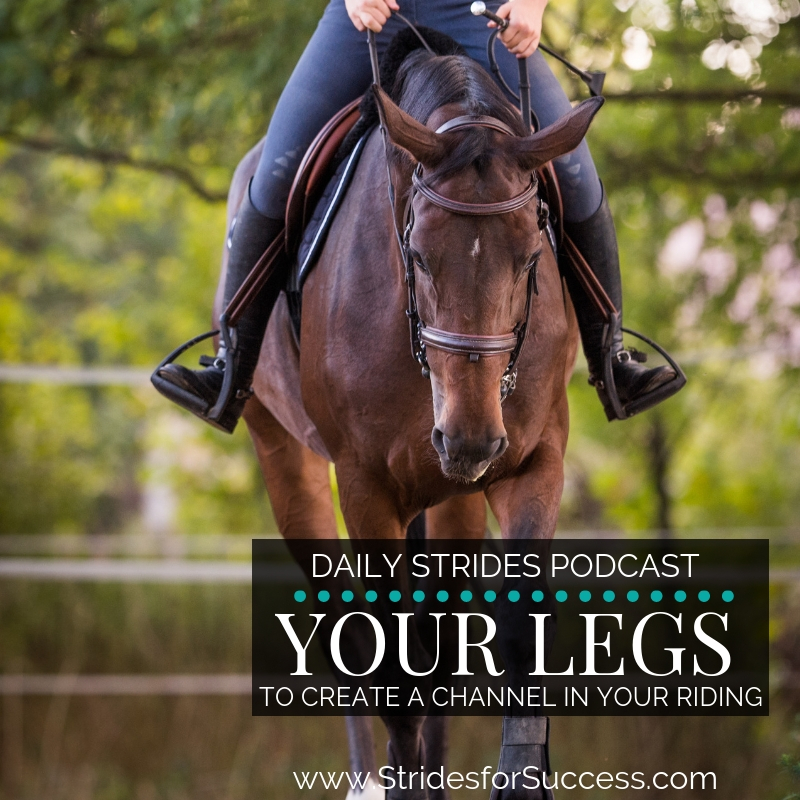
  • Using Your Legs to Create a Channel when Riding

    Using Your Legs to Create a Channel when Riding

    Using Your Legs to Create a Channel when Riding§§

    What this episode is all about & how it can help you:-

    • Sitting straight in the saddle
    • Allowing your legs to ‘drape’
    • Understanding an active aid versus an inactive one
    • Supporting your horse when he needs support

    [smart_track_player url=”https://op3.dev/e/traffic.libsyn.com/dailystridespodcast/1063-Using-Your-Legs-To-Create-A-Channel-In-Your-Riding.mp3″ title=”Creating a Channel with Your Legs in Riding” social_linkedin=”true” social_pinterest=”true” social_email=”true” tweet_text=”Ever wondered what your legs should be doing while you’re in the saddle? Here is the less obvious answer…” hashtag=”Equestrian #Horseriding #Podcast” twitter_username=”Strides_Success” ]

    Remember back to when you were first learning to ride.  You possibly saw your legs as being a ‘go button’ of sorts.  Go forward or go sideways.  However, as you began to improve the conversation, by refining your aids, you realised that your legs have started to also become a channel of sorts…

    A channel for the energy that is created inside of the ‘container’ that is you and your horse together.

    In this episode of the Daily Strides Podcast you will learn all about creating that channel with your legs and how it will improve your overall riding.

    Your Whole Body is a Channel

    I want you to think about this; your whole body is connected.  I realise that this is not a new piece of information, however many riders fail to see how one part of their body has direct influence over other parts.  How the placement of your leg can impact the placement of your seat or vice versa.

    If you are just starting out, I think it is far easier to allow the more obvious body parts to influence the more ‘subtle’ parts.  Your legs to influence your seat, rather than the other way around.

    Later then, as you begin to gain more control over your body in the saddle, you can start ‘swapping’ this out a little.  Your seat to influence your legs.  Your seat will define or indicate where your legs are positioned at given time in the saddle.

    Sitting Straight in the Saddle

    Part of this influence is how straight you are positioned in the saddle.  When I say ‘straight’ in the saddle, it is straight in two ways.

    Firstly that there is an equal amount of you on both the left and the right of the saddle.

    One of the most common ways riders become ‘crooked’ is when they are sitting with one seat bone closer to the centre of the saddle than the other. 

    The second way to ensure you are ‘straight’ is to make sure you are indeed sitting on your seat.  Both of your seat bones centred and pointing straight down underneath you. It is all too easy to fall into the bad habit of sitting either with their pelvis rolled too far forward or too far back.

    Sitting on your fork, or rolled back into a more ‘armchair seat’ automatically shuts down your seat aids.  This will result in your legs not being able to work correctly while riding. 

    Allowing Your Legs to ‘Drape’

    Once your seat is correct, you can allow your legs to ‘drape’ over your horses sides.  This sounds exactly like what it is.  Drapes are often another word for curtains and you want to think of your legs being allowed to hang from your hips like curtains.

    They have their own weight and shape, and yet they will follow the contours of what they are ‘draped’ over.

    For many riders, particularly women, it can be difficult to truly allow legs to ‘drape. This is often due to the fleshy part on the inside of the thigh.  If you suspect this is an issue for you, I have a little exercise you can use to help.

    What I suggest is just put both your legs up as though you were a jockey, touching your knees above your horses withers. Now take your right hand from the back underneath your right leg and pull that fleshy piece out behind your actual thigh.  Then lift your leg out and gently allow your leg to drape down over your horses side.

    When your leg is positioned correctly, you will feel that there is contact all the way down.

    Many riders concentrate on the contact at the knee, but I prefer it if the knee is loose and it is not locked on the horse. What you will now find is that the rest of your leg from your thigh all the way down to your calf and ankle is going to be draped around the horse.

    Understanding an Active Aid Versus an Inactive One

    The next thing to understand is that you have active leg aids as well as inactive leg aids. In other words you can engage your leg aids, or you can disengage them.

    It is important to recognise that when your leg is off and is not engaged (or inactive), it doesn’t mean that there is actual daylight between your leg and the horse!

    Your leg is still ‘on’ the horse, however it is similar to having hit the off switch.  You have disengaged it. You don’t take your actual leg off or away from your horses side. There should never be daylight between your leg and the horse’s sides, but you do want it that the leg is not active.

    The reason that this is important is because later as you and your horse become more developed, you will play less and less of a supporting role to your horse.

    Very often in the beginning we, as riders, have to support our horses. This is not always actual physical support, in that you are holding him up.  It can also be more of a moral support. As soon as your horse’s balance develops and he becomes stronger, you will have to support less and less.

    If your leg were to be active all the time, you would first of all be exhausted and secondly your horse would eventually simply tune out

    Supporting Your Horse When He Needs Support

    Very often at the beginning of our development journey with our horses, riders find themselves supporting their horses.  This can be both a mental and a physical support.  It is a ‘reminder’ to keep things on track when things are going off track a little.

    A lot of the time this is described as ‘balance’.  You will step in initially when your horse loses balance and help him to regain it. 

    However, as confidence and strenght builds, your relationship with your horse will also shift and change.  As you and your horse becomes stronger and you are positioned correctly, you are better able to actively engage the aids when you need to engage them.

    When you engage your aids, you can create energy.  This energy is then put into the channel you have created, so you can best direct it. 

    Understanding and Strengthening Your Channel

    Managing this energy is really your channel.  It can also be thought of as the container that is made up of you and your horse. You actively and mindfully put energy in there.

    Then you decide how, where and when that energy will be used.  Yes, you can use your leg to ask your horse to create the energy, but once it is there you can use your legs to channel that energy as well

    Channeling can be in a directional way by directing where the energy is going to go. The channel can also be how the energy is being used. Is it running out, or is it being held?

    Developing Your Channel

    Of course, as you begin to refine the conversation between you and your horse, your seat will then become a bigger part of your channel.

    Initially it is your legs which are guiding your seat, but what we want is that the seat is doing more of the guiding. You will eventually build to that.  This may look like your seat allowing or resisting.

    However your seat moves and influences, it will become a bigger part of your overall conversation.  Of course your legs don’t completely cease to exist any more, but there is a balance of aids, and the balance will eventually shift.

    In other words it will then become less about your legs and more about your seat

    Your legs will still have to be positioned correctly because your legs dictate your seat, and your seat your legs. But as you become stronger and more developed you will have to think about it less, and it will naturally fall into place.

    That is the channel. Once you have the channel created then you can start strengthening the channel, and you can start creating true impulsion in your riding.

    Happy Riding

    Lorna

    Links mentioned in the episode:-

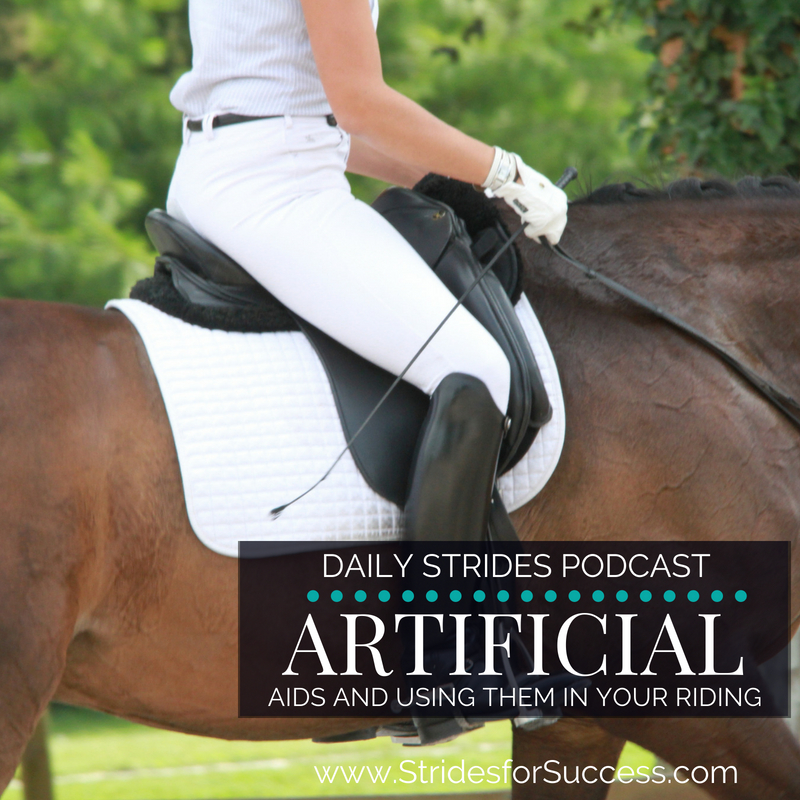
  • Using Artificial Aids in Your Riding

    Using Artificial Aids in Your Riding

    Artificial Aids and Using Them in Your Riding

    What this episode is all about & how it can help you:-

    • Identify the types of artificial aids
    • Know when you need to back up your natural aids
    • Understand the relationship between your inside leg and inside hand when using a whip
    • Follow through and allow your horse to respond

    [smart_track_player url=”https://op3.dev/e/traffic.libsyn.com/dailystridespodcast/1059-Using-Artificial-Aids-in-Your-Riding.mp3″ title=”Using Artificial Aids in Your Riding” social_linkedin=”true” social_pinterest=”true” social_email=”true” tweet_text=”Unsure about using a whip or crop when riding? Here is a way to use it that will only add to your overall conversation with your horse…” hashtag=”Podcast #Equestrian” twitter_username=”strides_success” ]

    Hands up if your communication with your horse, using your natural aids, leaves you feeling like there’s quite a bit being lost along the way?  Your hand is one of a sea of hands, so don’t feel too alone!  Many riders become frustrated over time due to the lack of effectiveness of their aids.  Luckily it is something that can be worked on, starting with the next time you are in the saddle.

    Using artificial aids are one of the ways you can begin improving your overall communication with your horse.  They work by drawing attention to those missed or ignored natural aids. 

    I realise that this is a topic that has the potential to divide riders; some are on the fence, some are in the ‘yes, use them’ camp and others are in the ‘no, they’re cruel’ camp.

    I personally feel that artificial aids are a great resource if used responsibly and carefully.  They can definitely add to the overall conversation with your horse

    In this weeks episode of the Daily Strides Podcast I will help you to feel more confident about using your artificial aids to improve the overall conversation with your horse.  I will explain how to use these additional tools responsibly and in a way that can only add to the overall ride.

    The Types of Artificial Aids…

    Artificial aids are anything that you carry or wear which will add or enhance how you can communicate with your horse. Your ‘riding’ artificial aids are whips and spurs. There are many other aids, or ‘gadgets’ which can be used, more by the horse wearing them.

    In this episode I want to focus on the artificial aids available to you in your riding, ones you can use in the saddle to back up your natural aids. Specifically whips or crops.  I feel that spurs are the next level up when it comes to artificial aids and should only be used by competent, ‘quiet’ riders who have already refined their aids.

    There are two types of whips, a jumping whip or crop which is shorter and a schooling or dressage whip which is longer. The lengths will vary, but are around 60cm and 90cm respectively. 

    A Jumping Crop Versus a Schooling Whip

    As well as there being a difference in length, there is often also a difference in thickness and weight as well.  The jumping whip is shorter and ‘sturdier’.  The dressage or schooling whip is longer, thinner and more elegant looking.

    The reason I am going to suggest that you begin with a schooling whip is due to your hand being able to remain on the rein while you are applying the aid.  

    A jumping crop requires you to place both reins into one hand first and then apply the aid.  The schooling whip only requires a simple ‘flick of the wrist’ to activate it.  This allows you to remain consistent with your contact while using the aid to back up your leg.

    Because your artificial aids are used to back up your natural aids, it is important to remain as consistent as possible when applying them

    Backing Up Your Natural Aids

    The only reason you use artificial aids is to back up your existing natural aids.  Your whip should never be used on its own or independently.

    Natural aids often require ‘backing up’ due to the horse either ignoring them, or not being as responsive as you want or need him to be. 

    Before you begin using your whip, it is important to make sure that your horse is not either of the above because of how you trained him.  Continuous nagging with your legs will often result in a horse who ‘zones out’ from the rider.  Similarly, inconsistent use of the aids will also cause confusion and a ‘lag’ in the horses overall responsiveness.

    Your whip should only ever be used responsibly, which means you are being clear and fair in how you are communicating and asking your horse to do things.

    Your Inside Leg & Your Inside Hand

    Hmmm… We always hear about the relationship between our inside leg and our outside rein, not the inside and the inside!  However, when it comes to whips and crops, this is the relationship we want to focus and become clear on.

    Your inside leg a bit like your ‘go’ button when riding.  Therefore in most (not all, but most) circumstances, your crop or whip should be carried in your inside hand to back up your inside leg. 

    This means that when you change rein or direction, your whip or crop will change hand to the ‘new’ inside hand.  Now, obviously there are times when you will actually need to back up your outside leg.  However, when getting started with using a whip, work on always carrying it in your inside hand ready to be applied when needed.  

    Applying Artificial Aids Responsibly

    I want you to think about how your artificial aid is only ever there to back up your natural aid.  It should not be used alone or independently.

    Simply put, you must always first ‘ask’ with your natural aid.  If your ‘ask’ is ignored or the response is slow, then you can immediately use your whip to back up your leg.

    Coupling the ask with correct timing is essential.  Your horse must associate the tap – an important word – of the whip to your ignored leg aid. Which is why ‘where’ you ask is also so important when applying the artificial aids.

    Your whip will ‘tap’ your horse directly behind your inside leg immediately after your original leg aid was ignored. 

    The whip is only to bring his attention to your leg aid.  It is like a pointer on a blackboard.  The pointer in and of itself is not the lesson.. It is just a way of turning the student’s attention to what really is important on the black board.

    Adding to the Conversation

    One of the side effects of refining your aids is how the overall communication becomes quieter between rider and horse.  You will begin to see how much of the ‘stuff’ being said, particularly by your aids, is actually taking away rather than adding to the conversation.

    Make sure that, before you go backing up an ignored natural aid, that it was indeed a necessary aid in the first place

    In order for your horse to respect your leg, your leg has to be worth respecting. The more responsible you are in how you use your leg aids, the more responsive your horse will become to your leg aids. 

    It all starts with you and how you are leading the team that is you and your horse. 

    Other Uses for Your Whip or Crop

    There are other uses for your crop or whip, other than just ‘going forward’.  Very often a tap on the shoulder can encourage a horse to remain straight if they are running out through the shoulder at a fence.  Or a tap can bring the attention to the outside leg.

    What is important is that the whip or crop is never used to substitute the natural aids.  Only when the horse is ignoring or failing to respond to the natural aid.  

    My biggest fear when giving riders a whip is that they start to become a little lazy in the saddle.  It is much easier to ‘flick the wrist’ than it is to truly engage your core and your seat.  It is easier to use the whip to keep the horse moving forward towards and over the fence than it is to truly channel the direction using your natural aids.

    When the whip is used correctly, it is a fantastic aid.  A tap that brings your attention to something is far nicer than being kicked hard repeatedly. 

    Allowing the Horse to Follow Through

    The final piece of using a whip, or any artificial aid really, is to make sure you are allowing the horse to respond and do what you have asked.  If you asked him to go forward; allow him to go forward.

    Keep in mind that your horse might be a little ‘over responsive’ initially to your tap – meaning he shoots forward.  Allow him to go forward and then slowly and gently bring him back. 

    Make sure you are not confusing your horse by blocking him going forward, and therefore giving him conflicting aids.  Your job is to allow your horse to respond to whatever you have asked him to do.

    The ‘balance of aids’ applies here just as much as when only using your natural aids.  It is only through time and constant adjusting will you be able to successfully find the balance that best suits you and your horse.

    Happy Riding

    Lorna

    Links mentioned in the episode:-