Tag: Aids

  • Using Artificial Aids when Working With Horses

    Using Artificial Aids when Working With Horses

    Using Artificial Aids when Working With Horses
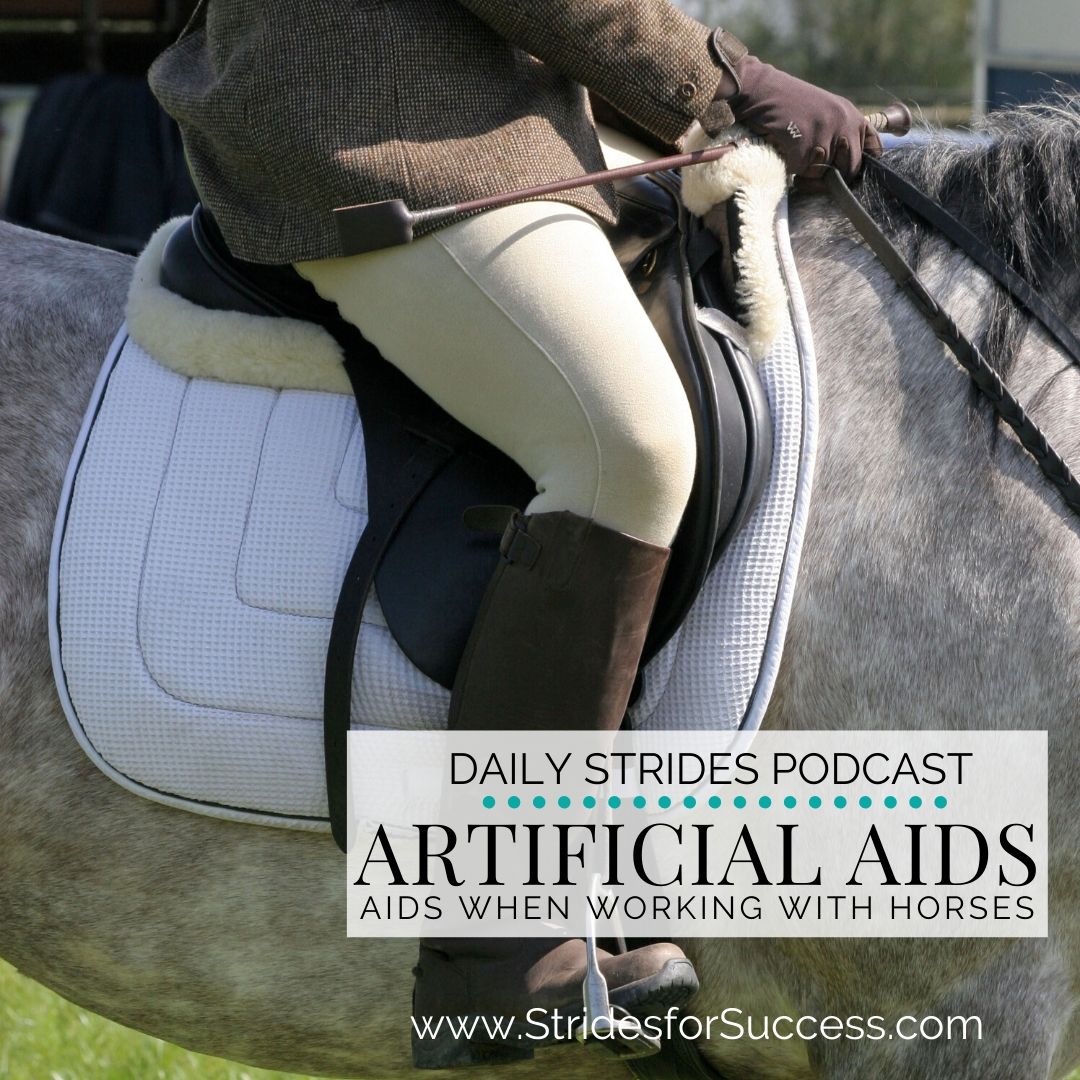
    For some reason, many riders have a negative story around artificial aids. And yet, most riders use artificial ads on a daily basis, whether riding or on the ground with their hose.
    What is important to remember is that artificial aids are neither positive nor negative.  
    They just are what they are.  And you can use them to create a positive or negative reinforcement with your horse.  And, let’s be honest here, you as well.
    So in light of all that, I want you to begin being a little more mindful when using artificial aids with your horse.  This will allow you to begin the process of figuring out when and how you can begin moving away from that aid and towards a more natural aid instead.

    Why Artificial Aids?

    Artificial aids help enforce boundaries.  And boundaries are vital for both horse and rider. They help us to clearly communicate what we want and also allow our horses to clearly communicate back to us.  Having no boundaries results in nobody really understanding what is expected of them.
    Clear Boundaries = Clear Expectations
    Many of your boundaries can be communicated and enforced using your natural aids.  Your own voice, hands, legs seat, position, etc.  However, there are times where an artificial aid is actually more helpful and less confusing for both horse and rider.  A railing or fence around the arena for example.
    I believe that the key to successfully using artificial aids is to realize that they are there to simply ‘back up’ or reinforce your natural aids.
    They are not used on their own.  Similarly, they should not be the lead in the conversation with your horse.  However, they are a powerful tool, when used correctly, to clarify what you want to your horse.

    What are Artificial Aids?

    Simply put, it is something you can use that is not part of your body, to help explain or clarify something to your horse.  Think of them as tools.  You can pick them up and put them down when you want.  Now, what is important to realize is that not all artificial aids can actually be ‘picked up’!
            • Bridle
            • Bit
            • Headcollar
            • Leadrope
            • Lunge line
            • Whip
            • Spurs
            • Arena wall
            • Stable wall
            • Groundpoles
    All of the above are artificial aids.  They are not part of your body, and yet they help you to more effectively communicate with your horse.  This is especially true when your natural aids are being ignored or ‘missed’ by your horse.

    When to Use Artificial Aids

    Most riders will use some form of artificial aids from day 1 of their experience when working with horses. And most horses will see the aids as an extension of the rider and a part of the overall conversation.  Artificial aids work just like your natural aids, in that it is all about pressure and release.
    You can apply pressure using artificial aids and then release it when your horse responds
    The amount of pressure is where many riders can have a negative narrative surrounding using artificial aids in their day to day riding with their horse.
    However, like any aid, natural or artificial, excessive pressure comes down to the rider and how mindful they are when applying the aid.
    Let’s take one of the more misunderstood artificial aid, the whip.  I think that this is simply a case of something having the wrong name!  If we referred to it as a ‘pointer’ or even a simple ‘stick’, would it have as much negativity attached to it?  Either way, it has and because of this many riders refuse to ride with one.
    But, is bruising your horse’s sides because you have to kick so hard any better than whipping your horse?  Neither is right – and yet one is seen as being acceptable by many riders.  This is something I take issue with.  I personally feel that a ‘reminder’ or ‘pointer’ to pay attention to the rider’s leg is a lot nicer than kicking the sides off a horse… What do you think?

    Consistency and Responsiveness

    More often than not, artificial aids are simply there to ‘back up’ your natural aids.  However, consistently is first required from the rider with regards to what they are doing at any given time.  I believe that most responsiveness issues can be traced back to a rider who is ‘wishy-washy’.
    If you are to use artificial aids to back up your natural aids, you must get clear on what you are doing and why.
    So, let’s go to the whip again.  It is important to first of all set things up.  We usually use the half halt to do this.  The half-halt is simply a way of bringing your horse’s attention to you and what you are doing in the saddle.
    Once your horse is listening, you then decide where your aid will be applied and how much pressure is required.  Then the aid must also be applied at the best time for your horse to take action and respond.
    What many riders find is that, even if all of the above are consistently being communicated, their horse either misunderstands or ignores their leg aid.  This is when I feel a schooling whip can add to the conversation.  If used correctly, it simply brings the horse’s attention to the missed or ignored leg aid.  A simple tap.  Not a whip, lash, or strike.  Just a simple tap, directly behind the leg aid, delivered immediately after the leg aid has been ignored.

    Weaning Your Horse Off Artificial Aids

    How long you want to continue to include artificial aids in your conversation with your horse will depend on your unique circumstances.  Some riders feel the need to have a way to bring their horse’s focus and attention back to them immediately.  Maybe while navigating a track of fences.  Other riders want to move away from anything that is not as natural as quickly as possible.  Artificial aids, when used correctly, are not wrong.  They just are.
    Often, if you begin to move away from them, both you and your horse must learn to trust and develop more confidence in yourselves and each other.
    Take the boundary fence of the arena.  If used consistently to help keep you both ‘straight’ when riding on the outside track, it will become a crutch.  In fact, it will actually begin to negatively impact your development and training over time.  But moving away from it requires confidence and trust.
    It requires developing mentally, emotionally, and physically.
    The same goes for the fence of the lunging arena.  Or the arena fence full stop.  On the ground, this can be the difference between begin able to tack up in a stable or out in the open.

    Building Your Natural Aids

    Again, artificial aids are neither good nor bad.  How you use and apply them makes them so.  But what is important is that you are always looking to developing yourself as a rider.  Develop your natural aids.  Your seat and weight aids.  Voice is another important one.  And, of course, legs, hands, body language and position.
    Your most powerful aid, either in or out of the saddle, is your thoughts.  You can use your artificial aids to clarify and improve your thoughts.  doing this will, over time, improve your other natural aids as well.
    Start with setting your boundaries.  Get clear on what you want and your expectations surrounding everything in your riding.  Then look at how you communicate and enforce this with your horse.
    There is always a balance of aids at play in your conversation and it will evolve and change over time…
    Happy Riding
    Lorna

    Additional Resources on This Topic

  • Your Half Halt on the Ground with Your Horse

    Your Half Halt on the Ground with Your Horse

    Half Halt on the Ground with Your Horse

    Sprinkled liberally all over the arena and every ride. That is how important the half halt is to your riding. However, it is also an important aid on the ground with your horse. And, it consciously practicing it on the ground can really help to clarify the aid for you, as a rider.

    [smart_track_player url=”https://op3.dev/e/traffic.libsyn.com/dailystridespodcast/1150-Half-Halt-while-Leading-Your-Horse-on-the-Ground.mp3″ title=”The Half Halt on the Ground” social_linkedin=”true” social_pinterest=”true” social_email=”true” tweet_text=”The half halt is not just for riding; here is how to use it on the ground as well” hashtag=”equestrianpodcast” twitter_username=”strides_success” ]

    So many riders think that the half halt is only for the saddle. It is an aid that exclusively happens when communication is coming from above with regards to their horse.

    However, I am a huge believer in groundwork and in how practicing the half halt on the ground will help your overall riding efforts going forward on your journey as an equestrian.

    The Half Halt Helps You

    Working on the half halt ion the ground is a great place to begin being more mindful about how you are showing up for the overall conversation with your horse. Be honest, how much of your interactions with your horse on a daily basis are just routine? Autopilot? No thought, you just do it?

    Autopilot is great for certain aspects of your riding. The conversation with your horse is not one of those things!

    Noticing and working on improving the half halt on the ground is a great way to begin taking the ‘day to day’ off of autopilot. Doing this has the potential to change the whole conversation, as you will see where the boundaries truly are. You will also see where you might just be allowing a lack of consistency to be the only thing that is truly consistent in your riding!

    Begin Beside Your Horse

    If I was to ask you to list the aids you use when trying to get your point across to your horse, what would that list look like? 3 or 4 aids? 10 or 12 aids? There are lots of aids at your disposal. Lots of different ways, both natural and artificial, you can use to explain what you want to your horse.

    But listing and using the aids are two different things. Next time you lead your horse, notice how many of those aids you are actually using.

    Start by simply walking your horse up and down the yard. How are you asking him to walk on? What are you doing when there is a turn or corner? And stopping him? What are you doing then? You see, often we know what we can potentially use and do, but knowing and doing are different!

    Your mind will always look for ways to make things as easy as possible for you and your body. Unfortunately, often where horses are concerned, the easiest thing might not necessarily be the best thing.

    Using Your Aids on the Ground

    The most obvious aid for many riders is the hand aids. As you lead your horse, you will hold either the reins from the bridle or the lead rope attached to the headcollar or halter. Your hands will, therefore, play a part in the overall balance of your aids when it comes to leading your horse around.

    Just like riding, how big a part your hand aids play will depend on your skills. Less skilled usually means they have a greater role in the communication

    The more skilled you are, the more that you will notice how your other aids make up a bigger part of the communication. Your voice and position. Body language. Even ‘weight’ can be used to communicate with your horse. Obviously these are more subtle aids.

    And just like in the saddle, the more subtle aids can only begin to be effective when we ‘quiet’ our more obvious ones. When we begin to become mindful of our own actions and the consistency of those actions.

    Ask for Halt; Mindfully This Time

    So all that being said, I want you to again, lead your horse up and down the yard. Except for this time, you are going to really begin noticing your aids. The simplest way of doing this is to ask your horse to halt. What is the process that physically happens in your body from the point that you think ‘I want to halt’ to the point where your horse actually halts?

    As I said, you will probably notice your hands play a role. Remember, even when your aids are refined to the point where the balance has shifted, your hands are still an aid. They remain an important part of the conversation. I feel that many riders want to ‘delete’ or ‘get rid of’ their hand aids. Why? If used with consideration and kindness, they can be a great way of explaining and clarifying things with your horse.

    You might notice your voice. The tone rather than the words. A slow, low tone ‘whoa’ goes a long way when used consistently at just the right time.

    Your position is also important and a pretty easy one to notice. I speak a lot about the importance of position for good, clear communication. This is whether you are in the saddle or on the ground. Think about how you can use where you are standing in relation to your horse in order to communicate ‘stop’ or ‘go’. If that is too big of a challenge, think about slow down or speed up.

    Your body language is also a very powerful aid when working on the ground. For example, your shoulders are a simple way to ‘close a door’ or ‘open a door’

    Your Most Important Aid?

    I do think that there is one aid that is above all of the others; and it is the one we have been chatting about from the start of this post. Your thoughts. In order to refine or effectively use any of your other aids, your thoughts are going to have to be clear about what you want to happen. And how you are going to make it happen.

    Observe yourself. Look at how your actions are all happening because of whatever it is you are (or are not) thinking. So it makes sense to work on controlling what your thinking, in order to control what you are doing, doesn’t it?

    What do I want my horse to do? How can I best tell him that is what I want him to do? And how can I then tell him that ‘Yes, that is what I wanted’ after he has done it? These are all thoughts. However, so often we either forget to ask ourselves these questions. Or we ignore the answers…

    The communication with your horse will improve when you start asking yourself better questions, and then responding to the answers of those questions with more consistent actions (or aids)

    Working on the Half Halt

    There is an important word in the sentence; half. It is not a halt. No stopping, either physically or mentally, must occur. The half halt is rather a way of getting your horses attention. A way of telling him to focus on you, because you need to communicate something important to him. What you then communicate depends on you. It could be steady up. Or slow down. Maybe that you’re turning a corner or bend. Or stopping.

    The important thing is to recognize the difference between how you communicate your intention for either movement to your horse. Halt or half halt.

    With the half halt, you have to first actively engage the forwardness. I’m using the word ‘engage’ here as a mental word. You are noticing and emphasizing the ‘forwardness’. There are many ways to do this using your aids and it is key to recognize that only by ‘playing’ with your horse, will you really begin to understand what your horse resonates with.

    Does your horse respond well to your body language? A click with your voice? Maybe a simple shift with your position. Or maybe an artificial aid is the best right now to clarify what you want?

    This Week with Your Horse

    I want you to begin playing with your aids. Experiment. See what happens when you:-

    1. Ask yourself better questions
    2. Become more mindful about noticing your answers
    3. Be consistent with how you take action on those answers

    There are so many aids you can use when working with your horse. I have just spoken about a few that you can use today. However, I want you to begin playing with them and others.

    I am also going to invite you to join me for a free live workshop all about your half halt on the ground. If you’re interested in learning more and potentially joining me for an hour where you will walk away knowing exactly what to do; register for the live training HERE

    Happy Groundwork!
    Lorna

    Additional Resources to Help with This Topic:-

  • Connection in Your Riding; Seat and Legs

    Connection in Your Riding; Seat and Legs

    Connection; Using Your Seat and Leg Aids More

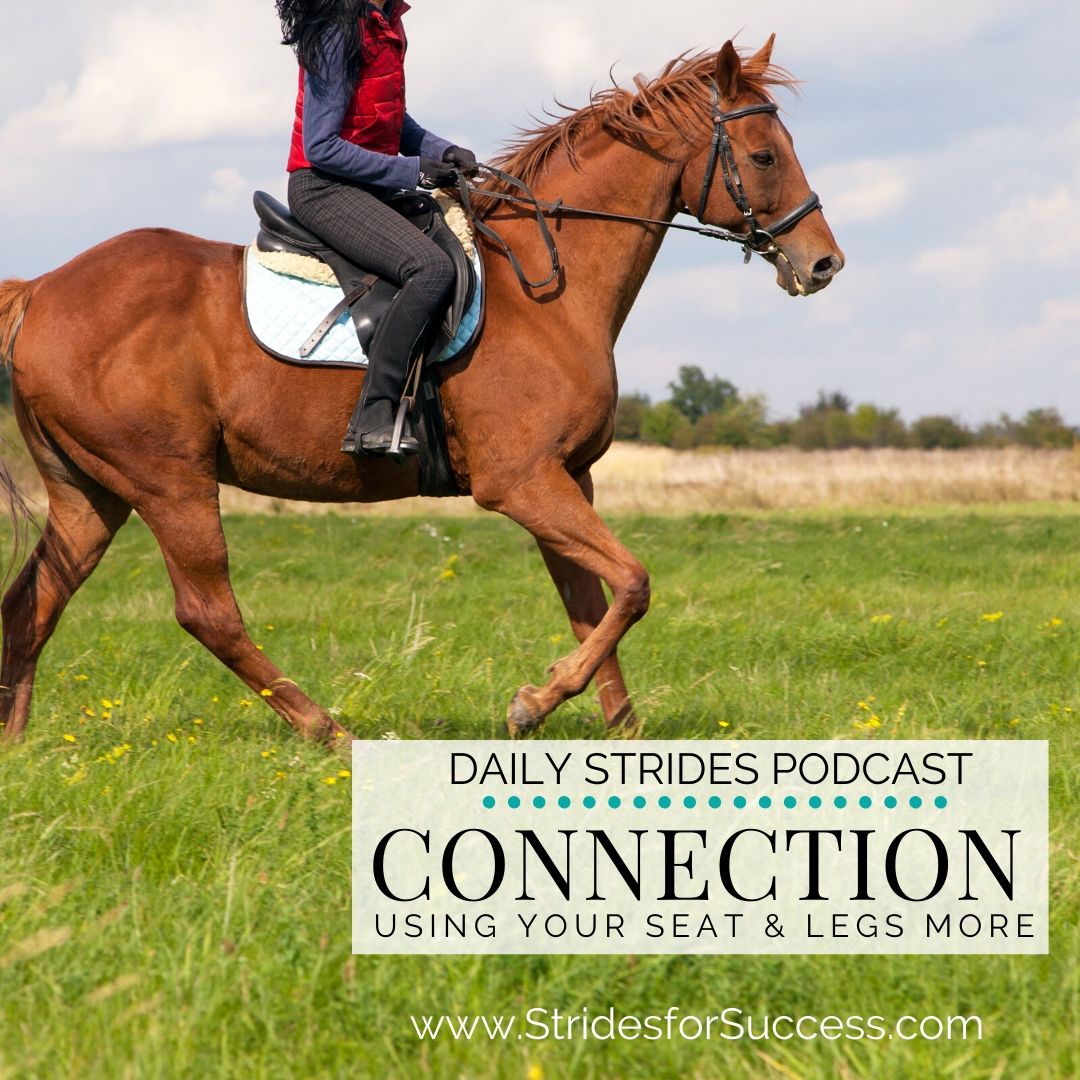
    Have you ever thought about what you can feel, in the saddle as you ride your horse? The physical connection points you have with your horse each time you’re in the saddle.

    [smart_track_player url=”https://op3.dev/e/traffic.libsyn.com/dailystridespodcast/1148-Connection-Points-In-Your-Riding-Seat-and-Legs.mp3″ title=”Connection in the Saddle; Your Seat and Legs” social_linkedin=”true” social_pinterest=”true” social_email=”true” tweet_text=”Your seat and legs do a lot more than just keep you in the saddle… Listen to this episode of the Daily Strides Podcast” hashtag=”equestrianpodcast” twitter_username=”strides_success” ]

    Often we can become so caught up with our aids and what we ‘should’ be doing, that we forget to focus on the actual points of physical connection between you and your horse. And the impact these connection points are having on each ride.

    Mount Up & Begin Walking

    The first thing I am going to suggest is to actually mount up and simply allow your horse to walk. It is amazing how often we forget to allow this to happen. We think that because we are in the saddle and the horse is moving underneath us, we are allowing the walk.

    And yet, so often we are blocking or working against our horse doing this simplest of tasks. Walking freely while we are in the saddle.

    How many times have you been in the saddle and focus on ‘getting the horse to walk’? This versus sitting back and actually just allowing the horse to walk.

    Doing Nothing

    One of the biggest challenges riders have is to do nothing. Not that I am telling you to do absolutely Jack Squack in the saddle! Rather any ‘doing’ your ‘doing’ is focused on yourself, rather than your horse. Things like carrying yourself. Another often overlooked part of riding for many riders.

    The simple act of mindfully beginning to carry your upper body, allows your lower body to follow, rather than remain ‘stuck’ between your ribcage and the saddle.

    The ‘doing nothing’ I am referring to is regarding swinging, forcing, shoving or any other ‘ings’ you can do that involve you ‘trying’ to get your horse to walk. Simply make sure that you are in the best possible position to allow your horse to walk; and in doing so, move the part of your body that is connected to the saddle.

    You are allowing your horse to move your seat; not you shoving your seat in order to move your horse

    Remain Independent

    Remaining secure and balanced of your own accord are the basics of independence. A quick test of this, as a rider, is to imagine you could instantly make your horse vanish. How would you land on the ground? On your feet? If so, you’ve got this covered already, congratulations! On your face or bum means that you have an issue with your other connections points; your legs.

    There should not be daylight between your legs and your horse’s sides. This is especially true of your thighs and your lower legs or calves.

    Your independent seat depends on your abilities to balance yourself. This depends on how you have positioned your body in the saddle. Any tipping, gripping, toppling, or leaning means that you are using your horse for balance.

    Using your connection points to hold on means that they cannot be part of the actual conversation. They are no longer aids and are pretty useless when communicating.

    Connection Points Between You And Your Horse

    Once you have positioned yourself so that you are carrying yourself, notice your legs. There should not be daylight between them and your horse’s sides. If there is, it usually means you are gripping or pinching somewhere higher up. Allow your legs to drape. To hang from your hips.

    Your legs are an important part of the conversation between you and your horse. However, because many riders do not use them correctly, they are misunderstood and ignored by the horse.

    Your legs are not to keep you on the horse. Rather to communicates with your horse. No one likes a ‘Cling-on Warrior’; meaning if you are using your legs to hold you on, you are taking advantage of your position. Rather allow your legs to ‘drape’. Let the weight drop down into your heel. And from there, your legs can actually be used for what they do best; to communicate with your horse.

    Your Seat & How it Feels

    Like I’ve said already, your seat is a valuable communication aid in the conversation with your horse. But only if you first learn to ‘allow’ through it. Allow your horse to move your seat, rather than you moving your seat in order to move your horse.

    I want you to zone in on how this feels. Actually, it physically feels. One of the first things you may notice is that there is a rhythm to it. Forwards and backwards rhythm to the physical movement. Stay with this feeling a while.

    Notice how there is also an ‘up and down’ to the movement. It too is in rhythm.

    When I am explaining this to riders, I often think of the pedals of a bicycle. Except when its the horse it is the other way around. Forward and down, backward and up. Rotation of your seat bones. Moving with the horse and allowing the horses back to move them.

    The Rhythm of the Conversation

    Have you ever been part of a great conversation with someone, and someone else will randomly just ‘butt in’ to your conversation? They may or may not be even speaking about the same topic. It doesn’t matter. The simple act of their interruption is enough to work against the natural flow or rhythm of the conversation.

    I think that if you are honest with yourself and begin thinking about your conversation with your horse like this, you’ll notice places where you’re not being as consistent as you would like. Your leg aids. Randomly going between squeezing to stay on and squeezing because it’s now an aid. Your seat; moving between digging, shoving, and the occasional half halt.

    Riders have a habit of ‘butting in’ randomly in the ongoing conversation between them and their horses. The the two most common places this happens is with the aids that form the natural physical connection between them.

    Get Clear on Your Connection & Your Aids

    You can always refine your aids. There are the basics, such as your position, your posture, and using the actual aids themselves, you get to play with the next level of this connection. The timing element. However, you can only begin to do all of this when you wake up to what you are currently ‘saying’ in the saddle, right now.

    Timing is the place that you can really take the conversation to a new level between you and your horse. Using your existing connection and timing how you communicate with it.

    However, it all starts with taking a good hard, honest look at what is currently happening with your seat and legs while you ride. Then mindfully beginning to change how you are using your connection to help enhance the overall conversation.

    Happy Riding
    Lorna

    Additional Resources to Help

  • Developing Your Seat in the Canter

    Developing Your Seat in the Canter

    Developing Your Seat in the Canter

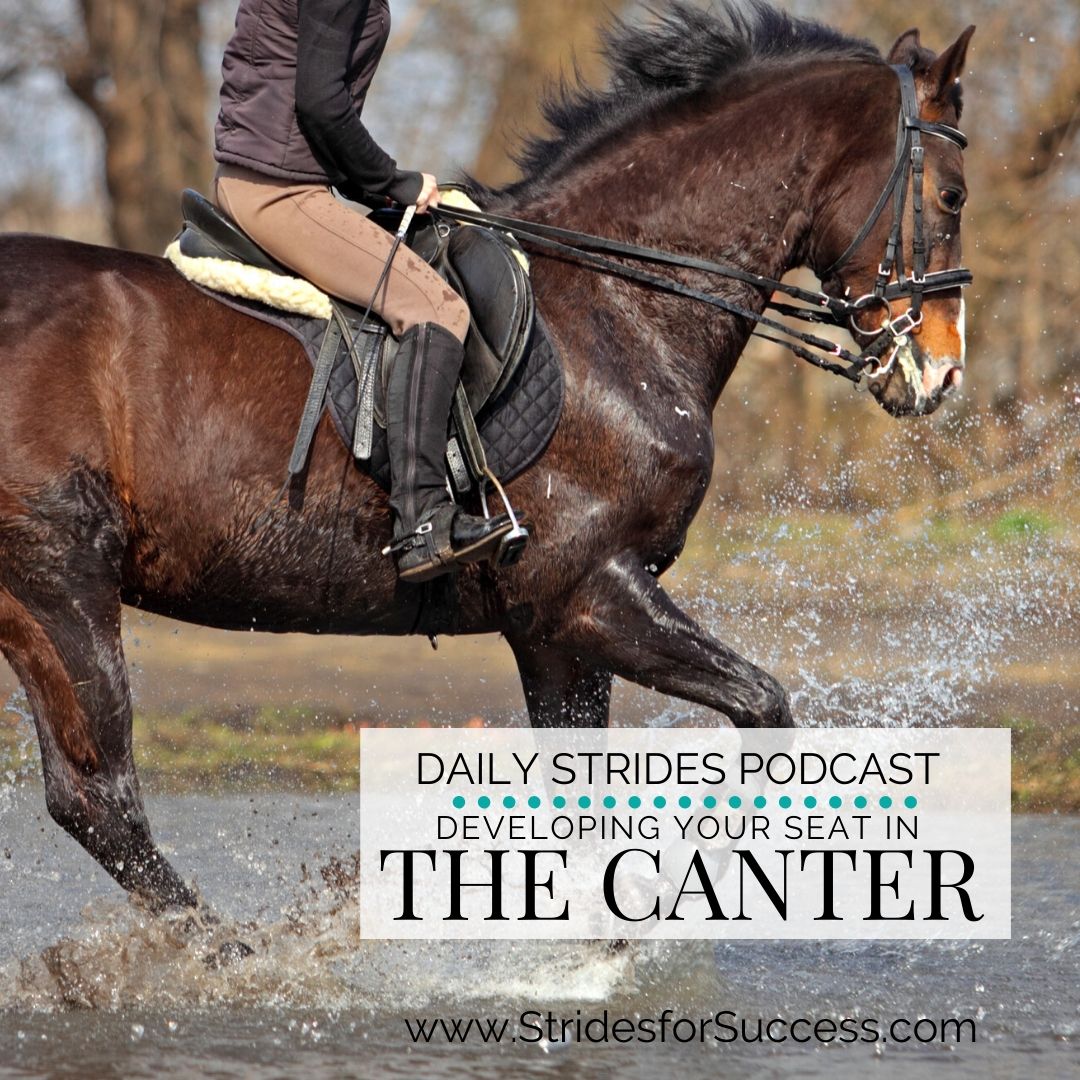
    The canter can be confusing for many riders. Especially what to do with your seat in the canter. You’re told to ride the horse forward with your seat. But you’re then told to be ‘quiet’ with your seat… So which is it? And how can you begin to develop a more effective seat in the canter?

    It all begins with knowing where you are right now. I feel that there are a few things that decide your success in canter with your horse. How much digging you’re doing is one of them. And how much shoulder action is happening is another.

    1. Start with Carrying Yourself

    I want you to think about a clothes hanger with a dress or something long hanging on it. When the wind blows, the dress is moved by the wind, however, the hanger ensures that the dress doesn’t blow away.

    Now, imagine your shoulders are like a clothes hanger. Your body is the garment hanging on the hanger. And your horse is the wind. The wind should be able to move the garment; your horse should be able to move your seat.

    Your horse’s movement will move your seat, but because you are carrying yourself, you won’t be ‘blown away’ by the horse. When you carry yourself, it requires you to use your core strength in order to maintain your own balance. This allows your horse to do what you have asked; canter.

    I think that canter is the gait that separates ‘fit’ riders from ‘unfit’ riders. It is definitely more difficult to fake strength and suppleness in the canter, hence a lot of riders having trouble with their seat to begin with in the gait. In order to really begin developing your seat, you need to first take responsibility for carrying your own body.

    Think about creating space between the bottom of your ribcage and the top of your hips. Carrying your upper body allows your lower body to move with your horse. It allows the ‘wind’ to ‘move the garment’…

    2. Allow Your Horse To ‘Lead You’ in the Canter

    The basics are something we should revisit over and over again in our riding. And yet, so many riders have resistance to this.

    The canter is a great place to get back to the basics in order to actually move forward and create momentum in your progress.

    Following and allowing are things I speak a lot about when working with riders. In order to really begin developing your seat in the canter, you need to first be able to ‘follow’ your horse. This simply means being supple enough through your body to have your horse ‘move’ it. As your horse moves your body, or more specifically your seat, will then follow him. Not shove him or push him, but simply follow his movement.

    Start in the walk. Slip your feet out of your stirrups and allow your horse to move your seat as you walk along. Notice how ‘carrying yourself’ is essential for this to happen.

    From here, you can begin doing the same in the trot. Again, without the stirrups. Before building up to the canter. Notice how you are not shoving, pushing, forcing, digging in or anything else. You are simply following your horse’s movement. You are letting the horse move your seat.

    3. Begin Refining Your Seat

    Once you can follow, you can then begin to look at having more influence using your seat in the saddle. I recommend starting with the half halt. A huge part of the half-halt is ‘allowing’. This is often overlooked or forgotten by so many riders.

    You ask the question, using the half halt and then you ‘allow’ your horse to answer, in this case through your seat.

    You will probably find that you need to ask quite a few times initially in order to get a response.  However, it is important to give your horse the space to respond each time. Ask and allow. Then repeat. Until you get the desired result.

    Yes, you may have to ask differently if your horse is not understanding or hearing the question. However, once you have found the ‘point’ where he hears you, this is where you can really now begin to shift your focus.

    Developing Your Seat in the Canter

    Think back to when you first began riding. I can bet that your aids then look a lot different to your aids now. When you begin using your seat initially in the canter, it will also be a little different from what you actually want it to be months and years from now.

    However, there has to be a ‘beginning point’. A place where you can start. And, once you have learned to follow with your seat, this is where I suggest you can begin focusing your attention on developing your seat in the canter.

    It is also important to remember what goes on ‘under’ your seat. Your horse’s back is the connection between the back end and the front end of his body. If you find yourself at any point struggling with forwardness or contact, I would suggest turning your attention back to ‘carrying yourself’ and following. This will almost always allow the energy to flow through.

    Canter is a wonderful gait. It does not have to be difficult or hard. And often, it only requires a willingness to ‘go backward’ a little in order to then leap forwards.

    Happy Riding
    Lorna

    Additional Resources to Help with This Topic

  • Developing Your Seat in the Canter

    Developing Your Seat in the Canter

    [fusebox_track_player url=”https://dts.podtrac.com/redirect.mp3/pdcn.co/e/traffic.libsyn.com/dailystridespodcast/1139-Developing-Your-Seat-in-the-Canter.mp3″ title=”Developing Your Seat in the Canter” social_linkedin=”true” social_pinterest=”true” social_email=”true” ]

    The canter can be confusing for many riders. Especially what to do with your seat in the canter. You’re told to ride the horse forward with your seat. But you’re then told to be ‘quiet’ with your seat… So which is it? And how can you begin to develop a more effective seat in the canter?

    It all begins with knowing where you are right now. I feel that there are a few things that decide your success in canter with your horse. How much digging you’re doing is one of them. And how much shoulder action is happening is another.

    1. Start with Carrying Yourself

    I want you to think about a clothes hanger with a dress or something long hanging on it. When the wind blows, the dress is moved by the wind, however, the hanger ensures that the dress doesn’t blow away.

    Now, imagine your shoulders are like a clothes hanger. Your body is the garment hanging on the hanger. And your horse is the wind. The wind should be able to move the garment; your horse should be able to move your seat.

    Your horse’s movement will move your seat, but because you are carrying yourself, you won’t be ‘blown away’ by the horse. When you carry yourself, it requires you to use your core strength in order to maintain your own balance. This allows your horse to do what you have asked; canter.

    I think that canter is the gait that separates ‘fit’ riders from ‘unfit’ riders. It is definitely more difficult to fake strength and suppleness in the canter, hence a lot of riders having trouble with their seat to begin with in the gait. In order to really begin developing your seat, you need to first take responsibility for carrying your own body.

    Think about creating space between the bottom of your ribcage and the top of your hips. Carrying your upper body allows your lower body to move with your horse. It allows the ‘wind’ to ‘move the garment’…

    2. Allow Your Horse To ‘Lead You’ in the Canter

    The basics are something we should revisit over and over again in our riding. And yet, so many riders have resistance to this.

    The canter is a great place to get back to the basics in order to actually move forward and create momentum in your progress.

    Following and allowing are things I speak a lot about when working with riders. In order to really begin developing your seat in the canter, you need to first be able to ‘follow’ your horse. This simply means being supple enough through your body to have your horse ‘move’ it. As your horse moves your body, or more specifically your seat, will then follow him. Not shove him or push him, but simply follow his movement.

    Start in the walk. Slip your feet out of your stirrups and allow your horse to move your seat as you walk along. Notice how ‘carrying yourself’ is essential for this to happen.

    From here, you can begin doing the same in the trot. Again, without the stirrups. Before building up to the canter. Notice how you are not shoving, pushing, forcing, digging in or anything else. You are simply following your horse’s movement. You are letting the horse move your seat.

    3. Begin Refining Your Seat

    Once you can follow, you can then begin to look at having more influence using your seat in the saddle. I recommend starting with the half halt. A huge part of the half-halt is ‘allowing’. This is often overlooked or forgotten by so many riders.

    You ask the question, using the half halt and then you ‘allow’ your horse to answer, in this case through your seat.

    You will probably find that you need to ask quite a few times initially in order to get a response.  However, it is important to give your horse the space to respond each time. Ask and allow. Then repeat. Until you get the desired result.

    Yes, you may have to ask differently if your horse is not understanding or hearing the question. However, once you have found the ‘point’ where he hears you, this is where you can really now begin to shift your focus.

    Developing Your Seat in the Canter

    Think back to when you first began riding. I can bet that your aids then look a lot different to your aids now. When you begin using your seat initially in the canter, it will also be a little different from what you actually want it to be months and years from now.

    However, there has to be a ‘beginning point’. A place where you can start. And, once you have learned to follow with your seat, this is where I suggest you can begin focusing your attention on developing your seat in the canter.

    It is also important to remember what goes on ‘under’ your seat. Your horse’s back is the connection between the back end and the front end of his body. If you find yourself at any point struggling with forwardness or contact, I would suggest turning your attention back to ‘carrying yourself’ and following. This will almost always allow the energy to flow through.

    Canter is a wonderful gait. It does not have to be difficult or hard. And often, it only requires a willingness to ‘go backward’ a little in order to then leap forwards.

    Happy Riding
    Lorna

    Additional Resources to Help with This Topic

  • Groundwork: Take a Walk with Your Horse…

    Groundwork: Take a Walk with Your Horse…

    Groundwork; Take Your Horse for a Walk
    Have you ever considered all the different ways you communicate with your horse, every day?  All of the aids you have at your disposal to ask your horse to do things the way you want him to do things.  Imagine if you could become a little more mindful about what you are doing and how you are doing it…
    [smart_track_player url=”http://traffic.libsyn.com/dailystridespodcast/1128_Take_a__Walk_with_Your_Horse.mp3″ title=”Groundwork; Take a Walk with Your Horse” social_linkedin=”true” social_pinterest=”true” social_email=”true” tweet_text=”When walking is not just walking with your horse…” hashtag=”equestrian” twitter_username=”strides_success” ]
    When you are with your horse, there are so many different aids you can use, such as:-
          • Thoughts
          • Body Language
          • Position
          • Voice
          • Seat
          • Legs
          • Hands
          • Artificial aids
    Each time you begin working on a new aid, it has to learn how to blend with all of the aids you have been previously using.  You have to learn how to blend it, and your horse has to learn how to understand it.

    Learning Takes Time

    So many riders expect to be able to begin using a new aid or applying an older aid in a different way and for it to just ‘work’.  They become discouraged when they meet the enviable resistance, both from the horse and their own other aids, towards this ‘new aid’.
    As you develop as a rider, you must be open to learning new things and new ways of doing things.  Different horses will require different approaches.  Understanding that there is a Balance of Aids and it is your job to try and keep it actually alive and well in your riding is key.
    I am going to suggest that, in order to really see how this balance plays out, begin playing with your new (or different application) of aids while on the ground with your horse.

    Groundwork

    So many riders see groundwork as being ‘with’ your horse.  Yes, you can use groundwork as a way to build your relationship with your horse, particularly natural horsemanship.  However, I would love for you to begin playing with groundwork in a way that will encourage more conversation in your riding as well.
    Using what you are doing on the ground, while beside your horse, to really enhance the conversation you then have in the saddle, while riding your horse. 
    Becoming mindful regarding what you are saying and how you are saying it when on the ground has the potential to literally change everything in your riding.  Remember, this is something you do every single time you get in and out of the saddle.  It is also something you do on the days your not even riding your horse.

    Start with Bringing Your Horse for a Walk

    Think about when you are leading your horse, there is a mutual agreement in place.  You are walking and expecting your horse to walk with you.  Hopefully, you’re not having to pull or drag your horse along and your horse is also not pulling or dragging you along!  It cuts both ways.
    Just having that simple unwritten agreement in place is a foundation you can build on in your riding.  If this is not the case, I strongly suggest you give THIS EPISODE a listen and start there.  
    But assuming that you and your horse are happy to walk with each other, why not begin playing and experimenting with your aids there?  Soft, gentle and subtle changes in your aids can make a huge difference in your overall conversation with your horse.
    Turning your shoulders slightly can either invite your horse to ‘walk on’ a little more, especially if he is not feeling very confident.  And, similarly, a twist of your shoulders the opposite direction can have a ‘whoa’ effect on your horse’s walk and energy as well.

    Pay attention to Your Position and Language

    Your eyes and where you are looking can have a huge influence over your horse’s way of going.  The same with your core.  If you apply a little ‘half-halt’ to your core, in the walk on the ground beside your horse, begin looking at how your horse notices and responds.
    You can only begin refining your aids when you truly commit to becoming mindful about your aids themselves
    Look at how your horse responds and then play with how you can influence that response by approaching the conversation a little differently.  Try a different aid.  Or change the balance of the aids you are applying.  Play and experiment and then commit to being consistent enough that your horse can actually begin taking part in this new, more refined conversation.
    Your horse is literally waiting to have a conversation with you; let groundwork be the place where you can really begin taking that conversation to the next level. 

    Groundwork for Riding

    I would love to help you to take this to the next level with your horse.  I have a program ‘Groundwork for Riding’ which will give you exact exercises you can begin applying today with your horse.
    The exercises are for use before or after your usual riding, so that you can really begin complementing what you are working on in the saddle with what you are doing before you get into the saddle. 
    If you are looking for fun ways to engage your horse, without having to spend more hours in the saddle, this program will do just that for you.
    Happy ‘working with your horse from the ground’
    Lorna

    Other Episodes, Posts, and Resources on This Topic