Tag: bucking

  • Question:- My Horse is Too ‘Spicy’; Help!

    Question:- My Horse is Too ‘Spicy’; Help!

    [fusebox_track_player url=”https://op3.dev/e/traffic.libsyn.com/dailystridespodcast/1302_Question_My_Horse_is_too_Spicy_Help.mp3″ title=”Help! My Horse is Too Spicy!!” social_linkedin=”true” social_pinterest=”true” social_email=”true” ]

    What a great way to describe a horse!  As I read this rider’s email and plea for help, I could almost picture what was going on for them when working together. In this episode of the Daily Strides Podcast, I answer a listener’s question:- My horse is too spicy; please help! I feel that many riders may be struggling with this particular issue, so let’s dive into it.

    My Horse Is Too Spicy

    In this particular situation, the horse is bucking, a lot! And this is both on the lunge, and while being ridden.  The bucks are showing up in walk, trot, and canter. And, working alone with her horse, this rider is beginning to doubt her ability to really cope with this in the long run.

    So, what can you do when you’re faced with trying to work with a horse who, for whatever reason, is coming to the conversation with too much energy?

     1. Call in the Professionals

    My first thought was to make sure the horse is happy and healthy.  This particular rider assured me that the horse is not ‘sore’ and that everything fits.  But I think that often there are things that can be picked up on by a professional (because they have spent years training and have years of experience) that riders can miss. S

    o, my first piece of advice is to call in the professionals.  Vet, chiro, bodywork therapist, farrier, dentist, saddle fitter, etc.  Once you have covered all of your bases there, then (and only then) continue on…

     2. Gaps in the Training

    My second thought was about how the horse has been developed.  If everything else is good and happy, I would begin to question the basic training and how well the horse understands it.  In this case, relaxation may have either been skipped completely, or not fully understood by horse or rider (or both!).

    Basic training is so important when you are setting expectations.  This is for both horse and rider.  And remember, different riders have different expectations, so there also may be a retraining issue…

     3. Natural Enthusiasm and Excitement

    Some horses are just naturally more expressive when it comes to their enthusiasm for certain things they enjoy. Often this level of ‘happiness’ and excitement won’t be matched by the rider about the particular situation!  If this is the case, it is important to realize that your horse is a unique individual with their own quirks…

    This is where you have to begin to set expectations and manage energy a little better.  And it could also be the deciding factor as to whether or not you are both going to go forward with your partnership… (more on that just now). 

     4. Assessing the Rider

    Your way of riding is completely unique to you.  Yes, there are some riders who will ride in a similar way, but you are you and you are unique!  This is great – and it can be an issue when a horse is used to someone else’s way of riding! As a rider, it is important to be realistic and honest about your capabilities, your habits, and your knowledge.

    My suggestion to begin exploring if this is, potentially, the issue would be for the rider to ride other horses and see what happens there. 

    Ideally, these other horses would not be ones that the rider will always ride and be comfortable with.  Just random other horses… If there’s a pattern, it will become noticeable very quickly!   And remember to take videos of yourself… So, so important especially when working alone.

    You can also put a different rider onto the horse and see if the horse is too spicy with someone else in the saddle.  Again, it’s about looking for patterns and seeing the changes as they occur.

     5. Be Honest about the Partnership

    My final suggestion is to honestly ask if this horse is the ‘right horse’ for you and if you’re the ‘right rider’ for this horse… This is often a difficult and uncomfortable thought for many riders. Especially if they have an idea about a ‘forever horse’ in your head.

    Let’s be honest, if neither of you is happy with the other, I think it is best to call it a day and find a new partner (and help your horse to do the same). 

    This does not mean ‘passing the buck’ – literally – to someone else.  If your horse needs help (physical or training-related) it is the responsibility of the rider to provide this for him.  But often this help may be beyond what a particular rider can offer.  This or a mismatch of personalities can often bring you to the point where you will look for another rider or owner for your horse.

    Get Your Question Answered

    I do hope that this will help any riders out there struggling with too much ‘spice’! If you have a question about your riding or your horse’s training, you can send me an email, lorna [at] stridesforsucess [dot] com.  And I will answer your question here on the Daily Strides Podcast as well.

    Happy Riding
    Lorna
    Other Resources to Help

  • Learning To Adopt a Defensive Seat While Riding

    Learning To Adopt a Defensive Seat While Riding

    If there was a soundtrack for having a defensive seat while riding, ‘Jaws’ music would be it!  It would sufficiently set the tone for what is going on in your head.

    Anyone who has been caught off guard by their horse while in the saddle, knows what I mean about this.  It usually begins when your horse does something ‘unexpected’.  You lose your balance a little.  And this all coincides with you beginning to experience that awful feeling of dread in the pit of your stomach.

    You know, the one reserved for when your horse gets his back up a little. And, you just know, that in the next few seconds will begin to show you exactly how athletic and agile he can be!

    Having a horse buck underneath you is not a good thing!  Being able to stay on and ride your horse through this challenge is essential for many riders.  Especially if the horse in question learns to take advantage of the situation!

    Learning to Adopt a Defensive Seat While riding

    A Defensive Seat While Riding

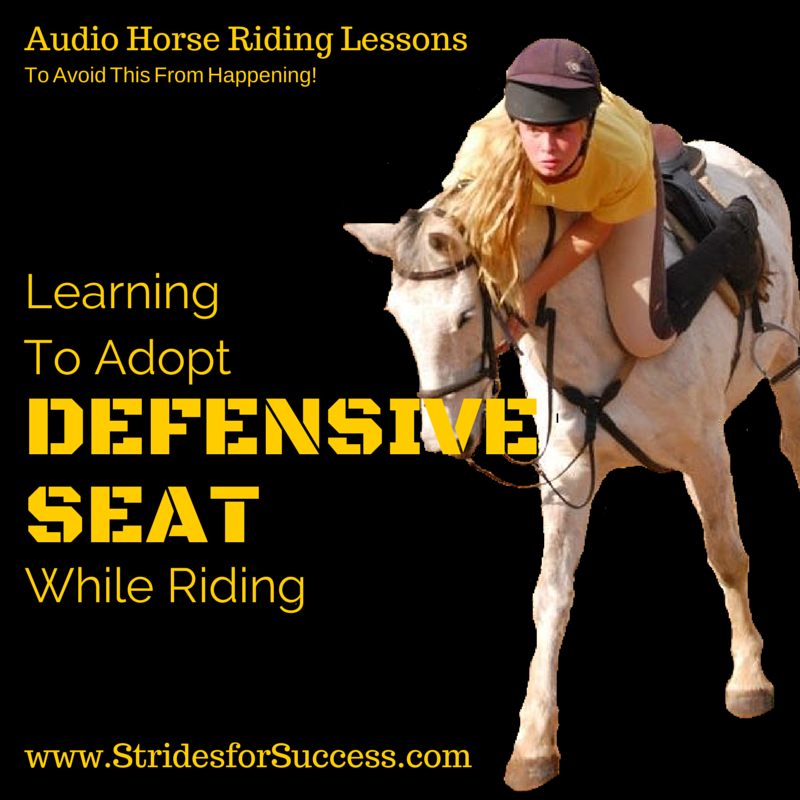
    ‘Staying power’ is a term that describes what many riders wish for in moments like these!  The ability to remain in the saddle, moving and working forward with your horse.  Leanring how to transition quickly into a more defensive seat while riding will help you achieve this.

    So, rather than just accepting your fate.  Simply allowing your horse to push the ejector button when he feels like it, here’s a few suggestions to not only keep you in the saddle but also ride your horse through the bucking and back to working with you in the arena.

        1. Push your heels down (really down!)
        2. Bring your shoulders slightly behind your hips, stretching out the front of your body
        3. Distract your horse by riding him through the problem and get him to use this energy elsewhere!

    I have written some more comprehensive blog posts surrounding this topic that you may find helpful to read or listen to (there is a short 12-minute podcast episode on each as well).

    Happy Riding
    Lorna

    Additional Resources To Help Equestrians:-

  • Riding Through The Handstands

    Riding Through The Handstands

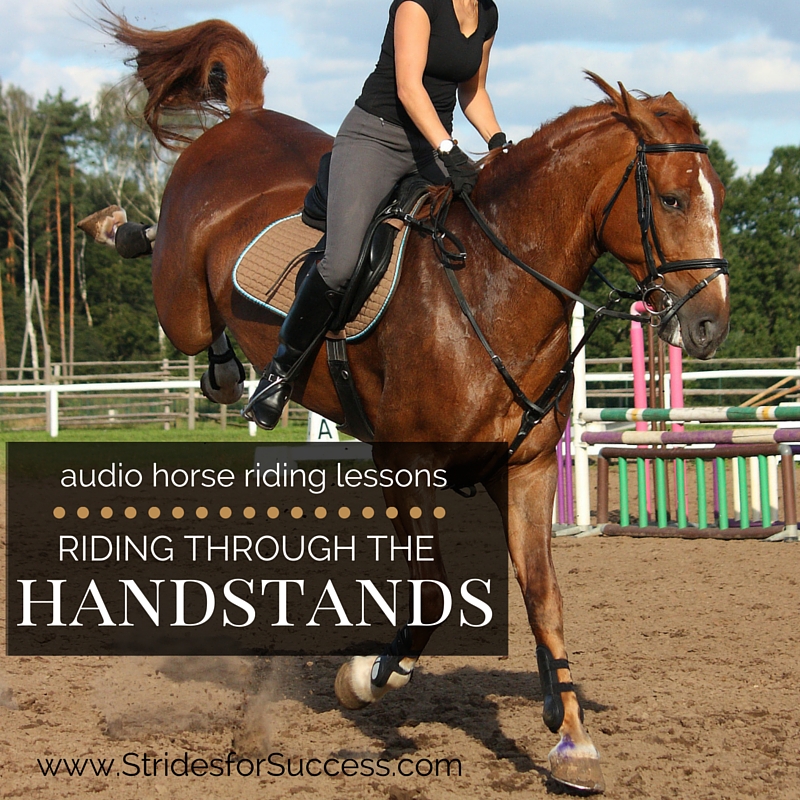
    Is there a feeling similar to ‘that’ feeling? The one where you’re happily riding your horse and you begin to feel that subtle lift in your horses back underneath you. This ‘up’ feeling is often accompanied by perhaps a head shake, or a swish of the tail.

    You just know, with a growing sense of dread, that at any moment your usually placid and co-operative trusty steed is going transform.  Your horse will demonstrate his gymnastic abilities with perfect handstands and cartwheels across the arena or field.

    Think Differently?

    But hold on, what would happen if you began to think a little differently about this behaviour change.  Where, instead of feeling impending doom and dread, you think ‘thank you’.  You can now assume that your horse is actually continuing to be his usual reliable self and is perhaps warning you of his intention.  All so that you can strap on your safety belt and enjoy the ride?

    Okay, probably not! But now that he has let you know, you can change the outcome.

    Your actions in those few split seconds, before he begins his merry dance,  have to ability to change everything. And they can become the deciding factor as to whether or not you finish the ride or get off at an earlier stop!

    So, the three things that will greatly improve your chances of finishing your ride?

    1. A defensive leg position
    2. Keep your upper body back
    3. Looking Up

    So let’s have a look at these three actions one by one in a little more detail.

    Riding Through the Handstands

    1. A Defensive Leg Position

    When we are riding, under normal circumstances, our lower leg (below the knee) should be underneath us.  Almost as though we were standing on our own two legs. Having your leg under you is one of the basics of supporting yourself and your body while you ride.

    Now, if your horse suddenly decides to try his hoof at the highland fling, everything changes. When your horse’s back changes position, from being basically horizontal to having a more vertical alignment, it would make sense for your lower leg to change position as well, in order to sufficiently support you in this new, if fleeting, position.

    The trick is to ‘assume’ this new lower leg position before your horse changes his.

    Of course, it almost goes without saying but let’s just mention it to be sure, this all hinges on you keeping your heels down. This is certainly not the time to be a ballerina on your tippy toes, trust me!

    2. Keep Your Upper Body Back

    There are three reasons that this is a vital key to staying in the saddle and making the super glue work. The first one is that you will use your abdominal muscles to brace against the momentum your horse will create when he bucks. Having a strong core is extremely helpful here. However, even if you are not as buff as you wish you were, there are things you can do.

    Simply rocking slightly back on your pelvis and opening your chest will activate those muscles.  This will help keep your body in alignment when the buck happens.

    The second reason this that you want to get your horse’s head up as soon as possible. When your horse bucks, he is using his body like a catapult; front end down, back-end up.  Often with the sole purpose of flinging his ‘load’ somewhere.

    If you can get the front end up, odds are that the back-end will go down.

    The third reason is that when you use your core, in addition to having a slightly forward lower leg position, from the side you will look like a ‘tug of war’ participant mid match. If we visualize an actual tug of war competition, we can see that by keeping this stance, they are using their whole body, not just their arms.

    This is what you want to do, brace your whole body, not just your arms against your horse.

    3. Look Up

    It sounds so simple.  And it’s probably the last thing you think of doing!  But this simple measure may be the difference between hitting the dirt and riding your horse through a buck. When you look up, you naturally keep your shoulders open and back. You also help your balance by looking at something in the distance.

    The other advantage of looking up is to see where you can send your horse to distract him. This allows you to ride him through and out of the bucking spree. Simple but so effective.

    Practicing Your Riding Skills

    So, there you have it, the next time your horse decides to show you just how athletic he can be, you know what to do.

          1. Get your lower leg forward
          2. Brace your core muscles by tilting slightly back
          3. Look up.

    The quickest way to end the performance is to get his head up and ride him forward into something different. Strangely, this is one of those things that, if you can keep those three points in mind, it actually is not such a big deal anymore at all.

    Have you ever had any ‘hair raising’ experiences on your horse while riding?  We would love to know what happened and how you dealt with the situation.  Make sure you join our free online community for riders HERE and tell us all about it.  Oh, and remember to include the outcome :)

    Happy Riding
    Lorna

    Additional Resources for Equestrians