Tag: confidence
-

Question:- Should I Train My Horse in the Wind?
[fusebox_track_player url=”https://op3.dev/e/traffic.libsyn.com/dailystridespodcast/1300_Question_Should_I_Work_With_My_Horse_in_the_Wind.mp3″ title=”Should I Train My Horse in the Wind?” social_linkedin=”true” social_pinterest=”true” social_email=”true” ]This is a big question for many riders, especially at certain times of the year when the wind can play a bigger role in your riding and training. In this episode of the Daily Strides Podcast I answer the question; Should I Train My Horse in the Wind?This is a great question and one that many riders ask themselves. In this episode of The Daily Strides Podcast, I give you my take on what you can factor into your decision when determining if you should indeed work your horse in the wind; or not!If you have any comments or suggestions for this particular question, please let us know HERE inside our Daily Strides Podcast Online Community. You are also more than welcome to submit any riding or training-related questions you have inside of the group as well.I look forward to connecting with you there🙂Happy RidingLorna -

Identifying Why You’re Struggling with Coordination as a Rider
[fusebox_track_player url=”https://op3.dev/e/traffic.libsyn.com/dailystridespodcast/1282_Idenifying_Your_Coordination_Issues_when_Riding.mp3″ title=”Identifying Why You’re Struggling with Coordination when Riding” social_linkedin=”true” social_pinterest=”true” social_email=”true” ]
Horse riding is essentially about how we can communicate with our horses – while riding our horses. However, as riders, in order to be effective we need to first master some basic coordination. And therein lies the challenge! It is often this part of communication, the one between our brains and our bodies, that can cause the greatest issues when it comes to our effectiveness when in the saddle.
Resulting in our lack of effective coordination creating havoc with our communication when riding our horse!
The lack of coordination really has a knock-on effect on all of the other parts of riding a horse. From our balance to our confidence. How we ask questions of our horses. And how we can respond when they answer. If any one of these elements is negatively impacted by poor coordination, it will cause challenges for both the rider – and their horse.
1. Identify the Trigger
This is a big part of beginning to successfully improve your coordination as a rider. In my experience, most riders are pretty okay with their coordination up to a certain point. And it is at that point (which is unique to every rider) that things tend to begin going a little (or a lot) off plan!
A trigger, for you, could be something physical, mental, or emotional. Meaning it could be a certain gait (like canter itself), a certain thought (I have to ask for canter), or a certain feeling (the fear of cantering).
The physical trigger shows up when your horse reaches a certain point with how much energy they are creating and using. Maybe a slow trot is fine, and you can still coordinate your aids effectively. However, as soon as there is more energy inside of that trot, oh the issues, they come knocking!
The mental and emotional triggers are often a little more challenging to identify, as it requires self-awareness regarding thoughts, beliefs, and feelings. However, they are just as disruptive to the overall flow of communication between you and your horse.
2. Notice What Coordination is Affected
Now, saying ‘I struggle with coordination’ is a little like saying ‘I struggle with confidence’ (something I hear so often from riders). It is just too open-ended and broad for anyone to give any real specific advice on how to improve coordination. By being more specific, you can start working on certain movements where you can practice and improve your skills.
Poor coordination can be knowing what you want to do, but not being able to do it. Or struggling to move one limb – without moving another. It can be shifting your weight to compensate for weak muscle tone or strength. Or even struggling to apply one aid without unintentionally doing something with another.
Just like the triggers, there are so many different types of a lack of coordination when it comes to your riding. Get really clear on what exactly or when exactly you struggle and start there.
3. Exercises to Help Strengthen & Improve
Once you know where the issue with your coordination lies, you can now easily begin to work on it. I am a big believer in creating situations where you get to ‘test’ yourself and practice the outcome you want. Think about this in your riding. What school moments can you ride that will require you to do something that you find a little challenging coordination-wise?
It’s also worth noting that physical strength, fitness, and stamina play a huge role in coordination. Even when the triggers are mental or emotional.
I would definitely advise you to do exercises outside of riding that will help you when you are in the saddle. I personally love hiking over rough terrain and yoga. They are both great for suppleness, stamina, strength, and overall fitness.
4. Revisit and Refine
Unfortunately, most riding issues are not a ‘fix one-time’ event! They will repeat themselves a lot. This is especially true when we ask new or bigger questions about ourselves or our horses in our riding. This is why, again, I really do believe setting these situations up for yourself intentionally is the most effective way of improving.
By intentionally putting ourselves in situations where our coordination may be questionable, we get to practice and become more effective.
This will also mean that when you find yourself being ‘tested’ unintentionally, there is a better chance of your body doing what you want and your horse understanding. This is exactly what we want in these situations. This can always be improved by revisiting and refining the basics of your riding.
Happy Riding
LornaOther Resources on This Topic:-
- The Link Between Responsiveness and Your Coordination
- Improving Rider Coordination
- How to Secure a Swinging Lower Leg
- Improving Your Effectiveness as a Rider
Training For Riders:-
- FREE Equestrian Fitness Challenge
- Returning to Riding
- Groundwork for Riding
- Free Online Community for the Daily Strides Podcast
- Free Online Community for Riders Working Alone without a Trainer or a Coach
-

Building Confidence When Riding a Nervous Horse
[fusebox_track_player url=”https://op3.dev/e/traffic.libsyn.com/dailystridespodcast/1274_Building_Confidence_when_Riding_a_Nervous_Horse.mp3″ title=”Building Confidence when Riding a Nervous Horse” social_linkedin=”true” social_pinterest=”true” social_email=”true” tweet_text=”Coping with riding a nervous horse” hashtag=”confidence #equestrian” twitter_username=”strides_success” ]Riding a nervous horse is one thing… Feeling less than confident about your own abilities while on your horse is quite another. Imagine it, up there, on your horse. He is beginning to get a little ‘jumpy’. Let’s be honest, so are you… Doubts are beginning to creep in and your thoughts are heading in a direction you would rather that they didn’t go…Building confidence in your abilities to both handle yourself and the horse when in this situation is often a long road. However, it can be done – with time and patience.Here are my suggestions for building your confidence in working with and riding a nervous horse.1 . Find Your Comfort Zone – and Stay There
I know this is a little contrary to what other trainers might suggest in this situation. So many coaches, trainers, and instructors encourage their riders to get out of their comfort zones. I tend to take the opposite approach, initially anyways.I believe that if you can find the place where you are happy, the place that is just close to the actual edge of the boundary of your comfort zone and work there for a while, you can begin to re-wire both your thoughts, your actions, and your habitsSo many riders have a ‘protocol’ when it comes to feeling anxious and nervous on a horse. Some will literally attempt to ‘curl up’ into a ball (think of a hamster). Others will become aggressive as a way to hide or mask their doubts. And many will just freeze; forget all training and just sit there, waiting for the inevitable to happen.Working inside of your comfort zone will allow your more relaxed habits to become more dominant. The key word there is ‘working’. Do things with your horse from where you are comfortable2 . Get Your Basics onto Autopilot
Very often, riders are failing to get one or two key basics in their riding running on autopilot. What I mean by autopilot is that you no longer have to think about ‘heels down’; it simply just happens. And any time ‘pressure’ is applied, it happens even more! This also applies to ‘sit up and carry yourself’. When your horse is having a moment, these are two things that you really don’t want to forget or stop doing in your riding.Focus on getting all the essentials to simply happen, on their own, so that if and when pressure is applied (things don’t go to plan), they remain in place and support youMany riders, can keep their heels down as long as they are thinking about keeping their heels down. Remember, when things go sideways, you won’t be running through a checklist of ‘essentials to remember’!You want to rather work on regaining balance for yourself and your horse and getting the ride back on track. This is close to impossible to achieve if you first have to ‘fix’ some of your basics with regard to position, posture, and aids3 . Begin ‘Testing’ Yourself – and Your Horse
This is where you can begin to have some fun, while also continuing to work on developing your aids, habits, responses, and reactions. You’re going to do this by ‘inviting’ some potentially uncomfortable things into your comfort zone. Where I would suggest going with this is to think of it from your horse’s perspective. What individual items might cause your horse to question the situation a little?Remember, the goal here is to build your confidence when riding a nervous horse – so by doing it this way, you get to remain ‘comfortable’ while your horse may experience a few nervesI also believe that getting creative with this is key to really beginning to transform anxiety into excitement – although we also want to take those emotions down a notch or two… Rather than thinking of you and your horse being ‘anxious, which can be a very heavy and big emotion, why not use the word ‘nervous’. I personally think ‘nervous’ can either be positive or negative; meaning it can go either way. We want it to go in a positive way…Think about how you can begin to transform ‘nervous’ energy into ‘curious’ energyOnly introduce things that you feel comfortable with, and continue to do this until your once nervous horse, also begins to relax and feel comfortable. This could take weeks… Once you have established a stronger, more relaxed ‘you’ as a rider, and you feel confident as that version of you, then you can begin thinking about venturing outside of that comfort zone…4 . Control Everything You Possibly Can
So, once you have things on autopilot and you have created supportive and good habits as responses and, maybe, reactions, it’s time to think about leaving the ‘comfort zone’. I am not a big fan of simply wandering off into the sunset with a wish and a prayer that all will be okay! This is where planning is going to help you succeed and build your confidence.Start off the ground, without your horse, and look at EVERYTHING from their perspective. Remember, you will be riding a nervous horse, so they will also look at, literally, everything!Remove any of the questionable things you may meet along your way. Also consider the time of day, who will be around or in the vicinity, the weather, feeding times, energy levels (you especially), and who can possibly be there for support.By creating a situation where, for the most part, you have removed many of the challenges, you and your horse can begin to experience working together and getting positive results – even if you both feel a little challenged and nervous5 . Mindset When Riding a Nervous Horse
Finally, it is so important to increase your self-awareness. What are you believing to be true about the situation? Is that really true (meaning anyone, regardless of who they are can agree 100%)? And where can you begin to tweak or change your story surrounding this?If you continue to tell yourself the same story, about you feeling nervous while riding a nervous horse, you will continue to produce the same results; change the story where necessaryBecoming more confident working with a horse who is likely to spook, spin, or fall to pieces is not easy. It will take time, commitment, diligence, patience, and a lot of forgiveness! You must remain dedicated to the job and do the work, physically, mentally, and emotionally.However, from experience, I can tell you that if you do stay the course, the results can be life-changing. So often these ‘nervous horses’ can often become the most trustworthy ‘horses of a lifetime’. And this is simply because someone refused to give up on them.Good luck and Happy RidingLornaMore on This Topic:-
More Training & Support
-

Fear and Horse Riding
[fusebox_track_player url=”https://op3.dev/e/traffic.libsyn.com/dailystridespodcast/1270_Fear_and_Horse_Riding.mp3″ title=”Fear and Horse Riding” social_linkedin=”true” social_pinterest=”true” social_email=”true” tweet_text=”Getting over fear about riding or horses” hashtag=”horseriding” twitter_username=”strides_success” ]Has fear or lack of confidence ever held you back in your riding? If so, you will know how debilitating this can be. Sometimes it’s caused by a past experience. Or it can be created when we think of all the things that ‘can’ potentially happen.Whatever the cause, I think that it is important to recognize that this particular challenge won’t simply vanish on its own. Sure, sometimes it can seem like it has shifted or even disappeared. But more often than not, it is simply buried and will rear its unwanted head again as soon as there is even a whiff of ‘danger’ or ‘warning’ in the air.I am a firm believer that confidence is something that we build over time. Couple time with consistent repetition, self-awareness, and taking the correct action and there’s a good chance that you can overcome the fear and begin thriving again in your horse riding.What Are You Afraid Of?
I think that it is important to actually name what you’re worried about in order to begin the work of changing your thoughts around it. There is a big difference between “I’m afraid to ride” and “I’m worried my horse will spook, spin, and dump me on the ground so hard that I break something”.Often when we actually speak about the exact thing that we fear when it comes to our riding, we can begin to dismantle that fear in our mindsIf we take the second statement mentioned above, there are a few key areas we can begin to work on BEFORE we ever even consider hopping into the saddle. “I’m worried my horse will spook, spin, and dump me on the ground so hard that I break something”.-
-
- Remind yourself that your horse, usually, doesn’t want to ‘dump you’ on the ground; especially in this particular situation
- What specific triggers have you noticed that your horse has reacted this way too?
- How can you avoid these triggers?
- What can you do to actually develop your horse’s confidence in himself?
- Is there a way you can develop your horse’s confidence in you more?
- Where can you ride that the chances of this happening are less?
- What can you do to potentially limit the severity of the fall, if it were to happen?
-
When we really begin to look at the fear we have, we can also begin to approach it from a different perspective – one of curiosity.What Can You Control?
Now, for years I have been preaching that the only thing you can control when it comes to riding is yourself. However, this is not really true for this particular situation. Firstly, when your mind is telling you terrible stories, often all sense of self-control flies out the window!And, secondly, I believe that there are actually external factors you can control in order to logically lessen the risks involved with riding. It’s just that we sometimes overlook these things because we are so caught up in the ‘fear’ itself.You can work towards controlling things like:--
-
-
The time of day you ride (this often has an impact on the energy levels of both horse and rider, as well as external factors like traffic, bystanders, other horses in the arena, etc.)
-
Who you are riding with
-
Where you ride
-
What feed your horse is receiving
-
How balanced and coordinated you are
-
Creating planned responses instead of fear-based reactions
-
-
You can also begin to develop a greater influence over things like:--
-
-
How fit or fresh your horse is
-
The thoughts in your head…
-
How fit and supple you are
-
Increasing the trust and partnership of your relationship with your horse
-
Developing your horse’s confidence in himself
-
-
The key here is to actively decide to change things and then create a plan of action in order to make it happen. Wishing, hoping, and praying won’t work in this situation!Maybe Don’t ‘Just Do It’…
Now, up until this point, we have been doing the ‘thinking’ work. And while this is both important and necessary, there comes a time when action is needed. A lot of trainers and coaches will force riders to ‘just do it’. And, to be fair, this often does work in the actual moment. It also can sometimes actually be the exact thing that is needed to unmask the fear forever for the rider.The issue I have with the ‘just do it’ approach is that while you may get a quick win under your belt, often the underlying cause has not been resolved; and will come up again when pressure is applied!Pressure, in this situation, is anything that causes you or your horse to experience a little emotional or physical discomfort. It’s usually emotional. Maybe a spook for your horse. Or a lack of time for you. These are the exact moments when you don’t want to experience fear!What’s Comfortable Now?
Start by figuring out where you and your horse both feel good and relaxed right now when you’re together. This could be riding together inside of an enclosed space, like an arena. However, it could also be dismounted, on the ground, with a door or a gate between you and your horse!It makes absolutely no difference what this is for you both now. What is important is to find that point in the conversation together where everyone feels relaxed, at ease, and enjoying the moment.Now, rather than mindlessly allowing these moments of true enjoyment and relaxation to simply pass, begin paying attention to how you ‘are’ in these moments.When you can begin to define truly what ‘relaxed and at ease’ is for you and your horse, you will begin to more easily recognize leaving that ‘comfortable’ space. And, how it feels to return to it.Building Confidence and Easing Fear
So, with this point in mind, begin thinking about how you could intentionally plan to make things a little more mentally uncomfortable for you and your horse. What could you actually plan and make happen that would intentionally make you feel discomfort? It sounds bizarre, but this is truly the key to gaining confidence and overcoming fear.The key to planning this work BEFORE you actually do it is that you will create ‘pressure’ circumstances that can easily and quickly be reversed.Meaning that you can turn it on and then when you choose to, switch it off. Sounds so simple! But we can do this in our riding as well. Maybe it is walking for 20 meters with someone leading you out of the arena and back to the stables. It could be standing beside your horse holding the lead rope, with the door or gate open.The goal is to create a situation where you will feel that mental discomfort and commit to staying in it for 20 or 30 seconds. Then, calmly returning back to the ‘comfort zone’ and ‘safety’ again.Consistency, Repetition, Awareness, & Action
Doing this once or twice won’t be enough to ‘reset’ your comfort zone. This work needs to happen consistently in order to be effective. The good news is that, over time, you will find the discomfort getting less and less.When the previously uncomfortable piece feels relaxed and easy, it is time to expand the ‘zone’ further. Find the next action that will build on the previous one and start the work again.By doing this over and over, both you and your horse will develop confidence in your own abilities. You will also begin to trust each other more, which will strengthen the partnership.Unfortunately, there are no quick fixes to overcome fear and develop confidence. And yet, the time invested in doing the work can yield so much more for you in your riding… It is well worth the investment.Happy RidingLornaSimilar Past Episodes
-
-
- Creating Planned Responses (Rather than Messy Reactions)
- How Your Stories are Influencing Your Horse Riding
- Reacting Versus Responding
- Why Enforcing Boundaries on the Ground will Improve Your Riding
- Building Confidence in Yourself as an Equestrian
- Returning to Riding – Focusing on the Basics
- Dealing with a Horse who Spooks and Spins
- Diffusing a Difficult or Dangerous Situation
-
Online Community & Support
-
-

Groundwork for Horses and Rhythm in Training
[fusebox_track_player url=”https://op3.dev/e/traffic.libsyn.com/dailystridespodcast/1259_Groundwork_for_Horses_and_Rhythm_in_Training.mp3″ title=”Groundwork for Horses and Rhythm in Training” social_linkedin=”true” social_pinterest=”true” social_email=”true” tweet_text=”Something different to work on with your horse…” hashtag=”equestrianpodcast” twitter_username=”strides_success” ]
Rhythm is genuinely one of those things that can seem so simple on the surface. And, don’t get me wrong, rhythm is a fairly simple concept. However, when we begin applying it to horses and riding, it is truly eye-opening just how deep we can go with the idea. A little like groundwork for horses…
And, because rhythm is something we can approach from different perspectives and filters, the possibilities are pretty endless. So when we combine rhythm and groundwork for horses, we can really begin to develop and train. Both ourselves, and our horses.
When working with your horse using groundwork, you can actually begin to both ‘see and feel’ how important rhythm is.
Syncing Your Body with Your Horse
I am a firm believer in modeling or demonstrating things for your horse. To do this, we must first become aware of our body and how we are using it to communicate with our horses. Become aware of your actions, breathing, rhythm, and energy in general. Once you are aware of your own physical presence, you can begin to ‘sync’ this with your horse.
Try to coordinate your legs and footsteps with your horse’s hind legs and hind feet. Similarly, your shoulders with your horse’s shoulders. This is both for movement and, often, placement as well.
Start in the walk. As you walk, move your feet in sync with your horse’s hind feet. Once you are both ‘in sync’, you can begin experimenting with how you can influence this part of your horse. The rhythm and the length of stride.
You can also begin to influence how the weight is carried by applying the half halt while on the ground, next to your horse.
Half Halt and Rhythm
Rhythm, in and of itself, is generally pretty easy to establish. Finding a repeating sequence of footfalls is not too difficult. However, very often the quality of the initially easily discovered rhythm can leave a lot of room for improvement. And this is where, as riders (whether in the saddle or on the ground) we must work on improving our abilities to ‘balance’ things a little more.
Improving your skills as a rider means that you improve your coordination, your feel, and your understanding so that you can have a greater positive influence over your horse.
A half halt is a key tool when you’re working on this. Being able to walk beside your horse and effectively ask for the half halt is a skill that takes time to refine. Doing this in a way that your horse understands is also pretty important! So, it makes sense that you understand your aids, and how to time them correctly. I have a full episode on this topic “Your Half Halt on the Ground with Your Horse” that goes deeper into this topic.
When you can use a combination of your aids, including your weight aids, at the right time to ask your horse to half halt while beside him/her on the ground, you can begin to ask bigger questions
Groundwork for Horses
Once you can begin to identify what is moving concerning our horse’s legs and bodies, and we understand how it is moving… We can place more focus on our influence over the movement. And the options are limitless for how to develop this further. I am a firm believer that most of what we can do in the saddle, can be worked on while on the ground, whether this is true groundwork or lunging.
And just like riding, groundwork takes dedication, consistency, time, and focus. It requires both you and your horse to learn new things and is a great opportunity to grow your partnership together.
From working in the stable while grooming and tacking up, to working in the arena, groundwork for horses is as versatile as it gets from a training perspective. In fact, I am pretty sure that if there is something you are struggling with in your riding, by finding a way to work on it, directly or indirectly, through groundwork, you can improve or transform it in your riding.
I have created a full 4-week self-study program for you to use to really begin achieving results in your riding – and all while on the ground. There are audio horse riding lessons for you to use each day to develop your horse and improve your skills as a rider. And all are created with the intention to improve your riding as well. All of the details are HERE
Happy Riding
LornaMore on Groundwork for Horses
-
-
- Groundwork for Riding – Successfully Take the Conversation from the Ground into the Saddle
- Groundwork; The Bookends in Your Riding
- 4 Ways to Work with Your Horse When Time is Short
- Why Enforcing Your Boundaries on the Ground Will Improve Your Riding
- Square Halt on the Ground
- Your Half Halt on the Ground with Your Horse
-
Join Our Online Community of Equestrians
-
-

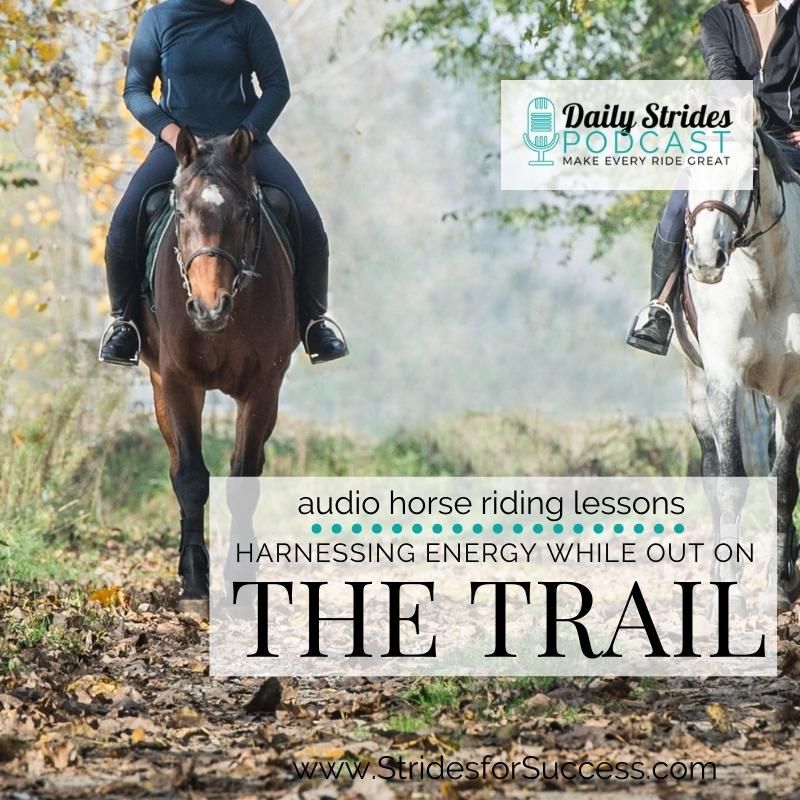
Out on the Trail; Harnessing the Different Energy
[fusebox_track_player url=”https://op3.dev/e/traffic.libsyn.com/dailystridespodcast/1241_Harnessing_the_Energy_When_Out_of_The_Arena.mp3″ title=”Out on the Trail; Harnessing the Different Energy” social_linkedin=”true” social_pinterest=”true” social_email=”true” tweet_text=”Do more than just ‘saunter’ on your next hack…” hashtag=”horseriding #trailriding” ]
Anyone who has ridden in an arena for a prolonged period knows how different the energy feels when they finally get out on the trail. What may have been feeling a little flat and, even, deflated, suddenly comes back to life. Both horse and rider seem to become more keenly self-aware. And more responsive to external elements.
Rather than being afraid of this energy or worried about it, you can rather begin to intentionally channel that energy to improving your training & riding.
By strategically channeling this energy, you can actually use your hacking or time out on the trail to actually improve things. Both you and your horse can positively influence your training and development. And, then return to the arena with a greater understanding of the different questions.
Start with ‘Forward’
I’ve noticed that many riders when they feel something different happening, ‘shut down’. Shutting down looks like the rider collapsing, but also stopping the horse from thinking or working forward. Maybe hanging onto the contact. Or sitting too deep and resisting with their seat. A little like ‘hunkering down’ and waiting for the storm they are convinced will come!
Keeping your attention on the individual footfalls that your horse is making each stride and the rhythm they create, will help you to keep actively working forward.
Once you have identified the rhythm, work on syncing your body to your horse’s movements. Are you able to allow your movements to be led? Rather than pushing your horse along with your body?
Thinking and working forward means that your horse is taking you somewhere with a sense of purpose, and you are very much along for the ride.
Independent Aids
From here, begin experimenting with your independent aids… What happens to your outside shoulder when you apply or use your inside leg? And what about your outside hand when you apply your outside leg?
Very often we miss the fact that our aids are not as independent as we first thought; use your work out on the trail to identify and tweak.
Having truly independent aids will allow you to better channel and harness the energy. It also allows for clearer communication, more responsiveness, and just more overall clarity between you and your horse.
Creating More Space
From here, I am going to suggest working on the space within each stride. Many riders only focus on the space between the strides (the tempo). However, by working on the actual space within each individual stride, you can begin to really define and improve the overall rhythm.
Riding a well-timed, well-balanced, clear half-halt is one of the best ways to begin defining each stride a little more and truly harnessing that different energy.
What’s really unique about the half-halt is that no two are ever really the same. There is a level of intuition that, as riders, we need to tap into and explore in order to truly ride it. Each individual situation, each individual stride, will call for something slightly different.
Learning how to balance your individual and independent aids together in order to effectively half halt, will open so many doors for you and your horse.
Half Halt Out on the Trail
Once you can effectively begin to use your half-halt, a whole other world will open up for you and your horse. You will find that the ‘fresh’ energy you experience while out of the trail becomes beneficial, rather than something that causes concern.
It also allows you to approach everyday schooling movements and exercises from a new place – with newfound energy and enthusiasm. I am a big fan of using both lateral work and flexion/bending while out on the trail to help better engage this energy.
And, when the energy is correctly harnessed, it leads to improved contact. Sometimes even better than what riders experience in the arena.
So, this week, plan a hack or an outing that will take you out of the arena and see what you can begin to harness and improve with your horse.
Happy Riding
LornaMore on This Topic
- Your Aids to Ride the Half Halt
- 3 Ways to Use the Half Halt In Your Riding
- What Not to Do When Riding a Fresh Horse
More Training & Support