Tag: engagement

  • Why Improving Your Accuracy Will Improve Your Engagement in Your Riding

    Why Improving Your Accuracy Will Improve Your Engagement in Your Riding

    [fusebox_track_player url=”https://op3.dev/e/traffic.libsyn.com/dailystridespodcast/1239_Using_Accuracy_to_Improve_Engagement_in_Your_Riding.mp3″ title=”How Accuracy Can Help Develop Engagement in Your Riding” social_linkedin=”true” social_pinterest=”true” social_email=”true” tweet_text=”Accuracy… It really can help improve your horses engagement…” hashtag=”horseriding” twitter_username=”strides_success” ]

    Accuracy can seem like a dull and boring concept when riding horses.  Sure, if you are going to compete in dressage or show jumping, accuracy can become really important.  But what about if you are simply a rider, working alone with your horse, trying to improve your overall skills?  Is accuracy still as important?

    I’m going to say yes, accuracy is important. And it is an excellent way of actually establishing and building engagement with your horse.

    Now, granted, accuracy and engagement might seem like they have nothing to do with each other initially.  How could do something at a specific point in the arena or in the conversation help with engagement?  And the answer is “more than you can even begin to realize”.

    What Is Accuracy?

    Accuracy is about doing a specific thing at a designated time or space when you ride. So, for example, picking up a canter at a specific marker in your arena, perhaps A or C.  Or riding a certain number of strides within a certain measured distance.

    However, in order for you to achieve true accuracy with your horse, the energy that goes into the preparation and, subsequent, follow-through is equally as important as doing the ‘exact’ thing.  

    This means that, as a rider, your attention to detail must include what happens before the transition, during the transition, and then after the transition. Realizing accuracy is about how well you can maintain what is established as you also allow the desired outcome to happen at the right endpoint.

    What Accuracy is Not…

    Contrast this with a rider who roughly kicks or pulls their horse in order to achieve the desired outcome at a specific point.  The overall ride lacks softness, consideration, knowledge of energy, and flow.  It is doing something with the sole purpose being to get a specific result.

    True accuracy is when the result adds to the overall performance and conversation between horse and rider.

    Being accurate, if it is merely to get something done, is not true accuracy.  It must play into the bigger picture of horse and rider.  Working on being accurate must incorporate the energy of what comes before and after the specific ‘point’.  And, in doing this, you can begin to build both engagement and true accuracy with your horse.

    What is Engagement?

    For many riders, when they hear the word ‘engagement’ in relation to horses and riding, the mind jumps to collection.  And, for most of those riders, true collection is not somewhere they visit regularly in their riding. And yet, engagement starts much earlier.  At the beginning in fact.

    Would your perception of engagement change if you began seeing it as a connection, rather than a collection, in your riding?

    If we think of the word ‘engage’ outside of horses and riding, it means that you occupy or attract someone’s interest or attention.  It can also mean entering into an agreement with someone. If we applied both of these to your conversation with your horse, can you see how engagement is a far more basic concept than we might first allow ourselves to imagine?

    And developing accuracy is an excellent way to attract your horse’s interest or attention a little more. To increase your horse’s focus on what you are saying or asking… On your desired outcome. 

    Engagement as an Agreement

    Once your horse has begun to focus a little more on you and what you are saying (or trying to say), you can begin to develop the conversation a little more.  This is where using accuracy can help to begin developing more contact and connection between you and your horse.

    Developing contact is often the point in your horse’s training where he agrees to begin taking on some of the responsibilities for your work together. An agreement. Engaged. 

    And this is also the point in training where energy can begin to truly be recycled through both of your bodies as you work together.  Rather than the energy falling out or leaking out somewhere, it remains within the container.  Part of the responsibility your horse engages with is to ‘hold’ that energy inside of his body.

    Accuracy and Engagement

    Hopefully, from this explanation, you can begin to see the link between improving accuracy and encouraging engagement when working with your horse.  It all begins with understanding that true accuracy requires a holistic approach.

    Attention to detail on the preparation, the doing, and the following through of what you intend to be accurate about. 

    As you become more consistent with this, your horse’s interest in what you are trying to achieve becomes heightened; engagement.  And at this point, you can begin to allow your horse to carry some of the responsibilities regarding your work together.

    Contact and connection.  Which, inevitably, begin to lead to the sort of engagement that will eventually, if you continue to develop and work on it, lead to collection.

    Happy Riding
    Lorna

    More on this Topic:-

    Join Our Online Communities for Equestrians

  • Are you Working on Your Self-Carriage When You Ride?

    Are you Working on Your Self-Carriage When You Ride?

    [fusebox_track_player url=”https://op3.dev/e/traffic.libsyn.com/secure/dailystridespodcast/1193_Are_You_Working_on_Your_Self_Carriage_When_You_Ride.mp3″ title=”Are You Working on Your Self Carriage when You Ride?” social_linkedin=”true” social_pinterest=”true” social_email=”true” tweet_text=”Self carriage is not just for your horse…” hashtag=”horseriding” twitter_username=”strides_success” ]

    Self-carriage is a pretty big topic when it comes to riding and riders in general. And it should be. It is an important aspect when it comes to training moving in the right direction. However – you knew there was a ‘however’ coming, right?!

    Often we put the cart before the horse when it comes to self-carriage in riding. We focus on the horse’s self-carriage – or lack thereof. When, in reality, we should first focus on the rider’s ability to correctly carry themselves first.

    Creating Space

    The reason this is true is pretty obvious when you actually spend time looking at horses and their riders. In order for the horse to truly begin to embrace the concept of self-carriage in their training, there must be space available for them to move into.

    In order for this to occur there needs to the necessary strength and engagement through the core of the body. And it is this ‘core engagement’ that is so often missing as riders work and train in the saddle with their horse.

    Think Standing Not Sitting

    One of the most simple ways to begin ‘testing’ this in your riding is to become aware. If you were to stand the arena, no horse underneath us, your core must engage. I say must, because if not, you will fall over. I say this because so many riders use ‘lack of core’ as an excuse for poor performance in the saddle.

    The simple truth of the matter is that if you walked unaided to your horse to mount up, your basic core is pretty sufficient to begin carrying yourself in the saddle when you ride.

    This brings me to the awareness of how it feels to ‘stand’ on your own two feet. This ‘standing’ feeling is different from when most people sit. Sitting encourages slouching and complete relaxation of the core muscles. This is what most riders do when they ‘sit’ in the saddle.

    Next time you ride, even though you are technically ‘sitting’, engage your core as you would if you were standing. This is where self-carriage as a rider begins.

    Carrying Your Hands

    The next piece is often an unhelpful habit than anything else. Riders, whether due to initial nerves or just not knowing, begin riding with their hands low. Too low. Dropping your hands’ changes how your hands feel and connect to the reins. It changes the tension levels that are communicated through the reins.

    If you are unsure as to whether or not you’re carrying your hands apply the ‘line’ rule. There should be a straight line from your elbow, through to your hand, through the rein, and connecting with your horse’s mouth. Any deviation from that line will result in muddled communication between horse and rider.

    When you carry your hands as you ride, you will naturally open your chest. Which will then encourage you to carry your upper body. Engage your core. And, begin riding in self-carriage.

    Developing Your Self-Carriage as a Rider

    So once you can identify if you are currently carrying yourself while you ride, I feel that it is then important to begin developing this to improve. As you learn and practice self-carriage, you naturally encourage it more in your horse. This is often why more experienced riders get a better ‘tune’ out of a horse than less developed riders.

    One of the easiest ways to improve your self-carriage is to focus on developing your suppleness in the saddle while maintaining a correct position.

    Any feelings of limitations that show up physically will be indicators to go deeper in that area. Many riders feel this, particularly while trying to ride the sitting trot and canter. The bouncing indicates you are not moving with, but rather against the horse.

    Unfortunately, these are also the areas riders often look for a way out. A shortcut. Buckling and hunkering down, rather than ‘sitting’ tall, engaging, and allowing the flow to come through your body.

    Working Off the Horse as Well

    There are also plenty of programs created for riders while on the ground to help improve these areas. Challenges, workouts, cross-training, yoga, pilates, and so many more different options you can look into.

    However, I really do feel that the key to improving your own self-carriage is to get really focused on what you are doing while ON your horse.

    Carry yourself. Allow the swing. And then see where it goes from there…

    Happy Riding
    Lorna

    Additional Links to Help You:-

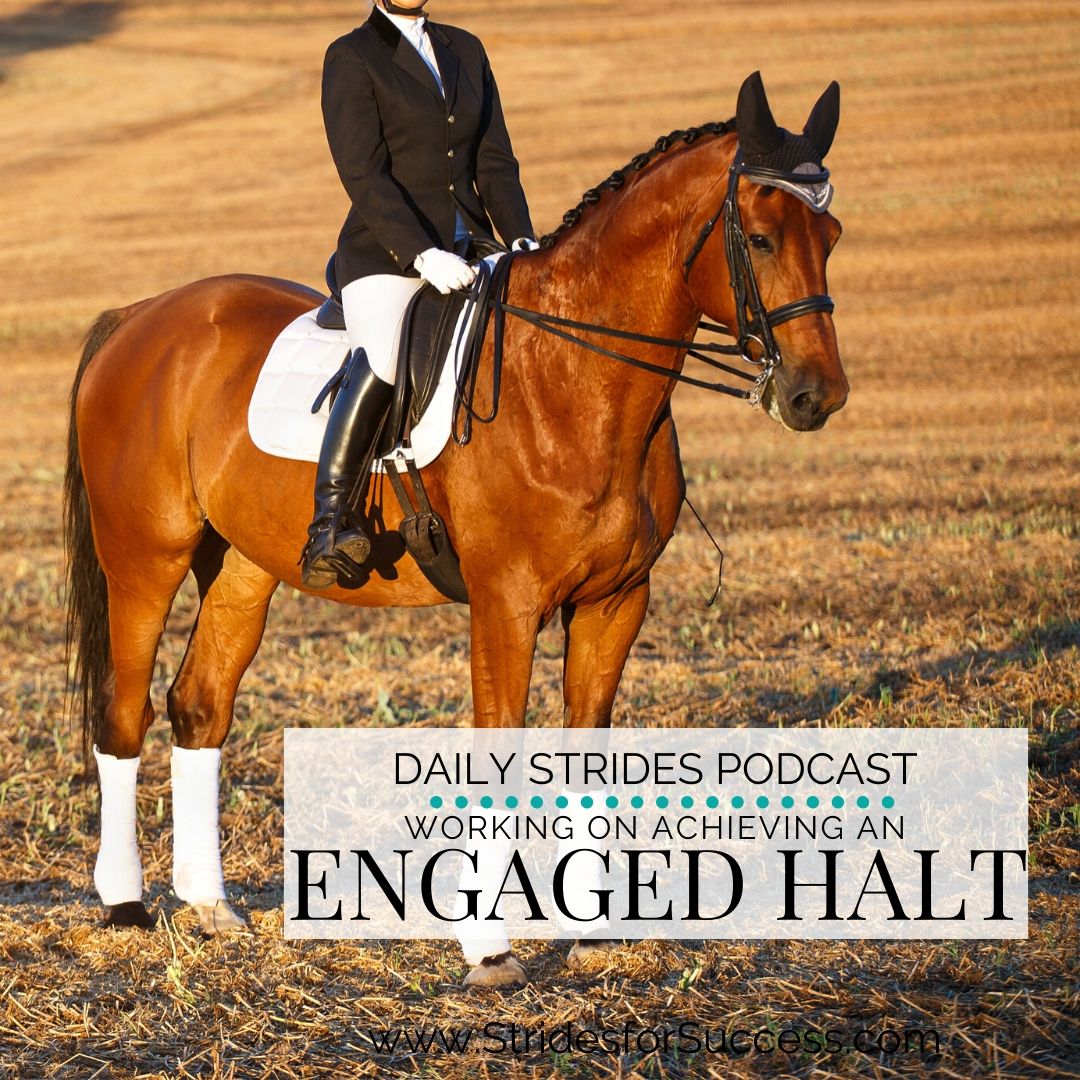
  • An Engaged Halt

    An Engaged Halt

    An Engaged Halt
    Quick question… If you were to guess, how many times did you halt throughout your last ride on your horse? Was it a ‘one time only’ event? Or perhaps you halted two or three times throughout the ride? Or was it into the double digits?  Once you have that number, here’s another question.  How many of those halts was the actual ‘end’ of the ride?
    So many riders treat all halts the same.  They see the halt as being the end of a moment or a sequence of movements, however, it rarely is.  In fact, there is only one lat that actually signals the end, the last one.  All the others are part of the ride and should be seen as an important exercise.  Yep, every single halt.
    [smart_track_player url=”http://traffic.libsyn.com/dailystridespodcast/1133-The-Engaged-Halt.mp3″ title=”An Engaged Halt” social_linkedin=”true” social_pinterest=”true” social_email=”true” tweet_text=”Start seeing each halt as an opportunity to move things forward for you and your horse…” hashtag=”equestrian #podcast” twitter_username=”strides_success” ]
    in today’s episode of the Daily Strides Podcast, we are diving into all things ‘halt’.  But not just any old halt; I want you to use this information, starting on your very next ride, to begin working on developing a more engaged halt for you and your horse.
    I want you to be able to keep the energy you already have as you approach the halt contained through halt and then allow that energy to carry you into your next movement. 

    Why a Good Quality Halt is Important

    We halt a lot every day when we are working with our horses.  This is true regardless of if we are on the ground leading or lunging, or in the saddle riding.  And often we pay a lot of attention to how we are transitioning in and out of the halt.  However, the halt itself also demands attention and focus if it is to truly serve the rest of the ride.
    Allowing everything to collapse or dissipate every time we transition into the halt means that we have to start all over when asking our horse to move out of the halt. 
    We have to reestablish the energy, the forwardness and, because of this, the contact as well.  Transitioning out of a less than great quality halt leaves us with a lot of work to do in the next gait, be that walk, trot or canter. So, it makes sense to begin giving the halt itself the same attention we give the rest of the gaits throughout each ride.
    I suggest that from now onwards in your riding, begin seeing each halt as a separate movement that requires your attention and focus just like every other movement in the ride. 

    What is Engage?

    Engage and engagement is a word we often use in horse riding.  Usually, we are speaking about the hindquarters or the core when we use the word.  However, I want to go a little further with ‘engage’ today.
    I feel that when we are talking horse riding and horses, to ‘engage’ is to agree to participate and show up.  Both horse and rider must engage in order for the engagement to be of any benefit to the overall ride.
    Engagement is a willingness.  It is being intentional and mental about something before it shows up physically.
    The next time you are with your horse, whether that be on the ground or in the saddle, I want you to really get intentional about every halt.  Mentally engage in the process of the halt and invite your horse to join you there.

    An Engaged Halt

    You probably have a good idea in your head about what a ‘nice’ halt looks like.  Horse standing still, without fidgeting, with a foot in each corner of an imaginary rectangle box on the ground.  However, I want you to go a little deeper about what makes a halt ‘good’.
    There is a sense of purpose in both horse and rider when the halt is engaged.  You can see that they are still ‘working’ and that the halt itself is part of the work.  
    The core of both horse and rider is engaged.  They are carrying themselves.  And it is this carriage that really gets to why an engaged halt is so important.  It means that the channel for energy to run, from the back end to the front end, is open and ready for the energy to flow.
    It also means that the energy that was in the channel before the halt is still in there; waiting to be redirected. 
    An engaged halt also will have both horse and rider maintain the contact that they arrived into the halt with.  Neither is being forced to stay there; again, there is an unmentioned but very obvious agreement from horse and rider.  I will continue to maintain this conversation inside of this halt.

    Improving Your Halt

    As always, I suggest starting out by assessing and making small but potentially far-reaching adjustments in your body in the halt.  How are you carrying yourself before and during the halt? There is a tendency for riders to ‘bear down’ with their weight in the halt.  Rather think about what you want your horse to do, and focus on modeling that first.
    You can still apply all of your aids to ask for a halt.  It is just important to realize that there are pressure and release in every aid.  I am reminding you to release when your horse as done what you’ve asked him to do. 
    With regard to your contact, it is important to carry your hands and maintain contact with your horse.  Dropping the contact when in halt is a bad habit that I see so many riders fall into.  Be mindful of what you are asking from your horse, especially in how you are approaching the movement yourself.

    Improving Your Horses Halt

    The first thing I am going to suggest you look at as you begin working on a more engaged halt is straightness. How straight are you and your horse as you approaching the halt.  And, how straight are you both inside of the halt?  It is common for a horse to ‘buckle’ a little as he steps into the halt.  This is usually due to a lack of relaxation.  The tension is not correctly managed or maintained throughout the transition.
    Noticing where there are issues is the key to begin working on the issues.  Does your horse step out with a shoulder or hind leg?  Perhaps he turns or twists his body a little on the last stride before the halt.  
    One of the best ways to help your horse with straightness is to ensure that you yourself are straight.  Then you can go about strengthening any weak points that show up in your horse.  Noticing where he has weaknesses is essential to create a training program that will allow him to develop and improve correctly.

    A Square Halt

    Imagine there was a rectangle marked out on the ground.  Square is when your horse has a hoof in each corner.  From straightness, you find that ‘squareness’ will begin to occur.  I don’t think that asking a horse to be square in front is too big of a challenge, for horse or rider.
    Asking for your horse to ‘square’ in front is something that you can work on and achieve positive results within a relatively short period of time.
    If either you or your horse is struggling with this initially, I suggest beginning on the ground and use groundwork to help you explain what you want to your horse.  A square halt requires your horse to step into the halt.  It requires energy moving into the halt.
    Square behind sees him ‘closing’ the halt by stepping into it with his hindquarters as well.  This may take more time, however, once he has mastered this, it is something you will use always in your riding.
    Happy Riding
    Lorna

    Additional Resources:-

    For more information visit the links below

  • How Engaged is Your Horse’s Core?

    How Engaged is Your Horse’s Core?

    How Engaged is Your Horses Core?

    So how do you know if your horse is really engaged? If he is using his body to the best of his abilities at that moment in time. For many riders, we know that it is important, however, we struggle to make it happen consistently.

    Being able to successfully and correctly engage your horse’s core is essential for ‘good’ work to happen when your horse is being ridden. I know, ‘good’ is a little generic, however, it is true!

    In order for your horse to successfully connect through the energy, he must be engaged. And in order for that to happen, you the rider, need to understand what it means when it is done right.

    [smart_track_player url=”https://op3.dev/e/traffic.libsyn.com/dailystridespodcast/1118-Engaging-Your-Horses-Core.mp3″ title=”Engaging Your Horses Core” background=”#ffffff” social_linkedin=”true” social_pinterest=”true” social_email=”true” tweet_text=”Is your horse really engaged when you’re riding? Find out here…” hashtag=”podcast #equestrian” twitter_username=”Strides_Success” ]

    The Flow of Energy

    When your horse’s core is engaged, it means that energy is able to flow through your horse’s body. Through the container that is you and your horse when you are riding. This energy flows from back to front. From the hindquarters, through to the front end of the horse. Rear-wheel drive.

    Your horse’s core strength will determine how much energy can flow through the channel or container at any given point.

    Your horses core must be engaged if the energy is to flow correctly. If your horse is going to use himself to the best of his abilities. He will be pushing, propelling or thrusting himself forward.  The energy will be carrying through.

    Engaging your horse’s core is absolutely foundational to correct training and long term functionality in your horse.

    Forwardness is Key

    Unfortunately, so many riders only look for the end result. The finished product. They will short cut the process of getting the result so that it ‘looks’ right. The obsession with ‘on the bit’ is all about this end result. Rather make sure that your horse is moving forward and thinking forward.

    Think of your horses back being like an electrical cable or water pipe. This cable or pipe will only be able to deliver the capacity of what that particular size can carry. In order to deliver or move more, the pipe or cable will have to expand or multiply.

    With your horses back, he must strengthen or develop in order for his body to successfully deliver more energy from back to front. In order for him to remain ‘engaged’ and moving forward.

    Removing ‘The Blockage’…

    In my experience, blockages can show up in two different ways.  A lack of consideration from the rider with regards to what it takes for the horse to truly ‘engage’ and carry himself.  And also, too much interference, whether intentional or not, from the rider!

    Most riders understand this concept of energy, strength and development.  Unfortunately many make the mistake of expecting too much too soon. You know that one day in the gym, no matter how many hours you spend, it will not suddenly result in you being able to lift enormous amounts of weights. Your horse is the same.

    One or two days of training will not suddenly result in your horse being able to engage and carry himself for prolonged periods when being worked and ridden. It will take time.

    As mentioned, the second way energy can be blocked is due to the riders blocking it!. This is often due to fidgeting, shuffling, twisting, turning, digging holes with their seat bones… All of the things that cause the energy to leak out and fail to flow through.

    When the energy fails to flow through, the horse never improves or strengthens his core.

    Start with Short Periods

    So, to develop your horse correctly and begin building his core strength, you will have to start somewhere. Start small. A stride or two initially. Many riders think ‘short periods’ and 20 minutes is their idea of short… I challenge you to try ‘planking’ for 20 minutes when you have never really planked before.

    Depending on what you’re doing, 20 minutes can sometimes feel like a lifetime! The same applies to your horse.

    Asking for too much too soon will result in your horse’s body looking for short cuts. Easier ways to do the things that he is doing. Unfortunately for you, these easier ways are rarely the correct or right ways. So, keep things short and sweet and focus on riding a few correct strides at a time. Then learning to string those ‘good’ strides together in order to create longer periods of engaged work.

    Start with the Halt

    I am going to suggest that you begin paying more attention to each halt. The quality of each halt that happens when you are riding. Earlier I mentioned how important forwardness is, both physically moving forward and thinking forward. The halt is no different.

    When a horse is thinking forward in a halt, the energy remains ‘engaged’ within his body. It is there, ready and waiting to be directed when the rider chooses to do so.

    That, of course, is a ‘good’ halt (there’s that word again!). The horse looks focused on the task. He looks eager. The contact between horse and rider has in no way diminished. Which brings me to the rider of the horse who has halted so nicely. They, too, are carrying themselves. Being responsible for their own body and their own contribution to this wonderful halt which has occurred…

    This is very different from the horse who ‘falls’ into the halt. The energy has left, usually leaked out or, sometimes, spilled out somewhere while getting into a halt. The back end is ‘open’. The front end is in fierce resistance to the rider’s efforts towards the contact.

    And the rider… Oh, the rider is bearing down, usually crooked as an S hook. Lost in a pointless tug of war they cannot win because there is no one even holding the other end of that imaginary rope…

    You Can Try This Yourself…

    Wherever you are right now, I want you to engage your core. You can do this if you are standing or sitting. Lying down is not a great example, so if you are – please sit up! But standing or sitting, when you engage your core, can you feel how you ‘grow’ a little? Can you also feel how you become a little more present and focused?

    Your horse has a similar result when he engages his core. He ‘grows’ a little, meaning he carries himself better. He also becomes more focused on what he is doing.

    The stronger and more developed your horse becomes, the longer he will be able to maintain a more engaged core. Which means the energy can flow more ‘unhindered’. It also will allow more energy to flow.

    I mentioned earlier how, often, it is the rider who gets in the way of the energy flowing. The rider causes the horse to ‘disengage’ through is core. So I am going to suggest that when you are initially working on this, you do so from a place that allows your horse to feel this for himself. Unhindered.

    Working on the Lunge

    On the lunge is the perfect place for this to happen. You are influencing using your aids. Your horse is responding to your aids, however, he now has space to really explore how it feels in his body. Without the rider tainting the end result!

    But there is one caveat to this; you must be lunging your horse correctly and consistently in order for it to work.

    You have to lunge your horse in a way that uses your aids to communicate just like you would in the saddle. Your aids on the ground literally take over from your aids in the saddle… The lunge line is the reins. Your lunge whip becomes your legs. And no, you don’t whip or hit your horse just like you don’t kick his sides black and blue with your legs! Your body position and language become your seat.

    Correct lunging will allow you to work specifically on engaging your horse’s core, without you getting in the way. It also allows you a different perspective. The perspective of the trainer or coach, rather than the rider.

    Just like I said at the beginning, steady and consistent work done correctly will develop your horse in a way he can learn to use his core. Once he has figured out what is expected of him, you can simply get into the saddle and then begin working from that perspective.

    Happy Riding
    Lorna

    Lunging For Riding

    If you are interested in go further with your horse on the lunge, I am going to encourage you to check out my digital program, Lunging for Riding – Results with Just 10 Minutes a Day. In there I will guide you through different exercises you can do, on the lunge, that will benefit both you and your horse when you are in the saddle.

    And don’t worry if you’re not great at lunging; I take you step-by-step through the process. You will learn how to lunge correctly and how, in the coming weeks months and years, you can use this fantastic tool to continue working with your horse in a way that will only enhance your communication in the saddle.

    This really affordable program is one that I want as many riders as possible to use and take action on. I want you to get the results that you are looking for. This program will help you do just that. It is fully digital and online, meaning you can do it from anywhere in the world. All you need is a horse, a small ‘flattish’ piece of land, a lunge line, a lunge whip, and an open mind. Find out more about Lunging for Riding – Results With Just 10 Minutes a Day HERE

    Other episodes, posts, and resources similar to this one:-

  • Engaging Your Horse’s Hind Quarters

    Engaging Your Horse’s Hind Quarters

    Have you ever looked at photos or videos of your horse and it looks like his hind quarters are, literally, being left behind? They are dragging out behind him, rather than working underneath him. Or perhaps you have gotten the feeling that when you ask for ‘more’ when in the saddle, there is just no way he can provide ‘more’ without speeding up and becoming long…

    Knowing how to activate and then engaging your horse’s hind quarters is vital to his long-term training and development. However for many riders, it can be a little daunting trying to figure out if he is truly in ‘rear wheel drive’ rather than ‘front wheel drive’ while they are working or schooling their horse.

    [smart_track_player url=”https://op3.dev/e/traffic.libsyn.com/dailystridespodcast/631-Engaging-the-Hind-Quarters.mp3″ title=”Engaging Your Horses Hind Quarters” social_linkedin=”true” social_pinterest=”true” social_email=”true” tweet_text=”Struggling to get the back end working? Engaging the hind quarters – step by step..” hashtag=”equestrian #dailystrides #horseriding” twitter_username=”strides_success” ]

    However taking the time to begin asking your horse to work correctly from back to front will be a key factor in his overall development and training and also, the deciding factor between him becoming stronger when being ridden, or just remaining where he is, effectively capping his progress.

    So, first and foremost when we talk about engaging the hind quarters, we are speaking about activating them or getting them to work while we are riding our horse and then connecting the energy produced to the front of his body. Engaged in this sense means to bind or interlock, so engaging the hind quarters is literally interlocking it with the rest of his body. Like I mentioned earlier, your horse being in rear wheel drive, means that his all the time pushing from behind, using his hind quarters. This is far more favourable when being ridden than pulling from the front with his front legs and shoulders.

    Before we go any further it is also worth mentioning that your horse will need time to develop the necessary strength to truly activate and then engage his hindquarters when being ridden. It is up to you, the rider, to make sure you do not push him beyond what he is capable of for his level of training or schooling. Slow and steady wins the race when working with horses…

    Pushing from behind requires your horse to be moving forward in the first place. Many riders seem to think that their horse merely moving is going forward, but in truth, going forward can more be described as your horse moving forward with a sense of purpose. They must have a little ‘pep in their step’ so to speak, rather than ambling along, hooves shuffling and dragging on the ground, each step looking like a momentous task

    Responsiveness is part of the key to having your horse moving forward. A simple ‘You ask; he responds’ system in place which both you and your horse understand that there is a mutual responsibility from all parties if it is to work effectively. You are responsible for making sure that you are clear in what you ask. Your aids and also where you plan on going from that point are well thought out and executed. Your horse must then become responsible for adhering to your aids and directions in a willing and cooperative way.

    If either side of the team, horse and rider, reneges on their individual responsibilities the result is a lack of forward movement, which will result in an inability to engage the hind quarters

    Once your horse is moving forward, it is then up to you to allow that energy being created from behind to connect with the front of the horse, thus actually ‘engaging’ the hind quarters. There are a few different aspects to allowing this to happen, but again, if any are missing it will result in the hind quarters being ‘disengaged’ and left to their own devices, separate to the rest of the horse’s body working with the forward movement.

    Engaging Your Horse's Hind Quarters

    Think of energy as being a little like water or electricity. It will generally always try to find the shortest and easiest route. If you allow your horse to become crooked through his body, the energy will not flow where you want it and rather ‘shoot out the side door’. An example of this is on a circle, the hind quarters being allowed to swing out wide of the tracks the front feet have created. When this happens the energy, rather than pushing forward from behind and connecting to the front of the horse, will be lost out the side door of the horse, resulting in the horse going into ‘front wheel drive’ again.

    When riding you should think of your aids, particularly seat, legs and arms, as being the banks of a river or canal. They will channel the water / energy that is being created in the hind quarters where you want it to go. This will continue to keep the energy moving forward and connecting, from back to front

    This is why straightness is so important when training a horse and rider. Many times we focus on how straight the horse is, but ignore the obvious twisting or tilting of the rider’s body. Any crookedness in either horse or rider will again result in a disengagement of the hind quarters, which will see the energy dissipate and eventually be lost.

    Another important factor to consider when thinking about this engaging of the back to the front of your horse’s body is the idea of ‘allowing’ that energy to flow underneath you through your horse’s back. Some riders really work hard at activating the hind quarters and getting them to work, but then due to a heaviness or tightness in their body, block this energy from connecting through or engaging with the front of the horse

    When we learn to ride initially, we are often told to ‘sit up’, however we are rarely told why; other than the whole falling off aspect of collapsing through your body. But let’s assume you have indeed mastered staying on, however you are still finding it difficult to truly connect the hind quarters to the front end of the horse (through your contact), it may just be because you are blocking this.

    Just as water can be dammed up, blocked or diverted, so too can energy. Sitting heavy in the saddle is the most common culprit here, but so too are shutting things down with your thighs. They can have a vice like effect on your horse if there is excess tension in your body. Also, leaning forward over your horse’s shoulders or withers will be highly effective in shutting down any engagement of the hind quarters.

    Make sure that when you are riding, you are all the time encouraging your horse to use his back by being ‘light’ in the saddle. This is often as simple as sitting up through your rib cage, carrying your upper torso. This simple change is often enough to allow your pelvis to begin moving with the horse, which will in turn allow your horse to use his back.

    Once you have managed to get your horse moving forward from his hind quarters or from behind and then are allowing that energy to flow underneath or through you in the saddle, the final piece of the puzzle is ready to happen…

    To truly engage means to connect, bind or interlock. In the case of the hind quarters, we want to connect them to the rest of the horse like a gear cog. This allows you to truly direct the energy being created there. We do this through our contact with the horse

    The unfortunate part of this is that most people look at the contact part as Step 1, rather than the final piece of the puzzle, or in this case for simplicity sake, Step 3. Contact is just like the responsiveness, there is a responsibility on both horse and rider to fulfil their end of the contract in order for it to work correctly and be effective.

    If either horse or rider try to force it, it will be lost. Similarly, if either side try to evade it, it will be lost. Many times we blame the horse for evading the contact, but I see many riders who also ‘evade’ through reins that are too loose, or fingers that are wide open and look better suited to playing a piano rather than holding their reins.

    Only when all three steps are in place can your horse truly engage his hind quarters and can you then begin to feel the difference between rear wheel drive and front wheel drive. The difference? Night and day! It feels like there is always energy there to perform what is asked. It feels like your horse moving forward with purpose. It looks so much more pleasing to the eye, as both horse and rider are in true agreement with each other, both maintaining responsibility for their individual part in keeping things together.

    There are many exercises you can do to begin asking your horse to use his hind quarters but none will really be successful until you truly understand what it means to engage and connect the back to the front.

    Happy Riding
    Lorna

    This is the first of 5 audio programs on this topic. In the rest of the programs you can listen to while riding for step by step instructions on how to effectively begin engaging your horse’s hind quarters. The exercises are suitable for all levels of riders and can be worked into your usual schooling routine with your horse.

    For more information on how to download the rest of the lessons and gain access to over 600 audio horse riding programs on a whole range of different topics, visit https://stridesforsuccess.com/join/

  • What Makes a Good Walk?

    What Makes a Good Walk?

    [fusebox_track_player url=”https://op3.dev/e/traffic.libsyn.com/dailystridespodcast/SFA321-What-Makes-A-Good-Walk.mp3″ title=”What Makes a Good Walk?” social_linkedin=”true” social_pinterest=”true” social_email=”true” tweet_text=”How to improve the walk with your horse…” hashtag=”horsepodcast” twitter_username=”strides_success” ]

    Walking… Does your horse do it with a sense of purpose, or is he rather resembling a slowly rolling ball of jelly; going nowhere slowly?  The problem many riders have is when we ask our horse to ‘walk on’, he becomes tense and stiff…

    The walk, when it is a good walk, should be forward-moving, unrestricted, and natural. There should be a sense of purpose to it; evident in both horse and rider. 

    Unfortunately, as riders, we can often have a very negative influence over this gait, causing our horses to begin shuffling rather than walking! Here’s how you can begin to nurture what your horse naturally does in the walk, and create a good walk for both of you.

    The Rhythm of the Walk

    The first thing to do is begin identifying the rhythm your horse has in the walk. The walk is a 4-time beat. This means that each hoof is placed on the ground at a different point during each stride. The left back hoof is first, followed by the left front hoof. After which the right back hoof and, finally, the right front hoof.  This means that the two hooves on one side of the body go first, followed by the two hooves on the other side.

    When a horse has learned to adapt or change his way of going in the walk, often the hooves on either side of the body can seem to almost move together. 

    So instead of the regular 1…2…3…4…1…2…3…4…1…2…3…4… your horse’s rhythm begins to sound a feel more like 1.2…3.4…1.2…3.4…1.2…3.4… Now, essentially, this is also a rhythm. It’s a pattern that is repeating.  However, it’s not a great quality rhythm! Meaning it’s not a good walk. This is where I would recommend beginning when you are assessing your horse’s natural rhythm in the walk.

    Ask yourself; Are there four distinctive hoof beats? And are they all equally spaced? Meaning that all are given equal ‘time’ within each stride?

    Seatbones and Hooves

    What you can begin doing today is syncing your seat bones with your horse’s hooves.  There is a direct connection between them and when you begin to understand it, you can be having a more positive influence. Your seat bones can help develop your horse’s walk. To begin creating a good walk.

    Your left seatbone is, basically, moved by your horse’s left hip. Meaning that you can beign to know where your horse’s back left hoof is at any point in the stride by paying attention to what your left seatbone is doing. 

    By knowing what is happening underneath you, you can begin to time your aids more effectively in order to have a better influence. Things like asking for the trot. Or even the canter. Your half halt. Noticing straightness or bending. When you begin syncing your seat bones to your horse’s hips, you have the potential to become more effective.

    Creating a Good Walk

    I go into much more detail in more recent episodes of the Daily Strides Podcast on how to do this and so much more. I will link to them all here and I highly suggest you give them a listen and begin improving things today.

    And, finally, if you would like to go further with your riding I highly suggest you give my free training series a go…Find the Gaps in Your Horses Training using this free audio series available for you to listen to in a private podcast feed – so just as easy as listening to the Daily STrides Podcast :) You can sign up for free HERE or visit https://stridesforsuccess.com/free

    Happy Riding
    Lorna

    Get Audio Horse Riding Lessons and Begin Training Your HorseToday!

    Right now, there are so many lessons, on all different topics, available for you on a Private Podcast Feed that delivers them straight to your phone, so you can listen as you ride your horse. Your own time, your own arena, your own horse… More Details HERE

    Connection is an online membership for equestrians working alone to train their horse without a coach or trainer.

    Get Support & Guidance in Your Riding