Tag: goals

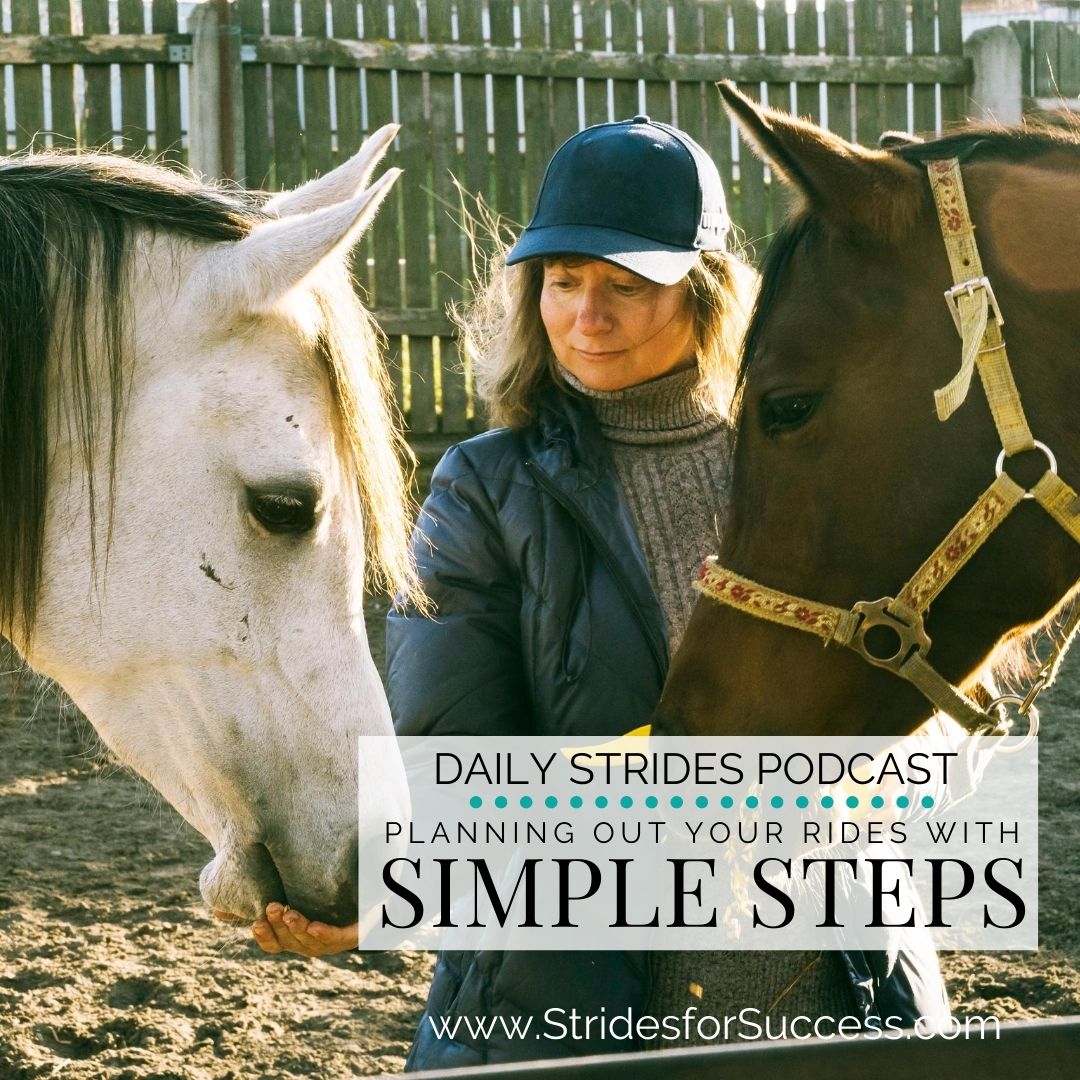
  • Plan Your Ride with These Simple Steps

    Plan Your Ride with These Simple Steps

    How often do you dismount and honestly have no clue what you just spent the previous 30 minutes working on? If this is happening more often than you want to admit, you’re not alone. The good news is that planning can help completely change this.

    [fusebox_track_player url=”https://op3.dev/e/traffic.libsyn.com/dailystridespodcast/1157-Plan-Your-Rides-in-3-Simple-Steps.mp3″ title=”Plan Your Ride with These Simple Steps” social_linkedin=”true” social_pinterest=”true” social_email=”true” tweet_text=”Are all your rides beginning to feel the same? Here’s how to make the most of your 30 minutes in the saddle – and enjoy yourself ;) ” hashtag=”equestrian” twitter_username=”strides_success” ]

    Plan Out Your Ride with These Simple Steps

    The conversation between you and your horse begins with the conversation already ongoing in your head. Your conversation with yourself. Tapping into that conversation – and maybe guiding it in a different direction – can help you transform your riding.

    Consistently doing this on an ongoing basis for 3 months has the potential to change everything in your riding.

    It all starts with sit-in down and beginning to create ‘the plan’…

    Before You Begin…

    Enthusiasm is great. In fact, it is one of my top values in life. However, sometimes it can backfire on us as riders. You see, often we want to achieve everything in a single day. And, when we are thinking about things from this positive and enthusiastic frame of mind, sure why not do it all in a day?!

    Instead, I think you should start smaller with your ‘1-day goals’, and then set the bar a little higher for your ’12 week goals’.

    Overwhelm is a real thing. And thinking too big in the short term is one of the top ways riders tend to bring this on themselves. Ironically enough, thinking this same way in the long term has the same effect. The whole ‘this is going to take forever’. It really doesn’t have to. Think bigger long term.

    Reverse Engineering Your Goals

    Let’s fast forward here a little. Imagine you have just achieved the thing that you want in your riding. What does it look like? Really get into all the nitty-gritty details. Where are you? what are you wearing? Who is with you? How does it feel? Got it? Okay…

    Now, I want you to get really clear on the differences between that ride (where you achieved the goal) and your very last ride in the saddle.

    What needs to change from your last ride in order to achieve the ‘goal’ ride? List the things out. One by one. What was different? Was it the tack? The level of understanding of the aids? Your physical fitness or suppleness? Maybe your horse’s strength and development? The barn or arena? It could even be the horse…

    When you know what the difference in between ‘here’ and ‘there’, you can go about building a bridge between those two places.

    One Month From Now…

    Now that you have a clearer idea of what you want and why you don’t have it already, you can begin making a plan to create that thing. I want you to think a month from now. Is it possible to achieve that thing in a month? If it is not, don’t panic. Simply take one essential missing element and that will become the thing you are working on for the coming month.

    Often we set our sights too high with how much we can do and achieve. Slow and steady will win the race when it comes to improving your riding and your partnership with your horse.

    Lay the Stepping Stones of Your Plan

    Any journey as being a series of steps, one by one, to get from A to B. Improving your riding is no different. See each ride as a stepping stone and another piece of the journey to reach your goal. When I began Strides for Success, the whole idea was to make every ride great. I still stand by that idea.

    If each ride was a stepping stone, imagine how different your riding would look just 16 rides from now.

    Why 16? Well, 4 days a week and 4 weeks in a month equal 16 rides each month. One month can transform your riding. Multiply that by 3 months and now you have 48 different interactions that you can use to reach your goal.

    Can you now begin to see how much you can actually achieve in 12 weeks if you begin getting intentional about your rides?

    So, What Can You Commit To?

    Now, I am suggesting 4 days a week, however, you need to figure out how many days a week will work for you and your current lifestyle. ‘Current’ is a keyword in that sentence. Don’t begin your plan with how you ‘want’ things to be. Start with how things actually are. Your current life.

    What is ‘do-able’ for you when it comes to working your horse on a weekly basis?

    Once you have this figured out, it is then your job to make each ride count. I am going to suggest that part of your commitment is to take one day each week to review and plan the upcoming week.

    Be Consistent with Your Plan

    Consistency is not exciting. I know… However, it is an absolute essential when working with horses. What I see happen to a lot of riders is they will go all out for 5 or 6 days. There is a feeling of accomplishment when you begin to hit a rhythm regarding being intentional with your rides.

    5 or 6 days is not an accomplishment. It is merely staying on the path of stepping stones you have laid out in order to reach the real accomplishment; your goal.

    This sounds harsh, but it is a common mistake riders make. And this is why I suggest 20 minutes once a week to review and plan the upcoming week in the saddle. Know what you are doing every day in advance. It will help you to stay on track when ‘life’ shows up.

    If you can summon the same feelings you felt in the beginning when you’re in the middle, you will reach the end.

    If you are interested in learning exactly how to plan your rides out, plan your stepping stones, I’m inviting you to join me HERE

    Happy Riding
    Lorna

    Additional Resources on This Topic:-

  • Transforming The Next 12 Weeks in Your Riding

    There is an opportunity right now to choose again. To become really intentional about what you want your riding to look like and feel like for you and your horse. Because everything has changed, you are at this unique place where you can change your riding. You can decide what is working for you and what is not, and then build out the coming 6 months to reflect this ‘new you’ as a rider.

    One of the positives of 2020 is that most people have greater clarity about what they actually want. What is really a priority and what was simply a habit?

    [fusebox_track_player url=”https://op3.dev/e/traffic.libsyn.com/dailystridespodcast/1155-Transforming-Everything-in-the-Upcoming-12-Weeks-In-Your-Riding.mp3″ title=”Transforming The Next 12 Weeks in Your Riding; for You and Your Horse” social_linkedin=”true” social_pinterest=”true” social_email=”true” tweet_text=”Wondering what the coming 12 weeks will hold for you and your horse? Wonder no more…” hashtag=”equestrian #podcast” twitter_username=”strides_success” ]

    You can choose your better. Maybe this is better scores or results. Or it could be a better partnership and conversations with your horse. Whatever your better is, I am urging you today to identify it and then go for it.

    Transform Your Riding in the Next 12 Weeks

    Give yourself a 12-week window and make this happen for you and your horse.

    Your Upcoming 12 Weeks in Your Riding

    All riders who make progress, while really enjoying their time in the saddle have one thing in common; they are consistent in their focus and their actions. They know what they want. It is something tangible and clear to anyone looking or watching from the sidelines.

    I want you to choose something and work towards it for the coming 12 weeks.

    12 weeks is enough time to see a marked difference in both you and your horse’s way of going, without being so long that you lose focus and intention. If you can really get clear on one goal for your coming 12 weeks and then see each ride as a stepping stone on the path to this goal, it becomes impossible not to make progress towards it.

    What Needs to Change?

    Where you are in your riding, right this second, is not where you want to go. And yet, we tend to think that doing the same thing over and over is the way to get there… The simple fact is that something has to change. Without the necessary change, you will simply repeat the same thing over and over and over again.

    It’s a bit like driving around a specific block in one town, again and again. And then wondering why you never make it into the next town!

    Take a good hard look at your riding today. What is overdue an update? Maybe it is the basics. Or it is your groundwork. It could be the boundaries you have laid out that need to be redefined. Or where you are riding and working is what needs to change. Think of it this way; the very first halt you even rode on a horse hopefully looks a lot different to the very last one you rode up to reading this post. You refined your basics. And they always can be refined even more.

    Everything in riding must be revisited and updated on a regular basis. Everything. Ignoring or hiding away from this simple truth is what keeps riders stuck.

    Change A Belief in the 12 Weeks

    Often it is our very beliefs that hold us back and continue to keep us ‘stuck’ as riders. What are you believing about your riding and your horse that is no longer serving you? Maybe it is what you can or cannot do. It could be regarding a certain discipline or training method. And check your ‘reasons’ as well, often they are simply excuses which are tied to long-held beliefs.

    When you identify a belief that is no longer serving you, begin looking for evidence to the contrary.

    Other riders who are successfully doing this thing, or not doing this thing. Areas of your life where this belief is clearly not true. This is a great one for confidence; where in your life do you feel confident and how does that feel in your body? Horses of a similar build, age, breed, temperament, etc. who are happily doing the thing you believe your horse cannot do…

    Every action you take is based on a belief you have. Every single one. Changing the belief changes everything.

    Your Opportunity is Here, Right Now

    2020 has allowed us the space to see what is working and what’s not. To identify what is important and what is just ‘fluff’. I really think that you have a golden opportunity right now to change your riding for the better. And it all begins with changing yourself.

    Your beliefs create your thoughts.  And your thoughts create your feelings. Then your feelings dictate your actions. And your actions lead to your results.

    The work begins by identifying a belief or two that needs to change and then doing to the work to make that happen.

    Mark 12 weeks from now on the calendar. Set the exact date. And then go for it. See what you can change in just 12 weeks; and remember to let me know when you have done it.

    Happy Riding
    Lorna

    Additional Resources for This Topic

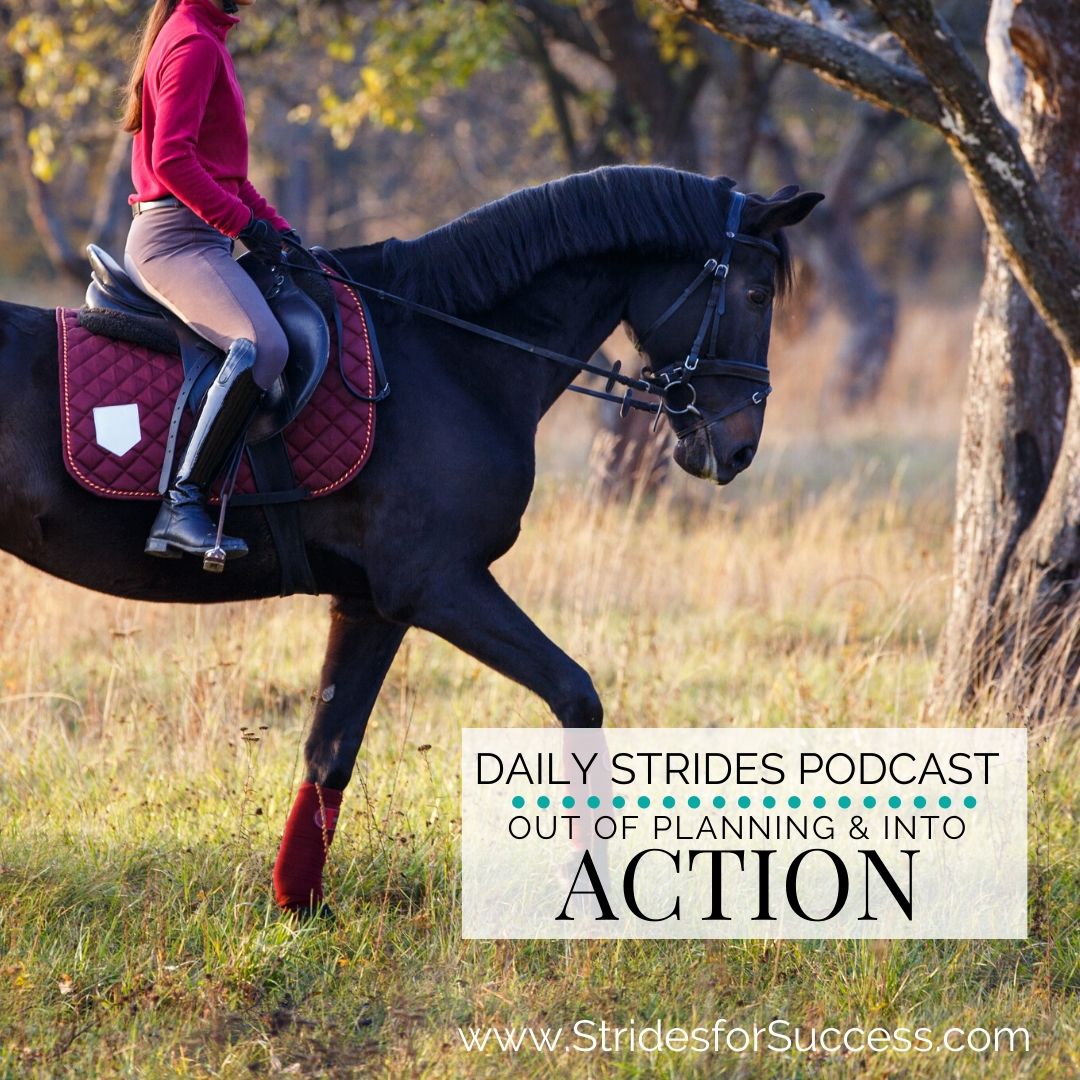
  • Out of Planning & Into Action

    Out of Planning & Into Action

    Out of Planning and into Action
    So, are you still on track?  As I write this we’re officially one month into the new year, the new decade, and I am wondering if you are still on track with any goals you set for yourself four or five weeks ago.  If you are, give yourself a pat on the back!  I’m impressed.
    However, if you’re not, don’t panic.  Firstly you’re not alone and secondly, my goal is to inspire you to take some action in the coming 48 hours that will get you moving where your riding journey is concerned.
    [smart_track_player url=”http://traffic.libsyn.com/dailystridespodcast/1134-Out-of-Planning-and-Into-Action.mp3″ title=”Out of Planning and Into Action” social_linkedin=”true” social_pinterest=”true” social_email=”true” tweet_text=”Are you struggling to make things happen in your riding progress? Here are a few helpful ideas to get you moving…” hashtag=”equestrian #podcast” twitter_username=”strides_success” ]
    In my experience, so many people get caught up in all the energy surrounding the new year.  They plan and create goals.  They choose new habits they want to form and get specific on the ones they want to change or let go of.
    But, after all the planning is done and dusted; and when time marches on – as time will always do – they find themselves with lots of plans, but nothing to show for it.  They fail to take action.

    5 Actions to Your Better Version

    In episode 1129 of the Daily Strides Podcast, I explained how you can choose 5 actions that will help you show up as ‘Your Better Version’ where your horse and riding are concerned.  If you have not already listened to, and then took appropriate action, I suggest you begin there today.
    Once you have your 5 actions, you can then begin looking at what you are doing now in order to really make this goal or ‘better version’ a reality.  It probably won’t happen overnight.  However, the only way that you can hope to one day seeing this ‘version’ of you in the saddle is by getting started.

    Be Willing to ‘Tweak’

    So why are you failing to take action on the things that you identified as being important for you and your riding?  One of the reasons I see many riders struggle with this is because they failed to set the right goals, to begin with. If this is you, you need to rein things in a little bit.  That’s not to say you need to scrap all your plans and goals, but rather that you may need to tweak them slightly.
    Try to make it more realistic for your current situation.  This is probably going to look a lot different to what you would LIKE your current situation to be!
    An important question to ask yourself is; “After all the hype of the holidays if I’m being honest with myself, do I REALLY want those things?”.   Maybe you really wanted them a few years or months ago.  But now, if you’re honest with yourself, circumstances might have changed or you’ve changed.  This usually results in what you really want to make happen to change as well.
    So check in with yourself and think about if that is indeed what you still want.

    Creating Fun Actions

    From there, I suggest making things a little more fun and exciting in your riding than what they are currently.  Because if things were really fun and exciting, you would be getting those 5 things done wouldn’t you?
    So how could you add a bit more fun and excitement to your riding?  
    Exciting can mean different things for different people.  I want you to think about what’s exciting for YOU.  For you, this could be trotting without stirrups.  Or Cantering across an open field.  It doesn’t matter if your ‘fun’ thing is not that exciting for another rider.  I want you to focus on what you enjoy.  On what’s exciting for you!
    My idea of ‘fun’ has changed a lot throughout the years, but when I’m thinking about what I find fun, I think about what I’d most like to do with my horse if there were no restrictions.  
    And then I try to incorporate this activity into my day-to-day at the barn.  For me (now go ahead and have a little giggle to yourself), I find detangling tails to be so much fun at the moment. I’m not quite sure why, but I find it so satisfying.  I’m beginning to think that it could be because life has been a little ‘frazzled’ the past few years with bringing 2 new people into the world and moving continents, twice!
    Another thing that I really enjoy is lunging, I love it! I love the connection with the horse and seeing how far you can take it with your more subtle aids.  That’s my fun.  For you it could be jumping, perhaps ground poles? What is fun for YOU?

    Being Mindful of Your Day to Day Experience

    I think that this one ’tweak’ has the potential to change a lot for you and your horse.  Being mindful means that you are focused on what you are doing, and making adjustments so that you are really enjoying the experience.  Every minute of that experience… I know, pressure right?!
    Let me clarify a little.  What I really mean when I say ‘mindful’ is that you’re not thinking about the house that’s a mess, a project at work, the children’s vaccines, or any of the other one thousand and ten things that are inevitably going on right now in your life.
    When you’re with your horse, you should be thinking about your horse
    At the time of writing this post, I am also busy creating content for our Groundwork for Riding Program.  A big part of the program is mindfulness.  Just 10 minutes of being really focused, present and mindful about the little things that we tend to take for granted.  In this case, how we are communicating with our horse.  If done right, and when you really get into the nitty-gritty, 10 minutes can actually feel quite long!

    Stay Inspired

    I strongly suggest for you to keep circling back to ‘Fun and Excitement’ when it comes to your horse.  Couple this with simply enjoying your time with your horse.  By going back to basics and simply enjoying the whole conversation with your horse and how that feels, you are opening the door for so much more inspiration.
    This is really an investment of your time, and certainly not a waste of it.  Spending time being present with your horse (even if it’s only 10 minutes!) and making time to do the things you really enjoy, will pay off in the future.  It will spark ideas and help you understand what you really enjoy and what you really want in terms of your riding. And that can be great!
    Also, keep in mind that you can always change paths if you want to, in order to better align with the rider you are right now. Pay attention to what you enjoy and what inspires you to take action, and then simply make a point of doing more of it in your day to day riding. 

    Finally, Simply Go & Take Some Action!

    So, if you have been feeling like the handbrake was never really released for you in your riding, I am going to challenge you today.  I want you to make a commitment to yourself to get into the saddle within the next 48 hours.
    Remember, once you take action, momentum begins to build and it becomes a lot easier to keep moving forward.  My suggestion for getting you out of this stationary state, and into action is to simply do something.
    Even if this ’something’ is not truly aligned with the goals and plans that you have made, do it anyway.  This is simply to get into the saddle!  From there, look for what you enjoy and let that lead you to create goals, and from those plans, that will have you keen to take the next step.
    So I’m going to challenge you to commit to yourself to get into the saddle within the next 48 hours.  2 days, can you do it?!  Let me know inside of my free group HERE
    Happy Riding,
    Lorna

    Additional Resouces for You:-

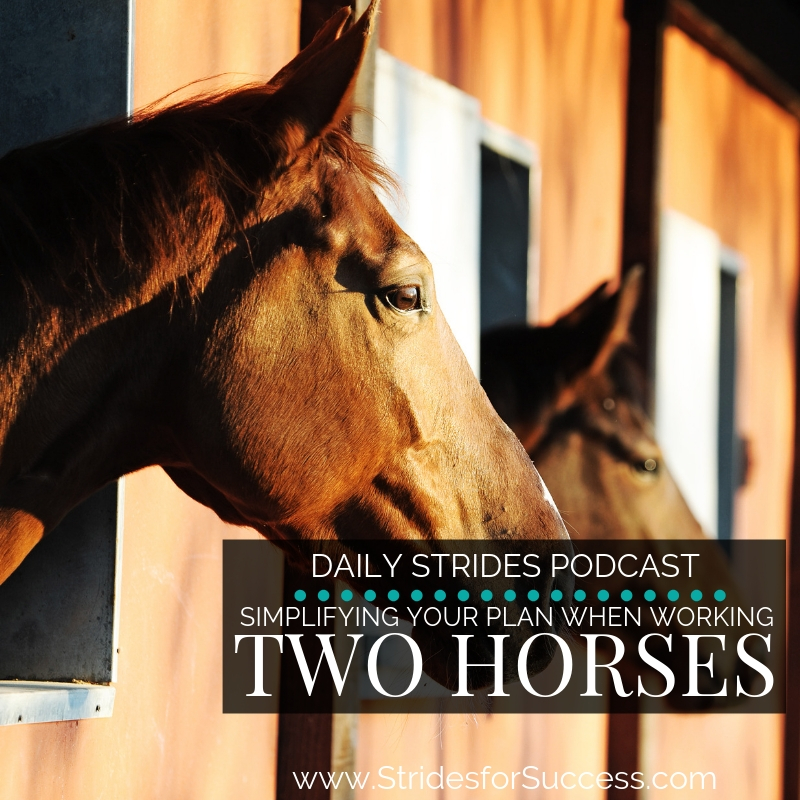
  • Simplifying Your Plan when Working Two Horses

    Simplifying Your Plan when Working Two Horses

    Simplifying Your Plan when Working Two Horses

    What this episode is all about & how it can help you:-

    • Figure out how to choose a theme or topic
    • Be specific about what you are going to do with each of the two horses
    • Align your schooling with the goals for each of the two horses
    • Understand that adjustments are often essential

    [smart_track_player url=”https://op3.dev/e/traffic.libsyn.com/dailystridespodcast/1088-Simplifying-Your-Plan-when-Working-Two-Horses.mp3″ title=”Simplifying Your Plan when Working Two Horses” social_linkedin=”true” social_pinterest=”true” social_email=”true” tweet_text=”Do you feel a little overwhelmed when it comes to creating a schooling plan for two horses? This episode of the Daily Strides Podcast will help…” hashtag=”equestrian #horseriding” twitter_username=”strides_success” ]

    Planning what to work on with your horse is often a task that many riders neglect.  Often this is due to having failed at making it simple enough that you can follow.  This ‘threat’ doubles when you add a second horse into the mix.

    Creating one plan can seem daunting enough; now to create two plans for two horses, who have different needs and goals can seem impossible.   Luckily, it doesn’t have to be…

    In this episode of the Daily Strides Podcast I take you step by step through a process that works where planning for two horses is concerned.  It works because it is simple to do.  Simple and easy.  In fact, once I explain this to you, I’m confident that you will feel like this is definitely something you can do in your riding and schooling.

    Why is Planning for Two Horses So Difficult?

    Well, the real answer here is that it actually isn’t!  It is often the rider who makes it difficult by over complicating the whole process.  In riding, there are thousands of different exercises you can ride with your horse.  Add lunging and groundwork into the mix and that number multiplies significantly.

    Don’t allow yourself to get caught in the trap of thinking that complicated exercises or school movements are necessary in your schooling. 

    Any rider who has a successful relationship with a horse will tell you to focus on the basics.  Get those right and then work on from there. Now, obviously when you are working two horses, particularly if one is more developed than the other, more challenging questions are necessary.

    However the question or the desired outcome should remain the focus of your schooling – not the exercises you are using to apply the question…

    Choose a Theme or Topic for Each Horse

    I know, it seems so obvious; and yet so many riders fail to do this.  I recommend having a monthly theme or topic that part of a bigger 3, 6 or 12 month goal.  Another way of choosing this is what came up during your last clinic or lesson… However you decide to choose a topic, the important thing is that you do just that – make a decision or choice!

    Having something that you want to work towards or achieve for each of your two horses will make deciding what to actually do in the saddle with each of them so much easier. 

    Your topics or themes do not have to be the same.  Now, of course, it will make life a whole lot easier if they are similar or related. But again, this does not necessarily have to be the case.

    Working two horses using two completely different themes or topics does not have to be difficult.  Your approach is what will determine the outcome; keep that in mind as you plan your exercises.

    Choosing Schooling Exercises for Your Two Horses

    Be careful here; this is where most riders overcomplicate and confuse both themselves and their horses!  If your ‘plan’ is too complicated or time-consuming, you are not going to stick to it.  It’s as simple as that!

    Think of the basics. Keep things as simple as possible.  And use your chosen theme as the perspective you approach each exercise from.

    I personally recommend choosing four exercises a month.  Then just riding them using the specific individual filter or perspective that you have already chosen for each of your two horses.  This way it doesn’t matter how far apart your two horses are in their training level.  They will both be worked in a way that benefits where they are right now in their development.

    Most basic schooling exercises can either be worked on using a different focus, perspective or filter.  And simple variations can be added where necessary to the existing basic exercise. 

    Less Time Planning; More Time Implementing

    Following the above suggestion will give you more time to actually school or ride. While setting up different exercises for each of your two horses might be a novelty at first, I can guarantee you that it will soon become a chore.  And we all know what happens when the fun is gone from something we once enjoyed!

    Choosing the same exercise for both horses will help you to simplify your whole schooling plan.

    The same exercise does not mean having the same intention, as mentioned, it simply means that you have more time to work on how the horse is actually working through the exercise.  Less time moving any poles or markers.  More time in the saddle actually working on what you want to improve with your horse.

    Riding the Same Exercise Differently with Two Horses

    So now that you have your four exercises for the month, what is next?  Well actually putting it all into practice and riding your both of your two horses through one of the exercises.  Let’s use an example here; one of your horses is a 4-year-old green horse who is still working on establishing rhythm, particularly through bends and circles. The other horse is a 12-year-old who is competing and working towards the next level.  Straightness is key for this horses overall development and strength.

    Remember, everything when riding is related; meaning that nothing worked on will be done in isolation from other schooling principles. 

    I would suggest one of your exercises being a simple serpentine.  With your first horse focus on riding the exercise as accurately as possible, and trying to maintain the rhythm throughout the whole exercise.  You can later begin adding some transitions into the same schooling exercise.  With your second horse, obviously the same will apply with the added focus of straightness through the exercise.

    The same exercise, ridden the same way just using a different filter or perspective depending on your end goal or focus with each of your two horses.

    The Advantages of Working Two Horses Using the Same Exercises

    As you begin working your two horses using the exercises you have chosen, use the fact that you are working two different horses to your advantage.  Begin noticing what challenges are coming up.

    Often a green horse can bring your attention to a missing element with a more advanced horse.  A basic missing element which otherwise might be overlooked.

    The other advantage of working two horses through the same exercise is that it highlights some potential pitfalls which are being caused by you, the rider!

    If two completely different horses at two different levels are having the same issue show up; one of the common denominators is you – the rider! 

    Is there something you are doing that is causing both horses to have a similar issue with the same exercise?  If so, what can you do to begin replacing this with something that is more beneficial to both yourself and your two horses?

    Working two horses at the same time does not have to be complicated or stressful.  Remember, simplify where you can.  Then just enjoy the process.  You are, after all, blessed that you have two horses to work in the first place :)

    Happy Riding
    Lorna

    Other posts and episodes that relate to this topic:-

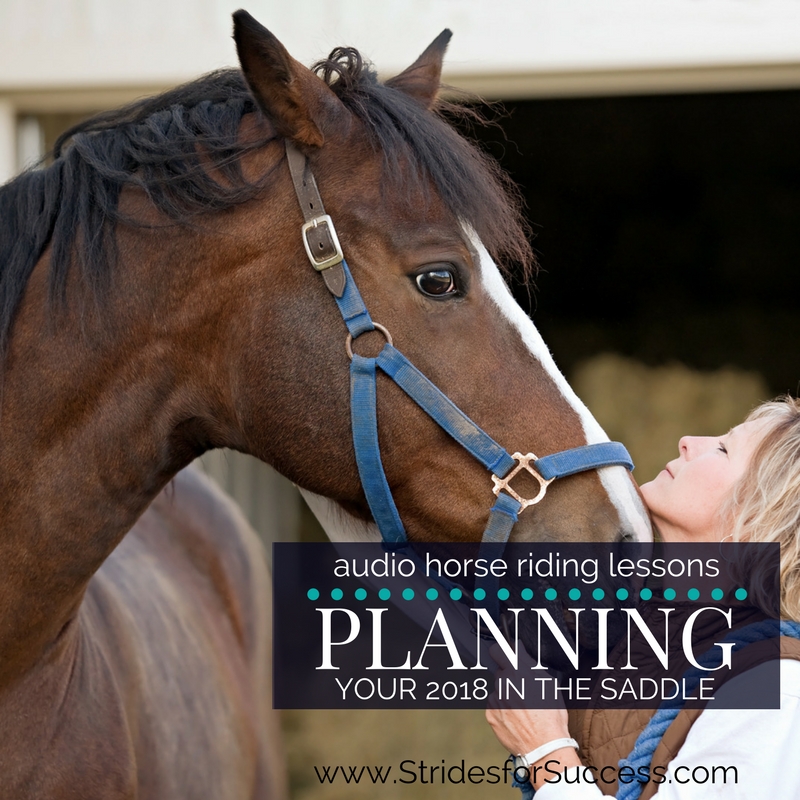
  • A System to Plan Your Year in the Saddle

    A System to Plan Your Year in the Saddle

    A System to Plan Your 2018 In the Saddle

    What this episode is all about & how it can help you:-

    • Reviewing the past year – what worked, what didn’t
    • Planning out the coming 12 months using quarterly themes
    • Including other ‘stuff’ in your plans to help keep it realistic
    • Building out the next 4 to 6 weeks

    [smart_track_player url=”https://op3.dev/e/traffic.libsyn.com/dailystridespodcast/1023-Planning-Out-Your-2018-in-the-Saddle.mp3″ title=”Planning out Your 2018 in the Saddle” social_linkedin=”true” social_pinterest=”true” social_email=”true” tweet_text=”Simple, step by step system to planning a year of progress in the saddle…” hashtag=”Horseriding #Planning #Goals” twitter_username=”strides_success” ]

    So how was 2017 for you and your horse?  More importantly, do you have a clear plan going forward into 2018?  For many riders, one of the big factors to 2017 not being as ‘great’ as it could have been is due to how they approached the year.  It is easy to enter January with big ideas, bigger goals and near impossible resolutions…

    What if, today, we rather invested a little time formulating a plan for the new year.  Something actionable that, when all is said and done, you feel is definitely possible for you to not only achieve, but also if given the right circumstances, surpass.  Interested?  Great!

    Review Your Past Year

    Firstly, you need to clearly lay out how things went in 2017, and how it has impacted where you are right now with your riding journey.  Try and go as deep as you can with this; the good, the bad, what worked, what didn’t.

    What I find works well for me is to think back and choose a couple of really stand out positive moments.  This helps me to start the process and also, gives me a guideline for some things that I perhaps want to make happen again in 2018.

    Becoming clear on what makes you happiest.   Then simply using those moments as a compass for plotting a course towards making more of that happen, or involving more of than in your current lifestyle in the new year..

    Once we have 4 or 5 of those positive experiences, we can turn our attention to the not so great.  Obviously, there are going to be a few of these littered throughout your past year.  Whatever your challenge was, it is important to understand it.  Have a look at what didn’t work, why didn’t it work, and what you could do differently to make it work.

    Choosing Your Word for the Coming Year

    From here, you can begin thinking about the coming 12 months.  What I would suggest you do is to pick a word for this coming year.  This word will help simplify decisions.  Is it aligned with the word, or not.   This word is what you want your riding journey to represent in the coming year.   Mindful, connected, compassionate or patience are some possibilities.

    Once you have this word choosen, you are going to begin seeing how you can weave it in to the quarterly themes that you choose for your riding.

    Planning Your Quarterly Themes

    A year can seem like a long time.  We all know and realise that it is not, but approaching it as one big chunk of time can often cause one of two things to happen.  Overwhelm or fatigue.

    In order to navigate around this, but still keep your ‘year goals’ on track, I suggest breaking the year into quarterly themes.   Each quarter will be a piece of the puzzle which will make up the year goals, but they will also have separate goals of their own.  A little like “sub” goals.

    Try and choose your themes in a way that act as stepping stones towards the big ‘year’ goal.  But see them as individual goals in and of themselves.  From here, break each goal down over the twelve weeks, 90 days or 3 months.  However you decide to do it, is up to you.

    Start by pretending you have achieved that smaller, quarterly goal and then work backwards to where you are right now.  This will give you a clear picture of what has to be done on a monthly, weekly and then daily basis to reach the goal from your current situation.  Then simply make sure that the theme works with your choosen word, therefore keeping you aligned with your values.

    Keep the Plan Realistic by Including ‘Life’ Events

    Before you finalise any of your quarterly plans, make sure you have also included any life events into your schedule or calendar as well.  The non-equestrian related happenings that we all have going on in our lives.   These include holidays, work events, birthdays, retreats, travel, school holidays or anything that has the potential to throw your regular calendar off a little.

    These things are important and they will have an impact on your time, your focus and attention and also, perhaps, financial situation.  Doing it this way also allows you to consider your energy levels.  You can ‘tweak’ your quarterly themes to work with you, rather than against your current lifestyle.

    The Final Step; the Next 4 to 6 Weeks

    The final piece of planning out your 2018 to get what you want is get really detailed on what the coming 4 to 6 weeks will look like in your riding.

    I realise that Christmas is a busy time for many people and, due to this, may not be the best place to start.  Find a date that you can realistically start things.  Spend a week or two preparing everything if necessary.  The riding place, the stables, inoculations, dewormer, farrier, leather repairs…  You and your horse are a team and as team leader, it is your responsibility to make sure that everything is in place when you do decide to move forward with your plans.

    Plan it all out, and then plot out the 4 to 6 weeks.  Look at what the theme was and now get specific on what you are going to work on each week leading towards that end goal, the 90-day goal.

    For example, it may be working on your half halt.  This builds up to your trot, which then builds to the canter.   Theme out each of the months inside of the 90 days, and then start filling in the details. I want to work on my half halt, which means I am going to dedicate 20 minutes on that day working on my seat and how I am using it in the saddle.

    As you work on each week, find exercises that are going to help you with exactly that.  They are going to keep you accountable and moving forward in your riding.  This is the key to getting the results you want in the coming year.

    Happy Riding

    Lorna

    Links mentioned in the episode:-


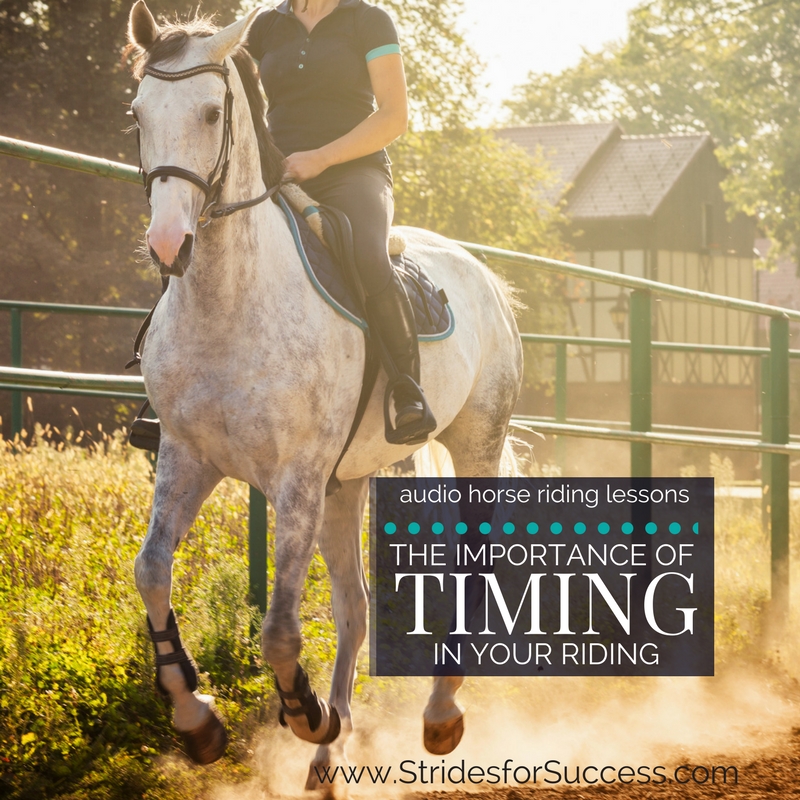
  • The Importance of Timing in Your Riding

    The Importance of Timing in Your Riding

    The Importance of Timing in Your Riding

    What this episode is all about & how it can help you:-

    • Timing – the big picture view
    • How to make the best use of your time in each ride
    • Using short bursts of time to focus you when you are in the saddle
    • Understanding the importance timing when it comes to your aids

    [smart_track_player url=”https://op3.dev/e/traffic.libsyn.com/dailystridespodcast/1022-The-Importance-of-Timing-in-Your-Riding.mp3″ title=”The Importance of Timing in Your Riding” social_linkedin=”true” social_pinterest=”true” social_email=”true” tweet_text=”Timing has a lot to do with if you will succeed or not in your riding… ” hashtag=”Equestrian #Horseriding #ticktock” twitter_username=”strides_success” ]

    Correct timing in your riding is essential to communication, both on the ground and in the saddle, with your horse.  In this episode we are going to take a look at timing from the ‘big picture view’ and also the closer, more intricate detail orientated, view.

    Timing when Working Towards your Goals

    I believe the most realistic and successful way of planning out goals when it comes to horses and riding is working in 90 day (or three month) chunks of time.  I think if we look further than that, especially with horses, it can tend to become a little hypothetical.

    That being said, it is clearly important to have a realistic picture of what you want things to look like a year from now.  Each of your 90 day chunks should be with that ‘year’ goal in mind.   Start with the coming 90 days and working backwards from that goal to where you are right now.  This is your beginning and the place you will measure your time from.

    Timing when Riding Your Horse

    Timing is important when you think about the ride itself.  From how long you are warming up, to how long you are schooling your horse and then your cool down time.

    Rhythm is another way of measuring time and rhythm can be worked on while preparing the horse to be ridden, of course the rhythm while actually riding your horse and also putting the horse away afterwards.

    If you plan to have an even, steady rhythm to all the above parts of each individual ride, you will minimise those feelings of being rushed, overwhelmed or frazzled. 

    Knowing how much time you have before each ride and allocating it out into flexible portions will give you a framework to plug your actual schooling into.

    You can also pay attention to the time of day you ride and how that influences both you and your horses way of going.  Perhaps there is a time of day when your horse is more responsive or he listens better,  more focused and less likely to spook or become distracted. Timing is all about finding what works best for you and your horse.

    Timing the Segments of Each Ride

    So we have already mentioned allocating time for your warm up, time for the actual schooling, then giving time for the cooling off.  However, we can go a little deeper here by focusing on the exercises themselves and what we want to achieve in that ride.

    Concerning exercises, many riders are of the opinion that they must simply ride through each exercise a couple of times in order for them to have benefit.  I want you to think about if you were to allocate a certain amount of focused time on working through each exercise.

    Let’s use the example of 20 minutes for actual schooling work.  This 20 minutes of time can be divided up into 6 minutes, 6 minutes and 6 minutes, and I am going to put a minute between the two as well.  I realise this is an extreme example, but by giving your horse and yourself a focused 6 minutes and then a minute just to relax and unwind, you will find the quality of the work improves.

    This method is proven to work because it stops the exercise from becoming monotonous and never ending.  Also, when we give ourselves an end point, it helps us become a lot more focused on what we are doing between now and then. 

    It helps us assess the quality of the work we are doing.  Noticing what you want to work on, and what you want to have made happen when you get to the end point will help you become more consistent and disciplined in the saddle.

    Timing of the Aids

    Timing can also be used on a very precise split second level in riding with the timing of the aids.  Specific aids given at an exact moment in order for your horse to take that direction and make the necessary changes happen regarding his movement.

    As riders, it is this type of timing that we look to refine every time we get into the saddle.  This is where you should be working every single day.  This is what you can focus and concentrate on in those timed schooling sessions.   The practiced refinement of the timing of your aids.

    This begins when you start working on what is moving when underneath you.  Your aim is to feel your way here, not peek over the side!

    Knowing what is moving when beneath you, is the foundation for knowing when to apply your aids to get a specific result.

    You should ask with your aid at the moment when the horse can respond to your aid.  Otherwise your horse may not be physically in a position to respond your aid, resulting in frustrations about a lack of responsiveness. 

    Start working on developing this skill next time you are in the saddle.  Take note of what is moving, when it is moving, how is it moving and where would be the best point for you to act and influence that movement to get the desired result that you are after.

    Begin Working on Your Timing Today

    It is important to understand the importance of timing when it comes to riding.  Taking it from the big picture, 90 day goal view, all the way down to the split second application of your aids in the saddle.

    Happy Riding

    Lorna

    Links mentioned in the episode:-