Tag: independent aids

  • Developing Independent Aids in Your Riding

    Developing Independent Aids in Your Riding

    [fusebox_track_player url=”https://op3.dev/e/traffic.libsyn.com/dailystridespodcast/1321_Developing_Independent_Aids_in_Your_Riding.mp3″ title=”Developing Your Independent Aids in Your Riding” social_linkedin=”true” social_pinterest=”true” social_email=”true” ]
    Ask any rider what they want to make happen when it comes to their riding aids and, hopefully, creating truly independent aids will be high up there on that list.  Because, let’s face it, your aids can only be as clear and useful in direct relation to how independent they are. But saying you want independent aids and working towards developing independent aids are two very different things.
    Especially when, as a whole, your aids are almost always used in conjunction with each other – not independently on their own…
    And yet, for each aid to become a useful member of your team of aids, I believe that you should first isolate each one and develop it intentionally and individually. Having one ‘strong’ independent aid when the rest are flapping about won’t be enough to create clear conversations with your horse.
    Each aid must be strengthened in its own right and then be allowed to contribute to the overall team effort.

    Intentionally Isolating Your Aids

    How well can you use your left leg without moving your right leg at the same time? Or for you, perhaps it’s your inside hand that, when actively engaged in communicating with your horse, causes an involuntary movement from your inside leg?
    When we can’t easily move one body part without unconsciously moving another, there is no way that our aids can be truly classed as independent.
    And yet, this can be quite a challenge for most riders initially – until they begin developing each aid in its own right and then putting them together. I prefer starting riders off with their more obvious aids first.  Their hands and legs. I bring their attention to previously unconscious and unintentional linked movements between these aids.  And whether you are just getting started on your riding journey, or you’ve been at this for a while, it can be eyeopening once these related movements – and their overall influence on the horse – are pointed out.

    Obvious Versus Subtle Aids

    As a rider, your aids can be loosely grouped into two different categories.  Subtle and Obvious.  As mentioned, your obvious aids are the ones that anyone can see and pick up on if they were watching you ride.  Bigger movements happening in your limbs are the obvious ones.  But so could your voice and position if not carefully applied.
    Your ‘obvious aids’ are usually the ones you rely on most when starting your riding journey.  So it makes sense that you work on creating independence in them first as a rider.
    Your subtle aids will then, over time, begin to take on a bigger role in your and your horse’s communication and conversation. These have more to do with your weight, your seat, and your thoughts. The things that are not as easily picked up on by an observer or cannot be seen at all.
    Your subtle aids will create the secret conversation between you and your horse and require true, independent aids to make a reality.

    Start with Obvious Aids First

    Next time you’re in the saddle, ask your horse to walk a 15m circle in the walk.  Spend a few strides making sure that you are in the correct position up there in the saddle.  Check your lines (‘head shoulder hip heel’ line and also the ‘elbow, wrist, thumb, rein, bit’ line).
    Then check that you have your obvious aids in the right place to create a channel or flow for your horse’s body and energy. 
    When on that circle, use your aids to ask for appropriate bend and flexion through your horse’s body while asking your horse to continue to move forward.  So, for example, your outside leg will be slightly behind or further back than your inside leg.
    Once you are correctly positioned, begin experimenting with using a single aid without it having an effect on your other aids. 
    Can you slide (or swing) your outside leg back without moving your hands or tilting/twisting your upper body?  What about gently squeezing the outside rein without lifting or gripping with your inside leg?  Or are you able to ask for ‘over’ using your inside leg without shoving with your seat?  How about asking for a canter using your legs and seat without tipping forward through your upper body?

    Then Work on Subtle Aids

    Why? This question runs through most riders’ heads when they are told to wait before developing their more subtle aids.  And I get it… The subtle ones are the ‘fancy’ ones. They are the aids that everyone speaks about. So why the wait?  Diving into developing independent ‘subtle aids is a complete waste of your time until those more obvious ones are under your control!
    The rest of your body must first learn to be ‘quiet’ in the saddle, so that your horse can really ‘hear’ your more subtle aids, such as your seat, weight aids, breath, etc. 
    You can of course begin training yourself to be in the best position to use these aids from Day 1 in your riding. So ensure that your seat, position, and posture are good. But to truly be fair to your horse, it’s best to have everything else under control and like I said, quiet.

    Your Independent Aids

    My final piece of advice for you developing your independent aids is to develop your physical fitness… And not just in the saddle.  When you are fitter and have more stamina, you will naturally have more control over your body.  And I find that when riders take the time and work on this OUT OF THE SADDLE, it really benefits them in the saddle.
    When you gain more control over your own body, and then understand your aids, you will naturally increase your ability to communicate effectively with your horse…
    And this is why I am rebooting the Equestrian Fitness Challenge for 2024.  Make sure you are on the list to get this year’s brand new challenge sent straight to your inbox by signing up HERE. This year we are focusing on walking… Yep, walking and expanding our knowledge, enthusiasm, and confidence in our abilities as a rider.
    Visit https://equestrianfitnesschallenge.com/24 to get the brand-new challenge!
    Happy Riding
    Lorna

    Equestrian Fitness Challenge ’24

    Let’s walk together for 21 days and have a chat about how you can do much more than you think you can as a rider and an equestrian… I am so excited to bring you along on this journey for the 100% FREE 2024 Equestrian Fitness Challenge
    There will be a daily walk, a 10 minute daily yoga practice, and lots of tips, ideas, exercises, and ways to improve so that you can show up as the best version of you – for you and your horse.
    Sign up today and let’s transform your riding – one stride at a time! 100% FREE 2024 Equestrian Fitness Challenge
    Have a super day
    Happy Riding
    Lorna

    Resources for Riders:-

    Connect with Lorna online:-

    Get Going in Your Riding:-

    Daily Strides Premium is back! You can use the first and original audio horse riding lessons to improve your riding, train your horse, keep things interesting, and have fun… Even if you don’t have a trainer or coach

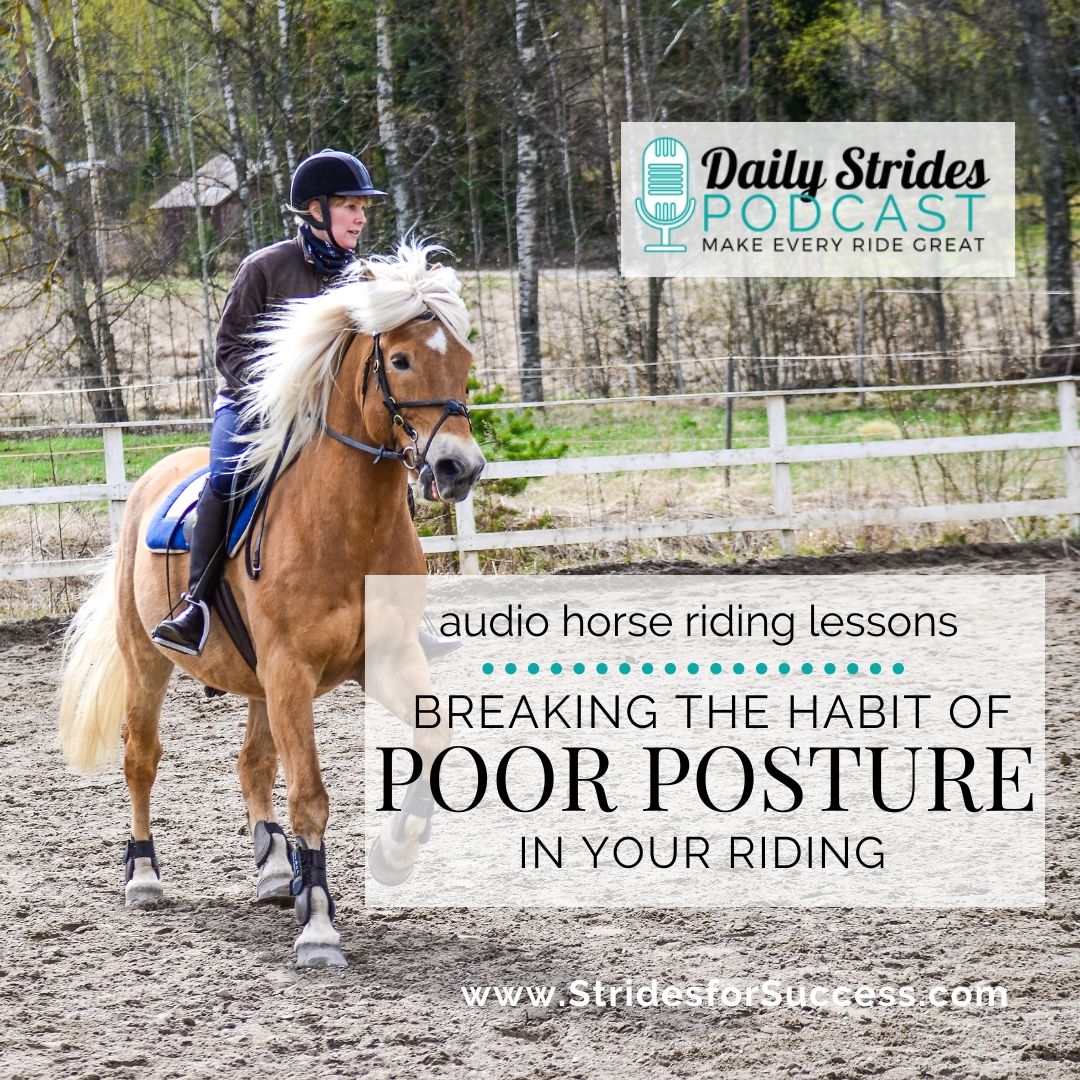
  • Breaking the Habit of Poor Posture in Your Riding

    Breaking the Habit of Poor Posture in Your Riding

    [fusebox_track_player url=”https://op3.dev/e/traffic.libsyn.com/dailystridespodcast/1320_Breaking_the_Habit_of_Poor_Posture_in_Your_Riding.mp3″ title=”Breaking the Habit of Poor Posture in Your Riding” social_linkedin=”true” social_pinterest=”true” social_email=”true” ]

    Whether you realize it or not, incorrect or bad posture is hurting your riding. And your horse’s way of going. And this habit will usually continue unchecked for sometimes years.  I don’t believe that riders ever initially set out to ride in a way that will negatively impact things. Usually what happens is that riding a certain way either produces a certain outcome or solves a particular challenge at some point… And then turns into a habit!

    But, what happens if you get stuck there?  Stuck with thinking the thoughts that cause you to use or carry your body a certain way…  Usually never good things!

    There are lots of reasons why you might have developed less than great posture when in the saddle.  Luckily, there are also lots of ways you can begin to both identify what’s going on – and how to begin remedying it in your riding.

    Symptoms of Poor Posture in Riding

    If you have started to ‘slip’ a little where posture is concerned in your riding, there will be signs!  Definite and obvious signs.  This is good because when you know what to look for, it makes it easier to begin to make those small tweaks that can make all the difference for you and your horse.

    Lack of Balance in the Saddle:

    It stands to reason that if you are struggling to carry yourself in the saddle, your balance will be affected.  You may feel yourself tipping or tilting.  This can be to the front, so tipping forward… Or it can be tipping backward, which then feels like you are being left behind.  You may also notice this around bends, corners, or circles as a sideways tilt or collapse.

    Whatever way you are tipping or tilting, you will also most likely notice that your horse will struggle with this as well.  Your lack of balance can really negatively impact your horses own balance. 

    He may speed up (especially through transitions or bends/corners).  Or he may slow down.  He can also fall in or fall out to try and compensate for your tilting to the side.  Finally, if you are regularly tilting back, he may being to hollow through his back to avoid any associated discomfort…

    Tension and Stiffness

    Poor posture will inevitably create issues with tension, and maybe stiffness in certain areas of your body.  And of course, your horse’s body if allowed to go uncorrected for any length of time. Many riders notice this in their shoulders, lower back, or hips.  However, this can also show up across your chest, your elbows, knees, and even calves.

    Last week I spoke about ‘opening up’ and practicing expansion as a rider.  This can really be helpful for this, especially if you focus on your posture as well. And, keep in mind that incorrect tension can go both ways; excessive tension OR a lack of tension… Both can lead to poor posture in your riding and block or prevent your horse from moving and working forward.

    Closed Down or Shut Down Position

    Otherwise known as the hamster effect we least expect…! This is the reason I actually wanted to really address this topic today; too many riders are resembling hamsters while in the saddle! So what do I mean by this?   Well, if you are crumpled, contracted, hunched over, closing your shoulders and chest, riding with your hands touching each other, gripping with your knees, and overall ‘rolled up’, you are riding like a hamster!

    Often this starts as a defense mechanism – although it only makes things worse, so it’s incredibly ineffective!  Maybe there was a time when you felt fear or anxiety when riding.

    The natural thing to do is ‘play small’, roll into a ball, and wait it out.  Except, when we are riding, this is ineffective – and often downright dangerous.  Again, I am going to point you to last week’s episode on Opening Up and Practicing Expansion in the Saddle.

    Ineffective Aids and Communication

    If poor posture is something you’ve been struggling with, you are also most likely having communication issues with your horse.  Responsiveness, or the lack thereof, is something that is most likely showing up.  Coupled with your horse understanding your aids. Unfortunately, this often then increases the initial problem of poor posture and tension issues as the rider ‘doubles down’ on ‘making’ their horse do whatever it is they are trying to communicate… Frustration can run high; for both horse and rider… Not an ideal situation.

    Back and Muscle Discomfort

    Did you realize that your lack of posture can actually be contributing to muscle fatigue in your riding?  When you are not setting your body up to use itself in the best way, it gets tired – very quickly!  And then continual poor posture can even result in back pain or injuries over time. This will 100% take away from how much you enjoy your time in the saddle – and can even cause you to eventually stop riding!

    Unable to Effectively Use Your Core

    We all know how important your core is when it comes to riding.  It really does impact EVERYTHING.  Good and correct posture requires core strength and engagement. And, without this, you will find it difficult to be independent through your seat and aids.  This can lead to confusion between you and your horse – and can actually set you up for a fall or an accident in the long run.

    Improving Your Poor Posture

    Okay, so there are so many ways this can show up and none of them are beneficial when it comes to improving your skills as a rider or training and developing your horse. So, let’s work on actually improving your posture in the saddle.  Investing time here will both enhance your riding experience and help you more effectively train your horse.

    Body Awareness

    Again, we chatted about this last week HERE.  When you begin to become more aware of your body’s alignment and position while riding, you will begin to feel and notice when things are not ‘right’. This is also where practicing exercises off the horse can help.  Especially those that promote body awareness, such as yoga or Pilates.  And they have the added bonus of strengthening your core muscles and improving your flexibility.

    The 100% FREE 2024 Equestrian Fitness Challenge will help you with this.  This year’s challenge includes a daily yoga practice from Emma-Jane Leeson (yep, my sister), a qualified yoga teacher.  And an equestrian just like you :) Make sure you get signed up for the 2024 Equestrian Fitness Challenge HERE

    Riding Lessons with Focus on Posture

    Get help when you need it most by investing in lessons with a proven instructor or trainer who can assess your posture and provide corrective feedback. I realize that this can be a challenge for many riders, especially when time/schedules and location are an issue.  If this is the case, think about video reviews or live virtual online lessons.  Both of these are available for riders inside of Connection; My Online Membership for Equestrians.

    Regular riding lessons with a focus on proper alignment in the moment and balance can significantly improve your posture over time.

    Using Mirrors or Video

    I know, in an ideal world, we would all have mirrors strategically placed around the arena.  If you do have, make use of them by paying attention to your posture and alignment.  If you don’t; use video.  You can either invest in something like a PIVO – use THIS LINK to get $20 off your purchase (this is an affiliate link and we will receive a commission on your purchase but it won’t affect how much you pay).

    Being able to watch back over your work will allow you to begin to see where things are falling out of alignment, and where you can make improvements. 

    Of course, you can also use the PIVO (affiliate link) to have virtual lessons in real-time online with a coach or trainer (again, this is part of the Connection Membership with me)

    Increasing Fitness & Stamina

    Do you walk? Walking is one of the easiest and most effective ways of moving your body and improving your overall well-being and fitness.  I LOVE walking.  Whether it’s on the road, on the trail, hiking, or just out to the fields to collect or turn out the horses. It helps to keep my body toned, and move my hips, and it is hands down amazing for my mental health and well-being.

    If you would like to walk a little more and see where it takes you and your riding; the 2024 Equestrian Fitness Challenge is ALL about walking.  Join me for 21 days as we take a daily walk together and chat about all things riding and training horses related :) It’s 100% free and it has the potential to transform your riding. CLICK HERE
    to sign up


    Mindfulness & Connection Techniques

    Recently, I ran an in-person program on my farm here in South Africa all about connection and energy techniques on the ground with your horse.  The results were amazing.  The difference then in the rider’s and horses’ performance when being ridden afterward was mindblowing.

    Just a simple practice of grounding before working with your horse can be transformational for both of you.  Couple this with the power of intention…

    I have packaged up this full program into a short email course that you can use with your horse.  The Connection Partnership Program Mini-Course lays out all of the techniques in step-by-step audio episodes.  And all delivered via your email.  You can get more details HERE

    Improving Your Poor Posture

    Phew, that was a lot.  I would love for you to take just one of these resources this week and begin working on it to help change any habits you may have in the saddle.  Remember, improving your overall posture and alignment in the saddle will not only help you but also have a positive impact on your horse as well.

    And, over time, improving your posture will result in better communication, clearer aids, and increased understanding between you and your horse when working together.

    Happy Riding
    Lorna

    List of Resources for This Episode:-

    Connect with Lorna online:-

    Get Going in Your Riding:-

    Daily Strides Premium is back! You can use the first and original audio horse riding lessons to improve your riding, train your horse, keep things interesting, and have fun… Even if you don’t have a trainer or coach

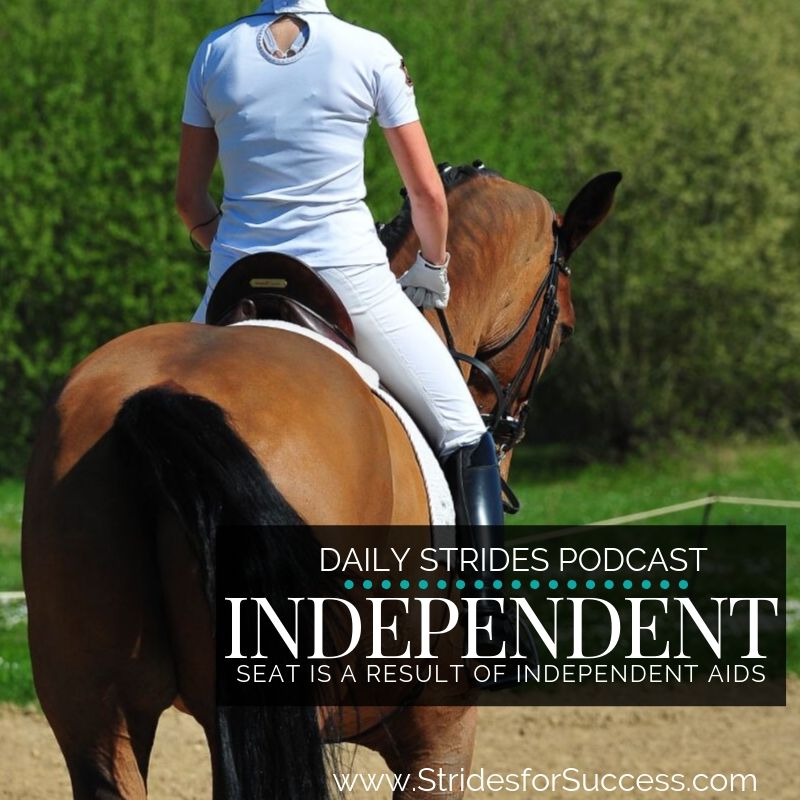
  • Your Independent Seat is a Result of Your Independent Aids

    Your Independent Seat is a Result of Your Independent Aids

    Your Independent Seat is a Result of Your Independent Aids

    What this episode is all about and how it can help you:-

    • Get clear on what an independent aid isn’t!
    • Understand what an independent aid is…
    • Get started developing your independent seat
    • Realise that it will take time to achieve

    Your independent seat. Are you, like so many other riders around the world, trying to achieve yours right now? If so, understanding what is really required to develop it will make it much easier for you to successfully work towards it.

    [smart_track_player url=”https://op3.dev/e/traffic.libsyn.com/dailystridespodcast/1105-Your-Independent-Seat-is-a-Result-of-Your-Independent-Aids.mp3″ title=”Your Independent Seat is a Result of Your Independent Aids” social_linkedin=”true” social_pinterest=”true” social_email=”true” tweet_text=”Working on the all elusive independent seat? This will help…” hashtag=”equestrian #horseriding” twitter_username=”strides_success” ]

    Keep in mind; your independent seat is a result of other things happening. It is not a ‘stand alone event’…

    What an Independent Aid Isn’t…

    This is one of those situations where it is easier to explain what it is not; before diving into what it really is. I am going to use an example here that I know you will have seen at some point in an arena somewhere..

    Rider is on their horse. They kick with their legs to ask the horse to go forward. However, as they kick – at the exact same time – , they jerk their hands backwards.

    It is almost as though their legs are directly connected to their hands. And, in this case, they are.

    Which leads me to what an Independent aid is…

    What an Independent Aid is…

    An independent aid is when you can apply an aid without it negatively impacting or affecting your other aids. Simply put, it is your ability to move things when and where you want, without there being an impact on the other parts of your body.

    No aid is ever really applied completely independently when riding your horse.

    Each aid is part of a balance of all the aids. However, refining that balance so that your choosen aid can be clear and concise is what takes practice.

    Allow Your Horse to Be Your Teacher

    Most of the time, when your horse is doing something, he is simply doing so in response to something you are doing. Becoming more aware of the influence you are having over your horse, positive and negative, will help you to begin developing independent aids.

    Mindfulness is a word that has become somewhat ‘fashionable’ at the moment… However, being mindful of how and when you’re applying your aids is important to developing independent aids.

    An easy way to see how you are maybe lacking independent aids or seat is to allow someone else to ride your horse. Ask them to do the same exercise or ride the same movement and see how the horse reacts to their aids.

    Work on Your Basic Position

    Being in the right place will help ensure that you are effectively communicating what needs to be communicated to your horse. A good position allows your aids to begin to work as they should, so that you can begin developing them independently.

    There are a lot of ‘basics’ in horse riding that you want to begin putting on ‘automatic’; meaning you don’t have to focus or think about them each time you apply them.

    A good position will help make this task easier, as everything will be where it should be when you do need to apply or use them.

    Allowing Your Seat To Become More Relevant

    As you refine your more obvious aids, such as your legs and hands, you can begin to ‘use’ your less obvious aids more. This is where your seat comes into play.

    Trying to develop an independent seat before you have really mastered your independent ‘obvious’ aids is, in the long run, a waste of your time!

    Rather begin mastering those obvious aids first. Yes, of course, relate them to your seat and how, later, it will play a larger role in your communication.

    Don’t allow your seat to become the sole focus of your attention, especially as you work towards developing your feel; your independent seat.

    I have spoken a lot more on each of these different topics of feel, independent aids and balance of aids before both here on the blog and in the podcast. You can find the links to all of the relevant posts below.

    Devleoping Your Riding Over Time

    What you will find is that your independent seat is not a ‘stand alone’, ‘I’ve got this’, ‘one time get it right’ event. Instead, over time with consistent, correct practice, your seat will become more relevant in the conversation.

    As your aids become more independent, so too will your seat begin to become more relevant. Your feel will develop more and more.

    Until one day, you will notice that you have developed the all important ‘independent seat’…

    Until then, work on getting the basics of your position and your independent aids right first.

    Happy Riding

    Lorna

    Other posts, episodes and resources that relate to this topic:-

    Daily Strides Premium

    Are you looking for exercises to get you started on your journey to an independent seat? Daily Strides Premium is packed full of audio trainings you can listen to anywhere you can bring your phone (including on your horse) that will help you work towards your goal of an independent seat in a focused way.

    You will also be able to create a plan for your rides and review what has happened when you join in on the monthly ‘Review and Planning’ call.  In there, you will go step by step through the month that was.  You then take that information and begin planning out the coming month.  When you will ride.  What you will work on.  And of course all aligned with your goals for you and your horse.

    Do you need to be competing? No!  Do you need to have competitive goals or ambitions? No again!

    In fact, I love working with riders who just ‘enjoy’ their horse; helping them to build and strengthen their relationship.  No competitions necessary ;) 

    Couple this with the live Q&As and the members only private group ~ we are here to help you remain accountable as team leader for you and your horse.

    All of the trainings are easily accessed using your phone, meaning that you can take them with you where ever you are going.  These trainings and so much more are available for you immediately when you join Daily Strides Premium. Find out more HERE

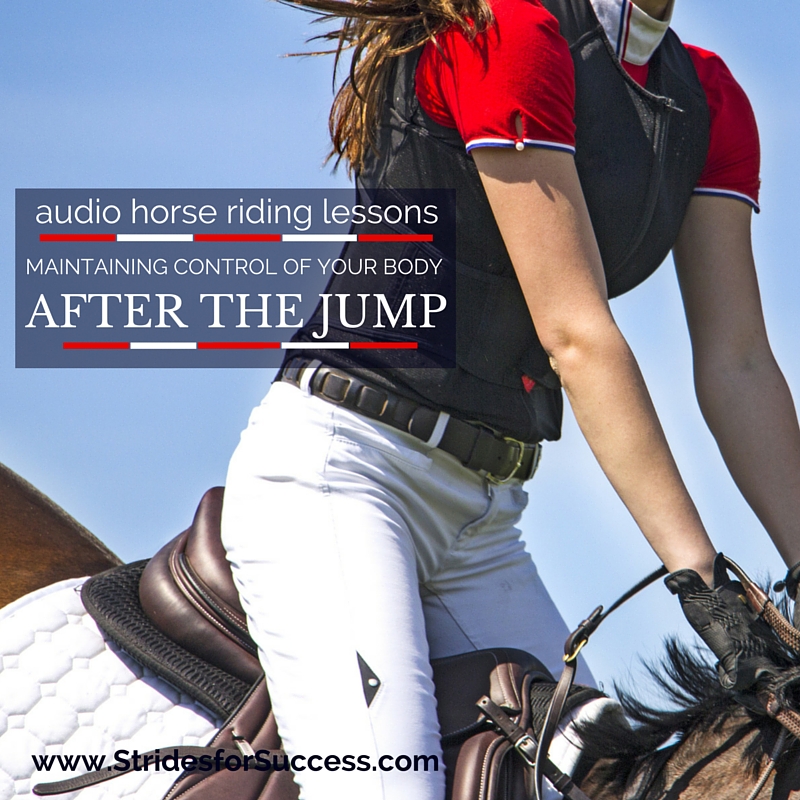
  • Maintaining Control After Jumping

    Maintaining Control After Jumping

    You’ve just popped the fence and, in your mind, it was a success. Mostly because you managed to stay on board for it!  However, as soon as your horse lands, you are beginning to think that your ‘upright seat’ is becoming more and more of a fantasy…

    In fact, every stride your horse takes is literally bumping you further and further onto his withers… Your lower leg is coming up and back. And you’re pretty sure that you’re on the verge of losing your stirrups.

    Who knew that jumping meant such an up-close and personal view of your horse’s neck?!  You glance up, and low and behold, you are approaching the corner; fast!!

    Let’s Remove ‘Forward’ From Your Position!

    This is a really common problem. And one that often begins when we first begin jumping and the word ‘forward’ is used to encourage the position.  Couple this with a really strong desire not to ‘catch your horse in the mouth’…

    The result is you diving forward, leaning on your horse’s neck with your hands (which are filled with as much mane as they can physically hold), and just being a heavy passenger both over and after the jump.

    Maintaining Your Position After the Jump

    Jumping…  It is really one of the most fun things to do on a horse, but if you are not in control on the ground, between the fences, things have a terrible habit of going from bad to worse very quickly!

    Things Get Worse As Fences Get Higher!

    What compounds the problem more is that, generally speaking, when we are jumping over smaller fences, this ‘technique’ works quite well.  You manage to get from A to B. And your horse is in possession of all his back teeth at the end of the lesson.

    However, the problems begin to show up when the jumps become a little higher. Or there are a few of them added together to form a track or course of fences.

    Having an independent, balanced seat both over and after the fence is essential for you to efficiently pilot your horse over all the obstacles. And achieve that all important clear round.

    What Your Horse Does When Jumping

    I think the first part of either preventing this from becoming your jumping technique, or correcting an already formed habit, is to fully understand what happens to your horse when he jumps.

    As he approaches the jump, your horse should begin to transfer his weight a little more back onto his hocks and hindquarters, rather than his shoulders.  This is in preparation for lifting his shoulders and front end off the ground when beginning his jumping effort.

    He will then, when at the fence, with his hind legs moving under him, lift his shoulders, head, and neck to begin his jumping effort.  His hind legs will then come under him, push-off the ground, and ‘propel’ him on, up, and over the fence.

    His head and neck will stretch out and down a little, his shoulders will pull his front legs up and his knees should ideally ‘snap’ up to clear the fence.

    His hindquarters will fold up underneath him. There will be a point where he will be suspended in mid-air over the jump.  Once he is ‘over’ the fence, he will get the landing gear out, so to speak.  He will stretch out his front legs. And, to balance himself, raise his head and neck in anticipation for the first getaway stride after the fence.

    With his head and neck raised, his front legs can touch down and then move forward again into the first stride leaving space for his hind legs to land.  And then he will push-off again with the hind legs to continue cantering after the fence.

    How We Can Interfere With Jumping

    There are a number of different times when we riders have a great potential to get in the way. This can cause problems with our horse’s technique.  Here are some of the more common mistakes we can be guilty of:-

        • Getting ahead of the movement, to begin with on the approach
        • Diving too early when we reach the jump, resulting in us ‘jumping before the horse’
        • Using our horses head and neck over the fence for support and balance – leaning on our horse
        • Collapsing on our horse’s neck on landing
        • Tipping forward on the landing stride and continue to tip more forward with every stride thereafter

    So in order to control our position after the fence, we need to first control our position in front the fence. I suggest that wherever you previously used the word ‘Forward’; substitute it with ‘Back and Down’.

    Adjusting Your Jumping Position

    Next time you approach a pole or a fence, imagine trying to create an open space in front of you. Think of from your chin to your horse’s withers. Focus on making this space as big and empty as possible.

    Open your chest wide from the shoulder point to shoulder point. Sit up through your waist (no creases in your tummy). And, finally, open the angle between your thigh and your tummy as much as you can.

    Then begin creating energy with your legs. Keep asking. However, instead of letting the ‘energy’ run out the front end, imagine that energy coming from your horse’s back hoof in a line towards his ears. It is ‘filling’ that space you created earlier in front of you. And as it does, you use your hands, and in particular, your outside rein, to contain it and direct it where you want it to go.

    You will have to continuously check that you are carrying yourself and your hands in order for there to be enough ‘space’ for this energy to come up.

    Keep this ‘space’ in mind as you approach your jump or pole or even better; Your marker…

    Choose ‘Markers’ in Your Arena

    The first thing I would suggest you do when working on improving your jumping technique does not involve jumping at all. Simply pick different places around the arena and pretend there is a jump there.

    I and my sister done this for years when hacking out (on the trail). We used the posts from fences as ‘markers’. Alternatively, we used telephone poles, or trees, shadows, signposts, other jumps that we rode past. The list was and is endless.

    As you ride past your marker each time, try to imagine where your horse would take off if that was an actual real jump.

    Keep in mind that you will only then follow your horse after he has actually begun to lift off… Not throw yourself at the fence. It is often helpful to say, either in your head or out loud “Wait, Wait, Wait – Lift”. (I know you may feel a little silly, but it really does help!)

    Practice Your ‘New’ Jumping Position

    Then shift into your jumping position over the ‘fence’ (your marker).  Work on coming back into your normal, upright seat afterward, just as quickly as you would if you were indeed jumping a fence.

    Begin in walk… And really pay attention that when you are moving into your jumping position, it is a correct position.

        1. Weight into the heels
        2. Lift your bum a little out of the saddle
        3. Make sure your bum ‘reverses‘ – REALLY IMPORTANT!
        4. As your bum goes back, fold your hips bringing your upper body closer to the pommel of the saddle or withers
        5. Make sure your back is straight
        6. Keep your chest open – the point of each shoulder stretched away from each other across your chest
        7. Give with your arms and hand, through your shoulders
        8. Look up!

    Carry Your Upper Body

    What I often see happen is that although people get out of the saddle, heels down, etc, etc… Because they don’t support and carry their upper body (open the chest), they are leaning on the horse’s neck for support. This is REALLY difficult to get up out of after the jump when the horse is moving.

    It also causes the rider to squeeze with their knees. From here, the lower leg pivots, the upper body comes more down, They usually lose the stirrups… And on, and on, and on :(

    Put A Basic Position on Autopilot

    Once you are getting in and out of your jumping position easily in walk and it should become something that you don’t have to think about.  However, at the beginning of each session do a mental checklist that you are doing each of the above parts. Practice the exercise with no poles.  Only your imaginary ‘markers’.

    Work in walk, in trot and, when that is good, move to canter.

    Then begin working over a pole on the ground… Use the same principle… And lastly, you will be well able to hold your own over a fence and support and balance yourself all the way.

    The super thing about being able to do that is that your horse will also be able to jump better because you’re not shifting all your weight onto his shoulders :)

    Happy Riding
    Lorna

    Additional Resources for Equestrians