Tag: leg

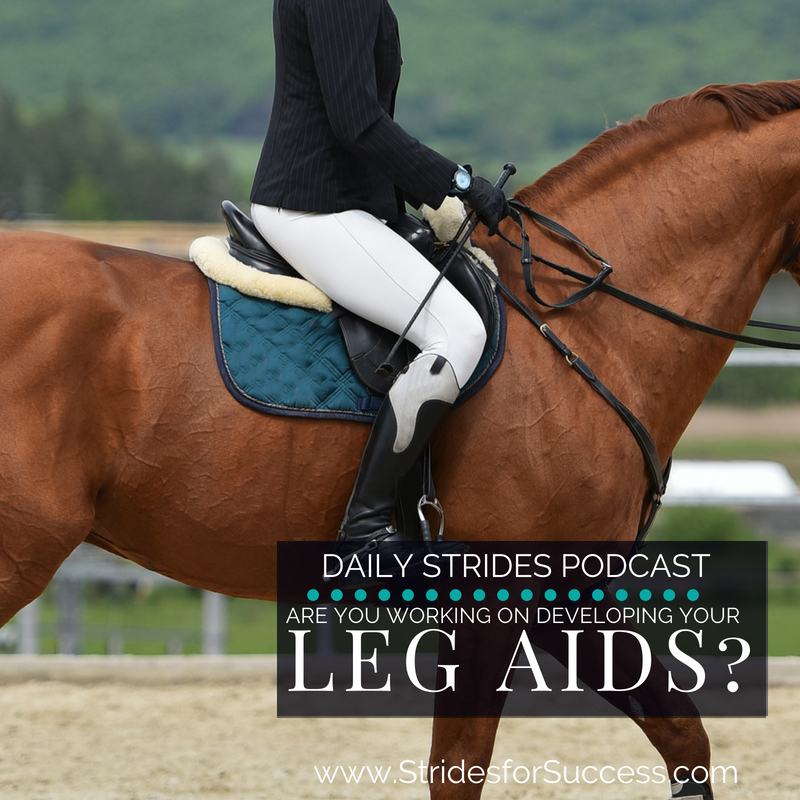
  • Are You Working on Developing Your Leg Aids?

    Are You Working on Developing Your Leg Aids?

    Are you working on Developing Your Leg Aids?

    What this episode is all about & how it can help you:-

    • Become more respectful with your legs & how it will help the overall conversation
    • Understand why how you apply the aid is so important
    • The difference between ‘loud aids’ and ‘quiet aids’
    • Develop your leg aids as a guide – not a crutch

    [smart_track_player url=”https://op3.dev/e/traffic.libsyn.com/dailystridespodcast/1058-Are-You-Working-on-Developing-Your-Leg-Aids.mp3″ title=”Are You Working on Developing Your Leg Aids?” social_linkedin=”true” social_pinterest=”true” social_email=”true” tweet_text=”How much time do you devote to improving how you communicate with your horse using your legs while riding? This will inspire you to invest more…” hashtag=”Podcast #Equestrian” twitter_username=”strides_success” ]

    Your legs make up such a huge part of the active conversation that happens between you and your horse when you’re in the saddle.  You can use them to ask questions.  They can be used to guide or direct your horse.

    Yet, so many riders fail to recognise how important their legs are to the whole conversation; and how improving your overall control of your legs, can have a huge positive effect on everything else.

    In this episode of the Daily Strides Podcast I will give you some ideas on how you can begin improving your leg aids, starting the very next time you are in the saddle.

    “My horse is not responsive”…

    One of the first statements riders say when we are working on their leg aids usually sounds a little like this.  They bemoan the fact that their horse is either a little slow to respond to their leg aids – or blatantly disregards them!

    I truly believe that responsiveness begins with the rider – and it begins when the rider shows respect to the horse in how they communicate with their aids. 

    Becoming more Respectful of Your Leg Aids

    I feel it is really important as the rider that you show up as the team leader.  Are you being respectful with your leg aids to begin with?  Or are you using them to stay in the saddle (the vice grip effect!).

    Or perhaps you are nagging.  On and on and on and on.  Horses, just like us, tend to begin ignoring the ‘dripping tap’ after a while.  The ongoing ‘drone’ that never really has anything constructive to add to the conversation.  This can often be described as ‘dead to the leg’.

    I also respectful means becoming more thoughtful about how you are applying the aid.  Huge kicks are not enjoyable for anyone involved.  

    If you horse is ignoring your leg aids, I suggest using a schooling whip directly behind the ‘ignored aid’ (your leg).  It will help bring your horses attention to the missed aid, without the unpleasantness of big, awkward, rhythm breaking kicks!  A simple ‘tap’ is a lot nicer than a huge kick.

    Respectful also means only speaking when you have something to add to the conversation.  Think of this next time you are in the saddle with regards to how you are using your leg aids. 

    How You are Applying Your Leg Aids

    There are a lot of different ways you can communicate with your horse using your legs.  If we think of asking your horse to move forward, it will almost feel like wrapping your legs around your horses tummy and lifting it up using your legs. 

    It is a ‘lift’ motion, which means that you also need to create space for that lift.  This is where your seat aid connects with your leg aids.  An allowing seat will create the space for your horse move into as he responds to your legs. 

    Turning your horse requires a different leg aid.  Think of your legs rather being the guide as to where you would like your horse to go.  The parameters that your horse can work within.

    Loud Aids Versus Quiet Aids

    I personally think that all aids can either be described as being loud or quiet.  Some can fall into both categories depending on how they are used and who uses them.

    Loud aids are the equivalent of ‘shouting’ at your horse.  They are obvious – to the point where they are visible to people who are watching from the ground.

    Quiet aids are the whispers.  The secret conversation that goes on between horse and rider.  Your seat is a good example of this – it should only really be ‘felt’ by you and your horse – not seen by other.

    Overtime the conversation between you and your horse will become more refined and more quiet.  Your leg aids will become quieter as your seat plays a bigger role. They will become more subtle.

    The Relationship Will Change as You Both Develop

    As you and your horse practice the conversation more and more together, it will improve.  It has to.  

    It is just like the people in your life.  The more time and energy you invest in building and developing the relationship, the more subtle you can communicate with those people.  A glance or a shrug can mean so much if the person knows you and your way of communicating with them.

    As you and your horse become more familiar and comfortable with each other, the conversation will develop further.

    Your Legs as a Guide Rather than a Crutch

    I really think that horses who ‘need’ the riders legs are created by riders who lack confidence to begin with.  The rider feels that they can and have to control every little thing when it comes to riding and being in the saddle.

    Please realise that as a rider, the only thing you can truly work on controlling is yourself.  The greater control you have over yourself, the greater influence you will have over your horse. 

    Gripping with your legs in order to stay on, or to ‘keep the horse going’ or anything else for that matter is not what your legs are for as a rider.  Focus on remaining balanced and equal in teh saddle and then ‘draping’ your legs around your horse.

    Riders who want to control will end up literally holding the horse up, using their inside leg, through corners, bends, turns – and even on the straight.

    Your Leg Aids Can Be Training Wheels Initially

    Training wheels, or stabilizers as we called them, are the two additions put on the back wheel of a bicycle when someone is initially learning to cycle.

    They only come into play when the bike leans or tips to a point where it is no longer stable and balanced.  They force the bike back to centre, and allow the new cyclist to continue cycling.

    Your legs should initially be the training wheels for your horse.  They don’t keep him upright or balanced – but when he wanders off track a little, they help bring things back to where they should be.

    Use your leg aids to ask the question.  Then allow your horse to respond and only when he goes a little off track, rejoin the conversation again to bring things back where they should be.

    This is how your horse learns to take responsibility for himself – and that is one of your biggest responsibilities as team leader :)

    Next Time You Are in the Saddle…

    Think about how you are using your legs to communicate with your horse.

    • Are you being respectful?
    • What about how you are adding to the conversation?
    • Are you applying the aids themselves correctly?
    • What about the timing, are you asking the right questions at the right time?
    • Finally, are you consistently working on developing and refining your leg aids to take them from being ‘loud’ to subtle and quiet?

    If you are interested in working with me further on this topic, here is your invitation to join me inside of Daily Strides Premium.  You can begin today for just $19 and get instant access to a whole collection of lessons focusing on your leg aids.

    Happy Riding

    Lorna

    Links mentioned in the episode:-
    

  • How to Use Your Leg While Riding

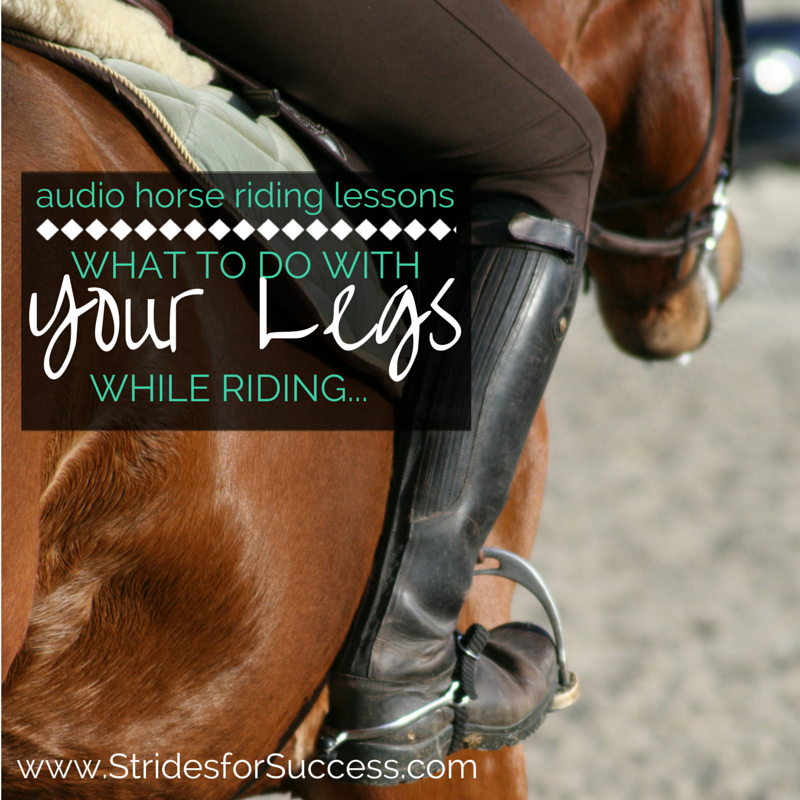
    How to Use Your Leg While Riding

    .How to use your legs while riding

    Do you find yourself a tad confused as to what exactly to do with your legs while you ride?  Do you find that even if you know what to do, degree of pressure to use or how often to apply the aid is confusing you?

    You are hearing terms such as ‘Keep your leg on’, ‘use your leg’, ‘more leg’, ‘leg’, ‘soften your leg’, ‘support with your leg’, ‘back up your leg’… leg, leg, leg!!!  You find yourself thinking back to the days when you were just happy keeping one either side of your horse!

    [smart_track_player url=”https://op3.dev/e/traffic.libsyn.com/dailystridespodcast/SFA416-What-to-do-with-Your-Legs-While-Riding.mp3″ title=”What to Do With Your Legs While Riding” social_linkedin=”true” social_pinterest=”true” social_email=”true” tweet_text=”Confused about leg aids in the saddle? This will clear things up…” hashtag=”equestrian #deadtotheleg #horseriding” twitter_username=”strides_success” ]

    Knowing how to apply your leg, when to apply your leg and with what pressure and regularity is something that takes lots of practice.  It falls under the ‘feel’ category of horsemanship and riding skills.  However, you can begin to improve your use of your leg right now with a few simple steps.

    Why Your Leg Aids are So Important in Riding

    You leg is one of the riding aids you use to communicate with your horse.  It is used to influence your horses forward and sideways movement.  It also has a regulating influence when necessary. Couple this with being essential for bending your horse, as well as helping to contain your horse.

    Your leg will always be present on your horses sides while you ride.  It should never be absent or, for whatever reason, taken away.  This is often the aspect of the leg aid that confuses many riders; they initially only see the leg as a driving aid.

    Before we begin, it is necessary to understand that in order to use your leg correctly, you need to have developed an independent seat while you are riding.  Using your legs to balance or grip will make it impossible for you to use them to direct and ask questions of your horse.

    It is also important to realize that consistency is key to mastering the leg aids, for both you and your horse.

    If you wish to better your skills in the saddle, committing to being mindful and present as much as possible while you ride. This is particularly true when it comes to how, when and why you are using your legs.

    How Your Overall Position will Affect Your Leg Effectiveness

    The first aspect of beginning to use your legs as effectively as possible begins with ensuring you have a correct position in the saddle.  Many times an ineffective or ‘hokey pokey’ leg is caused by a faulty seat.  Make sure you are sitting on your seat-bones.  This will allow your legs to ‘fall’ down your horses sides.

    You ideally want to establish the first of the two all important ‘lines’ of riding; the head, shoulder, hip to heel.  What is important to point out here is that your hip is not your backside!!

    Another way to think of this line and really know if it is true and correct is to imagine that if we could click our fingers and ‘abbrakedabra’ our horse away, you should technically land on your feet; not your backside and not on your face… Your feet should be underneath you at all times in the saddle!

    Learning to ‘Drape’ Your Legs Around Your Horse

    Once you have established what is right for you, don’t squeeze or tense your legs to keep them in position, this will happen naturally if your seat is correct and your hips and pelvis is open and relaxed.

    Keep in mind that how your legs ‘fall’ depends a great deal on how you are actually put together!

    In fact, the fall of your leg will depend on many different factors, the most obvious being both you and your horses conformation as well as the saddle etc.  Sometimes taking a few photos of yourself in the saddle from the side and behind can help you establish if your position is indeed correct to the best of the situation.

    Different Situations results in Different Applications

    Next thing to begin thinking about is the type of leg aid necessary for a given situation, and the degree to which it should be used.  This depends a lot on the horse himself and the type of questions you are intending to ask with your legs.

    Generally speaking, hotter horses respond better to a consistent pressure.  Laid back, docile horses prefer to be asked and then the aid taken away.  This action can then be repeated as much as necessary to achieve the desired result.  

    One of the biggest problems faced by many riders is that both these applications of the aids almost seems to appear counter-intuitive when they initially begin working with a horse that may be similar to either of the two I just mentioned.

    A ‘Hot’ Horse Versus a ‘Laid Back’ Horse

    A hot or sensitive horse almost invites us to keep our leg off, training the rider to just apply a mere hint of an aid when they feel it is absolutely necessary…  Frustratingly, this will just compound the problem and condition the horse even more that the leg is something which they must run away from.

    Strangely these same sensitive horses actually respond much better to a steady consistent pressure or contact from the leg, rather than short bursts of an aid here and there…

    Similarly, the same is true for the more laid back horses of the world.  The rider feels like they must give continuous, strong leg aids, usually to the tune of squeezing or ‘pumping’.  Unfortunately, this often increases their frustration as their horse ignores them more and more… These types of horses respond better to short, concise directions that are given when needed…

    Like all things worth doing, learning which aid to apply to a particular horse for the best result takes time.  However it is well worth the investment in the long run.

    The Varying Degrees of Pressure

    The third factor to consider when applying your leg aids is the degree of pressure that you use when applying the aid.  Again, this depends on many factors.  These include those we have already spoken about and others.  The feed your horse is receiving, if he is stabled or turned out.  Look at the work he is doing, his fitness levels.

    Even outside factors such as the weather conditions at that time, the riding conditions…  The list is endless and as I mentioned at the beginning, this again falls under the category of developing your feel as a rider.  Luckily, all of these things, you can work on daily and become aware of every time you get into the saddle.

    In fact, only through increasing your mindfulness will you have any lasting success in increasing the effectiveness of your leg aids.

    When it comes to actually applying your leg aids,  we can broadly break the term leg aids down into three different and distinct categories.  It is important to keep in mind that within these three categories, the aids can be further divided up based on degrees of pressure and regularity of occurrence.

    Your Driving Leg Aid

    The first is the driving aid.  Terms to describe this particular aid can often be heard resounding around arenas, ringing in the ears of exhausted riders.  Exasperated instructors and trainers can be seen, turning red in the face and heard roaring “Put Your Leg On!!” or “Give Him Some Leg!!”.  Sometimes, a short, repetitive and quite often effective ‘LEG!!” will do the trick.

    What the instructor or trainer is trying to say is ‘Use your leg to create initial energy in your horse’… Hmmm, come again?!

    I suggest thinking of your driving leg as turning the ignition or key in your car, or just switching on the vacuum cleaner. You ask and it responds without having to be continuously pushed in or turned.  When your horse is truly listening to your aids, this will also happen when you apply this aid.

    I recommend  that you imagine your legs are going to wrap underneath your horses tummy and pick him up.  Try lengthening your leg and then imagine that using your calves, you are going to lift his barrel up underneath you.  Of course, if you do really imagine doing this, your seat and core will also begin to respond in the correct way to ask for the forward movement.

    Your Maintenance Leg Aid

    The second use of the leg aid is a more maintenance aid.  Once your horse is going forward, this will be used to keep him doing so in the way you desire.  This is often expressed as ‘Keep Your Leg On’ or ‘Hold Him with Your Leg’.

    There is confusion surrounding this application of the leg aid.  Many riders turn purple in the face from the physical exertion of squeezing continuously while riding… Which of course is not what this means at all!

    If you can think of your legs as being the barriers on the side of the road.  Except instead of keeping your horses direction on the straight and narrow (which of course your legs help to do) rather, for this aid, think of keeping the energy being created focused where you want it go.

    Its like when you use the accelerator pedal in your car to go faster (your driving aid).  Once you have reached your desired speed you lighten the pressure.  This is while still keeping your foot on the pedal.  You are now maintaining that speed (keeping your leg on).

    Your Relaxed ‘Leg Off’ Leg Aid

    The final term and leg aid that often confuses riders is the ‘Relax Your Leg’ or ‘Take Your Leg Off’.  Again, this does not literally mean what it says.  In fact, trying to lift your legs off your horses sides for any length of time will quickly tire you out! This often results in twisting your upper body to compensate.

    Rather this means that, given the situation, think of softening your leg in order to achieve a particular outcome  

    For example, often relaxing your outside leg while leg yielding will allow your horse to actually move to the outside.  It creates a ‘door’ of sorts for him to move through.  Again, the use of this aid depends a lot on the situation and circumstances of it being applied.

    Becoming more mindful as to how you use your legs involves paying attention to the reaction you receive from your horse.  Keep in mind that only through consistent correct practice will you eventually achieve a ‘better’ leg.  This will lead to having almost invisible conversations with your horse.  Quiet and soft, with the result you desire.

    Happy Riding
    Lorna

    You can purchase the audio trainings on this topic HERE

    Links to related content & freebies:-