Tag: Mindset

  • Overcoming a Plateau in Your Horse Riding Progress

    Overcoming a Plateau in Your Horse Riding Progress

    Overcoming a Plateau in Your Horse Riding Progress

    It is inevitable. All riders find themselves there at some point in their riding journey. The point where progress stalls and the comfort of the plateau is no longer what they are looking for. Recognizing that you are feeling a little stuck is the key to making the necessary changes to ‘unsticking’ yourself. The key to starting working towards progress again.

    [smart_track_player url=”http://traffic.libsyn.com/dailystridespodcast/1122-Overcoming-Plateaus-in-Your-Riding.mp3″ title=”Overcoming Plateaus In Your Riding Progress” social_linkedin=”true” social_pinterest=”true” social_email=”true” tweet_text=”Feeling stuck with how well you are doing in the saddle? This will help…” hashtag=”equestrian #podcast” twitter_username=”strides_Success” ]

    Before we dive into this topic, I just want to point out that this happens to all riders. It is absolutely inevitable. If you were never to reach a plateau, you would burn yourself out and become exhausted with the constant ‘effort’. However, remaining there leads to feelings of boredom and ‘same old, same old’.

    A Plateau is Often Necessary

    I love hiking. I especially enjoy it when there is a sizeable hill or mountain involved. One of the reasons is because I feel that it ‘tests’ me a little. There is a climb. The discomfort and effort involved in actually moving up to where I want to go. And then there is the feeling of relief and accomplishment when I reach the next plateau. The plateau almost compliments the climb necessary to get there.

    Horse riding is very much the same. There are feelings of discomfort when you’re learning something new. The feelings of ‘gosh, maybe I should just turn around and go back to where I was comfortable’. The doubting. The necessary focus and concentration. Your ability to ‘dig deep’.

    Learning something new is like climbing. It has the potential to be uncomfortable; until it isn’t. And this the plateau. The ‘new normal’ in how you communicate with your horse from the saddle.

    But, just like actual hiking, the initial relief that reaching the plateau brings will soon be replaced with wanting more. And that is where you must begin ‘climbing’ or learning again.

    Is it You or Is it the Horse?

    So once you have established that you may just be on this plateau a little longer than you planned, you need to begin creating a plan or a route to get you moving again. The first part of this is figuring out who is actually holding ‘the team’ on that plateau? You or your horse?

    There is a whole group of riders who will point a finger at the horse. However, there is another group who will put their hand up and realize that they are actually the issue…

    If you feel that it is your horse, I want you to first take a good hard look at your leadership skills where your horse is concerned. Often we can be skilled riders but lack the ability to lead the team forward. Remember, as your relationship with your horse develops, you must allow him more responsibility for his own actions. This requires you to allow your horse to make mistakes. Your job is simply to correct and then stand back and allow again.

    Sometimes, it is really the horse that is holding you both on that same level. The horse has reached his full potential in that area and will truly struggle to go further. If this is the case, I feel that it then becomes your responsibility to find a new partner to continue on your journey with.

    It is unfair to continue to ask your horse to go further when it is clearly not enjoyable or possible for him to do so. This, again, requires leadership qualities.

    When You Realise You’re the ‘Sticking Point’

    Where do you need to begin working on yourself? Is it your leadership skills that require attention? Perhaps it is your riding skills. Maybe coordination is an issue for you. Or timing. Maybe it is that there are simply ‘gaps’ in your riding knowledge. Pieces and parts that you missed along the way.

    I find that most riders are struggling with having the ‘gaps’ in their overall knowledge. This can show up in knowing what to do, but not understanding why you are doing it.

    Knowing what to do is great when you have a ‘textbook example’ to work with. For example, asking for the transition into the canter. However, when things don’t go quite to the book – as in your horse won’t canter – what then? This is where knowing ‘why’ you are doing what you are doing comes into play.

    I have firsthand experience of this myself. When I was younger and riding ponies, it was usually focused on the outcome. If we reached B, we were happy. However, later when I began riding and competing horses, HOW we reached B became far more important. Particularly if we wanted to then go on to C and D and E and F…

    I am passionate about this now when I’m working with riders in the arena and online. I feel that it is important for them to understand ‘why’ they are doing something, rather than just ‘how’ to do it.

    Starting to Climb Again

    Once you have identified why you are stuck on that plateau, you can begin the task of climbing again. Learning what you need to learn. Or developing whatever it is that needs to be developed. Now, often there are a few things that need to be tackled together in order to reach the next level.  However, naming them is key to making it happen.

    And, let’s be honest, it is going to feel uncomfortable again for a while. That is what climbing to the next level requires. However, the discomfort won’t last forever. There will be another plateau soon.

    A system will help you to stay on track and continue to make progress. For many riders, this is having a trainer to help them.   However, you can do this without a trainer as well. The key is to notice what is working and what’s not.

    Often when we begin something ’new’ or ‘different’ we try lots of different approaches. We throw the spaghetti at the wall and hope something sticks! Success comes when we begin to take notice of what is sticking and do more of that.

    Self Doubt is Normal

    Once you are back on the climb, you may notice yourself thinking ‘why did I start with this’. ‘Maybe I should just go back to where I was’… Firstly, know that you can. You can always go back – but to what end? I strongly believe that if you can simply accept that there will be periods of discomfort while you ‘climb’, your approach will change.

    It is always easier to bear something when we know there is an endpoint. Your next plateau in your riding is your endpoint when you are feeling discouraged on the climb to the next level.

    And keep in mind that once you reach the next level and have given yourself time to enjoy it there, you will soon begin feeling those feelings of ‘what next’. This is your signal to begin looking for a new climb for you and your horse.

    Happy Riding
    Lorna

    Other episodes and resources to help you with your riding:-

  • 4 Ways to Work Your Horse When Time is Short…

    4 Ways to Work Your Horse When Time is Short…

    4 Ways to Work your horse when time is short

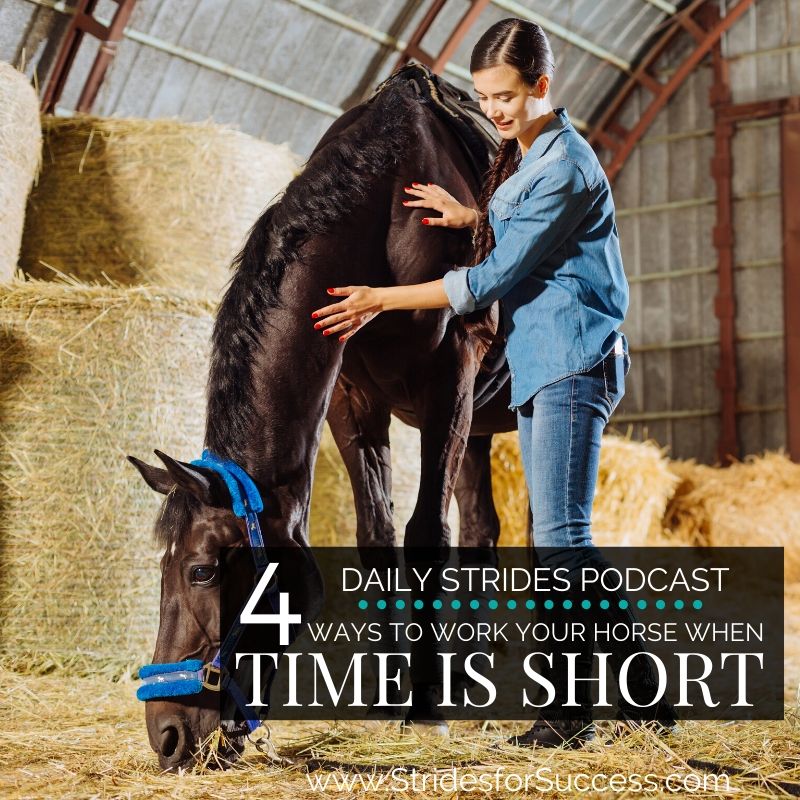
    As I write this, it is that time of the year. The clocks have just gone back here in Ireland. It is dark by 5:30 pm each evening. It is still dark at 7:45 am each morning… And we have close to two months left until the official shortest day of the year. Meaning things are only going to get darker between now and then.

    [smart_track_player url=”http://traffic.libsyn.com/dailystridespodcast/1120-4-Ways-to-Work-Your-Horse-when-Youre-Short-on-Time.mp3″ title=”4 Ways to Work Your Horse when You’re Short on Time” social_linkedin=”true” social_pinterest=”true” social_email=”true” tweet_text=”Struggling to fit riding into your winter months? Here’s 4 ways to make it happen for you and your horse…” hashtag=”equestrian #podcast” twitter_username=”strides_success” ]

    In the top half of the world, Winter has come! And with it, a complete lack of daylight, warmth and ‘perfect riding weather’. This means that riders have to begin changing their approach slightly if they are to still keep moving forward with their riding.

    Couple this with upcoming holidays and the Christmas season, flexibility is the name of the game for riders this time of year.

    So how do you keep your riding moving forwards when your riding times are shorter? And when your actual number of days in the saddle each week possibly changing week on week? Taking a different approach is the answer. I am going to give you 4 different options you can use to work with your horse, that take either lack of time or bad weather into account…

    1 . Lunging

    I personally believe that every rider in the world can benefit from learning to lunge correctly and well. It is something that is so easy to get started with. And, even better, your riding skills do not have a whole lot of sway over your lunging skills.

    Meaning you don’t have to be a ‘great’ rider in order to have a huge positive impact with lunging.

    This is a topic that we have covered many times here on the podcast and I am going to give you links to all the relevant episodes and resources I have created for you.

    2 . Groundwork

    The true bookends to every ride you will ever have. Groundwork is worth investing time into improving as it is something you do every single time you interact with your horse. It is also great for when the weather is less than ideal for riding. When you are confined to a smaller space, even if that space is a stable or barn.

    I am going to suggest starting with something you do every time you’re in the saddle; halt.

    The quality of your halt can be dramatically improved before you ever get into the saddle. Work on the pressure and release concept on the ground. This then allows you to refine something that is the foundation of how you apply your aids in the saddle.

    I have spoken about groundwork a lot in previous episodes. Here are the links to those episodes and other resources I have created for you about groundwork.

    3 . Massage or Desensitising

    Wet, cold weather often makes us want to settle in. Get nice and cozy and leave the weather outside! Well, you can do this with your horse as well, kind of! Massage is a great way to really bond or connect with your horse. It helps to build trust in your relationship with each other.

    Massage is also a great way of using rhythm as you prepare to ride to improve the ride itself.

    It promotes relaxation. You get to really learn what every inch of your horse’s body feels like. And, your horse gets to do something with you that doesn’t require any effort from him. He truly gets to enjoy the interaction between the two of you with little to no demands on him.

    Here are some resources I have created to help you get started with this.

    4 . Long Lining or Long Reining

    This one is probably the most challenging to get started with if you have never done it before. The reason is that two lunge lines double the chances of you becoming knotted up! However, I also feel that if you are confident on the lunge with your horse, you can potentially begin looking at long reining or long lining your horse.

    Long lining is great as you see things from a completely different perspective. It allows you to really see if there are issues with straightness, over or underdevelopment and suppleness.

    The other great thing about long lining is that you don’t need a huge amount of space. And, assuming you’re not into running, it is all done from a walk. This cuts down on the chances of having a slip in wet weather and heavy impact on legs in dry, hot weather.

    Again, you can find a ‘getting started’ guide for long lining at this link:-

    Lack of Time can be an Opportunity

    The change in season and scheduled does not have to spell the end to work with your horse. It is simply a matter of becoming a little more strategic with regard to what you are doing in the yard. Use this as an opportunity to try something you have not tried before.

    Remember, a change is often as good as a rest when it comes to routine. It is up to you to make that happen.

    Happy Riding
    Lorna

    CLICK HERE TO BEGIN SUCCESSFUL LUNGING OF YOUR HORSE TODAY

    Resources to help you with your riding journey:-

    For more information visit the links below

  • 3 Areas that Can Change Everything In Your Riding

    3 Areas that Can Change Everything In Your Riding

    3 Keys to Changing Everything in Your Riding

    So how do you become a ‘better’ rider?  What should you be focusing on in order to make progress regarding your communication skills in the saddle?  I believe there are three specific areas that, if you work on, you can really begin to see a difference in your riding. 

    There are a lot of areas in riding that you can’t control.  Your horse’s mood or attitude is a good example.  In fact, one of the reasons riders stop making progress is that they focus their attention on the things they can’t control, rather than what they can. 

    The simple truth is that by working on these three core pieces that you can actually control, you can have a much greater positive influence over the things that you cannot. 

    You can never really control your horse.  You can simply influence him… So with that out of the way, let’s get into those three things that I suggest you begin working on today. 

    [smart_track_player url=”https://op3.dev/e/traffic.libsyn.com/dailystridespodcast/1115-3-Areas-that-Can-Change-Everything-in-Your-Riding.mp3″ title=”3 Keys to Changing Everything in Your Riding” social_linkedin=”true” social_pinterest=”true” social_email=”true” tweet_text=”Imagine if there were just three things for you to work on, that had the potential to change everything in your riding… There are…” hashtag=”equestrian #horseriding” twitter_username=”strides_success” ]

    1 .  Your Physical Abilities & Fitness Level

    I am going to ask that, rather than flicking away from this blog post, you hear me out on this.  I know, it seems too simple.  So simple, in fact, that we can actually fail to see how important it actually is.  And, trust me, it is important!

    How fit you are will dictate how well you can control your body while in the saddle.  How well you control your body will dictate how clear you are when applying your aids.  This decides if your horse understands or not…

    I see time and again the hours riders dedicate to creating and implementing fitness and conditioning programs for their horses.  Hours spent planning every little detail of the week.  What food their horse is going to eat.  How many calories.  How long they get to socialize.  And planning their rest time as well.   This is great; don’t get me wrong.  However, this is only 50% of the team.  

    However you want to look at it, you cannot get away from the fact that you make up the other 50% of the team.  Failing to ‘condition’ and ‘increase fitness levels’ for yourself is letting your horse down. 

    Fitness and Suppleness

    There are a few different elements when it comes to your personal fitness.  How fit you are as a rider is a big one.  A few simple ‘tests’ can help you to get a clearer picture of just how ‘riding fit’ you are.  In fact, in the 2020 Equestrian Fitness Challenge, I will be helping you measure your riding fitness levels.  But being Riding Fit is not the only way you can improve your physical efforts while riding.  

    I am a big believer in ‘cross-training’.  Doing a few other types of exercise, out of the saddle, that will compliment your efforts while in the saddle.

    However, like all things there can be a downside to becoming too fit elsewhere.  I have noticed that runners, for example, often struggle with suppleness through their lower backs. Which affects their seat and how they are influencing their horse using their seat.  

    Now, obviously this does not apply to every single rider who also runs.  However, it is just something to be aware of. Suppleness is often seen as something only for horses.  It is equally as important for the rider as well.  

    The energy that moves through the horse, must also move through the rider.  Suppleness is the measure of how easily this energy can move.

    Increasing Your Fitness Will…

    Improve your life!  And of course, help you to become a more skilful and responsive rider as well.  You will find that your coordination will improve.  This, of course, helps with your aids, which is how we communicate with our horse.  

    Your balance will begin to improve, often dramatically.  This is great for staying on initially. However, later it also helps when you are working on improving your horse.  Your balance will help your horse to remain balanced. 

    Your energy levels will increase.  How many times have you been riding and find that before you have even finished warming up, your legs are feeling heavy?  You’re out of breath. Or you simply cannot respond appropriately to those ‘critical’ situations or moments.  

    How many times have you missed out on a great opportunity to just enjoy the canter because you were trying to catch your breath?!

    2 . Accepting Responsibility 

    This is the one that so many riders seem to struggle with.  Looking for things to blame for perceived shortcomings.  The irony is that if they could just accept the responsibility, they could begin to change the outcome!  Responsibility for your own actions.  Your thoughts and your words.  

    Also, accepting the responsibility that the progress you are making is probably being heavily influenced by how you are showing up, in and out of the saddle, for your horse…

    As a rider, you have a certain unique ‘style’ of riding.  That ‘style’ is how you actually teach or train your horse to respond to you.  If you are intentional about it, it will work for you.  If not, it can potentially work against you and your overall goals for your riding.  Taking responsibility for your own unique style is essential if you are to become a better rider. 

    When you are responsible for something, you are then able to make tweaks or changes that will result in a different outcome.  Actively look at ways you can take responsibility for your riding.  It has the potential to change everything!

    3 . Your Mindset

    This is how you are showing up and how you think about things.  Your beliefs and how you ‘do you’.  Your mindset can be easily identified through your stories.  Think about it; if I was to ask you why you are doing something a particular way, you will probably respond by telling me a story to explain why.  

    What is great to note here, is that we actually create our own stories.  This is usually to either make us or someone else, feel a certain way.

    It could be to feel less responsible for our own perceived shortcomings.  To make someone feel pity for us.  Or to make us feel validated.  Maybe to make us feel happy, sad, successful, busy, stressed, energized, anxious… So many feelings!  The important thing is to identify the ‘feeling’ you’re going for and then ask yourself why you’re going for it.

    Your mind will look for ways to validate your beliefs.  A great example of this is the rider who ‘believes’ that they are going to fall off…  Each time they think it or say it, their body aligns more and more with that belief.  

    When I’m in the arena with a rider like that, I can see the physical adjustments the body makes, in order to ‘make it happen’.  Of course, then the rider does indeed fall off, their first words are usually ‘I knew this was going to happen’… Ah, congratulations, you have proved yourself right, yet again!

    Working on Improving You in Your Riding

    I realize that the three topics I covered above seems so simple.  However, doing the work will not always be easy.  It will take time and diligence in order to successfully begin rewiring your body and mind in order to change how you think, feel and act in the saddle. 

    It is ‘do-able’.  Very much so.  But it will require a commitment from you in order to begin making it happen.  

    How soon will you see any changes?  Immediately.  Changing how you think, will change how you feel.  This will change how you act.  When you begin showing up differently, your horse will begin to respond differently. 

    It is as simple as that ;)
    Happy Riding

    Lorna

    Other resources to help you with this topic:-

  • Having Realistic Expectations for Your Riding

    Having Realistic Expectations for Your Riding

    Having Realistic Expectations for Your Riding

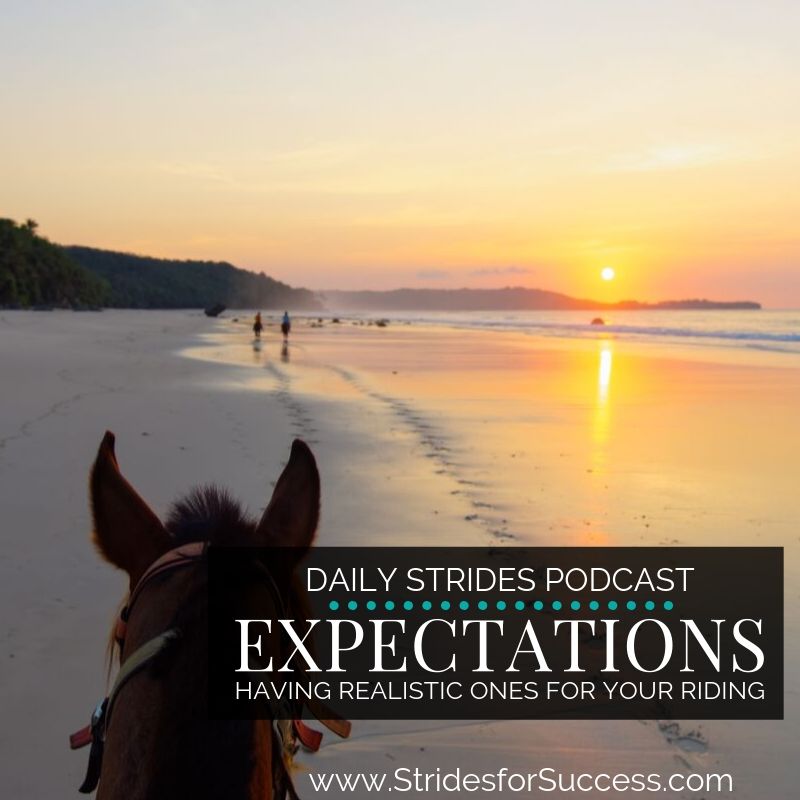
    So what do you expect to happen when you mount up?  Very often we can have either unrealistic expectations of our horses.  We can also find ourselves having negative expectations; usually not intentional, but they happen!

    Horses are great at living up to expectations.  However, they do have to be realistic.  Expecting your horse to perform difficult movements when we have not taken the time to build a solid foundation is unrealistic.  It is these unrealistic expectations that trip so many riders up. 

    In fact, unrealistic expectations are one of the biggest reasons riders fail to make progress with their horses.

    [smart_track_player url=”https://op3.dev/e/traffic.libsyn.com/dailystridespodcast/1114-Having-Realistic-Expectations-for-Your-Riding.mp3″ title=”Having Realistic Expectations for Your Riding” social_linkedin=”true” social_pinterest=”true” social_email=”true” tweet_text=”What do you ‘expect’ to happen when you get into the saddle? ” hashtag=”equestrian #horseriding” twitter_username=”strides_success” ]

    The conversations with your horse begin with the conversation going on in your head.  Your conversation with yourself.  So many riders create stories to explain why things are the way they are.  We do this with all the elements of our lives.  The unfortunate fact is that a lot of these conversations can be really limiting. 

    How You Think of Yourself in the Saddle

    How you feel about your abilities as a rider will influence your plans with your horse.  These plans can be actually written down plans, using a pen and paper.  Or the plans in your head that you make before each ride.  These plans can go in two very different directions.

    The first is the ‘this is going to be great’ route.  This is where you have seen or experienced something and you wish to replicate it in your upcoming ride.  

    You feel good and confident about being able to make it happen.  You find yourself thinking about how good it will feel to actually see it happening with your horse in the ride.  It is a positive feeling.  You feel excited and eager to get into the saddle. 

    The second is the ‘this is not going to be too great at all’ route.  This is where you have had or seen something negative happening and relate it to your upcoming ride. 

    ‘I feel off last week, I’ll probably fall again’.  Or ‘my horse struggles with that transition, today won’t be any different’.  The feelings as you mount up are usually negative.  You may feel anxious, worried, nervous, fearful, or just plain bored!  

    You might also feel like this is ‘deja vu’.  The same 30 minutes in the saddle repeating itself over and over again. 

    Your Expectations Shape Your Approach

    The key to beginning to use your expectations as a tool to help you in your riding is to notice them, to begin with.  How are you feeling as you tack up or mount up?  What are you expecting to happen?  What is your mindset like going into the ride?

    Noticing how you are thinking and feeling about each ride will allow you to begin changing your approach.  By changing your approach, you now have the power to change the outcome. 

    If you jump fences with your horse, you will already know how important a good approach is.  A slight or minor change in the approach to a jump has the potential to change the whole outcome.  The same applies with most things, both in riding and in life.

    Getting clear on what you want to make happen – and then tailoring your approach towards that outcome puts you in a much better position to achieve it. 

    Again, if you regularly jump you will know that wishing, hoping and praying will sometimes get you over the fence; but all results are going to be hit and miss.  They are left to chance.  Working towards improving your approach will begin to see you increase your success rate.  

    Putting on Your Blinkers

    If you have ever been to the race track or watched racing on the television, you will probably have seen a few horses with blinkers on.  The blinkers are to help focus the horse.  Help them run their own race, rather than being distracted by all the commotion going on around them. 

    Your expectations can be like ‘blinkers’ for you and your horse. They will help you focus and stay on track with your riding.

    By becoming really clear on what you are working towards and then being open to making adjustments in your approach to get there, you will put yourself in a far better position to actually reach your goals. 

    Setting Realistic Expectations

    So a few weeks ago, I sent out an email all about expectations.  I received a reply which I feel actually represents so many riders around the world.  It went a little along the lines of “I watch videos about riding, and I feel really positive going out into the arena.  However, after thirty minutes of riding, we leave the arena feeling frustrated because it didn’t work.  I had the same ride I always have.”

    The long and short of it was that they didn’t agree with me regarding expectations.  They felt that setting expectations were only serving to set them up for disappointment when they were not reached.

    This is where being realistic with your expectations is really important. Can you really explain what you want to your horse to do in a way that he a) understands and b) can realistically do?

    In order for your expectations to help you make progress in your riding, they have to be realistic.  Asking a three-year-old, just backed, horse to perform a perfect half pass is unrealistic.  Regardless of how many videos you watch, the books you read and the prayers you offer up!  

    Making Adjustments Along the Way

    Once you have chosen a realistic expectation for you and your horse which represents where you are at that moment in your journey together, you can begin making it happen.  Things can be planned out.  Some riders make the plans on paper, some do so in their heads before they ride.  However you choose to do it, I want to point out something that is true of almost all plans…

    Your plans will have to be adjusted along the way.  Your approach will have to be ‘monitored’ and ‘checked’ regularly in order to reach your expectation.  

    Think of jumping again.  You can choose the best line in the world.  A great approach.  As you begin moving towards the fence, however, you may find that the balance shifts.  You have to make an adjustment, immediately and as you are still on the approach, in order to get you both back on track to meet that jump as you want.

    The ability to make adjustments and be supple in your approach is key to actually turning your expectations into reality.

    Life Happens…

    When we put this into practice, you will find that life will throw you curve balls every now and then.  Your horse may become lame or lose a shoe.  Your work requires more hours or travel that was unexpected or unplanned. Your child or partner gets sick and needs your time and attention…  The list is endless when it comes to potential things that can derail our plans. 

    The key to making your expectations a reality is accepting these things are going to happen.  

    Allowing yourself to become frustrated will not move things forward.  In fact, it will only serve to move you backward.  Look at how you can adjust your plan to fit in with whatever is happening.  Maybe 30 minute rides 5 days a week have to become 10-minute groundwork sessions 2 days a week for a few weeks.  

    Another obstacle that has the potential to throw you off course is either you or your horse not developing as quickly as you thought.  If this is your particular frustration; I’m going to suggest taking a deep breath…

    Why do you want to achieve the goal?  I’m sure it has a lot to do with something around building a better relationship with your horse.  

    This is true if it is a groundwork, a flatwork or a jumping goal.  So, how can you explain things better?  How can you feel more confident about understanding something, and therefore explaining it to your horse so he too can understand and follow through?

    Creating Your Expectations

    So, what are you expecting to happen the next time you get into the saddle? Are you setting both yourself and your horse up to reach those goals?  

    Happy Riding

    Lorna

    Other links and resources to help you on this topic:-

  • Riding & Acting; the Connection

    Riding and Acting; the Connection

    Have you ever considered how, in order to be a good rider, you must be a good actor? Don’t worry too much if you haven’t, you’re not alone… Many riders fail to see the connection between these two things.

    As a rider, you will see a marked difference in your abilities in the saddle, especially when under pressure, if you work on your acting skills in the saddle.

    [smart_track_player url=”https://op3.dev/e/traffic.libsyn.com/dailystridespodcast/1107-Riding-and-Acting%3B-The-Connection.mp3″ title=”Acting & Riding; The Connection” social_linkedin=”true” social_pinterest=”true” social_email=”true” tweet_text=”A good equestrian is usually a good actor… Really! Here’s why…” hashtag=”equestrian #horseriding” twitter_username=”strides_success” ]

    In this episode of the Daily Strides Podcast I am going to give you a few ideas on how you can begin developing your acting skills, beginning right now…

    What has Acting to Do with Riding Horses?!

    Tell me, when was the last time that your horse reacted to something in a way you did not expect? Maybe he spooked. Or perhaps he stumbled. He possibly was simply full of the joys of life…

    Whatever the reason, when our horses act in a way we don’t expect, it can throw us off our concentration and efforts. It derails us a little… For many riders this leads to becoming ‘stuck’ and a loss of confidence in abilities.

    However, have you ever considered that your horse doesn’t know that you actually haven’t a cooking clue whats going on; or how things are going to turn out?!

    The key is acting well enough to keep the ball rolling. Keep the conversation going. Which will result in both you and your horse moving forwards. Past the ‘thing’ that had all the potential for both of you to become ‘stuck’.

    Knowing What You Want…

    Have you ever noticed how it is often difficult to get clear on what you really want. That is, until you are presented with what you definitely don’t want! I see this happen to riders all the time. Something happens that they become almost crippled by it. The thing that they don’t want.

    “How does ‘Insert Other Riders Name Here’ do this? How do they manage to just ride out of / through / over this?”

    These feelings are often coupled with the realisation that your horse has gained the ‘upper hand’. Your horse now knows the real truth; you really haven’t a clue what you’re supposed to be doing most of the time! You’re essentially winging it and hoping he doesn’t notice.

    Which is great until it’s not. Until he notices that, for whatever reason, you are unable to ride out of / through or over this particular one…

    How Is Your Horse Feeling Right Now?

    Now, I personally believe that far from your horse wanting to gain this hypothetical upper hand, he may just be as confused as you are. Horses, epsecially if they are more green or young, look to their rider for guidance.

    When the rider falls to pieces, well it doesn’t really inspire confidence in their leadership abilities. It often makes the horse question things. Is this safe? Should I rather not get out of here A.S.A.P?!

    It is really important to remember that, whether you like it or not, you are in a position of leadership when it comes to your relationship with your horse.

    It is okay to admit that things have veered a little from the plan. However it is not okay to fall to pieces when your leadership skills are needed most. Especially when this is what you really feel like doing!

    It’s All About ‘Pretending’

    Sure, you might not have a clue how to handle what has happened; but as a leader you need to ‘pretend’ that you do. In fact, you need to convince your horse that you not only are prepared for this, but have the perfect plan to work through or around it as well.

    There is a moment of initial discomfort. If you can have the self awareness to recognise this; and then act accordingly, you can turn the whole situation around.

    The initial discomfort is the sign that you are moving away from what you want, into the ‘I definitely don’t want this’ territory.

    Therefore, by recognising the discomfort and then using it to remind you to refocus on what you do want, your desired outcome, you can move both yourself and your horse through the challenge.

    Finding Role Models for Your Riding

    We have all heard about ‘faking it until you make it’. I personally believe that this is one of those situations that this can actually work for you and your horse.

    The key is to find role models that you can try to emulate in your riding.

    When I began to do this, I approached the situation all wrong. I was looking for that ‘one person’. One rider who I could try to channel in all sorts of different situations. That ‘perfect person’ doesn’t exist.

    Rather look for elements of what you like in different riders. Pick and choose. Mix and match…

    Reverse Engineering What You Want…

    The biggest challenge I find riders have when it comes to this is finding potentially suitable riders to ‘model’ when the going gets tough. But rather than letting a lack of talent stop you in your tracks, use it to pin-point what you really don’t like.

    By watching others and using their experiences to decide you on what you don’t like, you can begin curating a list of methods that you do like.

    If you don’t like how someone is doing something, it means that there is actually another way you prefer. The key is to take note of what you do like and begin ‘fleshing it out’ a little…

    Looking for Specific Situations

    I find one of the best places to notice different ways of dealing with ‘sticky’ situations is to watch riders in the warm up or practice arenas. Watching what goes on in there, and how people deal with things, is often an education in and of itself!

    I also strongly recommend watching people schooling their horses or having lessons / sessions with their trainer or coach. You want to actively begin looking for learning opportunities; and growth is usually in those ‘tougher’ moments!

    The key is that once you begin to recognise a potential learning moment, you pay attention to the details.

    It’s all well and good to say that a rider rode well. That they got themselves and the horse out the other side. But the gold lies in noticing what they did to make that happen…

    Noticing and then identifying how you could do a similar thing if the situation presented itself…

    “What Would _____ Do In This Situation?”

    Over time you will begin to build a bank of ways that have worked for riders you respect to overcome challenges. You will be able to pick and choose as you need. You can ‘tweak’ as you go…

    Horse riding has this great blend of rider, horse and circumstance. All three are rarely, if ever, the same. Meaning you must adjust and adapt.

    But by paying attention and preparing in advance, you will find that when one of those moments occurs, you have the tools to overcome it. Simply ask yourself “What would _____ do in this situation?”. Then, just do it. Do whatever that person would do. Act as though you are that person…

    Moving Forward with Your Riding

    Will this work first time out? Well, let’s be honest. It probably won’t go exactly to the plan you want. That will take practice. But it is a starting place. As you begin working through situations that would have initially halted you in your tracks, your confidence will grow.

    As your confidence in your abilities grows, you will find yourself ‘acting’ less and less.

    You will become the rider that others will want to ‘act’ like in a difficult situation.

    Happy Riding

    Lorna

    Other posts, episodes and resources that relate to this topic:-

  • Why Progress In Your Riding Can Often Feel Uncomfortable

    Why Progress In Your Riding Can Often Feel Uncomfortable

    Why Progress in Your Riding Can Often Feel Uncomfortable

    What this episode is all about & how it can help you:-

      • Recognise that new can often mean uncomfortable
      • Think differently about ‘upgrading’ your riding
      • Begin to make room for improvement
      • Have appreciation for what has got you this far in your riding

    [smart_track_player url=”https://op3.dev/e/traffic.libsyn.com/dailystridespodcast/1086-Why-Progress-Can-Feel-Uncomfortable-in-Your-Riding.mp3″ title=”Why Progress Can Feel So Uncomfortable in Your Riding” social_linkedin=”true” social_pinterest=”true” social_email=”true” tweet_text=”Do you sometimes feel like your riding is going backwards instead of forwards? This might help…” hashtag=”equestrian #horseriding” twitter_username=”strides_success” ]

    Have you ever noticed how, when you begin working on improving something, things can feel a little like they are falling apart initially. Getting worse rather than better!  You become all worried that you have ‘broken’ something which, perhaps wasn’t exactly as you wanted it to be, but it worked!

    This is often the feelings that come up for riders when they begin refining their skills and aids in the saddle. It feels like they are actually going backwards rather than making the progress they want in their riding.

    In this episode of the Daily Strides Podcast we are going to find out why this happens and what you can do to actually let this benefit you and move you forward in your riding.

    Recognise that New Often Means ‘Uncomfortable’

    I know, it is not what you want to hear, but it is the truth. Often, when we are working on improving something, we have to leave our comfort zone. And your brain, which is merely trying to protect you, begins sounding alarm bells and firing off its equivalent of ‘flares’ in order to try to get your attention to return to that lovely, safe, comfort zone!

    The thing to keep in mind is that ‘comfortable’ is not always best…

    Continuing to do things the way you have always done it will keep you inside of your comfort zone; but it will also ensure that you never make any real progress in your riding.

    Being able to recognise that your feelings of anxiety or worry about things going backwards are perfectly normal.  They are a necessary part of beginning to move things forward in your riding.

    It’s a little like tidying a room. Often it has to become messier and more ‘untidy’ before it actually begins to come together and improve. This is because some of the things in the room, while they once were useful, are no longer that way and must be removed to make room for what is needed right now in your life.

    Upgrading The Way You Do Things

    Horse riding is a little like this. Some of the things which possibly served you well up to this point, now need to be ‘replaced’ with things that are actually going to help you moving forwards.

    An example of this is the crest release when jumping. It works well when you are learning to jump. It allows you to feel secure and it gives you an actual physical ‘touch point’ if you do lose your balance.

    However, as your riding begins to evolve and as you begin to refine your jumping, things have to change.  Your trusty up until now crest release will eventually be replaced by the automatic release.

    This can often leave riders feeling a little ‘unbalanced’ initially. Their brain is literally screaming at them to ‘hold the mane’.  Overriding that impulse is key to integrating this new way into the day-to-day riding and jumping.

    Another example of how you will ‘upgrade’ your riding can often be seen by how riders ‘stop or slow’ their horses. When we learn to ride initially, we are often told that the brakes are the reins. Apply pressure and the horse will slow down or stop.

    However, as we refine our aids in the saddle, we begin to learn how our seat can actually communicate the same request to our horse, in a nicer and more ‘secret’ way. Again, it can initially feel like we are losing control. Our brains are telling us to just pull the reins and stop the horse! But, but persisting through the initially discomfort, we soon learn that the seat is indeed an effective aid when communicating with our horse.

    Making Room for Improvement

    I really think that riding is mindset first, physical abilities second. How you think about something has the power to influence your results. I would even go so far as to say that, in some cases, it is the cause of your results.

    Recognising that in order to improve, you will have to let go of certain ways of thinking and ways of doing things will free you up to learning new things.

    If you don’t understand why you should do something, research it. Find out why. Ask questions. Find out why this ‘new’ way is more effective.  Even if it doesn’t feel that way initially.

    Keep in mind that, just because you have made one change or upgrade, doesn’t mean that you will never revisit or upgrade this again. Horse riding, by its very nature, is a constant work in progress. You are always improving or refining how you do things, so that you can have more clear communication with your horse. If you are not, you are doing both yourself and your horse an injustice.

    What Got You Here Often Won’t Get You There

    Often, in order to get to the next level, you have to change tactics a little. Where you are now is not the same as where you want to go to in your riding. So it makes sense that you are going to have to do things a little differently in order to get to this ‘new’ place.

    Does this mean how you have been doing things is ‘wrong’ or ‘useless’?  No, not at all. They got you to where you are now. However, at each plateau in our riding, something has to change in order for us to grow and continue on with our journey as a rider.

    This comes back to becoming comfortable with being uncomfortable. Letting go of things, even how we do things, can often be difficult.

    We almost feel like we are being unfaithful to the things which have served us well up to this point in our riding.

    These feelings of guilt can even cross over to the trainer or instructor who initially recommended the thing you are now ‘letting go of’ or changing.

    Remember, that person and that suggestion served you where you were at that exact moment in your journey. You’re not there anymore.

    Things have changed. So the tools you need in order to get to the next part of your journey will also, most often, have to change.

    Appreciating the Tools That Have Served You

    I regularly hear riders complain or moan about trainers or instructors who told them something which, where they are right now, no longer serves them. I really think that this is a short-sighted and, quite frankly unfair, judgement to be made by the rider.

    That very thing or suggestion, while it might no longer be the correct advice for where they are now, is what moved them along on their journey.

    Many riders only reach out to a professional for help as a last resort.  Often after they have been ‘stuck’ at a certain point for a long time. Sometimes drastic action is needed to get them unstuck! Riding instructors and trainers are not fortune tellers… They cannot see where you will be 6 months from now.

    Often they are just working on getting you to the next level. And how will you know you have reached the next level? Well, you know because you have to now upgrade your skills and tools.

    You will have to think about things and approach things differently again. Always keep in mind that what is working right now, at this new level, will possibly also become something you have to replace at a later stage as well.

    Horse Riding is a Never Ending Journey

    I know, it sounds so cliché!  But it is true. In order for you to really improve as a rider, it is worth remembering this as you move forwards in your riding.

    If you want to reach a new level, new skills will be required of you and your horse. Rather than feeling discomfort and anxious about this, approach it with a sense of excitement and curiosity.

    That is the conversation and it is, after all, why we devote so much time to an activity that we never really reach any specific ‘end point’.

    Happy Riding
    Lorna

    Other posts and episodes that relate to this topic:-