Tag: rider fitness

  • Feeling Tired 20 Minutes into a Ride? Here’s What to Do…

    Feeling Tired 20 Minutes into a Ride? Here’s What to Do…

    [fusebox_track_player url=”https://op3.dev/e/traffic.libsyn.com/dailystridespodcast/1326_Feeling_Tired_After_20_Minutes_of_Riding.mp3″ title=”Feeling Tired 20 Minutes into a Ride? Here’s What to Do…” social_linkedin=”true” social_pinterest=”true” social_email=”true” ]

    That feeling. When you had the best of intentions about what a ride was going to be like for you and your horse. Only to realise, 15 to 20 minutes into the ride, that you are ‘beat’!  Your legs are just not doing what you want them to do. Your head and shoulders feel like they weigh a tonne and self-carriage on your part is just exhausting! And as for coordination and concentration; nope and nope!

    If you are noticing a pattern where you’re feeling physically ‘done’ 20 or so minutes into each of your riding sessions with your horse, you need to begin working on changing that for you and your horse.

    Physical fitness is an essential part of improving as a rider. You don’t have to be as fit as a flea, but there is a certain level of physical abilities that are essential if you are to improve as a rider – and as a trainer for your horse.

    The good news is that there are a few simple key areas you can focus on in your next ride so that when you hit that point where you’re feeling tired, you will have a few ‘go to’ exercises and practices to help you squeeze out a few more minutes of goodness in your training!

    Quality Over Quantity

    Before we go any further, I want to reiterate that I do not believe in ‘Clock-In Riding’.  Clock-in riding is when you set a goal of a specific amount of time that you and your horse will work together for a ride. 30 minutes or 45 minutes are popular ones.  My big question is WHY?! If you and your horse have achieved something great at the 23-minute mark, is it essential that you continue on for another 7 minutes to ‘reach your goal’? No, absolutely not!

    Instead of setting goals about the amount of time you will spend in the saddle, rather set an intention for what you would like to work towards or achieve while riding. 

    More often than not, continuing on after you’ve achieved the thing you set out to work on will only result in actually lowering the quality of the training session! Shift your mindset so that you begin to focus on and then celebrate the quality of the work, rather than the quantity of the work.

    The tips I’m sharing with you today are ideas to help you go a little further ‘if’ you still NEED to go a little further in that particular training session. They are not for you to use to hit an arbitory ‘time goal’… Okay? Okay :)

    Use Your Walk Intentionally

    The walk is always a great place to catch your breath.  However, spending 10 or so minutes of each riding session aimlessly wandering around an arena trying to stop yourself from ‘blowing’ too hard is not time well spent.  So my advice is to begin becoming intentional with your walk.

    You can measure the walk in lots of different ways; the rhythm, the length of the stride, your horses frame, your ability to follow with your seat without doing funky dance moves with your shoulders are just a few to mention…

    I’m going to suggest focusing on the length of stride and your horse’s frame as a great ‘allows us to regroup and also continue to remain focused on the work’ exercise for when you’re feeling tired. Work on transitioning from a more ‘medium’ walk; it does not have to be medium in the truest meaning of the word, you can also use the word ‘gathered’ walk or ‘put together’ walk. To moving into more of a ‘free walk on a long rein’.  These two different ‘types’ of walk have the potential to show a massive difference in how your horse is working and using his body.

    And when you are working on improving the quality of both of the walks and creating smoother transitions between, your body is allowed to rest and prepare for the next more challenging exercise you choose to ride.

    Position, Position, Position

    One of the most noticeable symptoms when a rider is feeling tired is how drastic their overall position and posture changes! Your position and posture are essential to ride well. And when you begin to notice that your energy is fading, you MUST check both.

    When tiredness is creeping into to the rider’s body, the horse will also usually begin travelling a little differently. Many times the horse becomes heavy in front.  Hanging on the bit…  And because the rider is feeling ‘beat’, they often just brace against the horse.  This usually results in any wins that might have happened during the ride being wiped out!

    If you feel like your horse is becoming heaver on your hand, check your position first. Are you supplying him with something to hang on (your arms and shoulders)? Rather than using your aids to ask him to begin carrying himself again?

    Allowing your horse to hang on your arms and shoulders will not help either of you long term. And if your legs and seat are feeling too tired to ‘ask’ him to make a change, bring it back to walk and try there. Allowing yourself to continue on with a bad position or posture will only lead to far worse habits further down the line! So be careful!

    Transitions & Half Halt

    These are another great way to lighten your horse up in front and put less physical pressure on your upper body. When you are feeling tired, riding good-quality transitions can be a challenge. So make it easier by riding these transitions in the walk.  Work between walk and halt.  And then walk and trot.  You can add intentional and well-ridden transitions between being ‘straight’ and riding through a bend, curve, or corner.

    Riding transitions that include the walk allows your body to ‘keep up’, even when it’s feeling tired.  And allows you time to rest a while still continuing with the training so not to break the focus. 

    However, remember that you will need to have first checked over and ‘tweaked’ any position or posture issues.  I like walking serpentines here.  They include so many different elements and are just as beneficial in the walk for rider and horse.  Use the centre line (the point where you cross it each time) as the point for your transitions.  Maybe halt on the centre line.  Or trot the loops and then 3 strides of walk as you straighten out while crossing the centre line.

    Of course, before and after all of your intentional transitions you will sprinkle a couple or more half halts. This will help you to remain connected and help your position and posture. 

    10m Circles in Walk

    My final suggestion for when you’re feeling physically tired while in the saddle is 10m circles in walk.  I like to ride these before I begin ‘working’ again in trot or canter. And, of course, I say 10m but this can also be 12m and 15m depending on you and your horse’s training level.

    10m circles in the walk work well to reestablish the connection between horse and rider after a little break to catch your breath. Especially if you are then going to trot or canter. 

    You may find that after the walk and especially when you’re feeling tired, the trot and canter can become a little ‘flat’ or ‘front heavy’. Neither of which you will want. So the smaller focused circles in the walk with the intention of ‘gathering’ things up again, can really help you both to re-focus.

    Stop Feeling Tired…

    Again, all of the above suggestions are made for you to try when you are really focusing on quality over quantity in your riding. Not just to help you ‘push on through’ for another 20 minutes in the saddle! At the end of the day, it will be up to you to increase your physical abilities so that you tire less or later in the ride. Obviously, riding itself will really help with this. But there are also other things you can do…

          • Prioritize enough good-quality sleep
          • Watch what you eat – especially what foods cause inflammation in your body
          • Stay hydrated throughout the day – not just after you ride
          • Increase your suppleness – yoga
          • Improve your stamina and fitness with cardio – walking and hiking are great
          • Create more control over your body and aids – strength training and workouts

    There will be days when your body is just ‘bushed’ at a certain point in the ride. Start listening to your body and know when you need a short ‘rest’ to recover, or you need to end the session and dismount! There is no shame in feeling tired.  And very often ‘pushing on through’ will only cause more issues down the line for you and your horse.

    Equestrian Fitness Challenge ’24

    And in the meantime, work on improving your overall strength, fitness, and stamina as a rider. The all-new and free 2024 Equestrian Fitness Challenge is a great place for you to do this.  It is walking and yoga-based (no workouts), so it will ease you into becoming a better version of yourself in the saddle gently. You can sign up HERE or by visiting https://equestrianfitnesschallenge.com/24 
    There will be a daily walk, a 10 minute daily yoga practice, and lots of tips, ideas, exercises, and ways to improve so that you can show up as the best version of you – for you and your horse.
    Sign up today and let’s transform your riding – one stride at a time! 100% FREE 2024 Equestrian Fitness Challenge
    Remember, there’s so much you can do to improve your riding, especially your energy levels.  Don’t just accept feeling tired as being the end of your training session.  Begin to work with your body so that you and your horse can go further in your training together.
    Happy Riding
    Lorna

    More Help for Riders:-

    Connect with Lorna online:-

    Get Going in Your Riding:-

    Daily Strides Premium is back! You can use the first and original audio horse riding lessons to improve your riding, train your horse, keep things interesting, and have fun… Even if you don’t have a trainer or coach

  • Improving Your Effectiveness as a Rider

    Improving Your Effectiveness as a Rider

    [fusebox_track_player url=”https://op3.dev/e/traffic.libsyn.com/dailystridespodcast/1325-REPEAT_Increasing_Your_Effectiveness_as_a_Rider.mp3″ title=”Improving Your Effectiveness as a Rider” social_linkedin=”true” social_pinterest=”true” social_email=”true” ]

    This article was originally published on stridesforsuccess.com in January 2022 by Lorna Leeson

    How many hours do you devote to training your horse each week?  Have you ever considered that you might just be the ‘team member’ that needs more work…?  That you might just be the ‘cap’ on your horse’s progress in his training and his development?

    Regardless of how much training your horse has,  eventually your effectiveness as a rider will determine what your horse can actually do with all that training…

    This week, I want you to begin thinking about, planning, and taking action on your own development. Your own conditioning, training, fitness, nutrition, social time, rest, and all of the things that you meticulously plan for your horse. 

    Why Do You Ride?

    I think to answer this, we first have to get clear on why we are riding our horse, to begin with… Most, if not all, riders are in the saddle because they have a certain outcome in their head that they want to achieve. This could be a feeling, such as relaxation or enjoyment. It could be a certain task, like getting a clear round or qualifying for something.

    Whatever the reason, it is worth remembering that you are taking time from your life to try and produce that outcome each time you mount up.

    Unfortunately, many riders often fall short of reaching the desired feeling, goal, or outcome. And, many times, this can be due to their horse not actually understanding what the outcome is that they are working towards. A lack of communication between horse and rider.

    What is ‘Effectiveness as a Rider’?

    When you know what you want to experience, it then becomes your responsibility to effectively communicate this to yoru horse. We do this, as riders, using our aids. And it is always a combination of aids.

    Your thoughts, legs, hands, body language, voice, position, seat, weight… And these are just some of your ‘natural’ aids.

    You also have a whole toolkit of artificial aids you can use to communicate with your horse. The saddle, bridle, arena, spurs, whip, lunge lines, lead ropes, etc. Most riders use a combination of natural and artificial aids in order to get their message across to the horse.

    The challenge becomes when they lack control over their own actions. This results in sloppy, haphazard, attempts at communication that muddies the message being communicated.

    When Communication Goes Awry…

    It is important to remember that, for the most part, whenever you get a result with your horse that is different to what you initially had in mind, the message probably became muddled. A simple case of you asking for one thing, but your horse hearing another, different, request.

    Retraining can play a big role in closing gaps between the expectations of riders and horses, however training is equally as important

    And training is not just for the horse. You, the rider, must also learn how to ask with more intention, focus, and clarity. It is easy to say that the horse is ‘stupid’ or ‘doesn’t understand’. However, the truth is often that the rider not clearly asking the question…

    There is a common misconception in horse riding that you ‘control’ your horse. You don’t – and never will. You merely influence…

    Your responsibility is to become better at influencing your horse using the aids that are available to you, natural and, when required, artificial.

    Developing Self Control

    The good news is that you can develop more positive influence if you work on improving your control over your body. How it moves. The range of motion you have with it. Your physical and mental stamina…

    Coordination is developed over time through a mix of developing physical strength, focused and intentional thinking, and building emotional confidence.

    I feel that saying ‘I’m not very coordinated’ is the easy way out for many riders. Lack of coordination, in most cases, simply means a lack of dedicated training; physical, mental, and emotional.  Improving effectiveness as a rider requires consistently upgrading yourself and your skills.

    I feel that, in order to truly begin experiencing the outcome you desire every time you get into the saddle, there’s work to be done on the ground as well.

    Taking Responsibility as a Rider

    If you are currently getting less-than-perfect results with your horse, then this work is for you. I think that it’s fair to say this is true of all riders. There will always be ‘more’ that we can do regarding developing our skills as an equestrian.

    Taking the time to develop yourself as a rider will allow you to begin responding rather than reacting when in the saddle.

    It will allow you to use your different aids in a way that is easily understood by your horse. Your mindset will become resilient, positively expectant, and open to new ideas and ways of doing things…

    All of these things will help you to have better conversations with your horse as you consistently improve your effectiveness as a rider.

    Happy Riding
    Lorna

    Equestrian Fitness Challenge ’24

    Let’s walk together for 21 days and have a chat about how you can do much more than you think you can as a rider and an equestrian… I am so excited to bring you along on this journey for the 100% FREE 2024 Equestrian Fitness Challenge
    There will be a daily walk, a 10 minute daily yoga practice, and lots of tips, ideas, exercises, and ways to improve so that you can show up as the best version of you – for you and your horse.
    Sign up today and let’s transform your riding – one stride at a time! 100% FREE 2024 Equestrian Fitness Challenge

    More Help for Riders:-

    Connect with Lorna online:-

    Get Going in Your Riding:-

    Daily Strides Premium is back! You can use the first and original audio horse riding lessons to improve your riding, train your horse, keep things interesting, and have fun… Even if you don’t have a trainer or coach

  • Improving Your Effectiveness as a Rider

    Improving Your Effectiveness as a Rider

    [fusebox_track_player url=”https://op3.dev/e/traffic.libsyn.com/dailystridespodcast/1229_Increasing_Your_Effectiveness_as_a_Rider.mp3″ title=”Improving Your Effectiveness as a Rider” social_linkedin=”true” social_pinterest=”true” social_email=”true” tweet_text=”Improving your effectiveness as a rider…” hashtag=”horseridingpodcast” twitter_username=”strides_success” ]

    Hours and hours… This is how long most riders devote each week to developing and training their horse. And yet, many riders fail to realize that they are the ‘cap’ on their horse’s further progress.

    Eventually, your effectiveness as a rider will determine what your horse can actually do with all the training you devote to him or her…

    So it makes good sense to spend time each week thinking about, planning, and then taking action on your own development. Your own conditioning, training, fitness, nutrition, social time, rest, and all of the other things that we plan for our horses.

    Why Do You Ride?

    I think to answer this, we first have to get clear on why we are riding our horse, to begin with… Most, if not all, riders are in the saddle because they have a certain outcome in their head that they want to achieve. This could be a feeling, such as relaxation or enjoyment. It could be a certain task, like getting a clear round or qualifying for something.

    Whatever the reason, it is worth remembering that you are taking time from your life to try and produce that outcome each time you mount up.

    Unfortunately, many riders often fall short of reaching the desired feeling, goal, or outcome. And, many times, this can be due to their horse not actually understanding what the outcome is that they are working towards. A lack of communication between horse and rider.

    What is ‘Effectiveness as a Rider’?

    When you know what you want to experience, it then becomes your responsibility to effectively communicate this to yoru horse. We do this, as riders, using our aids. And it is always a combination of aids.

    Your thoughts, legs, hands, body language, voice, position, seat, weight… And these are just some of your ‘natural’ aids.

    You also have a whole toolkit of artificial aids you can use to communicate with your horse. The saddle, bridle, arena, spurs, whip, lunge lines, lead ropes, etc. Most riders use a combination of natural and artificial aids in order to get their message across to the horse.

    The challenge becomes when they lack control over their own actions. This results in sloppy, haphazard, attempts at communication that muddies the message being communicated.

    When Communication Goes Awry…

    It is important to remember that, for the most part, whenever you get a result with your horse that is different to what you initially had in mind, the message probably became muddled. A simple case of you asking for one thing, but your horse hearing another, different, request.

    Retraining can play a big role in closing gaps between the expectations of riders and horses, however training is equally as important

    And training is not just for the horse. You, the rider, must also learn how to ask with more intention, focus, and clarity. It is easy to say that the horse is ‘stupid’ or ‘doesn’t understand’. However, the truth is often that the rider not clearly asking the question…

    There is a common misconception in horse riding that you ‘control’ your horse. You don’t – and never will. You merely influence…

    Your responsibility is to become better at influencing your horse using the aids that are available to you, natural and, when required, artificial.

    Developing Self Control

    The good news is that you can develop more positive influence if you work on improving your control over your body. How it moves. The range of motion you have with it. Your physical and mental stamina…

    Coordination is developed over time through a mix of developing physical strength, focused and intentional thinking, and building emotional confidence.

    I feel that saying ‘I’m not very coordinated’ is the easy way out for many riders. Lack of coordination, in most cases, simply means a lack of dedicated training; physical, mental, and emotional.  Improving effectiveness as a rider requires consistently upgrading yourself and your skills.

    I feel that, in order to truly begin experiencing the outcome you desire every time you get into the saddle, there’s work to be done on the ground as well.

    Taking Responsibility as a Rider

    If you are currently getting less-than-perfect results with your horse, then this work is for you. I think that it’s fair to say this is true of all riders. There will always be ‘more’ that we can do regarding developing our skills as an equestrian.

    Taking the time to develop yourself as a rider will allow you to begin responding rather than reacting when in the saddle.

    It will allow you to use your different aids in a way that is easily understood by your horse. Your mindset will become resilient, positively expectant, and open to new ideas and ways of doing things…

    All of these things will help you to have better conversations with your horse as you consistently improve your effectiveness as a rider.

    Happy Riding
    Lorna

    Equestrian Fitness Challenge ’24

    Let’s walk together for 21 days and have a chat about how you can do much more than you think you can as a rider and an equestrian… I am so excited to bring you along on this journey for the 100% FREE 2024 Equestrian Fitness Challenge
    There will be a daily walk, a 10 minute daily yoga practice, and lots of tips, ideas, exercises, and ways to improve so that you can show up as the best version of you – for you and your horse.
    Sign up today and let’s transform your riding – one stride at a time! 100% FREE 2024 Equestrian Fitness Challenge

    More Help for Riders:-

    Connect with Lorna online:-

    Get Going in Your Riding:-

    Daily Strides Premium is back! You can use the first and original audio horse riding lessons to improve your riding, train your horse, keep things interesting, and have fun… Even if you don’t have a trainer or coach

  • Are You Blocking a Better Trot with Your Seat?

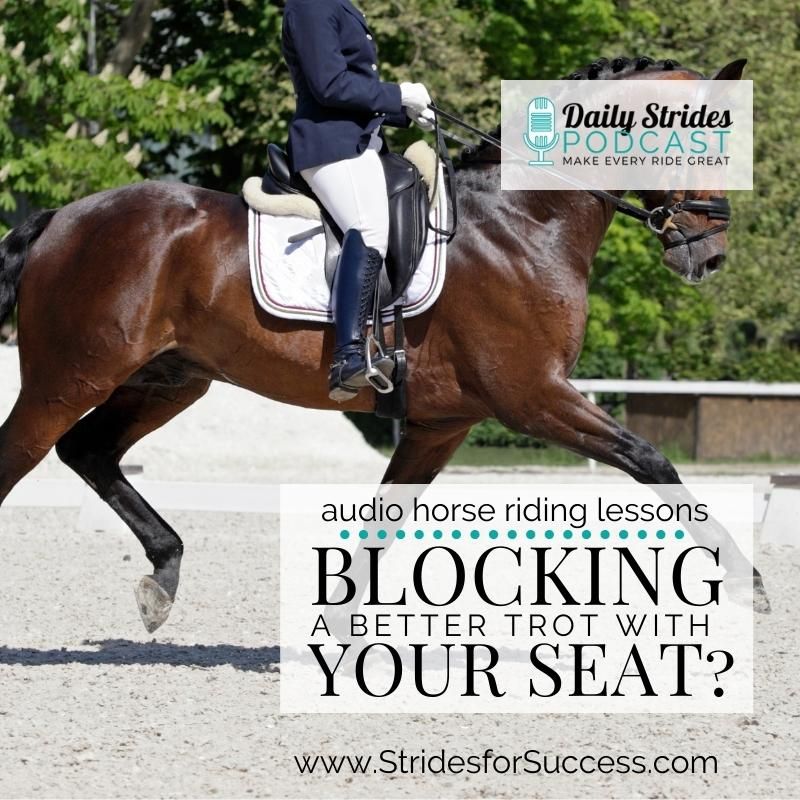
    Are You Blocking a Better Trot with Your Seat?

    [fusebox_track_player url=”https://hwcdn.libsyn.com/p/9/9/4/994f57b1c63c3c6a/1228_Are_You_Blocking_a_Better_Trot_with_Your_Seat.mp3?c_id=120043262&cs_id=120043262&expiration=1643183595&hwt=4d05493255573da0c5346dde60113de4″ title=”Are You Blocking a Better Trot with Your Seat?” social_linkedin=”true” social_pinterest=”true” social_email=”true” tweet_text=”Horse podcast that helps you ride better…” hashtag=”horseridingpodcast” twitter_username=”strides_success” ]

    Let’s be honest; many riders don’t really long for a ‘better trot’ in their riding.  In fact, most are quite happy to simply work with what they already have right now and see the trot as a filler.  A part of the ride that gets you from one thing to the next.

    And trotting, by its very nature, doesn’t really help change this! The rhythm can often have a slightly hypnotic effect on riders.  Lulling them into a contented 1,2,1,2,1,2,1,2, regardless of how good the trot is – or isn’t.

    In this episode, I want to begin helping you to turn your mind towards a better trot.  What would it look like for you and your horse? And how would it feel for you and your horse?  Finally, how prepared are you to actually allow this better trot to happen underneath you?  Will you be able to move with it? Or will you begin to block it with your seat?

    Rhythm & Tempo

    It is easy to simply accept standard 1,2,1,2,1,2, that you feel and move with every time you trot.  Believing that, after finally mastering the whole posting or rising, your work in the trot is complete.   Thinking that your sitting trot is as good as it is going to get right now – and not paying attention to it anymore.

    Being able to stay with your horse while posting, rising, or in the sitting trot is merely the beginning of your work to encourage a better trot.

    And I think becoming more aware of the rhythm and tempo you have right now will then help you know where to focus your attention going forward.  Start by really noticing each distinctive hoof beat inside of each stride.

    By paying attention to each individual beat, the 1 or the 2, you can then begin to notice what is between those beats – the space. 

    Creating More Space for a Better Trot

    How do you think having more ‘air’ within each of those strides will help you and your horse?  It will allow for slightly more time.  A bigger movement perhaps.  More energy. Which will all contribute to ‘more’ of a trot.  A better trot.

    Creating space begins with you, the rider.  If you lose your balance at the slightest change in tempo or rhythm, this is where your work will begin. 

    Focus on using your core in a way that positively impacts you in the trot.  Whether you are posting or sitting, assess if you’re carrying yourself, or being carried along by your horse’s energy.

    Two great exercises to begin testing this are ‘up,up,down’ and ‘down, down, up’.  Basically, you are either sitting or rising for an extra beat each time.  Two downs, followed by one up.  And two up’s (with no down in between) followed by one down.  Doing this will allow you to see if you are supporting yourself, or relying on your horse for support.

    Blocking with Your Seat

    Once you have the basics in place, begin asking bigger questions of your skills by adding more energy into the trot.  More energy will require more suppleness – from you and your horse.  And it is this lack of suppleness in the rider that often causes the seat to block the flow.

    If you feel like you cannot keep up with your horse’s movement, you’re probably right! This is caused by a lack of suppleness (or swing) through your seat. 

    In sitting trot, the result will be more bouncing.  The ‘trampoline effect’ of the horse’s back comes up to meet your bum as it comes down.  This causes that uncomfortable ‘double bounce’.

    When you’re posting, unable to ‘keep up’ will feel like either being left behind the movement or being bounced out of the movement. Both are caused by the rider depending on the horse to move them – rather than taking responsibility for their own body.

    Many riders find that they can do quite well when their horse is ‘slow and steady’ – but as soon as more  energy is made available inside of the trot – they are no longer in sync with each other through the movement. 

    Developing Your Suppleness

    Your suppleness needs just as much attention and work as your horses.  It truly irritates me when riders spend HOURS working on their horse – and then completely fail to work on themselves!  And I believe that riding alone, (unless you are riding all day long, all of the days, the right way), is not enough.

    Just like you use different exercises to develop your horse, find different ways to begin developing yourself too as a rider. 

    The trot requires a ‘hinge-like’ movement through your lower body.  And this movement can be difficult if there is any excessive tension or stiffness through the body.  Particularly the lower back and pelvis. Exercises that work on stretching this area can be of great benefit to riders.

    It is also good to pay attention to symmetry.  Is there a side you favor? Or do you find it easier to do things on one rein over the other?

    Trotting is very much ‘equal’ from a movement perspective, so it is worthwhile working on developing symmetry through your body.  Symmetry and strength.  This will then allow you to have more control over your body inside of the trot itself.

    And by having more control over your body, you can have a more positive influence on the trot itself.

    Happy Riding
    Lorna

    Extra Help for Riders

  • 3 Areas that Can Change Everything In Your Riding

    3 Areas that Can Change Everything In Your Riding

    3 Keys to Changing Everything in Your Riding

    So how do you become a ‘better’ rider?  What should you be focusing on in order to make progress regarding your communication skills in the saddle?  I believe there are three specific areas that, if you work on, you can really begin to see a difference in your riding. 

    There are a lot of areas in riding that you can’t control.  Your horse’s mood or attitude is a good example.  In fact, one of the reasons riders stop making progress is that they focus their attention on the things they can’t control, rather than what they can. 

    The simple truth is that by working on these three core pieces that you can actually control, you can have a much greater positive influence over the things that you cannot. 

    You can never really control your horse.  You can simply influence him… So with that out of the way, let’s get into those three things that I suggest you begin working on today. 

    [smart_track_player url=”https://op3.dev/e/traffic.libsyn.com/dailystridespodcast/1115-3-Areas-that-Can-Change-Everything-in-Your-Riding.mp3″ title=”3 Keys to Changing Everything in Your Riding” social_linkedin=”true” social_pinterest=”true” social_email=”true” tweet_text=”Imagine if there were just three things for you to work on, that had the potential to change everything in your riding… There are…” hashtag=”equestrian #horseriding” twitter_username=”strides_success” ]

    1 .  Your Physical Abilities & Fitness Level

    I am going to ask that, rather than flicking away from this blog post, you hear me out on this.  I know, it seems too simple.  So simple, in fact, that we can actually fail to see how important it actually is.  And, trust me, it is important!

    How fit you are will dictate how well you can control your body while in the saddle.  How well you control your body will dictate how clear you are when applying your aids.  This decides if your horse understands or not…

    I see time and again the hours riders dedicate to creating and implementing fitness and conditioning programs for their horses.  Hours spent planning every little detail of the week.  What food their horse is going to eat.  How many calories.  How long they get to socialize.  And planning their rest time as well.   This is great; don’t get me wrong.  However, this is only 50% of the team.  

    However you want to look at it, you cannot get away from the fact that you make up the other 50% of the team.  Failing to ‘condition’ and ‘increase fitness levels’ for yourself is letting your horse down. 

    Fitness and Suppleness

    There are a few different elements when it comes to your personal fitness.  How fit you are as a rider is a big one.  A few simple ‘tests’ can help you to get a clearer picture of just how ‘riding fit’ you are.  In fact, in the 2020 Equestrian Fitness Challenge, I will be helping you measure your riding fitness levels.  But being Riding Fit is not the only way you can improve your physical efforts while riding.  

    I am a big believer in ‘cross-training’.  Doing a few other types of exercise, out of the saddle, that will compliment your efforts while in the saddle.

    However, like all things there can be a downside to becoming too fit elsewhere.  I have noticed that runners, for example, often struggle with suppleness through their lower backs. Which affects their seat and how they are influencing their horse using their seat.  

    Now, obviously this does not apply to every single rider who also runs.  However, it is just something to be aware of. Suppleness is often seen as something only for horses.  It is equally as important for the rider as well.  

    The energy that moves through the horse, must also move through the rider.  Suppleness is the measure of how easily this energy can move.

    Increasing Your Fitness Will…

    Improve your life!  And of course, help you to become a more skilful and responsive rider as well.  You will find that your coordination will improve.  This, of course, helps with your aids, which is how we communicate with our horse.  

    Your balance will begin to improve, often dramatically.  This is great for staying on initially. However, later it also helps when you are working on improving your horse.  Your balance will help your horse to remain balanced. 

    Your energy levels will increase.  How many times have you been riding and find that before you have even finished warming up, your legs are feeling heavy?  You’re out of breath. Or you simply cannot respond appropriately to those ‘critical’ situations or moments.  

    How many times have you missed out on a great opportunity to just enjoy the canter because you were trying to catch your breath?!

    2 . Accepting Responsibility 

    This is the one that so many riders seem to struggle with.  Looking for things to blame for perceived shortcomings.  The irony is that if they could just accept the responsibility, they could begin to change the outcome!  Responsibility for your own actions.  Your thoughts and your words.  

    Also, accepting the responsibility that the progress you are making is probably being heavily influenced by how you are showing up, in and out of the saddle, for your horse…

    As a rider, you have a certain unique ‘style’ of riding.  That ‘style’ is how you actually teach or train your horse to respond to you.  If you are intentional about it, it will work for you.  If not, it can potentially work against you and your overall goals for your riding.  Taking responsibility for your own unique style is essential if you are to become a better rider. 

    When you are responsible for something, you are then able to make tweaks or changes that will result in a different outcome.  Actively look at ways you can take responsibility for your riding.  It has the potential to change everything!

    3 . Your Mindset

    This is how you are showing up and how you think about things.  Your beliefs and how you ‘do you’.  Your mindset can be easily identified through your stories.  Think about it; if I was to ask you why you are doing something a particular way, you will probably respond by telling me a story to explain why.  

    What is great to note here, is that we actually create our own stories.  This is usually to either make us or someone else, feel a certain way.

    It could be to feel less responsible for our own perceived shortcomings.  To make someone feel pity for us.  Or to make us feel validated.  Maybe to make us feel happy, sad, successful, busy, stressed, energized, anxious… So many feelings!  The important thing is to identify the ‘feeling’ you’re going for and then ask yourself why you’re going for it.

    Your mind will look for ways to validate your beliefs.  A great example of this is the rider who ‘believes’ that they are going to fall off…  Each time they think it or say it, their body aligns more and more with that belief.  

    When I’m in the arena with a rider like that, I can see the physical adjustments the body makes, in order to ‘make it happen’.  Of course, then the rider does indeed fall off, their first words are usually ‘I knew this was going to happen’… Ah, congratulations, you have proved yourself right, yet again!

    Working on Improving You in Your Riding

    I realize that the three topics I covered above seems so simple.  However, doing the work will not always be easy.  It will take time and diligence in order to successfully begin rewiring your body and mind in order to change how you think, feel and act in the saddle. 

    It is ‘do-able’.  Very much so.  But it will require a commitment from you in order to begin making it happen.  

    How soon will you see any changes?  Immediately.  Changing how you think, will change how you feel.  This will change how you act.  When you begin showing up differently, your horse will begin to respond differently. 

    It is as simple as that ;)
    Happy Riding

    Lorna

    Other resources to help you with this topic:-

  • The Direct Relationship Between Your Fitness and Your Riding

    The Direct Relationship Between Your Fitness and Your Riding

    The direct relationship between your fitness and your riding

    What this episode is all about & how it can help you:-

    • How your fitness impacts your enjoyment levels when riding
    • The whole ‘staying on the horse’ element
    • Why it improves your communication with your horse
    • Fast-tracking your progress and breakthroughs

    [smart_track_player url=”https://op3.dev/e/traffic.libsyn.com/dailystridespodcast/1323-REPLAY-The-Direct-Relationship-Between-Your-Fitness-and-Your-Riding.mp3″ title=”The Direct Relationship Between Your Fitness and Your Riding” social_linkedin=”true” social_pinterest=”true” social_email=”true” tweet_text=”Still on the fence about improving your fitness levels? This will inspire you” hashtag=”horseriding #fitness” twitter_username=”strides_success” ]

    Do you find yourself huffing and puffing after a couple of rounds of canter with your horse?  Or perhaps you feel exhausted after only 20 minutes into a lesson?  You find yourself wanting to do or give more effort, but you just can’t…

    My goal for this episode today is to inspire you to have even better communication with your horse by improving your overall fitness in the saddle.  It really has absolutely nothing to do with your horse at all.  This is all down to you, and what you can do to become a better team leader, for “Team You and Your Horse”!

    Rider fitness is a topic that a lot of people seem to avoid or overlook its importance to the overall effectiveness of how the horse goes.  Many riders spend hours planning out fitness, feeding, and conditioning programs for their horse, but fail to pay attention to their own fitness.

    Riding is a team sport, you and your horse.  I believe it is unfair and irresponsible, for you as the rider not to try to be the best version of yourself in the saddle.  The best version of you is one that can respond quickly and effectively and this comes down to your fitness levels.

    Focusing on improving your riding fitness levels will have benefits in so many areas of your riding.

    1.  You Will Enjoy Yourself More

    Have you ever experienced physical tiredness when riding?  It causes a slight lag in the relationship between your brain thinking something and your body doing it.

    When I returned to riding after a break, I both understood and experienced this a lot.  There were days when I felt mentally fine after riding, but physically I was exhausted.  That next day and the John Wayne Walk that it brought with it was not fun!

    In order for me to fully enjoy riding, I realised that I had to begin focusing on my personal fitness journey.  

    2. The Whole ‘Staying On’ Element

    One of the biggest benefits for many riders, when they begin improving their fitness levels, is the fact that they usually feel they can stay on a little easier!  Who doesn’t want that?

    The fitter you are, the better you will be able to cope with any unexpected movements that your horse may throw at you.  As riders, we know that when it comes to horses, things can sometimes be unpredictable.   The fitter you are, the better able you will be to control your body.

    Improved fitness simply means you can control your response; as opposed to just reacting, and trying to hang on for dear life.

     3. Improved Rider Fitness Improves Communication with Your Horse

    Personally, I feel that this is the most important reason for improving a rider’s fitness levels.  As an instructor, I often see how after twenty minutes into a lesson (usually the warm-up), tired riders begin to carry or hold themselves differently.

    A further ten minutes into the actual lesson, where real focus and concentrating are called for, they are pretty much exhausted.  The riders become frustrated because they want to do more, and mentally their brain is telling them to push on through.  But the reality is that their body is just not able to respond.

    Those slow responses, and sometimes even wrong responses ends up muffling the whole communication between the rider and the horse.  This in turn leads to even more frustration – not only for the rider, but for the horse as well.

    Imagine, if you were riding fit, how much more you could accomplish in your schooling time.  Physical fitness also lends to mental fitness.  So, when you are physically fit you will find that mentally, your concentration levels also improve.

    Again, from my personal experience, when I returned to riding I often found that my mind would start to wander after a while – obviously from fatigue.  It led to me being less than one hundred percent focused on what I was doing.  But as my fitness improved – so did my focus and my concentration.

     4.  Fast Tracking Your Progress and Breakthroughs

    Which do you think would help you and your horse get quicker and more consistent results?  An hour of ‘so-so’ work or twenty to thirty minutes of focused, quality work?  When it comes to riding horses, quality definitely outweighs quantity.

    Building your riding fitness will ensure that when you are finished, both you and your horse have enough in the tank to actually enjoy the cool-down, and enjoy each other’s company.  It feels like ‘celebration time’ together; you achieved a good quality workout.

    Imagine finishing each riding knowing that you both gave it your best, you gave it your all, and you had breakthroughs.

    Your becoming a better version of yourself fitness-wise, is going to directly impact the breakthroughs that you have in your riding.  The truth is that when a rider is unfit, they spend so much of their time in the saddle playing catch.

    When you are fit, you can focus on what you are communicating to your horse and how you are communicating it to your horse.  This allows you to respond in such a way that your horse is able to gauge exactly what you are looking for from him in the saddle.  It is only natural that this ‘better communication’ will have a direct positive impact on your progress and the speed of that progress.

    Now, bear in mind that I am all for having relaxing rides on your horse, the two of you enjoying yourselves together.  But wouldn’t it be great if you could get the same point across to you horse in, for example, 7 minutes rather than hammering away for 30 minutes and perhaps still being unsure whether the communication was clear?

     5.  Imagine What Your Horse Would Say…

    Hopefully, I have inspired a little something inside of you today to make your personal fitness a priority in your riding and your life.  If not, here is one final ‘nudge’ that might just help get you off the fence and onto the exercise mat…

    Imagine this … you are finished riding, and you put your horse either in the field or in his stable – either way back with his friends (the other horses).

    What would your horse say about you and about the ride as he experienced it? 

    If you are thinking (even a little), ‘oh thank goodness he can’t speak, or even if he can, thank goodness I can’t hear him’ – perhaps that is a sign that you should be doing a little bit more on focusing on your fitness.

    Happy Riding
    Lorna

    Links mentioned in the episode:-

    Equestrian Fitness Challenge ’24

    Let’s walk together for 21 days and have a chat about how you can do much more than you think you can as a rider and an equestrian… I am so excited to bring you along on this journey for the 100% FREE 2024 Equestrian Fitness Challenge
    There will be a daily walk, a 10 minute daily yoga practice, and lots of tips, ideas, exercises, and ways to improve so that you can show up as the best version of you – for you and your horse.
    Sign up today and let’s transform your riding – one stride at a time! 100% FREE 2024 Equestrian Fitness Challenge
    Have a super day
    Happy Riding
    Lorna


    Connect with Lorna online:-

    Get Going in Your Riding:-

    Daily Strides Premium is back! You can use the first and original audio horse riding lessons to improve your riding, train your horse, keep things interesting, and have fun… Even if you don’t have a trainer or coach