Tag: training scale

  • [Training Scale] Part 1 – Finding Rhythm in Your Training

    [Training Scale] Part 1 – Finding Rhythm in Your Training

    [fusebox_track_player url=”https://op3.dev/e/traffic.libsyn.com/secure/dailystridespodcast/1205_Have_You_Good_Rhythm_in_Your_Riding.mp3″ title=”Finding Good Rhythm in Your Riding…” social_linkedin=”true” social_pinterest=”true” social_email=”true” tweet_text=”How do you know if you have ‘good rhythm’ in your riding?” hashtag=”equestrianpodcast #horseriding” twitter_username=”strides_success” ]

    Rhythm is often a funny thing when riding.  The reason for this is that rhythm, in the true sense of the word, is any beat that is on repeat… And, most horses tend to have a beat or two that they repeat.  This leads many riders to struggle with rhythm.  Their question is “if there already is a rhythm, why is it something to work and develop?”.  And that is a mighty fine question…

    All rhythm is not made equal when it comes to horses, riding, and a general way of going. As riders, we need to find the correct rhythm that we want to repeat; and then make that happen regardless of what questions we ask…

    What is ‘Good Rhythm’?

    I often find that it is easier to begin explaining what ‘good rhythm’ is not. Have you ever been on a horse that feels like they are ‘sliding’ rather than walking?  It kinda feels like their legs are moving so quickly, that they might be moving together? But they’re not jig-jogging or trotting? They are also not gaited…

    The challenge here is that instead of being able to clearly identify a distinct 4 beat rhythm in each stride of the walk, the ‘beats’ are overlapping a little.  The left legs feel like they are almost moving together, and then the right legs.  Resulting in that ‘sliding’ feeling we just spoke about.

    Any rhythm is not a good rhythm when working your horse.  The indistinguishable beat produced by the horse ‘sliding’, while it is a rhythm – it continuously repeats itself – is not the rhythm we want in the walk. 

    A ‘good rhythm’ in the walk will have a clear one-two-three-four, one-two-three-four, one-two-three-four, on repeat.  Clear, distinctive beats that repeat consistently over a period of time.  This applies to the one-two, one, two, one-two, one-two, of the trot.  And the one-two-three, one-two-three, one-two-three, of the canter.

    Can Rhythm Be Improved?

    Okay, so once we can see what a basic ‘good rhythm’ sounds like in walk, trot, and canter, the next question often divides people.  Some riders believe that no, we cannot improve rhythm.  Doing so, or trying to do so, is asking the horse to do something unnatural for their unique abilities and as a unique individual.

    Similarly, there are other riders who believe the exact opposite; yes, you can totally change and ‘reform’ your horse’s rhythm to be different and better.  I’m not a huge fan of absolutes and ‘cookie cutter’ approaches when it comes to horses.  I tend to land somewhere in the middle of this debate…

    I believe that we can ‘enhance’ the rhythm each horse naturally has, particularly when it comes to helping them develop balance and strength through correct training methods, consistency, and time. 

    This means that, yes, each horse has their unique way of going.  However, through correct training, riders can ‘polish’ what is already there so that it becomes both more apparent and more beneficial to the horse’s way of going in general.

    How Do You ‘Develop’ Rhythm?

    I think that it is first of all important to understand the essential relationship that exists between rhythm and relaxation.  In my experience, when one is lost, the other will follow suit very quickly soon afterward!  In fact, many times the reason the rhythm is not ‘good’ to begin with is because of a lack of true relaxation in the horse and rider. I have written and spoken a lot about relaxation previously HERE, HERE & HERE (with more links at the bottom of each of those posts).

    Relaxation, in horse riding, is a word we use to describe how well the tension is being managed in both horse and rider in direct relation to the movement or task being performed at that point in the ride. 

    This means that the relaxation involved in walking to the arena and while warming up will look very different from the relaxation required to jump a 1.4m jump. Neither is better, neither is more correct.  They are different based on the question begin asked.

    To begin working on developing rhythm, it is first essential to identify if there is true relaxation present.  From there, depending on what you are doing (the question you are asking), simply allow your horse to move forward. As he moves forward, a pattern or beat will become noticeable.

    The rhythm that you experience when your horse is walking, trotting, or cantering while relaxed is the rhythm you can begin working with to enhance as you move forward. 

    And What is Tempo?

    Now, this is where I need you to pay close attention…!  So many riders think that rhythm and tempo as the same thing.  And that those words can be used interchangeably.  They are not and they shouldn’t! Rhythm and tempo are related to each other, but they are different.

    Tempo is how often a single rhythm occurs in a given measured space.  This can be measured using time or distance. 

    How often did the one-two-three-four, one-two-three-four, one-two-three-four, of the walk occur between two set poles for example or two points in the arena.  Or how often it repeated in a 15-second duration of time.

    When the tempo increases, or decreases, the rhythm remains the same.  It will just happen more or less often in a given time or space. 

    Maintaining as You’re Working

    Once you have a baseline, the next part of really developing your horse’s rhythm is to notice how this baseline changes when you ask different questions. For many riders, they may notice that the beat remains the same, however the tempo increases or decreases.

    An example of rhythm remaining the same but tempo increasing is often seen when a rider asks their horse to transition into canter through trot.  The one-two, one-two, one-two, of the trot begins to repeat itself far more quickly.

    Similarly, this can go the other way when a rider rides through a corner or bend.  The one-two, one-two, one-two rhythm of the trot decrease in how often it repeats.  The pattern or beat itself remains, but the tempo (how often that rhythm occurs) becomes less.

    I think that noticing where there are changes to both rhythm and tempo when you ask different basic questions of your horse is where you can begin when it comes to working on this. 

    Putting All the Pieces Together

    Again, the true rhythm will only really be there when there is also true relaxation and forwardness.  As you begin working with your horse, look for where any of these are being lost and really notice the effect it has on the rhythm.

    Many horses will become unbalanced, literally taking an ‘odd step’ that feels different to the others.  This will cause the one-two-three-four, one-two-three-four, to change.  Maybe it will feel like one-two—-threefour, or something else.

    Also keep in mind that the bigger the questions, the more likely it will be that this basic will be lost. 

    However, coming back to the basics again of relaxation, forwardness, and rhythm will allow you to begin working on developing the necessary strength in your horse to sustain a truly consistent beat throughout the ride.

    Happy Riding
    Lorna

    Find in the Gaps In Your Horse’s Training

    If you are interested in learning more about where you might be missing pieces in your riding, sign up for my new free training “ FIND THE GAPS IN YOUR HORSE’S TRAINING.  This audio training can be listened to, via podcast app, to help you figure out where to begin working with your horse.

    You can sign up and get it, for free, HERE

    More, More, More… To Help You :)

  • Putting All the Pieces Together When Training Your Horse

    Putting All the Pieces Together When Training Your Horse

    [fusebox_track_player url=”https://op3.dev/e/traffic.libsyn.com/secure/dailystridespodcast/1204_Putting_the_Pieces_Together_when_Training_Your_Horse.mp3″ title=”Putting All the Pieces Together for Your Horse” social_linkedin=”true” social_pinterest=”true” social_email=”true” tweet_text=”Have you been struggling with training your horse? Here’s a way to put all the pieces together…” hashtag=”equestrianpodcast” twitter_username=”strides_success” ]

    It can feel really overwhelming when we begin looking at all the different things you need to include when training your horse, right?  All these ‘steps’ and ‘principles’ are big pieces of a puzzle in their own right; they also have to work together in order to get the full picture!

    The training scale is a proven way for you to take these pieces and make them work, regardless of horse, discipline, schooling, or past experience. 

    And yet, if you just read ‘training scale’ and instantly decided that this is not the way for you where training your horse is concerned; hear me out.  It is not just for dressage.  And certainly not only about pictures of tall men on small horses from the 1900’s… (that is the picture that so many people have when the training scale is mentioned!).

    The training scale is as beneficial for trail horses as it is for dressage horses.  For showjumpers, to riding school ponies.  It is truly a system that helps all horses really harness their natural abilities and develop them. 

    Training Your Horse

    Let’s be really honest here; you are always training your horse.  Whether you are just walking him from the stable to the field, or you are jumping courses of fences, there is training happening.  Training is basically setting boundaries for what you expect and want to happen during the conversation.

    The more ‘developed’ your horse is, the better he will be able to respond to your questions. 

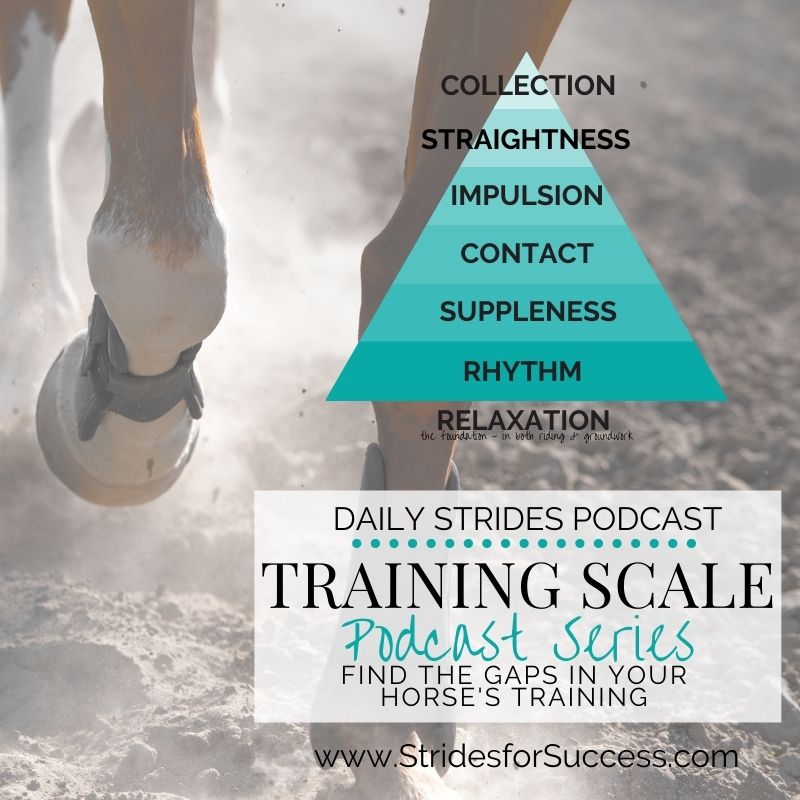
    The training scale is a system that helps him to develop; emotionally, mentally, and physically.  It takes basic concepts and builds on them, step by step, on a scale.  As you work with your horse you will touch on each of these concepts and strengthen them.

    The Steps in the Scale

    There are a few different opinions and ideas regarding the order, however, almost all scales will include the same steps.  Relaxation, rhythm, suppleness, contact, impulsion, straightness, and collection.  They will almost all end or finish with collection being the ‘goal’ or pinnacle of the scale.

    I suggest that when you are training your horse, start with the foundation of relaxation.  Let this be the principle that all the others are built on. 

    I have written more on relaxation HERE and HERE.  I feel it might have a slightly confusing name when it comes to horses and training horses.  Rather than it being about lying horizontal with a glass of something nice, it is about the ability to manage the correct levels of tension for the question at hand.

    In my experience, when the training scale is correctly applied, it will only serve to enhance what is already there; for both horse and rider.  

    Working Through the Steps

    A key question many riders have, is how long will all of this take?  How long can you expect to work on this process when training your horse?  The answer, unfortunately, is a little along the lines of how long is a piece of string?! Horse riding and all that goes with it is ongoing.

    It is something that you can always go deeper and further with, regardless of horse or rider.  There are no ‘end points’ when it comes to developing and training. 

    I think it would be pretty naive to try to work through the full training scale in 6 weeks (allowing a week for each step).  I also think it would be unrealistic to do this in 6 months…  6 years would allow you to see a lot of progress, however, I also don’t believe it could be seen as ‘done’.

    And the lovely thing about the training scale is that, as you work on developing each aspect more, you can do so through the filters of each of the other pieces. 

    Filling in the Gaps

    I would imagine that you have, at some point while training your horse, touched on two or more of the steps in the training scale.  Suppleness and contact, perhaps?  Or relaxation and straightness?  And this is just fine.  In fact, it is how many riders are working with their horses on a day-to-day basis.

    Using a system like the training scale allows you to reach all of the different aspects of your horse’s training.  It allows you to fill in the gaps – and, trust me, there are probably gaps!

    Gaps are funny things in horse riding!  They don’t normally show themselves until pressure is applied. Meaning, both you and your horse may be oblivious to them until something shows up that questions you both.  Maybe it is an unexpected event.  Or a bigger challenge than before.

    When you work with an actual system, it will allow you to return to any gaps and correct them, from a foundational level.  Rather than just putting on a bandaid and saying a prayer! 

    The Foundation

    As mentioned, I do believe in starting with the foundation of relaxation.  Relaxation is simply having the right amount of tension present for the movement that is being worked on at that moment.  It is also for both horse and rider; often excess tension comes from the rider, not the horse!

    As you begin to systematically work on training your horse using the training scale, allow relaxation to be the first ‘filter’ you use.  

    When you look at rhythm, is relaxation present as well?  As you do this more and more you will probably notice a relationship between the two of them, and how, when one is lost the other tends to leave as well pretty soon afterwards!

    From here, as you then work on suppleness, notice if both rhythm and relaxation are present.  Applying this to your training will give you a neverending list of potential things to work on with your horse.  And all through either groundwork, lunging, or riding.

    What Do You Believe?

    The final piece I want to touch on is using the training scale to train your horse by developing him emotionally.  I do think that this is often overlooked.

    We have all met the horse who, we know, can jump the fence; however, sadly, the horse does not believe in his own abilities.  It is never a good place to be, for horse or rider.

    As you work with your horse going forward, think about how you can help him to strengthen mentally and emotionally; not just physically.

    Happy Riding
    Lorna

    Find in the Gaps In Your Horse’s Training

    If you are interested in learning more about where you might be missing pieces in your riding, sign up for my new free training “ FIND THE GAPS IN YOUR HORSE’S TRAINING.  This audio training can be listened to, via podcast app, to help you figure out where to begin working with your horse.

    You can sign up and get it, for free, HERE

    More Resources to Help You on this Topic

  • A Map for Progress in Your Riding

    A Map for Progress in Your Riding

    Having a map often simplifies the journey.  It helps plan a clear route from A to B.  Riding is a journey.  And so many riders want a map or a plan to follow for progress in their riding.
    [smart_track_player url=”http://traffic.libsyn.com/dailystridespodcast/1121-A-Map-For-Progress-In-Your-Riding.mp3″ title=”A Map for Progress in Your Riding” social_linkedin=”true” social_pinterest=”true” social_email=”true” tweet_text=”Hit a plateau in your riding? You need a map…” hashtag=”equestrian #horseriding” twitter_username=”strides_success” ]
    Well, hold your horses!  What if I was to tell you that there is a map available for equestrians.  Oh yes, and it is loosely called the training scale or the traditional training scale.  So many riders discount this because they think that they have to be riding at a certain level in order to use it.  Or that the training scale is only for riders of a certain discipline, usually dressage.
    Many riders also believe that the training scale is only for the horse.  And a certain ‘type’ of a horse at that. This couldn’t be further from the truth.
    Horse riding is a team sport.  Your horse’s long term success depends on your abilities in the saddle.  Improve your riding skills and you will have improved conversations with your horse.  It is as simple as that.

    What is the training scale and how can you use it as a map in your riding?

    The training scale is a basic system many trainers use when working with horses.  There are certain principles or ‘steps’ which, when followed, ensure that the horse and rider have the mental, emotional and physical ability to progress in their training and riding.
    What often happens is that, without even being aware of the training scale, you are working on some of the principles.  However, when one piece is ‘missing’ or weak, you’ll find that progress stalls.  This is where so many horses and riders then become stuck. 
    Understanding what the training scale is and how you can begin using it today will help you with this.  It means you will clearly see what’s missing or needs work.  Which will inevitably lead to fewer gaps in your training.  Fewer gaps mean that momentum can really begin working for you where your training and progress are concerned.
    By following the principles, step by step, you can really make sure you have a full education in riding.  You can also ensure that your horse is being correctly developed, so he will have the physical and mental abilities necessary to progress in his training.

    Training Scale Foundation:- Relaxation

    Relaxation.  It is a big concept for so many riders.  And the fact that is has nothing to do with ‘doing nothing’ is what confuses so many!  Relaxation should rather be called ‘tension management’.  This is what you must do in order to fully understand and implement relaxation.  Manage your tension in the saddle.
    When you try something new in your riding, often relaxation is the foundational piece that needs attention again.  All new principles must be worked through from the perspective of relaxation.  Can you manage your tension levels as you move up and down through the gears or gaits?  How about if you switch from moving straight to moving laterally?  Or if you decide to pop a fence or jump?
    Different tension is needed for different tasks or work when riding.  Relaxation is your ability to manage your tension, so that it appears smooth throughout the ride. 

    Training Scale Step 1:- Rhythm

    Relaxation is the foundation.  This means that rhythm is the first actual ‘step’ on the ladder or scale.  Rhythm with horses, in my opinion, is that your horse is as close as possible when being ridden to how he naturally moves, in the field alone.
    I believe that your natural rhythm is how you feel when you are ‘doing you’.  When you are doing something you love to do that you find easy to do.  The thing that makes 3 hours feel like 3 minutes.  
    The trick is to work on bringing that same feeling across to the saddle with you. That same openness, flow, and energy.  Your natural rhythm.  This will take time to develop, however it is essential to make progress in your riding.

    Training Scale Step 2:- Suppleness

    The loosey gooseyness that is essential for both horse and rider.  I believe that in most cases where riders are ‘stuck’ are due to a lack of suppleness.  This is often seen when the contact is an issue.  It is a lack of suppleness from the rider that is causing the block through the horse’s energy.

    Suppleness is a mental, emotional and physical development.  It is the ability to move and flow, while still remain strong and true. 

    I am going to ask you to really consider this if you are having issues with, for example, contact with your horse.  If it is ‘fleeting’, you have it for a stride or 4 only to lose it again, take a look at your suppleness. Working on this has the potential to really and truly get you unstuck – without having to actually do anything ‘different’ in the saddle.

    Training Scale Step 3:- Contact & Connection

    Ah, the part everyone wants.  The holy grail; ‘on the bit’.  However, this cannot be correctly or consistency achieved if the other parts we have mentioned are not strong and active in both horse and rider.   I often think of contact as being the step of the training scale where both horse and rider ‘graduate’.
    It is where the horse begins to take responsibility for their own actions and way of going.  it is also where the rider must be confident enough to allow the horse to do this. 
    Contact is a little like a contract that both horse and rider are entering into.  I am agreeing to trust you if you meet me halfway.  This is why sawing, pulling, pushing and shoving will not produce correct contact.  The steps we spoke about before are the only way to actually achieving true, lasting contact in the ride.

    The Traditional Training Scale – Steps 4 to 6

    I have created a free mini-course for you where I go into detail far more detail about the training scale.  I really feel that if you can understand these basic principles, it will move your riding forward.  Even the most basic of conversations with your horse has these things woven through it.
    You can find the 5 Days to Clarity HERE.  I hope that you take the 5 to 10 minutes each day to give it a look or listen and really and truly move things forward in your riding.
    Happy Riding
    Lorna
    Other Resources to Help You in Your Riding:-
  • The Basics when Working a Young or Green Horse

    The Basics when Working a Young or Green Horse

    The Basics when Working a Young or Green Horse

    The opportunity to work with a young or green horse comes with great responsibility. You have the potential to place a lasting imprint on this horses riding career; and his opinion of being ridden in general.

    [smart_track_player url=”https://op3.dev/e/traffic.libsyn.com/dailystridespodcast/1109-The-Basics-When-Working-a-Green-or-Young-Horse.mp3″ title=”The Basics when Working a Young or Green Horse” social_linkedin=”true” social_pinterest=”true” social_email=”true” tweet_text=”Are you starting on your journey with a young or green horse? Here are a few helpful ideas…” hashtag=”equestrian #horseriding” twitter_username=”strides_success” ]

    In order to produce a well rounded riding horse, there are a few basic principles that you should pay attention to. Things that, when your horse understands and develops in each element, will lay a solid foundation for him going forwards.

    1. Forwardness

    It seems so basic that it is not even worth mentioning, however you would be surprised how many riders fail to develop this simple yet absolutely vital principle in their young horse from the beginning.

    So often I see riders on young horses and they are just not going anywhere. They may be physically moving forward, but really, there is no energy there. No ‘sense of purpose’.

    Forwardness is not just physical; as in moving. It is also mental. The ability to think forward is vital to your horses successful development.

    Riding a horse who has to be reminded to move forward every . single . stride . is exhausting. Having to continuously encourage your horse to show up is not ideal. However, when your horse learns how to ‘think forward’, the whole feeling of the ride changes.

    2. Relaxation

    When working with a young or green horse, relaxation is so important to begin establishing early in their training. I feel that there are two different types of relaxation when it comes to working with a young or green horse.

    The first is how we think about relaxation ourselves. We are ‘chilled’. There is no anxiety present. He is ‘carefree’ regarding what he is doing. This can often seem to cause issues when we work on being relaxed while moving forwards.

    With horses, there is always a balance that needs to be found. In this case it is the balance between moving forwards and also remaining relaxed.

    The second is relaxation that forms part of the actual training scale. A better name for this type of relaxation is ‘tension management. Excess tension does not have to show up as anxiety. It often shows up in the horses back. Almost like a stiffness.

    Your job is to make sure that as the horse is moving forwards, the tension is being managed. Especially through the horses back, in order to connect the energy from back to front.

    3. Rhythm

    All horses have a natural rhythm. The true aim of the game when it comes to riding is for your horse to display his ‘natural rhythm’ with us on his back, while remaining in perfect balance. No easy feat!

    Becoming aware of the rhythm is the key to helping your young horse develop his natural rhythm while you are in the saddle.

    A great way to do this is by correctly lunging your horse. It allows him to begin really ‘working’, but also learning how to balance himself; without a rider to worry about as well.

    Your horse has to develop. This will take time, as all development does. It is important to allow your horse the time he needs to develop correctly. In doing so, he will become more confident in his abilities.

    I believe that rhythm and confidence are related. As confidence grows, the rhythm becomes stronger, or less fragile.

    4. Suppleness

    Many riders think that suppleness is all about doing carrot stretches with horses. I don’t. Yes, stretching helps, that is without a doubt. However, suppleness is more about your horses ability to use his body while his body is moving. It is an active ability. As opposed to a stationary one.

    Obviously, suppleness is a physical aspect of your horses development. However, suppleness is also a mental element.

    It is the ability to shift and change mentally to the challenges as they present themselves. To remain confident when working through a challenge. Being able to course correct in order to move forwards again.

    5. Contact

    Contact is where things really begin to get serious when training a green horse. This is the first part of the journey where you ask the horse to take some responsibility.

    Contact is almost like an unwritten agreement between horse & rider that you are both willing to show up. You are ready and committed to participating and contributing to the conversation.

    In order for true contact to be present, all of the other elements must be developed to varying degrees first. It is the culmination of the other training elements. Unfortunately many riders try to establishing a contact too soon with their young or green horse.

    Allowing Your Green Horse Time

    Time is the final element that must be considered when training or working with a young horse. The horse needs time to develop, both physically, mentally and emotionally.

    Following a loose training program consistently over time will produce a solid young horse who someone will enjoy for years to come.

    Happy Riding

    Lorna

  • Working with the Training Scale over Groundpoles

    Working with the Training Scale over Groundpoles

    Working with the Training Scale over Groundpoles

    What this episode is all about:-

    • Rhythm & Relaxation
    • Suppleness
    • Contact & Connection
    • Impulsion & Straightness

    [smart_track_player url=”https://op3.dev/e/traffic.libsyn.com/dailystridespodcast/1052-Working-with-the-Training-Scale-over-Groundpoles.mp3″ title=”Working with the Training Scale over Groundpoles” social_linkedin=”true” social_pinterest=”true” social_email=”true” tweet_text=”Groundpoles… Are you wondering how to fit them into your current training?” hashtag=”#MakeEveryRideGreat #Equestrian #Podcast” twitter_username=”strides_success” ]

    Groundpoles… So many riders work with them on a regular basis with their horses.  However many riders struggle to work on specific areas in their training while using the groundpoles. 

    In this episode of the Daily Strides Podcast we are going to focus on how you can use groundpoles in your training that will complement what you are working on.  We will break down how they can be used; with a focus on the principles of the traditional training scale. 

    Rhythm & Relaxation

    Many riders make the mistake of assuming that the pole or poles will dictate the rhythm for them.  They see it as something that, because of the sequence of poles, doesn’t have to be worked or focused on.

    However, very often the loss of rhythm is happening either before or after the poles – which can cancel out the benefits of working over the poles to begin with

    When riding over or through groundpoles, make sure that there is consistency in the rhythm and tempo all the way through.  The ‘before’, the ‘over or through’ and the ‘after’.  The only way to really ensure this is happening is by becoming mindful of the rhythm to begin with.

    You can also focus on consistent relaxation throughout the exercise.  This is the management of the tension throughout the line you are riding.

    Make sure there is no anxiety present.  The same with too much energy or tension caused by over excitement or anticipation.  The tension should be sufficient to get to you the poles, over or through the poles and, then, away from the poles.

    Suppleness

    Most riders think of suppleness as being ‘bending’ or ‘flexing’ from one side to the other.  They are not wrong, suppleness is flexibility.  However, when working with groundpoles, we can look at suppleness in other ways as well.

    Suppleness of the joints as the horse has to lift his legs ‘higher’ to clear the poles.  Suppleness through the back, tail to poll, as the horse reaches for each step. 

    Think of your horses back as being a rainbow shape as he works over the poles.  You are on the top, in the centre of the rainbow.  His hind legs are having to stretch or reach more underneath him to power through the poles.  His head and neck will be working into the contact in front.

    The rider must allow the horse to engage through his core, ‘lift’ his back and connect the energy through from back to front.  This requires suppleness through both the horse and the rider to happen. 

    Contact & Connection

    When that suppleness is missing, either due to the horse being stiff, or due to the rider being ‘heavy’, the horse cannot connect through.  Which impacts the contact that is present as the horse works through the poles.

    Rather than throwing the contact at your horse through the poles, work towards creating and maintaining a consistent contact before, during and after the poles.   

    You should not have to lean on your horse’s neck or withers.  Your horse should not have to lean on your contact through the poles either.  Rather think of it as you both agreed to go together and hold hands through the exercise.

    Impulsion

    Earlier we mentioned how relaxation was the management of the tension throughout the exercises or movement.  Impulsion is the management of the energy.  The creation, how it flows or connects through and where it is directed to.

    As the horse is pushing through from the back-end or hind quarters, you are allowing that to connect through to the front.  It creates the rainbow and now you are directing it to where you want it to go. 

    Impulsion requires suppleness and an independent seat from the rider.  True impulsion requires relaxation, rhythm, suppleness and contact from the horse.  When you are managing the energy, you are deciding where it will flow to, which leads to…

    Straightness

    Straightness over poles is when both hind legs are propelling the horse forward with an equal amount of energy. There are no leaks, no falling out, no bulges; it is just flowing through the horse.

    Very often crookedness is a sign that there is a weak area, a lack of strength, which can be worked on through correct training.

    Straightness will not be present, in its truest form, until much later in your horses development due to the need for symmetrical strength. 

    However, it can be worked towards from early in your horses schooling.  It is also key to remember that the training scale applies to you as well.  Your straightness is just as essential and also needs suppleness in order to develop.

    Choosing a Focus for Your Groundpoles

    It would be incredibly difficult to think of all of these principles every single time you ride over or through groundpoles.  There is simply too much.  However, I suggest choosing one and making it your focus for each ride or session.

    Keep in mind that no principle of the training scale should be worked on in isolation.  As you focus on the ‘one’, the others will all play a part in mastering the one. 

    I am going to suggest starting at the beginning, with relaxation and rhythm.  Notice that as things become more difficult, you may have to go back a step of two in order to build confidence.

    Happy Riding

    Lorna

    Links mentioned in the episode:-

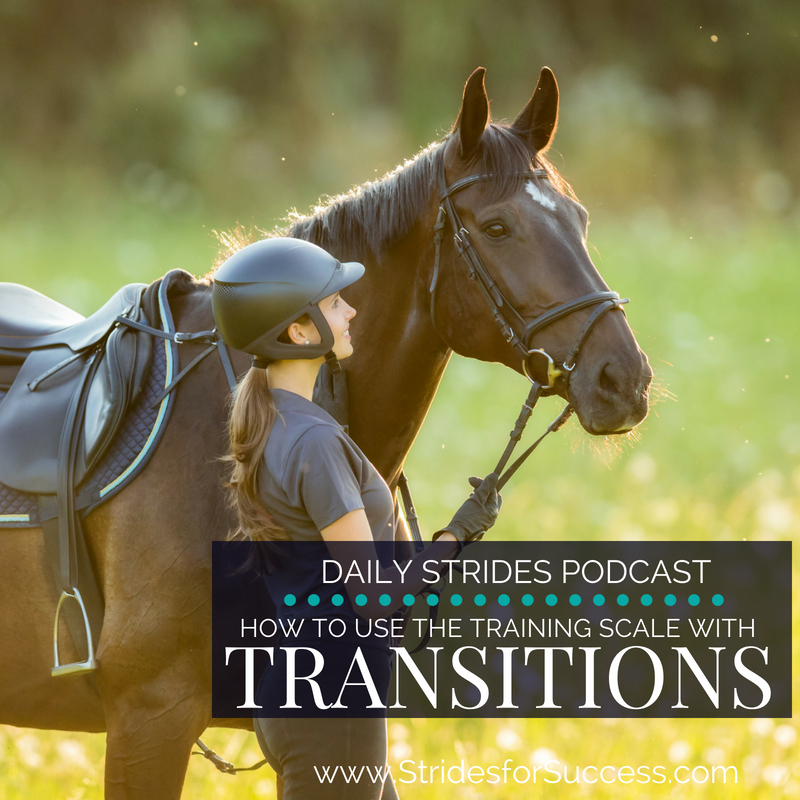
  • How to use the Training Scale with Transitions

    How to use the Training Scale with Transitions

    How to Use the Training Scale with Transitions in Your Riding

    What this episode is all about & how it can help you:-

    • Relaxation and Rhythm
    • Suppleness and Contact
    • Impulsion and Straightness
    • Putting it all together

    [smart_track_player url=”https://op3.dev/e/traffic.libsyn.com/dailystridespodcast/1046-How-the-Training-Scale-works-with-Transitions.mp3″ title=”How The Training Scale Works With Transitions” social_linkedin=”true” social_pinterest=”true” social_email=”true” tweet_text=”Ever wondered about the training scale and how it can help you ride better transitions? This episode from the Daily Strides Podcast will help” hashtag=”Equestrian #Podcast” twitter_username=”strides_success” ]

    The Training Scale is an important principle when it comes to riding and working with horses.  It is particularly important to consider the training scale when it comes to riding good transitions.

    However, you may find yourself thinking “How could I possibly fit the Training Scale into a couple of seconds?”…  That is what this episode of the Daily Strides Podcast is all about.We are going to begin at, well the beginning, the very start of the Training Scale which is Relaxation.

    Relaxation and Rhythm

    Relaxation is a principle that a lot of riders tend to become confused about.  This is often due to how we see relaxation in our everyday life and how we use the word relaxation in day-to-day living.  That is not this!  Please keep in mind that they are not the same thing – at all!

    Relaxation is the foundation of everything when it comes to riding and working horses.  I find that relaxation goes hand in hand with rhythm.   In fact, you will find that in some variations of the Training Scale they are somewhat interchangeable depending where they are and what they are doing.

    The first step to a good transition is the setting-up and preparing of your transition.  This simply means that whatever you are doing at the point before the transition must be ‘good’ and of a high quality.  You can usually assess this by assessing the overall quality of relaxation and rhythm in that exact movement and moment.

    The Catalyst for Your Transitions

    Have you ever thought about the word transition.  It means ‘change’.  As you ride through the transition, things are going to have to change.  However, in order for things to change, there must be a catalyst.  Something which, when added to the ‘mix’ will produce a change.

    In riding, the catalyst is very often the amount of tension present in the horse and rider. 

    This tension is not excess tension, which will show up as a loss of relaxation and rhythm.  Rather it is a change in how the energy is used, the tension, in order for the change to happen.

    However, when we focus on developing relaxation based on our day-to-day idea of it, the transition is going to suffer.  Many riders fail to see this difference.  They think things must remain the same.  However, if things remain the same – well they will stay the same!

    Your job as the rider is to manage this change of tension.  You can do this through your half halt before the transition and your ‘allowing’ after the transition.   You create the necessary tension and, also, you then smooth everything out afterwards. 

    They key is to manage tension so much so, that to those watching on the ground, it will appear relaxed all the way through.  From the original movement, through the transition and on to the next movement or gait.

    One of the best ways to measure your success in doing this, is to keep an eye on the rhythm.  Generally speaking, if the relaxation goes then the rhythm will follow suit.  These are the basics of the training scale that everything else is built on.

    Suppleness

    I believe true suppleness is two-fold.  You must be supple in the way you are approaching the transition mentally and physically.  The suppleness of the approach comes into the balance of your aids, and how you are going to ride this transition, to make it the best it can be.

    Suppleness in transitions, from your horse’s point of view, is the ability to manage that energy change. 

    The energy change comes through when the horse is literally changing what he is doing.  This could be that he is lengthening or shortening his strides.  It could be that he is moving between gaits.  Maybe that he is going from being straight to having slight flexion.  Whatever the case may be, there is a change happening.

    Working on your horses suppleness through that transition is working on how he is managing to allow that energy to flow through him, while this change is happening.  The more successful he is, the more supple he remains through the transition. 

    The more smooth it looks. The less energy is lost.

    Contact and Connection

    The next step of the traditional training scale is contact and connection.  Simply put, this is looking at how successful you are at keeping the energy connected through the transition.

    One of the easiest ways to simplify this is to think about your contact and connection in day-to-day life; it is simply your communication with other people.

    The trouble is that many riders think that contact is only to do with the reins, the bit and the hands.  It is not!  You are in contact and communicating with your horse in so many other ways – your legs, your seat.  You can influence your horse with your body, your voice, your thoughts.  All of these are contact points with your horse.

    So, rather than thinking about contact and connection as just being to do with your hands and arms, think of it as being more holistic. How am I communicating? 

    Here are a few questions you can ask yourself next time…  How am I connecting with my horse at this point through this transition?  How am I setting up this transition?  How do I do this in a way that as we move through this transition?  How am I connecting and communicating with my horse?  What is the contact and connection looking like, all the way through?  Is it consistent all the way through?

    Obviously, the consistency will not be the same all the way through, it must change because a transition is a change.  Therefore being able to balance your aids, balance the contact and connection all the way through the change of the transition, is what you are looking for.

    Impulsion

    Impulsion simply means that there is enough energy being created and held inside of the system that is ‘you & your horse’ to make something happen.  In this case it is the transition itself.

    My big piece of advice when it comes to training scale, impulsion and transitions is to make sure that you are not forgetting that the transition must go somewhere – you are transitioning into something else. 

    Sometimes riders can become so focused on the transition itself, that they forget to focus on what needs to happen afterwards.  Impulsion is there to make sure that you are having this continuation of energy all the way through.  It also ensures that whatever you are transitioning into, will have enough available energy there to carry it forward and maintain.

    Your job as the rider is to ensure that you are managing the impulsion.  You are setting things up so there is enough available energy there.  It is a balance.  If there is too much energy you will feel things become a little, well, volatile!  If there is not enough energy, it is not going to carry you through the transition.  There is a very fine balance that must be maintained all the way through.

    Straightness

    One of the ways to balance this by maintaining true straightness true your transitions.  Your straightness is really your channel.  It is your way of ensuring that the energy you create is directed, or channelled, where you want it to go.

    Leaks are where this energy is lost.  You can prevent leakages through focusing on the straightness.  The other thing you can manage, and hopefully prevent, are ‘explosions’!  If there is too much energy bundled up and it is not allowed to flow through, there are going to be ‘explosions’!

    I suggest that you think of straightness as not just channelling the energy, but consistently flowing the energy on to something else. 

    Your straightness through the transition is making sure that the energy is getting through to where you want to go.  Remember, the end point is what you are transitioning into.

    Collection

    The final step on the training scale is collection.  I don’t really feel that collection in and of itself, is necessary.  But where I would see the collection coming into each transition is the balance, or control, of all the above.  The half halt could perhaps be used to just re-balance as you are working through that as well.

    Collection is almost the gauge of the strength and obedience.  It is outcome when you are able to combine all the other pieces together in a balanced way.

    Putting It All Together

    We have covered a lot today.  In fact, each of these topics truly deserve a post or episode to themselves!   But if you can try to approach each transition by thinking about having all those elements and factors present.

    I really feel that understanding the connection between each of the steps of the training scale will help you as a rider; regardless of your level of experience.  With the Training Scale, one piece can never really be worked on in isolation.  There should always be a holistic approach to each of the steps as you are working with them with your horse.

    Start at the beginning with the basics, but have your eye on riding them through the filter of eventually developing the top level steps as well. 

    Happy Riding

    Lorna

    Links mentioned in the episode:-