Tag: training scale

  • Has Tension Been Holding You Back in Your Riding?

    [fusebox_track_player url=”https://dts.podtrac.com/redirect.mp3/pdcn.co/e/traffic.libsyn.com/dailystridespodcast/1352-Has_Tension_Been_Holding_You_Back_in_Your_Riding.mp3″ title=”Has Tension Been Holding You Back in Your Riding?” social_linkedin=”true” social_pinterest=”true” social_email=”true” ]

    As riders, we can often have a very negative association with tension. Yet, without it, neither you nor your horse would remain upright! Take away the tension and both of you will go limp and become a ‘dead weight’ immediately. So, instead of seeing tension as the enemy – it’s key to begin reshaping your understanding and your ‘practice’ of tension. You must begin managing your tension.

    Tension is absolutely 100% essential for both you and your horse. It’s the presence of too much or excessive tension that causes the issues… 

    Tension management is often called relaxation when it is related to horses and riding. And, just like tension, many riders don’t really understand the concept of relaxation as it pertains to riding and training horses. I don’t want to go too deep into relaxation today (there is a previous post and episode on that HERE).

    What’s important to understand about tension and relaxation is that it’s not just about the horse. This principle is equally as important for the rider to understand and develop throughout their own body. 

    In this episode of the Daily Strides Podcast, I will help you to begin developing more tension management throughout your body by beginning with creating ‘calm’ for both you and your horse. You will do this through your own actions and thoughts while working with your horse.

    What Is Rider Tension?

    As I mentioned, it’s what keeps you upright in the saddle! It is 100% essential in order for you to get on and stay on. It’s when the tension levels get too high that riders begin to see problems show up. This becomes especially obvious in your hands, shoulders, seat, and jaw!

    And when your level of tension becomes excessive, your horse can feel it too… Both physically because you are probably blocking through your body. And also emotionally!

    Many horses, when they feel the rider’s level of tension increase, simply mirror this back to the rider. There are lots of reasons why this is true. What’s important is that you begin to see the correlation between the tension in your body and your horse’s tension.  In horses, excessive tension can show up as anxiety, ‘rushing’, ‘pulling’, ‘bracing’, choppy steps, hollow back, and lack of focus on the job at hand.

    Resetting Your Tension Level

    Imagine the difference you would experience if you could quickly identify excessive tension through your body; and then take active steps that allow it to dissipate quickly and gently. Learning how to do this is essential for all riders.

    And while many riders can lower their tension levels while in the saddle, if this has been ongoing, you’re actually better off practicing managing your tension from the ground

    There’s less to distract you, less risk of things going sideways, and space to keep the focus on you while you reset. I’ve always noticed that one of the worst things to say to someone who is feeling tense, anxious, or over-excited is to ‘calm down’! What I’ve found works best is to gently bring awareness to how it actually feels in the body. Becoming aware of how your physical body actually feels at that point in time…

    Finding Your Neutral…

    I’m going to suggest a slightly different approach to ‘resetting’ your tension levels. Especially if they have a habit of going sky-high at the slightest inkling of something changing! Start on the ground. Close to your horse. If being right beside your horse increases your tension, step back. Go outside of the paddock, stable, or pen.

    Find the place where you really do feel relaxed in your body while standing up. Not tired or slumped. Alert, focused, and ready to interact with your horse – while maintaining the rhythm and flow of your movements and breath. 

    Then just take a moment or 5 and notice how this feels in your body. Are your shoulders still ‘high’ and tense? If so, intentionally drop them down. How about your jaw? I personally find myself holding excessive tension there; maybe you’re the same? If so, simply relax the muscles. And do this throughout your whole body. Anything that is ‘too much’ for what you are doing at that moment (standing close to your horse), open up and relax. Then pause a moment and feel how this is different from when you initially started.

    Let Your Horse Be Your Mirror

    Once you have found neutral, begin to intentionally interact with your horse. As you do this, look for responses or signals from your horse. They will probably be very subtle – but they will be there. As you become more intentional with your interactions, your horse’s signals will become more obvious. This is how we communicate with our horses.

    By paying attention here, you can use your horses responses to see where excessive tension might be building again through your body. Check in with your physical self frequently – and then look for how your horse mirrors this. 

    As riders, we can become so caught up in ‘doing things right’ or things being a certain way, that we miss the small subtle telltale signs that can guide us. As you move closer and closer to your horse, pay attention to how your body feels – and how your horse is responding. You may even notice that you begin mirroring each other’s breath rate, etc.

    Practice on the Ground…

    Once you have your ‘neutral’, your goal is to begin seeing this as the norm in your riding. Being able to mount up and work your horse with the exact right level of tension for the activity you’re doing at that exact moment. Tension levels fluctuate all of the time. They’re up and down. The problems show up when they get stuck on ‘high’!

    As you physically interact with your horse on the ground, begin thinking about being in the saddle. Again, notice how your body physically feels in this moment – and then imagine that same feeling in the saddle. This may be difficult initially, especially if you have been running on ‘high’ for longer than a few days!

    Every time, as you imagine yourself in the saddle, you physically feel your body becoming tight or stiff, intentionally relax or soften that part. Try including an intentional exhale as you do this as well. 

    As you practice this more and more, from the ground, you will see patterns begin to show up. Maybe it’s your jaw. Or your wrists. Perhaps your lower back or core becomes tight and stiff. Chances are that what you are feeling as you imagine riding (even though you’re on the ground) are the same feelings that are happening when you’re in the saddle. Knowing where your body holds excess tension will allow you to become faster at releasing it when it shows up.

    Grounding Before Each Ride

    If you have been struggling with excessive tension for a while, I strongly suggest investing time in learning to reset this while on the ground. 5 minutes spent grounding yourself and your horse before you mount up can work wonders in developing the connection between you both. It also gives you time to really become intentional about the type of energy you want to carry into the ride itself.

    And when you know how your body responds to too much tension, you can identify it more quickly – and let it go before it becomes an issue.

    When you begin working in true relaxation and flow, your horse will positively respond to that. Reducing the tension in your body will have an immediate knock-on on effect on your horse. And this will help you both to feel and develop a more positive connection with each other.

    The Energy Connection

    There are so many different ways and exercises you can use to help develop a more positive energetic connection with your horse. If you’re keen to find out more, join me for this free online training where I will give you exact exercises you can use to develop this with your horse.

    You can register for free for The Energy Connection Webinar HERE

    And, until then, take the time to ‘feel’ into your body. It will guide you as to where you are holding onto too much. Your intention will help you to release it – for both you and your horse.

    Happy Riding
    Lorna

    More on This Topic:-

    Online Training to Help Your Riding

    Connect with Lorna online:-

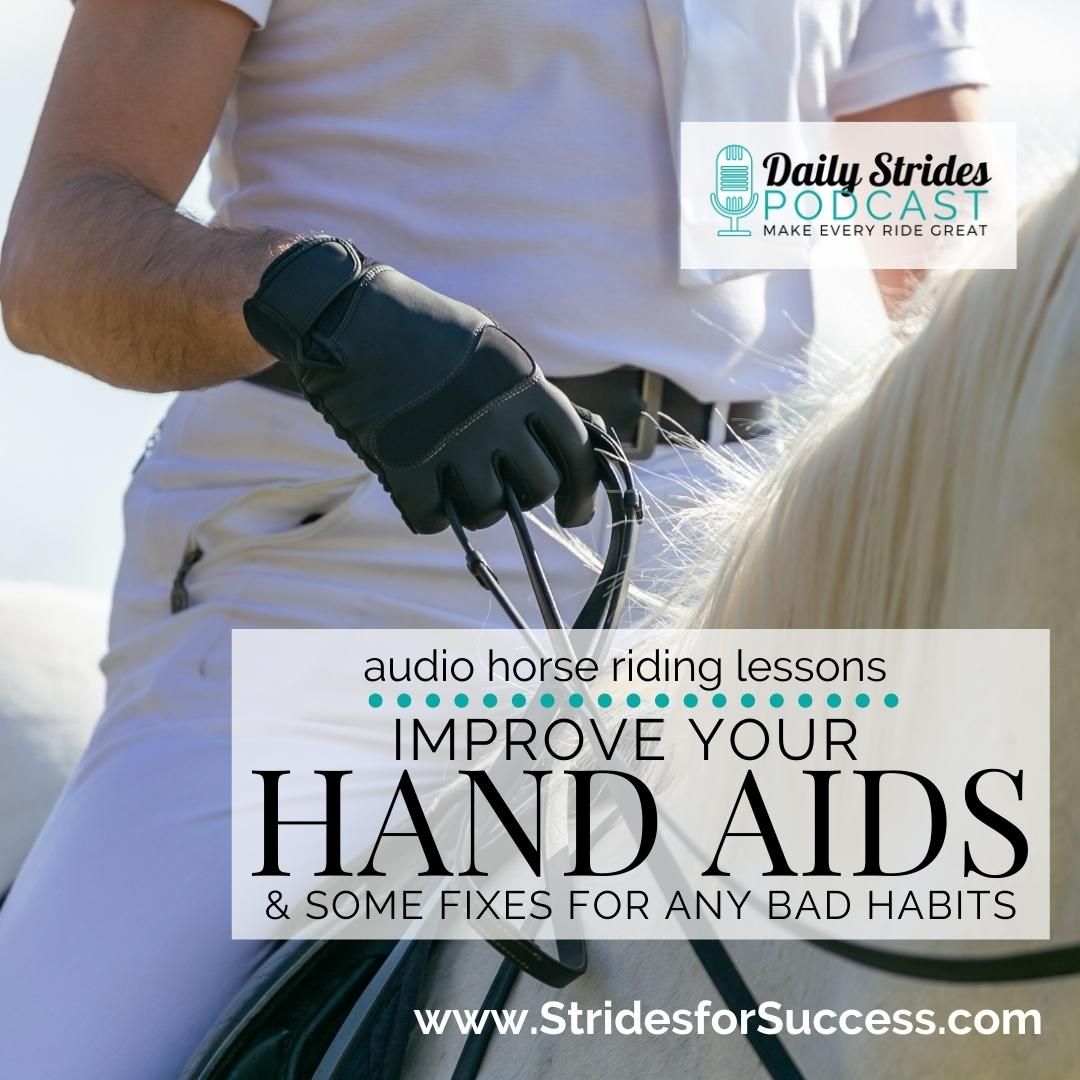
  • Simple Tips to Improve Your Hands & ‘Fixes’ for Those Habits…

    Simple Tips to Improve Your Hands & ‘Fixes’ for Those Habits…

    [fusebox_track_player url=”https://op3.dev/e/traffic.libsyn.com/dailystridespodcast/1271_Simple_Tips_To_Improve_Hands_and_Fixes_for_Bad_Habits.mp3″ title=”Simple Tips to Improve Your Hand Aids and Correct Bad Habits” social_linkedin=”true” social_pinterest=”true” social_email=”true” tweet_text=”Better hand aids for riding with this podcast episode” hashtag=”horsepodcast” twitter_username=”strides_success” ]
    Your hands are an aid in your riding. So understanding why the way you hold your reins and how to judge the height of your hands when riding is important. And realizing how much your hand aids are impacting and affecting your riding can change everything.
    As riders, one of the first things we learn is how to ‘hold’ the reins.  However, often the ‘why’ behind all of this is never really explained to us.

    Your Hands Connect

    So, it’s obvious that your hands are the connection between you and your horse’s mouth through the reins.  And it would be an awful pity if that connection ended there! As riders, one of our greatest responsibilities is to refine communication.
    When you refine your hands and how you use them with your horse, you can truly help to enhance the whole conversation between you and your horse.
    So just like with all of your aids, a great place to begin when refining your hands is their position. Being in the ‘right place’ will allow you to give more precise aids to your horse. And when we can create more clarity in our communication, it shows in our riding.

    What to Aim for with Your Hands

    Before we go any further it is worth mentioning that each horse and rider combination is a unique and individual blend.  However, there are a number of basic guidelines you can follow to really begin refining your hand aids.  And of course, develop better contact and connection with your horse.

    Thumbs on Top

    This is one of those really small details that makes a MASSIVE difference to your riding.  Holding the reins while in the saddle should feel like carrying two cups of tea (or coffee, hot chocolate, etc.).  If you were to carry the cups or mugs with your knuckles on top, there wouldn’t be anything left to drink when you finally go to take a sip.

    A great experiment is to literally pretend you’re riding and both carry your hands with your thumbs on top. Your hands will be around your belly button height in front of you.  Now, from this place, turn your wrists so that your knuckles are on top.  And feel the difference down and through your arms.

    Turning your hands so that your knuckles or the back of your hand is on top will create instant tension down through your arms.  When riding, this tension is passed through the reins to your horse’s mouth.  Not good! 

    Side View – Elbow, Wrist, Thumb, Rein, Mouth

    The first thing to look for is a relatively straight line from your elbow to your horse’s mouth when viewed from the side.  Now, I get that this can be difficult to really ‘see’ when you’re the one riding the horse!  However, if you don’t have mirrors, there are other options available.  Review some photos or videos of yourself while riding.
    The important thing to note here is that this ‘line’ should be there regardless of what gait you’re working in, or what moment of that gait your horse is currently in when the photo was captured. 
    This will indicate if your hands are truly fluid, elastic, and supple.  Your ability to ‘follow’ your horse or ‘stay with’ your horse through your hand aids is vital to really developing true and lasting contact.

    Overhead View – Wrist, Thumb, Rein, Mouth

    This second ‘view’ is one you can do all the time when riding.  The key is to ‘glance’.  Not LOOK! Looking will create a whole host of other habits that you don’t want to fall into habits with! Okay, so to check this you will, as you ride your horse, glance down at your hands.

    Notice how straight the line is from your wrist through to your thumb and then on down the reins to your horse’s mouth.  If you notice any ‘curling’ or ‘twisting’ simply straighten things out. 

    This particular ‘line’ is very much dependent on your thumbs being ‘on top’ as you ride.  If your hands have turned so that your knuckles are on top (like riding a motorbike) or your fingernails are on top, revert back to thumbs on top.  It will look and feel like you’re carrying two cups of tea :)

    If Your Hands Are Too Low

    This is the most common challenge I see with riders when it comes to their hands. Riders are trying to work their horses and improve the overall way of going, but literally ‘blocking’ their success!  Riding with your hands too low can be caused by a few different things.  Often it is a habit that was created due to holding onto the pommel or a neck strap.
    Another reason riders tend to carry their hands too low comes down to a lack of understanding regarding contact and ‘on the bit’.
    Many riders feel that when they lower their hands and then apply pressure quickly from each alternative rein, their horse will magically go ‘on the bit’.  And yes, the horse might tuck their head in to try and get away from the discomfort of the rider’s hands.  But this is definitely not being ‘on the bit!’.
    Hands that are too low can be corrected by simply bending the elbows and ‘carrying’ the hands more. Doing this will allow for greater elasticity and suppleness. Both are essential for correct contact. 

    If Your Hands Are Too High

    This is, thankfully, not as common as the low hands. And I say thankfully because this particular habit can often lead to a lot of needless discomfort for the horse.  High hands really change how the bit interacts with your horse’s mouth – and usually not in a great way.  Especially if not intentionally done.
    I think the big reason riders can develop this habit is due to a lack of balance. Very often, when the rider carries their hands too high to be effective as an aid, they are doing so to try to either remain balanced – or stay on!
    Excess tension in the rider’s body due to nerves or fear can cause them to raise their hands higher than what would be normal when riding.  The irony of doing this is that the horse usually becomes hollow through the back, which causes the rider to experience more bumps, wobbles, and bangs as the horse moves.

    If Your Wrists Are ‘Twisted’

    This is when you ‘glance down’ (important to emphasize – we are not LOOKING; just glancing) and you see that the line from your lower arm to the rein is not straight.  This lack of straightness can vary from anything like a slight ‘kink’ to a complete ‘lightning bolt’ shape!  True story!  The key to changing this is to first identify it.
    If you glance down and things are less than straight, focus on thinking about your lower arm (hand to elbow) as being an extension of the rein. Then just ‘straighten’ that rein out. 

    By creating that ‘straightness’ from the elbow, through the wrist and thumb, and then onto the rein, you create clarity with your questions. Clarity with your aids. This issue often comes up when a rider doesn’t want to necessarily ‘pull’, but they still feel the need to apply a lot of pressure with their hands. It can be a difficult habit to break, but one that is worth persevering with.

    If Your Knuckles Are On Top

    Ohhhh, this is something I personally resonate with.  I spent a couple of years doing ‘work riding’ for a racing yard.  This was coupled with teaching and actively eventing.  It did not all blend well.  I’m pretty sure that there are so many riders who can make this work – and let’s be honest, I did at the time.  But if I knew then what I know now… A completely different approach would have been taken!
    For me, this particular habit developed in my left hand.  I’m right dominant, so perhaps this was the reason? Either way, it became a MASSIVE issue for me later in my riding. 
    My left hand would just, on its own, revert to ‘knuckles on top’ when riding.  This, obviously, affected the contact between me and, well, any horse! And yet, it took me quite a few ‘seasons’ in my riding for this to be noticed. And a far few longer for it to be corrected!
    Trust me; knuckles on top changes EVERYTHING between you and your horse when riding. From how you move your arm, to how it feels in his mouth… EVERYTHING 
    If you find yourself with this habit, one or both hands (mind was just the left hand), focus on this first.  Think of carrying cups of tea and not allowing an ounce to fall… There is a certain way we move our bodies when we’re carrying cups of tea (or whatever). If we put that same fluidness into our riding… #Winning!

    Your Hands as Your Aids

    We connect with our horses on so many levels.  Our legs, our seats, our hands, our mood, our attitude, our intentions, our focus… And on and on it goes.  Yet, if we don’t develop our hand aids past what we learn in that very first lesson, we are doing both ourselves and our horse a disservice
    Your hands are your connection to something your horse NEEDS; his mouth
    His mouth is an absolutely essential part of his health, life, and experience every single day.  So it makes sense to spend time refining this aid… Maybe to the point where it becomes ‘feather light’ and ‘feather soft’.
    And in between, do all you can to remove any excess tension will definitely help :)
    Happy Riding
    Lorna

    More on This Topic:-

    More Training & Support

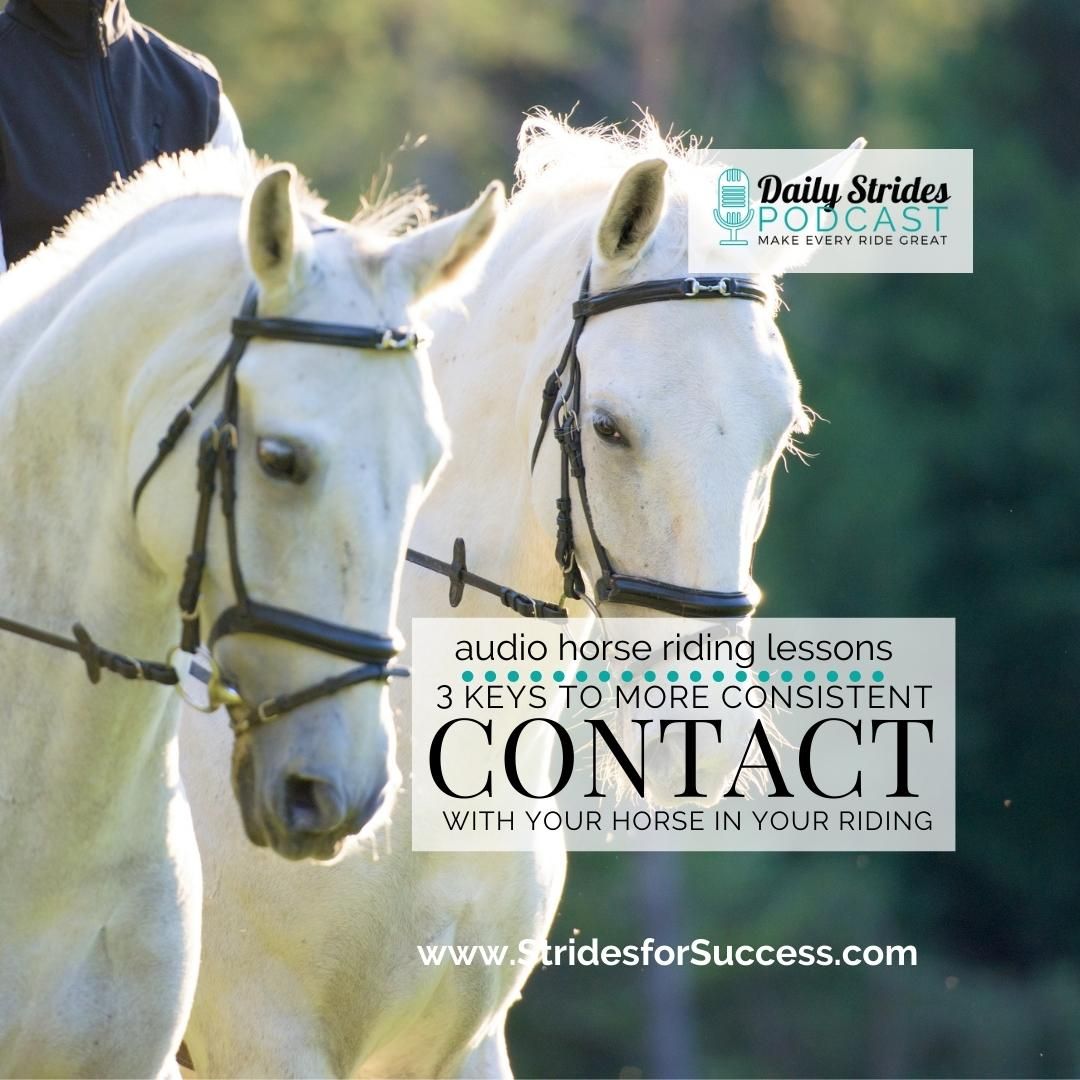
  • 3 Keys To More Consistent Contact

    3 Keys To More Consistent Contact

    [fusebox_track_player url=”https://op3.dev/e/traffic.libsyn.com/dailystridespodcast/1258_3_Keys_to_Consistent_Contact.mp3″ title=”3 Keys to Consistent Contact” social_linkedin=”true” social_pinterest=”true” social_email=”true” tweet_text=”Hi, you might enjoy this podcast episode about contact with your horse…” twitter_username=”strides_success” ]

    Contact can often look effortless for some horses and riders. And yet, for many other riders, consistent contact can seem like an enigma. Any efforts at consistency tend to lead to heaviness. Or a complete lack of any contact!  So where is this fine line between consistent, quality contact and washing lines?

    In order to develop contact with your horse, I feel that you must first understand what a ‘good’ contact is. This can often be confusing for many riders, so let’s start there…

    What’s Needed for Consistent Contact?

    Contact, for many riders, has to do with the reins.  And, yes, the reins do play a part in the contact conversation.  However, a good quality consistent contact is more than just the two strips of leather between your hand and your horse’s mouth.

    Contact is really the result of a lot of other things successfully working together first in your riding. Relaxation, rhythm, and suppleness are the obvious ones.

    As you begin to put all of the parts of your training together, over a period of time, you will see that contact begins to happen.  And this can be the challenge initially, maintaining contact.  Because, as you know, maintaining all of the other steps of the training scale that occurred before it, can also be a challenge! Especially when a bigger question is asked.

    Along with the obvious prerequisites for good consistent contact, are some more overlooked necessities. Things like your position, timing, and aids. And then your horse’s acceptance, and ability to take responsibility also need to be present.

    Click here for Free Half Halt Audio Lesson

    How It All Works Together

    Imagine being in a good position to ask a well-timed question and then allow the answer to happen.  There is the right amount of energy entering the channel that you and your horse create together (the container). Your horse is responsive and wants to work with you.

    You can feel the energy being created in his hindquarters and travel underneath you, along his back. As it does so, you can feel the lightness of the shoulders, head, and neck. The energy connects through to the ‘contact’ and then is harnessed to be reused again going forward. 

    The self-carriage you feel from both yourself and your horse is a key element to true, sustainable contact.  This self-carriage will only develop over time through correct and consistent practice. And this is a responsibility that both you and your horse share.  Each of you committed to carrying yourself so that the other ‘team member’ can do what they must do in order for you to both works together. That is true contact.

    True contact is an agreement that you both mutually respect and work towards sustaining as you develop together as a team. It’s the connection between horse and rider. 

    You can begin working towards this today by making sure that you are consistent with these three elements in your riding. This will allow your horse to begin working in a more consistent way as well.

     1. Hold with Thumbs, Not Fingers…

    It often amazes me how many riders have never been shown how to hold the reins properly.  They simply grab them with their hands and off they go. I’ve seen reins being held ‘backward’. Reins that are only connecting with the very tips of the rider’s index finger and thumb, almost yoga-like.  And I’ve seen other riders with their thumb wrapped around white knuckle fingers in an attempt to ‘keep’ the rein.

    While there are many ways to ‘use’ the rein, there really is only one effective way to hold it. And that is by passing it over the index finger and then ‘pinching it’ or ‘pressing it’ with the pad of your thumb. 

    The knuckles of your thumbs will be slightly bent, like a ‘roof’. And it is the thumb that holds the rein in place in your hand, not your fingers. By holding the reins this way, your fingers are instantly free to be used as a variation of the rein aids.  A squeeze.  Maybe a wiggle.  Often a vibration.  All are able to happen because they are not holding the rein.  Your thumb is.

     2. Your Hand is Not Yours…

    This can sound like an odd one!  But if you can begin to see everything below your elbow a little differently, it will help you and your horse create a softer, more consistent contact. I’ve already mentioned that self-carriage is one of the prerequisites for creating good quality, sustainable contact.  And this applies just as much to the rider as it does to the horse.

    By focusing on bending your elbows and carrying your hands, you allow a straight line to exist from each elbow to your horse’s mouth.  These are the true ‘reins’. Your elbows, all the way to your horse’s mouth. A straight channel. 

    This is the all-important second line that creates a position where you can be effective and allowing when riding your horse. When you drop your hands too low, this line will become a v shape.  If you lift your hands too high, the line will become an upside-down V.  Both will create a ‘break’ in the flow of the energy, which will result in energy either falling out or becoming blocked.

     3. Engage Your Other Aids

    It pains me to continue to see horses’ mouths being sawed left and right by misguided riders trying to get horses ‘on the bit’. If contact truly is an agreement, a mutually beneficial agreement, then sawing your horse’s mouth so that he moves away from the pressure (pain) cannot be part of it.

    Click here for Free Half Halt Audio Lesson

    Remember, contact is the RESULT of other things being present and having an influence. Contact is not your horse running around with his head ‘tucked in’ or your horse being ‘in a frame’. 

    One of the biggest parts riders misses when it comes to creating sustainable, consistent contact is the fact that energy must be both present and be replaced with new energy as it is being used. Meaning your horse must be going forwards. Forward does not just mean moving. It means thinking, being engaged, and moving with purpose.

    There is an essential relationship between your legs, seat, and hands that needs to be created and maintained as a rider. It will also need regular ‘upgrades’ and ‘tweaks’ as you develop. 

    Failing to take your legs and seat into account when it comes to successfully creating consistent contact will result in a heavy, dull, and lifeless pulling on the horse’s mouth. This is not true contact.

    Creating Consistent Contact

    As you begin working on this with your horse the next time you ride, remember that contact must be developed over time. Both you and your horse must have the necessary strength and development physically and mentally in order to maintain true contact.

    There are numerous audio horse riding lessons available to you inside of Connection that you can use to create this with your horse. Get started working on this today by joining HERE

    Happy Riding
    Lorna

    Click here for Free Half Halt Audio Lesson

    More on This Topic

    More Training & Support

  • How Well Must I Ride to Train My Horse?

    How Well Must I Ride to Train My Horse?

    [fusebox_track_player url=”https://op3.dev/e/traffic.libsyn.com/secure/dailystridespodcast/1211_How_Well_Must_I_Ride_To_Train_My_Horse.mp3″ title=”How Well Must I Ride to Train My Horse?” social_linkedin=”true” social_pinterest=”true” social_email=”true” tweet_text=”Do you ride well enough to train your own horse? Here’s how to find out…” hashtag=”equestrianpodcast” twitter_username=”strides_success” ]

    It’s a big question, and it’s a question that so many riders wonder about.  “Can I train my horse, alone?”.  For many riders, they will answer this question with another one; “An I a ‘good enough’ rider?”.   There are millions of riders all over the world, all with different combinations of skills and talents; being a ‘good’ rider is relative!

    However, if you want to begin truly working with and training your horse, I feel that there are a few simple questions that you can ask yourself to see if you are truly ready or not.

    How Much Do You Know?

    I have already said that ‘good’ is relative, but so too is training.  I love the idea that it doesn’t take a black belt to train a white belt in karate.  Meaning you don’t have to be a complete expert or master at something in order to teach someone who knows very little to nothing about that thing. “So I can train my horse then?”. Well, that depends…

    What is important is that you know more than your horse on the topic you want to improve.

    Let’s focus for a moment on rhythm.  If you begin working on improving your horse’s natural rhythm, it stands to reason that you at least have a good understanding of what that improvement would look like.   An even better situation would be to have achieved this previously with another horse.  However, depending on each unique situation, I don’t always feel this is essential. What is key is your understanding of the movement, principle, or topic.

    Hoping to train a horse on a topic that you have little knowledge, understanding, experience, or training on yourself is simply wishful thinking

    Having spent a number of years riding alone in an open field, I can definitely say that having resources is important.  Now, I am not saying that you need a perfectly manicured arena to make progress with your horse.  But there are certain things that, if you have them, will definitely make the training journey a more smooth one!

    Do You Have the Resources?

    Time is the number one resource you will need if you are going to ever hope to correctly improve your horse’s way of going.

    Lack of time is why most riders never really get going when they are working with their horse.  They will go ‘hell for leather’ for a week, maybe two.  And then, something happens and all horse-related activities are put on pause for another week or two.  This stop and start method will only serve to ensure that you keep reliving the same few weeks, over and over.  With little to no visible progress.

    Taking a break, intentional or otherwise, every now and again is not bad; in fact, sometimes it can be really helpful.  However constant stopping and starting with your training program is a recipe to remain stuck. 

    “I have the time, does this mean I can train my horse?”.  Again, it depends…!  Another important resource to take stock of is your riding area, especially if your climate is less than favorable a lot of the time.  Muddy, slippery, or baked hard footing is neither good for the horse or the rider (we tend to fall every now and again!).  If you are really serious about training your horse, make sure that you have somewhere to work, especially when the weather becomes a little otherwise!

    Remember to take stock and connect with the people in your life who can help you achieve your goals. 

    From a trainer for occasional advice, to an online course and community, to a babysitter or driver for children. You will need support if you are to successfully train your horse over the long term. Finally, resources can also include different tack and equipment, floodlights, poles and uprights, a lunging arena, suitable trails and hacking areas, and so much more.

    Are You Consistent with Consistency?

    At this point, many riders get a little excited!  “Yes, I have all of the above, so I must be ready to train my horse”… Well, not quite!  When training your horse, you will have to do different things in order to achieve different results.  Repeating the same thing over and over again will not take your horse from here to there (wherever you’ve decided there is).

    As a trainer, it is your responsibility to make strategic changes to what you are doing, and remaining consistent with those changes in order to track the result or outcome. 

    One of the biggest mistakes I used to make when riding in the fields when younger was trying things once. You see, I was usually open to giving things a go.  However, if I didn’t see immediate success, I was also quick to drop said thing and either revert to the old way or try something totally new again. Not the approach to take if you want to see success!

    Be willing to find out what you think may be the next thing to try, change, introduce to your horse’s training. Then track how your horse responds to this over a period of time.

    Being consistent means that you are intentional about every aspect of your approach to training.  From your schedule to the way you communicate, to your aids, to your rewards, to your corrections, and your attitude in general.

    How Supple Are You?

    “Okay, this has nothing to do with how I train my horse, surly?”  Oh, but it does!  You see, it’s easy to think of suppleness as just being something for your horse.  Ride a few bends and circles every now and then, and Bob’s your uncle, Sally’s your aunt!   However, I believe that suppleness is just as important for riders; and it’s not just about your physical aids.  It also concerns your emotional and mental development as a rider.

    I see many riders, who ride pretty well, become mentally ‘stuck’ on something in their horse’s training

    Usually, it is something they don’t want or desire.  And whatever the thing is, they fixate on it.  They have this all-or-nothing approach to it, and this means they cannot see past it.  For example, the horse that throws a buck in the first 10 or so strides of canter. An independent rider doesn’t even notice the buck; they are busy assessing the quality of the transition, and the quality of the canter they find themselves in.  The buck is just a distraction that they easily ignore.  And this generally means it will soon go away!

    The unsupple rider rides the transition into the canter, and the canter itself completely waiting for the buck.  Their only focus is what they ‘know’ is coming.  And, inevitably, it does!

    Training your horse will require you to look past any distractions that show up. It will require you to remain focused on the desired outcome, and to try keep your horses focus there as well. 

    How Independent Are You?

    Finally, if you have checked all of the above boxes, the last question I would ask in this situation is regarding my level of independence.  This is for both in the saddle and out of the saddle.  If you struggle to stay on in the trot, you need to be honest with yourself in that you are not the person to improve your horse’s trot!  Similarly, if you are struggling to stay on board in canter, or over a jump, you’re not the person to help your horse with these things!

    I suggest assessing your independence by asking yourself “Am I responsible for my own balance and support? Or am I using my horse to support and balance me?”

    “Oh, so I probably can’t train my horse then…”  Not exactly, I am a great believer that if there is a will, there’s a way…  If the answer to the previous question was the latter, I suggest getting help in developing more support and independence first; and probably on a different, more experienced, or schooled horse).  However, keep in mind that there are lots of ways you can begin to train and school your horse that don’t require you to be the world’s greatest rider.

    Lunging and groundwork do not require skill in the saddle, and, if done right, they both help to develop your skills as a rider – and your horse’s skills as a riding horse. 

    “Okay, so I can use lunging to train my horse! This is great, except I don’t know how to get started…”. I’ve got you covered; I have a free guided audio training ‘3 Days to Successful Lunging’ that you can get HERE
    .

    Confidence is Key…

    For many riders, training their own horse is essential due to a lack of resources.  There are no trainers close by, not enough of a budget to afford a trainer, or a lack of time to commit to a trainer.  If you find yourself in this situation, notice how the thoughts of training your own horse make you feel…

    Often we talk ourselves out of training our own horses because it will require us to do something we have never done before – and that is uncomfortable!

    If you are feeling uncomfortable about training your horse, yet you have ‘ticked all the boxes’ with the questions above, you’re probably ready!  It is simply the fear of failing that is holding you back.

    Growth requires us to get uncomfortable.  And as adults, because many of us are out of the habit of learning new things – and failing the first 10 or 20 times, training your horse can feel really uncomfortable!

    Start with what you know.  Go deep in your knowledge and understanding of something.  Think about the best way to explain this to your horse.  And then go do it. Remember to be intentional about changes, actions, aids, etc. Record it all… And see where the journey takes you

    So, to answer the question “Can I train my horse?”… The answer is clearly that it depends on a couple of different things, but if you are keen, there are lots of resources listed below to help.

    Happy Riding
    Lorna

    Additional Resources on This Topic:-

  • [Training Scale Series] Part 3 – Contact in Your Riding

    [Training Scale Series] Part 3 – Contact in Your Riding

    [fusebox_track_player url=”https://op3.dev/e/traffic.libsyn.com/secure/dailystridespodcast/1207_Contact_Being_The_Start_Of_True_Responsibility_for_Horse_and_Rider.mp3″ title=”Contact; The Beginning of Responsibility for You and Your Horse…” social_linkedin=”true” social_pinterest=”true” social_email=”true” tweet_text=”If contact was less about the reins and more about responsibility, how would it change your approach?” hashtag=”equestrianpodcast” twitter_username=”strides_success” ]
    Contact and connection; hot topics for many riders.  This is often because they can feel quite elusive.  There is confusion regarding what needs to happen in order for contact to occur.  And, how can you tell if the contact is correct and ‘good’?
    This post and episode are the third in a series about the training scale.  We have already covered rhythm and suppleness. The next ‘step’ in the scale is contact.

    What is Contact?

    This is a big question because most riders feel a lot of confusion around contact.  And this confusion impacts most of their riding and lessons.  The numerous different comments, suggestions, ideas, and methods can muddy the waters!  “Soften your contact”, “Stop losing the contact”, “Be more consistent with your contact”, “Ride into the contact”, or “Pick up the contact” are just a few ways contact is discussed in relation to riding. So, what is contact?. Is it the reins?
    It is important to understand that contact is not just one thing. It is a lot of things coming together. It occurs as a result of lots of other things happening, simultaneously.
    Essentially, in black and white, contact is the connection between your hand and the horse’s mouth down the rein. However, like most things to do with horse riding, it is not that simple.  This is due, in part, to all of the other ‘connections’ that influence the hands, reins, and mouth.
    For example, if somebody were to tell you to “soften your contact”, you may not be 100% sure what to do to soften it. It could, perhaps, be a softening through your elbow. But not always! Sometimes it is almost a ‘wiggle’ through your fingers which could be enough to soften it.

    Quiet, but Not Fixed…?!

    Another aspect of contact that can be quite confusing, is the fact that your contact should be quiet.  And yet, at the same time, it should not be fixed.  In the previous post & episode, I covered suppleness and how it is fluid and ‘loosey goosey’.  This applies to contact as well.
    When we think of quiet we tend to think of this as being still.  And yet, I can bet that you realize that when you’re riding with fixed and ‘still’ hands, things probably would not go according to plan!
    So quiet, yes… However, we also need to have a certain amount of ‘wiggle room’ through our contact, with the horse.

    Contact as a Result

    Let’s take things back a couple of steps, and look at contact as a holistic concept with your horse. If we begin to see contact through the filters of relaxation, rhythm, and suppleness, we can see how this applies.
    Everything begins with forwardness.  Thinking and moving forward.  From here, we can establish both relaxation (the right amount of tension for the question we have asked) and rhythm.  Building on that, we can then begin to assess how supple the energy and the body are.  Is there a ‘flow’?  Are we allowing this ‘flow’? Is your horse being allowed himself to use himself correctly?
    From here, we can begin to work towards true contact.  A little like seeing it as being the ‘next step’.  Contact is where, with this ‘flow’ of energy, you can begin to direct it a little bit more.
    It is important to remember that you are not forcing things.

    Plugging Holes and Leaks

    If there are leaks or weak spots in your ‘flow’, contact is where you can really begin working on plugging and strengthening them.  Imagine water flowing in a river, and the bank of the river had a little hole in it. Obviously, some of the water is going to flow out there, and over time the hole will possibly cause even more problems.
    Also, as the water leaks out, it leaves less and less water flowing down the path of the river. Your horse’s energy works in a very similar way.
    Over time, as you strengthen the channel that you and your horse create when working together, you will be able to put more energy in without it leaking or bursting out. 

    Directing the Energy

    Once you begin to work on plugging any energy leaks, you then allow your contact to begin to become about how you are directing that energy. Often, the confusing part for many riders is when they think that they should steer with their hands when riding. But that is not true.
    When you are steering and directing that energy, it has to come from your seat and your legs. Basically, you are then feeding it into the hands.
    Imagine as you ride, if you were allowing all of this energy to flow (through your seat and legs.  From here, imagine what would happen if you were to shut that flow down with your hands.  Things are going to begin damming up pretty quickly!
    Let’s go back to the example of the river; by shutting down your hands, you are making the river a lot narrower. This creates a build-up of water or pressure.  This can cause the water to overflow, and if we apply this to your horse, a similar build-up of energy will occur.  Energy must go somewhere, so you will either begin to produce new leaks, or there may be an explosion of sorts!  A lot of ‘naughty behaviour’ can actually be attributed to this!
    It is important to remember that relaxation and suppleness help to balance the contact, to ensure that the energy flows.

    Elasticity Through Contact

    Another element of ‘good contact’ is the ability to remain ‘elastic’ through your arms and hands as you ride.  This is where suppleness really helps to achieve contact.  It is about the stretchiness; the give and take.
    Remember, while contact should be quiet, it should also be moving.
    To understand the contact being quiet, imagine a conversation with someone. A good conversation is when two people are involved and there is a natural ebb and flow in the conversation. You almost know when it is your turn to speak. You refrain from jumping in because you know there is a lovely rhythm happening inside of the conversation.
    When we ride, we have a conversation with our horse.  Just like when we have a good conversation with a person, there is no shouting or dominating occurring inside of the conversation.  This goes for both rider and horse.  That is the connection, and that is the contact with your horse.

    How to Work on Contact

    How do we achieve true contact? Let’s start by thinking about the conversation and the ‘channel’ you create when you ride.  Distractions tend to ruin conversations.  So does constantly changing the tone or mood. ‘Fiddling’ with the length of the reins is a distraction that changes the tone.
    When you ride, think about setting the length of your reins – and then, as much as possible, leaving them there.  This helps to create a consistent tone and rhythm for your contact conversation with your horse.
    Also, imagine that your hands are directly connected to your seat. If your seat is following,  then your hands should be following in sync.  And if you were to apply the half halt, again, your hands work with your seat.  They are led by your seat.
    It is always important to remember that the seat comes before the hands.
    In order to achieve this ‘syncing’ between your seat and hands, both relaxation and rhythm must be present.  If there is any excess tension through your body, and stiffness, that flow cannot happen.

    Creating a Good Conversation

    Think about a conversation where there was no rhythm to it.  Or one where there was a lot of tension involved.  When a conversation is or becomes a little bit stiff, it lacks flow.
    A good conversation is where people are relaxed.  It also has this lovely understanding between the people involved that each person will respect the other person’s opinion and space. 
    If you can take all of this with you into your contact, you can begin to create a great connection between you and your horse.
    Happy Riding
    Lorna

    Find in the Gaps In Your Horse’s Training

    If you are interested in learning more about where you might be missing pieces in your riding, sign up for my new free training “ FIND THE GAPS IN YOUR HORSE’S TRAINING.  This audio training can be listened to, via podcast app, to help you figure out where to begin working with your horse.

    You can sign up and get it, for free, HERE

    More, More, More… To Help You :)

  • [Training Scale Series] 2. Suppleness in Your Horse

    [Training Scale Series] 2. Suppleness in Your Horse

    [fusebox_track_player url=”https://op3.dev/e/traffic.libsyn.com/secure/dailystridespodcast/1206_True_Suppleness_in_Your_Horse.mp3″ title=”Suppleness; The Flow of Energy in Your Horse” social_linkedin=”true” social_pinterest=”true” social_email=”true” tweet_text=”What if you began to focus less on bendiness and more on flow when it comes to your horses suppleness?” hashtag=”equestrianpodcast” twitter_username=”strides_success” ]

    What if I was to say that suppleness is less about being ‘bendy’ and more about how energy flows in you and your horse… Would that challenge you a little?  Or is this something which, if you think of yoga, makes sense?

    If you sometimes struggle to maintain that lovely ‘loosey gooseyness’ in your horse, is it possible that you have been making it more about the bend, and less about the flow?  Let’s have this conversation…

    Before we get into this conversation, it is important to note that this is part 3 of a series about the Training Scale and how you can use it with your horse.  You can read Part 1  HERE and Part 2 HERE

    The whole scale is build on a foundation of relaxation, and that is where I want to start our chat today…

    In The Beginning, There Was Relaxation…

    True relaxation is present when the body is able to work exactly as it should in that moment.  This applies to both horse and rider.  The body is without any excess tension, which will ‘block’ or hold things back.  True suppleness is when the body can move with the energy in a way that is fluid.

    I think flowing water is one of the easiest ways to imagine suppleness. Imagine water flowing somewhere, it is fluid.  It simply moves, moulds to, and fills up whatever is available for it to flow into.

    That is what suppleness is about when we talk about our horses.  And when this lovely looseness is present, both horse and rider are now able to use themselves to the best of their abilities.  There are no blockages, no ‘struggling’ or being ‘fixed’.  The energy that is being created is simply allowed to flow through the horse’s body.  And the rider’s body.

    Control Over the Body

    However, if we don’t fully understand relaxation as a principle in riding, there can be a flip side to working on relaxation!  You see, if there is too much relaxation present, so not enough tension in the body, you will actually lose suppleness.  This is because, in order to be supple, you do have to have a certain amount of control over the body.

    Yoga is a great example of this.  It is quite physical and while you are looking for this suppleness, you need relaxation (the correct amount of tension) in order to maintain the suppleness. 

    When you approach working on suppleness in your horse as working on yoga for your horse, you will begin to see how the flow of energy is so important to the exercises. Focusing on encouraging a lovely loosey goosiness.  And then, paying attention to how this will spread to all aspects of his work.

    Suppleness Requires Flow

    There are a couple of different ways we can begin working on suppleness for our horse. Yes, we can use a carrot or apple in the stable.  However, I feel this is more stretching than actually developing suppleness.

    When we want to develop horse and rider’s physical suppleness, we need to remember the flow.  The movement.  The forwardness.

    What I suggest first focusing on, when riding, is to ask his back to become a little bit looser.

    Types of Suppleness

    There are two ways he can stretch here, longitudinal or lateral.  So tail to head, or side to side.  Both are equally as important.  And while they are not the same, they can be used together to achieve an outcome.

    Many riders will begin with a longitudinal stretching when warming up.  They focus on lengthening and allowing the horse freedom of movement from his tail, along his back, to the tip of his nose.  The goal is lovely ease and freedom of movement.

    When riding, you can focus on using your aids to both encourage and allow this flow of energy.  Especially using your seat; and the ‘swing’.

    From here, you can then begin working on lateral suppleness.  The bendiness, side to side flexing that happens when we turn, circle or bend.  Lateral suppleness can also include lateral work. This will ask different questions of your horse’s legs; the joints, the muscles, the tendons, and the ligaments.

    Through asking questions laterally, many riders will find that their horse has differences in the range of suppleness depending on which side they are focused on.  Finding differences is a good thing.  This gives you focus points to work on loosening up and strengthening going forwards.

    Allowing Energy to Flow

    When you are working with your horse, remember to think of the energy flowing, like water.  One of our responsibilities, as riders, is to create a channel for that energy to flow.  This channel starts at the back and flows towards the front.

    Being mindful about creating this channel is vital to discovering weak points; leaks.

    When your horse loses energy through a leak, it results in both horse and rider being negatively impacted by the loss.  Over time if the leak is not addressed, just like leaky pipes, it will cause other issues and challenges to show up.

    Building Strength

    Addressing leaks means strengthening the channel.  Both you and your horses. This will take time.  For example, you may be initially able to maintain suppleness, relaxation, and rhythm on a 20m circle in trot, but struggle in canter.  And, similarly, as soon as the circle decreases in size to, let’s say, a 15m circle, the relaxation, suppleness, or rhythm may be lost.

    The ‘work’ becomes riding in a way that actively develops strength in both horse and rider so that the suppleness is developed. 

    Once the suppleness begins to improve, both horse and rider can move onto the next ‘step’ of the training scale; contact.

    Happy Riding
    Lorna

    Find in the Gaps In Your Horse’s Training

    If you are interested in learning more about where you might be missing pieces in your riding, sign up for my new free training “ FIND THE GAPS IN YOUR HORSE’S TRAINING.  This audio training can be listened to, via podcast app, to help you figure out where to begin working with your horse.

    You can sign up and get it, for free, HERE

    More, More, More… To Help You :)