Tag: Trot

  • Working Together on Your Trot – Audio Training

    Working Together on Your Trot

    Are you open to having a little fun together today in your riding?  If so, I have created this episode of the Daily Strides Podcast for you to listen to as you ride your horse.   If you are subscribed to the podcast already, you will find this episode on the date it was originally published; the 20th of January 2020.

    [smart_track_player url=”http://traffic.libsyn.com/dailystridespodcast/1132-Lets_Work_Together_A_Little_on_Your_Trot.mp3″ title=”Let’s Work Together on Your Trot” social_linkedin=”true” social_pinterest=”true” social_email=”true” tweet_text=”Going riding later today? Give this a listen while in the saddle…” hashtag=”equestrian #horselover” twitter_username=”strides_success” ]

    If you are not already subscribed to the Daily Strides Podcast – why not?!  You can find all the detail and subscribe using your favorite app HERE.

    Okay, so assuming that you have now gone ahead and found the episode on your phone, I suggest giving it a listen now and then again when you are actually riding your horse.

    The goal is to increase your awareness around what you are doing while in the trot in order to more positively influence the trot itself.

    Other Episodes to Help with Trot:-

    There are a few more episodes of the podcast I wanted to bring your attention to that also deal with this topic or support some principles mentioned in this episode.

    Remember, start somewhere, and then build from there…

    Working Towards a Consistently Better Quality Trot

    When was the last time you went out riding with the sole intention of improving your trot?  Trotting is a gait we spend a lot of time when in the saddle.  Yet, for many riders, it is an afterthought in their schooling plan…

    I think the reason for this is due to most riders feeling like they have ‘mastered’ the trot when they can manage a few ‘up-downs’ without being bounced out of the saddle!  It tends to get put on auto-pilot after that point, and promptly forgotten about it!

    If this has been the case for you and your horse, today is the day we take the trusty trot off of auto-pilot and begin consciously working on establishing and maintaining a better-quality gait.  Read More…

    Conscious Transitions Between Walk and Trot

    So there you are, walking along and at some point or another, you find yourself having to ask for trot.  You might walk a little faster, perhaps include a little jig jog or two until, 4 or 5 seconds later, you are finally trotting.

    This is not ideal at all!  But what is it about transitions between walk and trot, and not just walk to trot, but also trot to walk, that has a lot of us think they are not so important?

    Is it because it is the first real transition up the gears that we usually get to grips with when learning to ride? Most riders will have experienced going from walk to trot within the first lesson or three.  Or is it because we become so used to the trot being a wee bit bouncy, to begin with, that we are less than careful about trying to create a smooth transition into it?

    Whatever the reason, the transitions between walk and trot are some of the most overlooked by riders and it’s a pity because it is a transition that when given the attention it deserves, it can really and truly change your whole experience in the saddle and help you create that seamless communication between rider and horse. READ MORE…

    Finding the Correct Diagonal in Trot

    There you are, happily trotting around the arena, delighted at the fact that you can ‘post’ correctly; until someone goes and bursts your bubble by pointing out that you are on the wrong diagonal…  “Sit for two” they shout your way…  And you’re thinking ‘Come again?’!

    Being on the correct diagonal is to do with rising or posting to the trot.  We know that when our horse trots, his legs move in diagonal pairs, the front inside with the back outside and the front outside with the back inside.

    Your horse’s way of traveling, in diagonal pairs, is what creates the two-time beat that we experience in trot.  The 1,2,1,2,1,2…  or, when we rise or post to the trot, the up, down, up, down, up, down.  READ MORE…

    Rising or Posting to the Trot

    Have you ever sat down (no pun intended) and thought about how correct your rising or posting in trot actually is?

    Rising or posting in trot is one of the first aspects we learn when starting out riding a horse… We happily spend hours trotting around the arena or along the trail, up-down, up-down, up-down, without ever stopping to consider if the movement we are performing is helping or hindering our horse, or our own performance as a rider.

    The trot is a two-time beat, 1 2 1 2 1 2 1 2. This 1 2 is caused when the pairs of diagonal legs move together underneath you; off-fore with near hind (creating the 1) and then near fore with off hind (creating the 2).

    Understanding and Refining Your Halt Halt

    Riding horses is all about balance.  It’s a balance between your aids, it’s actual balance sitting on your horse.  However, one of the most essential, yet difficult balancing acts is the half halt.  There is an ever-shifting balance between the aids, the rider and the horse.  In this episode, I want to dig a little deeper into the half halt with some practical advice you can use immediately to get results.

    What is the half-halt?

    The half-halt is a communication aid between you and your horse.  It is your way of bringing your horse’s attention back to you, in order for you to then give directions about what you want him to do.  READ MORE…

    Increasing Your Horses General Responsiveness

    Are your horse’s response times a little dismal?  Do find yourself asking… and then waiting… followed by maybe asking again…  then maybe, just maybe, on the fourth or fifth request, you are lucky enough to get a response?!  Responsiveness is the factor that can make all the difference with you and your horse when working together.

    Riding is a little like day-to-day life in this regard; quick response to something will often set the tone for how the relationship will proceed from that point.  Slow or non-existent response times lead to frustration, hold-ups, loss of attention and energy.  They leave an overall bad taste in your mouth.  READ MORE…

    All the Episodes Straight to Your Phone

    Remember, you can get all the above episodes and hundreds more straight to your phone when you subscribe to the Daily Strides Podcast.  There are new episodes published every Monday and are perfect for helping you to do more with your 50% of the ride.

    Happy Riding

    Lorna

    Other Resources to Help you in Your Riding:

  • 3 Ways You Are Ruining Your Transitions from Trot to Canter

    3 Ways You Are Ruining Your Transitions from Trot to Canter

    3 Ways You Are Ruining Your Transitions from Trot to Canter

    What this episode is all about & how it can help you:-

    • Understand why a good transition means a better canter all round
    • Begin working on better timing of the ‘ask’
    • Realise how gripping with your legs is negatively impacting the transition
    • Ride smoother, more responsive trot to canter transitions

    [smart_track_player url=”https://op3.dev/e/traffic.libsyn.com/dailystridespodcast/1090-3-Ways-You-Are-Ruining-Your-Transitions-From-Trot-to-Canter.mp3″ title=”3 Ways You Are Ruining Your Transitions from Trot to Canter” social_linkedin=”true” social_pinterest=”true” social_email=”true” tweet_text=”Canter is great; it’s just that getting there can be a massive issue for so many riders…” hashtag=”equestrian #trotting” twitter_username=”strides_success” ]

    Cantering; maybe one of the most enjoyable things to do on a horse. However, for many riders the transition from trot to canter is one that rarely goes smoothly!

    If you are feeling a little more than a little unbalanced by the time you actually get into the canter.  Or if your transitions from trot to canter are a little ‘hit and miss’, this is for you.

    In this episode of the Daily Strides Podcast I focus on three different mistakes riders make when riding the trot to canter transition.  Identifying what is going wrong with your transitions, will help you improve them and have a better canter all round.

    A Good Transition Means a Better Canter

    So often I see riders literally throwing all their hard work away due to riding a bad transition. They will have established and maintained a good quality trot.  The basic elements are there for a good transition, but somewhere it all goes wrong. 

    A good transition from trot to canter will help you to establish a good quality canter much earlier in the gait

    It is easy to lose sight of why you are cantering in the first place.  It is rarely just to canter.  Most often it is because you are leading up to something else.

    The sooner you can establish and maintain a good quality canter, the better change you have of successfully transitioning in to the next part of your ride. 

    This could be a jump or a bend or circle.  You may have plans to transition back into trot.  Or even just to canter on a straight line.  Whatever the reason for you asking for the canter, the better you can set up the transition into the canter, the more success you will have in the canter itself.

    Mistake No. 1 – Failing to Consider Your Timing of the ‘Ask’

    The conversation you have with your horse from the saddle is a little different to a verbal conversation you have with another person.  There, you can ask and they can immediately respond.  When riding, your horses response will depend a lot on how much of an opportunity you have actually given him to respond!

    You need to time your ‘ask’ to coincide with when your horse is in a position to make any necessary changes, thereby responding to you. 

    This requires, amongst other things, knowledge of how your horse moves and the sequences of foot falls for each gait.  The trouble with trotting is that many riders struggle to feel which leg is moving where underneath them!

    How Your Horse Moves from Trot to Canter

    When asking for the transition from trot to canter, there is a ‘optimum time’ as your horse moves. This is when his outside back leg is just about to come up and move forwards underneath him. The outside back leg is important, as it is the leg that ‘strikes’ the canter.

    However, as mentioned, feeling which hind leg is moving when in the trot can be challenging for many riders.  This is where I suggest taking advantage of your knowledge of the sequence of footfalls.  When your horse is trotting, his legs move in diagonal pairs.

    This allows you to know where the hind legs are by glancing down and noticing where the front legs are.  I have a post about diagonals HERE that will help you figure this out.

    Simply put, when your horses outside shoulder is forwards, his outside hind leg is back, getting ready to move forwards. This is the point where you can ‘ask’ and he has enough time to ‘respond’.

    By asking at the right time, he can then set that outside hind leg down, with the intention of using it to propel him into the first stride of the canter.  Ask at any other point in the stride, and your horse will either take longer to respond.  Or he will become flustered and ‘rush’ into the canter.

    Mistake No. 2 – Gripping for Balance with Your Thighs and Legs

    Oh, this is a biggie!  So many riders have an effective leg position and application.  That is, right up until the moment comes when they ask their horse to transition from trot to canter!  Rather than allowing their leg to reach down and be effective, they draw their legs up and ‘pinch’ with their thighs.

    Squeezing with your thighs is the equivalent of becoming a clothes peg on your horses back! It is not comfortable, enjoyable or effective for you or your horse!

    When you are using your leg aids to ask your horse to transition from trot to canter, your whole leg plays a part.  By squeezing or pinching with the tops of your legs, you stop your lower leg from working.  An ineffective lower leg means a confused aid.

    Gripping with your thighs also affects your overall balance and position. Riders don’t grip to apply a leg aid.  They grip in a misguided attempt to ‘stay on’.  It usually has the opposite effect!

    Mistake No. 3 – Failing to Follow Through with the Canter

    The final ‘mistake’ I see riders make all the time when it comes to the transition from trot to canter is not allowing the canter to actually happen!  It sounds crazy, but it looks a little like this; the rider asks for the canter.  The horse responds and begins to canter.  Only to be ‘blocked’ by the rider from cantering correctly onwards!

    When your horse positively responds to your request for the canter, it is important that you then respond by following him in the canter. 

    This can often be the result of nerves or anxiety on the riders part.  However, it can also be due to a simple case of the rider being ‘stiff’.  Suppleness is not just for the horse!  It is equally as important for the rider, especially when the horse begins to demonstrate ‘bigger’ movements or energy.

    Allowing your horse to canter means that you are moving with him.  Your seat, your hands and reins.  Your thoughts.  All thinking and moving forwards.

    Positively Influencing the Canter Going Forwards

    When you can successfully negotiate a better transition from trot to canter, you can then turn your sights to improving the canter itself.  Very often when there is a poor transition into the canter, the canter itself is left ‘wanting’.

    Poor transitions into the canter result in choppy and unbalanced or rushed and flat canters.  

    Realising that you might just be the cause of the transition is great.  This means that you now have the power to change it for the better for you and your horse.

    Happy Riding

    Lorna

    Other posts, episodes and resources that relate to this topic:-

    Better transitions from the trot to the canter is the theme inside of Daily Strides Premium for April 2019.  In there we look at what you are potentially doing that is having a negative effect on the transition.

    There are also some simple ways you can easily and effectively replace any hindering habits you may have acquired where the canter is concerned!

    All the trainings are easily accessed using your phone, meaning that you can take them with you where ever you are going.  These trainings and so much more are available for you immediately when you join Daily Strides Premium. Find out more HERE

  • Working Towards a Consistently Better Quality Trot

    Working Towards a Consistently Better Quality Trot

    Working on a Consistently Better Quality Trot

    What this episode is all about & how it can help you:-

    • The importance of establishing Forwardness in the Trot
    • How you can begin encouraging more responsiveness
    • Why you must Activate the Inside Hind Leg & outside hind leg
    • How you will know when it is ‘working’

    [smart_track_player url=”https://op3.dev/e/traffic.libsyn.com/dailystridespodcast/1025-Working-Towards-a-Consistently-Better-Quality-Trot.mp3″ title=”Working Towards a Consistently Better Quality Trot” social_linkedin=”true” social_pinterest=”true” social_email=”true” tweet_text=”Trotting – we do it most times we’re in the saddle; here’s how you can make it better…” hashtag=”equestrian #horseriding” twitter_username=”strides_success” ]

    When was the last time you went out riding with the sole intention of improving your trot?  Trotting is a gait we spend a lot of time in when in the saddle.  Yet, for many riders it is an afterthought in their schooling plan…

    I think the reason for this is due to most riders feeling like they have ‘mastered’ the trot when they can managed a few ‘up-downs’ without being bounced out of the saddle!  It tends to get put on auto-pilot after that point; and promptly forgotten about it!

    If this has been the case for you and your horse, today is the day we take the trusty trot off of auto-pilot and begin consciously working on establishing and maintaining a better-quality gait.

    The Trouble with Auto-Pilot Too Soon

    As I said a lot of riders put their trot onto auto-pilot.  They get into the saddle and the auto-pilot part comes from the fact that they allow the horse to dictate the posting.  The ‘Up-Downs’.  The Rising.  The horse will move the rider, rather than the rider moving with or influencing the horse if necessary.

    Becoming stronger through your position, particularly where core strength is concerned, will allow you to hold or carry yourself.   This will in turn place you in a good position, which will allow you to easily communicate with your horse.

    As you become stronger in your position, particularly in trot, you will soon see how you can begin to influence the horse as opposed to the other way around.

    The Importance of Establishing Forwardness in the Trot

    It is easy to become lulled into a false sense of ‘purpose’ when it comes to the trot.  In fact, one of the most common challenges many riders face in trot is the is a lack of forwardness.  Forwardness is essential to developing a good quality trot, so start here.

    I realise that ‘forwardness’ has the potential to scare a lot of riders.  But rather than seeing forwardness as speed, see it as moving with a sense of purpose.

    Our aids help us channel the horse’s energy from the back to where we want to go.  You cannot channel anything, if it not there to begin with.  Make sure that your horse is working forward and that you are thinking forward as well.

    How Your Posting Can Influence the Overall Trot

    Once you have established forwardness in your trot, you can then begin to turn your attention towards ‘tidying’ things up a little.   This starts will encouraging responsiveness, in both you and your horse.

    I suggest working with your half halt and transitions.  While you are shifting up and down gears, become aware of how you are posting or rising in the trot.  You should be balancing yourself and moving your own body, rather than using the horse’s energy and momentum to ‘bump’ you up and down.

    In order to begin working on a better quality trot you must be able to positively influence your horse, rather than the other way around…

    Allowing your horse’s energy to bump you up out of the saddle, followed with allowing gravity to assist your ‘coming down’ is not posting.  That is bobbing along!  Focus on moving with your horse.  Meeting him half way. Think of dancing – you are moving together, but each person is responsible for their own part of the dance.

    When you learn to take responsibility for your own movement in the saddle, you can then begin influencing your horses movements.  A small ‘stretching out’ of the ups or downs to steady things.  A quickening of your movement to energize things.  There are so many things you can do when posting correctly to influence your horses way of going.

    Working on Encouraging Responsiveness

    I recommend using basic half halts and transitions to fine tune the communication between you and your horse.  Stick to basic transitions between walk and trot initially.

    Work on refining the transitions so much, that your horse feels like he is just waiting to do what you ask. 

    Depending on both your level of riding skill and your horses training, you can refine this exercise to the point where there are two strides of walk and then trot.  Maintaining the quality of the transition from the trot to walk is important here.  So too is are the two strides of the walk.  Finally, ensuring that the trot is pushing it forward again, forwardness…

    Why you must Activate the Inside Hind Leg & outside hind leg

    Activating your horse’s hind quarters is a vital part of a good quality trot.  The hind quarters are made up of the inside leg and the outside leg of your horse.  Depending of which way your horse is flexed, or bending, you have an inside and an outside.  When thinking about the hind quarters, it is important to also think about straightness.

    Straightness is, when speaking about the hind quarters, both hind quarters using the same amount of thrust as they are pushing your horse forward. 

    Many riders focus their attention on the inside back leg, but it is important not to forget about the outside back let.  Don’t allow it to just do its own thing.   In order for there to be a good quality trot, both hind legs must be present and pushing forward.

    Trot is a fantastic gait to work on this because, in trot, all things are equal.  Your horses legs move in diagonal pairs, and each diagonal is moving the same as the opposite pair.  This gives you a good opportunity to really develop this equal push.

    You can use your half halt to connect both back hooves to the ground.  The hoof on the ground is important to think about here, because this is where your horse pushes from.  Each stride sees his hoof is landing on the ground. This is followed by his leg (and body) moving over that hoof and then being propelled forward by his hoof pushing off the ground.

    If your horse is not pushing equally from both hind legs, he will not be straight through his movements.  Learning to tell which hind leg is on the ground and which is moving through the air at any given time is the start of influencing one or the other.  When you can do this, you can begin to truly influence the trot.

    How will You Know when the Trot Starts to Improve?

    Many riders begin with experiencing these wonderful ‘moments’.   Fleeting glimpses of how things should feel all the time.  It often feels like you are both ‘pausing’.  It does not feel like you are going faster, or slower.

    A good quality trot feels like there is more room in it.  More space available for you and your horse to use yourselves more each stride.

    You will also notice that your horse will begin to strengthen and develop more behind; his hind quarters.  This in turn feels like he can lighten the front end a little bit more, which in trot gives you that lovely expressive movement from the front legs; the ruler many riders hold their horses trot up against!

    All of this requires your position to be as correct as possible.  You will also have to develop an awareness for what you are doing in the saddle.   As you are posting, working on using each post as an area where you can start to influence the trot.

    Improving your trot is really and truly something that will have an impact on both your walk and your canter.  It also allows the rider to experience an almost instant change in how their horse is going, which helps inspire them to work on it more.

    Happy Riding

    Lorna

    Links mentioned in the episode:-

  • Conscious Transitions Between Walk & Trot

    Conscious Transitions Between Walk & Trot

    [smart_track_player url=”https://op3.dev/e/traffic.libsyn.com/dailystridespodcast/521-Concious-Transitions-Between-Walk-and-Trot.mp3″ title=”Conscious Transitions Between Walk and Trot” social_linkedin=”true” social_pinterest=”true” social_email=”true” tweet_text=”Working on Walk with your Horse? This will help :) Walk and trot – the most overlooked transition in horse riding!” hashtag=”focusonthebasics #equestrian” twitter_username=”strides_success” ]

    So there you are, walking along and at some point or another, you find yourself having to ask for trot.  You might walk a little faster, perhaps include a little jig jog or two until, 4 or 5 seconds later, you are finally trotting.

    This is not ideal at all!  But what is it about transitions between walk and trot, and not just walk to trot, but also trot to walk, that has a lot of us think they are not so important?

    Is it because it is the first real transition up the gears that we usually get to grips with when learning to ride? Most riders will have experienced going from walk to trot within the first lesson or three.  Or is it because we become so used to the trot being a wee bit bouncy to begin with that we are less than careful about trying to create a smooth transition into it?

    Whatever the reason, the transitions between walk and trot are some of the most overlooked by riders and it’s a pity because it is a transition that when given the attention it deserves, it can really and truly change your whole experience in the saddle and help you create that seamless communication between rider and horse.

    Begin where you are – the walk

    As with most things, the quality of the transition will only be as good as the gait leading up to it. invest time in establishing and maintaining a good quality walk with your horse.  Your horse should walk on and use himself correctly.

    Next time you are on your horse in walk begin to question the quality of the walk.

          • Is your horse responsive and listening to you?
          • Are you having to force him forward?
          • Are your connections with your horse equal?
          • Do you have an actual plan for what you want to happen?!

    Assess your past attempts at transitions

    Next, turn your attention to your past transitions and how they were…

          • Does it take your horse 4 or 5 ‘asks’ to eventually fall into a trot?
          • Or perhaps he is the opposite and shoots forward into the trot
          • Does your horse hollow his back as he picks up trot?
          • Does your horse ‘fall’ a little to one side or the other as he steps into the trot

    Most of the time our horse is responding to what we have allowed to continue, either with our lack of consistency or our ignoring the smaller, but essential details.

    One of the biggest reasons for poor transitions between walk and trot is a lack of responsiveness from both horse and rider.  Responsiveness is something that is mirrored in horse and rider – meaning that it is generally both parties at fault when it is less than ideal…

    Fine-tuning the responsiveness

    If your horse is a little dead to your leg, have a schooling whip on hand to back up your leg. You will probably find that 2 or 3 well-timed taps with the schooling whip is enough to send a message that your leg is something he should listen to.

    You may find that initially, he will run forward when you apply the whip, he will soon learn that there is no need to run away and charge forward.  The whip is merely a signal that he must pay attention to your leg and, therefore, begin to ‘step’ into the trot from your leg.

    Of course, the opposite of this is being a little too sensitive to the leg. If you experience this,  I suggest rethinking a little about how you are riding your horse. Are you teaching him that your leg is only used when he must go faster?

    If so, you need to begin reintroducing him to the fact that your leg is not something to run away from.  You can do this by being consistent with how and when you use your leg.  It is also good to be aware of what your leg is doing when it’s supposed to be relaxed (hint; this does not mean daylight between it and your horse’s sides!)

    You can also evaluate at your seat. Perhaps your horse is sensitive enough to begin reading your seat aids to move forward. If this is the case, you need to begin being more mindful about how and when you are applying them.

    Putting effort into your Preparation

    Preparing to trot from a walk requires just that; preparation. You need to begin to think about how you are signaling to your horse with your seat that he must move into a trot.

    Think about ‘allowing’ the energy to begin flowing underneath the saddle a little more.

    Practice how using your seat and weight aids can communicate either a whoa or a go to your horse and becoming consistent with applying them each and every time.

    Conscious Transitions Between Walk and Trot

    Understanding and Correcting Bad Habits

    Very often the hollowness which is generally accompanied by short, pottery or choppy strides is because we are simply not allowing our horses to trot. We often think of ‘allowing’ as being everything to do with our reins and hands, however, keep in mind that your rein aids are connected to your seat aids, so you must also allow through the seat.

    Rather than becoming a close peg and clamping down with your pelvis and thighs on your horses back when he begins to trot, think about opening up and allowing that energy to flow through your legs.

    Very often the reason people ‘clamp’ is because they are worried about the bounce they will experience when their horse takes the first few strides of trot. The irony of this is that the trot is far more uncomfortable when your horse is taking those short, choppy pottery steps – which a lot of the time is happening because your seat, legs, and upper body are like a vice grip on him!

    If you can relax and think about ‘carrying’ yourself into the trot, your horse will then be able to get his back legs underneath himself and push himself forward, rather than pull himself forward.

    A Good Transition – Every Transition

    Finally, I have mentioned consistency in cultivating a better transition a few times now, but it is important to stress that you must be consistent EVERY TIME you go from walk to trot, not just in the arena.

    Picture your horse actively walking around, and then beginning to push off into the trot correctly using his hindquarters. He will continue to carry himself, his shoulders will be free to swing along in the trot and you will experience a wonderful rhythmic trot from the word go.

    The Downward Transition

    The same thought and effort must also go into the reverse transitions, the trot to walk. All too often a nice trot is ruined by a rider literally dropping an anchor and hauling their horse back into walk.

    Just like you had to think about allowing the energy to flow while still continuing to move with it going up a gear, you must now begin to think about containing that energy, while still moving with it – more influencing it than controlling it – to get a wonderfully smooth transition that sets up a great walk.

    A lot of horses will fall into the walk.  Others will raise their head and neck and pull against their riders as they are asked to walk.  Another common sight is the horse that will hollow their back, hold their ‘head carriage’, but the whole hindquarters disengages.  All of these are usually rider faults.

    Horses that pull against their riders, generally do so as a result of riders pulling against their horse! Think of your reins as an influence, not a hand-break!

    It is important to set the transition up with lots of half halts. It signals to your horse something is going to happen and it shifts the hindquarters a little more underneath your horse.  This allows the horse to use their body more correctly as they ‘gear down’, carrying and balancing themselves better.  It also ensures that the is forward energy is maintained into the walk.

    Taking Responsibility for Your Body

    Lastly, don’t mistake hunkering down with your body for using your seat when asking for a downward transition. Very often the hollowness in the horse’s back is from a rider that simply makes themselves heavy in the saddle, which results in the horse moving away from underneath them.

    Be sure to continue to carry yourself, and be prepared to then immediately follow your horse into the walk as he steps into it. This is with seat and hand.

    I challenge you over the coming week to really focus on the quality of your walk to trot and trot to walk transitions. Not only will you see an overall improvement in how you and your horse communicate with each other, but also an improvement in both gaits, walk and trot, as a result of this as well.

    Happy Riding
    Lorna

    Finding the Gaps in Your Horses Training

    And, finally, if you would like to go further with your riding I highly suggest you give my free training series a go…Find the Gaps in Your Horses Training using this free audio series available for you to listen to in a private podcast feed – so just as easy as listening to the Daily Strides Podcast :) You can sign up for free HERE or visit https://stridesforsuccess.com/free

    Get Support & Guidance in Your Riding

    Get Audio Horse Riding Lessons and Begin Training Your HorseToday!

    Right now, there are so many lessons, on all different topics, available for you on a Private Podcast Feed that delivers them straight to your phone, so you can listen as you ride your horse. Your own time, your own arena, your own horse… More Details HERE

    Connection is an online membership for equestrians working alone to train their horse without a coach or trainer.

  • Canter to Improve the Trot

    Canter to Improve the Trot

    🌟🐴  Get the Improve Your Canter Program TODAY and transform your riding – and your training 🐴🌟

    Have you noticed how, very often, there are only two ‘gears’ when trotting; a good, forward trot or a bland, shuffle trot? However, changing from the latter to the former can often be one of the more difficult aspects of trotting.  If so, have you ever considered using the canter to improve the trot?

    Sounds too good to be true, but very often a good, forward canter can be the simple catalyst from that mediocre flat shuffle, to that wonderful springy and engaged trot.

    [fusebox_track_player url=”https://op3.dev/e/traffic.libsyn.com/dailystridespodcast/676-Using-the-Canter-to-Improve-the-Trot.mp3″ title=”Canter to Improve the Trot” social_linkedin=”true” social_pinterest=”true” social_email=”true” ]

    However, like everything worth doing in life, the canter must be of good quality, and the transitions both into and out of the canter from the trot will often dictate just how effective this technique will be to your horse’s schooling.

    What Makes a Good Trot?

    So, before we go any further, let’s chat quickly about what exactly makes a good trot.  The trot itself is usually quite easy to establish a rhythm, the 1.. 2.. 1.. 2.. almost setting itself up each stride.  The trouble for many riders is then regulating the tempo of that rhythm.

    If the rhythm is the 1.. 2.. 1.. 2.. the tempo is how often that 1.. 2.. rhythm occurs in any set period of time or distance.  

    For example, take the long side of a 60m arena.  By adjusting the tempo of the trot rhythm, you can either have a lot of ‘quick’ 12121212s occurring, or you can have fewer 1…… 2…… 1…… 2……. happening in the same distance.

    So when many riders begin trotting, establishing the rhythm and tempo is often not a problem.  But as soon as they begin to make adjustments to the trot, one (usually the tempo) or both can very quickly become erratic.   Those adjustments can be half halts, shortening the stride, lengthening the stride, or asking for a transition either up or down to a different gait, or within the gait itself.

    In fact, even just beginning to activate the hind quarters and connect the horse a little more very often results in a loss of rhythm and tempo.  This is where we see many horses either begin to run in the trot, or become heavy and lean on the rider’s hand.

    Canter to Improve the Trot

    Riding the canter to improve the trot will help riders to firstly become more quiet in the saddle. It also improves the riders skills in noticing if the gait itself is a quality one to begin with

    Because of the transitions between trot and canter, riders may want to rather ride in a sitting trot when riding the trot.  However, I strongly suggest just using the sitting trot for the actual transition.  Post or rise to the trot when working in the trot.  The reason I say this is because, in order to improve the quality of the trot, the horse must first engage his hindquarters.

    For this to happen, the energy being created there must be allowed to connect through, underneath the rider and saddle, from the back to the front

    Using Your Energy Wisely

    However, it has been my experience that when working between trot and canter for any length of time, riders tire quickly.  This causes them to begin ’slouching’ through their upper body and this, in turn, results in them ‘shutting down’ that flow of energy necessary for the horse to truly work in a quality trot.

    So, for the duration of this exercise, I suggest working in rising or posting to the trot where you can, to give both yourself and your horses back a little break!

    Start with ‘Forward’

    Start by asking your horse to work in what you would consider a forward-going ‘working trot’.  Focus on the rhythm and then the tempo, particularly as you work through corners or change rein.  Can your horse remain to maintain consistency in both?  Many riders wonder if the trot is indeed a ‘working trot’.

    The next part of the exercise will quickly tell you either way if your trot is working, or shuffling!

    Using Canter to Improve the Trot

    Using Half Halts to Prepare

    Begin to prepare your horse for canter.  Use your half halts, but all the while paying close attention to the aforementioned rhythm and tempo.  I also think noticing how straight your horse remains through the transition is important.  Do his hindquarters swing or drift?  Does he ‘curl’ around your inside leg?  Or perhaps he is bracing against your inside leg…?  If you notice any of the above, take this as your cue to begin working through these more basic evasions, before you allow your horse to canter.

    You may find maintaining the rhythm and, in particular, tempo as your horse transitions into canter from the trot rather difficult.  This is what your focus should be on throughout the schooling session.

    Think of ‘you ask – he responds’

    Working Forward in the Canter

    Once in the canter, firstly make sure the canter is moving forward and actually taking you somewhere.  One of the reasons we can use the canter to improve the trot is because the canter often has naturally more energetic and rolling energy with it.  Having to push and kick at every stride is not forward.  But it is important to note that allowing your horse to run like a wild thing around the arena is also not a forward canter.

    The canter can be classed as ‘forward’ if the energy is taking  you somewhere and that somewhere is dictated by you.  You can influence where it goes and how much is allowed ‘out’ at any give time in the gait

    The Canter to Trot Transition

    Once you have indeed established a forward canter, you can begin thinking about transitioning back into the trot.  Again, maintaining the rhythm and tempo is vitally important.  What is also important is the fact that you ‘allow’ your horse to trot.

    There is a split second, that you will feel, when your horse actually takes that step that transitions him from the canter into the trot.  In order to do this he must ‘land’ into the trot. And you must ‘allow’ or ‘soften’ through your hand so he can indeed move forward into the trot

    This is also where I suggest posting or rising from the first step.  This way, when you have ‘allowed’ him to continue to move forward, that energy in his hind quarters can indeed connect with the front end.  It will feel like he is ‘swinging’ underneath you.

    Feeling the Difference to the Trot

    Many riders find that the first time they really ride a good trot with their horse, the bounce is a little too much for them.  Again, rising or posting will help you initially.  Then, later, as you become more supple and allowing through your body, you can start moving with your horse and this new energy in sitting trot.

    You can use the canter to improve the trot both in the saddle and on the ground.  The same principles can be applied when lunging your horse with the added bonus of actually being able to see the results, rather than feel them

    Keep in mind that in order for your horse to improve and develop himself, it is your responsibility to establish and maintain that straightness, rhythm, and tempo.  Work towards being able to move up and down, through your horse’s gears, without losing any of the above.

    It is also vital that your horse continues to ‘move forward’ at all times; taking you somewhere.

    Happy Riding
    Lorna

    Improve Your Canter Program

    4 weeks of self-study with easy-to-follow audio horse riding lessons that will help you to transform your canter – and your aids in your riding. Suitable for riders who are just getting started with canter, and riders who want to improve both their abilities and their horse’s canter.

    And with lifetime access, you can dip in and out of the program again, and again… All of the details are HERE

    Connection; The Online Resource for Riders

    This podcast is the first in a series of five on this specific topic which were created for Daily Strides Premium, now know as Connection.  Every month you will get audio horse riding lessons to listen to as you work your horse. Connection is created to help riders working alone, without a trainer or coach, to continue to both improve their riding AND train their horse.

    All of the audio programs are step-by-step instructions for you to follow while riding your horse.  All of your lessons are available, on your phone, using a Private Podcast Feed. 


    All of the details are available at https://stridesforsuccess.com/join.  The membership is risk free, with no contracts.  You can cancel any time. I would love to have you on a lesson soon :)

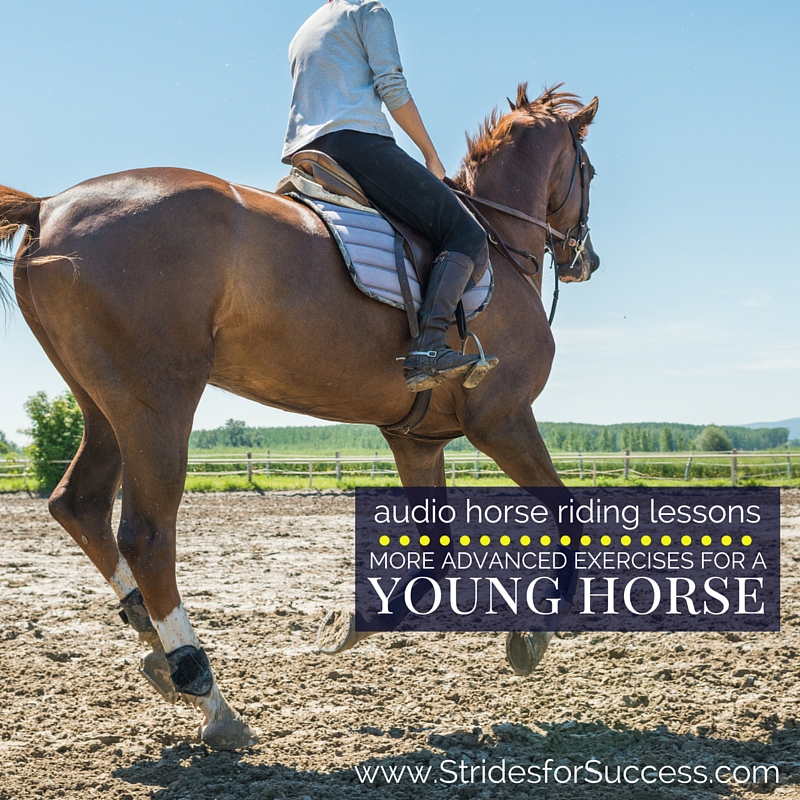
  • More Advanced Exercises for a Young Horse

    More Advanced Exercises for a Young Horse

    [fusebox_track_player url=”https://op3.dev/e/traffic.libsyn.com/dailystridespodcast/586-More-Advanced-Exercises-for-a-Young-Horse.mp3″ title=”More Advanced Exercises for a Young Horse” social_linkedin=”true” social_pinterest=”true” social_email=”true” ]

    You have spent the past few months diligently improving your young horse’s standard of education. A lot of time invested on the basics of moving forward in a balanced rhythmic way.  He is happy, you are happy and the next natural progression is to ask for the canter.

    However, it seems all those carefully cultivated hours in the arena fly out the door as soon as you ask for the upward transition.

    Your horse begins running on his forehand, each trot stride becoming longer and faster… He eventually breaks into a canter of sorts, but nothing like what you imagined it to be!  Unbalanced, uncoordinated, and no rhythm whatsoever!

    Introducing ‘New’ To Your Young Horse

    Often it seems that no matter how much preparation we put into preparing our young horse for his first departure from a trot into a canter, the canter falls a little flat and well below our expectations.   But rather than becoming frustrated and demoralized with your horse’s apparent lack of understanding, see this as being the next step of the ladder with regards to your horse’s education. And one that, if he graduates from, will see him in a great position to really begin working from.

    Just like when you first began riding your young horse in walk and trot, your horse is going to feel very unbalanced and unsure of himself when you do ask for the canter when in the saddle.  

    This is due to the canter having a three-timed beat which depends on your horse’s outside back leg starting and propelling the rest of his footfalls and body forward in each stride.  In the trot, it is far easier to remain balanced. This is due to the effect the diagonals have on balancing him with each stride. However, the canter is almost one-sided and extra strength and development are required of your horse in order to really ‘power’ into.  Power into it and then remain balanced through each stride.

    Preparing the Transition

    As with most things concerning riding, the preparation that leads up to the transition will have a massive outcome on the success of the transition itself

    See the trot as now being the foundation for setting up the canter.  Not only from a rhythm and balance point of view. But also with regards to developing strength through his body.  Use your half halts in the trot to begin asking for his hind legs to engage a little more. This may only be for a stride or two each time. However, it will allow him to begin building the muscles necessary for a good canter later.

    More Advanced Exercises for Your Young Horse

    Be Patient Through the Transition

    When you feel that you have prepared the trot enough, you can start thinking about the canter transition itself.  It is tempting to ‘push’ your horse into the canter at first. Using your upper body in particular.  However, throwing your upper body forward will only serve to unbalance him even further.

    Rather think of sitting up tall. 

    Then asking with the correct aids.  Including, perhaps most importantly, your voice and seat.  And, from here, allowing him to break into the canter himself.

    He may run for the first few strides of trot before then almost falling into the canter, but this is to be expected initially.  Your job is to remain balanced and ‘quiet’ throughout. This will help to build his confidence in his ability to actually move into the canter under the saddle.

    Make sure you follow through your body and also your hands and arms.  Catching him in the mouth or bouncing on his back, particularly in the first few transitions, will only serve to punish him. It may also cause him to associate the canter with anxiety and tension

    Once in the Canter

    Once he has actually transitioned into the canter, remain quiet but keep him moving forward.  Very often with a young horse, the canter may be a little ‘fast’ at first if forwardness is to be maintained.  This, again, is to be expected and rather allow him this. It will help him to begin to settle into this new gait and find his balance and rhythm himself.

    The canter requires quite a bit more effort from him than the trot, so he will probably tire quickly.

    Try to ask for the downward transition into a trot before he naturally breaks into trot himself.  

    You will usually feel the lack of energy in the canter, it will seem to become more strung out, rather than bounding forward.  Again, make sure you are balanced and quiet through the transition, using your voice and seat first.

    Re-Establish, Rinse & Repeat!

    As soon as he has come back into trot, begin the work of re-establishing a balanced rhythmic trot.  It may take quite a few strides initially, particularly after the first few canter to trot transitions… However, keep in mind that working forward in a balanced and rhythmic trot is something that your young horse knows how to do. So insist on it!

    Working in and out of the canter initially is a great way to begin developing your young horse for more prolonged and balanced canters.  

    Be sure that the trot is balanced and working before asking for the canter again each time.  Also, try to be consistent and regular with your aids both into the canter, while cantering, and then back into the trot.

    Developing Over Time

    Over time, your horse will begin to strengthen up and carry himself for longer periods, in a more balanced and rhythmic canter. The lenght of time will depend on many things.

    However, how mature your horse is and/or how much time you have spent working on the more foundational aspects of his schooling, will play a big role in how quickly he progresses, both physically, mentally & emotionally

    Continue to use the walk, trot, and halt to reinforce the aids and responsiveness.  Only when he has truly mastered the canter for longer periods can you then begin thinking about making adjustments within the canter itself.

    Initially, you will only ask for short canter periods each time, perhaps 5 or 6 strides of a better quality canter rather than laps of ‘racing’ and running around the arena, which will only serve to teach him how to incorrectly maintain the canter when being ridden.  Then slowly you can begin to apply the half halt in the canter itself, so to shorten the canter strides.

    Remember that forwardness is the foundation to all his gaits, so make sure that you keep him moving actively and with energy regardless of what you are asking.

    Schooling your young horse in the canter takes time and consistency. However, all the initial investment will pay off handsomely when your horse is able to maintain a balanced, forward-moving canter from which you can begin to make adjustments.

    Happy Riding
    Lorna

    Additional Resources for Equestrians

    Are you looking for step by step instructions to listen to as you ride your young horse? I have created 5 audio horse riding programs specifically focusing on this topic. To find out how you can get these lessons (and hundreds more) visit https://stridesforsuccess.com/join/