Author: Lorna Leeson

  • What Your OTTB Believes About Contact Right Now…

    What Your OTTB Believes About Contact Right Now…

    [fusebox_track_player url=”https://op3.dev/e/traffic.libsyn.com/dailystridespodcast/1332_What_Does_Your__Horse_Believe_About_Contact_Right_Now.mp3″ title=”What Does Your OTTB Believe About Contact Right Now?” social_linkedin=”true” social_pinterest=”true” social_email=”true” ]

    Contact is something so many riders want to achieve when working with their horses. However, it’s always worthwhile remembering that your horse was not born knowing how to be ridden.  This means that contact is something both of you must learn about and then refine through your work together.

    For many horses, the challenge is made even more difficult when they have been taught something completely different about contact because they had a previous career. Especially if that career was racing. 

    When working with horses, especially ex-racehorses or OTTBs, we need to understand that there will be both training and re-training involved.  And sometimes, the retraining can be a little more challenging than the training due to your horse wanting to ‘revert’.  Especially when they feel stressed or anxious.

    This episode is the first episode in a week of audio horse riding lessons from Daily Strides Premium. You can get all of the episodes and work on this topic with your horse at https://stridesforsuccess.com/dsp

    Start on the Lunge

    Tempting as it is to mount up, I suggest that you first try lunging instead. Lunging is great because it will give you the ability to help reframe the conversation for your horse. And for your horse to give you instant feedback you need to make adjustments that get results.

    Keep in mind, when you’re working with an OTTB, your horse has to relearn or reframe when he learned before – especially when it comes to contact and your seat.

    Both are usually quite different in how you would like him to engage with you when working together. There are a whole host of reasons for this. However, it all boils down to the same thing – you must start your retraining by reframing the expectations and conversations your horse has been having up to this point in his career.

    Re-Educate Your Horse To Your Aids

    One of the most common mistakes riders of OTTBs make is assuming that because your horse has been backed at some point, he knows all of the things. This couldn’t be further from the truth. Being ridden by two different riders practicing the same discipline can be confusing for a horse. When we add changing the discipline into the mix as well, you can see how wires can get crossed when it comes to aids and communication.

    A better way to approach this is to assume your horse knows nothing and start from the beginning again. Again, the lunge is a great place to do this for both of you. 

    And if you’re worried about how long this process will take, don’t. While re-training can sometimes be a little more time-intensive than straightforward training, so much can be achieved in each working session. Especially if you are intentional about what you’re doing and how you’re approaching each interaction.

    How to Get Going with Re-Training

    When you lunge with just a basic bridle, no fancy additions, you can begin to understand & reframe what your OTTB believes about the contact. Have the bit in his mouth. But no ‘pressure’ coming from the reins themselves, he can begin to explore this on his own.

    This is where well-fitted and good-quality side reins can come into their own. You want to get your horse going forward first without any contact. But then, you can simply engage the side-reins so that he can begin to explore the idea of the contact, without any pulling or fussing.

    This will begin to explain to your horse to go forward, on the lunge, with consistent contact that can begin to change what your OTTB believes about the contact. 

    It is also worth spending time here developing your voice aids. These will help greatly when you do mount up and are in the saddle. Your goal is to make things as easy for your horse to understand as possible. Again, the lunge will help you to do this easily.

    Mounting Up and Riding

    Make sure that you’re in a safe area. Again, keep in mind the expectations placed on him up to this point are vastly different from what you are now looking for.  This is why re-training can sometimes take a little longer. Your horse will naturally want to ‘go back’ to the original way of doing things. The original expectations.

    Being consistent with your approach to retraining your horse will help him to understand things have changed. 12 weeks of re-schooling done right can transform things for both of you. 

    There are no ‘quick fixes’ for redefining and overwriting what your OTTB believes about contact. It will take a commitment from you that will include patience, time, and compassion.

    What Your OTTB Believes About Contact

    If you would like step-by-step guidance on how to begin reframing this for your horse, I can help. Inside Daily Strides Premium, there are two weeks of audio horse riding lessons focused specifically on this. Get both the “Understanding Energy Creates Contact” and “Engaging the Energy in a Correct Channel” ready and waiting in there now.

    These 10 audio horse riding lessons, when coupled with the live calls and other training, will help you to transform your conversation with your horse, OTTB or not. 

    You can get all the details about Daily Strides Premium and join over at https://stridesforsuccess.com/dsp

    Happy Riding
    Lorna

    Other OTTB & Contact Episodes to Help You

    Online Training to Help Your Riding

    Connect with Lorna online:-

  • Tailoring Your Aids to Your Horse

    Tailoring Your Aids to Your Horse

    [fusebox_track_player url=”https://op3.dev/e/traffic.libsyn.com/dailystridespodcast/1331_Tailoring_Your_Aids_to_Your_Horse1.mp3″ title=”Tailoring Your Aids to Your Horse” social_linkedin=”true” social_pinterest=”true” social_email=”true” ]

    Just like us, all horses are different. They all interact with the world in their unique way. Their reactions and their responses. What would happen if you tailored your interactions with your horse specifically so that your horse can best understand and follow along? If each ‘horse conversation’ was a special one? If you could tailor your aids to your horse?

    When you begin to become mindful about tailoring your communication to your horse; your training, partnership, and skills will improve much more quickly

    So it makes sense to begin studying your horse – and figuring out what he really listens to in your riding. Especially if you’re noticing that your horse is not focused when working together. Or you’re just not getting the results you want in your riding.

    Become Self Aware

    The only thing you can control or really change is yourself. And then by controlling or changing yourself, you can have a different influence over your horse. So start with you.  What are you ‘doing’ that your horse is responding to, and what are you ‘doing’ that he is not?

    When you pay close attention to what you’re doing – and what your horse is telling you based on that – you can begin to tailor your communication to what your horse responds to. 

    The Balance of Aids

    So you know that you have a whole host of aids at your disposal when it comes to working with your horse.  You have your natural aids (they are part of you and go with you everywhere you go!). And you have your artificial aids (you can leave these down or behind in the yard).

    From here you also have ‘obvious aids’ that anyone can see you use or interact with your horse.  And you have subtle aids, which are either ‘invisible’ or can only be noticed by someone who knows what to look for…

    Imagine a pie chart, and each individual aid having a portion of that chart. These portions will differ in size depending on your horse, what you’re asking, the circumstances, etc. One of your responsibilities as a rider is to figure out what is the best proportions of the aids for that exact moment with your horse. This is the ‘balance of aids’. 

    Notice What Works

    Once you can start to see what your horse responds to, you can start using your aids in different ways that put more emphasis on what your horse currently responds to. In order to truly ‘train’ or ‘develop’ your horse, you need to begin in a place where you can both ‘speak’ to each other. You must really adapt your aids for your horse.

    Try actually speaking out loud what is working for your horse. Actually talk to your horse… It helps to bring your awareness to your own actions and helps you hone in on your horses responses. 

    By noticing what works, you can then set a foundation. And from that foundation, you can refine things even more.  You may find that your horse doesn’t really respond to your voice aids for example. But is very responsive to your position (whether on the ground or in the saddle).  As you discover more about your horse, you can ‘balance’ or adjust your aids and approach accordingly.

    Tailoring Your Aids to Your Horse

    So if all horses are different, you’ll often find individual horses who just don’t enjoy being ‘spoken to’ in a certain way.  And rather than forcing a conversation that the horse has no interest in being part of… Learn what that horse does respond to and become ‘good’ at conversing that way.

    Your horse is an individual, just like you. And I can bet that when someone takes the time to focus and speak to you in a way you respond to, the conversation flows. Your horse is the same…

    Start today by noticing what you’re doing, and if it gets a response or not.  From there, simply notice and tweak as you learn more about you and your horse.

    Happy Riding
    Lorna

    More Help for Riders:-

    Equestrian Fitness Challenge ’24

    Work on improving your overall strength, fitness, and stamina as a rider. The all-new and free 2024 Equestrian Fitness Challenge is a great place for you to do this.  It is walking and yoga-based (no workouts), so it will ease you into becoming a better version of yourself in the saddle gently. You can sign up HERE or by visiting https://equestrianfitnesschallenge.com/24 
    There will be a daily walk, a 10 minute daily yoga practice, and lots of tips, ideas, exercises, and ways to improve so that you can show up as the best version of you – for you and your horse.
    Sign up today and let’s transform your riding – one stride at a time! 100% FREE 2024 Equestrian Fitness Challenge

    Connect with Lorna online:-

  • Confidently Assessing Walk on a Different or New Horse

    [fusebox_track_player url=”https://op3.dev/e/traffic.libsyn.com/dailystridespodcast/1330_Confidently_Assessing_Walk_on_a_Different_or_New_Horse.mp3″ title=”Confidently Assessing Walk on a New or Different Horse” social_linkedin=”true” social_pinterest=”true” social_email=”true” ]

    Whether you’ve just purchased a new horse, or the opportunity to regularly ride a different horse, the first few rides can feel a little daunting. Especially if you are coming back to riding after a break or you’re used to riding another horse. One of the best things you can do is to begin assessing where you are both at in terms of training and communication. This episode is the first in a week of 5 lessons called ‘First Rides for Confidence on Your New Horse’ which are available now inside of Daily Strides Premium

    Those first few rides have to happen and if done right, can set a positive tone for both of you as you work together going forward.

    And these rides are the perfect time to really pay attention, assess where you both are in your training together and then build your relationship together.  In this episode, I will walk you through an exercise you can do while in the saddle to begin figuring out where you both are in your training.

    Finding & Stacking Wins

    Wins are not just for the competitive riders in the world.  All riders can find and ‘stack’ wins when working with their horses.  The key is to really notice them. So often we take the little things for granted.  However, it’s these little things, when accumulated and put together; that make the partnership great.

    Each time you have a set expectation of your horse, and your horse meets it; that’s a win! Especially true when it’s a new horse that you’re not really sure of or familiar with.

    The more ‘correct answers’ your horse gives you, the stronger the understanding between both of you becomes.  See it like a list of boxes that your horse must check.  Anything he doesn’t understand must be worked on – and will be.  But it’s also important to appreciate all of the ‘checks’ he did get. This will build both of your confidence in yourselves and in the partnership as a whole.

    1. Assessing the Shoulders

    Begin in walk with your new horse and pay attention to your horse’s shoulders.  How well are they moving?  Are they covering the ground or are they a little ‘choppy’ or ‘short’? It’s important not to lean down or over to do this.  Just ‘glance’ down with your eyes. You may have to move or plait/braid your horse’s mane if it is hiding or covering the shoulders.

    The shoulders are something you can ‘see’ when you are riding. And you are going to use this to assess what you can’t see.  The hind quarters.  

    Once you can identify the shoulders moving, begin to tie that into the feeling in your seat.  The movement of the shoulders will coordinate with the swing of your seat as your horse walks. You’ll notice both a backward and forward swing to your seat. And also a ‘left to right’.  The left to right is created by your horse’s barrel or rib cage moving as the horse walks.  And this will correlate with his back legs…

    2. Engaging the Hind Quarters

    The reason your horse’s barrel is swinging left to right is simple; it must move to create room for your horse’s back leg to come and step in underneath it.  So, if you’re not feeling that left-to-right swing through the barrel, there’s a good chance your horse is not using his hind quarters.

    Think of ‘engagement’ as being a committed relationship between your horse’s back end and the front end. No committed relationship; no engagement!

    If your horse has training and development under his belt, you will also see that the distribution of his weight has changed slightly so the front end is not so heavy.  However, even if your horse is very green or unfit, the ‘engagement’ we are talking about is a connection or relationship.  The energy is flowing through from the back to the front.  And all horses can do this, regardless of where they are in their training journey.

    3. Balance Through Corners

    A great way to assess this with your new horse is to pretend you’re a marble, ball, or egg! If your horse’s back is a tray and you are on the tray, what would happen while you’re riding on the straight? So down the long side of your arena. Is the tray tipping slightly to one side of the other?  Or is it perhaps tilted to favour the back or the front?

    Ideally,  you (the egg or ball) will remain nicely balanced in the centre of the ‘tray’, both on the straight and as you ride through corners and bends. 

    Often we don’t feel when our horses is tilting or tipping.  Especially through corners and bends.  However, play this game the next time you’re in the saddle.  Close your eyes if you can (and it’s safe to do so). And feel if you are ‘tipping’ somewhere you shouldn’t be!

    4. Noticing Relaxation / Tension

    Building from the previous exercise, you can then begin to add your use of the half halt before and during the corner into your assessment.  Does your horse respond to your half halt? And if so, does this have an impact on any of the previous elements of the ride?  How his shoulders are moving, the swing of the hindquarters, or you ‘rolling off’ the tray that is his back?!

    When riding a new horse, moments of incorrect tension will be pretty frequent and normal initially.  You are both getting used to each other…

    The important takeaway is to notice and begin refining so that the smoothness is maintained more easily.  I also suggest riding a 20m square when doing this work, as it will allow the corners to ‘come more quickly’ for you and your horse. And you will get more opportunities to work on improving it the next time.

    5. The Ears of Your New Horse

    My final idea for assessing the walk with a new horse is to watch his ears.  I realise this seems like a strange one, but bear with me! As you are riding the square or the rectangle in walk, and doing the above exercise with half halt and corners, do the ears change?  Do they get higher, indicating that he may be ‘hollowing out’ through is back? Or maybe they are dropping lower; possibly bracing against you? Or are they tilting (one higher than the other), showing a lack of straightness?

    When you are riding a different or new horse, the best thing you can do early on is to assess exactly where he is right now in his training. Then use this to create a plan to improve. 

    As the rider of the new horse, your job is to see how you are both getting along from the beginning.  And it is often so much easier to do this using what you can actually ‘see’.  Such as the shoulders and ears. Couple this with what you can feel, you’ll get a pretty good idea of how the ride is going.

    First Rides for Confidence on Your New Horse

    If this is something you would like more step-by-step help with, I am encouraging you to join us inside of Daily Strides Premium. You will get 5 episodes of audio horse riding lessons to use that will help you and your horse from the very first ride.  And they are not only for ‘new horses’.

    These lessons are also great for riders and horses who want to figure out what to work on next in their training and work together. Especially if working alone without a trainer or coach.

    So if you have your new horse, or you are getting to know a different horse to the one you are used to, let me help you both.  Those first few rides are really important ones; for both you and your horse… In this group of lessons you will steadily move through the different gaits with your horse, in a way that will build your confidence; and allow your horse to get used to you as well.

    Happy Riding
    Lorna

    More Help for Riders:-

    Connect with Lorna online:-

    Get Going in Your Riding:-

    Daily Strides Premium is back! You can use the first and original audio horse riding lessons to improve your riding, train your horse, keep things interesting, and have fun… Even if you don’t have a trainer or coach

  • Getting Through Tough Times in Your Riding…

    Getting Through Tough Times in Your Riding…

    Deciding to work towards something specific in your riding is a good thing. And, usually, you will feel positive about that decision, and all the work involved to get there, initially. Until you realize you must ‘do’ the work – and the novelty starts to wear off a little!

    Riding, just like most things, will involve effort. Especially when you are working to improve or reach a specific goal or outcome. And that ‘effort’ can often result in you quitting! 

    It’s normal to experience all of the excitement at the beginning of something. A new hobby, project, or goal.  And it’s also ‘normal’ to notice that as you get further down the road, it can feel hard.  This is to be expected and even planned for with your goals.

    What’s less ‘normal’ is to find the stamina to push on through that resistance you feel and cross the finish line. To see the goal or project to completion. That takes perseverance! 

    Creating Perseverance in Your Riding

    I think that being honest from the start with yourself is important. And part of that honesty will be to realize in advance that things will probably get a little harder before they get easier. Hard things at the beginning are usually overcome pretty easily. There is this optimistic momentum on your side that helps you overcome whatever obstacles are in your way.

    However, in the middle of the journey, when you’re feeling tired even a little bored from the monotony of doing the thing day in and day out, you need to build perseverance. 

    You can do this by honouring commitments to yourself. If you tell yourself you’re going to do it, honour that. Do what you say you’re going to do.  Each time you do this for yourself, you strengthen your discipline muscle. And this builds trust in yourself and your word. It sounds strange, but the more you can trust yourself, the better the chances you have of doing the thing you said you would do.

    When Enthusiasm Wanes…

    There are a couple of things you can begin to do to help get you through this period of the journey. From personal experience, I have had great success in implementing the following few ideas in my own life:-
          1. Don’t think; just do!
          2. Have a list of topics or things to do that inspire you
          3. Find ways to become curious again
          4. Plan what you want to do the day or week before
          5. Track the progress
    By having a few different options and creating a plan for you and your horse, you will find that on those days, you actually can ‘push on through’.  And once you do this a few times, you will build that trust in yourself, and your positive momentum will build from there.

    Tough Times in Your Riding

    There will be times in your riding when you just don’t feel like doing the thing. Where the past few rides have felt hard.  The key to overcoming this is to show up.  To commit, create a few ‘contingency plans’ and then just make it happen.
    Tough times in your riding will happen. It’s how you train yourself to respond to these times that will determine how you will show up as a rider and an equestrian. 
    If you would like a little ‘inspiration’ to get you over the ‘tough times’, make sure you’ve signed up for the 100% FREE 2024 Equestrian Fitness Challenge. I’ll accompany you for a walk each day for 21 days to inspire you to keep going and overcome the challenges in your riding.
    Happy Riding
    Lorna

    Equestrian Fitness Challenge ’24

    Let’s walk together for 21 days and have a chat about how you can do much more than you think you can as a rider and an equestrian… I am so excited to bring you along on this journey for the 100% FREE 2024 Equestrian Fitness Challenge
    There will be a daily walk, a 10 minute daily yoga practice, and lots of tips, ideas, exercises, and ways to improve so that you can show up as the best version of you – for you and your horse.
    Sign up today and let’s transform your riding – one stride at a time! 100% FREE 2024 Equestrian Fitness Challenge

    More Help for Riders:-

    Connect with Lorna online:-

    Get Going in Your Riding:-

    Daily Strides Premium is back! You can use the first and original audio horse riding lessons to improve your riding, train your horse, keep things interesting, and have fun… Even if you don’t have a trainer or coach

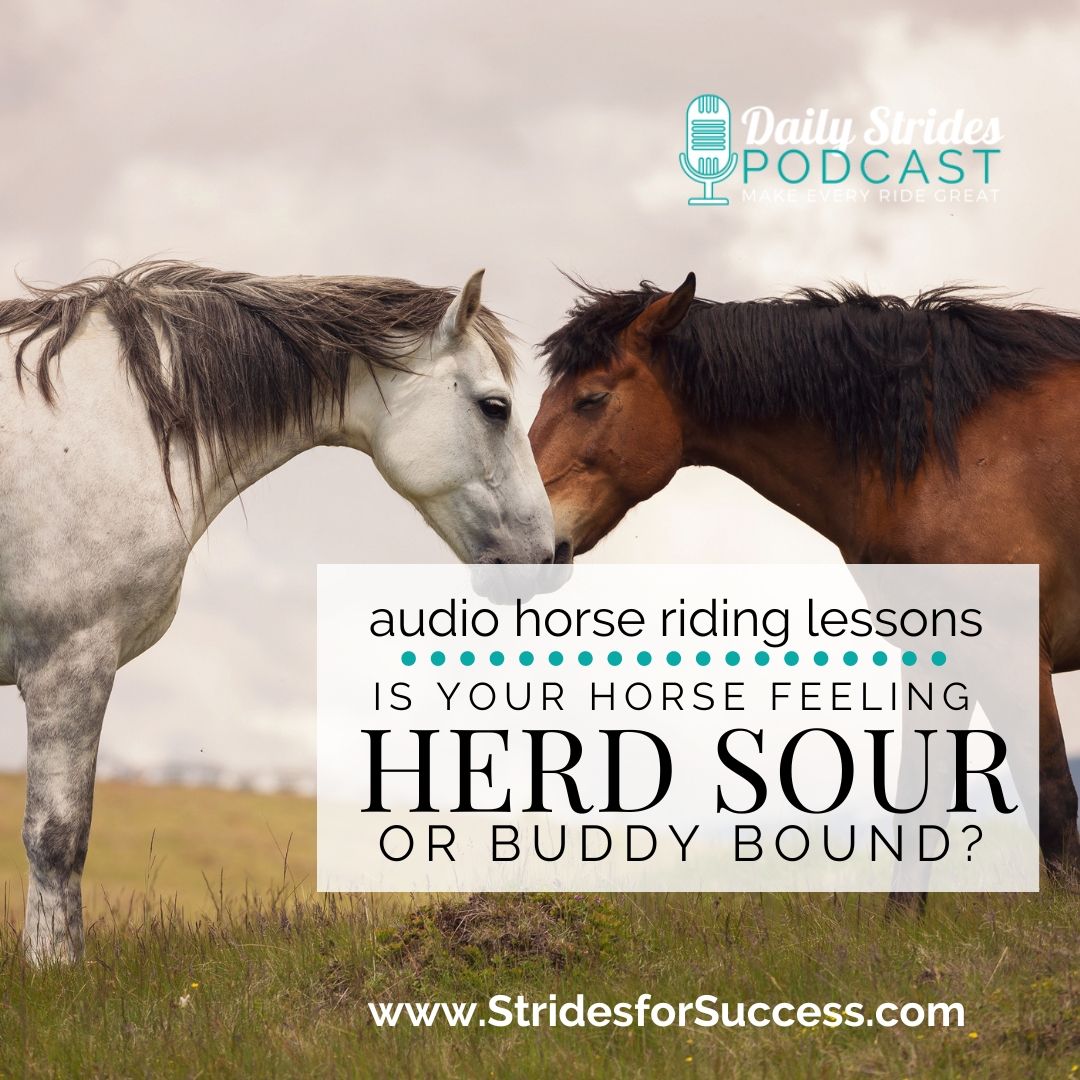
  • Is Your Horse ‘Herd Sour’ or ‘Buddy Bound’?

    Is Your Horse ‘Herd Sour’ or ‘Buddy Bound’?

    [fusebox_track_player url=”https://op3.dev/e/traffic.libsyn.com/dailystridespodcast/1328-Is_Your_Horse_Herd_Sour_or_Buddy_Bound.mp3″ title=”Is Your Horse Feeling Herd Sour or Buddy Bound?” social_linkedin=”true” social_pinterest=”true” social_email=”true” ]

    Horses are herd animals by nature. They will always choose to be with ‘their herd’ when they feel uncomfortable or worried about something. And this can become a big problem for riders. This is partially due to training and development requiring both horse and rider to ‘get out of their comfort zone’. Your horse’s past training or experiences can also play a big role in how he responds or feels about leaving his ‘herd’…

    And whether you need to build your horse’s confidence in himself and you, or focus on retraining him regarding his expectations and yours, it will require time, patience, and consistency to overcome.

    And a ‘herd’ does not have to mean a whole field full of horses frolicking and running wild in open pastures. It can mean this, but it doesn’t have to! Your horse’s ‘herd’ can be him, his horse friend, and the donkey they share the field with. It can be the one horse he lives ‘beside’ most of the time, in the neighbouring stable or paddock. Or, your horse’s ‘herd’ can also be the two goats he lives with full-time in the small paddock.

    Horses, being social creatures, will ‘bond’ with whoever they spend most of their time with. And once your horse has bonded, it can become quite the performance when you try to separate him from his ‘herd’…

    What’s Triggering the ‘Herd Sour’ & ‘Buddy Bound’ Feelings?

    The first thing to do is to recognize when this is predominately happening. Is it the moment you take him out of the paddock and he realizes his ‘buddy’ is not joining him? Or is it when other horses are ridden away from him and he’s left alone on the trail or the track? It could be when he is asked to leave the other horses, such as going into an arena on his own while others stay at the stables or in the practice area.

    The clearer you can get on defining when exactly your horse begins to act up or become anxious, the more direct you can be in your approach to helping your horse overcome this.

    One of the most important things you can do for both of you is to identify potential triggers. This way you can plan ahead so that you are doing all you can to remain safe. And your horse is as supported or corrected at the times he needs this most. I say supported or corrected because, sometimes, this can develop when a horse realizes that if he ‘performs’ a little, he will be allowed to return home, no questions asked.

    As a rider, it’s your responsibility to figure out if your horse is truly worried and anxious, or if he has just found an easy way to get back to his friends and not have to ‘work’…

    Past Experience and Training

    Most of the things your horse does, or doesn’t do, are learned. The thing with being herd sour or buddy bound is that it can both be learned – and something can also be naturally instinctual for your horse. Both will require your time and attention to remedy. But, before you begin, consider your horse’s history and experiences up to this point…

    Many horses that are bred for a specific purpose will have similar experiences, like thoroughbreds that raced for example. Most are bred at stud farms where they spend their earlier years with other horses around the same age. As they move into pre-training, the same will apply. They often get ridden out together, turned out together, put on the walker or exerciser together, etc. And then, if they make it to an actual trainer, this becomes even more true. Their ‘job’ requires them to ‘keep up with the herd’…

    In these situations, slow and specific planned retraining needs to happen to help your horse understand the new expectations – and feel confident about meeting them.

    It can be a bit of a culture shock if they find themselves starting their 2nd career as a ‘pleasure horse’ and are suddenly expected to see their rider as their confidant..! The rider is the one they should trust and want to be with all of the time, right? Well, that is how the rider sees it – but more often than not, their horse does not agree!
    This is also true for horses who have had little to no handling either recently or ever! They must learn how to build a partnership with a human where they feel confident and happy – even in more tricky situations.

    Developing the Bond or Partnership

    A good solid relationship requires trust – and trust can take time to build. Trust is knowing what to expect and having that happen, again and again. Get clear on your expectations first. How are you expecting your horse to behave or respond? Once you’re clear on your expectations, the next responsibility is effectively and clearly communicating them to your horse.

    Keep in mind, that your horse also has certain expectations of his own behaviour and his responses as well. This is even before we consider what he expects from you!

    I think that groundwork is really essential here in this part of the training for you and your horse. But not just random ambling around the yard and grooming. Specific exercises that focus on specific outcomes for both of you. Later, when there is a stronger bond, I am all for ‘ambling’ together. But if your horse has been showing signs of being herd sour or buddy-bound, this might not be the safest way to connect initially.

    Start with grounding and really getting clear on your own actions and intentions. From here, begin to notice how your horse responds to you and your different aids.

    Curiosity is essential in all good relationships, so get curious about your horse! What does he understand? What is he unsure of. Which aids does he seem to prefer or work better with? And how can you use what he already knows, either learned or instinctual, to better explain different or new things to him?

    Who Do You Trust?

    Thinking that you can spend an hour a week ‘working on this’ and then revert back to your usual self the rest of the time won’t work! In fact, this way of showing up is not just unrealistic, it’s madness! Think about people you trust and feel confident to both be with and follow if necessary. I can bet that they all have a few traits in common. Things like being reliable, consistent, even-tempered, and available. They ‘show up’ in a certain way, even when it seems and feels like everything has the potential to go completely sideways!

    Think about how you can begin showing up for your horse as a partner he can trust and rely on, even when the situation becomes uncomfortable or downright scary.

    Part of being reliable and consistent is that even when things don’t go to plan, you remain steady. You remain aligned with your original intention and then focus on getting there. Rather than being drawn into the drama that your horse is either experiencing or creating. Your job is to remain focused, steady, consistent, and ready to lead you both where you want to go.

    Another thing about ‘trust’ and reliability is that you know where to stand. Solid boundaries are a must for good relationships. And like expectations, you need to know yours before you begin working with your horse.

    Plan Your Work and Your Progress

    So, once you have decided on what you’re happy with, what is a no-no, and also have gotten clear on the potentially ‘greyish’ areas, you can begin working with your horse. All of this will depend on your horse; is he being genuinely anxious about leaving his herd or buddy? Or is he potentially trying to use this as a way to cut the ride short and get home ASAP?

    The plan you create to work on his herd sour or buddy-bound behaviour will depend on his true feelings about it… And your commitment to showing up consistently.

    I would definitely suggest only working on one thing at a time. So, if he is reluctant to leave his friend behind in the paddock while you go on the trail, but you can tell it’s more of a tantrum than anxiety, push on! And if you can’t or don’t feel confident enough to ‘push on’, ask someone to ride him who will do that.

    Very often in this scenario, two or three days of being sent forward and not getting his own way are enough to nip this in the bud and turn a new leaf. And it will require some serious commitment and reinforcement of your boundaries.

    On the other hand, if he is genuinely anxious and worried about being away from his friends, slow and steady work usually gets the best results.

    The key here is to focus on becoming someone he initially enjoys being with for short periods… And later feels confident being around for longer periods. In my experience, these types of horses, when they meet the right person who is all of the things mentioned above, become true partners. They really do give 100% of themselves in the relationship and are a pleasure to work with. But it does often take that initial commitment of time, and the intentional ‘showing up’ for them.

    Choose Your Riding Partners Carefully

    The final piece of advice I have for this situation is to choose your company wisely. Initially, whether your horse is throwing a tantrum or filled with anxiety, often the support of another horse and rider combination can help. Especially if they are the model of calm, cool, and confident.

    Horses learn from the horses around them, so choose wisely who you spend your riding time with.

    In my experience, especially with OTTBs who are herd bound, we spend a lot of time in the arena initially. We will pair the horse up with another 1 or 2 horses and let them walk together around the arena at first. Then, slowly, we will begin to put a little space between them. But always making sure to come back ‘together’ after 20 or 30 seconds. Then we stretch that time. And we work it both ways; the anxious horse is either held back from the others or vice versa.

    Over time – and sometimes this can be done in a single session, but usually a little longer – we are trotting and canter past the original horse with the others while he stays in a walk. Obviously the other horses and riders are carefully choosen to make this as much of a ‘non-event’ as possible.

    The key is to help your horse move away from the others without fussing. And once he is happy and relaxed riding ‘alone’ in the arena, we take it out to the trails or fields.

    Herd Bound to Rider Happy

    The important thing is to keep the end in mind and to keep yourself safe as you work through this with your horse. If you feel yourself becoming frustrated or angry, remind yourself that he has either been thought to do this or been allowed. And sometimes old habits, or ways of thinking, die hard!

    Don’t ask for too much too soon, hold your boundaries, be clear with your expectations, and remain calm, consistent, and steady in your approach. Be the leader your horse is asking you to be!

    Happy Riding
    Lorna

    More Help for Riders:-

    Equestrian Fitness Challenge ’24

    Work on improving your overall strength, fitness, and stamina as a rider. The all-new and free 2024 Equestrian Fitness Challenge is a great place for you to do this.  It is walking and yoga-based (no workouts), so it will ease you into becoming a better version of yourself in the saddle gently. You can sign up HERE or by visiting https://equestrianfitnesschallenge.com/24 
    There will be a daily walk, a 10 minute daily yoga practice, and lots of tips, ideas, exercises, and ways to improve so that you can show up as the best version of you – for you and your horse.
    Sign up today and let’s transform your riding – one stride at a time! 100% FREE 2024 Equestrian Fitness Challenge

    Connect with Lorna online:-

  • Tips When Trying Out a New Horse

    Tips When Trying Out a New Horse

    [fusebox_track_player url=”https://op3.dev/e/traffic.libsyn.com/dailystridespodcast/1327-Tips_When_Trying_Out_A_New_Horse.mp3″ title=”Tips When Trying Out a New Horse” social_linkedin=”true” social_pinterest=”true” social_email=”true” ]

    Finding your perfect new horse, for many riders, can also mean having to ride a lot of horses in order to find ‘the one’.  It is a decision that will have repercussions for years to come.  This is true for you, the horse, and also everyone who has to work closely with the two of you!

    So it makes sense that there can be quite a bit of pressure on riders to make the ‘right’ decision after trying out a new horse.

    But for this episode, let’s stick to a few good, old-fashioned rules of thumb when it comes to trying out a new horse for the first time…

    Be Realistic of the Potential

    ‘Potential’ is a funny thing.  We are all absolutely brimming to the top with it.  And all of our horses are too! However, there are very few humans or horses who actually live up to and experience their fullest potential.  I say this because, often, when we are trying out a new horse, we can either become oblivious to or we can get too caught up in the horse’s potential’

    So before you go trying out every and any horse you see, be clear on what exactly you are looking for – you probably won’t need the best horse in the world; you’re looking for the best horse for you right now…

    Be There to Groom & Tack Up

    For time’s sake, many sellers will have the horse already tacked up and waiting for your arrival.  I would strongly suggest phoning ahead and requesting that this is not the case. And this is especially true if you plan on keeping the horse on your property.  Experiencing the horse on the ground is important.  Knowing that you can safely groom and tack up the horse, especially if it will be staying by your own home, is essential!

    Watch for first impressions as well; when you reach the stable door what does the horse do? Walk to greet you or turn it’s business end to you? 

    Horses Respond to the People Around Them

    Keep in mind that the horse will be responding to the people who are currently working with it.  And will almost certainly change when they are with their new owner or rider for a few weeks or months.  There are certain things that can sometimes be overlooked.

    Horses will do what they have been trained to or allowed to do by the people who work with them.  Bad manners and lack of boundaries are just two of the ways this can show up…

    Your ability to retrain your horse will depend on your confidence and your horsemanship skills.  Trying out a new mount is not the time or the place to begin this work! But this point is an important one to keep in mind when looking at one.

    Honesty is the Best Policy!

    Be honest with the seller about your current riding level and commitment.  This includes time, facilities, trainer, etc. However, do keep in mind that, whether intentional or not, the seller can sometimes make what they are selling sound like it is perfect for you when it’s clearly not!

    A great way to avoid this is to first ask lots of questions about the current rider and what they are currently doing with the horse. “Why?” is your friend here… Keep digging! 

    Once you have a clear picture in your mind about the current rider and how they get on with the horse, then share about yourself. Tell them not only where you are at right now, but also your plans, goals, and ambitions for going forward.  If the horse hates trail rides or hacking out alone, but your 1-year goal is an overnight solo trail ride, this is probably not the right one for you!

    Mounting Up & Trying Out…

    Watch the horse being ridden first. This is important and something we can often fail to do due to sheer enthusiasm to ‘get in the saddle’. Hold your horses, practice a little patience, and slow down.  Rather stand back and watch how the current owner or rider handles the horse. This is true both before they mount up and when they initially mount up. If there is a reluctance on their part to get into the saddle and they have not mentioned anything to hint at why… You’ve got yourself a bit of a red flag.

    After watching them ride the horse, I love to have a rider I personally know who has come with me ride the horse. Knowing how that rider rides, I can better see from the ground how the horse goes… 

    And after all of that, then and only then, do I suggest mounting up yourself.  If you’re feeling happy and that this is a ‘match’, well test that theory out by spending time riding the horse. Keep in mind that this is not the time or place to have a lesson from your trainer, or to practice that nifty new movement you’ve been working on!

    And It Might NOT Be a Match!

    Okay, so if at any point prior to gently lowering your bum into the saddle, if you feel any sort of hesitation or ‘niggling feeling’ about mounting up; stop!  Simply tell the seller that you’ve seen enough and this is not the horse for you. Thank them for their time and be pleasant. You never know, they might even know of a more suitable horse for you… Very possible! And don’t feel bad…

    Most sellers would rather ‘save’ the horse for a more suitable potential buyer than have someone onboard who is not a fit from the get-go. And if they are genuine, they will remain respectful and pleasant.  No harm done! 

    Unfortunately, trying to sell a horse that was not a match for you from the beginning is very difficult.  Many people will blame the horse for the partnership not working out.  And, in my experience, these unfortunate horses tend to have untrue labels and names attached to them that become VERY difficult to change.

    Prepare Yourself for a NEW Horse…

    The final point I want to make here before I finish is that if you have had a horse for years and years and now, for whatever reason, are looking for a new partner… Give yourself a little grace! To go from having ridden and connected with the same horse for years… To suddenly jump on the back of a new horse and hope it all works out might be a little naive!

    If you have only had experience riding one horse for the past 2+ years, before trying out a new horse, book in for some lessons on a ‘different’ horse first.

    This way the ‘lesson’ horse can be the one you feel that initial discomfort of things being ‘different’ on. This will leave you better prepared to be more honest with yourself about the horse you are actually trying out when the time comes.

    Happy Riding!
    Lorna

    A Simple Plan for Trying Out a New Horse

    This episode is the first, taken from a week of lessons inside Daily Strides Premium. They are all about what to do when trying a new horse.  And while this is the first lesson, and a quick overview of the dos and don’ts of trying out a new horse, the following 4 audio horse riding lessons are the actual riding plan!

    A selection of simple exercises and movements you can use when trying out a new horse.  You will also learn what I suggest looking for at each stage of the ride. 

    These are all available right now inside of Daily Strides Premium. Audio horse riding lessons are delivered straight to your phone so that you can use your own time and your own arena to help you and your trusty steed.  Daily Strides Premium is back! You can use the first and original audio riding lessons to improve your riding, train your horse, keep things interesting, and have fun… Even if you don’t have a trainer or coach

    More Help for Riders:-

    Equestrian Fitness Challenge ’24

    Work on improving your overall strength, fitness, and stamina as a rider. The all-new and free 2024 Equestrian Fitness Challenge is a great place for you to do this.  It is walking and yoga-based (no workouts), so it will ease you into becoming a better version of yourself in the saddle gently. You can sign up HERE or by visiting https://equestrianfitnesschallenge.com/24 
    There will be a daily walk, a 10 minute daily yoga practice, and lots of tips, ideas, exercises, and ways to improve so that you can show up as the best version of you – for you and your horse.
    Sign up today and let’s transform your riding – one stride at a time! 100% FREE 2024 Equestrian Fitness Challenge

    Connect with Lorna online:-