Author: Lorna Leeson

  • Time or Money; Which is a Better Investment for You and Your Horse?

    Time or Money; Which is a Better Investment for You and Your Horse?

    [fusebox_track_player url=”https://op3.dev/e/traffic.libsyn.com/dailystridespodcast/1289_Time_or_Money_Which_is_the_better_Investment_for_You_and_Your_Horse.mp3″ title=”Time or Money; Which is a Better Investment for You and Your Horse?” social_linkedin=”true” social_pinterest=”true” social_email=”true” ]
    Your time or your money; it’s an age-old toss-up!  For the most part, most things can be improved, strengthened, corrected, or achieved when we invest either time or money towards it. And, for the most part, you can excel in the progression if you are able to invest both.  And training your horse is no different.
    And while many will argue that training a horse requires both time and money, for many riders it’s possible, or necessary, to offset one with the other.  It will simply depend on your unique situation.
    Like everything else, there are pros and cons to consider with each approach.  In this episode, I want to help you understand which choice may be better for you.  Investing your time or investing your money when it comes to training your horse.

    Investing Your Time: The Pros

    Training your horse when you can input a significant amount of time offers several advantages.  For many riders, the investment of their time will be the obvious choice based on their current circumstances.  However, there are many ‘hard-to-overlook’ advantages to this approach – whatever the reason for your choice to take this route.

     1. Developing the Bond:-

    Spending time with your horse during the training process can strengthen the bond between you. Building a foundation of trust and understanding is crucial for successful training and a harmonious partnership. So by you taking your own time when it comes to training, it allows you both to really develop that strong foundation that will stand for you.  Especially when working through any challenges that show up.  And, when working with horses, let’s be honest, the challenges will almost always show up!

     2. Unique & Personal Approach:-

    When you invest your own time in training your horse, you have the freedom to tailor the training sessions to suit your horse’s individual needs. This personalized approach allows you to experiment with different techniques and adapt to your horse’s unique temperament.  It also allows you to tailor the training program to suit your individual schedule and needs.  You get to choose what to work on, and when to work on it when it comes to your horse and your training program.

     3. Developing Your Skills:-

    The opportunity to work so closely and so consistently with your own horse will inevitably enhance your own riding and horsemanship skills.  The awareness that is an essential part of showing up as a ‘trainer’ for your horse will allow you to begin to tweak or improve your approach to different things. And with your horse providing feedback all the way, you can really develop your feel for riding and training.

    Investing Your Time; The Cons

    Now, let’s be clear… While there are many advantages to investing your own time into training your own horse, there are also a few drawbacks.

     1. Lack of Knowledge

    Experts are experts for a reason.  They have developed their expertise over time and through experience.  When you are choosing to invest your time to train your own horse, it can be difficult to identify, and later correct, any mistakes or training issues.  This also goes for behavioral issues. Training without an experienced trainer or coach may limit your progress and prevent you from reaching your full potential as a rider.  And this can also result in limiting your horse’s career or progress long term as well.

     2. Time Constraints:

    Yes, we have said that you are choosing the time over money scenario here.  However, so many riders fail to actually realize how much time it takes when working with and training a horse.  It requires a significant investment of time, and this may not be feasible for everyone.  Remember, you will be doing this while also juggling other commitments such as work, family, or studies.  Being consistent with your approach is essential with this method and many riders find it really difficult to dedicate sufficient time for effective training.

    Investing Your Money: The Pros

    When we are using the term ‘investing your money’ in relation to training your horse, this usually means that you will invest in professional training at a professional barn or yard.  This, obviously, can have many advantages over the ‘time’ investment.

     1. Expert Guidance

    You are now enlisting the help of a qualified or experienced trainer or coach who is doing this on a daily basis.  Their experience and expertise will allow you to avoid many of the pitfalls or potential challenges along the way.  Going this route also means that you get to ‘tap into’ their valuable ‘knowledge & experience bank’.  This is especially useful when it comes to correcting mistakes, and ensures your horse is introduced to effective, practical, and proven training techniques from the start.

     2. Time Efficiency

    When you hire someone who has successfully achieved a specific outcome numerous times before, it can be a little like taking a little-known but much faster ‘shortcut’.  They can help accelerate your horse’s progress at a rate that would be pretty difficult for you to match doing this for the first time.  And they can also, usually, overcome challenges more quickly as well.

     3. Safety & Confidence

    Professional equestrian trainers and coaches are equipped to handle difficult situations as they occur.  This means that both your horse’s safety and your own safety are maximized during the training process.  Couple this with the fact that most riders feel more confident when they have a trainer in the arena with them; you will usually ‘ride better’ in their presence. This is especially useful when working with a young, green, or challenging horse.

    Investing Your Money: The Cons

    And just like before, this too has its downsides.  Here are a few considerations when it comes to investing your money, rather than your time when training your horse.

     1. Financial Constraints

    Yep, it’s the whole time versus money thing again.  In order for you to save on time, you will almost definitely have to invest your money.  Remember, professional horse training can be expensive and costly.  This is especially true if you are on a limited budget.  Before you commit to this route it is really important to assess your current financial situation and determine whether the, often high, expense aligns with your current resources and priorities.

     2. Lack of Independence

    While a professional trainer or coach might be able to move your horse’s training along, can you then realistically continue to do this when your horse comes ‘home’ or back to you? Relying on a trainer means you may become dependent on their availability. There may be scheduling conflicts while the initial training is ongoing.
    And then the potential need for ongoing support might require adjustments to your training plans in the future…  Basically, it is difficult to really and truly learn how to figure things out for yourself when paying a professional to do the work for you.

    Time or Money; Which Will Suit You Best?

    I honestly believe that there is no real right or wrong answer to this challenge.  At the end of the day, it is a personal choice that will usually be dependent on personal circumstances.  Both approaches have their benefits and limitations.
    Investing your time allows for a deeper bond, more time and schedule flexibility, and faster development and growth of your abilities as a rider and trainer. However, this can often be countered by a lack of expertise and other commitments in your already busy life.
    On the other hand, investing money in your horse’s training introduces expert guidance, a ‘fast track’ time efficiency, and added safety and confidence. You can literally borrow it from them in the arena initially.  But it comes with often great financial considerations and, ultimately, a level of dependency on the trainer in the long term.
    For many riders, a blend of both is the way to truly make this work for them.  A balance that aligns with your goals, resources, and circumstances is key.
    Whether you choose to invest your time, your money, or a combination of both, the most important thing is to prioritize your horse’s well-being, your enjoyment, and the ultimate long-term partnership that will result from working with your horse.
    Happy Riding
    Lorna

    Seeking Founding Riders…

    If you are considering training your horse at home or alone (boarding at a barn, but don’t have a regular coach or trainer), make sure you check out the details of my upcoming brand-new program.

    I’m looking for a limited number of riders to work in-depth with me and my team as we go through this program for the first time.  Get on the waitlist to be the first to find out all of the information… We start in early September. Get All the Details HERE (no obligation to join the program, just be the first to know all of the details :) )

    More Training On This:-

  • Are You Ready for Training Your Horse?

    Are You Ready for Training Your Horse?

    [fusebox_track_player url=”https://op3.dev/e/traffic.libsyn.com/dailystridespodcast/1288_Are_You_Ready_for_Training_Your_Horse.mp3″ title=”Are You Ready for Training Your Horse Alone?” social_linkedin=”true” social_pinterest=”true” social_email=”true” ]

    When it comes to being ready for training your horse, you probably fall into one of two categories.  The first one is filled with riders who genuinely believe they can do anything. And that they’ll probably be successful.  The second is the riders who really weigh up every pros and cons before making a decision.  And they often second guess themselves or lack confidence in their abilities.

    This is especially true when it comes to actually working with their horse. And the fear is that they will somehow ‘ruin’ or ‘untrain’ their horse. 

    You Are Already Training Your Horse!

    However, I think that it is important to remember that you are ALWAYS training your horse. Which really makes the question of it you’re ready for it, redundant! Each time you interact together, there is either the acceptance of the behaviour, or correction of the behaviour.  This is training. So, if we assume for a second that you are, right now, already training your horse, what can you begin doing today to help you get better results?

    This is the exact reason why, in riding schools or yards working with more inexperienced riders, the horses and ponies often need to be ‘re-tuned’.  Basically, more experienced and knowledgeable riders will regularly ride that horse and make sure that the basic fundamentals of the training are still in place and present.

    And this might be the very challenge, you’re experiencing now – you don’t have anyone to do the ‘re-tuning’ for you.  It’s just you and your horse – and you’re doing all of the training. 

    And that can seem very daunting.  But it is ‘doable’; if you are willing to follow a few simple guidelines that will help transform you from just a ‘rider’ (or a passenger), into your horse’s trainer. And I believe that your attitude to this is what really decides if you’re ready for training your horse – or not!

    Observation & Understanding

    Have you ever been working with your horse and thought something along the lines of “I wish he could just tell me what he doesn’t understand?” Believe it or not, your horse is really trying to.  It’s just up to you, as the person responsible for training your horse, to notice it. Developing a keen sense of observation and really understanding horse behavior (and more specifically, your horse’s behaviour, will help you get those answers.

    Observe your horse’s responses. Notice those tiny signs of change; in tension levels or relaxation, rhythm, or suppleness initially.  Then adapt your aids and approach.  It’s like learning a secret language between you and your horse. And, newsflash, you can begin working on improving this today :)

    Master Your Aids

    You have a secret power as a rider: your aids! Think of them as your superpowers—your legs, seat, hands, voice, weight, and even your thoughts.  Your aids can be blended in numerous different ways.  And it’s up to you to figure out what combination your horse responds to and understands.

    The great news is that you don’t have to be the world’s greatest rider to improve your aids.  You can start working on this today when on the ground beside your horse or on the lunge.

    Both will positively impact your aids in the saddle as well :) And help your horse to better understand your unique style and communication.  Being ready for training your horse requires you to find out more and go deeper. How can you develop your aids today?

    Timing & Feel

    Once you have developed a fair understanding and coordination of your aids, it’s time to work on both your timing and feel.  This will allow you to unlock a whole new level of communication with your horse.  However, it does require you to be pretty independent with your aids, your balance, position, and posture.

    It’s all about asking for responses at the perfect moment (without having to overanalyze the moment) and being able to tune into your horse’s movements and energy. 

    Problem-Solving Attitude

    Every rider needs problem-solving skills, and you’re no exception. And once you feel that you’re ready for training your horse, you will encounter behavioral puzzles or training roadblocks. Rather than getting flustered, understand that this is completely normal and just needs to be ‘figured out’.

    By paying attention to your horse and really getting to know both him and your abilities, you will soon be able to uncover the key issues holding you back. 

    And the more you understand basic training, the more you will develop the ability to apply some different, and maybe even creative solutions to keep your horse training moving forward.  This can also be a great opportunity to have a community of online or in-person equestrians, some of who will hopefully be more experienced than you, to turn to for help.

    Learn, Learn, Learn

    Keep growing your skills as a rider and a horse trainer.  Horse riding is never a ‘done’ thing.  In fact, as a rider and trainer, the learning never ends. Stay curious! Try out new training techniques, attend clinics or workshops, and be open to different approaches.

    The more tools you have in your riding toolbox, the more approaches you can take when working with your horse, and positively training your horse alone. 

    Ready for Training Your Horse

    So, after hearing all of this information, I’m pretty sure that you’ll agree that while training your horse alone might not be ‘easy’… It is definitely doable.  Especially if you are consistent, patient, and open to learning new things about yourself and your horse.

    And the great news is that once you get started, it actually becomes less daunting over time. And once you get a few successes under your belt, your confidence in your own training abilities will grow – and this will have a positive effect on everything else. Including your horse.

    Happy Riding
    Lorna

    More on This Topic

    Training For Riders:-

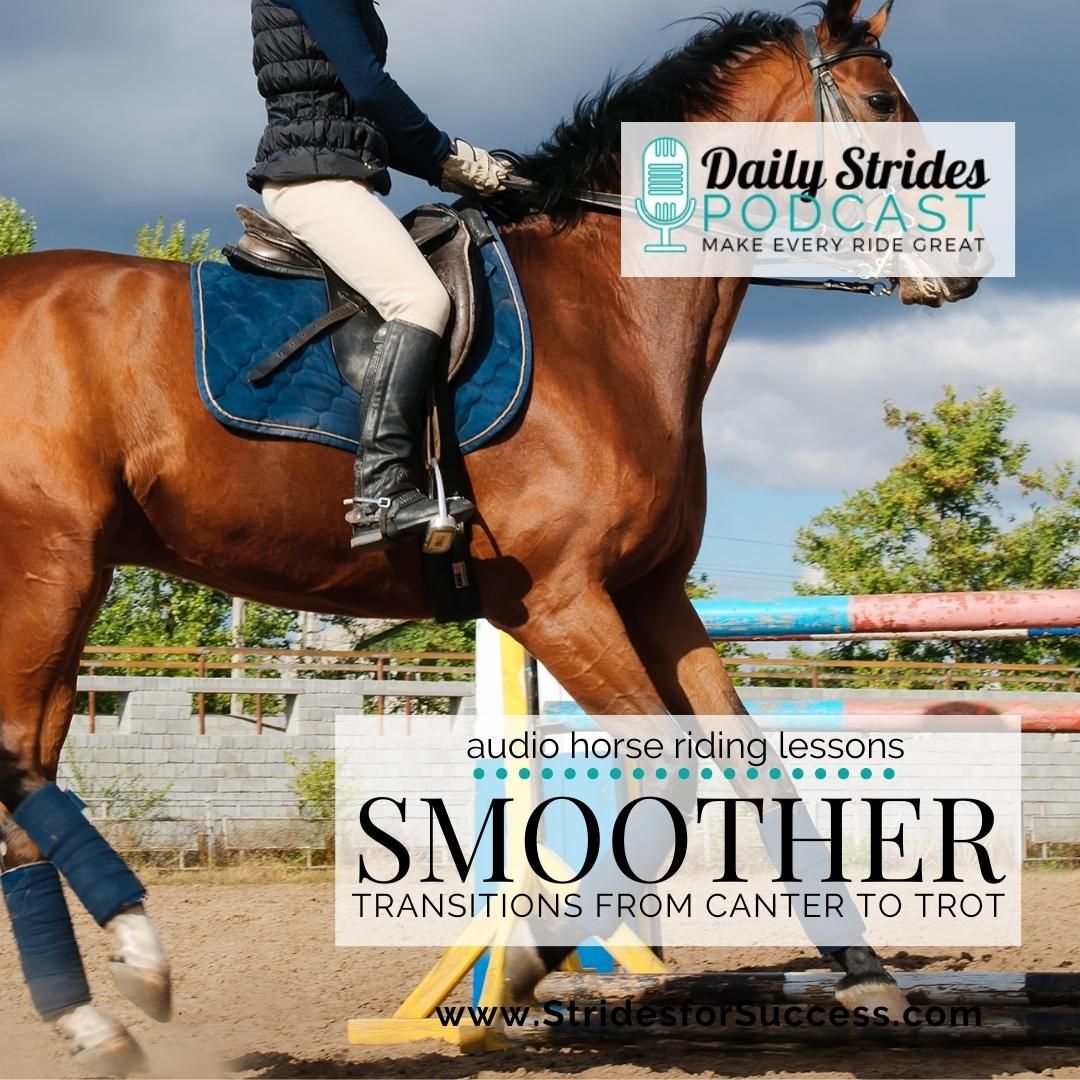
  • Smoother Transitions from Canter to Trot

    Smoother Transitions from Canter to Trot

    [fusebox_track_player url=”https://op3.dev/e/traffic.libsyn.com/dailystridespodcast/1287_Smoother_Transitions_From_Canter_to_Trot.mp3″ title=”Smoother Transitions from Canter to Trot” social_linkedin=”true” social_pinterest=”true” social_email=”true” ]

    What goes up, must come down; apparently. And this certainly applies to the gaits when you’re riding your horse. For many riders, successfully riding the transition into the canter and then staying with the movement in the canter itself is a great achievement. However, the next piece of the puzzle is returning to the trot.

    For many riders, no matter how good the canter is and how well they can ride it; the bumpy, uneven, and unbalanced return to trot puts a damper on the whole experience.

    And, yes, the transition from canter to trot can be tough to ride; but it is definitely ‘doable’. Here’s how you can improve this for you and your horse.

     1. Prepare Yourself and Your Horse

    I know, it seems a little ‘Captain Obvious’.  However, when we have to do something that we struggle with, we can approach it with a ‘get this over with as quickly as possible’ type of energy!  So rather than ‘just doing it’, remember to first take the time to set both yourself and your horse up for the upcoming canter to trot transition.

    As you are cantering and preparing for the downward transition, make sure your horse is balanced and responsive to your aids. Also, work on maintaining a consistent rhythm in the canter

    Another part of the preparation is to make sure you are in the best place to both ask for trot and allow the transition to happen.  I will chat more about this later in the article.

     2. Use Your Half-Halt

    So many riders think of half halt as being a once and done thing.  The truth is that, more often than not, the half halt is a ‘more the merrier’ aid to use when riding.  A few good quality half-halts will help to rebalance your horse before the transition. And let him know something is happening so he can be on the lookout for your eventual ‘ask’.

    The half halt will not only balance and steady the energy in the canter, it’ll also help your horse to lighten the front end a little more; essential for a smooth canter to trot transition.

    Use your full body in the halt halt.  Your seat, your legs, and your hands.  And remember that the ‘squeeze’ or resistance is only for a split second.  One beat of the stride.  Then release.  The goal is to engage your horse’s hindquarters and bring them back onto their haunches.

     3. Sit up and Engage Your Core

    And the required self carriage is not just for your horse.  It also applies to you.  Make sure that you prepare your body for the transition by sitting up tall and engaging your core muscles. This will help you maintain your balance and give clear cues to your horse.

    If you are in the right position to give the canter to trot aids, there is a much better chance your horse will understand – and then respond – to those aids. 

    This also allows you to follow the transition from the canter into the trot.  Collapsing through your seat will only result in a bumpy experience as the transition happens! And it will also leave you in the wrong place to ride the trot after the transition.

     4. Coordinate Your Aids

    Asking for the transition can be tricky for some riders. There is a struggle with how to truly balance the aids so that you ask the ‘right’ way for your horse to understand.  Focus on your seat first.  The ‘swing’ or ‘roll’ of the canter.  With canter, your inside seat bone is always leading your outside seat bone.  Part of the aids to ask for trot is to signal the change using your seat.

    Once you have engaged your seat bones, you can also your voice as an aid to support your other aids. Saying something like ‘woah’, ‘steady’ or “trot” or can be a big help for your horse to understand what your physical aids are asking.  From here, close your legs and squeeze lightly to encourage your horse to move forward into the trot.

    It’s really important that you are ready to follow your horse into the trot. This is really how you can ‘smooth’ the tension. 


    5. Allow in the Trot

    This is a key piece to any downward transition.  You MUST allow the horse to move forward into the new gait.  So many riders hold on too long with their aids.  This will only cause the trot to become jerky, hollow, or flat. Allowing involves your body moving in a way that works with the horse, rather than against.

    Practice identifying the very first step of the trot. As your horse takes that step, allow through your seat and your hands (your elbows, really). This will soften the contact – and smooth the tension.

    From here, move with the horse in the trot.  Think about keeping steady contact with the reins while allowing your horse to find their balance in the new gait.  It is usually easier to post or rise when first in the trot.  If you find that your horse is becoming hollow, this is especially important.  Often it is a bouncy rider trying to ride sitting trot that causes that hollowness!

    Practice the Canter to Trot

    It goes without saying, in order to improve you will have to do the work.  Regular practice will help you and your horse become more familiar with the transition.  It will also improve your timing and communication. Gradually work on refining the aids and asking for smoother transitions over time.

    Remember, transitions require coordination and communication between you and your horse. Be patient, and try to remain balanced.  Work on asking your horse with clear and consistent aids to achieve a smooth canter to trot transition.

    Happy Riding
    Lorna

    Improve Your Canter

    The canter is a big topic for riders. There can be so much pleasure and joy found there. And, often, an equal amount of bumps, flatness, and non-starts! If you are keen on improving your canter in just 4 weeks, make sure you take a look at my program Improve Your Canter.

    You will learn what is happening and how you can best time your aids so that your canter will go from being hit-and-miss to smooth and connected.

    With audio horse riding lessons to listen to 4 days a week while you ride, all filled with different exercises for you to practice, Improve your Canter will help you finally ride the canter the way you want.  Every single time.

    More on This Topic:-

    Training For Riders:-

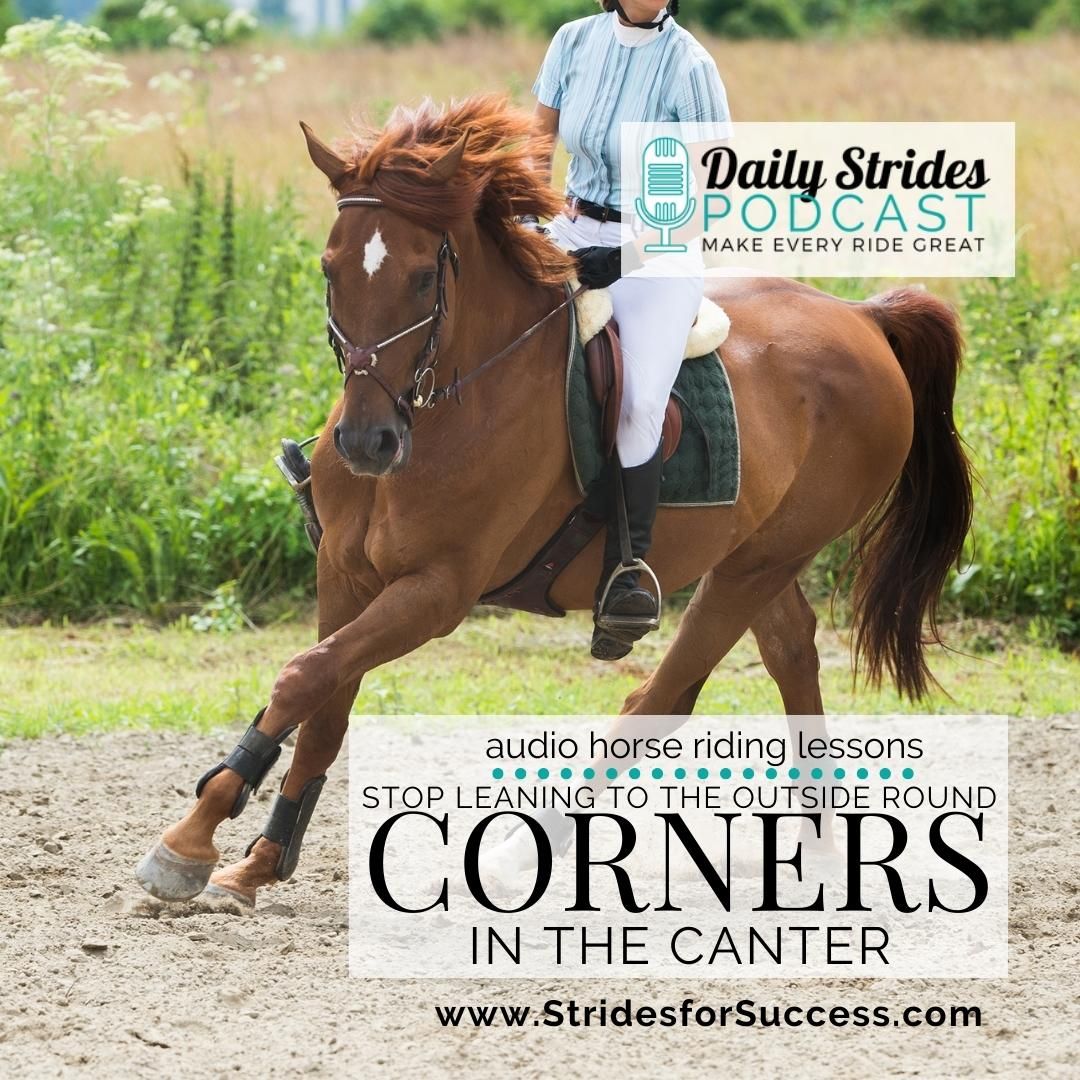
  • Stop Leaning to the Outside Round Corners when Cantering

    Stop Leaning to the Outside Round Corners when Cantering

    [fusebox_track_player url=”https://op3.dev/e/traffic.libsyn.com/dailystridespodcast/1286_How_to_Stop_Being_Pulled_to_the_Outside_in_the_Canter.mp3″ title=”Stop Leaning to the Outside Around Corners when Cantering” social_linkedin=”true” social_pinterest=”true” social_email=”true” ]

    The challenge is real… And, unfortunately, the momentum is as well! For so many riders, cantering is all well and good until the point where you have to turn! Cantering around corners can be so challenging for many riders for a lot of reasons. Here are 3 points to focus on to help you maintain your alignment and balance.

    1. Understand Momentum

    When cantering around corners, there are certain laws of physics at play!  One of the easiest ways to think about this is to use the example of a children’s merry-go-round.  When the merry-go-round is moving, it is much easier to remain balanced the closer you are to the center of the platform.  The closer you are to the edge, the stronger the force or momentum that feels like it is sucking or pulling you off the merry-go-round. Cantering on your horse is the same.

    If you are not actively positioning your body and your weight to help balance yourself, momentum will ‘suck’ you to the outside.  And with your horse moving to the ‘inside’ – that is not going to end well!

    2. Assess Any Potential Crookedness in Your Body

    If you have a tendency to lean or collapse through your body, this will become more amplified the more energy your horse creates when you ride.  Especially in the canter. Many riders don’t realize how much they collapse or they lean when they ride. Until they are asked to canter. And, even then, it is only really when they find themselves leaning to the outside around corners and through bends that it becomes a problem that urgently needs fixing!

    Start by assessing yourself in the walk. From here move into the trot, and then canter. Notice any height differences between your hands or shoulders.  Your knees as well. And also, how ‘equal’ you are sitting in the saddle…

    3. Correct Your Weight Aids & Position

    Once you have ‘straightened yourself out’ and really worked on developing symmetry through your body as you ride, now is the time to begin putting correct position and weight aids into practice.  So many riders have heard that they must ‘weight the inside seat bone’.  And this is not wrong.  It’s just how they are doing it that’s wrong.  They ‘lean’ to the inside using their shoulders – which only causes their inside seat bone to migrate to the outside of the saddle. Nope!

    Weighting the inside seat bone requires you to elongate and engage the inside of your body. Think of lengthening the inside leg and then, by positioning your upper body to ride through the corner, engaging your core.

    Leaning to the Outside in the Canter

    It is not an enjoyable experience.  However, it is one that can be corrected pretty easily if you are consistent with your approach.  By looking at the overall position of your body as you ride through any corner, in walk, trot, or canter, you will begin to do this without any thought.

    And when you can put the basics of position, weight, and straightness on autopilot, that is when you will find yourself, someday soon, not even thinking about this anymore in your riding.

    Happy Riding
    Lorna

    More on This Topic:-

    Improve Your Canter

    The canter is a big topic for riders. There can be so much pleasure and joy found there. And, often, an equal amount of bumps, flatness, and non-starts! If you are keen on improving your canter in just 4 weeks, make sure you take a look at my program Improve Your Canter.

    You will learn what is happening and how you can best time your aids so that your canter will go from being hit-and-miss to smooth and connected.

    With audio horse riding lessons to listen to 4 days a week while you ride, all filled with different exercises for you to practice, Improve your Canter will help you finally ride the canter the way you want.  Every single time.

    Training For Riders:-

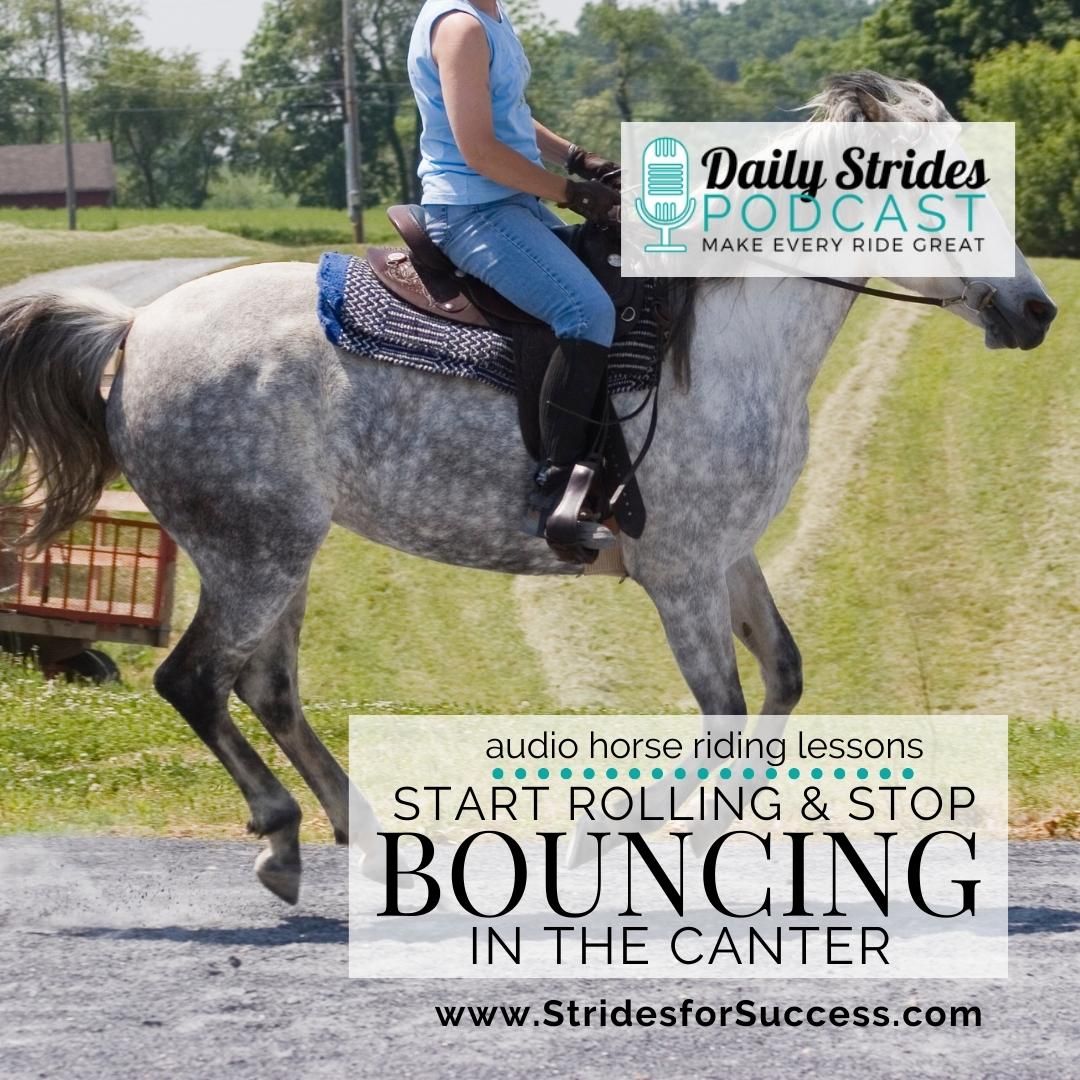
  • Start Rolling & Stop Bouncing in the Canter

    Start Rolling & Stop Bouncing in the Canter

    [fusebox_track_player url=”https://op3.dev/e/traffic.libsyn.com/dailystridespodcast/1285_Start_Rolling_Stop_Bouncing_in_the_Canter.mp3″ title=”Start Rolling and Stop Bouncing in the Canter” social_linkedin=”true” social_pinterest=”true” social_email=”true” ]

    One of the fun things about canter is the ‘moment of suspension’.  Except when this ‘moment’ applies to the rider, not just the horse!  Yes, there is a moment when the horse will be ‘off’ the ground; suspended in midair.  However, we definitely don’t want you to experience this bouncing in the canter.

    Becoming airborne whenever your horse strides in the canter is no fun!  And the ‘land’ when you connect with the saddle again brings little relief.  Instead of being a safe and reassuring place to ‘come back to earth’; it can feel like the saddle is trying to push you back into ‘thin air’ again.  Never a good feeling!

    In order to truly stop bouncing in the canter, I think you first have to understand the canter. And what your body needs to do in order to stay moving with the horse, rather than against it. 

     1. Start in Walk

    I think the walk is the perfect place to really begin moving your body in a way that will help your canter.  Allow the movement of the walk to move your body. Focus on how loose and supple your lower torso and seat can be.  Once your body has begun moving, you can really go deeper with what is actually happening.

    Instead of just thinking ‘backward and forward’ with your seat, notice the ‘higher and lower’ that goes with it.  Down and forward, up and back, down and forward, up and back…

    The ‘roll’ that we want to use to continue to move with our horse while cantering is just a more ‘advanced’ version of the roll you experience while in the walk. But so many riders are unconscious of this.  They fail to notice all of the little nuances. Spend time in the walk.  Know it with your eyes shut. And then practice some more.  This will truly help you when you canter.

     2. Understand the Canter

    Most of us understand that there is a moment of suspension in the canter.  And it is that moment of suspension that can cause so many hassles for riders! In order for you to really ride a smooth canter, every stride, it’s important to realize what is happening during the moment.

    In canter, you have 1,2,3, roll.  Then it repeats.  The ‘roll’ part, while not an actual beat, is really a silent beat.  It is where the horse resets.  Meaning your horse’s body and the legs pass over the inside front leg (the 3 in the canter stride sequence).  To do this, everything comes ‘up’.  It lifts.

    So, the down and forward happens during the 1,2,3.  And the up and back happen during the ‘roll’. Like a slightly wonky-shaped circle.  Down and forwards, up and back. 1,2,3, roll. 

     3. Self Carriage

    So once you know what is happening and you’ve begun to get to grips with your seat and how it’s moving, the next part is to really carry yourself.  Self-carriage is not just for horses. In fact, as riders, we should ideally be modeling this for our horses.

    One of the easiest ways to really begin carrying yourself while riding is to think about your posture and your position, When you work on your posture, you will naturally engage your core – and begin carrying yourself. 

    And this carrying yourself is key to being able to move with your horse, rather than working against him.  bouncing in the canter happens when we are moving against our horse.  It’s not pleasant for horse or rider, so working on your physical strength, fitness, posture, and position will help both you and your horse in the canter.

     4. Your Seat is a Pendulum

    Now, while I say ‘swing your seat’, I really mean allow your seat to be swung! As you get better at moving with the canter, yes, you can definitely use your seat to influence the canter. But for the start, just to get you out of the ‘bouncing mode’, you must learn to allow your seat to move with your horse.

    One of the easiest ways to think of this is that your seat is like a pendulum.  It is moving backward and forwards, underneath a certain point. And that point is pretty consistent.  In your case, the ‘point’ is your shoulders and upper body.  Your seat is your pendulum.

    Unfortunately, many riders are operating their pendulum upside down!  Their shoulders and upper body is doing all the movement. While the seat is stiff, stuck, and blocking. 

    Being able to move with your horse in the canter will require your body to be supple, elastic, and loose enough to move with your horse through each stride of the canter. And not just the forward and back, but also the down and up.  This truly creates the roll.

     5. Practicing, Correcting, & Practicing

    When you properly understand what is happening and can move your body, in walk, in preparation for ‘greater things’, then it is time to canter. Remember, bouncing in the canter happens on the roll.  So really start to become aware of the 1,2,3,roll. When you know what your body is supposed to be doing at which point in the stride, you can make adjustments.

    If you feel like you are losing rhythm and suppleness, reengage your core and carry yourself again. This will give your seat space to move with your horse.

    Cantering is not easy.  The more energy that is being created by the horse will always cause any weaknesses in the riders to be amplified.  In this case, it’s often a lack of posture, position, and suppleness. However, these can also all be worked on by becoming intentional when you ride.

    Happy Riding
    Lorna

    More on This Topic:-

    Training For Riders:-

  • Creating a More Responsive Transition into the Canter

    Creating a More Responsive Transition into the Canter

    [fusebox_track_player url=”https://op3.dev/e/traffic.libsyn.com/dailystridespodcast/1284_More_Responsive_Transitions_into_the_Canter.mp3″ title=”Creating a More Responsive Transition into the Canter” social_linkedin=”true” social_pinterest=”true” social_email=”true” ]

    Getting into the canter can be a challenge! For so many riders the transition into the canter can be a truly bumpy, hair-raising, rushed, and flat experience.  There is none of the upward, poised, clean, and intentional 1 that leads to the 2, 3 for the canter stride. It is just a matter of creating enough momentum with a flat, running trot to finally, eventually, fall into the canter. Not good!  But all is not lost…

    I believe that by working on a few key elements in your riding and your training with your horse, you can literally transform your canter transition in a VERY short period of time.

    The key to doing this is to first be very honest with yourself.  Honest about both your abilities and what you are doing.  And also, your horse’s abilities. Is he actually  ‘able’ to simply step from a trot into a canter, carrying you, at this level in his training?  That there is a really good question and one that’s worth getting clear on today.

     1. Check All External Influences

    We have all heard of the horse who, once the feeding program was changed went from being a Lazy Daisy to an Arkle… And yet, so many riders simply fail to consider calories, protein, fats, vitamins, and minerals when it comes to their horse’s energy levels. I am not an equine nutritionist.

    However, I have seen (and personally experienced) how a simple tweak to the diet or supplements can have a massive impact on performance and concentration.

    This is always something to consider when your horse is struggling with energy levels during training. And the same can be said for tack and equipment.  How many horses ‘inherit’ a saddle and bridle?  I was guilty of this for years with my own ponies.  There’s a bridle with a certain bit in the tack room that is not being used.  Great – let’s shove it into ‘Shadow’s’ mouth.  Hmmmm…. We know our horses are individuals.  So it makes sense that their tack should be selected for them – individually.

    Make sure that all of the equipment, especially saddles, is allowing your horse the freedom of movement through his back and shoulders so that he can actually do what you ask him to do :) 

     2. How’s Your Responsiveness?

    So you ask a question.  Great.  What response do you get?  This past week I’ve worked with 3 different riders who want to ‘fix’ big things.  And yet, I sent them all home to work on their responsiveness.  You see, I believe that responsiveness is a rider issue…

    Responsiveness comes down to what expectations you set and what boundaries you are willing to communicate and enforce. 

    So many riders are ‘wishy-washy’ about things.  A simple pushover on the ground.  An unwillingness to walk ‘shoulder to shoulder’ (if you’re Irish you’re singing) as you lead from the ground.  Responsiveness matters.  And it all comes down to being clear on what you want – and how you ask for it.

     3. Understanding the Canter

    So the canter is lovely because there is this natural ‘moment of suspension’ involved in it.  We meet it every single stride.  Which also includes the very first stride.  And if we, as riders, are hoping for suspension… Well, it stands to reason that we are doing all we can to help that happen.

    If we are collapsed on our horse’s shoulders and withers as the transition happens… How can we expect our horse to elevate and ‘step up into’ the canter? We need to allow space for the transition to happen.  So for the 1 to happen – the first step of the 3 beat stride – there must be space for the 2 and the 3.

    It’s the upward trajectory of the canter that creates the momentum many riders can’t ‘sit’ or ‘handle’.  And this is a simple lack of self-carriage and suppleness through their own bodies that causes this issue. 

     4. Your Seat is a Pendulum

    A great way to begin improving your ability to ‘follow’ and ‘stay with’ your horse in the canter is to imagine your seat as a pendulum.  It is swinging from your shoulders or upper rib cage. Meaning that they should remain relatively consistent, while the seat is doing the movement.

    So many riders are riding the canter the wrong way around… Their shoulders are doing the ‘swinging’ while their seat is stiff, hunkered down, and blocking the natural flow. 

    I go into more detail on this in THIS ARTICLE. However, for now, just keep the idea in mind that your shoulders and upper body must remain in self-carriage.  This will allow your seat to literally go with your horse into the canter itself.

     5. Gain Clarity On Your Aids

    The final piece when improving your transition into the canter is to become really clear on your aids. And the fact that the word aids is plural is really important here!  There is no ‘one aid’ that will get you into the canter.  It is a combination of good preparation meeting an accurate and effective combination of aids.

    So many riders seem to think that their outside leg is a magic wand.  One swish of it and ‘voila’ your horse will be cantering!  Not so, not so…

    Your half halt is so important to really prepare both yourself and your horse.  It helps rebalance and refocus you both on working together to achieve something.  From there, your aids will then, if positioned and timed correctly, ask the question.  Which then leaves your horse the space to answer the question.

    Improve Your Transition into the Canter

    The canter is a big topic for riders. There can be so much pleasure and joy found there. And, often, an equal amount of bumps, flatness, and non-starts! If you are keen on improving your canter in just 4 weeks, make sure you take a look at my program Improve Your Canter.

    You will learn what is happening and how you can best time your aids so that your canter will go from being hit-and-miss to smooth and connected.

    With audio horse riding lessons to listen to 4 days a week while you ride, all filled with different exercises for you to practice, Improve your Canter will help you finally ride the canter the way you want.  Every single time.

    Happy Riding
    Lorna

    More on This Topic:-

    Training For Riders:-