Author: Lorna Leeson

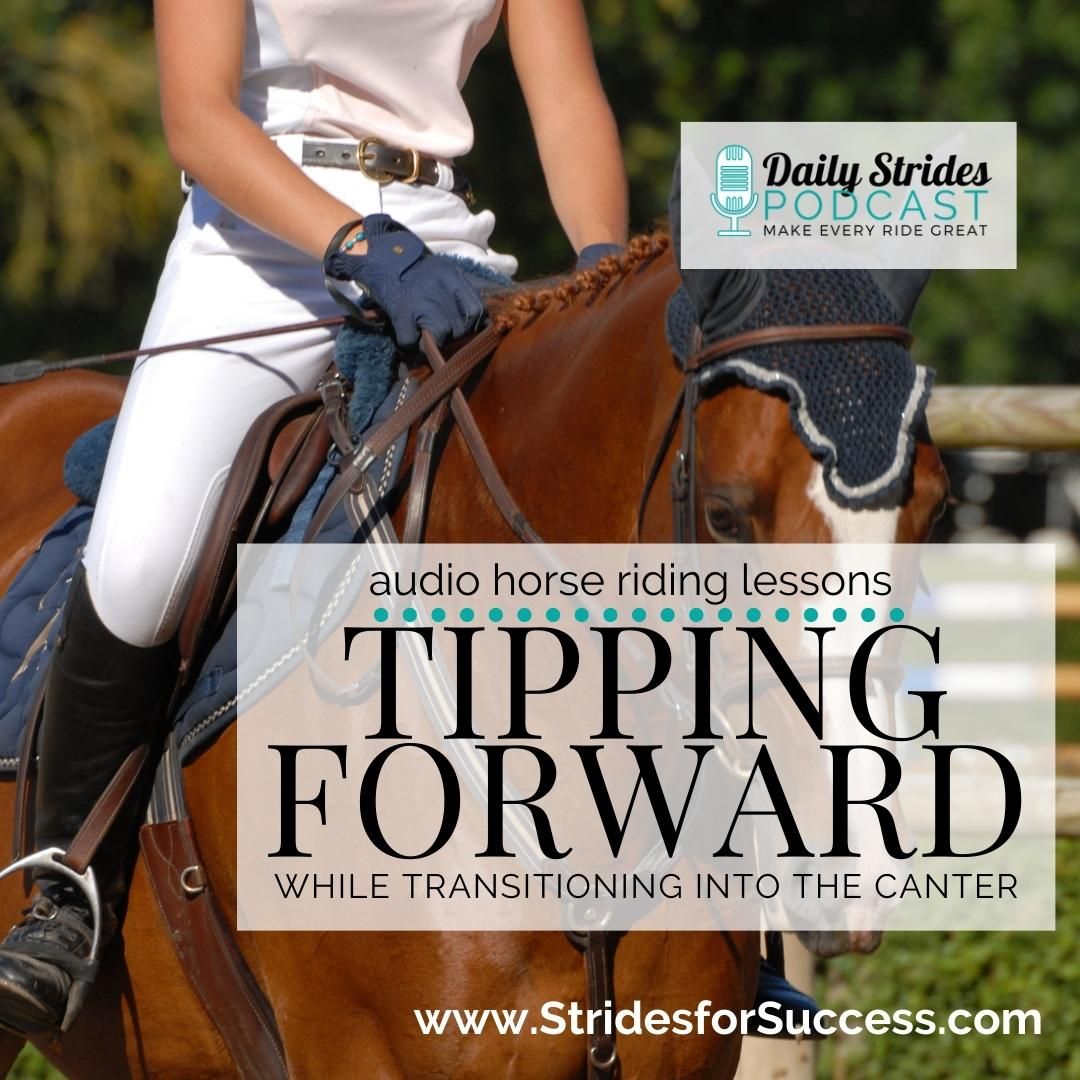
  • Tipping Forward while Transitioning into the Canter

    Tipping Forward while Transitioning into the Canter

    [fusebox_track_player url=”https://op3.dev/e/traffic.libsyn.com/dailystridespodcast/1277-Tipping_Forwards_while_Transitioning_into_Canter.mp3″ title=”Tipping Forwards While Transitioning into the Canter” social_linkedin=”true” social_pinterest=”true” social_email=”true” tweet_text=”How to stop tipping forwards through canter transitions” hashtag=”canter #onlinehorseriding” twitter_username=”strides_success” ]

    Have you ever fallen into the trap of trying to actually get your horse to canter? It’s a sneaky one that hides in plain sight. And it is an exhausting one as well. The good news is that you’re not alone! Over the years, I have seen so many riders make this mistake.

    Because trying to make your horse canter, and asking your horse to canter are two completely different things…

    And the latter, asking your horse, is so much easier, balanced, and enjoyable for all involved. It also has a much higher success rate as well ;)

    Tipping Forward while You Transition into Canter

    There are lots of reasons why riders find themselves tipping forward when getting into the canter. Lack of balance, coordination, self-awareness, position, and correct aids, to just name a few. And, as already mentioned, believing it’s your job to ‘make’ your horse canter also causes many challenges.

    Whatever the reason for it, finding yourself tipping forward on entry into canter is often not the best place to be, for the transition and for the canter itself

    And tipping forward not only makes things more difficult for you, but it also really can become a hindrance for your horse as well. It can negatively impact your horse’s ability actually to complete the transition. Just like us, our horses need to try and remain balanced, coordinated, and ‘forward thinking’ during the transition. And on the off chance that he does indeed make it into the canter, the rider tipping forward can make it difficult to establish a good quality, forward-moving, and engaged canter.

    The transition into the canter is an ‘upward’ transition, both between gaits and physically as well. If you throw your weight forward, you are blocking the horse with your body

    The Transition into Canter for Your Horse

    As your horse prepares to move into the canter, whether it is from walk or trot, he has to ‘reorganize’ his body a little. This is due to the canter being completely different from the walk or trot. The footfalls, the energy, the rhythm… All of it changes.

    In an ideal situation, your horse would maintain balance, engage the hindquarters, lighten the front end, and literally ‘step’ into the canter from the previous gait

    If the rider has tipped forward, this becomes close to impossible. The rider’s weight will have shifted onto, usually, their knees and inner thighs. This prevents the seat from connecting through the transition. The rider’s hands will also be affected. Either they will run forwards, up the mane. Or drop downwards, further leaning weight on the withers and shoulders.

    Often you will see horses responding to the rider tipping forward by ‘running’ through the transition. Or failing to transition at all into the canter

    Focus on Your Seat & Posture

    So, let’s say that you have identified that you do, indeed, have a bit of a habit of tipping forward through the transition. The first two things I would suggest to work on this is to try to remain engaged through your seat and aware of your posture.

    Work on trying to keep your shoulders above your hips, not in front or behind, both before, during, and after the transition; this will require self-carriage and engagement of your core

    As your horse ‘steps into’ the canter, notice how your belly button (your seat) will lead the rest of your body into the canter. If your shoulders are ahead of your hips, your seat cannot move with the horse into the canter.

    If you can maintain your posture before, during, and after the transition, it will allow your aids to work freely, independently, and with clarity to communicate with your horse

    Pay More Attention to Timing & Accuracy

    Rather than just seeing the transition into a canter as being random, become more specific. When and where do you want it to happen? From what type of trot or walk? And on which lead are you asking your horse to ‘strike’?

    By investing time and effort to better prepare your transition, you can then also decide when is the best place inside of the stride to ask…

    Asking for the transition at the wrong time in the stride of the current gait can often result in your horse becoming too tense. Losing relaxation will cause both rhythm and balance to also be lost. Also, horses usually want to please, and your horse may feel like he adds a ‘hop, skip, and jump’ just before the transition to get there!

    Any tipping forward of your body can make all of these things worse and cause an even greater loss of balance – for both of you!

    Focus on Your Hands and Legs

    A practical piece of advice is to focus on your hands and legs throughout the transition. Notice if you tend to ‘drop’ one of your hands… Or maybe lift a hand. Also, pay attention to how you move your hands through the transition.

    Your hands are the aids you can actually ‘see’ when you ride, so use them as indicators or guides as to how well you are maintaining your posture and seat before, during, and after the transition

    Remember, all of your aids are connected, so tipping forward will have a domino effect on all of the ways you use to communicate with your horse. Once you have your hands pretty independent through the transition, focus on your legs. Are your heels and lower legs coming up? Maybe just one is due to you tipping to one side – a very common issue, especially to the ‘inside’.

    By noticing if you can maintain the weight into your heels, you can begin to assess what your lower body is doing through the transition

    Your legs are there to both help ‘ask’ for the canter, but also to support your horse, especially if he’s green, into the canter and in the canter itself. This means they need to be in the right place and independent both before and when you ask. They also need to assist with establishing the canter after the transition as well. They cannot do any of this when you are tipping forward through the transition.

    Ask and then Allow

    My final suggestion is the one that I use all the time with riders. I want to simply remind you that it’s your job to ask the question. It is NOT your job to canter!

    Get really clear asking the question, and then get out of your horse’s way and let him respond

    Getting out of the way means positioning yourself in the best possible place for your horse to answer the question. You can do this by maintaining your posture, your own independence, and balance.

    The more you can begin to focus on setting the transition up as best you can, and then creating as much clarity as possible with your aids, the better your transitions into canter will become

    If tipping forward as you transition into canter is a habit that you have had for a long time, it may take a little work to replace. However, I also know that the key to doing this is to become mindful of your body and actions.

    Happy Riding
    Lorna

    More on This Topic

    More Training & Support

  • Declutter Your Riding and Watch What Happens…

    Declutter Your Riding and Watch What Happens…

    [fusebox_track_player url=”https://op3.dev/e/traffic.libsyn.com/dailystridespodcast/1276_Decluttering_Your_Riding_And_Watch_What_Happens.mp3″ title=”Declutter Your Riding and Watch What Happens” social_linkedin=”true” social_pinterest=”true” social_email=”true” tweet_text=”30 minute exercise that can transform your riding…” hashtag=”equestrian #horseriding” twitter_username=”strides_success” ]

    I bet that you still remember the day you made your first ‘big’ equestrian-related purchase.  Whether that was a helmet, a saddle, a horse, or a property, it’s a special time for all riders.  And of course, all of the ‘big ones’ that come after that are equally as memorable.

    The same applies to your riding.  That feeling when you ‘finally’ understood the canter and how to move with your horse – rather than bouncing against!  Or the first clear round you and your horse worked together to achieve.

    Big moments that, just like physical things, usually lead you on the path to your next ‘big thing’.

    And as riders, we also tend to collect a whole lorry load of smaller things as well.  The amounts of which tend to correlate to the amount of time we’ve considered ourselves as ‘riders’.  The daily essentials that, over time, we find we have 7 or 8 of each one (hands up who has a whole cupboard of brushes in the tack room!).

    Clearing Out the Clutter

    This is why, I believe, a good clear-out is essential for your progress as a rider. So many of the things you have collected over the years are probably not in regular use anymore.  And sure, some of them are things you only need every now and again, but are handy or essential when you need them.

    However, other things are simply sitting there taking up space. They are part of a past version of you as a rider and no longer complement the version of the rider you are today

    This can be certain equipment or training aids.  It can also show up in the form of healthcare, supplements, lotions, or ointments.  How often have you purchased something, usually on the recommendation of someone else, only to find that you really don’t enjoy using it?

    Often the reason we don’t throw things out or give things away is that we paid ‘good money’ for them…  Yet, if these things are reminding you of bad purchases every time you arrive at the barn, they’re not really helping you to enjoy your time with your horse, are they?

    Creating Space for New Things

    Of course, once the clutter has been cleared, you will begin to see all of the space you’ve created.  And because there are only things that you actually love and use there, you get to feel more aligned with your ‘stuff’ as well.  This often helps us to feel more comfortable while with our horses.

    With the space that you have created, begin to ask yourself what the current version of you as a rider would have there. And what would ‘future you’ begin to look for?

    By asking yourself these questions you will automatically begin to future-pace yourself a little.  This is not just inspiring at the moment, but also a continual reminder that you are growing as a rider.  It will help you to create more confidence in yourself as well because you can clearly see how far you have already come.

    Applying This to Your Riding

    Just like the physical things you accumulate along the way as a rider, you also will collect mental clutter.  And riding habits.  Lots and lots of habits! These habits are everywhere; how you groom, tack up, mount up, warm up, ride, cool down, untack, pack things away, etc.

    Habits are things that you’ve learned and then, whether intentionally or not, put onto autopilot in your day-to-day riding and interactions with your horse. 

    For the most part, they usually serve you well… Until they don’t! And this can be where many riders find themselves stuck or plateaued when it comes to making progress.  They are doing all of the things, riding all of the time, but just not getting anywhere.

    It is amazing how often riders discover that by changing one simple thing they are doing, often on autopilot, they immediately get unstuck and begin to grow again in their skills and mindset. 

    Declutter Your Riding Aids & Methods

    I’m always wary of people who are unwilling to consider different methods and ways of doing things. I think one of the hallmarks of a great rider and trainer is to always be of the mindset that you have so much more to learn.  And that this knowledge can show up in the most random of places!

    Having had The Daily Strides Podcast for 10 years this year, I am pretty confident that some of the things I’ve said are things I no longer align with 100% now.  

    And this will also be true for you in your riding.  How you stopped a horse the very first time you got onto a horse and how you halt today are, I’m hoping, two very different things. And so, the same applies to everything else.  How you use your aids.  The combination, timing, weight, pressure, etc.  What you know about how your horse moves.  And your actual beliefs about yourself, your abilities, and those of your horse as well.

    The only way you will continue to progress as a rider is to regularly allow yourself to be very present with what you’re doing on autopilot… And tweak, change, replace, stop, or start where necessary.

    The old adage of ‘what got you here won’t get you there’ applies to this.  So it’s well worth taking the time this week to dive into your equipment and your riding and begin making space for the next best version of you as an equestrian.

    Happy Riding
    Lorna

    More on This Topic

    More Training & Support

  • Developing More Patience as a Rider

    Developing More Patience as a Rider

    [fusebox_track_player url=”https://op3.dev/e/traffic.libsyn.com/dailystridespodcast/1275-Developing-More-Patience-as-a-Rider.mp3″ title=”Developing More Patience as a Rider” social_linkedin=”true” social_pinterest=”true” social_email=”true” tweet_text=”Increase your patience with yourself and your horse…” hashtag=”horseriding #patience” twitter_username=”strides_success” ]
    A lack of patience is something that many riders feel shame about. I was one of those riders for many years, so I know full well how it feels. The initial frustration, the following swift judgment or potential explosion, and then the guilt that happens afterward. Let’s be honest, coming out the other side from losing your patience is rarely a good place to be!
    And yet, for years I simply believed that I was not a patient person. Like it was something that you are either born with – or not
    Now, I do think that some people have naturally more tolerance and more patience than others. However, I also now believe that patience can be developed – in all riders. It is simply a matter of believing you can, and then committing to doing the work required.

    Developing More Patience is Work

    I say this because let’s be honest, it probably won’t be easy initially. If you’re a rider who struggles with patience, there’s a good chance that there is a pretty well-formed habit or reaction that occurs each time you feel impatient! This is different for all riders.
    Lack of patience can show up as anything from excess tension through the jaw, right the way to becoming physically aggressive with your horse or those around you
    I think many riders also lack patience with themselves. When I’m working with riders in the arena, I often see this play out. The rider is ‘trying’ to do something. And they are trying and trying… Each attempt is with more tension through the body – which usually results in the rider moving further away from where they need to be in order to ‘ask the question’ with clarity.
    As you work on developing more patience, keep in mind that it’s really worthwhile developing it for both yourself and your horse
    And that this will take both time, consistency, and accepting that there will be a lot of speed wobbles along the way. Times where you don’t respond as you would like. But, unfortunately, find yourself playing out the old, learned, reaction or habit… It’s going to happen, accepting it before you begin the journey will make things much more enjoyable for you :)

    1 . Have You Set Clear Boundaries?

    So, before we begin working on your patience levels, I think that it’s worth noting what you are currently allowing. And what you’re not. These are your boundaries. So often, it is a lack of numerous boundaries that eventually leads to the rider losing patience.
    Remember, if you have not specifically communicated with your horse about what’s allowed and what’s not… It is essentially your own fault when things don’t go as you would like
    Another issue I often see is a rider who has not established firm and supportive boundaries on the ground. The horse will keep overstepping the mark while being groomed and tacked up, resulting in the rider’s patience becoming ‘worn down’ before they ever even make it into the saddle.
    Part of developing more patience as a rider is knowing what you want and what you don’t. What’s acceptable and what’s not? Then let your horse know – and enforcing where necessary

    2 . Set Clearly Defined Goals

    Once you know what you want, you can now begin to shape or mold each interaction with your horse to work towards that. Meaning you will now have a clear picture of ‘where we are right now’ in relation to ‘where we want to be’. This gives you both acceptable ‘wiggle room’.
    Knowing the differences between ‘here’ and ‘there’ will clearly define what is still acceptable as far as training, manners, skills, etc. are concerned. This gives you space – and removes pressure
    So, for example, if your goal is to canter a 20m circle on the left rein, but you are both still struggling to pick up the left lead on the transition into the canter. A good ‘expectation’ for your next ride would be to begin developing flexion to the left. Even if it’s only in the walk for now. By doing this, you will have taken the pressure off; allowing space for more patience with that process.
    Or if your horse is currently walking in circles and pushing you around when grooming and tacking up, your end goal might be that he stands still. However, in your next interaction with each other, you will decide ahead of time what your response will be to correct him each time he pushes you around or over. Implement this first… And you will soon be working towards the real goal, standing still. And, this way, your horse will also be more likely to work with you as he will respect you a little more.

    3 . Become More Self Aware

    This was a key step to developing more patience for me. I simply began to notice myself more. Initially, I was only able to do this after the fact. So after I had ‘lost my patience’. But over time, I was able to do it mid ‘patience losing’! And now, thank goodness, I can catch myself right at the thought that triggers the whole avalanche!
    Where ever you can, simply stop focusing on your horse, and really – REALLY – feel what’s going on in your body. Where is there excessive tension lurking; and how does it physically feel?
    And then just sit with it. It can feel REALLY mentally uncomfortable to notice and then simply allow the feeling of excess tension in the body. However, this will actually result in it dissipating. Meaning you can get back to ‘true calm’ much more quickly – and without doing or saying anything you may regret.
    When we ignore the feeling of excess tension in our bodies or pretend it’s not there, we simply mask it for a while. However, it will usually pop up again, with even more ‘vuma’ soon after
    Another way I have found to be really effective in becoming ‘self-aware’ is to imagine that I am being videoed. And thinking about, at that moment, what I look like in that video. It almost instantly causes me to ‘drop’ the tension and relax. It also causes my mind to think about something else. To move away from the initial thought that was triggering the lack of patience.

    4 . Remind Yourself Of Why You’re Doing It

    So, in the spirit of honesty, sometimes implementing self-awareness is not enough to reverse the feelings and thoughts inside of your body and your mind. Sometimes, you may feel ‘justified’ in reacting the way you either are, did or want to. And this is where I find giving myself a reality check works well.
    Simply answer the following question; “why did I decide to do this in the first place?” Usually, the answer is ‘to have fun’ or ‘feel good’. Then, ask a second question, ” How can I begin to turn this current situation into that?”
    Again, it’s at this point I often just laugh at myself! Laughing is a great way to allow the excess tension to work its way out, and cause no harm (emotional or physical) to yourself or those around you! Realizing that you are busy with a reaction that in no way aligns with your purpose for being there is usually pretty sobering. A great wake-up call.
    Another way I find really useful to turn the situation around is to ask “How is my horse/the rider/my instructor possibly feeling right now? Are they confused, tired, frustrated, or fearful… If so, how can I help change that to something more positive?”
    When you can intentionally put yourself into the other person’s (or your horses’) shoes, the different perspective is often enough to change the energy of the situation

    5 . Be Willing To Fail – A Lot!

    Finally, when you are on the road and committed to developing more patience as a rider, there will be speed wobbles. Lots of them! You’ll have days where your physical feelings will get in the way. Tiredness and hunger are two of the big ones for many riders! You’ll also have days where you will feel pushed for time. And then there are the days when other people will have an influence over how you’re showing up and feeling.
    The key to consistently growing and developing your patience is to catch yourself, as close as possible, to the original thought that triggers it all. Some days you’ll have more success than others
    One of the biggest challenges we have as riders (humans) is gaining authority over our own minds. Being able to notice thoughts, and not emotionally respond or react to them is the first step.
    Being able to cultivate thoughts that produce more desirable feelings and outcomes is the next step, and this will take time and commitment
    Remember, no matter how many times you find yourself on the other side of another ‘lost my patience speed wobble’, remind yourself that’s all it was. A momentary speed wobble.
    Then pick yourself up, apologize to whoever may have been affected, and continue trying. Some days it might be better to call it a day, for that day. And there’s also no shame in that either.
    In the beginning, it can feel almost impossible, but over time, trust me, it becomes so much easier.
    Happy Riding
    Lorna
  • Building Confidence When Riding a Nervous Horse

    Building Confidence When Riding a Nervous Horse

    [fusebox_track_player url=”https://op3.dev/e/traffic.libsyn.com/dailystridespodcast/1274_Building_Confidence_when_Riding_a_Nervous_Horse.mp3″ title=”Building Confidence when Riding a Nervous Horse” social_linkedin=”true” social_pinterest=”true” social_email=”true” tweet_text=”Coping with riding a nervous horse” hashtag=”confidence #equestrian” twitter_username=”strides_success” ]
    Riding a nervous horse is one thing… Feeling less than confident about your own abilities while on your horse is quite another. Imagine it, up there, on your horse. He is beginning to get a little ‘jumpy’. Let’s be honest, so are you… Doubts are beginning to creep in and your thoughts are heading in a direction you would rather that they didn’t go…
    Building confidence in your abilities to both handle yourself and the horse when in this situation is often a long road. However, it can be done – with time and patience.
    Here are my suggestions for building your confidence in working with and riding a nervous horse.

    1 . Find Your Comfort Zone – and Stay There

    I know this is a little contrary to what other trainers might suggest in this situation. So many coaches, trainers, and instructors encourage their riders to get out of their comfort zones. I tend to take the opposite approach, initially anyways.
    I believe that if you can find the place where you are happy, the place that is just close to the actual edge of the boundary of your comfort zone and work there for a while, you can begin to re-wire both your thoughts, your actions, and your habits
    So many riders have a ‘protocol’ when it comes to feeling anxious and nervous on a horse. Some will literally attempt to ‘curl up’ into a ball (think of a hamster). Others will become aggressive as a way to hide or mask their doubts. And many will just freeze; forget all training and just sit there, waiting for the inevitable to happen.
    Working inside of your comfort zone will allow your more relaxed habits to become more dominant. The key word there is ‘working’. Do things with your horse from where you are comfortable

    2 . Get Your Basics onto Autopilot

    Very often, riders are failing to get one or two key basics in their riding running on autopilot. What I mean by autopilot is that you no longer have to think about ‘heels down’; it simply just happens. And any time ‘pressure’ is applied, it happens even more! This also applies to ‘sit up and carry yourself’. When your horse is having a moment, these are two things that you really don’t want to forget or stop doing in your riding.
    Focus on getting all the essentials to simply happen, on their own, so that if and when pressure is applied (things don’t go to plan), they remain in place and support you
    Many riders, can keep their heels down as long as they are thinking about keeping their heels down. Remember, when things go sideways, you won’t be running through a checklist of ‘essentials to remember’!
    You want to rather work on regaining balance for yourself and your horse and getting the ride back on track. This is close to impossible to achieve if you first have to ‘fix’ some of your basics with regard to position, posture, and aids

    3 . Begin ‘Testing’ Yourself – and Your Horse

    This is where you can begin to have some fun, while also continuing to work on developing your aids, habits, responses, and reactions. You’re going to do this by ‘inviting’ some potentially uncomfortable things into your comfort zone. Where I would suggest going with this is to think of it from your horse’s perspective. What individual items might cause your horse to question the situation a little?
    Remember, the goal here is to build your confidence when riding a nervous horse – so by doing it this way, you get to remain ‘comfortable’ while your horse may experience a few nerves
    I also believe that getting creative with this is key to really beginning to transform anxiety into excitement – although we also want to take those emotions down a notch or two… Rather than thinking of you and your horse being ‘anxious, which can be a very heavy and big emotion, why not use the word ‘nervous’.  I personally think ‘nervous’ can either be positive or negative; meaning it can go either way. We want it to go in a positive way…
    Think about how you can begin to transform ‘nervous’ energy into ‘curious’ energy
    Only introduce things that you feel comfortable with, and continue to do this until your once nervous horse, also begins to relax and feel comfortable. This could take weeks…  Once you have established a stronger, more relaxed ‘you’ as a rider, and you feel confident as that version of you, then you can begin thinking about venturing outside of that comfort zone…

    4 . Control Everything You Possibly Can

    So, once you have things on autopilot and you have created supportive and good habits as responses and, maybe, reactions, it’s time to think about leaving the ‘comfort zone’. I am not a big fan of simply wandering off into the sunset with a wish and a prayer that all will be okay! This is where planning is going to help you succeed and build your confidence.
    Start off the ground, without your horse, and look at EVERYTHING from their perspective. Remember, you will be riding a nervous horse, so they will also look at, literally, everything!
    Remove any of the questionable things you may meet along your way. Also consider the time of day, who will be around or in the vicinity, the weather, feeding times, energy levels (you especially), and who can possibly be there for support.
    By creating a situation where, for the most part, you have removed many of the challenges, you and your horse can begin to experience working together and getting positive results – even if you both feel a little challenged and nervous

    5 . Mindset When Riding a Nervous Horse

    Finally, it is so important to increase your self-awareness. What are you believing to be true about the situation? Is that really true (meaning anyone, regardless of who they are can agree 100%)? And where can you begin to tweak or change your story surrounding this?
    If you continue to tell yourself the same story, about you feeling nervous while riding a nervous horse, you will continue to produce the same results; change the story where necessary
    Becoming more confident working with a horse who is likely to spook, spin, or fall to pieces is not easy. It will take time, commitment, diligence, patience, and a lot of forgiveness! You must remain dedicated to the job and do the work, physically, mentally, and emotionally.
    However, from experience, I can tell you that if you do stay the course, the results can be life-changing. So often these ‘nervous horses’ can often become the most trustworthy ‘horses of a lifetime’. And this is simply because someone refused to give up on them.
    Good luck and Happy Riding
    Lorna
  • Using Transitions to Improve Your Posture

    Using Transitions to Improve Your Posture

    [fusebox_track_player url=”https://op3.dev/e/traffic.libsyn.com/dailystridespodcast/1273_Using_Transitions_to_Improve_Your_Posture.mp3″ title=”Using Transitions to Improve Your Posture” social_linkedin=”true” social_pinterest=”true” social_email=”true” tweet_text=”A riding exercise for this week ” hashtag=”horseriding #equestrian” twitter_username=”strides_success” ]
    For many riders, posture is something that they rarely think a whole lot about. It’s a basic that you ‘set and forget’. Meaning, you figure out what it is and how it feels, and then you are diligent in putting it onto autopilot. Which then frees you up to focus on other things. And this works well; until it doesn’t…
    Transitions, particularly between gaits, have this special ability to shine a spotlight on any weaknesses either horse or rider has, and riders posture is often the focus of this attention
    However, transitions by their very nature can also be a really useful tool to help riders overcome any posture challenges. They require you to engage and carry yourself. And they also continually question you by requiring balance throughout the movement.
    Here are a few ideas to help you make the most of using transitions to improve your posture…

    Know What You Want Before the Transition

    It seems so obvious but getting clear on exactly what you want to achieve beforehand will help.  This means moving out of ‘autopilot’ and becoming present with regards to how you are using your body in the original gait. How does it feel through your shoulders and chest when you are carrying yourself?  And your seat?  What are your hands doing?
    In order to improve something that you already have a habit of doing, you must first become self-aware. Use your time in the gait before the transition to assess your posture and correct any problems. 
    By becoming more self-aware, you will often notice where those bad habits are beginning to slip into your everyday riding.  Maybe it’s a collapse of a shoulder through a bend or corner.  Or perhaps a tendency to become heavy through your seat as you half halt.  Whatever you notice, fix it inside of the gait first, before then moving on to working on it through the transitions themselves.

    Practice in Walk and Halt

    What if someone said that before you could trot, canter, or do any of the ‘fun things’ you love to do on a horse again, you first had to perfect your ability to walk?  Many riders don’t think of the walk as being something that needs work, but this couldn’t be further from the truth.  This is why I think investing time in your walk will help both you and your horse in the long run.
    When you first begin actually using transitions to improve your posture work between walking and halting.  Focus on being as consistent as you can within these two gaits, and only then, begin introducing trot to the mix. 
    Notice how well you can maintain both your posture, your position, and your positive tension throughout your body.  All of the above will influence the horse through the transition, and help determine if the transition is a success or a little less than inspiring!

    Positive Tension in Your Body

    This is a key part of transitions.  The energy needed to ride a transition is different from what’s being done both before and after the transition itself.  And it can often be a struggle to find the correct level of tension – relaxation – through it.
    There is also the responsibility of smoothing out the tension levels so that what came before blends with the transition and then smoothly continues into the new gait. 
    Riders who carry excess tension in their bodies through the transitions tend to lose their posture.  They either become ‘contracted’ through certain parts of the body – for example, the arms and shoulders – or they ‘lean’. This will look like their shoulders are either in front of or behind their hips.
    One of your goals as a rider, through all transitions, is the ability to find the correct level of tension and then blend that with what’s before and after the transition itself – and then help your horse to do the same. 

    Remain Aligned Through Your Body

    Once you’re clear on what you want, you can now begin to practice this through different transitions.  Pay attention to the alignment of your body.  If you find, at any point, that you have lost that basic alignment, pause a second and try to figure out why…
    Keep in mind that sometimes poor posture is a symptom of something else going on, perhaps position related. Find the root cause, and correct that first. 
    This will often result in your posture being more consistent, without you having to actually ‘fix’ anything regarding your posture. Self-carriage is a big part of posture, so if in doubt, lift yourself.  Carry through your body, open your chest, and elongate or lengthen down through to the heel.

    Using Transitions to Improve Your Posture

    As I’ve mentioned, transitions are a great way to really highlight what’s going on in your body when you ride. By taking the time to really notice what you’re doing, you can often fast-track your progress in other areas.
    Keep in mind, if your posture is letting you down through each transition, you are spending precious strides in each new gait trying to ‘fix’ that and re-establish what was lost. 
    Making ‘good posture’ a goal for you and your horse over the coming weeks and months will allow you both the space, literally, to begin implementing new things in your riding.
    Happy Riding
    Lorna
  • How to Secure a Swinging Lower Leg

    How to Secure a Swinging Lower Leg

    [fusebox_track_player url=”https://op3.dev/e/traffic.libsyn.com/dailystridespodcast/1272_Securing_a_Swinging_Lower_Leg.mp3″ title=”How to Secure a Swinging Lower Leg” social_linkedin=”true” social_pinterest=”true” social_email=”true” tweet_text=”Stop the swinging lower leg when in the saddle…” hashtag=”horseriding #equestrianproblems” twitter_username=”strides_success” ]
    What is it about a swinging lower leg that makes it so annoying for riders, horses, and trainers the world over?! I mean, everyone has their specific ‘riding issues’ and deals with them accordingly. And yet, a swinging lower leg has the potential to have riders stuck on a plateau forever!
    I don’t need to tell you how important it is to have a secure lower leg when riding. It is vital for the safety, communication, and, maybe, mental health of all involved!
    If you have been struggling with a lower leg that prefers to play ‘hokey pokey’ swinging back and forth, rather than help you gain clarity with your horse, don’t lose faith. Here are a few ways to begin securing those legs, once and for all.

    1 . Check Your Stirrup Length

    I think sometimes riders can be a little too optimistic when it comes to deciding on the length of their stirrups. This is especially true if there is a more advanced rider that they are trying to emulate in the saddle. Those riders have been practicing for years and are also most likely more ‘riding fit’ than the average ‘happy hacker’.
    There is nothing wrong with having shorter stirrups initially when riding. This will help you to feel more secure and develop your independent aids initially when getting started
    What is also key to remembering here is that your energy at the start of the ride, and then in the middle of the ride will differ. When you begin to feel tired, it can become more difficult to ‘control’ your aids. This is especially true of your legs. So, keep in mind that sometimes, putting your stirrups up a hole mid-ride can help with this issue as well.
    Adjust your stirrup length for the rider that you are right now… Not who you ‘want’ to be further down the line.

     2 . Is Your Horse Moving Forwards?

    Just like an untamed swinging lower leg, if your horse has to be kicked, shoved, or pushed forward every single stride, it is equally as exhausting! And this will really begin to negatively impact your position and posture over time. Not to mention the coordination and timing of your aids.
    Your horse must work forward on his own. Not have to be coaxed forward every single stride by you kicking your legs.
    Creating a secure lower leg is close to impossible if you are having to keep ‘rallying’ your horse to go forward. My suggestion for this is to work on responsiveness. Do so while riding, while lunging, and also with your groundwork. Once he/she is moving forward, you can begin thinking about your lower leg ‘asking’ questions, rather than shoving your horse along!

     3 . How’s Your Overall Position?

    The first big question is “are you sitting on your bum?”! If you have pitched forwards, even slightly, onto your crotch area, your lower leg will swing. This is due to you ‘closing’ your pelvis and, subsequently, squeezing your knees together. Sitting on the small of your lower back (tucking it in under you and sitting on your tailbone) is equally as problematic. This will result in your lower legs shooting forwards.
    Remember, your lower leg wants to be below you at all times – not in front of you or behind you. And it wants to channel your weight to your heel…
    Which leads me to ‘heels down’. Keeping the weight in your heel will help with so many of the issues riders struggle with when riding. You don’t have to ‘force’ your heels down. But simply allow the weight to drop there. This will go a long way to securing your lower leg.

     4 . Drape, Don’t Grip, with Your Legs

    Now, I get it. If your leg is swinging back and forth, it almost makes sense that if you can ‘hold’ it still, this will help. Unfortunately, it usually won’t. First of all, usually, riders try to secure their lower leg by squeezing their knees. This will 100% make the swinging lower leg even worse. That I can guarantee you! Don’t squeeze your knees!
    Focus on your legs being a channel and directing the energy. This way, you will begin to feel the contact with your horse down the full length of your leg – rather than just focusing on your knees.
    When you can allow your legs to drape, your focus will naturally shift to the contact between the inside of your thighs and the inside of your calves with the saddle and your horse. Your knee and ankle should be loose and supple.

     5 . Rider Fitness and Practice

    I think it is a little unrealistic to end this advice without mentioning your overall fitness as a rider. So many riders who struggle with a swinging leg are actually riders who are coming back after a break. Whether this break is 2 months, 2 years, or 22 years, it is vital to acknowledge that your body has changed. Give yourself time to improve.
    And remember, as you become more physically tired in the saddle, your lower leg will begin to swing more. So rather focus on shorter, more intentional rides where you can get more from the work.
    I would also suggest starting some form of complementary fitness activity. I personally love hiking and cycling. But I think any sort of movement will help you to gain more control over your body. And to increase your stamina too.
    Finally, good practice makes perfect; the quality of your rides will determine how quickly you progress. Riding for the sake of riding will not help this…
    So plan rides where you get to make the most of your energy and see if you can do more of those shorter rides.

     6 . Your Light Seat

    This leads me to specific exercises you can use while warming up and cooling down that will help you remedy a swinging lower leg… The trusty light or 2-point seat.  Practicing this while riding will help you to put many of the above principles into action.
    When you ride a true light seat, your lower leg is positioned where it should be, under you.  It allows your weight to drop into the heel and requires you to ‘drape’, not grip with your legs. And will help improve your fitness and your riding in general. It also prevents you from blocking any forward energy with a potentially heavy seat.
    However, just like everything else, your light seat must be correct in order for this exercise to be effective. It also really requires you not to balance on your hands, your horse’s mane or a neck strap to have maximum effect. 
    I have an episode on “Improving Your Riding with Your Light Seat” HERE that will help you.  Alternatively, sign up for the Equestrian Fitness Challenge HERE.
    You can learn to secure a swinging lower leg, but it will take consistency, dedication, and time. Good luck!
    Happy Riding
    Lorna

    More on This Topic

    More Training & Support