Author: Lorna Leeson

  • 3 Mistakes when Purchasing an Online Horse Program…

    3 Mistakes when Purchasing an Online Horse Program…

    [fusebox_track_player url=”https://op3.dev/e/traffic.libsyn.com/dailystridespodcast/1265_3_Mistakes_when_Joining_an_Online_Equestrian_Course_or_Program.mp3″ title=”3 Mistakes Riders Make when Purchasing an Online Horse Program” social_linkedin=”true” social_pinterest=”true” social_email=”true” tweet_text=”Before you buy another online equestrian course or program…” hashtag=”equestrianpodcast” twitter_username=”strides_success” ]

    There are times each year when special offers are just an inevitable part of life. Right now is one of those times; I can only imagine how, right now, your inbox is full, full, full, with all of the things!  And some of those things, online horse programs, are just so, well, darn good… Right?

    Hmmm… Maybe too good?!

    I think that most of us would agree that knowing how to discern ‘all of the things’ when it comes to online horse programs and courses can be a bit of a fine art.  Particularly when you’re not an expert on the topic of the course or program you’re interested in, maybe, investing in.  And this is true for most of us.  After all, we are not going to spend time and money on knowledge or training on things we already are well versed in! 

    So, in the hope that I can help you a little with all of the decisions regarding what’s ‘right’ for you and your horse…  Here’s a quick rundown of the 3 common mistakes I see riders make.

    1. Purchasing Before You’re Ready

    This is a trap that A LOT of riders fall into…  Making purchases for where they want to be – rather than where they actually are.  And before this raises too many eyebrows, please understand that I am all for making progress and developing all of the things.  That is not what I mean. 

    In this case, purchasing before you’re ready is a little like starting school at age 4 in a class filled with 12-year-olds – who’ve all been to school for all of the years.

    Yeah, things are not going to align or match.  A lot of online horse programs and courses will tell you ‘No Experience Necessary’… Hmmmm…  In my experience (a little meta, I know), a little or a lot (depending on the situation) of rider experience is often the very thing that changes EVERYTHING for riders…  Good or bad.

    My advice is to be honest with where you REALLY are at this point in your riding journey.  And with your current resources and how available they are; time, money, help, etc. 

    2. Expecting a Fairy Good Mother

    It’s always wonderful to think that the solution is as simple as just buying the course or the online horse program.  Wonderful, but completely unrealistic.  Horse riding just doesn’t work like that.  I see many riders become so swept up in the euphoria of actually ‘buying’ the online course or program, that they forget this is just the first step.  Now they have to go do the work! 

    I think it’s important to see the purchase as being Step 1 on the journey… A journey that will include a whole lot more steps as you do the work and apply the training to your riding. 

    Making the purchase is making a commitment to you and your horse.  I think creating something to help you fulfill that commitment is really important.  With online courses or programs, it can be so easy to say the initial ‘yes’ and then let the weeks and months slip by without ever logging on or engaging with the training. 

    Let the first thing you do when you invest in online training be to create time and space in your schedule to begin working through the content. And implementing the training in your riding. 

    3. Not Suiting Your Learning Needs & Style

    I’ve been creating online training for riders since 2013. That translates to many online horse programs and many riders taking them. And, throughout these 9 years, I have created a lot of different types of models or programs. And I have been part of a lot of ones as well.  I’ve noticed that a big part of success comes down to being in the right ‘type’ of program.  

    Trying to do everything won’t work. It will only lead to overwhelm.  But figuring out the key elements that help you to feel supported while working through the training, and then looking for programs that offer that – Gold! 

    Things like accountability, whether it be group or individual, structured or more loosely applied. Also the delivery of the training. This can be done via email, logging into a website, YouTube, a private podcast, Fb Group, Voxer, Telegram, or all of the other ways your course can be delivered to you. Is there a structured time frame, or a more flexible ‘self-study at your own pace feel to it?  Time and access to the trainer may be another big consideration.

    You will know what you need in order to flourish. Make sure you purchase programs or courses that will offer or provide this for you, depending on what you want most. 

    Why an Online Horse Program At All?

    So after reading or listening to all of this, you may be wondering ‘why would I buy an online course or program?’.  And, this is where I think that you may be missing out on a big part of the puzzle.  I am a firm believer that as riders, we should try to create our own style when it comes to working with our horses. And I think one of the best ways to do this is to find bits and pieces of things you like – and blend, blend, blend!

    When you get to learn from someone online, a person who you potentially may never ever meet in person, you get to add more to the blend that creates your personal riding style. 

    And this is especially useful if you have other things in your life that prevent you from hopping all around the world, trainer to trainer ;)  I really do believe that 99% of online equestrian coaches have something wonderful to offer.  The key is to make sure what they are offering lines up with what you want and need in your riding at that moment in time.

    Happy Riding
    Lorna

    More On This Topic:-

    Support in Your Riding Journey

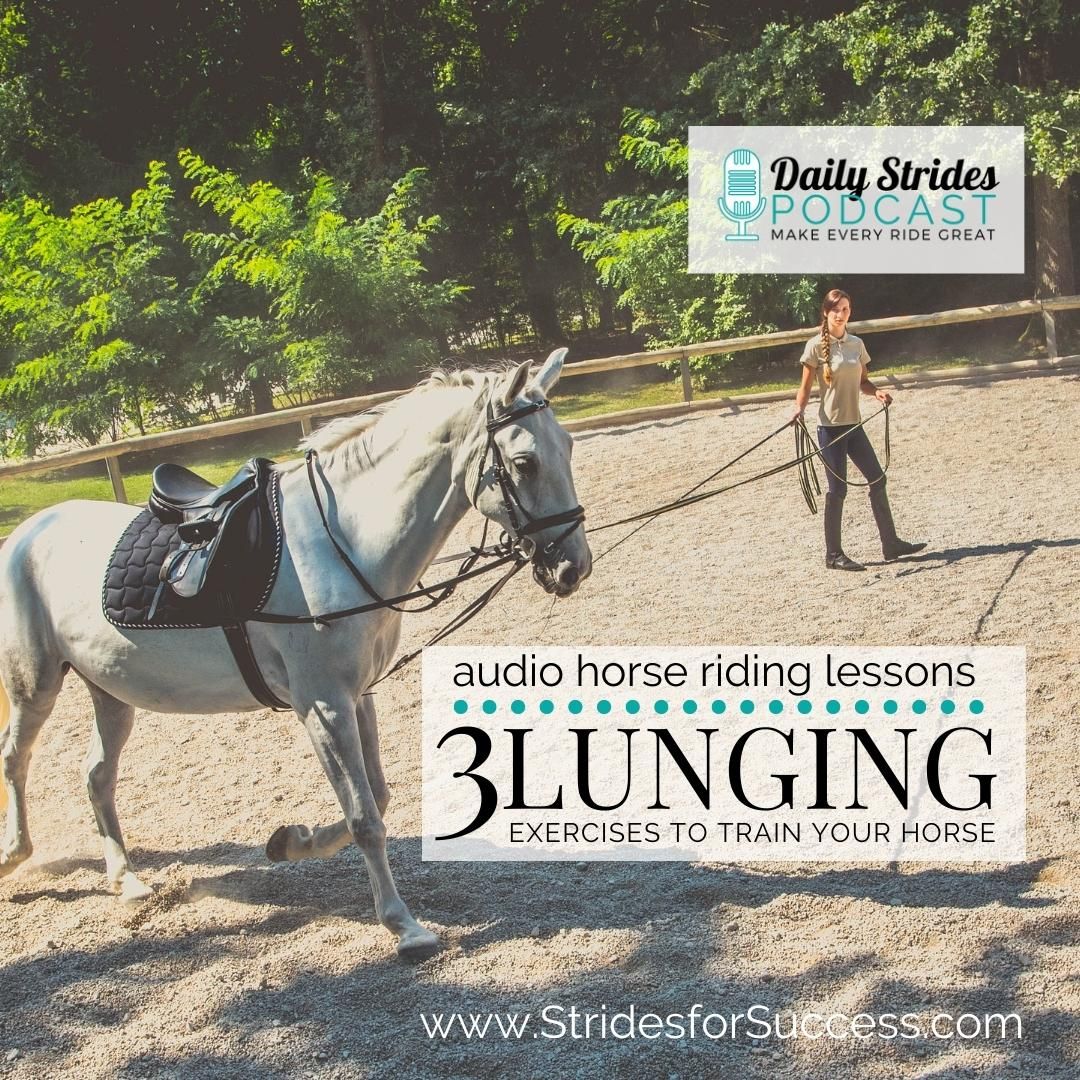
  • 3 Lunging Exercises to Train Your Horse

    3 Lunging Exercises to Train Your Horse

    [fusebox_track_player url=”https://op3.dev/e/traffic.libsyn.com/dailystridespodcast/1264_3_Lunging_Exercises_to_Train_Your_Horse.mp3″ title=”3 Lunging Exercises to Train Your Horse” social_linkedin=”true” social_pinterest=”true” social_email=”true” tweet_text=”3 exercises to try when lunging – I think you’ll enjoy this ” hashtag=”horsepodcast” twitter_username=”strides_success” ]

    As a rider, it is important to always look for ways to keep your schooling work interesting; for you and your horse. One of the ways you can do this is by working on different lunging exercises.  And they don’t have to be ‘fancy’ or complex.

    In fact, there are a few basic exercises you can begin working on introducing, or refining today that will help you to really begin utilizing lunging as a training tool for you and your horse. 

    Now, just like riding, it is important that before you dive into ‘working’ your horse, you take the time to warm up correctly.  I enjoy walking my horse (leading my horse) the ‘long way round’ to the arena I will be working in.  I use the 5 or so minutes to do a little groundwork on the way.

    And bonus points if the groundwork sets up, introduces, or relates to what you will actually be working on when lunging your horse.  It is the perfect way to start the conversation. 

    Lunging Exercise 1 – Responsiveness

    The first exercise you can do will help to increase responsiveness in both you and your horse.  Many riders can ‘miss’ more subtle cues from their horse because they are simply not looking for them.  And by intentionally focusing on responsiveness as what you want to improve, you also ‘fine-tune’ what you’re noticing in your horse.

    Notice what combination of aids is most effective to ask your horse to go forwards.  Also, how much pressure is necessary to ask the specific question before you get an immediate and timely response? 

    From here, begin working on refining it all.  Begin expecting your horse to respond to ‘lighter’ or more subtle aids. This will require consistency and focus from you.  And it will require concentration and willingness from your horse.

    Lunging Exercise 2 – Accuracy

    As the level of responsiveness increases, you can then begin working on improving accuracy and again, this is for you and your horse.  Increasing accuracy is a lunging exercise that really requires both the horse and the rider (the lunger) to concentrate on what is happening.

    Increasing accuracy also requires both horse and rider to work together. It requires teamwork and there is a shared responsibility to help improve it. 

    Your horse will learn to wait for and then respond to your aids.  The ‘waiting for’ part can be a challenge for many horses initially, however, it is essential to increase accuracy.  This will also force you to become even more clear and intentional with your aids

    Improving accuracy as a lunging exercise also requires you to work on and improve your timing.  A key part of the answer depends on if the horse can respond at that moment…

    So, instead of simply asking questions, you must begin to pay attention to ‘when’ you’re asking the question. You will begin to time your ‘ask’ with the part of the stride where your horse can actually respond to you. This will take time.  And it will require that you have first worked on and improved responsiveness.

    Lunging Exercise 3 – Halt on the Track

    The third lunging exercise that will really transform your lunging sessions with your horse is the ability to halt on the track.  This means that your horse does not turn into you, walk towards you, fall in from the circle, or fall out of the circle.  And this often takes quite a bit of work initially!  Especially if your horse has been allowed or trained (same thing really) to do any of the above!

    Once you have established the halt, you can begin working on the quality of each and every halt.

    The better the halt, the more energy it will contain inside of it. This can initially feel mentally uncomfortable for your horse and he will probably want to step out of it.  However, by increasing his capacity here to ‘hold’ the energy inside of the halt, you are growing his comfort zone.  This will allow for bigger questions in his overall training.

    Developing Your Lunging Technique

    I love lunging and I am all about using this tool as a way to continue to train and work with our horses, even when time or space is short.  And just like riding, lunging takes time to develop and improve.  It requires coordination from you. And it requires a knowledge of the aids you can use to communicate with your horse.

    Lunging is NOT simply running in circles; it is an active way of schooling and training your horse. And using lunging exercises intentionally will help you to make the most of this tool.

    If you are unsure of where to start, make sure you check out the links below this article for more information and past Daily Strides Podcast episodes on lunging your horse.

    Happy Lunging
    Lorna

    More on this Topic:-

    More Support and Training:-

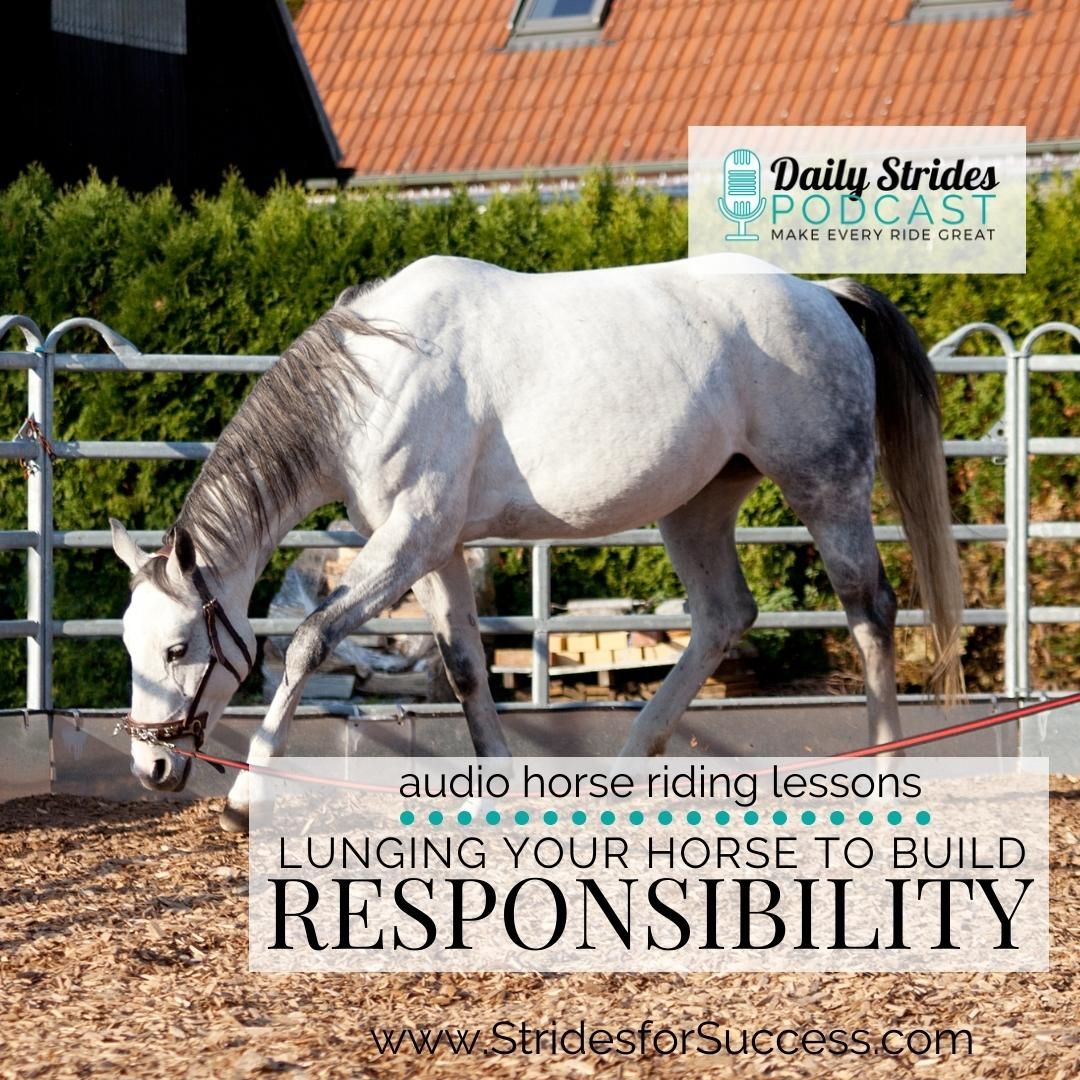
  • Using Lunging to Help Your Horse Build Responsibility

    Using Lunging to Help Your Horse Build Responsibility

    [fusebox_track_player url=”https://op3.dev/e/traffic.libsyn.com/dailystridespodcast/1263_Lunging_to_Help_Your_Horse_Build_Responsibility.mp3″ title=”Using Lunging to Help Your Horse Build Responsibility” social_linkedin=”true” social_pinterest=”true” social_email=”true” tweet_text=”Give this a listen… It’s good #horselovers” hashtag=”horsepodcast” twitter_username=”strides_success” ]

    As both a rider and trainer of your horse, one of your responsibilities is to help your horse build responsibility. In order for riders and their horses to take their training further, both sides of the team need to show up and work together. This cannot happen if we, the riders, are trying to control all of the moving parts. And so, this can bring up a few questions for riders…

    How can I begin to help my horse work ‘with’ me, rather than just ‘for’ me? And how can I develop his confidence so that he feels ready to take on some of the responsibility?

    Now, I believe that the responsible way to do this is to be consistent and invest time. I also think that this part of the learning should be approached in a few different ways. In the saddle, on the ground, and on the lunge or long lines. This way we can both explain, allow, and respond to our horses from lots of different perspectives. And this, in turn, allows them more opportunities to develop their ‘responsibility muscle’.

    Recently I spoke about how to begin doing this while riding. You can read or listen to that article/episode HERE. However, today, I want to dive into a personal favorite of mine; lunging.

    The Rider’s Responsibility

    Let’s start this conversation by saying the obvious… Before you can expect your horse to begin taking responsibility, it’s important that you do this first. In my experience, the most successful way to train horses is to ‘model’ what we expect from them. In this case, that is a personal responsibility for their role in the overall conversation and work. So, you must ‘show up’ first…

    This begins with the understanding that lunging is not just running in circles. It is an opportunity to introduce, develop, and refine aids and responses between horse and rider

    So, it makes sense that before you can truly begin focusing on your horse taking care of his own stuff, you must first ensure that you’re both on the same page regarding expectations and communication.

    Once you have established the basics in your lunging, you can then start working on delegating some of the responsibility for the work to your horse

    The Horse’s Responsibility

    So, once there is a basic level of understanding regarding basic communication while lunging, you can begin going a little deeper with your horse. Often this is simply beginning to expect a little ‘more’ from your horse. Tweaking those expectations slightly creates slightly different outcomes and results.

    Some of the specific ways you can begin this work are:-

        • More responsiveness to increasingly more subtle aids (this requires your horse to pay greater attention)
        • Greater accuracy regarding where and when (increased ‘body control’ and, again, more attention)
        • Maintaining rhythm for longer periods (working alone without constant input)
        • Larger circles (working more independently from you)
        • More accurate circles in open spaces (developing true straightness through the body)
        • Accuracy & rhythm over ground poles (increased physical abilities and concentration)
        • Self-carriage and collection (physical and mental development)

    Now, obviously, this is not a definitive list; there are many other opportunities for your horse while lunging to develop responsibility, however, these are probably the most obvious. Today, I want to dive a little deeper into one of these. My hope is to demonstrate how versatile this is and how it truly does develop personal responsibility in your horse.

    CLICK HERE TO DOWNLOAD a printable version of this article now, so that you can refer back to this list over the coming weeks and months to help you plan your training with your horse.

    Working on Larger Circles

    Often, when we initially begin lunging a horse for the first time, the circle can get big pretty quickly. However, this is generally due to the horse going faster, larger, and wider as he explores this new way of working together; exuberance rather than focused work! This is why I generally suggest getting started with lunging in a more enclosed space.

    It is really important that you are not using the lunge line, the contact, to keep your horse in the circle. This will instantly close the door on any true work and connection begin achieved

    So, that being said, the larger circles I am referring to here are intentional ones. Where, you actually ask your horse to move further away from you while on the circle, and he happily responds and obliges.

    It is key to understand, at this point, that you are not achieving this bigger circle by you standing still… You must be an active participant in lunging. The amount of lunge line between you and your horse has simply increased

    Working in Open Spaces

    When your horse is willing to work more independently from you, while still listening for and responding to your aids, it is a sign that he has developed greater confidence in both of you. And this is where you can begin to apply other intentions to your training session together. I would start by opening up the space you are working with.

    By removing the outside boundary, you are also removing an artificial aid – and you can only do this when your natural aids are being understood and respected

    By being able to effectively work with your horse in an open space, you have proven that your horse can be responsible for his part in the conversation as a whole. This is an important milestone when working with horses. And for him to do this while maintaining that space between both of you; that is developing independence as well.

    The more independent and responsible your horse becomes, the more he can add to the ongoing conversation that’s happening between you. On the ground, on the lunge, and in the saddle

    Lunging to Build Responsibility

    Anything great that took time to build, required someone who maintained focus while getting there. When it comes to you and your horse, this will be one of your responsibilities inside your partnership together. It will be up to you to create the plans and set the intentions.

    By choosing something specific to work on each lunging session, you will help your horse to develop more confidence in his own abilities – and in yours.

    You can download this article so that you can keep the list above to use to help you plan by CLICKING HERE. And then, from there, just show up and be consistent. If part of your responsibility is to model what you desire for your horse, start there🙂

    Happy Riding
    Lorna

    More on This Topic:-

    Get Support & Guidance in Your Riding

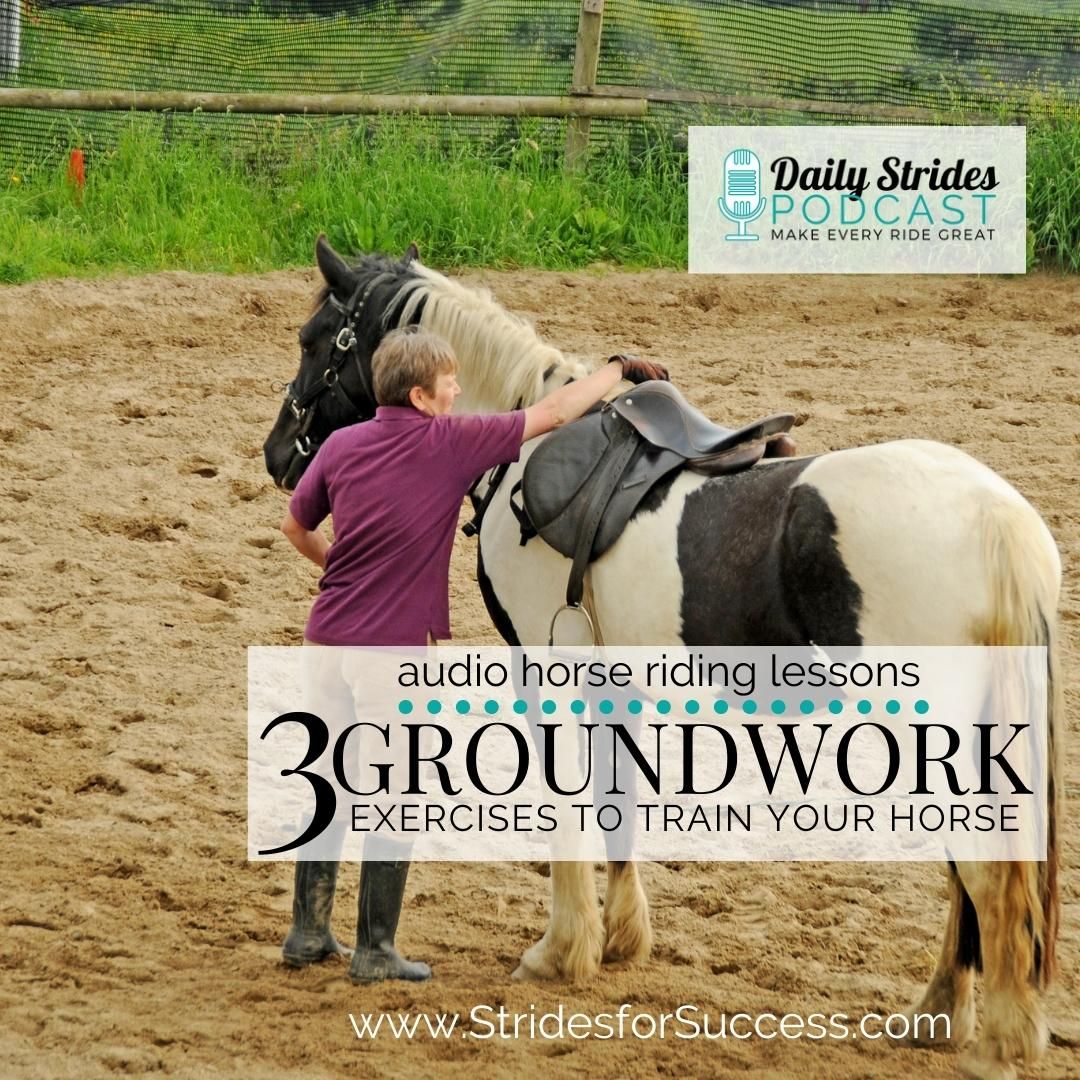
  • 3 Groundwork Exercises to Train Your Horse

    3 Groundwork Exercises to Train Your Horse

    [fusebox_track_player url=”https://op3.dev/e/traffic.libsyn.com/dailystridespodcast/1262_3_Groundwork_Exercises_for_Your_Horse.mp3″ title=”3 Groundwork Exercises to Work on With Your Horse” social_linkedin=”true” social_pinterest=”true” social_email=”true” tweet_text=”3 different training exercises for horses – with rider on the ground” hashtag=”horsepodcast” twitter_username=”strides_success” ]

    Just last week, I noticed a rider literally dragging their horse from the stables towards the arena. The rider was about a meter in front of the horse’s head. Her face was red with effort! And her horse was literally going nowhere slowly. It occurred to me that so many riders make things really difficult for themselves by not having a few ground rules in place when it comes to their horse and their expectations.

    And what better place to work on ground rules than on the ground? Beside your horse. Groundwork is an essential part of training your horse. It is where you can set expectations, create boundaries, explain ‘rules’, and develop partnerships.

    Groundwork exercises also help you to refine your own skills as a rider. By simply having to figure out a slightly different way to ‘say’ something to your horse, you get to explore your own knowledge of the subject.

    So, all of that being said, here are 3 groundwork exercises you can use this week when working with your horse…

    Groundwork Exercise 1 – Backing Up

    Going backward when asked is something that can benefit all horses and their riders! When you can ask your horse to reverse, it makes doing some of the daily activities so much easier when you ride. It also gives you more flexibility and options when it comes to moving your horse.

    Backing up in a straight line will also work your horse physically and mentally. The key word is straight… 

    By working on improving this on the ground, and then later practicing while in the saddle, your horse will develop both sides of his body.  By remaining straight, the symmetry will ensure equal development.

    FREE Groundwork Exercise to Promote Suppleness

    Groundwork Exercise 2 – Flexion

    Flexion is one of those things that, as you and your horse begin to go deeper into training, will become very important.  It is also something that you can begin encouraging while on the ground. And this will, again, have a positive impact when you are in the saddle.

    Flexion is often the key to transforming the work you and your horse are doing together. When you begin paying attention to correct flexion, it leads to an increased softness… 

    It is also important to remember to work both sides with your horse. Again, that all-important symmetry that is necessary to develop, stretch, and work your horse equally. Focus on the flexion of the head and neck initially. Keep in mind that any ‘movement’ in the right direction should be rewarded :)

    FREE Groundwork Exercise to Promote Suppleness

    Groundwork Exercise 3 – Pressure & Release

    Applying pressure is how we ask questions and communicate what we want to our horses.  We can use so many different aids, singularly or in combination, to apply pressure. Even your voice can apply pressure.  However, pressure in and of itself is not enough.

    In order for our horse to understand what we want, we must let him know when he does the thing we want after we ask. This is the release. Apply pressure to ask the question. Release pressure to say ‘affirm’ the response.

    There are lots of groundwork exercises you can do that focus on this topic.  One of my personal favorites is turn on the forehand.  And, in both asking and working through each turn on the forehand, your horse also gets to put some of the flexion work to good use.

    A Step-by-Step Groundwork Exercise

    If you are keen to find out how you can begin using the “Increasing Suppleness Through Flexion Groundwork Exercise” to develop and train your horse today. Get the free guided audio training to use before or after your ride, to really begin introducing and increasing your horse’s flexion.  And you will also get a bonus audio horse riding lesson as well to use when in the saddle to ask put some of your work into practice while riding.

    The”Increasing Suppleness Through Flexion Groundwork Exercise” to develop and train your horse is 100% free and you can get yours when you CLICK HERE

    Happy Riding
    Lorna

    FREE Groundwork Exercise to Promote Suppleness

    Additional Links on Groundwork

    Other Resources to Help Riders

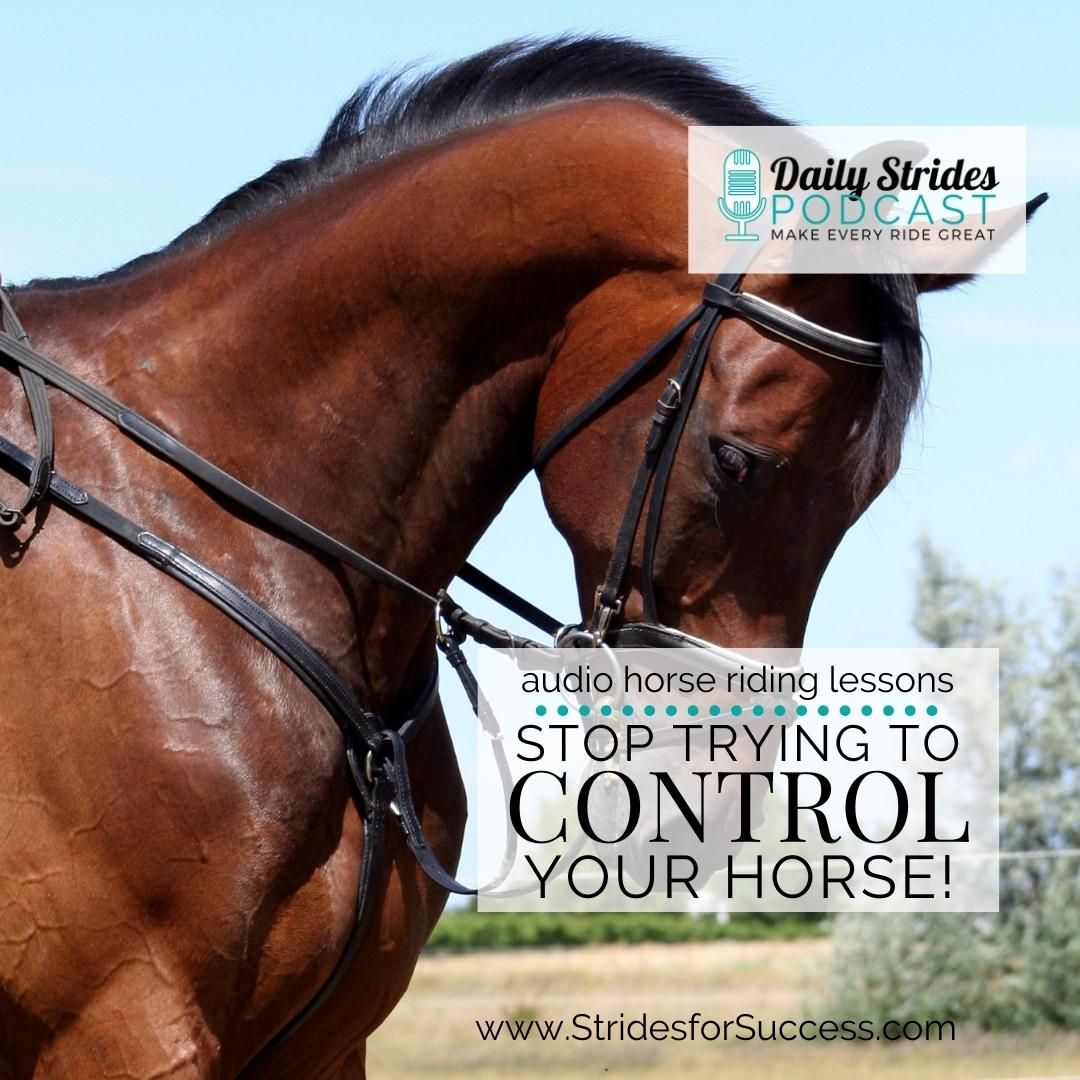
  • Stop Trying to Control Your Horse!

    Stop Trying to Control Your Horse!

    [fusebox_track_player url=”https://op3.dev/e/traffic.libsyn.com/dailystridespodcast/1261_Stop_Trying_to_Control_Your_Horse.mp3″ title=”Stop Trying to Control Your Horse” social_linkedin=”true” social_pinterest=”true” social_email=”true” tweet_text=”A different perspective on training your horse…” hashtag=”horsepodcast” twitter_username=”strides_success” ]

    For years, I was all about control when it came to horses.  I wanted to understand how to control them better, and how I could help riders do this… Until, one day, I realized I was working under a false pretense! You see, I figured something out.  It was like an ‘oh wow’ moment.

    There is no way to control a horse – or at least a way to do this that encourages the development and training of horse and rider.

    And I really and truly believe that if more riders could understand this, they can make progress far more quickly. And enjoy the whole training journey a whole lot more as well…  In this episode of the Daily Strides Podcast, I am diving into all of the reasons that trying to control your horse is actually holding you both back from doing more in your work together.

    Why You Cannot Control Your Horse

    I realize that horse riding is essentially the act of us, the riders, getting onto our horse’s backs and having them do what we want them to do.  We can debate this all day long, but this is the long and the short of it!  However, it is also really important to remember three things:-

          1. We must ‘ASK’ our horses to do whatever it is we want them to do
          2. Our horse must UNDERSTAND what we are asking
          3. Our horse must actually ‘WANT’ to do it…

    If either of those three elements is missing, things can come undone very quickly!  Now, I am going to make an assumption here that you are a conscientious, caring, and compassionate equestrian, who is not into forcing your horse (whips, ropes, and all other methods) to do things against their will…

    Your horse has a mind of his own that you can never control. So, it makes sense to stop trying – and rather focus your efforts on controlling what you can, so that you can have a more positive influence over your horse…

    What You Can Control

    In order to increase your positive influence, you can work on controlling the one thing you can do; yourself.  Unfortunately, this is often easier said than done! For many novice riders, the challenge is physical.  Coordinating your aids and developing independence can feel exhausting in the early days of riding.  And, for more advanced riders, it becomes a real mind game.

    Being able to identify thoughts and beliefs that are limiting your progress in the saddle is a skill riders must work on developing if they want to do more and go further in their riding. 

    One of the best ways I have found to do this is to have a riding journal ready after each ride or session with your horse.  As soon as you dismount and have looked after your horse, begin writing things down.  This way, over time, you will begin to see patterns.

    Couple this with some form of exercise that will complement your riding and develop strength and fitness.  Hiking, cycling, swimming, strength training, yoga, pilates… Whatever takes your fancy really!  I suggest doing something you enjoy, and then if you find that you are needing further work in a specific area, going deeper then.

    The only way you can develop your skills as a rider is to develop yourself. And doing this is the way to then helping your horse to do the same as well. 

    Where to Focus Your Attention

    From here, instead of each ride being about how well you can control your horse, change the focus.  Think about how well you can set your horse up for success. How well can you plan what you want him to do, and then communicate that to him in a way he understands and is happy to try?

    When you work on setting things up, rather than controlling everything, you give your horse the opportunity to begin really being a partner in your work together. Rather than a robot. 

    And this leads to horses who can think for themselves in a safe, calm, and effective way.  Remember, you won’t get it right 100% of the time.  And when you do find yourself in one of those ‘sticky’ situations, it is always good to know that your horse can figure it out and get you both out of it.  Phew! But this is a skill you MUST allow him to develop.  And you can only do this by stopping trying to control your horse all of the time!

    Allowing for Mistakes (lots of them)

    One of the ways we learn is by making mistakes.  We realize the mistake and find a different way to do the thing that produces a different outcome.  Your horse is similar.  He also learns by making mistakes.  And yet, as riders, this can be something we dread to allow to happen!  But it simply MUST.

    One of your responsibilities as a trainer for your horse is to allow room for him to make mistakes. Allow, notice, and then simply correct.  Then allow again…

    It is rare to see a toddler simply stand up and walk on their first attempt.  They must attempt walking a lot before they get it right. Each attempt will result in wobbles, or loss of balance, and usually, falling down.  However, we accept this as par for the course because they are learning something new. So let’s begin to gift both ourselves and our horses with the same level of grace, compassion, and understanding.

    See each mistake your horse makes as an opportunity for him to grow and develop. Then, simply make the correction in a calm, timely manner – and forget about it. 

    Using Correction to Develop Responsibility

    When you correct your horse but continue to remember the mistake, you will end up trying to control your horse. This irrational fear of him making the same mistake again will dampen out everything else in your ride together… And erode your horse’s confidence.

    Your horse’s confidence will grow in his own abilities if you simply correct each mistake, and then move on! This means allowing him to make the same mistake over, and over until he gets it right. All without judgment or holding a grudge! 

    Trust me, when you leave behind trying to control your horse, and embrace becoming more of a positive influence on your horse, your riding will transform.

    Happy Riding
    Lorna

    Links to More Helpful Stuff:-

    Join My Online Communities for Equestrians

  • Training Your Horse without a Horse Arena or Flat Riding Space

    Training Your Horse without a Horse Arena or Flat Riding Space

    [fusebox_track_player url=”https://op3.dev/e/traffic.libsyn.com/dailystridespodcast/1260_Training_Your_Horse_Without_A_Horse_Arena_1.mp3″ title=”Training Your Horse without a Riding Arena or a Flat Riding Space” social_linkedin=”true” social_pinterest=”true” social_email=”true” tweet_text=”Ideas for working your horse without an arena…” hashtag=”equestrianpodcast” twitter_username=”strides_success” ]

    Whether it comes down to circumstances, weather, or location, finding yourself without a flat, good-quality, horse arena to train in, can often derail everything. It can feel like every single exercise you see or hear about requires acres of space and dozens of poles! And, maybe even more frustrating is when you begin to feel things coming together, only to slip or unbalance due to questionable footing or ground levels.

    Let’s be perfectly honest here; having a good quality suitable horse arena to work in is important if you have long-term goals with your horse… However, there are some short-term solutions you can use to keep training moving forward while you figure things out.

    A Less than Perfect Horse Arena

    So many riders have a space to ride in… However, due to a whole multitude of reasons, it is not exactly what they want.  This could be a field that has become a little water-logged or muddy.  A paddock that has been baked hard by the sun and now is like riding on concrete!

    There are arenas that, over time, have become a little sagged, overworn, or even outright ‘hilly’ in places. And there are arenas that have tracks worn deep into them, grooves, that simply prevent any useful work safely happening in them!

    If you have a flattish space that is available to ride in, begin to think in terms of squares rather than circles. This will allow you to make better use of the space available

    A 20m x 20m of fairly flattish space with safe footing can go a long way when ridden as a square (rather than one long continuous circle.  Of course, this type of space can also be used for lunging (again, if the footing is safe and suitable). In fact, 20m x 20m is even big enough for some well-thought-out pole exercises… The key is to find the space and then become creative with your schooling and exercises.

    I have a previous Daily Strides Podcast episode called Making the Most of Riding in a Smaller Space And in August 2020 I shared a week of audio horse riding lessons called Beneficial Exercises when Riding in a Smaller Space that’s available for you to use when you join Connection

    Roads & Lanes

    If an arena or field is not available to work in, the next choice would be a quiet road or country lane. What’s great about roads is they are generally level, meaning that things like rhythm, coordination, timing, and balance can improve when working there.

    However, working on the hard ground all of the time is, obviously, not ideal. And the width of the road can also be a limitation.   Yet, there are ways to make this work for you and your horse.  Things like simple transitions between halt, walk, and trot can be a great focus while out hacking.  Lateral work is also possible. As well as straightness (using the markings on the road or the border of the road for support if necessary.

    If you have a clear intention for your riding while out on the road, you can really make each hack a beneficial one for both you and your horse. 

    Roadwork is also a great way to increase fitness, strengthen legs and build confidence and partnership for you and your horse. The key is to have a plan for what you will do, and a safe, suitable road to do it on.

    There’s an episode of the Daily Strides Podcast called 3 Exercises to Use to Develop Your Horse While Out on the Trail HERE that you can use to gain some inspiration. And, inside of Connection, July 2021 is PACKED full of audio horse riding lessons to use while riding outside of the arena.

    Undercover Aisles & Passageways & Stables

    Sometimes, the weather alone is a challenge for riders.  Extreme heat or cold, rain or wind can all force riders back indoors!  Which can hinder training and progress. This is where groundwork can become an important addition to your training program.

    If you have a space where you are protected from the weather, you can begin working with your horse on the ground in order to both refine your aids – and develop your horse. 

    A lot of riders think that riding is only about riding.  However, groundwork is a vitally important aspect of training for both horse and rider. It helps you to define boundaries, refine aids, increase understanding, and build trust and partnership.

    FREE Groundwork Exercise to Promote Suppleness

    You can work on simple things such as ‘woah’ and ‘go’. And then, either introduce or improve things like lateral work, transitions, bending, flexion, and rhythm.  Right up to developing self-carriage and collection. Again, having a plan will make all the difference as to how effectively you and your horse use your space.

    I have an episode of the Daily Strides Podcast about Using Pressure and Release in Groundwork HERE.  I also have a full 4 week, self-study program on Groundwork HERE for you to use.

    Other Facilities and Communities

    If at all possible, my final recommendation is to find somewhere else to ride!  Now, I realize this will not be possible for everyone.  However, if you do have the opportunity to box or walk your horse to a more suitable horse arena or riding space, I strongly suggest trying to make this happen as much as possible.

    Often, riders will club together to rent an arena for an hour or two.  Some bring a trainer alone, and others simply use the time and facilities to school alone. The more who join in, the less it will cost. 

    Alternatively, riders join riding clubs or lesson programs that have regular meet-ups. These meetups are usually held at suitable, weather-tight venues such as indoor riding schools or well-maintained all-weather horse arenas.

    Going this route can also be helpful when trying to make regular riding a goal.  If you have a commitment with other riders, there’s a much higher chance of you showing up :)

    If you are struggling to find a space to ride, why not ask for ideas or suggestions in our Online Community?  You can request to join and then post HERE. I’m pretty sure other riders will have a few great ideas for you to help ensure your riding and progress stay on track.

    Happy Riding
    Lorna

    FREE Groundwork Exercise to Promote Suppleness

    Links That May Help:-

    Join My Online Communities for Equestrians