Author: Lorna Leeson

  • Improving Rider Coordination

    Improving Rider Coordination

    Coordination; It’s always a wonderful feeling when you can do something effectively without having to put too much thought or effort into it. Being able to cultivate this skill, regardless of what is being done, takes a large number of hours invested in practice. However in order for that practice to be beneficial, it must be correct or perfect practice.

    This is the one element that trips many riders up when it comes to having more coordination in the saddle. Hours are spent moving through particular school shapes, years dedicated to specific movements; however unless the practice is correct and performed in the correct sequence, the benefits will be slow to appear – assuming they ever do.

    [fusebox_track_player url=”https://op3.dev/e/traffic.libsyn.com/dailystridespodcast/666-Improving-Rider-Coordination.mp3″ title=”Improving Rider Coordination” social_linkedin=”true” social_pinterest=”true” social_email=”true” ]

    Watching a rider who is coordinated riding side by side with one who is not is like watching a chicken trying to keep up with an eagle in the flight department! It is one of the most decisive factors in the outcome of each ride and quite unique in that each rider’s coordination, whether it be good or bad, has very little to do with the horse underneath the saddle.

    You know that as a rider, being able to communicate with your horse about what you would like him to do requires you to apply a particular set of aids, in a specific sequence. In fact, many different movements or directions we give to our horses have similar, if not the same aids, but it is how and when they are applied that make the difference.

    Improved rider coordination makes the communication between horse and rider more fluent, more subtle and more effective

    For those with a lack of coordination, each movement must first be thought out in their head – a list of sorts created out of the aids that must be applied to achieve that particular goal. But having to think things through, step by step, almost ensures that the subtleties which make all the difference, go unused and forgotten. Things like the amount of pressure applied, or how long an aid is held, or making quick adjustments to timing, sequence, and pressure as necessary.

    Essentially, being coordinated in the saddle means that you can perform the ‘sequence’ of aids without having to consciously think about it; leaving you open to rather focus on the more subtle aspects of your aids and course correcting as the movement progresses

    So how can we be sure that our practice is indeed helping to improve our coordination in the saddle?  Let’s focus on the idea of perfect practice. I see a lot of riders in the saddle who are happy with mediocre ways of doing things, particularly the basics. I think that riding must be fun and enjoyable, but a large part of that enjoyment is getting the basics right from the start. There are times with riders when I feel that they are really and truly just wasting time, money, and energy because they do not see the importance of creating a strong and solid foundation from where they can then grow their skills.

    Things like how you are sitting in the saddle. How you use your core to communicate with your horse – from the first time in the saddle. Where your leg is in relation to your body. Carrying your hands. Opening up your chest as you ride. As an instructor, there is nothing as frustrating as having to repeat the same thing to a rider, week in and week out.

    What is most ironic is that those same riders, who won’t take responsibility for their own body in the saddle are very often the ones who are very quick to blame the horse or circumstance for their lack of progress

    Becoming responsible for your body and how it moves in the saddle is something you can begin doing today. Is there one thing that you consistently do that you can start working with right now? For me, it was a tendency to allow my left hand to ‘turn’. My right hand remained where it should be, but my left hand… Knuckles on top and, if left to its own devices, it would dip an inch or three lower than its partner. It was something that, once it was pointed out to me, I became so aware of every time I was in the saddle. I would set myself a goal in each training session; not have my trainer mention my wayward left hand once in the time we were together. Initially, I had to continuously ‘check’ myself; I created little markers around the arena where a mental alarm bell went off to ‘fix my left hand’. It was exhausting, but it worked – In fact to this day I subconsciously correct my left hand when riding; without ever having to remind myself to do so.

    Improving Rider Coordination

    The challenge for many riders is that they are not willing to make correcting one thing a habit to begin with. But becoming almost obsessed with the most basic of your riding faults and committing to ‘fixing’ it before even thinking about moving on to the next one is the most effective way to make your practice as perfect as it can be. One of the other benefits of doing this is that once that basic building block is in place, a lot of other issues you thought you had will vanish. Many riding faults are merely symptoms of a larger, and more basic, fault to begin with.

    Putting that fault on ‘autopilot’, so to speak, frees your thinking brain up so you can begin focusing on the more intricate and subtle aspects of communicating with your horse when in the saddle

    Create small checkpoints around the arena to remind yourself to ‘fix’ that fault. In doing so, you are building systems within your own schooling sessions, regardless of if you have a trainer with you or not, to help make your practice become better and better each time.

    Another way to improve your coordination in the saddle is by physically improving your body and how it can handle itself. It always amazes me how riders will spend weeks, months and years planning their horses fitness program – while never giving a single thought to their own physical performance in the saddle

    Having taken some longer breaks from riding at different times over the years, I can tell you from first-hand experience that very often when I get back into the saddle often feels like my brain and body and speaking a different language! My brain knows what to do and how to achieve a particular outcome, but my body just physically can’t / won’t respond in order to carry the aids out. It is the most frustrating thing about being out of the saddle for any sort of period of time; in fact at 6 months pregnant right now, I am wondering if my body will ever feel like it used to again!

    I see a similar situation with riders who only get into the saddle once a week. We spend the first half of our time together ‘re-tuning’ their aids and coordination in order for them to be able to really begin riding. However there is a way to mitigate this; whether it be a prolonged break from riding like myself, or longer periods between less frequent rides like some of my students – exercise.

    Fitness and exercise are like everything else, you get out what you put in. The quality of the movements and how well they translate across to your riding is what matters.  For more information on how to become a better version of you in the saddle, you can visit https://equestrianfitnesschallenge.com.

    This topic is fleshed out into individual exercises for you to ride that will begin today helping you to improve your coordination when in the saddle.  There are 4 additional audio programs for you to download and listen to on your phone that will take you to step by step through putting those basic ‘fixes’ on autopilot, allowing you to free up your thinking brain for the more complex parts of riding a horse!

    If you are interested in getting this full week of audio programs, as well as access to over 600 other audio programs that will take you step by step through different topics about horse riding, visit www.stridesforsuccess.com/join/ to find out more.

    Happy Riding
    Lorna

  • Reforming a Horse with a Habit of Running Out

    Reforming a Horse with a Habit of Running Out

    Reforming a Horse with a Habit of Running Out You’re cantering along, the jump firmly in your sights, getting ready for your horse to take off…  When all of a sudden he begins to ‘veer’ a little off course.  Before you know it, the jump flies past you, to one side…  Your horse has, once again, proven that he is the master of running out at a fence! [smart_track_player url=”https://op3.dev/e/traffic.libsyn.com/dailystridespodcast/656-Reforming-a-Horse-with-a-Habit-of-Running-Out.mp3″ title=”Reforming a Horse with a Habit of Running Out” social_linkedin=”true” social_pinterest=”true” social_email=”true” tweet_text=”Is your horse pretty special at jumping; in that he is special at dropping the shoulder and ducking?! Here’s what to do…” hashtag=”equestrian #horseriding” twitter_username=”strides_success” ] Frustrating, right?  Particularly when it seems to happen regardless of what you do.  Or how you do it.  In fact for many riders, it feels like they spend more time running out at fences than actually jumping any at all!
    The unfortunate side of this is that the more confident your horse becomes with being able to sidestep a jump, the more often he will do it.
    And the more he does it, the better he becomes at dropping that shoulder and ducking to the side.

    Running Out…

    Running out is a common problem many riders face when they begin jumping more demanding fences.  Now, more demanding can mean 50cm to one person and 1m to another.
    Horses who have learned to employ the running out technique rarely discriminate on fence heights and types!  
    However, what is important to note is that it generally happens when there is an actual jumping effort required.
    For the rest of this blog post we are going to assume that you have eliminated all the obvious reasons that your horse might not want to jump; teeth, back, tack, soreness, sickness, being overfaced, tiredness etc.  This blog post is about horses who have learned to use running out as an easier alternative to jumping the actual fence.

    How Running Out is Different to a Refusal

    Many riders confuse running out with refusals.  Perhaps this is because they are penalised similarly.  However it is good to remember that running out and refusing a jump are two very different things.
    When your horse refuses, he generally stops in front of the fence.  Think of a grinding, sliding halt.
    Refusals can have many causes and reasons; many of which are to do with a horse not feeling confident or comfortable jumping the fence.
    Running out, on the other hand, is when your horse maintains his forward momentum, however he changes course in front of the fence and simply canters or trots past the fence to one side.  
    It can sometimes also be caused by overfacing the horse, however I have found that most horses who become skilled at running out, do so because the rider is allowing it to happen…

    Running Out and The Rider…

    “What?!”, you say.  “I do not ‘allow’ him to run out!  He just does it himself and there is nothing I can do to stop him!!”
    And that there is probably the biggest stumbling block most riders meet when trying to reform a horse who has mastered the art of running out. They try to fix it by working over fences or jumps
    Almost all cases of running out can actually find their roots way back in the basic flatwork schooling, or lack of, in the horse.  What generally tends to happen is the horse has been jumping quite happily, popping fences without question.  But one day, for whatever reason, he takes a chance and dives out the side door… The mere fact he was able to change course like that, usually without repercussions, is enough to plant a seed that perhaps – if the right opportunity presents itself – he can do it again!

    The Path of Least Resistance

    Sounds devious, but don’t worry, I am not suggesting your horse has some evil or mischievous tendencies; he has just found the path of least resistance and has decided to take it!
    The downside to having a horse who has a talent for running out is that reforming him is often a long journey.  This is particularly true if the rider he runs out with is the one accompanying him on this journey. Again, this is because very often it is the rider’s lack of ‘riding’ that has given him the opportunity to take the side door to begin with.  But, it can be done.  It will just take a lot of consistency, time, firmness and pure concentration from the rider to get there.

    Correcting the Rider First

    So, as mentioned earlier, the rider makes all the difference when dealing with a horse who has developed a knack for spotting a side door and running out.  It may be due to the rider getting into their jumping position too early.  This is essentially dropping the contact.  When the contact is dropped, your horse is left to his own devices.  Again, if so inclined, he will take the path of least resistance or the easiest route!
    Running out may also be caused by the rider not using their legs, seat and hands to correctly ‘channel’ the horse’s energy and direct it where they want.  
    Just like if the banks of a river are weak and the water runs out, so too will your horse if your legs are not being used to shut down those tendencies and keep him moving forward to where you want him to go

    Riding a Line

    The third most common reason I see horses running out is due to their riders taking a less than straight approach to the fence or jump.
    There is no ‘line’ to the fence.  Nothing connecting the approach to the getaway. 
    This often results in the horse meeting the fence at an odd angle.  Which essentially opens a door and allows him to simply canter on past.

    Approaching with Too Much Speed

    The final reason I want to mention, before we begin talking about solutions is that the horse is allowed to become too fast to the fence.  Due to the speed of the approach, the rider has no control over the horse.
    All the energy is running out the front like a freight train.  And just like that freight train; once it begins to derail, a whole army would find it difficult to get it back on track.

    Working on ‘Over’ Rather Than ‘Around’…

    So, now that we have placed the cause of the running out squarely in the riders court, we can begin working on how to re-school and reform the horse, so he goes over rather than around. When we ride, we often hear the term between leg and hand.  Put simply this means that the energy you are creating with your legs, is being directed to where and how you want it used with your hand.  Now, obviously things are a little more complicated that that, however, the basic principle is true when riding.
    When you’re dealing with a horse who likes to take the side door, the connection between your leg and hand is not a very strong one.  
    Simply put, there are holes there that your horse, if so inclined, can take advantage of.  Begin by practicing how you channel this forwardness and movement in your horse.

    Strengthening Your ‘Channel’

    Focus on straightness throughout his body when being ridden, and on the level of responsiveness to your aids
    Your horse should remain straight and true when being worked on the flat.  If you find him becoming crooked or ‘veering’ when working, quickly and quietly correct him.  He should then be responsive enough to your aids, particularly your leg in this situation.
    I also find that working on the centre or quarter lines is a good test of this straightness. 
    From here, you can also begin working on implementing better half halts.  This will help you to ‘steady’ things a little when you approach the fence.

    Gathering Energy on the Approach

    As I mentioned above, sometimes the approach to the fence is just too long, fast and strung out for you to keep the connection between leg and hand.   The energy is all running out the front.  This allows your horse to take advantage of this lack of direction. Practice applying the half halt, while continuing to move forward where you want to go.  It will help to ensure you gather the energy, rather than allow it to run out.
    You may find that as you begin closing those ‘side exits’ that once existed for your horse and his energy, there is a lot more energy there underneath you which needs to be directed.  
    This is another reason why working on perfecting your half halts is vitally important, otherwise your horse may begin to run…

    Using Ground Poles

    Another thing you can begin practicing, before you attempt jumping again, is working over ground poles.  This is good for both you and your horse.  You get to learn how to ‘wait’ for your horse to go over the pole, before following him over.
    Your horse has the opportunity to become familiar with the concept of working over the centre of the pole.  Ride a perfectly straight line on the approach, over the jump and continuing on with the getaway on landing
    Because you are channelling him between your leg and hand, all side exits have been shut.  The only way forward is the one which you present by riding him straight to where you want him to go. Running out is a frustrating and often costly habit where penalties are concerned.  However, before you lay the blame at your horse’s door, it is one of those challenges that very often has its roots in the rider’s own tendencies. This may be a bitter pill to swallow, however knowing that you may just be the reason also means that you are the key to banishing those pesky side dives and running out into the past; for good! Happy Riding Lorna This podcast episode and blog post is an overview of this weeks topic, running out.   The other four audio programs are step by step exercises and instructions you can listen to while in the saddle.  They help you to begin working through this problem with your horse.
    You can purchase the full 5 audio trainings for this topic HERE
    It is like having a riding instructor with you in the arena.  The lessons are simply downloaded to your phone and are then ready to listen to while you are in the saddle.
    You can listen to the over and over again, until both you and your horse are popping the centre of those jumps; every time!

    Daily Strides Premium

    Daily Strides Premium is packed full of audio trainings you can listen to anywhere you can bring your phone (including on your horse).  They will help you work towards your goal of having better conversations with your horse, both in and out of the saddle. You will also be able to create a plan for your rides and review what has happened when you join in on the monthly ‘Review and Planning’ call.  In there, you will go step by step through the month that was.  You then take that information and begin planning out the coming month.  When you will ride.  What you will work on.  And of course all aligned with your goals for you and your horse.
    Do you need to be competing? No!  Do you need to have competitive goals or ambitions? No again!
    In fact, I love working with riders who just ‘enjoy’ their horse; helping them to build and strengthen their relationship.  No competitions necessary ;) 
    Couple this with the live Q&As and the members only private group ~ we are here to help you remain accountable as team leader for you and your horse.
    All of the trainings are easily accessed using your phone, meaning that you can take them with you where ever you are going.  These trainings and so much more are available for you immediately when you join Daily Strides Premium. Find out more HERE
  • Exercises to Improve Your Horses Coordination

    Exercises to Improve Your Horses Coordination

    Have you ever experienced moments when ‘lack of coordination’ seems to be the best description for you while in riding  your horse?  It often leads to feelings of clumsiness and a general lack of confidence in your abilities, right?  Well, imagine how it feels when your horse suffers a similar lack of coordination; lack of balance leading to an uncomfortable ride for both of you.

    This lack of coordination in horses is often associated with fitness and general conditioning, and this is partly true.  Your horse’s general fitness levels, or lack thereof, can play a large part in his overall ability to remain in a balanced way of going.  However, there are other factors that also play a large part in how well your horse can use his body, particularly when in a different or unfamiliar situation.

    [fusebox_track_player url=”https://op3.dev/e/traffic.libsyn.com/dailystridespodcast/646-Exercises-to-Improve-Your-Horses-Coordination.mp3″ title=”Exercises to Improve Your Horses Coordination” social_linkedin=”true” social_pinterest=”true” social_email=”true” ]

    Take your own coordination as an example; if you were to do a task that you do regularly, such as making a cup of tea or coffee in your own kitchen, you would find that your actions happen as though your body is on autopilot.  However, if I asked you over to my house to make some tea; you would find it much more difficult to do pretty simple tasks.

    The same principles apply to your horse, if it is something he does a day in and day out, his body has already figured out the best and most effective way for it to do that particular movement or task.  It is smooth and probably looks graceful and simple because it is done in balance in a way he feels comfortable.   However, just like your own tea making capabilities, when you begin to add different factors to your horse’s schooling, or change scenarios, things can become rather wobbly quite quickly!

    You have to agree that most young horses look wonderfully coordinated while in the field however, as soon as a rider is placed on their back it suddenly seems becomes a rather large effort to continue with one foot in front of the other without falling over!  This is the horse having to learn or adapt to a different situation – this particular one being having a rider on board

    We also see older horses struggling with coordination.  Particularly when they are ridden all the time in a beautifully manicured and maintained arena.  They are used to having perfect footing underneath.  But if you take them out of the arena, maybe on the trail or into an appropriate paddock or field; well things are very different.  The rhythm and balance are suddenly lost and it almost feels like the horse has forgotten all his past training.  Sure, you will have moments where it feels good, but for the most part, it is a disjointed effort that pales in comparison to when he is working in his comfort zone.

    When we are in the saddle, it is always a great advantage when your horse can adapt immediately to different situations you may find yourself in, quickly and without a break in balance or rhythm

    So the first step in improving your horse’s coordination is highlighting the quality of your transitions. This is something you can begin working on immediately when riding your horse the next time.  Focus on the balance and consistent rhythm of each individual transition.  Pay attention that your horse is not speeding up the tempo of the gait he is in before the transition.  Also, work on establishing the new gait as quickly as possible after the transition.   By becoming more concise and specific about how you prepare, and then ride each individual transition, you can begin conditioning your horse to balance himself better and adapt to different situations with greater ease.

    Don’t make the mistake of only working in the more exciting transitions, such as trot to canter and canter to trot.  Transitions that include halt, walk, and trot are equally as beneficial and often easier for the rider to be more consistent through.  Again, focus on the quality of the gait leading up to the transition, maintain that gait right the way until the transition occurs.  The transition itself should be coordinated, straight and smooth, and then followed by a good quality gait afterward as well.

    Imrpoving Your Horses Coordination

    The second thing you can do is working some lateral movement into his schooling routines.  Think of the transitions as really working him while moving in a straight line, tail to head.  The lateral movement then works him sideways, so working his body differently and forcing him to balance differently.  Very often horses that can adapt and who have good coordination are able to remain in balance while moving sideways.  Practicing this in the arena will begin to develop your horse’s ability to do this as well, with you on his back.

    One of the other ways to improve your horse’s coordination is to work him over ground poles.  He must become very aware of how he is moving his body and where he is placing his hooves.  Groundpoles also helps coordination by improving the physical strength of your horse’s back.  They ask more of his joints, his back, and his whole topline in general.  All this while remaining balanced and moving forward in a rhythmic manner is excellent for him.

    You can use single groundpoles placed randomly around the arena, with your horse having to ride different shapes to reach.  You can also use basic trotting poles, either flat on the ground or raised, and later you can build simple grids.

    Regardless of how you use the poles, they will definitely help your horse to become more aware of his feet and legs while being worked in the arena and build muscle and strength while doing so

    The final suggestion I have for you to begin improving your horse’s coordination is hill work.  I am not talking about steep, grueling inclines that exhaust your horse; rather mild inclines that ask him to use himself slightly differently, but in doing so, strengthen and condition his body.   You can work up and down the hills, and later once you are both happily walking and trotting up and down, you can begin asking different questions by introducing transitions into his hill work.

    Maintaining the rhythm of the gait while working and down hills is difficult for many horses.  It is also different because most hills will be either on the trail or in a paddock or field, making the footing or terrain a little less accommodating as well

    So improving your horse’s coordination won’t happen overnight, it will take time.  By working some of these exercises into your daily schooling, or warming up and cooling down, you will help your horse reach a greater level of coordination throughout his body, which will make riding more enjoyable for both of you in the long run.

    Happy Riding
    Lorna

    This blog post and podcast episode is an introduction to 5 audio programs on this specific topic, taking you step by step through exercises you can ride that will improve your horse’s coordination. The other programs are created with riding in mind and listening to them is literally like having a riding instructor with you while you school your horse. The lessons are easy to download onto your phone and then use when in the arena.

    To find out more about how you can get this week’s lessons, as well as over 600 others, you can visit www.stridesforsuccess.com/join/.


    [wp-tiles post_type=”post” orderby=”date” order=”DESC” grids=”News”]

  • Communicate with Your Horse through Groundwork – Part 1 Touch

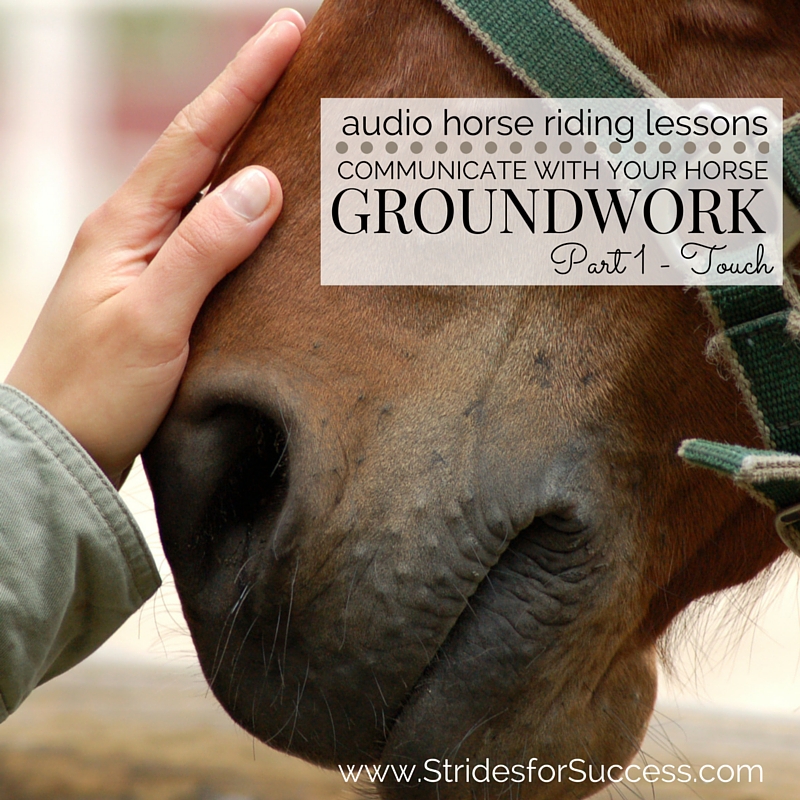
    Communicate with Your Horse through Groundwork – Part 1 Touch

    Communicate with your horse through touch - Groundwork part 1

    How much time do you spend strengthening your relationship with your horse while on the ground?  Many riders only think in terms of ‘riding’ when they think of communicating with their horse.  However there are many other ways you can begin to not only create a stronger sense of trust but also to improve your horse’s overall training.

    [smart_track_player url=”https://op3.dev/e/traffic.libsyn.com/dailystridespodcast/641-Using-Groundwork-When-Training-Your-Horse-Part-1-Touch.mp3″ title=”Groundwork Part 1 – Touch” social_linkedin=”true” social_pinterest=”true” social_email=”true” tweet_text=”Groundwork and how it can help your riding” hashtag=”horses #equestrian #makeeveryridegreat” twitter_username=”strides_success” ]

    Groundwork is really exactly what it sounds like.  It is working with your horse while being on the ground, rather than in the saddle.  Unfortunately many riders see this work as being a means to an end while starting or backing young horses.  This is completely untrue.

    In fact, groundwork is something that can help develop your overall conversation with your horse, regardless of where you are in your training or development.

    Groundwork can be beneficial at any point in your horse’s life.  From a young, unstarted and nervous 2-year-old, to an older 20 plus senior

    How ‘Good’ Groundwork Can Help You & Your Horse

    The benefits of working with your horse on the ground are far-reaching for both horse and rider.  It helps to build trust and to establish certain ‘personal space’.  This helps to build respect for you as your horse’s leader.

    Working with your horse from the ground allows you to get to know what is ‘normal’ for your horse, both emotionally and physically.  Groundwork will also help to begin desensitising your horse.

    Groundwork allows you to being instilling basic training principles that can be transferred across to training while in the saddle later

    From a health perspective, different types of groundwork can help promote circulation, loosen or relax stiff or tense muscles.  It also allows your horse to become familiar with you touching more sensitive areas of his body without fear or apprehension.

    Using Groundwork To Compliment Your Riding

    I really feel that we are constantly communicating with our horses, not just when our bums touch down in the saddle.  Groundwork is a great way of keeping the conversation, and often training, moving forward when riding is not possible.

    This can be for any number of reasons; time constraints, injury, weather or just to add something different to your horse’s training plan or schedule.

    Groundwork can be used to either explain principles that you will or are using in the saddle. Correct groundwork will also strengthen your aids and overall communication when you are riding.

    In fact, I am a huge believer of using the necessary ‘groundwork’ that happens before rides to help relax and set the tone of the overall conversation for the ride.

    Using ‘Touch’ to Work with Your Horse

    In this particular blog post I want to focus on groundwork relating to touch.  More specifically, how you can begin incorporating massage, stroking and basic touch techniques into your training with your horse that will be enjoyable and educational for both of you.

    So, before we go any further, it is important to note that in order to work with your horse, you will need to be in a safe and suitable environment.  Very often when your horse is being massaged, he might become so relaxed that any sudden or different movements or noise can cause an unexpected reaction from him.  This could potentially lead to accidents.  It is also important to wear your helmet at all times when working near or around your horse.  Once you have chosen a suitable location you can then begin working with your horse.

    It may sound a little strange, but the attitude and energy you approach your horse with can play a big part in how your horse reacts to you and your touch.  Keep your mind calm.  Free of stress and, just like when you ride, try to remain focused on the task at hand throughout the groundwork session.

    Being relaxed and feeling confident and present is vitally important to the success of your work, whether it be on the ground or in the saddle, with your horse

    Respecting Boundaries and Personal Space

    Do you, like many riders, only think of boundaries and respect from your own point of view? We need to also give our horses the option of saying ‘no’ if they feel uncomfortable.

    Obviously the types of touches or work you can do with your horse will depend on the relationship you have with your horse.  Nervous or anxious horses should be approached in a sensitive manner and only touched where they allow you to.

    The aim is to build trust, so forcing any particular connection or touching of a certain area will only serve to damage that fragile relationship, not strengthen it.

    Your horse will let you know what he is happy with.  Look for signals from him such as yawning or licking and chewing.  This generally occurs when your horse is feeling relaxed and enjoying the proceedings.  Pinning their ears, lots of anxious, tense movements or lifting the head or tail higher will rather tell you to leave well enough alone.

    Staying Inside of the ‘Comfort Zone’

    At any point if your horse becomes uncomfortable with what you are doing, go back to a place where they are happy and rather work there for a while.  It may take a few sessions before you have built up enough trust to move on from there.   Also keep in mind that, just like us, there may be days that your horse just does not want to be massaged or touched!

    There are many different ways you can use your hands that will promote a different feeling in your horse’s body.  Again, the key is finding what your horse is comfortable with initially and then working on from there.  

    I suggest beginning with just stroking the neck, shoulder and back area where the saddle would sit. Use your whole palms and fingers and rub in the direction the hair lies naturally

    One of the easiest ways to promote a bond is to always have one hand on your horse.  You can do this by making sure the hand finishing the one stroke remains on your horse until your other hand begins the next stroke.

    Pay Attention to the Pressure You’re Applying

    Think about the pressure you are applying as well.  Start each stroke with a soft pressure and build to where you want.  Then finishing the stroke with a similar pressure to where you began.

    Very often the amount of pressure will depend on your horse and the area you are working on, but most often horses enjoy  something around what you would apply when using a rubber curry comb or similar.

    Too soft and it may tickle or annoy your horse, too hard and your horse may find it uncomfortable or even a little sore.

    Experiment with What Works for Your Horse

    Once you have worked over the neck, shoulder and back area like this, you can begin experimenting with using your hands in different ways.   One such way is using your hand to move the skin in small circles on a particular area.  Simply lay your hand on your horse’s coat and, applying a little more pressure with the sides of your palm and fingers, begin moving your hand in a small slow circle.  Your hand will not move from the area, rather just move the skin around over the muscle underneath in that specific area.

    Again, while you are doing this with your one hand, keep your other hand on your horse to help promote that feeling of connection between you

    Finally, you can also begin to loosen out the neck and crest area by gently squeezing there with your hands.  Just like it feels good for you to have your hair slightly and gently tugged or squeezed, it also is an enjoyable feeling for your horse.  Start at the withers and work up towards the poll.  Only go as far as your horse is comfortable with and then begin working your way back towards the withers again.

    Keep in mind that even though your horse might not enjoy you working near his ears or head initially, consistent calm work like this will encourage him to trust you.  This will eventually lead to him allowing you to work around his head and ears in a safe manner

    Touch Is Just One Element of Groundwork

    Groundwork is a big topic.  There are so many different ways you can begin using this both in the stable and the arena. In the next blog post, which you can find HERE, I discuss the concept of pressure and release.  This is a foundational principle to you successfully working with your horse on the ground, and in the saddle.

    Taking the time to truly connect and work with your horse through groundwork will add a whole new dimension to both your training and your relationship with each other.  I suggest starting today with your horse and see where it leads you both.

    Happy Riding
    Lorna

    Save Your Seat for the Upcoming Live Online Training HERE

    CLICK HERE to save your seat for the upcoming free live training on groundwork

    If you are interested in learning more about incorporating touch into your groundwork training with your horse, we have created a full series of audio trainings, inside of Daily Strides Premium, that you can listen to which will help you begin building a routine with your horse.

    There is also a full workbook to go along with the audio trainings.  This includes the different types of movements you can use when working with your horse. Visit https://stridesforsuccess.com/join/ for all the details.

  • Riding a Horse with a ‘Chip In’ Habit at Take Off to a Jump

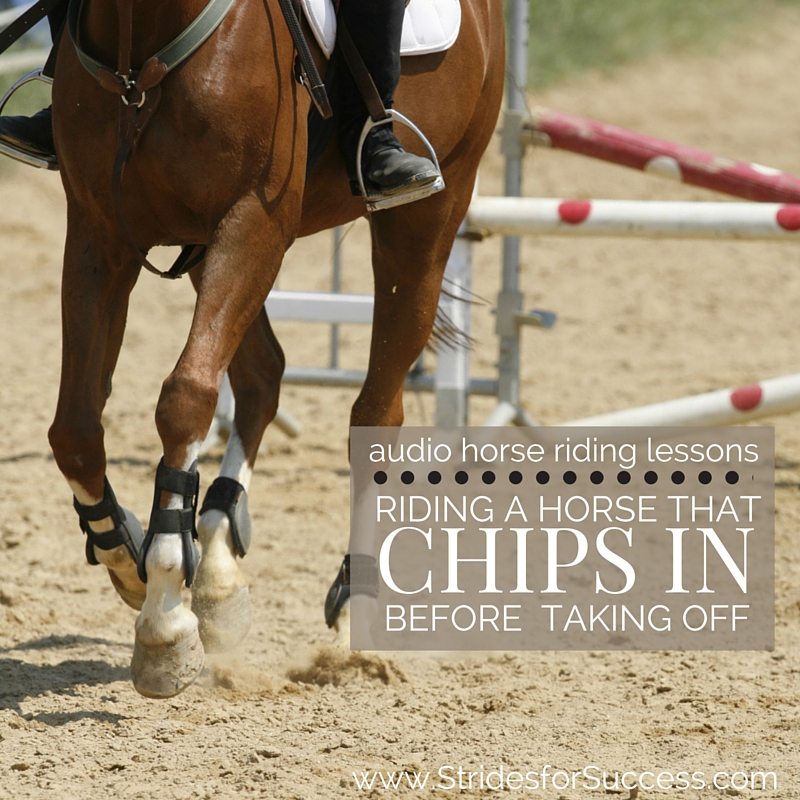
    Riding a Horse with a ‘Chip In’ Habit at Take Off to a Jump

    You are cantering towards the jump… 3… 2… 1… But instead of the ‘Jump’ that should have followed the 1; you get a chip in.  A moment where your usually trusty horse decides to test both of you by inserting a little ‘half stride’ in there before takeoff!

    The result is you do a great Thelwell impression and your horse does his best helicopter move; straight up and straight down…  Not a good feeling for anyone!

    Riding a horse that regularly includes a chip in or three is not enjoyable for anyone; the rider, the person watching, or the horse.  Of course, it can happen to anyone, we call have days where we get the stride to the fence wrong. However, for some horses, it becomes a habit that can seem almost impossible to break. That extra little half stride…

    [fusebox_track_player url=”https://op3.dev/e/traffic.libsyn.com/dailystridespodcast/636-Ridig-a-Horse-that-Chips-In-Before-Take-Off.mp3″ title=”Riding a Horse That Chips in Before Take Off” social_linkedin=”true” social_pinterest=”true” social_email=”true” ]

    What A Chip In Looks & Feels Like

    This habit is uncomfortable and does little for building confidence to clear a course of fences safely.  However, before we look at how to begin working with a horse who adds a little stride here and there, let’s back up. It is important to first realize what this is and why it might be happening.

    When a horse chips in before a fence, he has literally fitted an extra stride into a space. A space that there was really not enough room for that stride…

    He decided that, rather than taking off where he initially met the base of the fence, he would get creative.  He would add a quick little half stride in there and then take off.  It often results in a ‘cat jump’ which is all four legs really taking off and touching down at the same time, due to the loss of impulsion or energy.  It can also result in a ‘helicopter jump’, which is a jumping effort, but with an extremely steep up followed by an extremely steep down, with just the width of the fence in the middle!

    In both these situations, the horse is not using his back or body to the best of his abilities and it feels really uncomfortable for the rider.   Because of the loss of ‘flow’ in the stride, the rider very often ends up either too far ahead of the movement or left behind.  Both scenarios will usually result in both horse and rider not being correctly prepared for the next, upcoming jump.

    Why Your Horse Might Chip In

    There are lots of reasons your horse may chip in before a jump or fence.  It is also worth remembering that most horses will do this at some point in their training.  However, we are dealing today with a ‘chip in addict’, or a horse that does it more times than not.  In order to identify why we must first look at the horse’s approach to the fence…

    Is it rushed?  Maybe he leaning or pulling on the reins and being heavy on the forehand?  Or is he moving forward? Perhaps are you literally scrubbing and kicking every stride just to get to the base of the fence?  

    With regards to the rushing or leaning, this may be due to a lack of training.  This will often result in a lack of confidence in your horse.  He may be off the mindset that he must ‘just get it done’ as quickly as physically possible.  Unfortunately when this happens, the rider’s reaction and how they deal with it plays a big part in not only the result for that particular fence but also the long-term as well.

    Retracing some basic steps in his training is very often the way to begin overcoming this challenge

    If your horse is on the other side of this coin, he is not taking you to the fence at all, this can also be a training issue.  However, again, it may also show signs of a lack of confidence in his abilities.  I strongly suggest that, whatever the cause, take things back to basics.  It truly is the key to building and developing correctly.  And to show your horse that he can indeed successfully make it from A to B over a fence.

    Could It Be You?

    Sometimes, a horse that chips in is doing so because of how he is being ridden by the rider…  A nervous rider often tends to throw themselves into their jumping position a little early.  This will encourage the horse to ‘chip in’ before the fence.  Unfortunately, this is often a difficult and vicious cycle to break.

    The rider is nervous because the horse is rushing, the horse begins to chip and rush even more because the rider collapses before the fence and ‘drops him’, both emotionally and physically. This causes the horse to rush even more.  And so it goes on and on…

    If you feel that this is the issue, I would strongly suggest working over a single pole and practicing your timing and your balance.  The light seat is wonderful and will help you do this.

    Riding a Horse that Chip In before Take Off at Jumps

    Begin By Improving Flatwork

    So, once we have discovered why your horse chips in before a fence, we can then look at how to begin working through it so we can get a good take-off point and reach each fence in the best possible way.

    A good place to start working with your horse on the flat and improving his general responsiveness and understanding of your aids in the saddle.  Does he listen when you half halt?   Or do you find yourself pulling and hauling to get him to ‘steady’ a little?

    Does he move forward when asked to do so from your leg?  Or do you have to kick and click like a crazy person to get any sort of movement happening?!  These are basic training issues and need to be addressed before we even think of turning our hoof to jumping.  It sounds repetitive, but this is because it is true… You have to have the basics mastered before you can move on to more ‘exciting’ things in the saddle!

    Your ability to balance things with a half halt while keeping your horse moving forwarding is vital to being able to approach any fence successfully.  Keep in mind that a horse who chips in every now and then is a horse who is not so confident in jumping.  He needs a rider who can allow him to build his confidence in a controlled, systematic and patient environment

    Figure Things Out for Himself

    So, once you have the basics working, I suggest beginning to allowing your horse to figure things out on his own, without a rider, in a controlled environment.  This can either be lunging or loose schooling, but the word controlled is the important one in the previous sentence!

    Loose schooling or lunging a horse over fences does not mean chasing them into a frenzy around the arena at dizzying speeds.  

    It is simply creating a situation that is conducive to an optimum jumping effort, either one or two fences.  Then allowing your horse to approach and work things out himself.

    The benefit of loose schooling is that you can have two jumping efforts, 2 measured and correct stride lengths apart from each other.  The first jump, a cross pole, is to set your horse up correctly for the second fence, which can also be a cross pole or an upright or parallel. Due to consistently meeting the second fence at the correct distance, your horse will begin to figure things out himself.

    Distance & Spacing of Poles & Jumps

    It is also important to remember that the ‘correct distance’ is what is correct for him, not trying to force him into a standard jumping distance.  Rather allow him to first build his confidence in his own abilities using a distance that suits his current way of going or current stride.

    Once he is able to begin ‘picking’ a correct take off point, without any anxiety, you can then slowly begin working over adjusted distances

    Also, don’t see the loose schooling or lunging as a once-off occurrence.  Rather, try to incorporate them into his training for as long as necessary.  Very often with horses, it is a lack of balance that causes them to be unsure of the jump, leading to a chip in here and there.  The rider will definitely affect this balance or lack of, so allow him time and space to work it out alone before then adding a rider into the equation.

    Using Groundpoles while Riding

    As well as the above, you can begin working over ground poles in the saddle with your horse.  Laying out a single ground pole and cantering over it can be a helpful exercise for both horse and rider.  With regards to the horse, we are looking for a balanced and rhythmic approach and also, a canter that is taking you to the fence, rather than you having to ask and push for every stride.  Try to keep the rhythm as consistent as possible, and the hindquarters underneath the horse.

    You can also use this to begin training yourself to see a better stride before the fence.  Simply counting backwards from where you think there will be three strides before take off is a fantastic exercise to get you in rhythm with your horse and begin seeing the stride.  Only when you can actually see the stride can you then look at adjusting the stride.  Before that it is just the luck of the draw – never a good idea when there are jumps involved!

    As you canter in on your ‘approach’ to the fence start 3…  2…  1…  Jump.   If you get in wrong the first few times, don’t worry.  Just keep trying to gauge that point where you are three strides away.  Later you can make things a little more difficult for yourself with 5…  4…  3…  2…  1…  Jump.  You will find that the more you ‘tune’ your eye into the approach, the further out you will be able to see if the take-off point is a good one or is a little too far away or close.  This will give you time to adjust the strides in between which will, in turn, allow you to arrive at the jump in a better position to clear it comfortably.

    Related Distances

    From here you can add more poles on the ground at ‘related distances’ to each other.  Work at maintaining the forwardness of the canter while keeping the rhythm and balance all the way through.  Also, work on your timing of the jumping position.  As I mentioned earlier, it is tempting to get into it a little early if your horse is rushing, but this will only make the problem worse.

    Try to use your 3…  2…  1… to steady yourself and only allowing your body to follow your horse at the ‘Jump’ part

    Once both you and your horse are more comfortable and have stopped any added strides or half strides before the pole, you can begin to build some small fences where the poles are.  Remember that if your horse chips in,  a lot of the time it is a confidence issue, so don’t be tempted to push him further than he is comfortable.  Just because he is ‘able’ does not mean he is comfortable doing it!

    Your horse’s ability to see a stride takes time to establish, just like yours.  Give him that time and it will pay dividends later when you are out on the track.  Count yourself down to the base of each fence, 3… 2… 1… at all times initially (in your head when in the company of others if you want!), but use it as a way to balance both of you on the approach to the fence.

    Happy Riding
    Lorna

    Connection for Equestrians

    If you are interested in finding out more about how you can begin re-schooling your horse in all aspects of riding, Connection might just be what you are looking for. Each week you will receive 5 audio ‘lessons’, where I give you step by step instructions.  You can listen using a free app on your phone, on your computer, or via your favorite podcast app.

    This makes it really handy to use and listen to while riding your horse; in the saddle.

    We cover loose schooling, working over single poles, related distances, and also working on improving your eye to see a stride. There are also diagrams with the actual distances for you to replicate in your arena.

    Find out more over at https://stridesforsuccess.com/join

  • Engaging Your Horse’s Hind Quarters

    Engaging Your Horse’s Hind Quarters

    Have you ever looked at photos or videos of your horse and it looks like his hind quarters are, literally, being left behind? They are dragging out behind him, rather than working underneath him. Or perhaps you have gotten the feeling that when you ask for ‘more’ when in the saddle, there is just no way he can provide ‘more’ without speeding up and becoming long…

    Knowing how to activate and then engaging your horse’s hind quarters is vital to his long-term training and development. However for many riders, it can be a little daunting trying to figure out if he is truly in ‘rear wheel drive’ rather than ‘front wheel drive’ while they are working or schooling their horse.

    [smart_track_player url=”https://op3.dev/e/traffic.libsyn.com/dailystridespodcast/631-Engaging-the-Hind-Quarters.mp3″ title=”Engaging Your Horses Hind Quarters” social_linkedin=”true” social_pinterest=”true” social_email=”true” tweet_text=”Struggling to get the back end working? Engaging the hind quarters – step by step..” hashtag=”equestrian #dailystrides #horseriding” twitter_username=”strides_success” ]

    However taking the time to begin asking your horse to work correctly from back to front will be a key factor in his overall development and training and also, the deciding factor between him becoming stronger when being ridden, or just remaining where he is, effectively capping his progress.

    So, first and foremost when we talk about engaging the hind quarters, we are speaking about activating them or getting them to work while we are riding our horse and then connecting the energy produced to the front of his body. Engaged in this sense means to bind or interlock, so engaging the hind quarters is literally interlocking it with the rest of his body. Like I mentioned earlier, your horse being in rear wheel drive, means that his all the time pushing from behind, using his hind quarters. This is far more favourable when being ridden than pulling from the front with his front legs and shoulders.

    Before we go any further it is also worth mentioning that your horse will need time to develop the necessary strength to truly activate and then engage his hindquarters when being ridden. It is up to you, the rider, to make sure you do not push him beyond what he is capable of for his level of training or schooling. Slow and steady wins the race when working with horses…

    Pushing from behind requires your horse to be moving forward in the first place. Many riders seem to think that their horse merely moving is going forward, but in truth, going forward can more be described as your horse moving forward with a sense of purpose. They must have a little ‘pep in their step’ so to speak, rather than ambling along, hooves shuffling and dragging on the ground, each step looking like a momentous task

    Responsiveness is part of the key to having your horse moving forward. A simple ‘You ask; he responds’ system in place which both you and your horse understand that there is a mutual responsibility from all parties if it is to work effectively. You are responsible for making sure that you are clear in what you ask. Your aids and also where you plan on going from that point are well thought out and executed. Your horse must then become responsible for adhering to your aids and directions in a willing and cooperative way.

    If either side of the team, horse and rider, reneges on their individual responsibilities the result is a lack of forward movement, which will result in an inability to engage the hind quarters

    Once your horse is moving forward, it is then up to you to allow that energy being created from behind to connect with the front of the horse, thus actually ‘engaging’ the hind quarters. There are a few different aspects to allowing this to happen, but again, if any are missing it will result in the hind quarters being ‘disengaged’ and left to their own devices, separate to the rest of the horse’s body working with the forward movement.

    Engaging Your Horse's Hind Quarters

    Think of energy as being a little like water or electricity. It will generally always try to find the shortest and easiest route. If you allow your horse to become crooked through his body, the energy will not flow where you want it and rather ‘shoot out the side door’. An example of this is on a circle, the hind quarters being allowed to swing out wide of the tracks the front feet have created. When this happens the energy, rather than pushing forward from behind and connecting to the front of the horse, will be lost out the side door of the horse, resulting in the horse going into ‘front wheel drive’ again.

    When riding you should think of your aids, particularly seat, legs and arms, as being the banks of a river or canal. They will channel the water / energy that is being created in the hind quarters where you want it to go. This will continue to keep the energy moving forward and connecting, from back to front

    This is why straightness is so important when training a horse and rider. Many times we focus on how straight the horse is, but ignore the obvious twisting or tilting of the rider’s body. Any crookedness in either horse or rider will again result in a disengagement of the hind quarters, which will see the energy dissipate and eventually be lost.

    Another important factor to consider when thinking about this engaging of the back to the front of your horse’s body is the idea of ‘allowing’ that energy to flow underneath you through your horse’s back. Some riders really work hard at activating the hind quarters and getting them to work, but then due to a heaviness or tightness in their body, block this energy from connecting through or engaging with the front of the horse

    When we learn to ride initially, we are often told to ‘sit up’, however we are rarely told why; other than the whole falling off aspect of collapsing through your body. But let’s assume you have indeed mastered staying on, however you are still finding it difficult to truly connect the hind quarters to the front end of the horse (through your contact), it may just be because you are blocking this.

    Just as water can be dammed up, blocked or diverted, so too can energy. Sitting heavy in the saddle is the most common culprit here, but so too are shutting things down with your thighs. They can have a vice like effect on your horse if there is excess tension in your body. Also, leaning forward over your horse’s shoulders or withers will be highly effective in shutting down any engagement of the hind quarters.

    Make sure that when you are riding, you are all the time encouraging your horse to use his back by being ‘light’ in the saddle. This is often as simple as sitting up through your rib cage, carrying your upper torso. This simple change is often enough to allow your pelvis to begin moving with the horse, which will in turn allow your horse to use his back.

    Once you have managed to get your horse moving forward from his hind quarters or from behind and then are allowing that energy to flow underneath or through you in the saddle, the final piece of the puzzle is ready to happen…

    To truly engage means to connect, bind or interlock. In the case of the hind quarters, we want to connect them to the rest of the horse like a gear cog. This allows you to truly direct the energy being created there. We do this through our contact with the horse

    The unfortunate part of this is that most people look at the contact part as Step 1, rather than the final piece of the puzzle, or in this case for simplicity sake, Step 3. Contact is just like the responsiveness, there is a responsibility on both horse and rider to fulfil their end of the contract in order for it to work correctly and be effective.

    If either horse or rider try to force it, it will be lost. Similarly, if either side try to evade it, it will be lost. Many times we blame the horse for evading the contact, but I see many riders who also ‘evade’ through reins that are too loose, or fingers that are wide open and look better suited to playing a piano rather than holding their reins.

    Only when all three steps are in place can your horse truly engage his hind quarters and can you then begin to feel the difference between rear wheel drive and front wheel drive. The difference? Night and day! It feels like there is always energy there to perform what is asked. It feels like your horse moving forward with purpose. It looks so much more pleasing to the eye, as both horse and rider are in true agreement with each other, both maintaining responsibility for their individual part in keeping things together.

    There are many exercises you can do to begin asking your horse to use his hind quarters but none will really be successful until you truly understand what it means to engage and connect the back to the front.

    Happy Riding
    Lorna

    This is the first of 5 audio programs on this topic. In the rest of the programs you can listen to while riding for step by step instructions on how to effectively begin engaging your horse’s hind quarters. The exercises are suitable for all levels of riders and can be worked into your usual schooling routine with your horse.

    For more information on how to download the rest of the lessons and gain access to over 600 audio horse riding programs on a whole range of different topics, visit https://stridesforsuccess.com/join/