Author: Lorna Leeson

  • Day 1 ~ SfS 12 Days of Christmas Equestrian Challenge

    Day 1 ~ SfS 12 Days of Christmas Equestrian Challenge

    SfS 12 Days of Christmas Equestrian Challenge Day 1

    How was 2016 for you and your horse?  What did the year represent?

    In order to move into 2017 and begin building on and progressing with your riding it makes good sense to first close off the current year.  Therefore regardless of what 2016 was for  you and your horse, look back over it with gratitude.  It got you to where you are now…

    Today, for Day 1 of the SfS 12 Days of Christmas Equestrian Challenge, I want you to find or capture a photograph that best represents 2016 and all that it was for you and your horse.

    Was it a year of competitions, or perhaps a year of laying a solid foundation?  Maybe this was the year you and your horse got to know each other better, or it might have been a year of rest…

    Along with the photograph, I want you to sum the whole year up in 1 word… This might sound difficult, however being able to sum things up, helps close things off – so 1 word it is :)

    Once you have your photograph and your word, share them with us below in the comments or online.  If you are posting them online, copy and paste one or all of the hashtags below so others can follow you and your progress throughout the 12 days.

    #Sfs12DaysOfChristmas #12DayChristmasEquestrianChallenge #MakeEveryRideGreat #30DayRiderFitnessChallenge #EquestrianChristmas #PayingItForward #FitforRiding #RidingforWellness #EquestrianLifestyle #ChristmasChallenge #SfSChristmasChallengeDay1

    The Strides for Success 12 Days of Christmas Equestrian Challenge is an opportunity for equestrians throughout the world to give their favourite equestrian businesses, bloggers and horse people in general a big virtual shout out & “Thank You” throughout the 2016 build up to Christmas!

    To join in the fun, simply CLICK HERE and help spread the love & gratitude throughout the horsey world.  

    When you join the 12 Days of Christmas Equestrian Challenge you will receive the daily emails, with links to the videos that go into a little more detail for each day.  You can also join the Facebook Group and will be in with a chance to win some goodies for yourself this Christmas as well!

    Happy Christmas
    Lorna

    Day 1, Day 2, Day 3, Day 4, Day 5, Day 6, Day 7, Day 8, Day 9, Day 10, Day 11, Day 12

    And help us to spread the Christmas goodwill all over the equestrian world by sharing the challenge with your friends and fellow riders.  Thank You!

  • 12 Days of Christmas for Equestrians

    12 Days of Christmas for Equestrians

    Have you ever thought about the person who really encouraged or influenced you on your journey into the world of horses?

    Have you ever considered where you would, or wouldn’t, be if it was not for them and the time, money or interest they invested in you and nurturing your love of horses?

    As riders and ‘equestrians’ many of us tend to believe we are masters of our own destiny.  Maybe it is due to the whole ‘freedom’ feeling many of us are chasing when we ride.  Perhaps it is because we see ourselves as a little more daring than the average person.  Gallivanting around the countryside on the back of an animal who weighs more than a small car and pointing it at hedges and fences designed to contain livestock – all in the name of entertainment – can perhaps do that to a person!

    However, the fact remains that your love of all things horses, whether you enjoy hurtling towards fences while travelling at breakneck speeds or you rather enjoy a simple groom in the stable, was probably sparked, nurtured and cultivated by someone.

    Imagine how that person would feel if they were to receive a hand written letter of gratitude from you…

    Imagine how you would feel if, twenty years from now, you received a similar letter from someone whom you invested some of your time, money or attention in…

    This December I want as many equestrians as possible to join me in a little Christmas Challenge of sorts.  The Strides for Success 12 Days of Christmas Equestrian Challenge is all about giving back, paying it forward, gratitude and just getting together to express our heartfelt thanks and appreciation to those who have or are making an impact on our lives. 

    Interested?  Visit www.StridesforSuccess.com/Christmas and join us today.  Let’s see just how big an impact we can have on the horsey world this Christmas :)

    Happy Riding & Happy Christmas

    Lorna

    The Strides for Success 12 Days of Christmas Equestrian Challenge is a free challenge for all equestrians and riders throughout the world.  You do not need a horse to take part, but rather a love of horses in general.  Scroll to the bottom and & let me know in the comments below if you are going to join us…

    Day 1, Day 2, Day 3, Day 4, Day 5, Day 6, Day 7, Day 8, Day 9, Day 10, Day 11, Day 12

    Oh, and please share with as many riders as possible – the more the merrier ;) and the bigger impact we can have!

  • Crookedness in the Saddle; Identifying Yours

    Crookedness in the Saddle; Identifying Yours

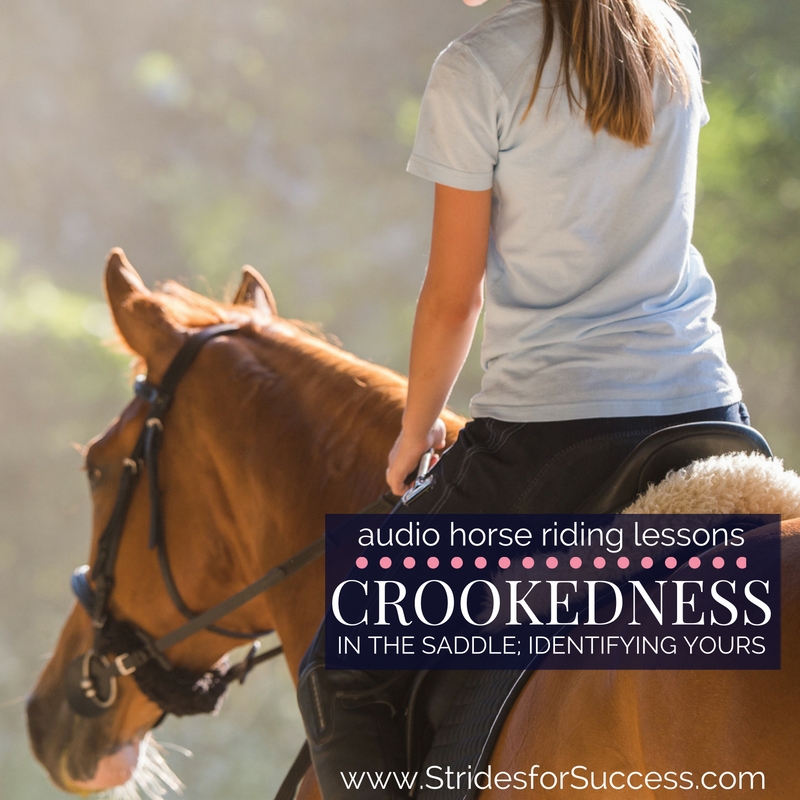
    Crookedness – it is a word and a concept that is continuously showing up when we talk about horses, riding and training… It is also a little like the ‘chicken and the egg’ – which comes first?  Many riders make the mistake of thinking it is only the horse we are speaking about. Meanwhile, riders can be just as crooked, if not more so, than their horses – and because of the relationship, one will always affect the other.

    When was the last time you honestly assess how straight or crooked you are when you are riding? Perhaps it all looks good when you are actually riding on the straight; but things become a little twisted when any change (either in direction, gait, tempo) happens.

    Crookedness in riders shows up in lots of different ways.  Sometimes it is very obvious, the stirrups are different lengths, or the rider is leaning.  But other times it can be very subtle; perhaps the horse becomes disunited in the canter, or a hand or arm tends to dip on a corner.

    Regardless of the degree of crookedness, what is almost agreed upon by all riders is that unless a conscious effort is made to practice symmetry in the saddle, crookedness will creep into your riding in some form or other.  This is simply because all people have a dominant side, which will compensate for the weaker side – particularly when the going gets tough.

    So, this being said, what can we do as riders to become more straight and, how can we then influence our horses to follow suit with us?

    Assessing your horse & saddle

    What many riders don’t realise is that crookedness is sometimes created by the horse itself or the saddle.  Horses, just like us, have a dominant side.  Why this is so has been the topic of many debates and there are many schools of thought on it – however what is important is that your horse favours one side or the other.  Taking this into account and depending on the work or training a horse does, this can sometimes lead to the horse becoming unevenly muscled.  One side of the body will become disproportionately stronger – and therefore larger – than the other.  If the shoulder or back muscles are involved, this will then affect how the rider sits on the horse.

    Crookedness in the Saddle - Identifying Yours

    The other consideration before you even mount up is the flocking or padding in your saddle.  Over time saddles become worn, just like a shoe would on your foot.  This ‘shape’ can be influenced by a few different things, the rider, the horse or the quality of the saddle in general.  The result is that the saddle is no longer symmetrical.  This lack of symmetry can often be the cause of the uneven stirrups, or one seat bone being more forward or dropped than the other.

    I suggest having a good look at both your horse and your saddle and stirrup leathers.  See if there are any noticeable differences between the right and left side.  If there are, have an appropriate professional assess ad make changes where necessary.  Once that is done, you can then turn your attention to yourself.

    Assess your reflection

    Unfortunately not all riders are blessed to have mirrors in their arena, however this does not mean that they cannot make use of other ways to assess their crookedness when they are riding.  There are windows that you can use as mirrors.  You can also use your shadow on the ground.  Both of those suggestions definitely require a little more effort on your part, but if needs must…

    Begin by halting in front of the mirror / window / shadow.  Square your horses shoulders to it, so you can see exactly how ‘equal’ you are on either side of your horse.  Assuming that you have already checked your equipment and horse to make sure the issue is not stemming from there, check are your stirrups the same length?  Are your shoulders the same height?  If you and your horse could be safely chopped in half, head to tail, would both sides be an exact copy of each other?

    Keep in mind that, if your head is also ‘straight’, your eyes won’t lie to you.  Many riders spend so long being crooked that it feels ‘normal’ .  In fact, when they are corrected, it feels so unusual and different, your brain tells you that it couldn’t possibly be right.

    If you have been harbouring a certain crookedness in your riding for any length of time, you may very well have to retrain your brain to what is actually straight again. 

    If you do notice any crookedness here, look at ways you can measure this quickly when you move away from the mirror.  Maybe it will involve looking if your knees are symmetrical.  Or perhaps it you can place stickers on your clothes, marking your left and right point of shoulder, or hip.  There are lots of ways you can get creative, but what is important is that you know what actual straight feels like and keep correcting things back to there.

    Finding Straight when Riding

    Once you have a good idea of what straight looks and feels like at the halt, you can begin accessing your position when riding.  This is where your dominant side plays a big part, and where your markers or stickers will really help you if you don’t have mirrors in your arena.

    Crookedness in the Saddle - Identifying yours

    Start off in walk on the straight.  Notice if you are remaining symmetrical.  Try focus your attention on your seat bones in particular, and the way your weight is distributed between them.  It should be equally or evenly balanced between both seat bones.

    Confusingly for many riders, ‘weighting’ your seat bone does not involved shifting your weight or lifting your weight off your other seat bone.  It rather involves the muscles in your pelvic and core areas.

    Keep in mind that regardless of what you are doing, their should be an equal amount of your body on either side of the horse.  The left will not visit the right and vice versa.  If you find yourself leaning or shifting over, bring it back to centre and straight before trying again.

    Becoming a positive influence

    It is only through continuous correction that you will overcome any crookedness in your riding.  Once you are truly straight, you may find that a lot of your horses ‘crookedness’ will also vanish.  As riders our relationship with our horse is a unique and special one.  We are directly influencing each other all the time when riding.

    Let your influence on your horse be a truly positive and straight one

    Happy Riding
    Lorna

    There are 4 audio programs of step by step instructions on this topic waiting for you inside of Daily Strides Premium.  You can simply download them to your phone and listen while you ride.  You can find out more about Daily Strides Premium HERE

    [wp-tiles post_type=”post” orderby=”date” order=”DESC” grids=”Simple”]

  • 3 Keys to Maintaining Progress in Your Riding

    3 Keys to Maintaining Progress in Your Riding

    Horse riding is a skill that is always a work in progress. A rider can never truly claim to have finished or completed their training… That being said, one of the more frequent questions I get asked by new riders is “how long will it take until I can ride?”.  Which inevitably leads to thoughts of “How long is a piece of string?” and a long conversation!

    But, seriously, if we don’t ever have a true ‘end-point’, how do we keep moving forward & motivated?

    1. Discover what inspires you

    I know, the word ‘inspiration’ can be a little overused in this day and age, particularly when coupled with the words Pinterest and Instagram. However, knowing what you like and developing your style when it comes to riding is very often dictated by what you see and experience.

    Notice what excites you.  Take heed of the things that spark your imagination regarding whats possible with you and your horse. Then begin to thread some of those into your everyday reality with your horse.  What can this look like?

    • Saving up for those jodhpurs
    • Booking that riding holiday
    • Reserving your place in the upcoming clinic
    • Baking those treats for your horse
    • Organising that trail ride with a friend
    • Entering that upcoming competition

    The list of possibilities is endless because inspiration is everywhere.  Also, your combination of things that inspire you, is unique to you.  Some may be simple and easy to implement, others may involve more time or money in order to make happen.  Either way, what matters is that you begin paying attention to what makes you want to get in the saddle and be a better rider.

    2. Share your experiences with others

    “A joy that’s shared is a joy made double” ~ John Ray

    How true this is.  Horse riding is often seen by non riders as not being a team sport.  Anyone who has ridden a horse will of course know that the rider and horse makes the team.  But equally as important to your success and happiness are the people you are riding with.  They will very often have a sizeable influence on your experiences in the saddle.

    If you have not already, I strongly suggest that you begin seeking out like-minded riders with whom you can share your experiences with; both when in the saddle and having a cuppa at the stables.  Having a good support system is often the difference between you becoming a confident rider who makes progress in developing your skills and you becoming anxious, nervous rider who seems destined to ride the same year, over and over again!

    This may just mean moving barns or yards.  Or, maybe you can join a riding club that focuses on a discipline you enjoy.  If location is an issue, this could look like finding support and friendships in an online space and environment.

    Regardless of what your situation or circumstance is, begin cultivating relationships that support you in your riding.  Having cheerleaders makes the good times better and will help get you into the saddle again when the going gets tough.
    3 Keys to Maintaining Progress in Your Horse Riding

    3. See your riding as a journey

    All good journeys happen on the way to somewhere…  That somewhere does not have to be the final destination in your riding, however knowing you want to reach a specific place opens up a lot of different options regarding how you will get there.

    Many riders make the mistake of creating a single goal for their riding; which in itself is not a bad idea.  The trouble arises when they fail to create a plan of how to get there.  It is like me setting out the front door of my house here in Ireland with the goal of reaching my farm in South Africa – but having no map or itinerary to get there!

    The journey would be haphazard, frustrating and long – at best!  I would probably make it to my end goal, but whether or not I would do so safely and in a ‘timely fashion’ is up for debate!  Needless to say, this would not be a good way to reach my goal.

    Many riders approach their riding in this exact way.  A destination is chosen – but no plan is created to get them there.

    Having a plan, even a lose one, is the best way to actually make things happen in your riding.  The plan does not have to be set in stone.  In fact, it is almost impossible to create a detailed plan further than 4 to 6 weeks out when it comes to horses.  Rather create a series of loosely mapped out ‘mini’ goals.  One will lead on to the next, which will lead to the next… This is your journey with your horse. This journey will eventually take you to that ‘place’.  The destination or goal; the one thing you wanted.  From here, you can choose a new destination and all the fun places you can visit on your way there!

    Keep in mind that the plan ‘will’ change.  Horses have an uncanny ability to test our flexibility and willingness to persevere with something.  But if you know where your destination is, a detour or two along the way is not the end of the world – and who knows what you might discover or experience along the way.

    3 keys to maintining progress in your riding

    Take Action Today

    So, as you were reading this blog post, what ideas and thoughts popped into your mind.  What have you seen lately that inspired you?  Who can you share it with?  If you don’t have anyone right now, where can you begin seeking out like-minded riders?  Riders to keep you company on your journey.

    And, staying on the whole ‘journey’ theme; where will your next destination be when it comes to your riding?

    I would love to hear from you in the comments below.  Perhaps you can inspire another rider who is feeling a little ‘lost’ right now where their horse riding journey is concerned.

    Happy Riding
    Lorna

    Every week I create a series of audio horse riding programs that riders can download and listen to while they ride their horse.  It’s like having an instructor with them in the arena!  Daily Strides Premium is where all these ‘lessons’, past and present are waiting for you.

    The programs are divided into Collections; Leg Aids, Groundwork, Basic Training, Cantering, Gridwork, Reschooling, Seat Aids, Healthcare to name a few.  Give Daily Strides Premium a try today – and make EVERY ride great.

  • Relationship between Your Inside Leg and Outside Rein

    Relationship between Your Inside Leg and Outside Rein

    Most riders have heard about how they should ‘ride from the inside leg to the outside rein’; but really – what does that mean?!  How exactly do you ride from what seems like a bit of a diagonal and what about all the other aids?  Should we forget about them?

    [smart_track_player url=”https://op3.dev/e/traffic.libsyn.com/dailystridespodcast/766-The-Relationship-Between-Your-Inside-Leg-and-Your-Outside-Rein.mp3″ title=”The Relationship Between Your Inside Leg and Your Outside Rein” social_linkedin=”true” social_pinterest=”true” social_email=”true” tweet_text=”A simple explanation – to clear up any confusion – of the relationship between the inside leg and outside leg in the saddle ” hashtag=”equestrian #horseriding” twitter_username=”strides_success” ]

    The term ‘riding from the inside leg to the outside rein’ is one that is used a lot when it comes to riding.  The confusing part of it however, is that this concept is so much more than just those two aids.  In fact if it is done correctly, it is a finely balanced combination of all your aids – that is continuously requiring adjustment and ‘recalibration’ with every passing stride.

    A channel for your horses energy

    What is important to remember is that your aids are like a channel for your horses energy.  Think about the banks of a river; they keep the water in, and therefore, flowing where they want it to go.  Your aids work in the same way for the energy your horse creates.

    When you ride, you ask your horse to create energy with his hind quarters.  This energy must then be directed where you want it to go.  If you allow it to just ‘run out the front’, your horse will most probably become quite long and stringy.  He will also become heavy on his forehand.  If you hold too much energy in and don’t allow it to flow, you run the risk of encountering an explosion of sorts!

    Understanding that your job is to ask for the creation of energy and then regulate the flow is, in my opinion, the first step to grasping the concept of the ‘inside leg to outside rein’.

    The Relationship Between Your Inside Leg & Outside Rein

    How responsive is your horse to your aids?

    From here, you need to asses how responsive your horse is to your aids, particularly your inside leg.  Is he quick to respond to questions you ask with it, and does he clearly understand what is expected of him when you ask those questions?

    Your inside leg asks for the energy to be created.  This energy is created in the hind quarters and then flows though the horses back to connect with the front end.  As we have already mentioned your aids then channel the flow of this energy.  However this cannot happen if your horse ignores or is unresponsive to your questions to begin with.

    You cannot channel and regulate what is not there!

    The Role of Your Outside Rein

    So once this energy is flowing, your inside leg is then used to ‘contain’ it and keep it in the imaginary river that we spoke about earlier.  However, all rivers need two banks.  This is where your outside rein comes into play.  it is the opposing channel or bank for the inside leg.

    Now, obviously, this is a very simplified version of what is going on, however in order to fully understand how they work together, I find it is one of the easiest ways to explain the concept.

    What is important to realise is that it is this relationship, between inside leg and outside rein, that then dictates how that energy flows through the horse.  If it is allowed to run freely out the front, or if it will be regulated. 

    If you are regulating that flow of energy, you then need to begin working on how you are balancing that flow.

    Balancing Your Inside Leg to Your Outside Rein

    Again, think of the energy as being water in a river.  If it is allowed to run freely out, it will be fast and lack direction.  If it is dammed up, their is much more potential there to work with.  If it is blocked, well, it may just explode (think bucking and general high jinx)!

    You need to work on balancing the energy being created, keeping the energy flowing in the ‘river’ and deciding how much you are going to allow it to flow out.  Once you understand this, it is now time to incorporate your other aids into your communication.

    Your Other ‘Supporting’ Aids

    In order for the relationship between the inside leg and outside rein to truly work; your outside leg, inside rein and seat must also be involved.  Their role is more of a supporting one – they are not the lead characters in the relationship!

    The additional involvement of your inside rein and outside legs will constantly change, depending on the questions you are asking your horse and his response.  If you fail to incorporate them into your riding, the basic principle of your inside leg to outside rein cannot work effectively.  

    However, if you overuse the supporting aids, well it’s a little like “too many cooks spoiling the broth”.  It becomes overwhelming, each aid fighting for your horses attention and consideration.  This is where you see the horse either shutting down completely and ignoring the rider, or becoming agitated, frustrated and displaying far too much excess tension throughout their body.

    The Relationship Between Your Inside Leg & Your Outside Rein

    Fine Tuning this Relationship

    Initially you may have to use more pressure or apply your aids more frequently until your horse begins to understand what you are asking.  How long it takes until you can begin to become more subtle with your aids will depend on your riding skills – and how quiet you are when riding – and also your horses training.

    Refining the relationship between your inside leg and outside rein means having your seat and body play a larger part in your communication with your horse.   

    Begin by Focusing on the Where & How

    I suggest you begin by focusing on your position in the saddle.  If you are in the correct position, your body is in the best place to apply the aids clearly and correctly. This is true for your leg and your rein.

    Pay attention to your ‘lines’; head, shoulder, hip, heel and then ‘elbow, wrist, thumb, rein, bit’.  When those correct lines are in place will have a dramatic influence on the effectiveness of your aids.

    From here, work on your horses responsiveness to your aids and how much pressure and how often you are applying those aids.  This is always changing, from stride to stride, so it is up to you to begin developing your feel in order to consistently adapt your aids to the situation.

    Happy Riding
    Lorna

    There are four more audio programs on this topic available for you to download and listen to while riding inside of Daily Strides Premium. The additional programs will take you step by step through the process of applying these aids when riding, helping you to better understand and apply this concept in the saddle.

    They are part of the ‘Rider Aids Collection’, a series of audio programs all about the different aids we use when riding and how you can best apply yours. This collection is divided into Seat Aids, Leg Aids and Rein Aids; allowing you to find the group of lessons that best suit your particular needs – regardless of where you are in your riding.

    You can find out more by visiting HERE >>

    [wp-tiles post_type=”post” orderby=”date” order=”DESC” grids=”News”]

  • Starting a Green or Young Horse – Part 1

    Starting a Green or Young Horse – Part 1

    Starting a Green or Young Horse - Part 1

    Have you ever wondered about the process involved in taking your equine friend from a ‘young and wild’, spirited, unbacked horse, to becoming a wonderfully responsive and responsible riding horse under the saddle?  Do you perhaps currently have a horse or pony that needs to begin the next part of his journey.  The part that includes carrying a rider for the first time?

    Starting or backing a young or a green horse is a process which, ultimately, has the power to shape your horses feelings on being ridden for many years to come.  Decisions made during those initial few weeks and months have the potential to impact your horses feelings towards carrying a rider for the rest of his life.

    [smart_track_player url=”https://op3.dev/e/traffic.libsyn.com/dailystridespodcast/721-Starting-a-Green-Horse-Part-1.mp3″ title=”Starting a Young or Green Horse – Part 1″ social_linkedin=”true” social_pinterest=”true” social_email=”true” tweet_text=”Starting a young or green horse – part 1… ” hashtag=”younghorse #equestrian ” twitter_username=”strides_success” ]

    A Foundation that Builds Confidence

    The process itself is not just about ‘riding’ the horse, but also introducing the horse to different training principles.  These will become the foundations for him to begin ‘schooling’ once the actual backing or getting a rider into the saddle is complete.  Understanding and feeling confident about what is going on is fundamental to your horse being able to move forward in his training.  This will allow him to build, week on week and month on month, in his development, confidence and knowledge.

    There are a few ways you can approach this; as quickly as possible being one of them!  However I truly believe in taking things slow and steady when starting him off.  This will allow him to grow in confidence.  This confidence is both in you, the rider, and also in himself and his own abilities.

    Rushing through this part of the process might get you into the saddle quicker initially.  However it almost guarantees roadblocks further down the road and will ultimately slow your horses training down in the long run

    A horse who has had a chance to ‘work things out’ initially, both physically and mentally, has a huge advantage.  This horse will, generally speaking, become more capable when figuring things out if and when you need him to do so later in his training.  Whether that be to navigate a particularly uneven piece of ground, or a difficult jumping distance, or even just being confident on the trail.

    The early methods you employ to teach your horse about being ridden will very often dictate his reactions when under pressure later.

    Creating a Time Frame

    I generally recommend taking approximately six weeks when ‘starting’ your horse.  I feel that this stage of his training will end when he is happily working under the saddle with his rider and understands basic aids and questions the rider will ask.  He will be essentially ready to begin a more comprehensive ‘schooling’ program.

    Ultimately you must keep in mind that your horse will dictate the speed of the progress.  It is also worth keeping in mind that each horse is an individual.  Meaning this will vary from horse to horse…

    If he becomes anxious or stressed at any point, rather go back a few steps and try again.  He must be happy with each individual part of the process before you can move on to the next.  This means that your plans must be flexible.  There should be ‘wiggle room’ for any detours or delays that may occur on the journey.

    Consistency and Routine

    Just like children, horses thrive within a set routine and boundaries.  This becomes even more apparent when you are introducing new experiences into his day-to-day life.

    Make sure that you have enough time to actually complete this process, before you begin!

    A week here or thirty minutes there is not the way to introduce a horse to being ridden for the first time.  You need to block out a regular daily slot for at least 6 weeks where you will dedicate that time to your horses training.  If you cannot do this, perhaps finding a professional who can, is a better option for you and your horse?

    You also need to develop a regular routine in how things are done.  Will you groom first?  If so, what is the sequence for your grooming?  Perhaps you will ‘work’ first and groom afterwards.  This is entirely up to you.  What is important is that you stick to it on a daily basis.  Remember, horses thrive in routines.  This approach will help to ensure your horse remains relaxed throughout the process.

    The Importance of Relaxation

    Over the next few weeks with your horse, one of the key indicators that you are on the right path will be how relaxed your horse is with his work.  Often we only begin to think about relaxation when we are in the saddle.  We see relaxation as something which is only relevant when riding.  When we begin setting our sights on working up the ‘training scale’.  This is simply not true…

    Relaxation starts from Day 1.  Part of your job as the person who introduces your horse to this new concept of carrying a rider on his back is to promote and, later, ensure this relaxation prevails.

    Each horse, just like us, is different when it comes to how and what they find relaxing.  It is your job to tailor your program over the coming weeks to ensure you do all in your power to keep your horse as stress and anxiety free as possible.

    Remaining relaxed will allow him to better absorb what you are working on.  It will also ensure that he learns to ‘go forward’ in a relaxed manner.  As you well know, relaxation is one of the basic building blocks to working correctly when being ridden.

    Considerations for Each Individual Horse

    The first of these is handling.  More specifically how and what handling has been done to and with the horse up to the point where you wish to ‘start’ him under the saddle.  How he has worked with people in the past will have a great impact on how he will perceive you now as you begin to work with him.

    Basic respect for people is, in my opinion, a must for all horses.  It will make your job easier and safer when working with him.  

    Also how relaxed and comfortable he is with being touched, lead and just generally worked with on the ground will also dictate how much time you will have to invest in the initial weeks of his training.

    We have discussed how you can begin incorporating groundwork into his routine HERE >>

    Healthy is Happy

    Another consideration before starting your green horse on his journey to becoming a riding horse is his overall health and wellness.  All the basic checks should be made before you begin working with him.  Things like having his teeth checked, his vaccinations up to date, his hooves seen by a farrier, an up to date deworming program in place etc.

    Just like you, he will not give his best if he does not feel his best.  Any pain or discomfort while introducing tack etc, can really leave a lasting negative impression on him

    Quality over Quantity

    The final consideration is how much time you have available.  When working with horses, particularly younger ones, quality over quantity is generally the way to go.

    Shorter sessions, with a particular plan or goal will ensure you have his full attention. 

    It will also help to ensure that he doesn’t become bored.  Young horses have short concentration spans.  You don’t want him to begin to look for other ways to entertain himself!

    Equipment and Facilities

    Your initial week of working with your horse will require a few basic items if you are to use this time to your full advantage.

    • A round pen / enclosed arena
    • A lunge line
    • A lunge whip
    • A cavesson
    • A reliable, calm and experienced helper!
    • Time, a plan & a schedule
    • A quiet stable / stall / enclosed area to work in

    Make every experience a ‘happy’ one

    It is worth mentioning again the importance of these ‘starting’ weeks for your horse.  How your horse sees this whole process has the power to influence his feelings about riders and being ridden far into his future.  Therefore, focusing on trying to make each new experience a happy and relaxed one is vitally important.

    This may take a little planning ahead on your part.  Simple things like having an older, more experienced horse in the stable or stall next to him when you are working with him.  This will help him to remain relaxed.  It can also help him to feel more confidence.  He will see, first hand, that there is nothing to worry about.  This can be particularly useful if he does become a little overwhelmed or anxious during those initial few weeks.

    Keep in mind that a lot of the initial ‘introductions’ will happen in the stable.  Choose your ‘stable’ or enclosed space wisely. 

    Things like the bit and bridle and then, later, the roller and saddle.  You will use the stable when working through these initial steps.  Therefore having a quiet, relaxed atmosphere is absolutely essential.

    Recruiting a Reliable ‘Helper’

    Another part of the puzzle, which I strongly suggest you incorporate into your starting process, is a reliable person to help you when necessary.  This person will know and understand horses.  Keep in mind that your horse will look to the people around him to assess new situations.  Having confident, calm and ‘happy’ people there will help his transition across to working under a saddle.

    You don’t want someone who is nervous or anxious. Nor do you want someone who gets in the way due to not knowing or understanding what is going on.  This will only serve to frustrate you and, potentially, scare or intimidate your horse

    Your helper will be there to assist with the initial lunging of your horse, the initial introduction of the tack, particularly the numnah, roller and saddle.  They will also be there to dish-out smooth, coordinated leg ups when the time comes to actually mount your horse.  They play an important role in many aspects of your starting process.  Choose wisely!

    Introducing Your Horse to Lunging

    Before we even begin working on the lunge, it is important to firstly see things from your horses point of view.  I would hazard a guess that up to this point in his life, he has been thought to work ‘beside’ you.  This is true for grooming, handling, leading and just basic day-to-day interaction in general.

    I have discussed lunging in more detail HERE >>

    However, when you begin lunging for the first time, you are now asking him to work ‘away’ from you… This can be quite confusing for your horse

    In order to help smooth the transition from ‘beside’ to ‘away’, your helper plays a big role.  They will guide your horse out onto, and around, the lunging track.  You will remain in the centre of the circle, communicating with your horse.  However, initially, it will be your helper that will literally take your horse by the rein and show him what to do.

    Keep in mind that you want to begin communicating to your horse from the ground with aids that you can, in the coming weeks, transfer across to being ridden under the saddle

    Your body language, voice, lunge line and lunge whip all play an invaluable role in this initial communication and each element has a corresponding aid when you are in the saddle later.

    A Lasting Impact

    The overall thing to remember during this initial first week of  ‘training’ is that how your horse experiences things will most certainly have a lasting impact on all future interactions he has with people and riders.

    I cannot stress enough the importance of keeping things relaxed – physically and mentally – and also the importance of routine and consistency during the coming few weeks.

    Slow and steady wins the race; don’t rush things!

    Happy Riding
    Lorna

    Related posts, episodes and freebies you might enjoy:-

    Links to related content & freebies:-

    Click here to sign up for free live online training

    Step by Step Instructions & Help for Starting Your Horse

    Taking a horse, by the hoof, on his journey to becoming a solid citizen under the saddle is a big responsibility and undertaking for any rider. Decisions made throughout those initial few weeks have the potential to impact your horses attitude to being ridden for many years to come, if not for the whole of his life.

    The Starting Collection is a series of audio trainings that will take you step by step on the journey of starting your horse, from the initial handling and groundwork, through to riding him away, under the saddle.

    There are daily programs for you to follow, which will literally take all the stress, the confusion and the ‘lack of a plan’ out of the process for you.

    All the programs in this series (as well as ALL past programs) are waiting for you inside of Daily Strides Premium. For more information, you can visit HERE >>