Author: Lorna Leeson

  • Riding a Hot Horse

    Riding a Hot Horse

    Have you ever found yourself riding a hot horse where the slightest touch of your leg sends them shooting forward with the speed of a snake strike?  Even worse, once they start on that forward trajectory, they get heavier and heavier on your hand.

    It becomes more and more unbalanced until, eventually, there is an epic tug of war happening.  Horse and rider pitted against each other, often at speeds, which for the space you are currently occupying, are breakneck

    [smart_track_player url=”https://op3.dev/e/traffic.libsyn.com/dailystridespodcast/SFA346-Riding-a-Hot-or-Sensitive-Horse.mp3″ title=”Riding a Hot or Sensitive Horse” social_linkedin=”true” social_pinterest=”true” social_email=”true” tweet_text=”Is your horse a little too ‘hot to trot’?! Here is what to do:-” hashtag=”HottoTrot #equestrian #hothorse” twitter_username=”strides_success” ]

    Think ‘Increase Relaxation’ rather than ‘Slow Down’

    Horses become like this as the result of many different factors and influences.  It may be that they experienced pain or anxiety in a similar past situation.  Some horses are just a naturally more anxious or sensitive by nature.

    What’s important to remember is that rather than slow your horse down, you are instead looking for more relaxation.   This is both when he is being ridden and when he responds to your aids, particularly your leg and seat.

    Understanding Excess Tension

    Often when horses run away from the leg, they become tense all over.  They hollow their back, they raise their head, their muscles become stiff and taunt.  They also invite you to ride really badly… which is why the first part of retraining your horse is to make sure you are asking the correct questions in the correct, timely manner.   Also, that you are responding to your horse correctly.

    This takes consistent ongoing effort and rewiring if your horse is to accept your leg and seat aids.  Ongoing meaning months, if not years.  However, the effort is always worthwhile, for both you as the rider and the horse.

    Ruling Out the Obvious Culprits

    The first part of this is making sure your horse is not running away from anything causing him discomfort or pain.  This means checking him thoroughly for any medical or health issues as well as back or muscular problems.  Then ask a professional to check your tack and of course, have his teeth seen to on a regular basis.

    Riding a Hot Horse


    Correcting Your Position and Leg Aids

    Once you have covered all possible outside influences, we can begin to look at what you can actively do to retrain your horse to happily accept your leg.  To do this, I think it bears mentioning that you must have an independent seat and knowledge of how your legs must be correctly applied and the correct result or outcome to this application.

    So, once you are clear that your position in the saddle is correct and you have a sound knowledge of how to apply your leg and seat aids, I suggest investing some time developing your often overlooked voice aid. I really believe for horses like this, the voice is a tool you can use to begin reprogramming their reactions in a calm controlled way.

    Spend Time with Groundwork

    You can begin doing this by lunging your horse and observing their behaviour and their way of going.   Notice things that trigger a reaction.  Then, slowly, using your voice along with your other lunging equipment begin to ask more demanding questions of your horse.  Of course, all the while backing every question and response up with your voice.

    This time spent working correctly on the lunge will also allow your horse to experience how comfortable and enjoyable things can be if he relaxes and uses himself correctly… Without the interference of the rider.  Remember, often our horses are running away from us, whether we like it or not and sometimes the key to retraining is by taking us out of the equation initially!

    Training  to the voice first on the lunge gives you a ‘back up’ for your legs as you are riding.  It allows your horse to begin understand when he has indeed taken a step in the correct direction.  This is especially true when used in conjunction with an ‘offering’ of the inside rein to reward while riding.

    Your Actions Affect Your Horses Relaxation

    Talking also keeps you breathing while in the saddle.  This simply means you are less likely to tense up and become stiff, which your horse will inevitably pick up on and perhaps be affected by.  Your voice also focuses your horse on you and calms them.

    As I mentioned, the other great advantage of lunging is the fact that you can spot other influences that are causing certain reactions.  We had a particularly ‘sensitive & hot’ mare here a few years ago.  She was an OTTB and quite ‘goey’ as well as ticklish.  We noticed that when she was wearing a square saddle pad, rather than a shaped numnah, the her attitude changed and she became more difficult to work with.  We figured out that this was due to the corner of the pad ‘tickling’ her close to her sensitive flank areas.  We changed the saddle pad and while she was not ‘cured’, she was certainly easier to work with afterwards.

    Changing Things Up and Getting Out of the Arena

    The second suggestion I have is getting out of the arena.  Often sensitive horses over think things a little and begin to anticipate.  We then, in response to this anticipation, begin to tense up and a vicious cycle is born.  In these cases riding on roads, lanes or trails works well to relax a sensitive or hot horse.  It also demonstrates what you are actually looking for when you do venture back into the arena and how you are going to ask for that in future.

    You can begin this by focusing on regulating the tempo in trot while on the trail.  You are initially looking for a long, relaxed and low, if necessary, shape to begin setting a new ‘normal’ which you can work on improving in the arena.  Regulating the tempo has a calming effect and being out, perhaps with a friend, often relaxes horses and allows them to be more open to suggestions.

    I have to stress the importance here of consistent use of your leg.  Your horse has to begin to realize that you leg on their side is normal and not something to run away from and often the trail is a good place to start this due to the more relaxed feel of the ride.

    The Importance of Understanding How To Use your Leg Aids

    Remember keeping your legs off and only using when absolutely necessary, while initially will seem like it’s helping, will only prolong an already irritating situation.  He may initially rush or run away, however by keeping your legs there, quietly he will begin to relax and the tempo may slow, while the stride becomes longer.

    All the while I urge you to keep your leg on, gently..  Not gripping, not nagging, just there and asking questions when needed, such as inside leg for impulsion, outside leg to balance and straighten etc.  Once you have mastered this on the trail, you can then begin to look for similar results in the arena, using your voice in a similar manner to when being lunged and the same leg and seat aids from the trail.

    Ignoring the Invitation to ‘Ride Badly’!

    When you do begin working in the arena, or an enclosed space you may find that your horse will again speed up, fall onto the forehand and lose balance…  In order to end this tug of war, it is extremely tempting to take your leg off, however only reinforces in the horse that the leg means go and only go.

    You must essentially ignore all his invitations asking you to join in to that tug of war and rather stick with consistently applying your leg aids in a correct and also using the half halt to balance and regain his attention.  When you get a positive reaction, no matter how small, be sure to acknowledge it by rewarding with inside rein and allowing him to move forward again

    Do not allow him to rush, pull on your reins or lean on your reins and also do not stop using your leg.  Rather gently insist with half halt, remembering that so much of the half halt is your legs and seat, that he comes back and when he does so, rewarding with voice and a softening of the inside rein.

    Focus on Consistent Rhythm and Tempo

    When in the arena, work on regulating tempo but be careful of horse becoming stiff and tense though their back.  They sometimes lock against the rider, resulting in a horse that is noticeably ‘slower’ but that is stiff throughout their body and not using themselves to their full potential.

    Keep you leg in contact with the horse at all times, not gripping, but in contact.  If you need to desensitise him you can, beginning at walk, gently ‘rub’ or ‘swing’ your legs against your horse’s side.  Each time he tries to run forward, use your half halt, again including your leg, to let him know that it does not always mean rush forward.  However, I must caution you that I personally think desensitising him will open another can of worms later down the line, but I do know of people who have had success with this so it bears mentioning.

    The final point I want to make is that very often being sensitive to the leg means being sensitive all over, and horses like this pick up on the rider being tense and stiff.  I mentioned earlier the benefit of the voice, and from this point I believe it works both ways.

    Retraining a horse that runs away from your leg takes months of consistent work; paying attention to asking correctly and then rewarding when small progress is made.  Keep in mind that there is a big difference between allowing him to go forward and asking him to go forward; meaning that you must be prepared for the response to the questions you ask.

    Happy Riding
    Lorna

    Related Topics:-

  • Riding Just to Ride

    Riding Just to Ride

    A couple of weeks ago I was faced with a particularly irritating scenario; the clients who had booked for the final lesson of the day didn’t show…  Not a word of explanation… Nothing!

    I am sure you have had similar experiences, whether you work with horses or not, and can relate to how I was feeling at that point; tired, frustrated and annoyed!  After ten minutes of ‘busying’ myself around the yard and admonishing myself for thinking the worst in people (it is possible they had a mishap on the way here, you know… Hmmm!), I finally accepted the fact that they were not coming and I was left with a barn full of ponies, all tacked up with nowhere to go.

    But just before I let myself completely wallow in the ‘Poor Me’ mindset of no return, I looked for ways I could turn this whole scenario around on its head…  What if?

    Riding to Just Ride

    What if I were to just take one of the ponies out on the trail, no schooling, no lessons, no ‘being an example to all who see me’.  What if I were to just mount up and ride like I used to ride when I was younger to, quite frankly, just enjoy the actual ride.

     What if we just let loose, not giving a care in the world as to how we looked, not even a thought towards considering all the finer points that I know now but didn’t know or care to know about then…

    And that was when magic happened, literally.  As I mounted my favorite pony I had this feeling of excitement and anticipation that I honestly have not felt in years.  Like Christmas Eve… when I was 6 years old!  The feeling that anything was possible; the feeling that we were just going to enjoy each other, together, on the trail.

    And as we left the yard, it was almost as though this feeling was contagious and this wonderful little mare was reading my mind and becoming giddy with the possibilities…

     What a ride we had!  I spent that time just ‘being’ with my pony, present in the moment.

    I think sometimes, as adult riders we become so caught up with having to ride a certain way that we sometimes lose the initial passion for why we ride in the first place.

    We are always trying to improve ourselves and our horses, which is not wrong, but perhaps sometimes, every now and then, to just let loose and forget all that we know is often the key to being able to return to our work of self-improvement with a renewed passion and a better understanding of what it actually means to be blessed enough for this wonderful animal to allow us the life changing experience that it is to ride on their backs, with them.

    This coming weekend, I challenge you to just spend time with your special horse or pony… Relax, relate and reignite those initial sparks that got you into the saddle in the first place…

    I would love to hear about your thoughts or experiences on this in facebook group of the Rider Fitness Challenge – details below!

    Happy riding
    Lorna

    [wp-tiles post_type=”post” orderby=”date” order=”DESC” grids=”Fancy”]

  • Developing Your Riding Seat

    Developing Your Riding Seat

    [fusebox_track_player url=”https://op3.dev/e/traffic.libsyn.com/dailystridespodcast/SFA341-Developing-Your-Riding-Seat.mp3″ title=”Developing Your Riding Seat” social_linkedin=”true” social_pinterest=”true” social_email=”true” ]

    There’s always a desire among riders to develop their seat in the saddle. Most riders understand that developing this one aid is a key part of improving as a rider. But what does it really mean? And how can you start to do it?

    Developing your riding seat begins with understanding that your seat must be used to signal to your horse.  It is not there to interfere or disrupt his natural movement.  

    In order for you to utilize this aid successfully, it is imperative that you be relaxed first.  Relaxation is not floppiness, it is just an awareness of your body and how you are using it without any excess tension or resistance through your muscles.

    Control Without Excess Tension

    The problem and confusion over developing your riding seat often begin right at the start when we first learn to ride. We hear certain phrases repeated continuously. Phrases like “sit up straight, shoulders back, heels down, look up, bend elbows”.  The list goes on and on.

    However, all those commands, while each in their own way is correct and coming from a good place, can very often have the negative effect of making us stiff and resembling a poker!

    Developing your riding seat essentially the ability to control your core muscles, both when you need to use them and when they should remain passive or neutral.

    Many riders think that this is a foreign thing for them to do; using their core to influence something else. But cast your mind back to when you were small and enjoying the sensation of the wind in your hair as you swung back and forth on a simple swing. Yes, the ones with two ropes hanging from a branch or beam and a plank in the middle for you to sit on.

    Now, think how you were more than able, on your own steam and without touching the ground, to make each swing go higher than the last… You were essentially using your ‘driving seat’ to do that.  

    Likewise, think about when you wanted to get off the swing; you used your body to slow the momentum down and bring the swing to a halt; your resisting seat.

    How Your Seat Can Influence Your Horse

    This same approach applies when riding a horse, although admittedly used in far more subtle applications.  We can use our seat to drive our horse forward.   We can also use our seat to slow our horse down or gather our horse up a little.

    In fact, when we start being mindful about what we are doing and the effect it has on our horse, we realize that our seat is an important factor in going, turning, stopping, starting, transitions, not to mention the more intricate movements such as lateral and adjusting suspension and movement within a gait.

    Developing Your Riding Seat

    But just as being able to guide your horse along to perform what you wish of him, equally as important is the ability to shift your seat into ‘neutral’ and allowing our horse to actually do his job.  

    Often when people begin realizing how powerful their seat is in riding, they are quickly horrified as to how much ‘chatting’ they are doing without realizing it every time they are in the saddle!

    Becoming Mindful of Your Seat

    So, what do we need to do in order to begin tapping into our seat aid and using it when we ride?

    First and foremost, you must have or begin to condition your body to have, a strong core in order to correctly use your seat.  So many people are after this ‘independent seat’ but are not willing to put in the necessary effort and time that it takes to achieve it.  Learning to use your seat correctly is not something which we achieve overnight.

    It takes years of practice to develop the ‘feel’ and conditioning of your bodies in order to truly support you when you ride

    30 Day Rider Fitness Challenge

    It seems so strange, but so many riders just don’t carry themselves when on their horse… And those same riders get awfully upset when their horses refuse to carry themselves as well!

    You also must become almost obsessive about the cause and effect of every movement while in the saddle.  Being finicky and playing close attention initially to each movement and the reaction that it causes is the key to being able to perform what appears to be an effortless ride in the long term.

    Negative Effects of Excess Tension

    Earlier, I mentioned how essential it is to relax your body while riding.  One of the reasons is to prevent gripping!  I see so many riders in the saddle and they seem like they have the fear of God inside them that they might just fall off!

    Firstly, you will fall off if you stay riding long enough.  It is as enviable as the sun rising in the East each morning and setting in the West every evening.  Secondly, gripping will only work to get you there sooner, trust me!

    When you find yourself tensing and beginning to grip, catch yourself in the act and then rather relax.

    Think of a stone and a piece of jelly on a plate.  If you bounce the plate up and down, which bounce off first?  The stone of course!  Don’t be the stone.

    Confusion in Communication

    Gripping also works against you because it tells your horse a different story to what you are really perhaps trying to convey.  I have come across quite a few horses, particularly OTTBs, whose riders get a little nervous and begin to grip.

    The horse’s general reaction is always something that moves them farther from what the rider actually was trying to achieve and quite often ends with the horse showing his athletic ability with a few cartwheels for good measure.  This of course causes the rider to grip more, drive more and so the cycle goes on and on.

    Learn to relax both your mind and your body while riding. This will improve your ability to really develop your seat

    Your Position and Your Seat

    We can also look at the rider’s position when speaking about seat.  Make sure you are sitting in the lowest part of the saddle and not leaning back towards the cantle of the saddle. Leaning back will cause your legs to stick out in front of you with your toes tipping your horse’s shoulders or elbows.

    When a rider is continuously tipping back while in the saddle, the horse will begin to hollow his back all the time in order to get away from the uncomfortable pressure of the rider’s seat-bones.

    Equally as important is to guard against crouching over the pommel of the saddle.  People who ride like this are completely unbalanced and will never cultivate an independent seat.

    Also, you cannot ride a horse sitting on their neck; so don’t try it!

    30 Day Rider Fitness Challenge

    ‘Driving Seat’ Challenges

    Another position fault I see with riders, particularly when they try and use a driving seat is the ‘Quasimodo Position’.  They have tucked their pelvis so far forward that their back and, in particular, the area between the shoulder blades become curved into a C shape.

    In this position, the core is being ‘squashed’ making it impossible to carry the upper body, with the effect being that the rider becomes extremely heavy and cumbersome on the horse’s back.

    The last position problem that I want to mention today which is common when riders try to engage that ‘driving seat’ is an upward and forward thrust of the pelvis, coupled with an equally powerful thrust backward of the shoulders.  The result is again, a complete loss of any core engagement and an extremely arched and uncomfortable position for your spine to be in!

    When we look at what causes riders to do any of the above, it tends to circle back to two underlying reasons.  The first is a lack of time spent cultivating that all-important feel for the seat. And the second is a lack of strength and flexibility in the core of the body.


    Step by Step Training on This Topic

    This week in Daily Strides we are working on your seat. Specifically learning how to begin feeling it and then how to influence your horse with it.  The second lesson focuses specifically on asking our horse to move forward and how the seat is the first part of this ask.  Think about how you subtly adjust your body just before you stand up out of a chair.  This is a similar use of your core.  You will be riding exercises to help you use your ‘forward going’ seat correctly and also the correct application and use of the driving seat.

    In Wednesday’s lesson we knuckle down on how we can use our seat correctly while slowing down and stopping.  We are working on transitions between gaits themselves and using your seat to encourage a change within the gait itself.  This seat is often called a resisting seat. And if used correctly can be the difference between a connected and fluent transition; or a hollowed and choppy one!

    Finally, we put this all together on Thursday…  And for the brave few, I lay down a challenge that will open your eyes to the consequences of using your seat aids correctly. And the unfortunate issues that can arise when riders choose not to!

    The aim of this group of lessons is to help you to sit quieter in the saddle. This will lead to greater influence and better understanding of all the intricacies you are communicating to your horse as you ride.

    All this week’s lessons are available for you right now inside of Connection.  In fact, there are over 500 audio horse riding lessons on a huge variety of different topics in there. All ready for you to dive into with your horse.

    We will also help you set goals and create a plan to reach those goals – and equally as important.  You can find out more about Connection HERE >>

    Happy Riding
    Lorna

    Additional Resources on This Topic

    30 Day Rider Fitness Challenge

  • Keeping a Hoof Journal for Your Horse

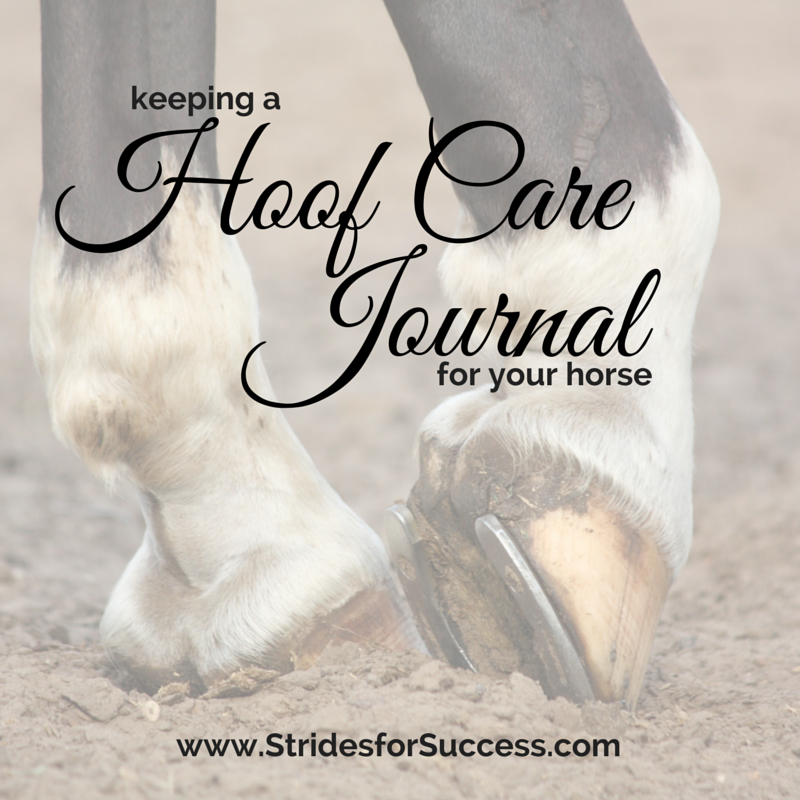
    Keeping a Hoof Journal for Your Horse

    We have all heard the old saying ‘No hoof, no horse’, and any of us that have been around horses for any length of time know it to be true.

    But, aside from just the regular picking out and greasing of your horse’s hooves, what else are you actively doing to ensure the long term integrity of your horse’s feet and how closely are you paying attention to the small changes that can sometimes lead on to big problems?

    Often as owners and riders we just assume our farrier is doing his job well and the hooves are ‘all good’, however when you begin to consciously get involved in monitoring the subtle changes on a weekly or fortnightly basis…  You stand a much greater chance of keeping your equine friend sounder for longer.

    Hoof Care Checklist

    So, why should we record and chart our horses hooves?

    Well, horses feet change for variety of reasons, both environmental or mechanical.  Because of this I think it is vital to note the facts of the hooves themselves but also keeping records of other outside external factors which may be contributing to healthy feet or subtly causing problems to occur.

    Factors such as

    • Feed and forage
    • Supplements
    • Weather
    • Stabled or living out
    • Type of bedding
    • Stable management routine
    • Work surface
    • Chiropractor
    • Inoculations
    • Tack
    • Type of work required
    • Rider (weight, experience, height, habits and style of riding)

    Keeping a hoof journal for your horse will help keep track of your horses hooves, but also perhaps notice any changes early enough so as to intervene before they become a problem.

    Hoof Care Journal

    Your journal can be as basic or as detailed as you wish, however I would recommend tracking the following details

    • Hoof shape and size – photographs and measurements
    • Hoof condition – monitoring cracks, brittleness, exposure to moisture
    • Hoof growth – measuring, photographs and any topical or supplements you are giving to promote
    • Hoof quality – photographs and notes concerning texture

    Also those external factors that I spoke of earlier such as farrier details, work, diet, supplements and a whole multitude of other influences which may or not be unique to your horse.

    To help you with this I have created a free checklist for you to download and use when at the barn.  You can print it off and keep it in your records file, or digitally fill it in and save it on your phone or computer.

    hoof Care Checklist

    Along with this checklist, I have also created a fully comprehensive hoof journal which along with the above mentioned checklist, is also filled with a whole host of more detailed, quick and easy understand and use pages that you can use to capture all those small but important details keep track of your horse’s feet and deal with any issues right at the beginning.

    So, here’s to healthy hooves!

    Lorna

    Hoof Care Journal

    [wp-tiles post_type=”post” orderby=”date” order=”DESC” grids=”News”]

  • Why is Your Horse Falling In?

    Why is Your Horse Falling In?

    [fusebox_track_player url=”https://op3.dev/e/traffic.libsyn.com/dailystridespodcast/SFA336-Why-is-Your-Horse-Falling-In.mp3″ title=”Why Is Your Horse Falling In?” social_linkedin=”true” social_pinterest=”true” social_email=”true” ]

    Why is your horse falling in?  More importantly, how do you know if your horse is falling in?

    The quickest and easiest way I can explain falling in is to imagine you are riding a circle. One that you have planned out beautifully in your head. However, as your horse travels around it you seem to be getting more and more off track with each passing stride. In fact what started out as a 20m circle is soon resembling a 10m triangle, drawn by a three-year-old…

    Another area where this problem can tend to rear its ugly head is when traveling around a corner and, again,  just like before you have set the course. You half halt, but your horse’s actual path and the one you envisioned in your head are worlds apart.

    The initial problem is then compounded by the frustration that it is happening so regularly, there being 4 corners in every arena and all.  

    Welcome to the world of falling in… Which is almost exactly what it sounds like.   You set a course, and instead of following it, your horse ‘falls in’ on the shape.

    What Causes Falling In?

    Now while we may initially blame ourselves for bad planning or awful usage of basic shapes, this is often not the root cause.  Because, very often, after we reach for our markers to help guide us along, we begin to realize that far from this being our inability to correctly execute a circle, this issue stems more from our horse’s inability to balance himself while being ridden on the said circle.

    This is a frustrating and annoying problem that  may represent a fundamental flaw in a horse’s basic training. What is actually happening is your horse cannot balance himself correctly.

    The Ineffective Quick Fixes…

    Now, most riders’ first reactions are to pull the ‘outside rein’ and try to get back on track.  This causes horses to flex incorrectly to the outside and often has the effect of the body continuing to fall in while the head and neck are poking out having a good look at everything outside the arena or circle…

    When this happens, riders will turn to the next tool in their box; coupling their outside rein with a few well-placed ‘kicks’ of the inside leg. And, to be fair, often this is enough to get their horse back out to the original track.  The problem comes when instead of it being an enjoyable circle, you are now having to use every ounce of strength and concentration to keep him there…

    You begin to literally hold him up with your legs and reins. You have become his stabilizers or support for when he is not feeling balanced

    In doing this ‘quick fix’ the problem has just been made worse by training your horse to balance on your hands/reins. This means that he will not become strong or correctly muscled enough to rely on himself for balance… Which, as we mentioned, is usually the core of the issue, to begin with.

    Straightness on the Circle

    So how can be we begin rectifying the problem in a way that will build a solid foundation for you to build on in the future?

    By learning to go ‘straight’ on a circle. Back feet tracking corresponding front feet – not inside back foot slightly more to the outside (hind end swinging out).

    When asking for true straightness, your horse will begin to work correctly and use himself for balance.   Only by consistently maintaining this ‘straightness’ on a circle, will the necessary muscles develop to balance and carry you both in more complicated work and movements

    Get Clear on Your Track and Your Aids

    The first thing I would suggest is becoming very clear in your head about what you should be doing on the circle, and being consistent in not straying from that path, no matter what!  This can be difficult, as it is so tempting to ‘fix’ your horse back onto the correct circle, but your horse must learn to ‘fix’ himself!  Make sure you keep a correct position on the circle, you are asking the correct questions, and then keep persevering by riding from your inside leg to your outside rein.

    Your inside leg is not a prop for your horse, so don’t allow it to become one.  

    The same applies for your outside rein.   Try keep your leg and hand position as close to where they should be as possible, however initially, you may have to open your outside hand or rein to encourage your horse back out to it.

    Developing Your Horse

    Your horse must develop equal muscles on both sides of the body in order to carry himself and the rider.  This will take time and consistent correct action, so don’t expect it all to happen in one day.

     Rather spend a few minutes each day working correctly on both reins; slow and steady will win the race.

    Initially, you may just end up going on smaller circles, but if you remain calm and true to your correct position, all the while keeping a sharp focus on not allowing him to ‘run’ forward and continuously speed up, your horse will soon begin to realize that the bigger circle, ridden correctly, is generally the easier way to go… Small circles are hard work, especially when your rider is no longer propping you up with reins and legs!

    When you are riding correctly, you are not supporting the horse with your reins.  

    This means no neck reining or crossing your hands over (your right hand must stay on the right-hand side, and vice versa!)… Rather guiding or indicating when necessary, but then allowing him to figure it out for himself.   Maintaining your correct position and consistent use of correct aids at the appropriate times will soon nullify this bad habit that may develop.

    His Hindquarters & Falling Out…

    Finally, make sure you are using your outside leg in a correct manner to prevent his hindquarters from falling out. This is often what will happen if you manage to ‘fix’ the front end.  Your horse must learn to be truly straight on the circle. Meaning that the inside back leg is on the same track as inside front leg and same for the outside legs.  If your horse’s inside back leg is following his outside front leg, he is falling out through his hindquarters.

    If you find this all overwhelming, try breaking things down into steps, and be persistent in working through them, step by step, until it becomes second nature.  Just, again, make sure you are correct in your riding and position before graining a habit in yourself!

    The final piece of advice I can offer is to regularly, or as much as you can,  jump onto a horse that is well-schooled so you can feel what it is like and how your body is perhaps compensating for your horses lack of balance, without you even being aware of it.  Often we can become the ‘enabler’ to our horse’s bad habits… Make sure you are not falling into this trap.

    Happy Riding
    Lorna

    Additional Resources to Help with This Topic

  • Moving Off Your Leg

    Moving Off Your Leg

    [smart_track_player url=”https://op3.dev/e/traffic.libsyn.com/dailystridespodcast/SFA331-Getting-Your-Lazy-Horse-To-Move-Off-Your-Leg.mp3″ title=”Moving Forward off Your Leg” social_linkedin=”true” social_pinterest=”true” social_email=”true” tweet_text=”Struggling with a horse who ignores your leg? ” hashtag=”Equestrian #Horseriding #deadtotheleg” twitter_username=”strides_success” ]

    Is there a more frustrating and exhausting experience when riding to match that of being on a horse that is not paying you a blind bit of notice?!  You are on board kicking and pumping away.  And all the while your horse is just meandering along.  Ignoring you completely and acting as though he is on a relaxing Sunday outing.

    Training your horse to move off your leg will help you overcome the inertia.  It will also actively improve responsiveness in your horse.  Starting the very next time you ride. 

    Why Is He Ignoring Your Leg?

    It is always a good idea to first take a good, in-depth look at your horse’s health.  Rule out the possibility of there being something physically wrong that may be causing him to be so nonchalant and laid back.   Question whether or not the environment or weather could be contributing factors.  Or perhaps his fitness levels, or lack thereof?  Also, things like tack fit and confidence working on a particular type of surface or ground.

    Moving Forward off your Leg
    Once you have confirmed that he is fit and healthy and able for the level of work you are asking for, you can then begin to look at other factors.

        • Has he been trained to ignore the rider’s questions?
        • Is his rider asking correctly and then allowing him to go forward?

    Inconsistent Riding Aids

    Let’s first look at the fact that he may just be ignoring your aids.  Some horses will only do what is absolutely necessary for them to do. Surprise, surprise!  In a lot of instances, if they are not motivated sufficiently to go the extra mile, they won’t. Simple as!

    As riders, often we ride to enjoy ourselves and relax.  Unfortunately, during these rides, we can be a little ‘too relaxed’.  This is in both our communication and our instance of doing things the correct way.  

    The problem arises when we ask for ‘more’ and then get upset when our horse doesn’t want to actually do ‘more’ for us.  This is a direct result of our inconsistent riding and disciplining!  If this is the case, your horse is simply reacting to how he has been conditioned or trained by you, the rider.

    Nagging Riding Aids

    On the other side of this incorrect training are novice riders who, whether knowingly or not, consistently do too much in the saddle.  Whether it’s due to a lack of awareness, balance, or control over their seat and limbs, the result is the same.  Riders become the ‘dripping tap’ on their horse’s sides… Nag, Nag, Nag.

    Unfortunately, like the dripping tap, your horse will soon learn to completely ignore the leg aids.  ALL OF THE TIME!  So when you actually put your leg on to go forward, he just sees it as another ‘Nag’ and ignores it.

    One of the most important skills we can cultivate with regard to our riding is mindfulness.  Knowing what we are doing, when we are doing it, and why. 

    I also think it is worth mentioning that you must carry yourself, and your horse must carry himself while riding. This will help you to be more effective with your leg aids.  And your horse to become more responsive.  Both are necessary when moving off your leg is what you want to improve in your riding.

    Conflicting Riding Aids

    The last part of the equation is the fact that the rider may be giving conflicting instructions to the horse.  Using their leg while at the same time, using the hand for balance.  This is often due to a lack of independence in their seat.

    It is a common sight in arenas, the knee jerk reaction of the hand moving when the leg is used.

    Alternatively, instead of actually applying the leg when and where you should, riders often ‘polish’.  This is when, to ask a question, the rider allows their leg to swing back along the horse’s side.  It never actually does anything constructive except to shine a 6″ stripe on both sides of the horse’s body!

    The rider gets frustrated.  And their horse becomes confused. Luckily, being the kind soul he is, decides that if in doubt, rather don’t go or move anywhere! This is definitely not moving off your leg!

    In fact, he is now ignoring your leg at all costs… Which is the exact opposite of what the rider actually wanted in the first place! 

    Improving ‘Moving Off Your Leg’

    I have other resources on this topic, which have more detail on how to more effectively use your legs when riding.

    Choose one of the topics, go deeper and see what you can achieve in your riding.

    Happy Riding
    Lorna

    Additional Resources:-