Tag: confidence

  • Dealing with a Horse who Spooks & Spins

    Dealing with a Horse who Spooks & Spins

    Dealing with a horse who Spooks and Spins
    There are you, enjoying your ride with your horse; when suddenly your horse performs the sort of spin around that would put a figure skating champion to shame.  Without a word of warning he is off and running in the opposite direction, leaving you either hanging on for dear life, or wondering what just happened as you crash to the ground!

    [smart_track_player url=”https://op3.dev/e/traffic.libsyn.com/dailystridespodcast/856-Dealing-with-a-Horse-that-Spins.mp3″ title=”Dealing with a Horse that Spooks and Spins” social_linkedin=”true” social_pinterest=”true” social_email=”true” tweet_text=”Struggling with a horse that spooks or spins? Here’s the answer…” hashtag=”Equestrian #spooky” twitter_username=”strides_success” ]

    It is one of those things in riding that really catches you completely by surprise, and not in a good way!  It is also one of those things what, once you realise that the horse you are on does this on a pretty regular basis, makes it almost impossible to relax and enjoy the ride.

    Modifying Your Approach and Mindset to the Spin

    Overcoming this challenge requires a certain approach and mindset.  I feel it is really important to tackle this in a sympathetic, consistent manner.  We know that some horses are more ‘spooky’ than others, so creating more fear around this type of situation for a horse who is already fearful will not provide any positive long-term results.

    And this is exactly what we are looking for, long-term results.  Unfortunately, it generally takes quite a bit of time in order to really get those results.  There is no real lasting ‘overnight cure’ for this type of thing.

    Yes, you can keep the horse going forward – but what I would aim for is that the horse continues to go forward itself, without you having to ‘guard’ him from spinning the whole ride… Far more enjoyable, right?!

    Creating a New Law when a Spin Feels Inevitable

    So, first and foremost, we need to lay down the law when it comes to the spinning.  Your horse needs to begin realising that while spinning around and running away worked a few times up to now, those days are over – and he must just trust you that everything is okay going forward.

    Sounds so simple, doesn’t it!  But as we all know, trust is not something which can happen overnight.  This is why there must be a long-term approach when it comes to eradicating this behaviour from our horses habits. 

    However, while there are ways you can begin today to build that trust, and I will chat more about that just now. But first and foremost, you must put an end to the spinning around.  This will be done through really becoming ‘strict’ on channelling where your horse goes and the direction he travels.

    Shut and lock all the exits

    So when a horse spins around, it is because he has found a ‘side door’ which was open and easy to duck out through.  The rider must make sure that all those ‘side doors’ are shut and locked – all through the ride.

    This takes a great amount of consistent effort from the rider.  It means that as soon as the horse even thinks about spinning, that ‘exit’ is shut tight, and the only way out is forward (or wherever the rider wants the horse to go).

    At the beginning the horse may get through the door, meaning that he might spin around.  Perhaps initially the full 180•, but as you become more aware of his triggers, he may only get to the 90• mark, and later only a few degrees either way.  What is important is that when the ‘spin’ begins, he is immediately turned back the direction he came from, and directed forward.

    Attitude & Consistency will get you Everywhere

    Now, earlier I mentioned that I feel a sympathetic approach is necessary for this sort of re-schooling.  This is because there is a good chance that your horse has learned to ‘spin’ due to the fact that, at some point in his life, he did just that and it put space between him and something that really bothered him.

    Said another way?  He was afraid at some point and bolted.

    Working through an issue like this with a heavy-handed approach will never truly give you lasting results.  Yes, you can push the horse on and get past the ‘spinning point’, but would it not be far nicer to have your horse develop confidence in you and later himself, so that both of you can relax on your rides?
    Dealing with a horse who spooks and spins

    Sometimes a more experienced rider may be necessary in order to ‘shut down’ those escape doors effectively.  Again, make sure you choose wisely regarding who you ask to do this for you, as it can have far-reaching consequences.

    Noticing the Triggers

    But back to the running away from feelings of discomfort; the downside to this, from the riders point of view, is that whenever he feels uncomfortable, either physically, mentally or emotionally, he thinks the best approach is to, once again, put distance between himself and that feeling, or whatever is causing the discomfort.

    Maybe it is a signpost.  Or a tree that looks a little ‘odd’.  It could be a strange-looking gate.  Or a shadow.  It may even be a smell or noise… Either way, your horse does not enjoy how he feels and thinks the best way to handle this is to get out of there – as quickly as possible.

    Begin to look at what triggers this behaviour for your horse.  Is there a particular place he does this?  Or is it a certain noise or occurrence that does it?  Is he perhaps reacting to feelings of tension and stress in the rider’s body?

    Whatever the reason, figuring it out is important.  From here you can begin to set up ‘controlled’ introductions to that scenario, in order to give your horse some ‘wins’ under his belt.  You will allow him to slowly realise that he doesn’t need to run away in order to feel better.

    A Long-Term Approach

    Developing his trust in you, the rider, is how to truly get to the bottom of this issue and see long-term results.  You can do this through groundwork exercises, retraining him to relax and trust you when you say that things are okay.

    You can also create small ‘courses’ in a safe enclosed area which you can initially lead your horse through, and later when he feels more confident, ride him through as well.  Time invested in desensitizing your horse will pay dividends in this situation.  As will approaching the matter with a firm, yet gentle and compassionate frame of mind.

    And finally, using your horses herd instinct can also work.  However, I would caution against only using this method.  Ideally you want your horse to feel confident on his own and in company.  But, it can definitely work if you are in a situation where there seems no other alternative.

    Riding a horse who is known to spin on a sixpence and head for home with no warning signs can be a daunting experience.  However with patience, compassion and a well thought out game plan, it is definitely a challenge which can be overcome.

    Stick with it and keep in mind that it will be easier if your horse trusts you first before learning to trust himself later.

    Happy Riding
    Lorna

    This topic is just one of whole range of titles on ‘re-schooling’, inside the Reschooling Collection in Daily Strides Premium.

    If you are interested in finding out more, you can sign up HERE and I will send you all the information.
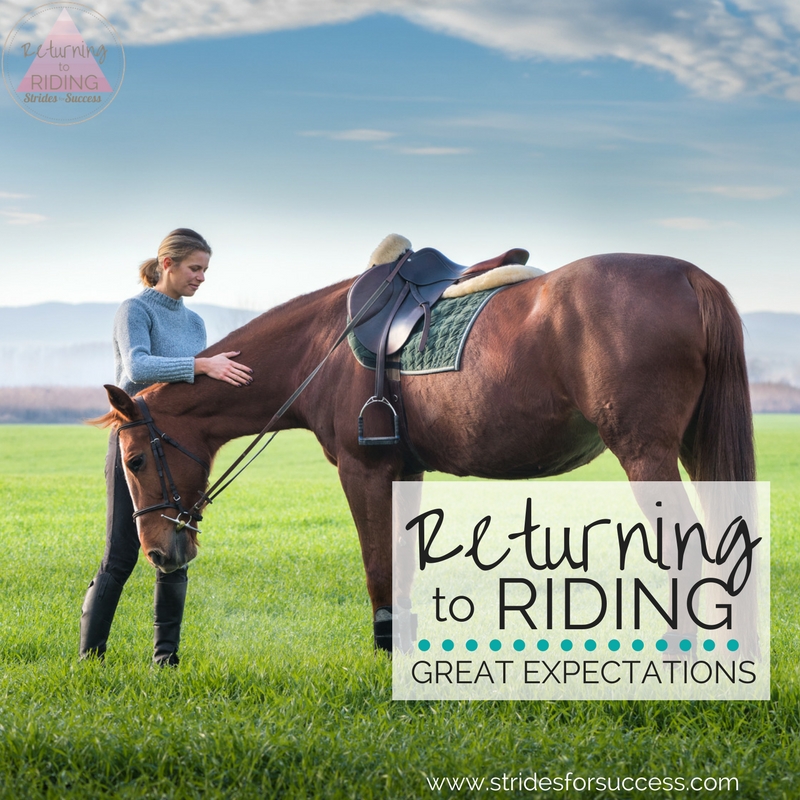
  • Returning to Riding – Great Expectations…

    Returning to Riding – Great Expectations…

    Returning to Riding - Great Expectations

    They say absence makes the heart grow fonder – and riding horses is no exception to this.  Unfortunately, this ‘fondness’ is one of the big reasons many riders, on returning to riding, end up feeling quite underwhelmed very quickly when back in the saddle.

    If you have ever had to take a break from riding, planned or not, you will know all about the whole range of feelings and emotions that surface when the time comes to get back into the saddle…

    Excitement, joy, and sheer unabated happiness tinged with a little anxiety, apprehension and lack of confidence.  The good and the not so good emotions mixing together to result in a high of sorts, which usually begins to dissipate quite quickly when your bum actually touches the saddle.

    Realizing things have changed…

    Why?  Well, because most riders think they can go straight back to the way things were before.  Pick up the reins and just carry on where they left off as though not a day has passed in between.

    They fail to allow for the very real fact that they have changed; physically, mentally, emotionally, as a rider – as a person.

    Seeing the opportunity…

    So, if we cannot ‘go back’ to how things were before, is there any point in continuing on?  And is there any hope of recapturing the initial feelings that caused you to become addicted to riding in the first place?

    Yes of course  there is!  In fact, returning to riding might just be the golden opportunity you need to really make the lasting changes you are after in your riding.

    So we mentioned the whole ‘absence makes the heart grow fonder’, but equally as true is ‘out of sight, out of mind’ – particularly where your body is concerned.

    Returning to Riding - Great Expectations

    Muscle memory and ‘feel’ are very important and necessary tools when it comes to horse riding.  Knowing instinctively what to do, and when, is what we are after when it comes to our skills in the saddle.

    But very often our ‘muscle memory and feel are, well quite frankly, wrong!  We develop bad habits over time.  These habits become ingrained in how we ride, sometimes regardless of what we do to try iron them out.

    However, when you take a break from riding and then return, your body has literally had the ‘out of sight; out of mind’ experience with what you do in the saddle.  

    Unfortunately, many riders focus on the lack of control of their body when back in the saddle; rather than being motivated by the options which have suddenly opened up for them…

    Becoming a better version of before…

    What if those same riders began to see this as their opportunity to restart?  Relearn all the aids.  Become better at knowing what to do and when.  Recommit to learning to ride – and make sure that those old kinks do not appear back in the fabric of their riding.

    Returning to riding is daunting for many riders.  This is often regardless of how long they have been out of the saddle, or the reasons behind their break in the first place.  Nevertheless, rather than becoming frustrated with what you no longer can do, see this as your golden opportunity to iron out any kinks.  Then maybe, just maybe, you will finally become the rider you wanted to be.

    So, should we have ‘great expectations’ when returning to riding?

    Yes, definitely!  Though sometimes a slight shift in those expectations is in order – before we frustrate ourselves trying to be the rider we no longer are.

    Happy Riding

    Lorna

    Returning to Riding

    Are you returning to riding?  Are you feeling a little overwhelmed with it all?  I may just have the thing to help you get back into the saddle – and enjoying yourself there again!

    The Original Returning to Riding Plan is a complete step by step audio program that takes you from ‘not riding’ to regularly riding and enjoying yourself again.  The plan is laid out over 6 weeks, however, you have lifetime access to go over it again and again as you want in the coming weeks, months, and years.

    You can find all the details HERE.  And I wish you all the best in making your ‘Returning to Riding’ as enjoyable and successful as you dreamed it would be :)

  • Rebuilding Your Confidence in the Saddle

    Rebuilding Your Confidence in the Saddle

    Rebuilding Your confidence in the Saddle

    I’m going to just assume that because you are reading this, confidence, or the lack thereof, has become a theme in your riding.  If so, you are in good company.  Unfortunately lost confidence is an all too common issue for a lot of riders. 

    I say ‘lost’ confidence, because there seems to be an extra challenge in losing your confidence, as opposed to not having any to begin with.  Losing your confidence means that at some point you experienced horse riding without anxiety.  You felt the pure pleasure derived from just being in the saddle.  That ‘oneness’ when horse and rider are just moving together in harmony.

    But then ‘that’ happened.  Your ‘that’ will be different from other riders ‘that’.  What is ‘that’?  ‘that’ is the catalyst that changed everything for you.  It might have been a one-time event, such as a fall or bolt.  It may have been something that built slowly, simmered away so to speak, before finally boiling over – and we all know that once it boils over, things are never the same afterward, are they?  Or ‘that’ might just be the story you have been telling yourself, which has somehow become a part of your reality now…

    Regardless of what ‘that’ is for you, the sting in the tail is that you know how good riding can be, how good you can be, if you could only get things back on track.  And it is often that sense of loss that is the most frustrating, maddening and often heartbreaking part of losing your confidence in the saddle.

    However, you CAN get it back.   In fact, you can begin right now – this moment today – turning things around and rebuilding your confidence, inch by inch.

    Will it be easy?  No, probably not, but the fact that you are still reading means that it is important for you.  Important enough to do the work, put a little effort in, and to have all those lovely experiences again when riding your horse.

    What can you control?

    Let’s start by becoming very clear on what you CAN control.  Once you have identified those, you are going to shift your focus to doing just that – controlling what you can, rather than what you can’t.  

    You can control how your body works in the saddle.  Working on your fitness levels, first and foremost.  Know that when you ask your body to do something, it can do it.  Things like applying clear aids, maintaining its own balance, suppleness to move with the energy underneath you when riding…  (You can join the FREE 30 Day Rider Fitness Challenge HERE)

    You can also control your thoughts… Pretty simple when written down, however I know that this is as easy as it sounds. Visualise daily what you want your riding to look and feel like.  

    If you find any anxiety creeping into your ‘daydreams’, simply dismount and get comfortable again.  

    A lot of confidence issues stem from what we ‘think might happen’, so rather focus on what you want to happen.  Consistent purposeful thinking and keeping a journal will definitely help you with making this a habit.  


    Rebuilding Your Confidence in the Saddle

    What do you really want?

    Make sure that what you are trying to do is what you really want to do…  Sometimes a lack of confidence can be traced to an increase in ‘common sense’ that comes with getting older and more mature.  

    Worried about falling off while galloping across country?  Do you really need to gallop across country any more?  Would you not be happy trotting on a trail?  Cantering over a hill?  

    Maybe, maybe not – but either way, make sure that your lack of confidence is not a symptom of growing up and having responsibilities…!

    Do you have the right partner?

    From here, finding the right horse is ESSENTIAL to building your confidence.   If your confidence issues are centered around your own horse, is there another horse you can use for a while?  Perhaps a riding school horse or a lease horse?  

    You need a horse you can trust.  A horse that will pick up the slack when you have moments of doubt, which will inevitably happen.  A horse who will work with you, rather than against you.

    Start small and build a strong foundation

    If you can, start small – really small – with basic groundwork.  This way you can set up your boundaries with the horse while working in a way that you feel in control (there is a 4 part, step-by-step, series on groundwork in Daily Strides Premium if you are interested in this HERE).  

    There are many things such as pressure and release that you can first implement on the ground before transferring over to later in the saddle. I have written a blog post on this topic HERE

    Invest your time in your comfort zone

    From here, I would suggest doing only what you are comfortable with – and finding a sympathetic but confident person to help you get back into the saddle.  This could look like just riding a circuit of a round pen in walk while being led.   Or it might look like sectioning off a 20m x 20m piece of an arena or field.  Whatever allows you feel like you are in control and can cope.

    I think there are certain situations where ‘just do it’ helps, however I have yet to find a rider where this approach yielded long-term results when it comes to rebuilding confidence.  

    Rather stick to what you feel comfortable with, and begin to ‘train’ yourself to ride without any anxiety.  From here, slowly (literally inch by inch) stick your toe out of the comfort zone for short periods, but where you know that you can instantly return to whats comfortable if necessary.

    REBUILDING YOUR CONFIDENCE IN TEH SADDLE

    Give yourself time & the Confidence Collection

    However, if you choose to being rebuilding your confidence, having the right resources there to support you is vital.  Time is one of the most essential factors that is most overlooked.  This WILL take time.  You probably don’t want to hear that, but having realistic expectations is another essential component of this rebuilding process. 

    Another resource you could use is the ‘Confidence Collection’ inside of Daily Strides Premium.  It contains audio programs to listen to either in or out of the saddle that will help you better understand different aspects of riding – and rebuild your confidence, step by step.  You can join Daily Strides Premium HERE

    Whatever you decide to do, please do something.  I wish you nothing but the best going forward from here and getting back in the saddle.  

    Please remember to not rush this process; you are doing this for you.  Take all the time you need to make sure it is an enjoyable experience; that is the reason you want to ride, anxiety free, in the first place.

    Happy riding
    Lorna

    More Training & Support

  • Stability Over Jumps for Rider & Horse

    Stability Over Jumps for Rider & Horse

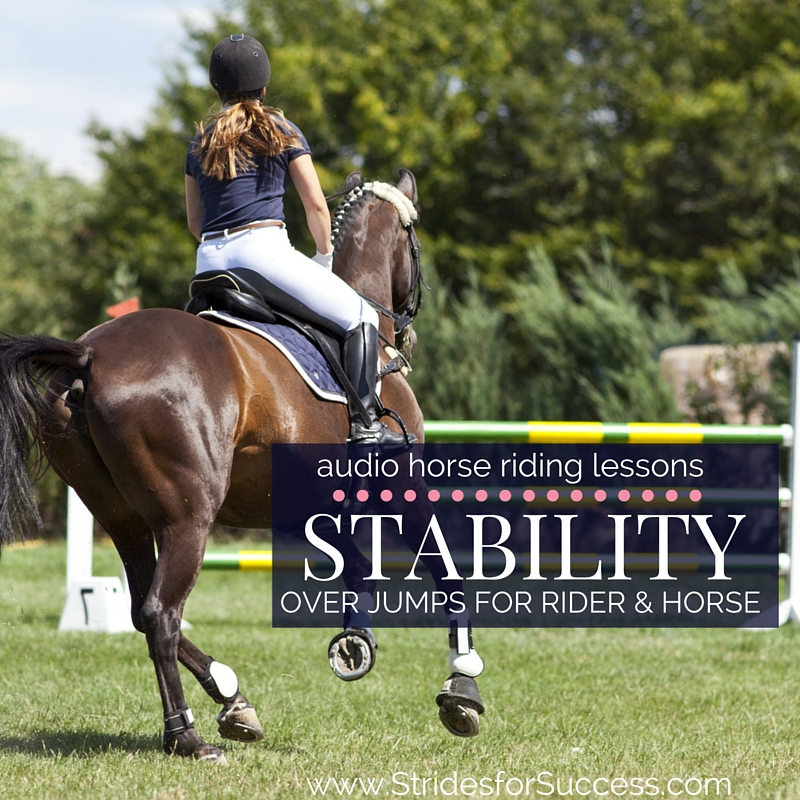
    More stability in the saddle – as riders we are all guilty of being a little like Oliver Twist when it comes to it; we want more, please sir! This is none more true than when it comes to jumping as it is often the activity that makes us feel most unbalanced and ‘wobbly’ in the saddle.

    As riders we want to be as effective as possible in the saddle. We are working towards having aids and general communication that cannot be confused or misunderstood by our horse.

    [smart_track_player url=”https://op3.dev/e/traffic.libsyn.com/dailystridespodcast/691-Improving-Stability-over-Jumps-Rider-and-Horse.mp3″ title=”Increasing Stability over Jumps for Horse and Rider” social_linkedin=”true” social_pinterest=”true” social_email=”true” tweet_text=”Struggling to remain balanced over the fences?! This will help… for horse and rider” hashtag=”Horseriding #jumping #stayingon” twitter_username=”strides_Success” ]

    One of the most rewarding results of developing better stability is that riders find their effectiveness and overall application of their aids increases dramatically.  This is due to  the rider being ‘quieter’, which allows the horse to distinguish better between an actual aid and a random move or shift.

    An easy way to see the benefits of a stable load is to imagine having a schoolbag or backpack strapped over both shoulders; and then going for a jog. If the bag does not fit correctly, perhaps the straps are too loose or there is too much play inside the bag itself, it is going to bounce around quite a bit as you run. This is going to have a direct effect on how you run and also your balance while running. Imagine trying to jump a fence or jump with this same loose, moving backpack – pretty difficult, right?  This is similar to how it feels for your horse when you are unstable or unbalanced in the saddle.

    However, when it comes to riding, there is the added problem of your horse having to try to decipher between your actual aids and your ‘speed wobbles’

    He is also going to become more unbalanced himself, as he struggles to keep both of you upright while working through certain movements while being ridden, regardless of if they include jumps or not.  This is often very obvious through corners and transitions.

    Very often when riders progress plateaus it can be traced back to the rider being less balanced in the saddle than they should. The impact of which, as mentioned, is very often muddled and conflicting aids being given to the horse.

    So it goes without saying that these challenges are compounded where jumping is concerned. It is not unusual to see riders who have a somewhat secure seat when working on the flat experience a major lack of stability when fences are introduced.  All balance and stability is completely undone as soon as a pole or jump is attempted.

    Become familiar with your 2 point seat

    One of the best ways riders can begin to develop more stability in general in the saddle is to work in a correct 2 point seat. It is difficult for many riders initially to hold and ride.

    However, the 2 point seat will allow you to become very secure in the saddle, through literally standing on your own two feet. It requires a secure and correct lower leg in order for it to work; which overtime will strengthen.

    The 2 point seat is also a great way to both see and feel the relationship between different parts of your body. For example, how an open chest can directly influence your backsides position in the saddle. Or how the position of your lower legs will dictate how balanced the rest of the body is while the horse moves underneath.

    Your chest area will basically balance out your backside when in the 2 point seat. If you don’t have the correct ratio of balance between the two, you will lose your balance in the saddle

    Your brain needs time to ‘recalibrate’ the factors needed to keep your body balanced when in the saddle. Riding in the 2 point seat helps this process to happen a little faster; and for the rider to understand the process as well.

    Improving Stability over Jumps for Horse and Rider

    Realising ‘Cause and Effect’ is Happening

    When we are jumping we need to be in complete control of our body, so we do not feel like the loose backpack to our horse. A lot of riders make the mistake of relying on the horse for balance over the fences.  They will lean on the horse’s neck or ‘hunker down’ into the saddle, which will inevitably hinder how the horse can use himself over the jump.

    Of course, the added problem with using the horse for balance is if the horse stumbles, runs out or perhaps has a refusal at the fence. The rider is completely ineffective to help; and often ends up on the ground because their balancing aid – the horse – suddenly stops working!

    Developing a secure lower leg is key to beginning to take responsibility for your own stability and balance when riding your horse. The 2 point seat, and the ‘burn’ that often accompanies it, is a fantastic way of working this part of your body in the saddle.

    Knowing how to adapt the use and position of your lower leg when in the saddle, will directly affect what happens to the rest of your body in the saddle.

    The difference between ‘secure’ and ‘fixed’

    When initially beginning to work on this particular aspect of riding, many riders mistakenly try to ‘fix’ themselves in the saddle. They become rigid and stiff. This, unfortunately, will result in a marked decrease in their overall stability and balance.

    You definitely don’t want your leg doing the ‘hokey pokey’ when you are riding – but fixing your leg in one place will not work either.

    You need to rather focus on suppleness through your body and leg. When you are supple in the saddle, you will be able to move with your horse, all the while remaining in the best possible position for your body to make the micro adjustments needed to stabilise and balance you in the saddle.

    You need to allow and move with your horse, rather than fix and bump against your horses motion

    This suppleness comes from your joints; ankles, knees and hips. Working in the 2 point seat will help you notice and then begin to use your joints to stabilise your position and body in the saddle as your horse moves underneath you.

    I think it is also worth mentioning at this point that your contact is important when working in the 2 point seat. Many riders seem to think that the 2 point seat is rather a jumping position on the flat. It is not!

    Your contact will remain consistent with your horse throughout your 2 point seat, which will allow you to, again, effectively communicate with your horse while you ride

    Once you have begun to master the 2 point seat on the flat, through walk trot and then canter, you can begin adding some ground poles to your exercises.

    Becoming more secure on the flat is the key to being able to move with your horse in a balanced way, rather than relying on, your horse over fences. The ground poles will allow you to work up to some jumps later; but I strongly suggest waiting to move forward with your training when you have mastered this on the flat initially.

    Happy riding
    Lorna

    This podcast episode is the first in a series of 5 on the topic, available for you inside of Daily Strides Premium. The remaining 4 lessons will take you step by step through different exercises that will help you become more secure and balanced in the saddle.

    Those audio programs can be downloaded onto your phone and then listened to as you ride your horse. They are filled with reminders on what to do, step by step instructions on how to do it – can have the added bonus of being replayed over and over again! You can find out more about Daily Strides Premium by visiting www.stridesforsuccess.com/join/.

    [wp-tiles post_type=”post” orderby=”date” order=”DESC” grids=”Simple”]

  • Communicate with Your Horse Through Groundwork – Part 2 Pressure & Release

    Communicate with Your Horse Through Groundwork – Part 2 Pressure & Release

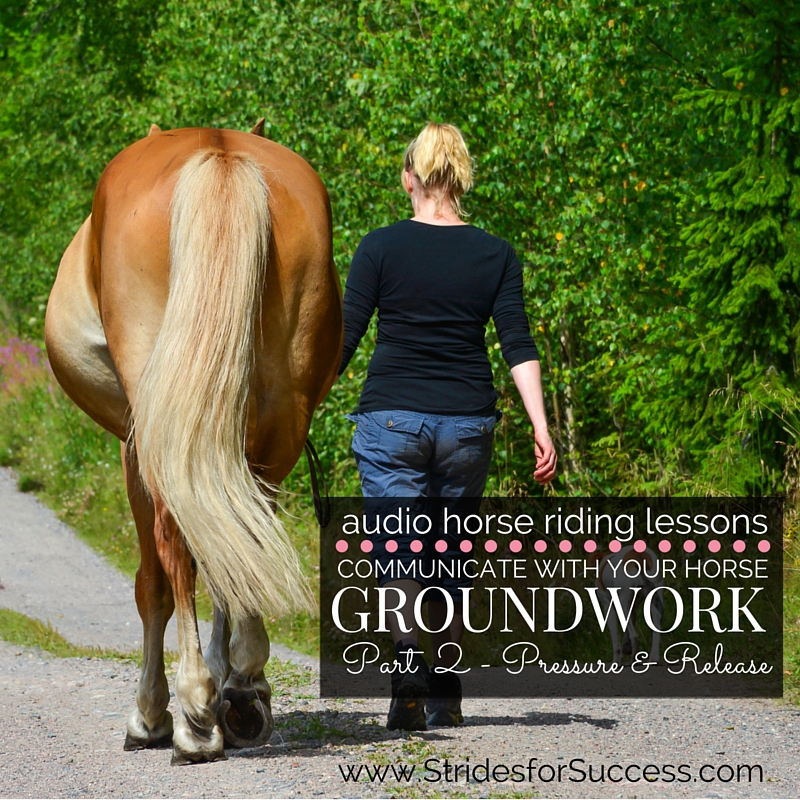
    Groundwork, when referring to horses, simply means working with your horse from the ground in order to train and increase communication skills.  In this blog post we are going to focus on ‘Pressure and Release’ and how you can begin to correctly and fully understand the concept in order to further your horse’s training from the ground.

    This is part 2 of a full series dedicated to Groundwork from Strides for Success. Part 1 which explains the basics and then moves into specifically dealing with ‘Touch’ can be found HERE >>

    [smart_track_player url=”https://op3.dev/e/traffic.libsyn.com/dailystridespodcast/671-Using-Groundwork-when-Training-Your-Horse-Part-2-Pressure-and-Release.mp3″ title=”Groundwork Part 2 – Pressure and Release” social_linkedin=”true” social_pinterest=”true” social_email=”true” tweet_text=”Groundwork and how it can help you teach your horse about pressure and release” hashtag=”horse #horseriding” twitter_username=”strides_success” ]

    When we are in the saddle, most riders and trainers will use the concept of pressure and release to communicate with the horse, from the saddle, what they want the horse to do.  Pressure and release is viewed as ‘negative reinforcement’ in that when you apply the pressure, you are placing the horse in a somewhat uncomfortable situation.  However as soon as the horse makes a move towards the direction you desire, you reward him by removing the discomfort; or pressure.  This is the release part of the work.

    What is important to note however is the word ‘discomfort’ and how we view applying this to the horse in any given situation.  I personally do not believe that the level of pressure being applied must be painful for the horse.  Think of discomfort as being literally a hoof step out of the horse’s current ‘comfort zone’.  By gradually, over time, increasing the comfort zone, you can train your horse using the pressure and release concept, without ever raising their anxiety levels.

    Raising your horse’s anxiety levels, regardless of the situation, rarely will produce a positive outcome.  I have found that the pressure works best when it asks the horse to think a little differently and when it is applied by a person they have learned to trust.  If you apply pressure to the point where it causes pain, that trust will be eroded – and we all know how difficult it is to rebuild trust when broken.

    This brings us to the other all important aspects that makes the ‘pressure and release’ way of training work; timing and amounts of pressure applied.  Having worked with riders who are literally just beginning their journey into the world of horses, these are often the most difficult parts of teaching this way of working with horses.

    The challenge seems to lie in the fact that every situation is different, regardless of the horse or the circumstances.  Factors such as the weather, the time of day or even just how the sun is creating shadows  can lead to having to adjust the approach and the technique used.  It is learning how to assess this and then proceed confidently that trips many riders up

    I used the word confidently there on purpose; another factor that dictates a successful outcome when using the pressure and release system when training is the mindset of the rider, both before, during and after the groundwork or riding session with the horse.   If you want your horse to become comfortable ‘stretching’ his comfort zone, you must be comfortable and certain of how you ask and the consequences of asking that question.

    Any hesitation on your part will be seen as uncertainty to the horse, and quite frankly, would you trust someone who seemed a little ‘iffy’ about something?  I didn’t think so!  Therefore, don’t expect the horse to do so either.

    Groundwork Part 2 - Pressure and Release

    So taking all this into account, how can you being incorporating pressure and release into your groundwork sessions in a way that will positively benefit your horse later when under the saddle?

    Start slowly and have a plan for every action you take with your horse.  It sounds pretty simple, but you would be surprised how many riders launch into something with no idea of just how they want the outcome to look like or feel like…  Let’s take something simple like asking your horse to move over in the stable.  Firstly, do you want him to ‘pivot’ around his front end, or are you asking him to move his entire body over?  Secondly, how far over are you wanting him to move?  And finally, are you confident enough to remain in charge, even if things don’t go quite as planned?

    Now, bear in mind that the more you work with your horse, the more this will just become second nature; I rarely have to consciously ask myself these questions as I do this daily with horses.  But if it is either you or your horses first time, very often becoming clear on the desired outcome before you begin is the vital key to your success.

    So, assuming that you have indeed thought about all the above, you can begin to position yourself in the best possible place to make this happen.  Remain calm and confident as you move around your horse and realise that once you have committed, you will most likely have to remain in this ‘moment’ until he makes even the slightest move in the direction you desire.   I find that placing your hand on his body where your leg will be later if you were to ask a similar movement when riding is the best way to approach this.  However, you can also work with your horse moving away from the pressure regardless of where your hand is placed; hindquarters etc.

    The next consideration on your part is the amount of pressure applied.  This varies depending on so many factors; the horse itself, the area you are touching, the type of touch etc.  Start off with the smallest amount of pressure possible and then gradually build the amount you are exerting until your horse begins to respond.

    The response of the horse will dictate the ‘timing’ factor I spoke of earlier.  It is vitally important that in order for this to work, you must reward the horse for the slightest move towards what you are desiring.  The reward is the release of the pressure.  Now, depending on the horse and, again, the circumstances, you can release the pressure slightly and then increase again if you want him to move further over.  Or you can release the pressure all together however I personally don’t suggest taking your hand away as this will rather train the horse to ‘run away’ from pressure, rather than react to it.

    You can also verbally reward your horse, something I highly recommend incorporating into your everyday interactions with your horse.  I personally use a higher pitched tone when communicating a ‘reward’ to my horses, this way they understand what they did was correct and it is something that can later be transferred over to their training when being ridden under saddle.

    What you will find, if done correctly, is that when you consistently take the same approach each and every time, the amount of pressure you will have to use to enact the desired response will lessen.  This is what many riders call ‘lightness’, whether it be on the ground or in the saddle.

    The pressure and release training methods can be used in many different ways when working with your horse.  From asking them to move over in the stable, to asking them to walk forward.  It is one of the most successful ways of training horses when being ridden and it can even be used, without touching the horse at all.  This happens when you replace physical pressure with a more subtle ‘body language’ pressure.

    Regardless of how it is used, the concepts of understand what you want, noticing the amount of pressure, timing the pressure and the release and then being consistent and confident throughout is vital to this working with your horse.

    Happy Riding

    Lorna

    This is the first of a five audio programs, taking you step by step through applying these principles with your horse.  The other four programs can be downloaded to your phone and then listened to as you work with your horse, helping to ensure your success when applying this method of training.  You can visit www.stridesforsuccess.com/join/ for more details.

    As mentioned above, this is the second in a series of trainings on how to correctly apply groundwork techniques when working and training your horse.  The first in the series – Touch – and all following sections of this topic are all included inside of Daily Strides Premium.  If you would like to find out more about how you can access over 600 audio horse riding lessons, including the groundwork lessons, you can visit www.stridesforsuccess.com/join/

  • Improving Rider Coordination

    Improving Rider Coordination

    Coordination; It’s always a wonderful feeling when you can do something effectively without having to put too much thought or effort into it. Being able to cultivate this skill, regardless of what is being done, takes a large number of hours invested in practice. However in order for that practice to be beneficial, it must be correct or perfect practice.

    This is the one element that trips many riders up when it comes to having more coordination in the saddle. Hours are spent moving through particular school shapes, years dedicated to specific movements; however unless the practice is correct and performed in the correct sequence, the benefits will be slow to appear – assuming they ever do.

    [fusebox_track_player url=”https://op3.dev/e/traffic.libsyn.com/dailystridespodcast/666-Improving-Rider-Coordination.mp3″ title=”Improving Rider Coordination” social_linkedin=”true” social_pinterest=”true” social_email=”true” ]

    Watching a rider who is coordinated riding side by side with one who is not is like watching a chicken trying to keep up with an eagle in the flight department! It is one of the most decisive factors in the outcome of each ride and quite unique in that each rider’s coordination, whether it be good or bad, has very little to do with the horse underneath the saddle.

    You know that as a rider, being able to communicate with your horse about what you would like him to do requires you to apply a particular set of aids, in a specific sequence. In fact, many different movements or directions we give to our horses have similar, if not the same aids, but it is how and when they are applied that make the difference.

    Improved rider coordination makes the communication between horse and rider more fluent, more subtle and more effective

    For those with a lack of coordination, each movement must first be thought out in their head – a list of sorts created out of the aids that must be applied to achieve that particular goal. But having to think things through, step by step, almost ensures that the subtleties which make all the difference, go unused and forgotten. Things like the amount of pressure applied, or how long an aid is held, or making quick adjustments to timing, sequence, and pressure as necessary.

    Essentially, being coordinated in the saddle means that you can perform the ‘sequence’ of aids without having to consciously think about it; leaving you open to rather focus on the more subtle aspects of your aids and course correcting as the movement progresses

    So how can we be sure that our practice is indeed helping to improve our coordination in the saddle?  Let’s focus on the idea of perfect practice. I see a lot of riders in the saddle who are happy with mediocre ways of doing things, particularly the basics. I think that riding must be fun and enjoyable, but a large part of that enjoyment is getting the basics right from the start. There are times with riders when I feel that they are really and truly just wasting time, money, and energy because they do not see the importance of creating a strong and solid foundation from where they can then grow their skills.

    Things like how you are sitting in the saddle. How you use your core to communicate with your horse – from the first time in the saddle. Where your leg is in relation to your body. Carrying your hands. Opening up your chest as you ride. As an instructor, there is nothing as frustrating as having to repeat the same thing to a rider, week in and week out.

    What is most ironic is that those same riders, who won’t take responsibility for their own body in the saddle are very often the ones who are very quick to blame the horse or circumstance for their lack of progress

    Becoming responsible for your body and how it moves in the saddle is something you can begin doing today. Is there one thing that you consistently do that you can start working with right now? For me, it was a tendency to allow my left hand to ‘turn’. My right hand remained where it should be, but my left hand… Knuckles on top and, if left to its own devices, it would dip an inch or three lower than its partner. It was something that, once it was pointed out to me, I became so aware of every time I was in the saddle. I would set myself a goal in each training session; not have my trainer mention my wayward left hand once in the time we were together. Initially, I had to continuously ‘check’ myself; I created little markers around the arena where a mental alarm bell went off to ‘fix my left hand’. It was exhausting, but it worked – In fact to this day I subconsciously correct my left hand when riding; without ever having to remind myself to do so.

    Improving Rider Coordination

    The challenge for many riders is that they are not willing to make correcting one thing a habit to begin with. But becoming almost obsessed with the most basic of your riding faults and committing to ‘fixing’ it before even thinking about moving on to the next one is the most effective way to make your practice as perfect as it can be. One of the other benefits of doing this is that once that basic building block is in place, a lot of other issues you thought you had will vanish. Many riding faults are merely symptoms of a larger, and more basic, fault to begin with.

    Putting that fault on ‘autopilot’, so to speak, frees your thinking brain up so you can begin focusing on the more intricate and subtle aspects of communicating with your horse when in the saddle

    Create small checkpoints around the arena to remind yourself to ‘fix’ that fault. In doing so, you are building systems within your own schooling sessions, regardless of if you have a trainer with you or not, to help make your practice become better and better each time.

    Another way to improve your coordination in the saddle is by physically improving your body and how it can handle itself. It always amazes me how riders will spend weeks, months and years planning their horses fitness program – while never giving a single thought to their own physical performance in the saddle

    Having taken some longer breaks from riding at different times over the years, I can tell you from first-hand experience that very often when I get back into the saddle often feels like my brain and body and speaking a different language! My brain knows what to do and how to achieve a particular outcome, but my body just physically can’t / won’t respond in order to carry the aids out. It is the most frustrating thing about being out of the saddle for any sort of period of time; in fact at 6 months pregnant right now, I am wondering if my body will ever feel like it used to again!

    I see a similar situation with riders who only get into the saddle once a week. We spend the first half of our time together ‘re-tuning’ their aids and coordination in order for them to be able to really begin riding. However there is a way to mitigate this; whether it be a prolonged break from riding like myself, or longer periods between less frequent rides like some of my students – exercise.

    Fitness and exercise are like everything else, you get out what you put in. The quality of the movements and how well they translate across to your riding is what matters.  For more information on how to become a better version of you in the saddle, you can visit https://equestrianfitnesschallenge.com.

    This topic is fleshed out into individual exercises for you to ride that will begin today helping you to improve your coordination when in the saddle.  There are 4 additional audio programs for you to download and listen to on your phone that will take you to step by step through putting those basic ‘fixes’ on autopilot, allowing you to free up your thinking brain for the more complex parts of riding a horse!

    If you are interested in getting this full week of audio programs, as well as access to over 600 other audio programs that will take you step by step through different topics about horse riding, visit www.stridesforsuccess.com/join/ to find out more.

    Happy Riding
    Lorna