Tag: confidence

  • Why Your Position while Lunging is Everything

    Why Your Position while Lunging is Everything

    Why Your Position while Lunging is Everything

    What this episode is all about & how it can help you:-

    • Understand the relationship between your position on the ground & in the saddle
    • Identify the difference between ‘Neutral’, ‘Driving’ and ‘Resisting’
    • Know when to move into the ‘driving’ position
    • Know when to move into the ‘resisting’ position

    [smart_track_player url=”https://op3.dev/e/traffic.libsyn.com/dailystridespodcast/1073-Why-Your-Position-in-Lunging-is-Everything.mp3″ title=”Why Your Position while Lunging will Determine how Successful You Are” social_linkedin=”true” social_pinterest=”true” social_email=”true” tweet_text=”Where are you standing when you lunge? Is it affecting how well your horse is going? Daily Strides Podcast episode” hashtag=”horseriding” twitter_username=”strides_success” ]

    Lunging is one of the more popular ways of working horses, especially when time and daylight are in short supply!  It is a fantastic way of maintaining fitness and even moving your horses training forward. I highly recommend it to all riders and their horses. 

    In this episode of the Daily Strides Podcast we are chatting about one of the biggest mistakes riders make when they are working their horse on the lunge.  Namely, not paying enough attention to where they are positioned in relation to their horse as they lunge.

    Your position when lunging is as important as your position when riding.  When riding, a good position means that you can more effectively communicate with your horse.  It is the same when you lunge.  

    What is Your Position when You Lunge?

    I want you to imagine you are lunging your horse right now.  There will obviously be a circle, which is the track your horse will work on while lunging.  You are in the centre of that circle (although when you lunge you are not actually stationary, but rather working on a ‘smaller’ circle within your horses ‘larger’ circle).

    Imagine this circle as being a pizza or a pie.  You and your horse are a ‘slice’ of this pizza or pie. You in the centre, your horse at the edge.  Your lunge line creates one side of your slice and your lunging whip creates the other side of the slice. 

    Your position is where you are standing in relation to your horse at any given time.  Keep in mind that when you lunge, both you and your horse are moving.

    One of your biggest responsibilities as the ‘lunger’ is to be in the correct position so that you can be most effective with your aids.

    Your Position on the Ground and In the Saddle

    When you are in the saddle, your seat is one of the most important elements of your position.  If you are tipped too far forwards, you will ‘pinch’ or block the horse’s energy going forwards.  If you are leaning too far back, it can have a similar effect – or it can drive your horse forwards.

    Your position on the ground while lunging is as important as your seats position in the saddle when you ride.  It is the foundation for the rest of your position and therefore how effectively you can use your aids to communicate.

    When your position in the saddle is less than ideal, your communication with your horse becomes mumbled and, well, less than clear.  Your lunging position has the same impact.

    If you are too far behind or too far ahead of your horse while lunging, it will impact your horses way of going.  If you are too tired to ‘keep up’ with your horse while lunging and rather just allow your horse to run circles, that will also negatively impact your horses way of going.

    Just like when riding, mindfulness over how you are using your position will begin allowing you to refine it and improve it as a positive aid when working with your horse. 

    Neutral, Driving or Resisting

    Becoming mindful of your position while lunging will mean understanding how your body language and position influences your horse.  Are you in neutral, are you driving your horse forwards or are you using your position to create a little resistance to your horse going forwards?

    Your seat can influence your horses way of going and over time will become one of your most influential aid in the saddle.  Your basic position in relation to your horse when lunging can have the same impact on the ground.

    Finding Your ‘Neutral’ when Lunging

    Neutral will be the place you will find yourself in most of the time when you are lunging.  It is the place where you can be ‘quiet’ with your aids and allow your horse to figure things out for himself. Neutral is the easiest place for you to take action if and when needed.

    Think of your seat when it is in ‘neutral’ when riding.  You are not driving, you are not resisting.  You are moving with the horse.  Neutral while on the ground lunging is the same.  You’re not driving, nor are you resisting.  You are simply moving ‘with’ your horse.

    The easiest way to find ‘neutral’ is to position yourself opposite where you would sit when in the saddle.  Too far forward and you will be opposite the horses shoulder or elbow.  Too far back and you will be opposite the flank or hind quarters.

    Think about where your seat would communicate with your horse, and try to place yourself directly opposite there while moving with your horse on the circle. 

    The Balance of Aids while Lunging

    From this ‘neutral’ you can move either way.  You can drive or resist.  Remember, even though you are on the ground, lunging requires you to balance your aids continuously while in the saddle.

    Yes, your aids are slightly different.  You are substituting your legs for a lunge whip and your hands for a lunge line.  However, the combined effect will be the same.

    When riding your seat is not the only aid you communicate with from the saddle.  When lunging your position is not the only aid you will use with your horse.

    Like riding, in order for your other aids to be effective, your basic position must first be balanced and correct.  This is neutral on the lunge. 

    Also, just like riding, there are times in riding when you will have to ask for ‘more’ or drive your horse forwards a little more.  There are also times when you will have to resist or ‘block’ your horse from going forwards.  Changing your basic position in relation to your horse can help you do either, as necessary, when lunging.

    Understanding Your ‘Driving’ Position

    A driving position is often necessary when your ‘neutral’ position is no longer effective in actively encouraging your horse to move forwards.  You may have already used your lunging whip to also encourage (not hit or whip the horse, just suggest) him, just like you would use your legs in the saddle.  However, you find that your horse is still not actively going forward in the way you want.

    Remember that lunging, just like riding, requires your horse to move and think ‘forward’ at all times.  It is essential to make progress in your training.

    By positioning yourself to being opposite the flank or hind quarters, you are now allowing the horse to move ahead of you a little.  This is due to you now being more ‘behind’ the horse and, therefore, able to encourage him forward more effectively.

    You can then use your other aids, from this ‘driving position’ to encourage your horse more forwards. An effective aid can be your body language itself when you take a purposeful step towards your horse.  Or your voice to either encourage him on, or to help set the tempo for the gait.  Your whip can be used in a ‘swishing’ way on the ground to ask him to ‘push’ a little more from behind.

    Your aids applied from this different position will have a different effect than if applied from neutral. They will have a more ‘driving’ and ‘forward’ effect. 

    Understanding Your Resisting Position

    Equally as important is your ability to ‘steady’ or resist your horse going forwards some times.  I find that this ‘resisting’ position is especially important when working with young or inexperienced horses on the lunge.

    The resisting position involves you getting a little ‘ahead’ of your neutral position.  Being opposite your horses shoulder, rather than back where you would sit when in the saddle. 

    Your resisting position is a way you can ‘slow’ your horse down or actually have him halt, without turning into you and the centre of your circle.

    Why I Suggest Not Allowing Your Horse to Turn In on the Circle

    One of the biggest mistakes I see riders make when lunging is allowing their horse to turn in and face them, shoulders squared to the riders shoulders, on the circle.  It seems harmless enough, however it actually really impact the quality of work you can potentially achieve with your horse while lunging.

    Transitions are important when schooling horses. Lunging is no different. In order to really ‘work’ your horse on the lunge, transitions between trot, walk and halt are essential.

    If you allow your horse to turn in and face you every time he transitions into walk or halt, you are breaking the concentration and the ‘contact’ of the work you are doing. You are literally undoing everything that has led up to that point on the lunge!

    Using Your Resisting Position to Positively Impact Your Lunging

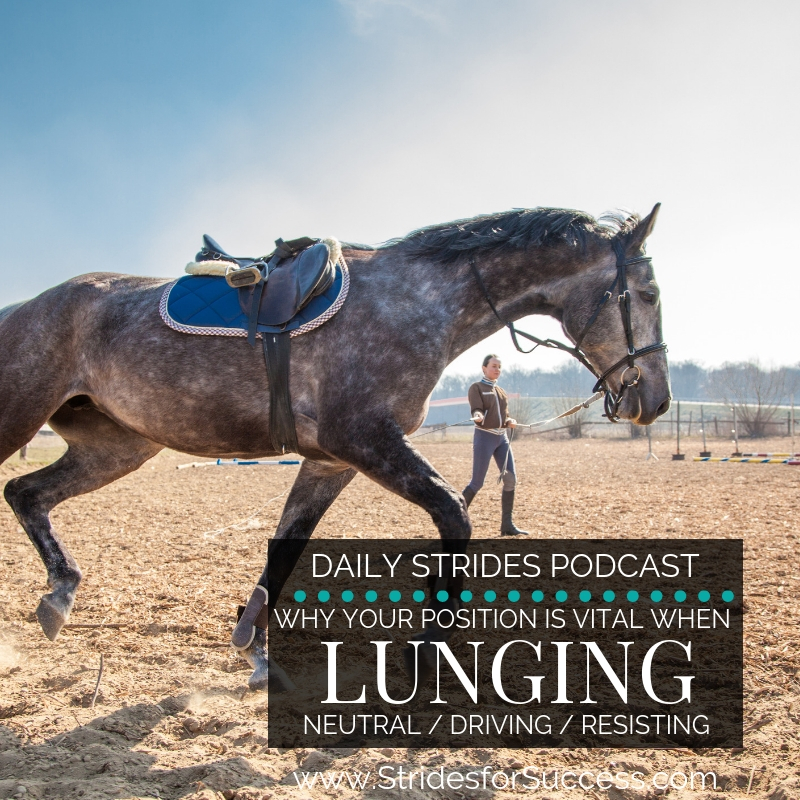
    Along with being opposite the horses shoulder, you can also turn your ‘flank’ to your horse.  Turn your side to your horse, your leading shoulder.  You can also take a few steps ‘backwards’ to keep up with the horse.

    If your horse is not slowing down or stopping, whatever you want him to do, you can take this further by using your ‘resisting position’ to walk your horse into the fence around your lunging area.

    By using the fence to stop or slow your horse, he will still technically remain on the circle, not turned in and facing you.  Meaning you can resume the ‘work’ without any break in contact or concentration. 

    Obviously, with all things related to horses, repetition and consistency are the keys to making this work for you.  However, over time when you learn how much pressure to apply with your ‘resisting position’, it will become a handy aid you can turn to while lunging your horse.

    If you are struggling with lunging and would like some simple step-by-step instructions to help get you and your horse off to a good start, make sure you sign up for the “3 Days to Successful Lunging” Guided Audio Training. It is completely free and will have you on the lunge and working with your horse today.

    Happy Riding
    Lorna

    Links mentioned in the episode:-


  • What are ‘The Basics’ When It Comes to Riding?

    What are ‘The Basics’ When It Comes to Riding?

    What are the Basics when it Comes to Riding

    What this episode is all about & how it can help you:-

    • Understanding the conversation is always happening
    • Your position
    • Your Aids
    • Understanding how your horse ‘goes’

    [smart_track_player url=”https://op3.dev/e/traffic.libsyn.com/dailystridespodcast/1067-What-Are-‘the-Basics’-When-it-Comes-to-Riding.mp3″ title=”What Are The Basics When it Comes to Riding” social_linkedin=”true” social_pinterest=”true” social_email=”true” tweet_text=”Feeling overwhelmed trying to figure out the basics in riding? This episode of the Daily Strides Podcast will help…” hashtag=”podcast #equestrian” twitter_username=”strides_success” ]

    The ‘basics in riding’… It sounds like a bit of a list for riders to master before they move on.  And I suppose in a way, they are.  Like most things, there are a few foundational pieces that, once you understand how they work, can be used to create a foundation for you & your horse going forward.

    CLICK HERE to register for the free online live training on

    In this episode of the Daily Strides Podcast we will chat about 4 of those ‘basics’ and also, where you will transition to after the basics have truly been mastered.

    Understand that the Conversation is Always Happening

    The first thing to remember is that the conversation is always happening. Always.  It is on-going and not only when you are in the saddle. As the ‘Team Leader’, you need to set the tone of the conversation.

    The conversation starts when you and your horse first begin interacting.  When you are aware of the others presence. 

    You build on the conversation all the time. Each day you build on the conversation you had the previous day.

    Many riders make the mistake of thinking that the only time they are communicating with their horse is when they mindfully ride an active aid.   However, for most novice riders, they are talking all the time to their horse.

    The constant shifts and movements in the saddle unintentionally adding to (and confusing) the overall conversation between horse & rider.

    Ask yourself, ‘How am I leading this conversation?’, and ‘How am I contributing to this conversation?’.  The answers to these questions are something you can continually try to improve.

    Your Position

    If you have ever had a formal horse riding lesson, this is something your trainer or instructor probably devoted quite a bit of time to.  And for good reason.  Your position is a vitally important part of the basics.

    A correct, supple and strong position puts you in the best possible place to have the most impact when you do activate your aids.  You are in the right place at the right time. 

    You are not having to readjust all the time and you are not giving muffled instructions to your horse. It means that things are clearer from you, and your horse has a better chance of understanding.

    Of course, another big advantage of having the correct position is that there is a better chance of you staying in the saddle!

    A correct position results in a balanced rider.  A balanced rider relies on their own body to balance themselves, rather than relying on the horse, the stirrups or the reins.

    One of the easiest ways to check your position is to make sure ‘the lines’ are present.  Head, shoulder, hip and heel is the first line. Elbow, hand, through the rein to your horses mouth is the second line.

    Get those two lines right all the time, and you will have a much better chance of sitting pretty in the saddle.  You will also be far more successful in your overall communication with your horse. 

    Your Aids

    An obvious but oh so important part of the overall conversation you are having with your horse.  The problem occurs when you are ‘going through the motions’ with your aids, but failing to truly understand your aids.

    One of the issues I see come up a lot is active versus passive.  There is a lot of confusion surrounding an engaged and active aid versus a disengaged aid.  A good example of this is the leg aids and ‘taking the leg off’.

    It is really important that you understand your aids and how those aids work when asking your horse a question.   A good example is the transition to canter.  You probably have been told to put your outside leg back – but do you really know why you are doing that?

    Begin trying to understand why you are doing what you are doing.  This way, you can begin to ‘weave’ aids together depending on the different situations you find yourself in.

    The Basics also Include the Balance of Aids

    Aids are not static.  They are consistently evolving and changing.  This is the balance of aids. How they change is in the proportion that you are using them with each other in different circumstances.  The pressure will also vary as well as the sequence.

    In order to truly begin improving the overall conversation between you & your horse, you need to understand why a particular aid is being used in a particular way. It is knowing how that aid influences the horse that allows you to become more effective & of greater influence in the saddle.

    As I mentioned, the aids are constantly evolving and part of that is then taking the next step.  Focusing on the timing of a particular aid.  Asking a question at the right time, allows your horse to respond in a timely manner.  It allows the smooth grace of the ride to continue.

    You can use your aids in different sequences.  They can be grouped together differently to mean different things. Once you have mastered the basics aids, you can then begin refining things further.  Making adjustments within the gait itself or even within the stride itself.

    Understanding How Your Horse ‘Goes’

    “Goes”…  It is a fairly basic word in and of itself, isn’t it?!  However so many riders I meet just fail to really and truly understand how their horse is moving underneath them.  I feel that it is important to understand how your horse goes, and not just in the basic walk, trot, canter and, if you’re brave, gallop.

    It means understanding how he moves his body. What it looks and feels like when he is moving correctly and how he is moving it when things are less than what we want them to be.

    It is begin able to see and feel the differences between the version we don’t want and the version that we do.

    For example would you notice if he began lifting his legs higher during each stride.  Would you feel the extra flexion, energy and suppleness through his joints and, consequently, throughout his whole body?

    Knowing how he is ‘going’ means that you understand how he is achieving a certain way of moving – so you can influence him in repeating it. 

    Building a Correct Foundation of Knowledge

    One of the bane of many trainers and horses lives is the ‘quick fix’!   So many riders try to find a quick fix to issues that they don’t really understand to begin with.  Going on the bit by sawing his mouth. Or putting him in a frame using a gadget to hold him there.

    It is so much better to begin figuring out what is causing the horse to do whatever he is doing that you are having an issue with.  The ‘undesirable’ action.

    It is also worth noting there that, a lot of the times if you don’t fully understand ‘why’ he is or is not doing something, you are probably a large contributing factor to that something!

    As a rider, you need to understand the mechanics of each situation.  If your horse needs to move a certain way, you will then begin to see how you can either assist him or hinder him with how you try to influence him.

    Identifying Your ‘Basics’ that Need Attention

    It can feel a little overwhelming initially trying to figure it all out.  Go easy on yourself and start at the beginning with your seat, your position & your aids.

    To summarise, remember that the conversation is always ongoing, both on the ground and in the saddle. It is constant and does not stop.

    A good position is very important because it leads to more effective aids. Understanding your aids and noticing how your horse is responding to them. If he is not responding you need to know how to tweak your aids.

    Finally you need to understand the mechanics of how your horse works.  Moving from being a passenger to being a team leader for your horse means that you begin influencing.  Knowing what is going on underneath you will allow you to begin positively influence the horse by what you are doing in the saddle.

    Happy Riding

    Lorna

    If you are feeling a little overwhelmed and find that you are stuck in your progress, I would love you to join me on a free online live training called ‘The 6 Basics to Focus On when Riding”.

    CLICK HERE to register for the free online live training on

    Links mentioned in the episode:-

  • Riding a Horse Who ‘Won’t Listen’

    Riding a Horse Who ‘Won’t Listen’

    Riding a Horse who 'Won't Listen'

    This episode will explain how:-

    • Looks can be deceiving this type of a horse
    • And why I suggest bringing the whole conversation back to basics
    • To create a channel for the ‘forwardness’
    • You can identify any ‘weak spots’ in your channel

    [smart_track_player url=”https://op3.dev/e/traffic.libsyn.com/dailystridespodcast/1061-Dealing-with-the-Horse-Who-Won’t-Listen.mp3″ title=”Riding a Horse Who ‘Won’t Listen’” social_linkedin=”true” social_pinterest=”true” social_email=”true” tweet_text=”Are you having trouble getting your horse to listen to you? This episode of the Daily Strides Podcast can help…” hashtag=”Podcast #Equestrian” twitter_username=”strides_success” ]

    We all know one… The horse who makes you question everything about your riding abilities and knowledge.  The horse who, when you get on, just seems to invite you to ride as though you began yesterday!

    It can be such a frustrating place to be for any riders trying to improve themselves.  It can cause a confidence crises.  However, rather than just giving up and accepting it, I want to give you a few ideas on how to begin making this more positive.  Positive for you and positive for the horse as well.  

    This episode of the Daily Strides Podcast is about how you can begin reframing the conversation with this horse, so you can both walk away feeling good afterwards.

    Looks Can Be Deceiving with a Horse who ‘Won’t Listen’…

    If you are currently working with a horse like this, you might feel even worse because of how the horse ‘seems’ to be.  He is calm. People might even comment that he is ‘easy’.  This of course only adds to your frustration, and negative self talk, because you know first hand that he is anything but!

    Very often a horse who is ‘easy and safe’ can be a huge struggle to get going forward.  And if, by some miracle, you get them going forward it is exhausting to keep them going!

    You might notice how issues that you corrected years ago, or lessons ago, in your riding are now all of a sudden cropping up again.  Things which you thought were put on that all important ‘autopilot’ have, as if by magic, been brought back into play.

    This of course only compounds the whole problem.  Now, you have to deal with ‘fixing’ yourself, as well as dealing with the horse who ‘won’t listen’.

    Often, because your position or basics have reverted to an earlier version, you end up not even asking the correct question any more!  All of this gives your horse a great excuse to ignore you further…

    This is where I am going to suggest you stop what you are doing, and bring everything back to the absolute basics.

    Bringing the Conversation Back to the Basics

    In my experience, usually the big missing piece in this sort of situation is forwardness.  I think that if you can focus on just that one thing initially, it can have the power to change everything else.

    Work on consistent forwardness in the walk and trot.  Don’t worry about the canter right now.  If you can lay down a few ‘rules’ in the slower gaits, they will carry over to everything else. 

    Another reason I suggest leaving canter out of your schooling initially is due to it being a big contributing factor to this issue.  Have you noticed that the trot to canter transition is often the one that causes everything to come apart at the seams?!

    Forwardness is Both Physical and Mental

    You and your horse must ‘think’ forward as well as ‘go’ forward.  If the mental forwardness is missing, there will be no consistency in the ride later. 

    When a horse is thinking forward, he is open to listening to what you are saying.  He is actively part of the conversation that is happening between both of you.  A lack of forwardness can often be the physical manifestation of a lack of basic respect.  He literally ‘won’t listen’ to you.

    There are some links to past episodes and blog posts that deal with this problem at the bottom of this episode.  I strongly suggest having a read or listen if you are struggling with this in your riding.

    Creating a Channel for that Forwardness

    Now, you’re possibly wondering what is a channel?  Think of it like a river flowing.  The banks create the channel that keeps the water inside and, well, flowing in a particular direction.  You can also think of it like train tracks.  Anything that dictates where the ‘thing’ is travelling to.

    If your channel is weak, or has weak parts or areas, it will be very difficult to put more energy in there without it leaking or bursting out somewhere. The horse we are chatting about right now is a master at figuring out those weak spots. 

    When he can figure out where there are those weak spots or areas, he will try to take advantage of them.  Why?  Well, because he can then distract you and not have to worry about applying himself too much to doing what you are asking him to do!

    If he can make the energy ‘leak out’, there is less engagement, less carriage and less ‘working’ all round required from the horse.  There is also a lot of ‘managing’ required from the rider – which is why you feel so exhausted and frustrated! 

    Identifying Any ‘Weak Spots’ in Your Channel

    If this is all sounding familiar, great!  It means that now you can begin identifying those weak spots and actively ‘reinforcing’ them where necessary.

    A stronger channel, coupled with a horse who respects you and goes forward are the keys to turning things around when in this situation. 

    I want you to think about something you do with your horse, where it ends up being a battle of wills.  Perhaps it is the transition I mentioned earlier, from trot to canter.   Think of how you normally get everything up the right way.  In this case, half halts and asking for a little flexion.  However, when you ask for the transition itself, that is where things begin to break down.

    Where do you find yourself three or four strides out from this? Are you remaining centred?  How does your contact look?  What about noticing how the ‘flexion’ is looking now?  Things were probably great when you initially ‘asked’.

    However, as more pressure was applied – that is where those leaks begin showing up. Being open and honest with yourself as to how far away from the ideal you are, is the key to begin identifying the weak points in your channel. 

    Bracing or Resisting can also mean ‘Won’t Listen’

    For many riders, this is where they begin to feel that their horse is really bracing against them.   This is another reason I am suggesting that you keep things in walk and trot initially.  Work on asking for a little flexion from your horse.

    Make sure you are correct in how you are asking – and remain correct even if he ignores or braces against you.  Horses can brace through their barrel, their shoulder or their neck.

    I would suggest making sure you are correcting him, while making sure you are focused on what you want to do and where you want to go. 

    Notice when it is happening and, then be quick to correct him.  You will begin to notice the difference between him being a little stiff and him becoming a little defiant and ‘rude’ in response to your questions.

    Now, obviously it goes without saying, but let’s just add it here anyway, that you want to make sure your horse is physically able to do what you are asking…

    Your Forward Thinking Can Change Everything

    We have already covered how forwardness is a mental as well as physical aspect for your horse.  But many riders fail to see that this is also true of them, the riders.

    Your ‘thinking forward’ plays a huge part to resolving this issue for both you and your horse.  Allowing yourself to become ‘stuck’ on the issue is not thinking forward. 

    Yes, you must notice what is happening, but don’t allow it to derail you regarding to what you want to achieve.  This is one of the biggest factors in overcoming this ‘battle of wills’ for many riders.

    You must ‘think’ forward all the time.  I also strongly suggest having a theme or a specific goal or topic for each ride which you can come back to when you find things are getting a little ‘off track’.

    Remember, this horse is literally inviting you to ride badly – don’t give in and RSVP to him! 

    Final Piece of Advice

    The final piece of advice I’m going to give you today is to focus on becoming more supple.  both you and your horse.  Yes, bending and flexion is part of it, but it is not the whole picture.   Work on moving the shoulders or the hind quarters.

    Become incredibly accurate in your head about what you want to happen.  Then see how close to perfect you can get to it when actually making it happen. 

    When both you and your horse are finally ‘thinking forward’ everything else becomes so much easier.  He will literally be waiting for your next input to your conversation together.  You will become more relaxed and able to ‘feel’ more, which will also only add to the over all experience for both of you.

    Happy Riding

    Lorna

    Links mentioned in the episode:-
    
  • Relaxation; Building it Before You Get into the Saddle

    Relaxation; Building it Before You Get into the Saddle

    Relaxation; Building it on the Ground before getting into the saddle

    What this episode is all about & how it can help you:-

    • The importance of your mood and mirroring
    • Being mindful of what you are bringing to the conversation
    • How building rhythm can lead to relaxation
    • Creating routines that work for you and your horse

    [smart_track_player url=”https://op3.dev/e/traffic.libsyn.com/dailystridespodcast/1056-Building-Relaxation-Before-You-Get-into-the-Saddle.mp3″ title=”Relaxation; Building it Before You Get into the Saddle” social_linkedin=”true” social_pinterest=”true” social_email=”true” tweet_text=”Relaxation you can work on before you get into the saddle to help your riding” hashtag=”Podcast #Equestrian” twitter_username=”strides_success” ]

    As riders, it is easy to only think of relaxation when it comes to riding as something that starts when you get into the saddle. However, relaxation actually begins long before you ever mount up and that is what this episode of the Daily Strides Podcast is all about.

    It all starts when we are on the ground, interacting with our horse. This interaction truly sets the tone for each ride and there are ways that you can intentionally improve this tone; which will improve the whole conversation in the saddle.

    Your Mood and Mirroring

    I want to encourage to you begin checking your mood each and every time before you go to your horse. Your horse will often mirror back to you what you project on him.

    I find one of the best ways to maintain a ‘good attitude’ when riding is by setting a basic intention for the interaction with your horse

    Let this intention be your focus both on the ground, so grooming and tacking up, and also in the saddle. It is the goalposts that you are working towards with each interaction you and your horse have.

    Using Your Horse as a ‘Rescue Remedy’

    I find it a little alarming just how many riders I come across who use their horse as a ‘pick me up’. The go to their horse when they are in need of inspiration and a lift in their mood.

    Imagine if you had a friend who treated you the same way… They only ever contacted and visited when they were miserable, in order that you could help them feel better. Not such a good relationship and one that you would begin resenting over time.

    If you have been using your ‘horse time’ this way, I am urging you to shift that a little. Be the inspiration for your horse for a while and see how the relationship really grows.

    Being Open to Things Happening Differently

    Setting an intention is great, but only if you are truly aware that things will not go 100% to plan each time. Part of checking your mood and really being a leader for your horse is making peace with this.

    Become more supple in your approach. When things go off track, as they inevitably will from time to time, allow your intention be the guide to get you back on track

    Act like you would like your horse to act… Model, Model, Model…

    Be Mindful to What you Are Bringing to the Conversation

    We are all the time trying to improve our conversations with our horses. Part of a good conversation is being present.  Remaining focused on the person you are engaging with. Keeping your focus on them, rather than the person behind them or across the room!

    Remaining calm, relaxed and interested also help build the conversation. If you can remind yourself to bring those qualities to each of your interactions with your horse – the relaxation will follow naturally.

    Focused, present, calm and Interested…

    If you can work these qualities into your time with your horse on the ground, before you mount up, it will improve the overall relaxation when you do get into the saddle.

    Building Rhythm can Lead to Relaxation

    You can definitely begin creating the rhythm for your ride before you get into the saddle. Again, allow your intention for that day to lead the way.

    Adjust your routine to compliment what you will later work on when in the saddle

    For example, if you are going jumping – keeping things upbeat and energised is a good place to begin on the ground. It sets the tone for a focused and ‘sharp’ ride later.

    However, if you are rather working on encouraging relaxation throughout the ride, maybe working through some anxiety in your horse, the opposite will be required on the ground. Slow, steady, calm, relaxing interactions while grooming and tacking up will go a long way to setting the tone when in the saddle.

    Creating Routines that Work for You and Your Horse

    I personally have different routines to prepare both myself and the horse, depending on what we will be doing in the saddle.

    A routine for when time is short. A routine for when you have a lot of time to play with. A routine before jumping. A routine before a hack or trail ride.

    A well thought out routine on the ground will help create a rhythm, which will help maintain the relaxation throughout the ride

    Working with Your Voice as an Aid

    Because horses are not proficient in verbally expressing themselves, it is easy to overlook our own voices when it comes to communicating with them. However, your voice can be a powerful aid and one that, when it comes to relaxation, can work particularly well – both on and off the horse.

    The tone of your voice is far more important than what you are saying when it comes to communicating with your horse

    Imagine communicating with a toddler. Very often the words themselves are lost on the child, however the tone behind them is enough to allow the message to be understood.

    You can also use your body language with your voice to express yourself.

    Asking the Question ’Does He Understand?’

    A quick question you can ask yourself throughout your interactions together that will help to encourage relaxation. Horses, just like us, become frustrated when they don’t fully know what is being asked of them.

    Keep in mind that a ‘wrong answer’ from your horse is usually either down to you not asking the right question or not explaining well enough what you actually want

    If at any point he doesn’t fully understand, go back. This is also where mastering the basics helps you progress much more later down the road.

    Using a ‘Uniform’ to Help Build Relaxation

    Finally, as i just mentioned, horses enjoy knowing what is coming. You can begin using this to build relaxation by having ‘uniforms’ in both you and your horses lives.

    A particular set of boots means jumping. A specific pair of gaiters means flatwork. A certain field means relaxing turn out, while another field is for working in.

    I really think it is important that, initially anyway, you horse has two separate spaces that you are using. One for ‘work’, such as the arena or pen and one for ‘rest’ such as a paddock or turnout.

    It will help him to adjust his mindset for what is coming later.

    Build on Each Interaction

    Allow each day to build on the previous one. Relaxation and routine being blended together which create a rhythm that you can both work with.

    Let the baseline, for each interaction, be relaxation and let everything else build on that foundation

    Horses enjoy routine, they thrive in it. Routine is really the conscious blending of time and consistency. Begin creating ones today that allow your horse to feel good because he knows what is coming.

    Happy Riding

    Lorna

    Links mentioned in the episode:-
    
  • Confidence, Building it from the Ground Up

    Confidence, Building it from the Ground Up

    Confidence, Building it from the Ground Up

    What this episode is all about & how it can help you:-

    • It is your journey – so it can be what you want it to be
    • Find your confidence ‘reset point’ and stick to it for a while
    • Becoming confident in being a little uncomfortable
    • Consistency, Support and Stories…

    [smart_track_player url=”https://op3.dev/e/traffic.libsyn.com/dailystridespodcast/1048-Confidence+and+Building-it-From-the-Ground-Up.mp3″ title=”Confidence; Building it From the Ground Up” social_linkedin=”true” social_pinterest=”true” social_email=”true” tweet_text=”Is there a story playing in your head that is stopping you from getting into the saddle? Building Confidence… ” hashtag=”confidence #lovinghorses” twitter_username=”strides_success” ]

    Does the thought of getting into the saddle fill you with a sense of anxiety and dread?  Yet you really want to be able to ride your horse in a way that gives you a sense of enjoyment?

    This is the ‘catch 22’ faced by a lot of riders.  The trouble is, even though there are so many riders feeling this way, it is a very lonely place to be on your riding journey. This episode of the Daily Strides Podcast is the episode for you.  My hope is that, after listening, you will feel more confident about thinking about the journey back into the saddle and anxiety free riding.

    Why This is an Important Topic

    I regularly get emails from riders, all over the world, asking me what they can do to get back into the saddle. This in part comes from the fact that I created the 30 Day Rider Fitness Challenge.  A lot of riders take the challenge because they hope that by feeling fitter, it will actually grow their confidence.  I do believe that while fitness is definitely part of building confidence, it is not the full story.

    It is important that you understand as a rider, that you can never really control the horse.  You can influence the horse. The only thing you can truly learn to control is yourself. 

    If you can learn to have more control over yourself, you can learn to have better influence over your horse.

    Today I want to start from the ground, and work up from there. This is where I suggest that any rider who is in this particular situation should start.

    This is Your Journey

    Make it exactly what you want it to be.  Not what other people want you to make it.  Very often when a rider is feeling anxiety, or pressure, some of it is coming from outside forces. Simple questions like; “But you have a horse, why don’t you ride?” or “But you used to do all of this, why aren’t you doing it anymore?” or “It’s simple, it’s easy, just do it, get over yourself!”

    Those questions are probably coming from a good place. They might be coming to you with the greatest of intentions.  But they are not helping you.  At all.

    The first part of building confidence is realising that your journey with horses is just that – YOUR journey.

    The reason you want to include horses in your life is because it probably makes you feel good. However, if you are feeling anxiety, stress and all of these negative feelings, well, they are the exact opposite of good.

    Stop.  Hit the re-set button. Choose what you want.  And feel good about it because, again, it is your journey and you can make it whatever you want it to be.

    Finding Your Confidence Re-Set Point

    Find the place where there is no anxiety, and stick there for a while.  I know that is not always the fun or exciting thing to do.  In fact, it is probably not what you want to hear at all…  However, I really believe that this is the only long-term way of actually getting yourself to a place where you can enjoy horses again.

    Your ‘place’ could, for example, be just talking to your horse over the paddock fence.   It could be talking to your horse in the stable.   It could be taking your horse with a head collar and lead rope for a walk.   It could be having someone lead you on your horse.

    It doesn’t matter what or where it is.  Remember, this is your journey. I want you to find the place where you don’t have anxiety, and I want you to settle in there and get used to it. Every time you see a horse, or see something on Facebook about horses, or you are looking at pictures of horses – I want you to think about this place with no anxiety.

    It is going to take time, and it is going to take commitment on your part, because you are consciously going to have to find ways that are going to make you think about that ‘happy place’ with your horse.  However, it is well worth the ‘mental conditioning’!

    Becoming Confident in Feeling a Little Uncomfortable

    Once you are there, and only when you are there in your place where you don’t feel the anxiety anymore, you can think about growing.  Start to become a little more confident by becoming a little bit more uncomfortable.

    Uncomfortable for you might be having somebody lead you on your horse.   It might be going for a 5 minute ride in walk, in a lunge ring.   It could be getting into a 20 x 40 meter fenced arena and going for a trot. It doesn’t matter what it is – it’s about what it is to you.

    What is important is that at any point, you know that you can go back to the ‘comfort zone’, but you are going to challenge yourself.

    Because you know how comfortable the ‘comfort zone’ is, and because you feel so safe and secure there, you can then stretch things a little, and push yourself into the uncomfortable part.

    You will start noticing how the uncomfortable part begins to feel comfortable. And that is it – slow and steady. You don’t move out of that uncomfortable zone, until that uncomfortable zone begins to feel comfortable. In this way, your ‘comfort zone’ is expanded and bit by bit, you can move forward.

    Confidence, Consistency and Stories…

    In the beginning, this takes time. But you will find that once you start to get the little ‘win’, and then the next little ‘win’, things will start to gain momentum.  The discomfort dissipates quicker and quicker each time.

    As you start to feel more confident about your own abilities, you see that perhaps the story you were telling yourself, wasn’t the truth. And even if that story was the truth at that time, it is not the truth anymore because you have changed as a person.

    You have changed on the inside, and you have re-set what was making you feel anxious and tense. Simply put, because you have changed, you have to now change your story to match this new you.

    You must change what you are telling yourself, what you are telling people and, importantly, what you are allowing people to tell you.

    Finding the Right Support

    All of this takes time.  Which is the frustrating part for many riders.  You can speed the process up however, if you find the right support.  Support in the form of a knowledgeable person whom you trust. Somebody who will stay with you and allow you this time.  Not the person who says one thing and then without warning, proceeds to unhook you and leave you high and dry!

    A trustworthy, sympathetic and compassionate person who is also going to ground you back into reality. A person who, when your story is a little ‘muddled’, you can rather listen to theirs for that moment.  Just until you feel relaxed again. 

    I wish you all the best with this.   Know that it can be done!  All it takes is that you get clear on what you want – not what people want for you. Then start today to take those small steps towards confident riding again. You can do this!!

    Happy Riding

    Lorna

    Links mentioned in the episode:-

  • Relaxation when Riding a Hot Horse

    Relaxation when Riding a Hot Horse

    Relaxation when Riding a Hot or Sensitive Horse

    What this episode is all about & how it can help you:-

    • Set an intention or baseline for each ride and encounter
    • Confidence and its direct link to relaxation
    • Becoming comfortable in the discomfort
    • What the ‘rinse and repeat’ looks like for relaxation

    [smart_track_player url=”https://op3.dev/e/traffic.libsyn.com/dailystridespodcast/1043-Relaxation-when-Riding-a-Hot-Horse.mp3″ title=”Relaxation when Riding a Hot or Sensitive Horse” social_linkedin=”true” social_pinterest=”true” social_email=”true” tweet_text=”Does relaxation seem like a far off distant ‘wish’ on your sensitive horse? This will help…” hashtag=”equestrian #podcast #relaxation #HotHorse” twitter_username=”strides_success” ]

    Have you been trying to work on relaxation when riding? However, your horse is just a little too ‘hot’ to relax. It seem the more you try to make him ‘relax’, the hotter and hotter he comes.  You’re not alone, it is a frustrating experience for many riders.

    This episode is focused how you can start to cultivate more relaxation when riding a hot or sensitive horse. I say sensitive because often the word ‘hot’ can bring up negative ideas. However, looking at your horse as rather being more sensitive means we can look at the situation with more compassion and less ‘heat’!

    Set an Intention for Each Interaction and Ride

    Before we go any further, relaxation is simply a lack of excess tension when the horse is being ridden.  Relaxation is also relative depending on the specifics of each unique situation.

    Relaxation is almost always accompanied by rhythm.  They are not the same, however it is very rare to have one without the other.  With this in mind, I believe that relaxation begins before you even interact with your horse each day.  Very often riders will arrive at the barn, and bring all their outside stresses with them.  The job, the dinner, the finances etc.

    What they fail to realise is this energy and frame of mind really and truly sets the tone for the interaction they have with their horse.  It sets the rhythm, which in turn will directly impact the relaxation.

    Becoming Aware of the Voice in Your Head!

    Why or how does this happen?  I’m not 100% sure, perhaps it is telepathy, perhaps not… What I personally think is that whatever you are subconsciously thinking about, the internal dialogue, is then being played out in your physical body.  The tension, frustration, anger, nerves etc.

    Because you then are in direct contact with your horse, and when riding you are actually using your body to communicate with your horse, this has a direct impact. 

    Setting a clear intention for each ride or interaction helps to prevent this from happening.  It helps you to get in the correct place mentally and emotionally in order to then interact, and therefore, influence your horse.

    Confidence and It’s Direct Impact on Relaxation

    This ‘head chatter’ can also have a direct impact on your confidence and your horses confidence.  I want you to think about something you do, which you are good at.  You have a level of confidence about it, which leads to a physical ‘ease’.  The task itself might not be easy, however you are almost flowing with it.

    The fact remains that very often the confidence issue can often be introduced by the rider.  Perhaps you are thinking about yesterdays ride.  Or maybe you are thinking about what ‘could’ go wrong.  Every time you get into the saddle, it is a whole new ride.  A clean slate.  Keep your focus on that fact and allow it to help you build confidence.

    Confidence is Equally as Important for Your Horse

    I also want you think about the fact that clarity leads to confidence.  When your horse understands what he is supposed to be doing.  When you are telling him ‘Yes, that is what I wanted, well done’, his confidence will grow exponentially.

    Confidence also comes when you build trust in your relationship with your horse

    As always, I am going to suggest starting on the ground, with basic groundwork to build that trust.  Create a rhythm on the ground.  Be compassionate in how you interact with your horse.  Build on it every day, routine and rhythm, routine and rhythm which will lead to a great trust when you are in the saddle.

    Groundwork builds your horses confidence, which will result in him being able to relax more through his body while being ridden

    Becoming Comfortable in the Discomfort

    Let’s take a different example this time to explain this concept… Imagine you are on a mare, she is a sensitive soul, and you can feel that the energy levels are definitely rising.  That feeling.  Most riders first reaction is to ‘rein her in’; literally using the reins to try to shut things down.  This rarely helps and often has the opposite desired effect by increasing the excess tension.

    Hmmm… Put yourself in the horses shoes here.  This is basically the equivalent of telling a highly stressed or excited human to ‘please relax’ or, even better, ‘calm down’.  It never works!  In fact, it has the opposite effect of making the person feel like they are not being heard or not being taken seriously.  It adds fuel to an already volatile situation.

    If you are beginning to feel frustrated, anxious, fearful in a situation, you are really only adding to the excess tension of the situation.  Rather feel your way a little through the discomfort.

    What does this discomfort look like?  It it almost an allowing of things to unfold, rather than jumping in to ‘control’ everything.  It is letting it ride for a few strides, rather than reining it in.  It is going with horse and learning to trust that all will be well.

    If you can become mindful enough to sit in the emotional or mental discomfort for a few seconds longer, the energy will begin to dissipate from that situation.  

    The result is almost always that your horse will also begin to feel more comfortable, which leads to increased confidence, which leads to greater ease, which leads to greater relaxation.

    If you stop ‘fighting’ it, the excess energy or tensions has nothing to fight and therefore nowhere to contain itself.  Obviously this is all within the confines of a safe and enclosed area.  Somewhere you feel confidence starting off.

    This Is Not a Physical Discomfort

    It goes without saying, but just for the record let’s say it anyway – this is an emotional or mental discomfort.  It is the voice in your head triggering feelings throughout your body.  There is no physical pain involved.

    The same principles apply for your horse.  Asking and allowing him to stay with the discomfort a little until it eases.  For many sensitive horses, this can be something as basic as having the riders legs in contact with their sides.

    Many riders with ‘hot’ horses, over time, learn to ride with their lower leg a little too far forward.  They see their leg as a ‘trigger’ for the horses tension levels.  However, in order to truly move forward in their training, those horses must learn that the leg is okay.

    It is an emotional discomfort for the horse, which can be eased if the rider is compassionate and consistent with letting it become the new ‘normal’.

    Yes, there will be moments of tension and anxiety, but you can learn to remain calm, confident and compassionate, your horse will soon become comfortable and relaxed in a previously stressful situation.

    How to Apply this when Riding?

    Let’s go back to our example of the mare who was beginning to feel a little excited or anxious underneath you.  Your job as the rider is to remain calm, be the energy you want her to mirror.

    Hold it out a little longer than you would have previously done.  This is you remaining in the ‘discomfort’.  Try to control where your mental and emotional energy is going.

    From here, you are then going to ask your mare to become a little uncomfortable with the situation.  Again, this is mental or emotional discomfort, never physical.  This can be when you begin to apply a little pressure through the half halt.  Keep in mind that the half halt is not an anchor thrown behind you in the sand, it is more of a suggestion to your horse.  A ‘heads up’.

    As soon as she begins to respond, you release the pressure, the discomfort.  It is as simple as that! Of course, it is also one of those often ‘easier said than done’ scenarios!

    Let’s be honest, it will take time and a consistent approach to really cultivate relaxation throughout your ride when in this situation.  However, it can be done.  You must be mentally and emotionally strong enough to lead the way for your horse.

    Happy Riding

    Lorna

    Links mentioned in the episode:-