Tag: confidence

  • Confidently Getting Started Over Jumps

    Confidently Getting Started Over Jumps

    Confidently getting Started Over Jumps

    What this episode is all about & how it can help you:-

    • Why the basics still apply
    • Why balance is essential; for both you and your horse
    • Think of helping your horse, rather than hindering
    • How to begin perfecting over small jumps first

    [smart_track_player url=”https://op3.dev/e/traffic.libsyn.com/dailystridespodcast/1038-Getting-Started-Over-Jumps.mp3″ title=”Confidently Getting Started Over Jumps” social_linkedin=”true” social_pinterest=”true” social_email=”true” tweet_text=”Thinking about jumping but feeling a little overwhelmed about the ‘up and over’? Here is how to confidently get started over jumps” hashtag=”equestrian” twitter_username=”strides_success” ]

    Does the thought of jumping with your horse fill you with excitement?  Is that excitement mixed with a dash of fear?  Like most riders, you probably have thought about jumps and jumping.  And yet thoughts of the ‘up and over’ tends to keep you, and them, away from it.

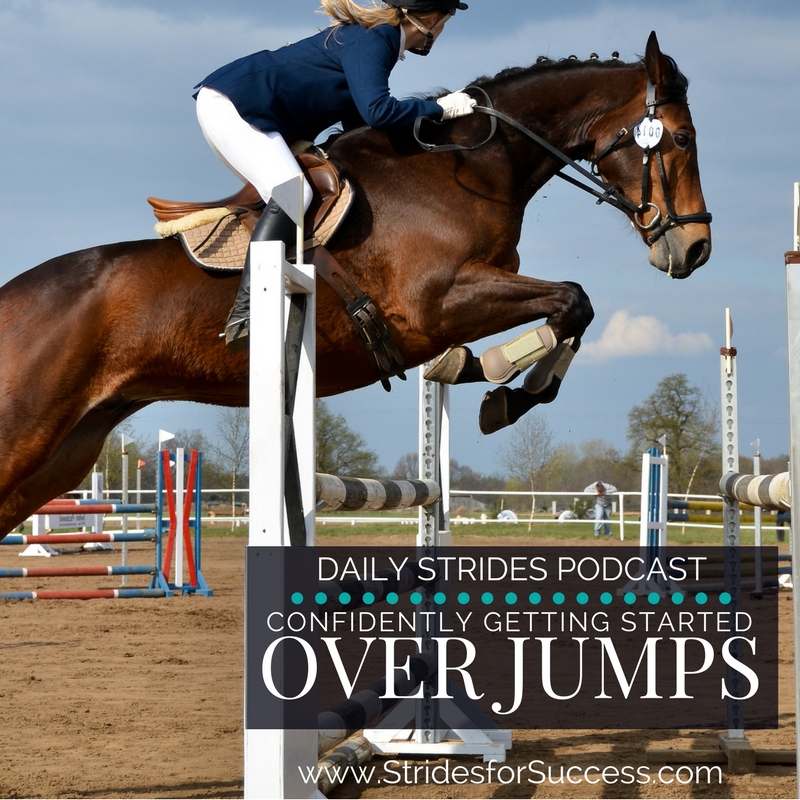
    This episode is all about jumps and, more specifically, getting you started over jumps in your riding.

    Working over jumps can be beneficial for both you, the rider, and horse.  It helps to keep things fresh and interesting.  It works both the brain and the body in a slightly different way.  But there can be the limiting perception of a ‘barrier to entry’ for many riders.  A very high barrier that perhaps you feel that you cannot get over in order to make it happen.

    I’m here today to tell you that you can not only get over the barrier, but enjoy yourself along the way as well.

    Jumping is really and truly just like riding a very big canter stride.  I am basing todays training on the prerequisite that you have a fair working knowledge of the canter;  how it works, what’s happening, what you should be doing and what your horse should be doing.

    From canter, beginning to jump is simply placing a pole underneath that canter stride.  I know this sounds like a very simplified description, but bear with me here.   My goal is to lower your anxiety towards jumps and jumping by at least a couple of notches!

    The Basics Apply Still – Especially Rhythm & Relaxation

    Successful jumping is built on the basics of good flatwork, with principles such as relaxation and rhythm being extremely important when it comes to jumping.  One of the most obvious ways riders start off on the wrong track when it comes to working over jumps is the tendency to confuse speed with impulsion.  Bounding towards a jump at great speed becomes scary for all involved; the rider, the horse and even the spectators.  It is definitely not how it should be done.

    Jumping is all about relaxation and rhythm, and that is why you should try to eliminate any anxiety as it shows up.

    Balance is Essential; Both You and Your Horse

    Start by cantering over a single pole.  Focus on your on balance as you do this.  Balance between and over the jumps is essential for both you and your horse.  Where many riders tend to fall short in the balance department, is that they depend on the horse to balance them.

    A good basic jumping position will help you to remain balanced using your own body.  You can practice this on the flat, before trying it out over a pole or, later, a fence.   

    It is important that you keep the weight into your heels, keep your leg underneath you, and you use your bum to basically balance the upper half of your body – a little like a weighing scale effect.  Lastly, your horse must be given enough freedom through his head and neck, for him to stretch out and make it over the canter pole, or whatever you are doing.

    Allowing does not mean that you throw everything at him and with a ‘best of luck’ attitude.  Remember, think about balance here.  Your horse also needs to remain in balance.  It is no good you being balanced, if your horse is not.  Your job as rider is to help your horse remain balanced as well.  You can practice all of this while cantering over a single pole on the ground.

    Think of Helping Your Horse, Rather than Hindering

    This is a largely misunderstood principle in jumping.  Many riders, when they start jumping, think only of themselves.  They launch themselves forward towards the horse’s head, without a single consideration for how this will feel for their horse.

    If you have ever jumped anything yourself (on your two legs) with a backpack on your back, you are going to understand what I mean here.  Imagine yourself with your backpack on your back and some things inside.  This particular backpack is loose and is moving around – meaning it’s not very secure.  Jumping anything in this set of circumstances is hard work!

    However, let’s now change that backpack for a more professional type of backpack that hikers would use  One that is stabilised at the front as well as the back, where it fits correctly, and is shaped to suit the body of the person wearing it.  Everything is snugly packed inside and is not moving around, it is balanced and secure.  It now becomes a whole lot easier to jump something, with that on your back.  That is how you need to become for your horse.

    You need to become balanced and secure over the fence, rather than loose and floppy.  I know, simple words – but sometimes simple is easiest to understand!

    Your horse needs to lift his front legs to get over the fence.  If you launch yourself in the general direction of the horse’s head, you are make it very difficult for your horse to truly lift and use himself correctly.

    Resisting the Temptation to Throw Yourself Forward!

    Throwing yourself at your horse’s head means you are no longer balancing yourself, simply because your legs are no longer underneath you!  Your legs will be left behind in the saddle with the rest of your body on the horse’s neck.   Your weight is now being added to his own body weight that he has to lift in order to clear the fence.

    I think this happens because a lot of riders want to model their position on top show jumpers. However there is one big difference between a lot of riders and the top showjumpers – the height of the jumps! 

    You don’t really have to do a whole lot at all going over a small pole, the bigger factor here is that you are remaining balanced.  Balanced will help your horse, launching yourself will hinder.

    Make Perfect Over Small Jumps First

    Finally, I am strongly suggesting that you perfect things over the little jumps, even the pole on the ground, before you start building up.  If you can get it right over the smaller ones, you are inevitably going to get it right over the bigger ones.

    This way you will also get to build your confidence.  In building your confidence, you build the relaxation.   When you build the relaxation, you will also find that the rhythm becomes more natural as well. 

    The result will be an approach that feels good, a correct take off and you and your horse feeling balanced and ‘a team’ as you are going over the fence. Everything is in balance, relaxed and rhythmic.  From there you are perfectly poised to either go on to your next fence, or whatever you want to do.

    The Benefits of Starting Working Over Jumps

    Unfortunately a lot of riders may feel that working over jumps is not for them.  However, if shown the value of including this in their schooling, a lot reconsider.  Values such as engaging a different sets of muscles within the horse and the rider.  Being prepared on the trail or a hack to pop over something you meet.

    Jumping also gives you a greater sense of this balance and this communication.  It is a real feeling of teamwork between the horse and the rider, that they must work together to get over this obstacle that is in the way.

    I suppose the important thing to remember is to take it slow and steady.  Work over smaller jumps initially before building to bigger, higher and more complex.   This way, you and your horse can successfully work out jumping, and get it working for both of you.

    Happy riding

    Lorna

    Links mentioned in the episode:
  • Enjoying Yourself and Learning as a Mature Rider

    Enjoying Yourself and Learning as a Mature Rider

    Enjoying Yourself and Learning as a Mature Rider

    What this episode is all about & how it can help you:-

        • Realizing that you, as a mature rider, have changed
        • Cultivating a support team around you
        • The benefits of starting at the beginning again – even if you think you don’t have to
        • The importance of maintaining your physical fitness

    [smart_track_player url=”https://op3.dev/e/traffic.libsyn.com/dailystridespodcast/1029-Enjoying-Yourself-and-Learning-as-a-Mature-Rider.mp3″ title=”Enjoying Yourself and Learning as a Mature Rider” tweet_text=”Are you finding that things are different because you’re a mature rider? A few ideas on how to excel…” hashtag=”equestrian” twitter_username=”strides_success” ]

    Are you trying to navigate the equestrian world as a mature rider?  Are you feeling that a lot of advice, ideas and activities don’t really align with you where you are right now?  Does it feel like a lot of what goes on in the global equestrian community is catered more towards younger riders?

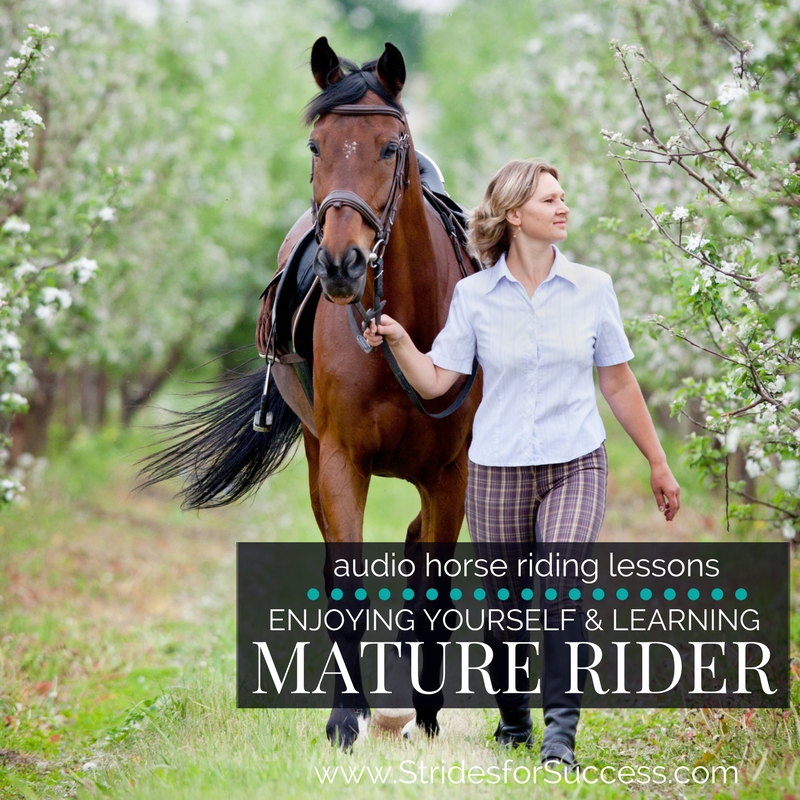
    Today I want to talk specifically to the more mature rider in my audience; a group of riders that I love working with.

    Realizing That You Have Changed

    What is your ‘story’ as a mature rider?  Your story is your mindset – what you tell yourself and others day in and day out.  Is your story aligning with your current lifestyle?

    It is important to understand that mentally you have grown, or that you are growing.  The considerations that you may have had a few years ago probably look a lot different from the thoughts that weigh on you now as a mature rider. Disregarding this and trying to gloss over it won’t work.  These things are always there, in the back of your mature rider mind.

    Your responsibilities are constantly changing and evolving.  Looking after yourself becomes a little bit more of a priority now that you are a mature rider. 

    When you are younger you don’t have that same weight of responsibility regarding looking after your body and keeping healthy and fit.  You know that, for the most part, you will repair and your body can handle a lot of the knocks and bumps that will show up in your experience as a rider.

    However, as you begin to get a little older, falling off and breaking something is a very real and present consideration.  It presents a lot more of a challenge now than what it would have presented years ago.

    Recognize this, allow it to be there, and validate it.  This way your decisions become a little clearer and easier.  Rather than making decisions from a very ‘fear-based’ place, you are doing so from the realistic circumstances you find yourself in.

    What decisions are you making?  A lot of people get into the rut of doing the same thing that they have always done.  And yet, as we have just said, you have changed as a rider.  You are now a mature rider.

    You have grown.  You have evolved. You have shifted mentally. What you believed back then is not going to be the same set of beliefs you have now.

    Of course, physically you will also have changed.  It is important to recognize that and to recognize that perhaps your riding also needs to change to facilitate these changes, particularly in order to keep it enjoyable for this new version of you.  Being open to these changes is important as a mature rider.  This does not necessarily mean that you should change discipline. Perhaps it is the type of horse you would normally ride.  Maybe it is where ride.  Or the type of Instructor you are riding with.

    Sometimes, you don’t have to change anything at all as a mature rider.  However recognizing, realizing, and coming to terms with this ‘new’ you are going to make all the difference in going forward in your riding.

    Cultivating a Support Team Around You

    A good support team can be a great help, particularly if you are returning to riding when resistance shows up.  You will most likely have plenty of people who are your cheerleaders and praise you.  But there is often the odd one or two – you know the ones – that will give their little niggly comments every now and then.  Rather than allowing those one or two comments to overshadow your enjoyment of riding, listening, and focusing on your ‘supporters’ will help you ignore the ‘naysayers’.

    The right Instructor is part of that support base.   A supportive Instructor will sit down with you and figure out what you want.  They will not try to force you down a path of what they think you should want. 

    However, if you are not currently taking lessons, the role of an instructor can, potentially, be replaced by a group of other like-minded and experienced riders.  Again, the important thing to look for is that you feel ‘built-up’ after chatting with them, rather than negative and lacking confidence in your abilities.

    Having the support of your husband, partner, significant other, perhaps children or good friends, is also important.  If they are constantly telling you that you are crazy to go back to horse riding, it is going to have an impact on that mindset that we spoke about earlier.

    I believe that if you approach this from a responsible point of view, which comes back to understanding and recognizing that things have changed, and then trying to plot a new course for yourself.  This is going to make all the difference.

    The Benefits of Starting at the Beginning Again (even if you think you don’t have to)

    I would also suggest at some point, going back and starting at the very beginning when it comes to your riding and your training.  Why?  Because as your body and your mindset are changing as a mature rider, you may find that how you do things change as well.

    The half-halt for example; the physical changes in your body may mean that the balance of your aids is now a little different as it was before.  Riding is a constantly evolving process, so too is the half-halt – so it makes sense to revisit it from time to time.

    Starting at the beginning gives you a fresh clean slate.  It allows you to recognize and realize what is going on inside of your own, mature rider, body, and inside of your own, mature rider, head.  If you can be mindful of how you are changing as a rider, you now have a platform from which to work from.

    Remember, if you are trying to do the same thing that you have always done – even though you have changed; can you imagine how confusing it must be for your horse?!  

    He probably has no clue what you are asking for half of the time!  So give yourself the luxury of starting back at the beginning, and rediscovering your aids, your feel, and your general basic knowledge of the what’s, when’s, and hows in the saddle.

    I actually suggest this practice to all riders – go back to basics, master the basics.  You will see that any very successful riders spend 80% of their time doing the basics.  Day in, and day out.

    The Importance of Maintaining Your Physical Fitness

    The final thing, and of course we must bring it up as a mature rider, is your physical body.  One of the (many) things which change as we age is our body.  It can potentially become a lot less supple.  A lot less strong, physically.

    You need to manage it and maintain it regularly.  I would suggest that you begin to add a simple, basic routine off the horse that is going to compliment and support you when you get on your horse.

    Strength is so important.  Start thinking about where you could make changes today, that would incorporate a little bit of strength training, which will really and truly complement your work in the saddle.

    You can join the free 30 Day Rider Fitness Challenge HERE

    Finally, I personally think those mature riders are an inspiration…  Keep doing what you are doing and, most importantly, enjoy yourself.

    Happy Riding

    Lorna

    Returning to Riding

    Are you returning to riding?  Are you feeling a little overwhelmed with it all?  I may just have the thing to help you get back into the saddle – and enjoying yourself there again!

    The Original Returning to Riding Plan is a complete step by step audio program that takes you from ‘not riding’ to regularly riding and enjoying yourself again.  The plan is laid out over 6 weeks, however, you have lifetime access to go over it again and again as you want in the coming weeks, months, and years.

    You can find all the details HERE.  And I wish you all the best in making your ‘Returning to Riding’ as enjoyable and successful as you dreamed it would be :)

    Links mentioned in the episode:-

  • Starting with the basics in order to build confidence

    Starting with the basics in order to build confidence

    What this episode is all about & how it can help you:-

    • Understanding the importance on being clear about what you want to achieve
    • Learn to rather aim for refinement than perfection
    • The power of choosing two exercises that you know you are able achieve
    • The importance of consistency when building confidence

    [smart_track_player url=”https://op3.dev/e/traffic.libsyn.com/dailystridespodcast/1018-Starting-with-the-Basics-in-order-to-build-Confidence.mp3″ title=”Starting with the Basics to Build Your Confidence” social_linkedin=”true” social_pinterest=”true” social_email=”true” tweet_text=”4 basics to building your confidence in the saddle ” hashtag=”Horseriding, #podcast” twitter_username=”strides_success” ]

    Confidence is one of those big “buzz words” when it comes to riders and equestrians all over the world.  In this episode I want to go into how you can use a few basics in your riding to build your confidence every single day.

    So, what is confidence?  I really think that confidence comes down to feeling capable about your own abilities in the saddle. 

    A lot of people say that confidence is not feeling afraid and not feeling nervous.  I think that fear is a good thing, it keeps us alive!  However, sometimes we do have to rein it in a little, otherwise it can tend to run away with us.   I believe that if you feel capable in your ability to do something, while understanding and being aware of what may or may not go wrong – that is true confidence.

    The added bonus of this is that when you feel capable, your horse picks up on that and is more likely to follow your lead.  My personal opinion is that we need to grow as riders each and every day, and that is why I would suggest you start building confidence in you own capabilities and in your own abilities.

    Firstly you have to get really clear on what you want to make happen; both long term and short term.

    A lot of riders, particularly those where confidence is a little bit of an issue, have no real clarity, and are kind of stuck at a certain point, and they don’t know what they want past that point.

    There is no clarity around what they are looking for, why they want that and what doing that is going to get them, or how it will make them feel – and that is what it all comes down to – it’s all about feelings. 

    I advise you to become REALLY clear on your goals, both long term and your goal for the end of each ride.  What would you like to be doing in 6 months time and what do you want to have achieved by the end of your next ride?  The answers to these questions are what you need to focus on. 

    It is also important that what you want to do is actually what YOU want to do. 

    Sometimes that is actually the issue in itself with the confidence – where people start to lose confidence in their own abilities because what they are doing is not aligned with what they want to do.  So get really clear on what YOU want to do, and then start aiming for that each and every time you get into the saddle.

    The next important point is that rather than thinking about perfection, I want you to start thinking about refinement.

    You can really work on refining your technique each time you ride.   This applies to everything – how you are feeling, the mood, your attitude, your performance.  Everything when it comes to riding.

    A great way to do this is to work on the basics in the saddle.  If you have an idea of what you are looking for, I am sure there are lots of basic exercises which will allow you to work on just that.

    Many riders make the mistake in over complicating things, but the basics – and particularly where confidence is concerned – can start off as simple as getting a nice transition between walk and halt.  It can even start off as simple as asking your horse to stand while you mount.  What is important is that you are working on refining it a little more, each and every time.

    Finding two exercises that you know, with a little stretch, you can make happen.

    I suggest that the exercises you choose should be as basic and simple as possible.  The point is that you should be able to ride them, and feel confident about riding them.

    The key is to have a specific goal around the two exercises; they are related in some way.

    The exercises should be basic enough that they allow you to focus on really refining your aids and your communication with your horse.  Improving, and later mastering, those basics will build your confidence in your capabilities, which will give you the confidence later to increase the level of difficultly

    Finally; rinse and repeat – consistency is everything.

    There is no point in going out and being so focused, and diligent in what you are doing one day if you are not going to follow it up the next day  – and the day after that…

    In order to build a solid rapport with your horse, you must be consistent in how you ‘do’ things in the saddle. Inconsistency will not only damage your relationship with your horse, but it will also reduce your confidence in yourself.  

    Working on the basics is a perfect way to develop your physical mental and emotional strength, which is essential for all riders in moments where things don’t go to plan.  Confidence is being able to handle yourself in those moments…

    Happy Riding

    Lorna

    Links mentioned in the episode:-

    Other resources that will help you to dive deeper into this topic:-

  • Riding Alone; How To Keep Moving Forward

    Riding Alone; How To Keep Moving Forward

    Riding Alone - How to Keep Moving Forward

    Riding alone – does this best describe you and your horse when schooling and working?  If so, I understand how it can sometimes leave you feeling like you are trying to piece together a difficult jigsaw puzzle – with no ‘picture’ to help guide you!  Things not quite fitting together how you would like them to.

    [fusebox_track_player url=”https://op3.dev/e/traffic.libsyn.com/dailystridespodcast/936-Riding-Alone-How-to-Keep-Moving-Forward.mp3″ title=”Riding Alone; How to Keep Moving Forward” social_linkedin=”true” social_pinterest=”true” social_email=”true” ]

    You’re not alone.  Equestrians who are riding alone often find themselves struggling with:

        • a lack of motivation
        • not knowing if challenges are caused by horse or rider error
        • a lack of accuracy & consistency
        • no accountability (“I’m just too tired to ride today”, anyone?!)
        • riding the same 30 minutes for the last three years…
        • the temptation to jump from A to B (without doing all the required work in between)

    It can be disheartening, especially as you probably were initially so excited about riding alone and working your horse by yourself.

    However, if you are struggling – there are definitely ways that you can start, today, overcoming those challenges.  So before you give up, which is the unfortunate end result for many of the thousands and thousands of riders out there riding alone, I want to give you a few ideas today on how you can turn your situation around.

    How you can make riding enjoyable, pleasurable, interesting, and, well, fun again for you and your horse.

    1.  Regular Inspiration

    Now, this seems a little obvious, but a lack of motivation can often be overcome by tapping into some really small, but potent, inspiration.   What is it that really gets you excited about horses and riding?

    For some people, this can be a simple as doing something different, such as getting out of the arena.  However, I am willing to bet that you have already wrung every drop of inspiration out of riding somewhere new – meaning a different approach is needed.

    Different mediums work for different people, so find what works for you and then make time in your schedule to tap into that source or feeling regularly.

    And remember, motivation will wear off, so it needs to be repeated on a regular basis to be effective.

    2. You or Your Horse?

    This one can be tough and confusing to try to figure out.  You find yourself riding alone and trying to work through a specific movement, or master a particular principle.  Over and over and over again you try, but it is just not coming together or happening.

    If you had a pair of eyes on the ground to guide you alone, the ‘course correcting’ would be much easier, but you don’t.  It is just you and your horse – and this problem!

    There are two ways you can deal with this challenge and I would suggest trying both, together, in order to really gain some insights on what is going wrong and why.

          • Start a riding journal
          • Take regular videos of your riding for comparison purposes

    The riding journal can be initially a little time-consuming and bothersome.  However, if you can capture a few details after every ride you will find that it becomes one of your greatest resources in identifying patterns.   I have a full detailed blog post on this HERE

    A riding journal will also help you pinpoint the cause, as opposed to treating the symptom. 

    With the videos, I have written a full blog post on this and how to implement it in your riding HERE

    3. Increasing Your Accuracy & Consistency

    This is actually one of the easiest pieces of the riding alone puzzle to begin putting together.  There will be a little work up front, but overall it will be something that can be put onto ‘auto-pilot’ pretty quickly in your riding.

          • Install ‘markers’ around your arena or riding space
          • Identify potential ‘markers’ if working outside the arena

    Now, many riders think that they have to get the expensive markers, or they feel that they must have an actual arena.  But ‘markers’ can be as basic as a large rock or a tyre and as sophisticated as professional dressage markers.

    And regardless of where you ride, this is something you can make work for you.  You can even go so far as to use trees, electricity poles or (yes, I am Irish, so don’t judge me here) potholes in the road as your markers!!

    What is important is that there is something or somethings that don’t move and you must ride past.  Then begin planning your transitions, your halts, your bends, your circles, your school movements, your leg yielding, your lengthening, your shortening (the list is endless) at those markers.

    Accuracy happens when you can do what you want to do at the exact point you want to do it. This is when your body passes the marker, not your horse’s head or tail.  You.  

    Now, you can also use these markers to improve consistency by creating little challenges for yourself.  “Every time I pass a marker, I will half halt and rebalance”.  Simple, yet effective.

    Implementing Change to Move Forward

    So there you have it.  We have covered the first three challenges on our original list and I really hope that you get some ideas here on how to move things forward.

    You can also download a free plan HERE to show you how to use One Exercise Mulitple Ways

    In there I will show you how you can begin mapping out some work for your riding.  There will be an actual plan you can use.  I will also be showing you how you can begin adding more outside accountability into your riding and how you can get out of frustration and move into clarity when riding alone.

    Happy Riding

    Lorna

    Additional Links to Help You:-

  • Riding alone? Are you Making Progress in Your Riding?

    Riding alone? Are you Making Progress in Your Riding?

    Riding alone? Making sure you are making progressHave you ever noticed how things are less fun when it consists of the ‘same old, same old’ day in and day out?  Many riders make the mistake of thinking that making progress in their riding only pertains to riders who compete, or desire to do so…

    However, having had a riding school and livery yard for 12 years now, I can tell you first hand that the biggest reason people give up on their horse riding dreams is lack of progress.

    Getting your first horse, whether it be a lease horse or actually purchasing a horse is one of the most exciting and memorable times in the life of a horse lover.  A chance to do what they love – whenever they want!

    Unfortunately your first horse will also tend to coincide with more time spent riding without a trainer or instructor in the arena with you.  There is no longer someone there planning out your rides, guiding you along and keeping you and your horse ‘on track’.  

    Now, I say unfortunately because while this may indeed be fun and a bit of a novelty initially, this can all change quite quickly.  Why?  Well, like anything we do where we don’t have someone holding us accountable, if we are not disciplined and focused it becomes very easy to take our eye off the ball, or in this case the goal – which is progress.

    Now there are a few obvious solutions to this – like get an instructor – but sometimes this is not always possible.  And sometimes you might just enjoy riding alone with your trusty steed…

    There are ways to make sure you are making the progress you want with your horse while riding alone.  Here are a few ideas to get you started:-

    Begin with where you are

    In order to really begin identifying the key areas you should be focusing your attention on, you first need to asses where you are right now with your riding.

    Many riders make the mistake of never considering that something might be holding them back, which leads to them never progressing at all with their skills and knowledge in the saddle.

    Ask yourself a few questions…

    How much progress have you made in the past 6 months?

    Sometimes progress can be difficult to quantify, particularly when we don’t have regular lessons or compete regularly.

    However, it is just a matter of knowing what to look for, to see if you are indeed progressing as a rider…

    You should always be progressing in both physical capabilities and in mindset and thought

    Think of your last ride.  What part of the ride felt the most natural for you?  What part did you feel could improve?  Now, think of yourself and your riding 6 months ago…  Ask yourself the same questions – and if you have the same answers then, yes, something is a little ‘stuck’ with your progress.

    Imagine what a trainer would say to you if you stayed at the same level, despite consistently getting into the saddle.  The sad fact is that many riders do not see their time in the saddle as an investment.  Your time

    There will always be something you are working on improving in your riding.  There will always be something that needs more attention in order to happen with greater ease and softness.  HOWEVER, these things should change as you improve as a rider.

    How much progress as your horse made in the last 6 months?

    Horse riding is a team sport, you and your horse.  This is why it is important to assess the whole team when we are looking for obstacles to progress and success.  This can be difficult when you are riding alone, however it is certainly not impossible.  Again, it all comes down to knowing what to look for…

    Assess your horses progress as you would your own.  Is your horse still struggling with the same challenges?  Is the training progressing and building your horse, both physically and mentally?  Is your horse learning new skills and refining the older ones?

    Where would you like you both to be 6 months from now?

    Riding Alone? Are you making progress?

    Once you have a clear picture on how the past 6 months have impacted your riding and training, let’s turn your attention to the coming 6 months.

    Knowing what the ‘destination’ looks and feels like

    So often we allow ourselves to become ‘stuck’ where we are.  Either we cannot see a way to go forward, which is usually mindset and confidence issue.  Or we have set big goals and don’t have a plan to actually make them happen.

    Either way, becoming ‘unstuck’ can be as simple as really knowing what you truly desire in your riding.

    Is it the ability to have a ‘secret conversation’ with your horse?   Is it the feeling of confidence in both your own and your horses abilities?  Is it that feeling of connection which, up to now, has proved elusive in your riding?

    Once you have a starting point, start fleshing it out…  Ask yourself a few questions about what this ‘desire’, when achieved, will look like.  Where will you be?  What horse will you be riding?  Who will be there with you?  How will it feel?

    Simple questions that start to move you mentally, from where you are to where you need to start going.  

    Riding alone does not have to mean the end of progress when it comes to your skills as a rider.  Becoming clear on what you want – and how that will feel – is the key to making your time in the saddle, whether it be with an instructor or if you are riding alone, ‘worthwhile’ in the greater scheme of things.

    It is so much easier to move forward when there is something wonderful pulling you there.  The desire to be a better rider is a strong one.  Harness it in your riding by going a little deeper and figuring out what you truly want in your riding.

    Happy Riding
    Lorna

  • Whats Holding You Back in Your Riding?

    Whats Holding You Back in Your Riding?

    What's holding you back in your Riding?
    Seems like a simple enough questions, doesn’t it? And when you read the above question, ‘what is holding me back in my riding?’, you probably instantly answered it in your head.

    What was your answer?

    Now, most of the time I am all for taking the first answer that jumps into your head, the intuitive answer.  Except today, I want you to dig a little deeper…

    Why?

    Well, because very often what is holding you back in your riding is either a story you keep telling yourself and others, or an excuse that you have formulated to protect yourself from something ‘uncomfortable’…

    It sounds harsh and it is probably not what you wanted to read when you started this post.  However, in order to really uncover what is holding you back, you need to begin to become very honest with yourself and identify why you are really allowing things to stop you from progressing with your riding.

    Unmasking Your Stories

    Have you ever noticed how what you continue to tell yourself, will usually become a self-fulfilling prophecy of sorts?

    It is so important as a rider to become aware of the internal conversations you are having every day – and editing them where necessary.  

    The reason these ‘conversations’ become a reality is that your brain will actively seek out ways to confirm and validate your beliefs.  If you think that you cannot canter due to an injury you had twenty years ago, guess what?  You probably won’t be able to canter because of that injury you had twenty years ago!

    However, if you start to tell yourself a new story, your brain will – over time – begin to look for ways to confirm that.  This allows you space and room to begin moving away from the old, original story.

    Over time you can completely change your beliefs about what you can or cannot do.  You can mould your beliefs into you need them to look like in order to move forward.

    Now, it is important that we don’t actually go out and tell ‘porkies’ or lie to ourselves and others here.  But rather turn the story around.  Your old ‘I can’t canter due to old injury’ story can become ‘I’m working towards learning to canter again’.

    This is a true story; in fact it was exactly what you were doing all along, it is just how you have phrased it or ‘told the story’ that has changed.

    So, start with becoming really aware of what you are telling yourself and others, and editing where necessary to suit how you want your riding to progress.

    Unmasking Your Excuses

    Ohhh, this one will make me a little unpopular!  However many of the ‘reasons’ we tell ourselves things are the way they are – are actually excuses in disguise.

    A reason is an explanation of what happened and why it happened.  It is logical.

    An excuse is a reason that tries to justify what happened.  Blame is usually placed somewhere – and rarely is it correctly placed.

    Most people find that when they are using excuses to justify something, they have to defend it.  It is not just stating the facts of the situation.  They feel they must hammer the point home.

    What's holding you back in your riding?
    If we take the transition out of the canter back to trot, for example, the excuse might look like “my transitions are not smooth because the trot is too bouncy when I transition down”.  A reason would look like “I struggle to remain balanced as the horse transitions back to the trot.”

    The difference?  The excuse puts the responsibility of the problem out of your control.  The reason states the facts – and gives you a focus point on where to begin working on your riding, the balance.

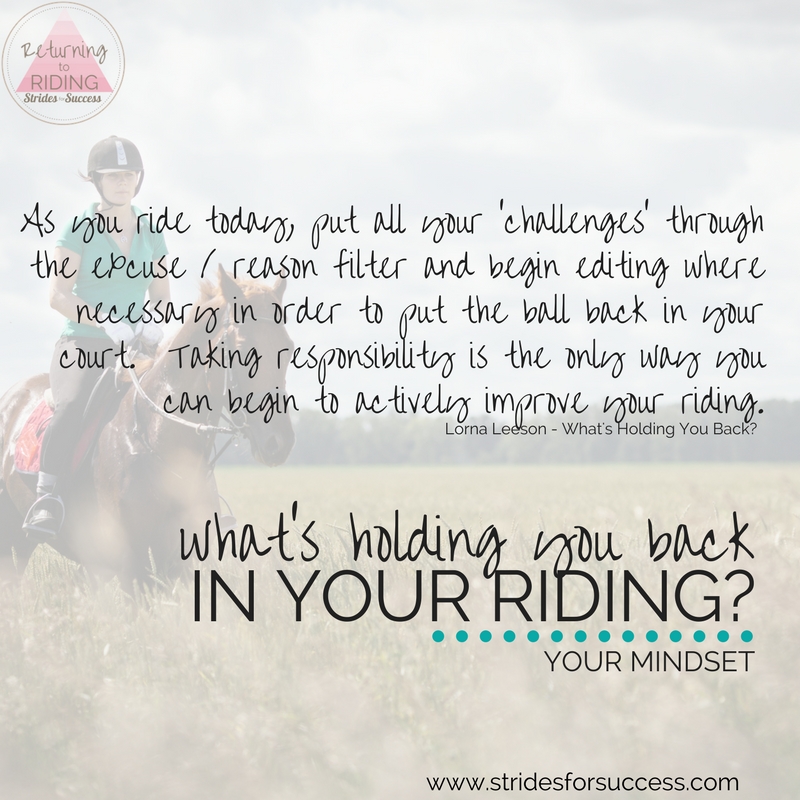
    As you ride today, put all your ‘challenges’ through the excuse / reason filter and begin editing where necessary in order to put the ball back in your court.  Taking responsibility is the only way you can begin to actively improve your riding.

    Honesty and Compassion

    Once you have begun to get clear on what you are telling yourself and others, it is important to make sure you don’t fall into the trap of beating yourself up.

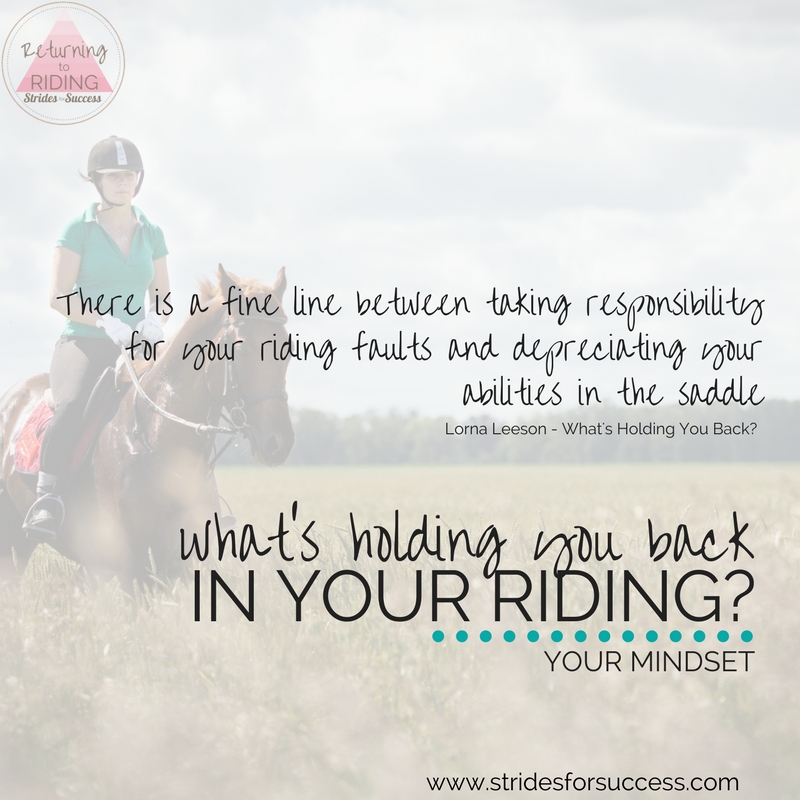
    There is a fine line between taking responsibility for your riding faults and depreciating your abilities in the saddle.

    We are all on a journey with our riding.  Your journey is unique to you.  Beating yourself up over a lack of progress will only serve to damage your confidence in your abilities in the long run.

    These exercises are to help you get ‘unstuck’ when it comes to your progress.  Make sure that the ‘excuse pendulum’ does not swing back the opposite way and you begin laying all the blame at your own feet.

    There is a balance in riding.  There are many moving parts.  There can be many reasons things are not working out…  Explore all the different possibilities before creating a plan to move forward. 

    By being really honest with yourself and then compassionate enough to accept that you will not be immediately brilliant at everything you do, you will open to the door to explore what things you do need help with.

    Your mindset is the first key to begin making changes in your riding.  Spend the next few days being aware of the stories you are telling and the excuses you are using in your riding. These are the keys to beginning to really unveil whatever it is that is truly holding you back in your riding.

    Happy Riding
    Lorna

    Once you are figured out what is holding you back, taking action on removing that block is essential. Knowledge is only power when we use it to make something happen.

    Join our free Facebook group, filled with riders from all over the world on a journey to improve their riding – one step at a time. Sometimes letting someone know that you intend to take action on something is enough to start that ‘change’ ball rolling.

    Share your story HERE and let me know what your first ‘action step’ is to get over what is holding you back from being the rider you want to be.

    Good luck!
    Lorna
    What's holding you back in your riding?

    Returning to Riding

    Are you returning to riding?  Are you feeling a little overwhelmed with it all?  I may just have the thing to help you get back into the saddle – and enjoying yourself there again!

    The Original Returning to Riding Plan is a complete step by step audio program that takes you from ‘not riding’ to regularly riding and enjoying yourself again.  The plan is laid out over 6 weeks, however, you have lifetime access to go over it again and again as you want in the coming weeks, months, and years.

    You can find all the details HERE.  And I wish you all the best in making your ‘Returning to Riding’ as enjoyable and successful as you dreamed it would be :)