Tag: connection

  • [Training Scale Series] Part 3 – Contact in Your Riding

    [Training Scale Series] Part 3 – Contact in Your Riding

    [fusebox_track_player url=”https://op3.dev/e/traffic.libsyn.com/secure/dailystridespodcast/1207_Contact_Being_The_Start_Of_True_Responsibility_for_Horse_and_Rider.mp3″ title=”Contact; The Beginning of Responsibility for You and Your Horse…” social_linkedin=”true” social_pinterest=”true” social_email=”true” tweet_text=”If contact was less about the reins and more about responsibility, how would it change your approach?” hashtag=”equestrianpodcast” twitter_username=”strides_success” ]
    Contact and connection; hot topics for many riders.  This is often because they can feel quite elusive.  There is confusion regarding what needs to happen in order for contact to occur.  And, how can you tell if the contact is correct and ‘good’?
    This post and episode are the third in a series about the training scale.  We have already covered rhythm and suppleness. The next ‘step’ in the scale is contact.

    What is Contact?

    This is a big question because most riders feel a lot of confusion around contact.  And this confusion impacts most of their riding and lessons.  The numerous different comments, suggestions, ideas, and methods can muddy the waters!  “Soften your contact”, “Stop losing the contact”, “Be more consistent with your contact”, “Ride into the contact”, or “Pick up the contact” are just a few ways contact is discussed in relation to riding. So, what is contact?. Is it the reins?
    It is important to understand that contact is not just one thing. It is a lot of things coming together. It occurs as a result of lots of other things happening, simultaneously.
    Essentially, in black and white, contact is the connection between your hand and the horse’s mouth down the rein. However, like most things to do with horse riding, it is not that simple.  This is due, in part, to all of the other ‘connections’ that influence the hands, reins, and mouth.
    For example, if somebody were to tell you to “soften your contact”, you may not be 100% sure what to do to soften it. It could, perhaps, be a softening through your elbow. But not always! Sometimes it is almost a ‘wiggle’ through your fingers which could be enough to soften it.

    Quiet, but Not Fixed…?!

    Another aspect of contact that can be quite confusing, is the fact that your contact should be quiet.  And yet, at the same time, it should not be fixed.  In the previous post & episode, I covered suppleness and how it is fluid and ‘loosey goosey’.  This applies to contact as well.
    When we think of quiet we tend to think of this as being still.  And yet, I can bet that you realize that when you’re riding with fixed and ‘still’ hands, things probably would not go according to plan!
    So quiet, yes… However, we also need to have a certain amount of ‘wiggle room’ through our contact, with the horse.

    Contact as a Result

    Let’s take things back a couple of steps, and look at contact as a holistic concept with your horse. If we begin to see contact through the filters of relaxation, rhythm, and suppleness, we can see how this applies.
    Everything begins with forwardness.  Thinking and moving forward.  From here, we can establish both relaxation (the right amount of tension for the question we have asked) and rhythm.  Building on that, we can then begin to assess how supple the energy and the body are.  Is there a ‘flow’?  Are we allowing this ‘flow’? Is your horse being allowed himself to use himself correctly?
    From here, we can begin to work towards true contact.  A little like seeing it as being the ‘next step’.  Contact is where, with this ‘flow’ of energy, you can begin to direct it a little bit more.
    It is important to remember that you are not forcing things.

    Plugging Holes and Leaks

    If there are leaks or weak spots in your ‘flow’, contact is where you can really begin working on plugging and strengthening them.  Imagine water flowing in a river, and the bank of the river had a little hole in it. Obviously, some of the water is going to flow out there, and over time the hole will possibly cause even more problems.
    Also, as the water leaks out, it leaves less and less water flowing down the path of the river. Your horse’s energy works in a very similar way.
    Over time, as you strengthen the channel that you and your horse create when working together, you will be able to put more energy in without it leaking or bursting out. 

    Directing the Energy

    Once you begin to work on plugging any energy leaks, you then allow your contact to begin to become about how you are directing that energy. Often, the confusing part for many riders is when they think that they should steer with their hands when riding. But that is not true.
    When you are steering and directing that energy, it has to come from your seat and your legs. Basically, you are then feeding it into the hands.
    Imagine as you ride, if you were allowing all of this energy to flow (through your seat and legs.  From here, imagine what would happen if you were to shut that flow down with your hands.  Things are going to begin damming up pretty quickly!
    Let’s go back to the example of the river; by shutting down your hands, you are making the river a lot narrower. This creates a build-up of water or pressure.  This can cause the water to overflow, and if we apply this to your horse, a similar build-up of energy will occur.  Energy must go somewhere, so you will either begin to produce new leaks, or there may be an explosion of sorts!  A lot of ‘naughty behaviour’ can actually be attributed to this!
    It is important to remember that relaxation and suppleness help to balance the contact, to ensure that the energy flows.

    Elasticity Through Contact

    Another element of ‘good contact’ is the ability to remain ‘elastic’ through your arms and hands as you ride.  This is where suppleness really helps to achieve contact.  It is about the stretchiness; the give and take.
    Remember, while contact should be quiet, it should also be moving.
    To understand the contact being quiet, imagine a conversation with someone. A good conversation is when two people are involved and there is a natural ebb and flow in the conversation. You almost know when it is your turn to speak. You refrain from jumping in because you know there is a lovely rhythm happening inside of the conversation.
    When we ride, we have a conversation with our horse.  Just like when we have a good conversation with a person, there is no shouting or dominating occurring inside of the conversation.  This goes for both rider and horse.  That is the connection, and that is the contact with your horse.

    How to Work on Contact

    How do we achieve true contact? Let’s start by thinking about the conversation and the ‘channel’ you create when you ride.  Distractions tend to ruin conversations.  So does constantly changing the tone or mood. ‘Fiddling’ with the length of the reins is a distraction that changes the tone.
    When you ride, think about setting the length of your reins – and then, as much as possible, leaving them there.  This helps to create a consistent tone and rhythm for your contact conversation with your horse.
    Also, imagine that your hands are directly connected to your seat. If your seat is following,  then your hands should be following in sync.  And if you were to apply the half halt, again, your hands work with your seat.  They are led by your seat.
    It is always important to remember that the seat comes before the hands.
    In order to achieve this ‘syncing’ between your seat and hands, both relaxation and rhythm must be present.  If there is any excess tension through your body, and stiffness, that flow cannot happen.

    Creating a Good Conversation

    Think about a conversation where there was no rhythm to it.  Or one where there was a lot of tension involved.  When a conversation is or becomes a little bit stiff, it lacks flow.
    A good conversation is where people are relaxed.  It also has this lovely understanding between the people involved that each person will respect the other person’s opinion and space. 
    If you can take all of this with you into your contact, you can begin to create a great connection between you and your horse.
    Happy Riding
    Lorna

    Find in the Gaps In Your Horse’s Training

    If you are interested in learning more about where you might be missing pieces in your riding, sign up for my new free training “ FIND THE GAPS IN YOUR HORSE’S TRAINING.  This audio training can be listened to, via podcast app, to help you figure out where to begin working with your horse.

    You can sign up and get it, for free, HERE

    More, More, More… To Help You :)

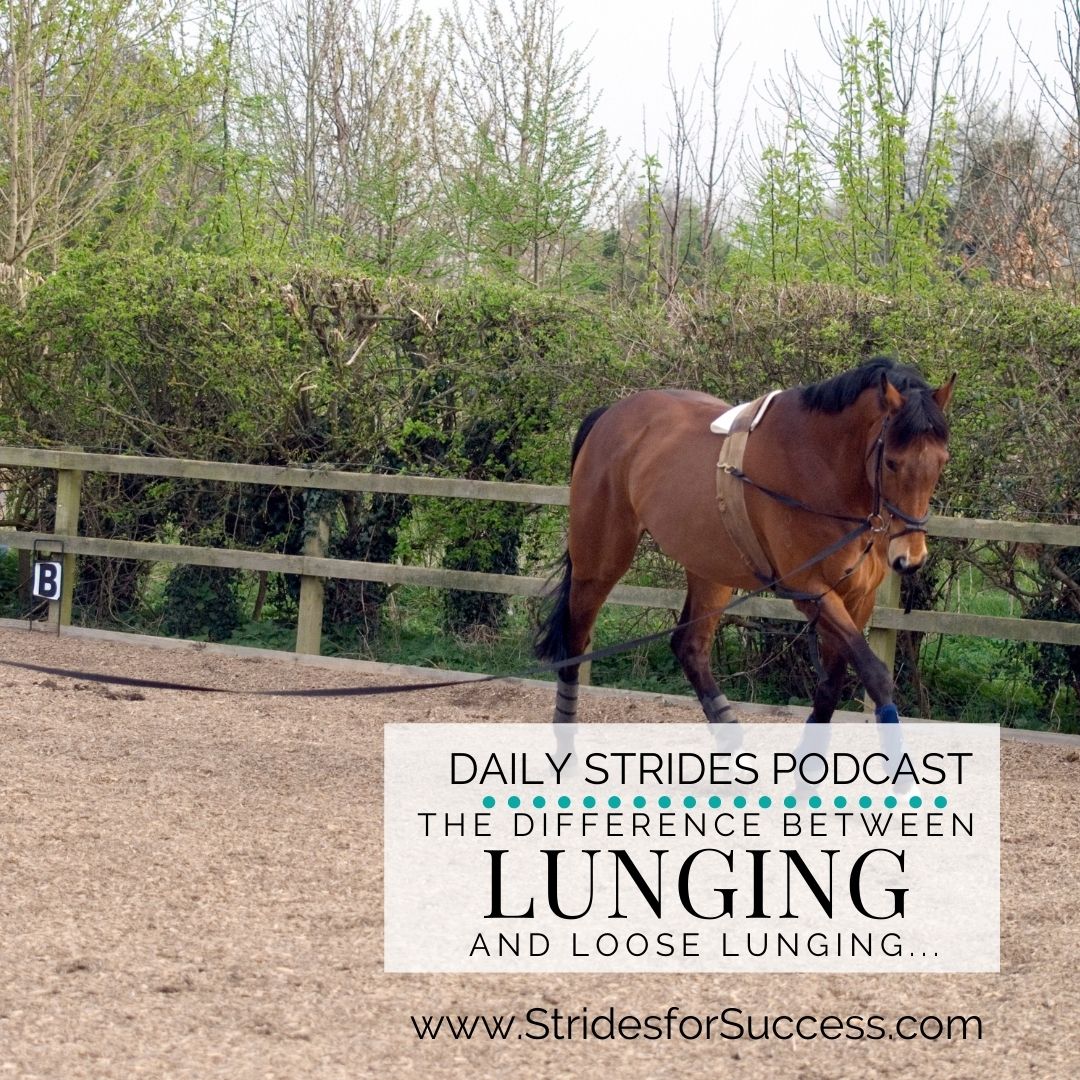
  • Loose Lunging versus Lunging…

    Loose Lunging versus Lunging…

    [fusebox_track_player url=”https://op3.dev/e/traffic.libsyn.com/secure/dailystridespodcast/1190_Why_Loose_Lunging_is_not_Lunging.mp3″ title=”Why Lunging and Loose Lunging are Different…” social_linkedin=”true” social_pinterest=”true” social_email=”true” ]

    Do you know that, contrary to popular belief, lunging is not ‘running in circles’? That, when done right, lunging is one of the most beneficial, easy to use, and low barrier to entry tools you can work with your horse to improve your riding.

    True and good quality lunging improves both horse and rider; and can be used by all horses and riders, regardless of where they are in their riding journey.

    Yes, it is that good… This is why I feel a little passionate when people confuse loose lunging for actual lunging! In fact, I don’t believe that loose lunging should even be called lunging. What it should e called depends on what you are using it for… But it is not lunging.

    So, what is Lunging?

    Lunging is when you use a combination of natural and artificial aids to ask questions of your horse. A lot of those questions are ones that you would use similar aids to ask when you are riding.

    True lunging is when you ask your horse to do things using a combination of aids that would also work if you asked a similar question when in the saddle. Just now, you’re on the ground.

    Just like you use your seat, your legs, your hands, the reins, your weight, your thoughts, your voice, groundpoles, the arena fence, and so many other natural and artificial aids when you ride, you do the same when you lunge. Your position, your body language, the lunge line, the lunge whip, the arena boundary, groundpoles, your voice, etc., etc.

    And, what’s magic is that you and your horse get to experience all of this from a new and helpful perspective.

    And what is Loose Lunging?

    Loose lunging is when you take a lot of the artificial aids out of the equation. Notice I said a lot, not all. The boundary is still there (so the arena fence or rail). And also, many people use a rope or other similar piece of equipment to enhance their natural aids. A little like the lunge whip would do if lunging.

    The key difference between lunging and loose lunging is the contact and connection.

    True lunging, just like riding, encourages contact and connection between horse and rider.  Loose lunging does not have that element because there’s no lunge line.  And while you can ride without reins, the result is not the same as riding with them.  The same with lunging…

    Which is one of the big reasons I personally think loose lunging often quickly ends up being simply running in circles. Not always, and I want to stress this. But very often, the horse is simply running aimlessly around the rider in the center who has little to no influence over the situation as a whole.

    It also very often has a lack of focus or intention for the interaction… So it doesn’t really move the conversation forward for horse or rider.

    How Do I Start Lunging?

    If you would like step-by-step instruction on getting started and then taking your lunging further, Lunging for Riding is ready and waiting for you to join HERE. In there you will get 4 weeks of lunging plans, audio training. All put together in an easy-to-follow program that will literally transform your lunging – and your riding.

    Happy Lunging
    Lorna

    Other Resources to Help You with This Topic:-

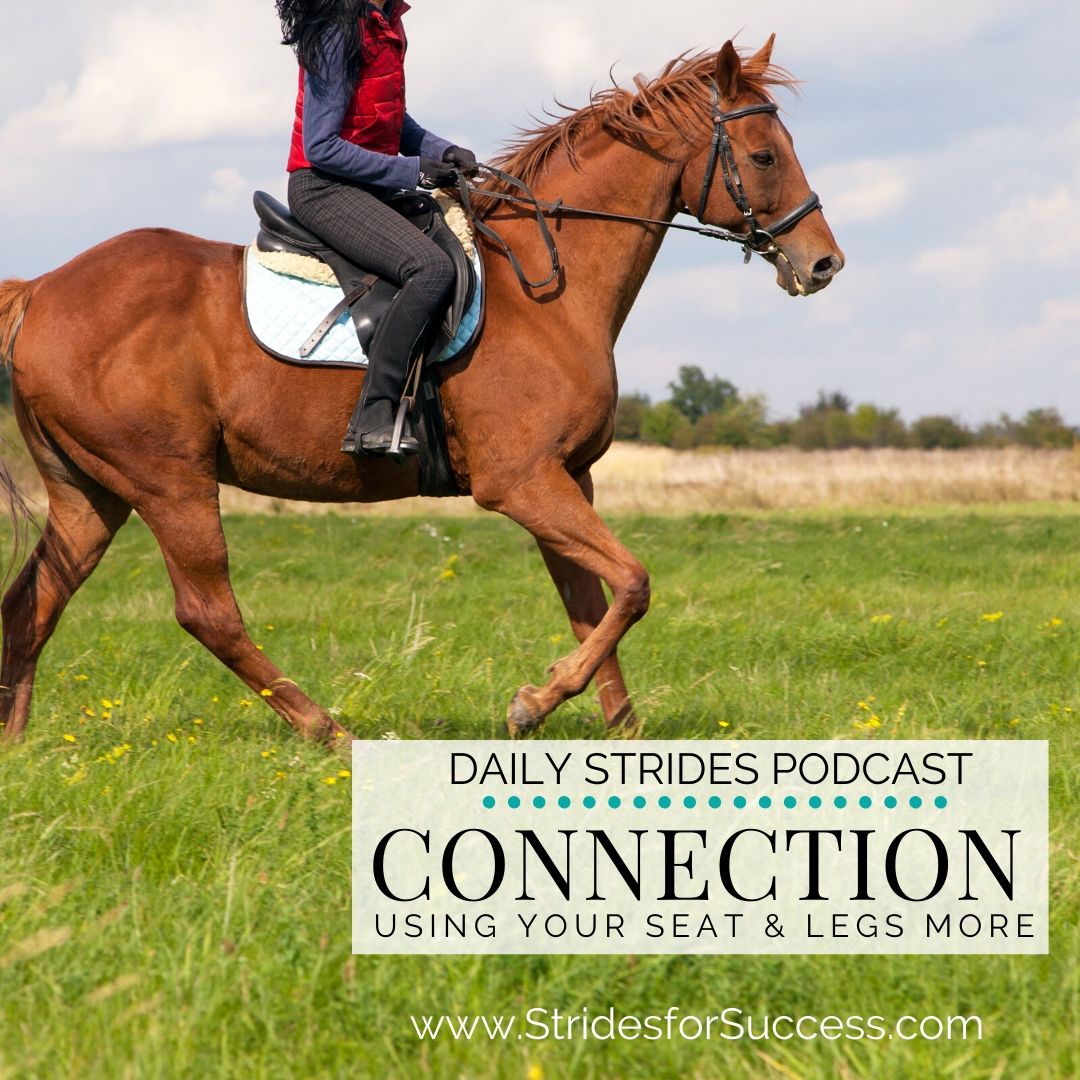
  • Connection in Your Riding; Seat and Legs

    Connection in Your Riding; Seat and Legs

    Connection; Using Your Seat and Leg Aids More

    Have you ever thought about what you can feel, in the saddle as you ride your horse? The physical connection points you have with your horse each time you’re in the saddle.

    [smart_track_player url=”https://op3.dev/e/traffic.libsyn.com/dailystridespodcast/1148-Connection-Points-In-Your-Riding-Seat-and-Legs.mp3″ title=”Connection in the Saddle; Your Seat and Legs” social_linkedin=”true” social_pinterest=”true” social_email=”true” tweet_text=”Your seat and legs do a lot more than just keep you in the saddle… Listen to this episode of the Daily Strides Podcast” hashtag=”equestrianpodcast” twitter_username=”strides_success” ]

    Often we can become so caught up with our aids and what we ‘should’ be doing, that we forget to focus on the actual points of physical connection between you and your horse. And the impact these connection points are having on each ride.

    Mount Up & Begin Walking

    The first thing I am going to suggest is to actually mount up and simply allow your horse to walk. It is amazing how often we forget to allow this to happen. We think that because we are in the saddle and the horse is moving underneath us, we are allowing the walk.

    And yet, so often we are blocking or working against our horse doing this simplest of tasks. Walking freely while we are in the saddle.

    How many times have you been in the saddle and focus on ‘getting the horse to walk’? This versus sitting back and actually just allowing the horse to walk.

    Doing Nothing

    One of the biggest challenges riders have is to do nothing. Not that I am telling you to do absolutely Jack Squack in the saddle! Rather any ‘doing’ your ‘doing’ is focused on yourself, rather than your horse. Things like carrying yourself. Another often overlooked part of riding for many riders.

    The simple act of mindfully beginning to carry your upper body, allows your lower body to follow, rather than remain ‘stuck’ between your ribcage and the saddle.

    The ‘doing nothing’ I am referring to is regarding swinging, forcing, shoving or any other ‘ings’ you can do that involve you ‘trying’ to get your horse to walk. Simply make sure that you are in the best possible position to allow your horse to walk; and in doing so, move the part of your body that is connected to the saddle.

    You are allowing your horse to move your seat; not you shoving your seat in order to move your horse

    Remain Independent

    Remaining secure and balanced of your own accord are the basics of independence. A quick test of this, as a rider, is to imagine you could instantly make your horse vanish. How would you land on the ground? On your feet? If so, you’ve got this covered already, congratulations! On your face or bum means that you have an issue with your other connections points; your legs.

    There should not be daylight between your legs and your horse’s sides. This is especially true of your thighs and your lower legs or calves.

    Your independent seat depends on your abilities to balance yourself. This depends on how you have positioned your body in the saddle. Any tipping, gripping, toppling, or leaning means that you are using your horse for balance.

    Using your connection points to hold on means that they cannot be part of the actual conversation. They are no longer aids and are pretty useless when communicating.

    Connection Points Between You And Your Horse

    Once you have positioned yourself so that you are carrying yourself, notice your legs. There should not be daylight between them and your horse’s sides. If there is, it usually means you are gripping or pinching somewhere higher up. Allow your legs to drape. To hang from your hips.

    Your legs are an important part of the conversation between you and your horse. However, because many riders do not use them correctly, they are misunderstood and ignored by the horse.

    Your legs are not to keep you on the horse. Rather to communicates with your horse. No one likes a ‘Cling-on Warrior’; meaning if you are using your legs to hold you on, you are taking advantage of your position. Rather allow your legs to ‘drape’. Let the weight drop down into your heel. And from there, your legs can actually be used for what they do best; to communicate with your horse.

    Your Seat & How it Feels

    Like I’ve said already, your seat is a valuable communication aid in the conversation with your horse. But only if you first learn to ‘allow’ through it. Allow your horse to move your seat, rather than you moving your seat in order to move your horse.

    I want you to zone in on how this feels. Actually, it physically feels. One of the first things you may notice is that there is a rhythm to it. Forwards and backwards rhythm to the physical movement. Stay with this feeling a while.

    Notice how there is also an ‘up and down’ to the movement. It too is in rhythm.

    When I am explaining this to riders, I often think of the pedals of a bicycle. Except when its the horse it is the other way around. Forward and down, backward and up. Rotation of your seat bones. Moving with the horse and allowing the horses back to move them.

    The Rhythm of the Conversation

    Have you ever been part of a great conversation with someone, and someone else will randomly just ‘butt in’ to your conversation? They may or may not be even speaking about the same topic. It doesn’t matter. The simple act of their interruption is enough to work against the natural flow or rhythm of the conversation.

    I think that if you are honest with yourself and begin thinking about your conversation with your horse like this, you’ll notice places where you’re not being as consistent as you would like. Your leg aids. Randomly going between squeezing to stay on and squeezing because it’s now an aid. Your seat; moving between digging, shoving, and the occasional half halt.

    Riders have a habit of ‘butting in’ randomly in the ongoing conversation between them and their horses. The the two most common places this happens is with the aids that form the natural physical connection between them.

    Get Clear on Your Connection & Your Aids

    You can always refine your aids. There are the basics, such as your position, your posture, and using the actual aids themselves, you get to play with the next level of this connection. The timing element. However, you can only begin to do all of this when you wake up to what you are currently ‘saying’ in the saddle, right now.

    Timing is the place that you can really take the conversation to a new level between you and your horse. Using your existing connection and timing how you communicate with it.

    However, it all starts with taking a good hard, honest look at what is currently happening with your seat and legs while you ride. Then mindfully beginning to change how you are using your connection to help enhance the overall conversation.

    Happy Riding
    Lorna

    Additional Resources to Help

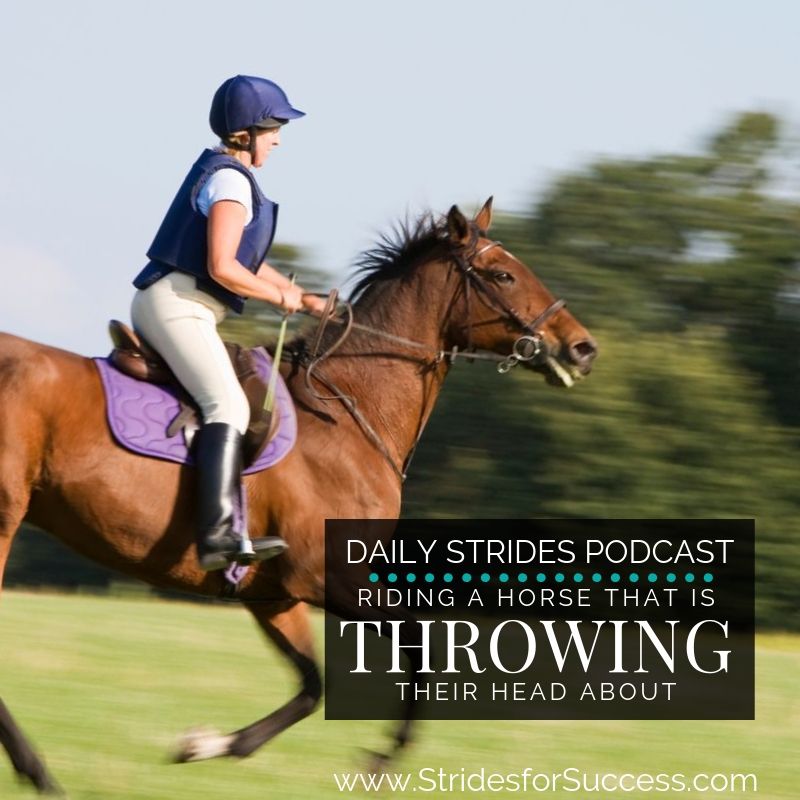
  • Riding a Horse who is Tossing or Throwing his Head

    Riding a Horse who is Tossing or Throwing his Head

    [fusebox_track_player url=”https://op3.dev/e/traffic.libsyn.com/dailystridespodcast/1117-Riding-a-Horse-that-Tosses-or-Throws-his-Head.mp3″ title=”Riding a Horse that Tosses or Throws His Head” social_linkedin=”true” social_pinterest=”true” social_email=”true” tweet_text=”To retrain a horse that tosses or throws his head…” hashtag=”horsepodcast” twitter_username=”strides_success” ]

    Setting goals and making plans can feel like a waste of time when your horse is continuously tossing or throwing his head about. If you have a horse who reacts this way when being ridden, you will agree with me. It seems that no matter what you do, this issue is going to taint everything else in your riding. And it will.

    Horse riding is about the conversation between horse and rider. A big part of that conversation is the contact and the connection.  Tossing or throwing of the head makes consistency in both of these things pretty impossible.

    I do want to preface this by stating the obvious. If you are struggling with this issue, get your horse checked first and foremost by a vet. Rule out any health issues or other issues that may be leading to this behavior. I am also going to strongly suggest having a chiropractor, dentist and qualified saddler come out and assess or work with your horse.

    With head tossing or throwing, the details are important. Rule out every possible outside interference first. From there, you can begin to work on things that you can influence when it comes to changing this behaviour.

    Consider Your BIt

    I know, I have already said about a saddler. But having a look at the actual bit can sometimes help to clear this problem up from the get-go. As riders, we tend to have a couple of favorites or go to bits. One that we have had success with over the years and we find most horses enjoy being ridden in. However, we often forget the one really important thing

    Horses change. What worked for the past 5 years, or 5 weeks, might no longer work that well anymore. As your horse develops, the contact will change. It stands to reason that pmaybe the bit may need to change as well.

    It is always important to remember that all horses are unique individuals. What works for one might not work for another. It is easy to assume everything is training related. However, sometimes, the horse is just not comfortable with a particular piece of equipment. All the training in the world won’t change that.

    Keep in mind that this may also be the noseband or even the shape or type of bridle. Assess all the equipment regularly and make changes as necessary

    Is it a Training Issue…?

    A horse who is continuously sticking his nose in the air is going to have developed differently from a horse who engages through its back. Simply put, where the energy goes will decide how the horse physically develops. Hollowness seems to almost always accompany a horse who is tossing or throwing his head about.

    Correct training is using specific principles in order to allow the horse to use his body to the best of his natural ability.

    A horse who is traveling with his nose in the air is definitely not doing this. Now, whether the training caused the tossing or the tossing caused the incorrect training will depend on each situation. What is important to note is that most horses who are regularly tossing or throwing their heads about will need some form of re-training or re-schooling.

    A simple way to imagine this is by thinking of your horse’s back like a stick. His ears are one end of the stick, his tail the other. When you put something really heavy in the middle of the stick, it will break. Now, and this is the important part, look where the ‘ears’ of the stick go when the stick breaks. Up in the air.

    The Rider’s Influence

    Now, you might be thinking that having his nose in the air and tossing or throwing his head about are two different things. And they are. However, it is the rider’s reaction to the nose in the air that can lead to the horse beginning to toss or throw its head about.

    Hollowness occurs when the energy is not connecting through from the back to the front. The energy channel is broken. Correct training can repair or strengthen that channel

    And yet, most riders will focus on what they can see. What is right in front of them… Their horse’s nose. A ‘war’ begins. The rider tries to force the horse’s head down. The horse resists, because of the hollowness, and tries to keep its nose up.

    The riders focus should be on what is happening underneath them, rather than what they can see in-front of them. The ‘in front’ is usually the result of what is going on both behind and under the rider at any given time.

    Re-Training Takes Time…

    If your horse has been tossing or throwing his head about for any length of time, his body will have developed in a way that best supports this behavior. For the most part, this is not the ideal way a horse should develop! Particularly if we want to go on and ‘do something’ with the horse where we are asking bigger questions of his abilities.

    Muscles take time to develop. Which means that your horses retraining will take time.

    I would suggest setting up an initial 12-week or three-month plan to really begin working from the beginning again with your horse. I personally believe that the traditional training scale is a great way of really allowing your horse’s natural abilities to shine while developing him physically and mentally.

    I have a step-by-step program HERE that gives riders the exact tools and exercises they need to begin working on this the right way.

    Quick fixes are not going to ‘cure’ this particular issue. They are a band-aid, which when pressure is applied, is going to come off. Time, correct training, and consistency are really the only way to re-training or re-school this issue if it does stem from incorrect training. This is also true if some other issue has caused the horse to develop incorrectly.

    Head Tossing due to Anxiety

    Increased anxiety in the horse often results in head tossing. I find that this often is the result of the rider asking questions that the horse simply cannot answer. Why they can’t answer can be down to either being unable to answer the question. This is often called ‘over-facing’ a horse.

    Asking too much too soon. The horse is just not physically, mentally or emotionally able, at that point, to do what is being asked of them.

    Anxiety can also come from simply not understanding the question. This can be down to two reasons. Lack of training, in which case, I will again suggest the traditional training scale. Not understanding the question can also be due to the rider not asking correctly. Rider error…

    The Rider…

    So many horses are tossing or throwing their heads about as a direct result of something a rider is, or isn’t, doing. If you have a horse who is doing this particular behavior, I feel that it is really important to put your riding under the spotlight.

    Piano fingers can often be the culprit. Riders who are allowing the reins to get long. And then, realize this and shorten them back up again. Their fingers are in almost constant motion up and down the reins! Piano fingers!

    You have a huge influence over your horse. Particular over your horses head seeing as you have a literal direct line to it in your hands.

    Another way a rider can be the issue is when they, intentionally or not, are asking the horse to create more energy. But then blocking or holding that energy and not allowing it forward. It can be a driving seat. A tapping or swinging leg. A whip that is literally animated with each stride the horse takes.

    Pressure & Release

    The final suggestion I am going to make when it comes to working with a horse who is tossing or throwing their head about is to work on refining pressure and release. This is the way we really and truly communicate what we want to our horse. We apply pressure and then, as soon as the horse begins to make a move the way we want him to, we release the pressure. The release is the reward.

    Pressure and release is so important when it comes how we train or re-train our horses. It can also help to begin working with a horse who is feeling anxious or who is not responsive to aids.

    It is important to realize that this particular challenge will usually require a more long-term approach to correctly retraining the behavior. It will take time. It will take consistency. However, it can most certainly be done.

    Happy Riding
    Lorna

    Other resources to help with this topic:-

    Other Episodes on Similar Topics

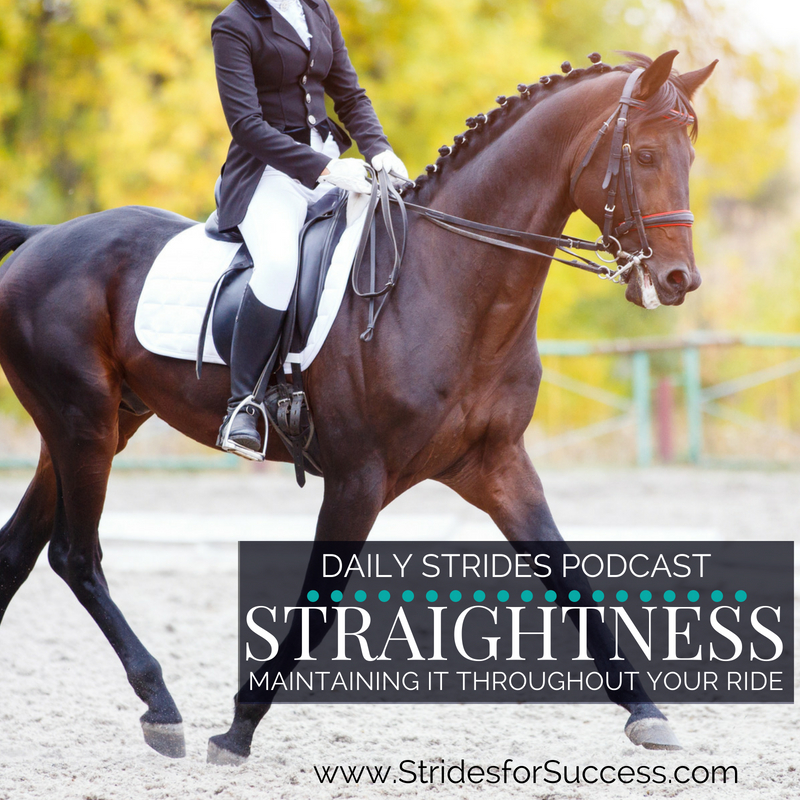
  • Maintaining Straightness Throughout the Ride

    Maintaining Straightness Throughout the Ride

    Straightness, Maintaining it Throughout Your Ride

    What this episode is all about & how it can help you:-

    • Be clear on what is straightness
    • Understanding how your aids are a mould
    • Knowing why you have to regulate where the energy is flowing
    • Notice when things are crooked

    If I were to stand in the arena, and you were to ride directly towards me – how straight would you and your horse be?  And how well could you maintain that straightness?  Be honest!

    [smart_track_player url=”https://op3.dev/e/traffic.libsyn.com/dailystridespodcast/1047-Maintaining-Straightness-Throughout-Your-Ride.mp3″ title=”Maintaining Straightness Throughout Your Ride” social_linkedin=”true” social_pinterest=”true” social_email=”true” tweet_text=”Struggling with keeping things on the ‘straight and narrow’ with your horse? ” hashtag=”equestrian #horselovers #makeeveryridegreat” twitter_username=”strides_success” ]

    Before we even get into the straightness it is important to stress the fact that, in order for your horse to be straight, there must be energy happening inside of his body.  Often riders try to work on straightness, but there is just no energy happening!

    If you look at the traditional Training Scale, impulsion comes before straightness.  Phew – that being said, let’s crack on with today’s topic…

    What is Straightness?

    If we were in an arena together and you were to ride towards me, I would assess straightness just like this.  I would look for your horse’s two legs on the left side of his body and the two legs on the right side of his body to be travelling on two separate tracks, that are running parallel with each other. Train tracks.  It’s that simple.

    Your horse must not deviate from those two parallel tracks.  Simply put; he must not ‘derail’. 

    How could he derail?  He could go crooked by winding and bending.  He could ‘wander’ a little.  However one of the biggest issues riders face is that the shoulders or hind quarters tend to shift off the track.  The horse really and truly derails ‘just a little bit’!

    Bringing it back to us in the arena together, let’s pretend I am standing in front of you (being all brave!).  You are riding towards me.  I should not be able to see your horses hind legs, because technically they should be behind the front legs (this is an example and of course confirmation etc will not make it literal!).

    So, if your horse were to deviate off the tracks, I would then be able to see the hind legs (from the front), or the front legs (from the back).  If I can see this, your horse is no longer working on parallel tracks, but rather three or four different tracks – which dissipates energy.

    Todays episode is all about working on the two parallel train tracks with your horse in basic riding and schooling.

    Your Aids are a Mould

    I said earlier that for straightness to be true, there needs to be energy coming into the channel that you and your horse are creating.

    Rather than ‘channelling’ energy, think about your aids being a mould – and any and all energy that is created in the hind quarters has to fill this mould. 

    When that mould is filled, the physical representation of it is that your horse is riding straight.  If your horse is crooked, it is usually because your mould is, somehow, crooked.

    Sometimes horses can develop where they are a little bit stronger on one side than on the other.  This can be due to a lot of different factors – perhaps an injury.  But it could also be the rider being an influence.

    But usually, if given the opportunity, the correctly schooled horse will go straight – until the rider steps in the way and gets the mould a little wrong. 

    Think about how maybe you are sitting more one side more than the other.  In doing so, your mould is not symmetrical.  Maybe your one hand has dipped down; maybe your one hand has opened more; maybe you have more tension in one seat bone more than the other; maybe your shoulders are tipped slightly; or maybe your one shoulder is travelling ahead of the other.

    By thinking about this mould in the context of any crookedness showing up in your horse, it sometimes becomes easier to identify how you are possibly negatively influencing your horses straightness.

    Sometimes It is Not the Rider

    That all being said, sometimes it can be that the horse has developed physically in a way that he is stronger one side that the other.  This causes him to become uneven as he pushes forward.  He is basically covering more ground one side than the other, which is causing him to be crooked.

    In this case you, the rider, may be straight and your mould is indeed true and perfect.  The the simple fact that there is more energy coming into your mould on one side than the other, is causing the mould to bulge.

    So, there are two ways we must consider this.  First, that we are setting up the mould correctly.   Secondly, that if we are sure that our mould is symmetrical and even, we need to consider that there is more energy coming in one side than on the other, that could be causing the crookedness.

    You Have to Regulate Where the Energy is Flowing

    As a rider, you need to begin thinking about regulating energy, and where this energy flows.  Very often when we talk about regulating the energy and energy flow, we can take it back to contact and connection.  This is how you are communicating with your horse at any given point.

    When you couple your connection or communication with straightness; this is where you get the horse to go where you want him to go

    Let’s assume that you have straightened yourself out.  Sometimes, a horse is perhaps a little bit stronger on one side than the other.  You may see this with a horse that tends to travel one way, the wrong way, over the other, the right way!   For them, it feels uncomfortable to do anything else.

    This is a good indicator of where you need to start regulating things.  Start simple.  Sprinkle little adjustments and exercises in to the regular work.

    Make it easy by doing things that your horse can easily do and perhaps enjoys doing – and then sprinkling the more difficult exercises or movements in between

    One way you could do this is working on a slight incline.  It is very difficult for a horse to have unequal thrust going up a hill.  By your regulating where that energy is flowing, and all the time making sure that your mould is perfect, your horse is going to begin working straight.

    Also, bear in mind that because he has travelled a certain way for a while, it is going to be uncomfortable for him to travel a different way.  Even if this ‘new’ way is the correct way.

    Don’t push it.  Slow and steady is going to win the race when it comes to true straightness

    Noticing When Things are Crooked

    For many riders, issues with straightness will show up in the canter.  If this is the case, I would suggest rather going back to basics; transitions between walk and trot and halt.  You will notice a lot there.

    Notice where there deviations away from the straightness with your horse.  Think about why this could be happening, and then begin to formulate a plan

    But remember, you must be the mould.  The energy must come through to fill your mould, and if your mould is not symmetrical and equal, well your horse is not going to be either.

    Happy Riding

    Lorna

    Links mentioned in the episode:-

  • The Training Scale for You & Your Horse

    The Training Scale for You & Your Horse

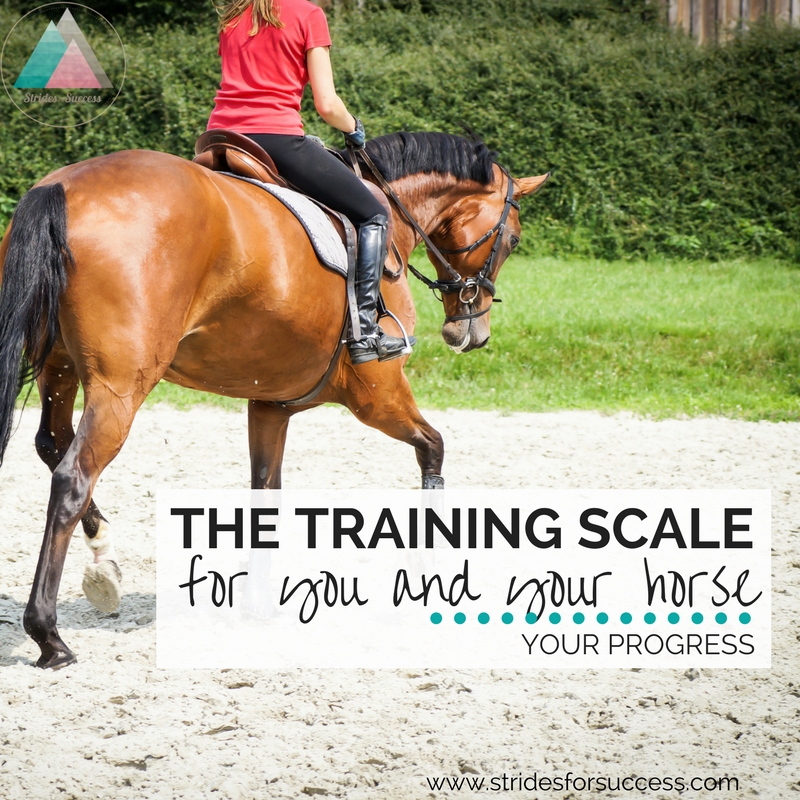
    The Training Scale for You and Your Horse

    It is always nice to have a plan or a map to follow when learning something new.  The training scale is that map for many riders when they begin schooling their horse.  However, the training scale can be equally as valuable for you, the rider.  It is a road map to help keep you on track with your riding.

    So before we begin, let’s be clear about what the training scale actually is.  The training scale is sequence of different aspects of training which, when worked through, has been found to develop horses correctly for being ridden.

    While each step is an individual aspect of training, none of them will be worked on individually.  There is a relationship between all of the steps – and that association must be maintained throughout the horses training.

    For the sake this blog post, we are going to call each of these aspects ‘steps’.  Another way to look at them is as blocks.  One must be laid down in order for the next to be placed on top. 

    They take a horse from the very foundational ‘basics’ of rhythm and relaxation and, when used correctly and thoughtfully, build up to the ‘pinnacle’, which is collection.

    The Training Scale - Strides for Success

    Many riders think of the training scale as being a ‘check list’ of sorts.  They feel that once they have reached step 1, they should only focus on mastering step 2 and so on.  When you consider the training scale, it is worth noting that no one step can be correctly achieved when another step has been ignored or cast aside in order to do so.

    The training scale should rather be approached with a more holistic mindset.  Yes, the bottom steps need to be in place in order to successfully build on the next step – but while mastering the bottom steps, a keen eye should be kept on all the steps.  This same principle applies when working on the top steps, the bottom steps need to be the basis of that work.

    No one step of the training scale can be taken and worked on independently and in a vacuum

    So taking this all into account, let’s have a quick overview of those steps and how they look for both horse and rider moving forward.

    The Foundation – Relaxation

    Relaxation is often included with or instead of the first two steps of the training scale.  However, I believe that relaxation starts before a saddle is ever even place on the horse.   The term relaxation is a confusing one for many riders; mostly due to our pre-programmed ideas of relaxation including a swimming pool, a lounger and a beverage!

    True relaxation is when horses and their riders lack excess tension, physically and mentally

    Some tension is needed in order for the horse to carry himself.  This is also true of the rider, a certain amount of tension is necessary.  It is the excess tension, caused by anxiety, stiffness, fear, nervousness, excitement and a whole list of other basic feelings, that causes the lack of true relaxation in the horse.

    The amount of relaxation required will depend on both horse and riders level of training.  Relaxation is relative, however it is also essential to correct riding – in both horse and rider.

    Step 1 – Rhythm

    Rhythm can be defined as a “strong, regular, repeated pattern of movement or sound”.  The key words in that description are regular, repeated pattern.   Each horse has their own natural rhythm.  This is equally true of riders.

    Rhythm, like relaxation, starts on the ground.  The rhythm of the routine you have created for your horse.  What works, what doesn’t.  Learning to know your horses natural rhythm begins here

    In the saddle, the repeated pattern is the footfalls or hoofbeats. The rhythm should not change.  It can be repeated more or less in a given time – and this the tempo that is being changed – but the rhythm itself should remain the same.

    As a rider, you must learn to first follow the rhythm.  Many riders try to force a rhythm on their horse, however forcing the rhythm will actually break your horses natural rhythm.

    Rhythm must initially be worked with, not worked on 

    A loss of rhythm will immediately direct your attention to a loss of balance.  It is learning to pin point that very first beat out of your horses natural rhythm that will determine your success as a rider.  Once the break in rhythm is identified, you can work at re-establishing it again.

    Rhythm & relaxation must be present in all other steps of the trainings scale in order for them to be correct and true

    Step 2 – Suppleness

    Suppleness, rhythm and relaxation are often shuffled around on the first two steps, depending on what training scale you are working from.  However, rather than allowing this to confuse you, think of all three as being equally as essential in order to begin building things further.  Visually, it would look like a triangle, all parts being necessary to maintain each other.

    Suppleness is the elasticity or ‘loosey gooseyness’ that your horse needs in order to use himself to the best of his abilities. It is the ease at which he can perform the work required of him

    Many riders think suppleness is address solely in the warm up phase of riding and schooling, however your horse must have suppleness throughout all his movements when being ridden.

    Stiffness will stop the energy flowing through your horse; and in order to truly connect your horses back-end and front ends together, that energy must be allowed to flow as easily as possible

    From the riders perspective, a lack of suppleness will negatively impact the horses way of going.  Riders often make the mistake of focusing only on their horses suppleness.  They then become frustrated as their progress seems to stall.  The rider must try to consistently improve their own suppleness if they wish to be effective in the saddle.  Remember, the training scale is equally as important for the rider as it is for the horse.

    Due to its direct impact on the flow of the energy through your horse, suppleness, along with relaxation and rhythm, must be present before your horse can begin working on step 3 of the training scale.

    The Training Scale for You and Your Horse

    Step 3 – Contact & Connection

    Once both you and your horse can perform work to a certain level while effectively maintaining relaxation, rhythm and suppleness, you can begin working on improving your contact and connection.

    I like to think of the contact as being a conversation with your horse.  A good conversation has a certain give and take, and ebb and flow, to it – and it is important to consider this when it comes to your contact

    Many riders think of contact as being the thing that creates the ‘head carriage’ in their horses ‘frame’.  Unfortunately if you approach contact or connection in this way, you will actually set your training – and your riding – backwards.

    Contact must first of all be established and then maintained as the horse is being ridden.  It requires soft hands, soft elbows and also good posture and position in the saddle.  A fixed contact will lead to the disappearance of the relaxation and suppleness in both you and your horse.

    Contact and connection are like the ‘banks’ of the river that is your horses flow of energy.  They are how you can begin to direct, influence and channel that energy as your horse is working

    For this reason, it is important to consider your overall position, seat and leg aids as being a part of the contact.  If you seat is heavy or if you are pushing, or shoving with your seat, that energy cannot flow, which will then prevent you from having that elastic contact you need in order to correctly work your horse.

    Steps 4, 5 and 6 – Impulsion, Straightness & Collection

    As your horse works through the first three steps of the training scale, rhythm, suppleness and contact, it is important to keep the next steps in mind.

    For example, there is a certain amount of energy needed to come from behind, impulsion, in order to truly maintain a working contact.  There is also a certain amount of straightness needed when working on truly suppling your horse.

    I will go into more detail on the other three steps of the training scale next week.  However, I strong suggest working on your relaxation and rhythm with the end in mind.

    It is also worth noting that, as I mentioned at the beginning, the training scale is not a checklist.  You cannot forget about rhythm as soon as you begin working on suppleness, or even collection.  Each of the steps need the previous steps to be in place and operating correctly in order for that step to be mastered.  Collection cannot happen without rhythm being present.

    And all of the steps have the potential to test the abilities of both you and your horse, even at the most basic levels of your training.  Investing the time and effort in learning to master the basics will see both you and your horse progress correctly later.

    Click here to subscribe

    If you download the free poster of the training scale, I will send you some information on each of the ‘steps’ in more detail.  It is 100% free and you can sign up HERE to access it.

    Happy riding
    Lorna

    Click here to subscribe