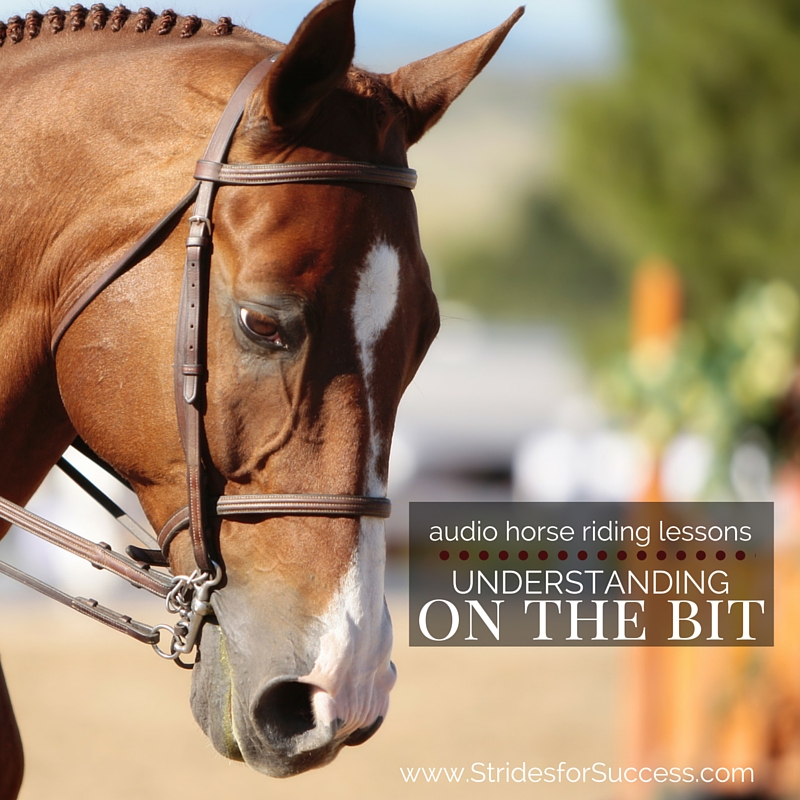
Tag: connection

  • How Well Does Your Horse Understand Your Aids?

    How Well Does Your Horse Understand Your Aids?

    Have you ever become frustrated when someone is failing to understand and respond appropriately to your requests and communications?  Have you ever experienced this in the saddle? For many riders, they noticed that, even more frustratingly, this often occurs when they feel their riding should actually be improving.

    You’re not alone.  Many riders begin to feel this way after they have taken action to improve their skills in the saddle.  It could be that you invested in extra lessons, attended a clinic, joined Daily Strides Premium, completed the 30 Day Rider Fitness Challenge…  Perhaps you have studied a little more deeply as to the hows and whys of particular aids and the timing of them.  Whatever it is, you will have recently done something to take your skills in the saddle to the next level, but it actually seems that things are going backwards!

    The first thing that comes to mind for many riders is their horses responsiveness, or the lack thereof, when they apply their aids.  However, I want you to ask yourself, is it a responsiveness issue or a basic language breakdown you are experiencing?

    Often we improve our riding, but fail to update our horse on the fact that the situation has changed

    Now before we go any further, firstly I think it is fantastic that you are working towards better communication with your horse.  But remember, your knowing what to do and then you doing it is only one half of the equation.

    Your horse has not attended the same ‘study group’ and, if we think of our aids as a language, he has no idea that the dialect has changed…

    Part of improving your skills in the saddle is to effectively communicate with your horse in order to update his ‘responsive’ and ‘listening’ skills as well.  However, before you rush out and begin ‘retraining’ your horse, you need to first figure out exactly what he understands, and what has gotten lost in translation.

    I suggest starting at the beginning with the basics.  How effective are the simple ‘stop / go’, ‘steady’ and ‘turn’ commands working?  Very often we learn how to better control our seat when directing our horse, however our horse is still listening for the ‘old aids’.

    Next time you are in the saddle, work on establishing the basics again:-

    • Half halt
    • Moving forward and slowing down
    • Bending and turning

    From here, you will need to test how well your horse is truly understanding your aids.  Knowing what he understands and what is being ‘lost’ will give you a good starting point to move on from.

    • Test the walk to halt
    • Test the walk to trot
    • Test the canter transitions
    • Test the ability to adjust the length of the stride
    • Test how your horse understands the lateral aids

    Once you know where you stand with your horse, you can then look at how you can begin to educate or train your horse to understand your aids, giving you both clearer communication in the saddle.

    To help you with this process, I have created audio programs for you to download, for free, that will take you step by step through this process.

  • Engaging Your Horse’s Hind Quarters

    Engaging Your Horse’s Hind Quarters

    Have you ever looked at photos or videos of your horse and it looks like his hind quarters are, literally, being left behind? They are dragging out behind him, rather than working underneath him. Or perhaps you have gotten the feeling that when you ask for ‘more’ when in the saddle, there is just no way he can provide ‘more’ without speeding up and becoming long…

    Knowing how to activate and then engaging your horse’s hind quarters is vital to his long-term training and development. However for many riders, it can be a little daunting trying to figure out if he is truly in ‘rear wheel drive’ rather than ‘front wheel drive’ while they are working or schooling their horse.

    [smart_track_player url=”https://op3.dev/e/traffic.libsyn.com/dailystridespodcast/631-Engaging-the-Hind-Quarters.mp3″ title=”Engaging Your Horses Hind Quarters” social_linkedin=”true” social_pinterest=”true” social_email=”true” tweet_text=”Struggling to get the back end working? Engaging the hind quarters – step by step..” hashtag=”equestrian #dailystrides #horseriding” twitter_username=”strides_success” ]

    However taking the time to begin asking your horse to work correctly from back to front will be a key factor in his overall development and training and also, the deciding factor between him becoming stronger when being ridden, or just remaining where he is, effectively capping his progress.

    So, first and foremost when we talk about engaging the hind quarters, we are speaking about activating them or getting them to work while we are riding our horse and then connecting the energy produced to the front of his body. Engaged in this sense means to bind or interlock, so engaging the hind quarters is literally interlocking it with the rest of his body. Like I mentioned earlier, your horse being in rear wheel drive, means that his all the time pushing from behind, using his hind quarters. This is far more favourable when being ridden than pulling from the front with his front legs and shoulders.

    Before we go any further it is also worth mentioning that your horse will need time to develop the necessary strength to truly activate and then engage his hindquarters when being ridden. It is up to you, the rider, to make sure you do not push him beyond what he is capable of for his level of training or schooling. Slow and steady wins the race when working with horses…

    Pushing from behind requires your horse to be moving forward in the first place. Many riders seem to think that their horse merely moving is going forward, but in truth, going forward can more be described as your horse moving forward with a sense of purpose. They must have a little ‘pep in their step’ so to speak, rather than ambling along, hooves shuffling and dragging on the ground, each step looking like a momentous task

    Responsiveness is part of the key to having your horse moving forward. A simple ‘You ask; he responds’ system in place which both you and your horse understand that there is a mutual responsibility from all parties if it is to work effectively. You are responsible for making sure that you are clear in what you ask. Your aids and also where you plan on going from that point are well thought out and executed. Your horse must then become responsible for adhering to your aids and directions in a willing and cooperative way.

    If either side of the team, horse and rider, reneges on their individual responsibilities the result is a lack of forward movement, which will result in an inability to engage the hind quarters

    Once your horse is moving forward, it is then up to you to allow that energy being created from behind to connect with the front of the horse, thus actually ‘engaging’ the hind quarters. There are a few different aspects to allowing this to happen, but again, if any are missing it will result in the hind quarters being ‘disengaged’ and left to their own devices, separate to the rest of the horse’s body working with the forward movement.

    Engaging Your Horse's Hind Quarters

    Think of energy as being a little like water or electricity. It will generally always try to find the shortest and easiest route. If you allow your horse to become crooked through his body, the energy will not flow where you want it and rather ‘shoot out the side door’. An example of this is on a circle, the hind quarters being allowed to swing out wide of the tracks the front feet have created. When this happens the energy, rather than pushing forward from behind and connecting to the front of the horse, will be lost out the side door of the horse, resulting in the horse going into ‘front wheel drive’ again.

    When riding you should think of your aids, particularly seat, legs and arms, as being the banks of a river or canal. They will channel the water / energy that is being created in the hind quarters where you want it to go. This will continue to keep the energy moving forward and connecting, from back to front

    This is why straightness is so important when training a horse and rider. Many times we focus on how straight the horse is, but ignore the obvious twisting or tilting of the rider’s body. Any crookedness in either horse or rider will again result in a disengagement of the hind quarters, which will see the energy dissipate and eventually be lost.

    Another important factor to consider when thinking about this engaging of the back to the front of your horse’s body is the idea of ‘allowing’ that energy to flow underneath you through your horse’s back. Some riders really work hard at activating the hind quarters and getting them to work, but then due to a heaviness or tightness in their body, block this energy from connecting through or engaging with the front of the horse

    When we learn to ride initially, we are often told to ‘sit up’, however we are rarely told why; other than the whole falling off aspect of collapsing through your body. But let’s assume you have indeed mastered staying on, however you are still finding it difficult to truly connect the hind quarters to the front end of the horse (through your contact), it may just be because you are blocking this.

    Just as water can be dammed up, blocked or diverted, so too can energy. Sitting heavy in the saddle is the most common culprit here, but so too are shutting things down with your thighs. They can have a vice like effect on your horse if there is excess tension in your body. Also, leaning forward over your horse’s shoulders or withers will be highly effective in shutting down any engagement of the hind quarters.

    Make sure that when you are riding, you are all the time encouraging your horse to use his back by being ‘light’ in the saddle. This is often as simple as sitting up through your rib cage, carrying your upper torso. This simple change is often enough to allow your pelvis to begin moving with the horse, which will in turn allow your horse to use his back.

    Once you have managed to get your horse moving forward from his hind quarters or from behind and then are allowing that energy to flow underneath or through you in the saddle, the final piece of the puzzle is ready to happen…

    To truly engage means to connect, bind or interlock. In the case of the hind quarters, we want to connect them to the rest of the horse like a gear cog. This allows you to truly direct the energy being created there. We do this through our contact with the horse

    The unfortunate part of this is that most people look at the contact part as Step 1, rather than the final piece of the puzzle, or in this case for simplicity sake, Step 3. Contact is just like the responsiveness, there is a responsibility on both horse and rider to fulfil their end of the contract in order for it to work correctly and be effective.

    If either horse or rider try to force it, it will be lost. Similarly, if either side try to evade it, it will be lost. Many times we blame the horse for evading the contact, but I see many riders who also ‘evade’ through reins that are too loose, or fingers that are wide open and look better suited to playing a piano rather than holding their reins.

    Only when all three steps are in place can your horse truly engage his hind quarters and can you then begin to feel the difference between rear wheel drive and front wheel drive. The difference? Night and day! It feels like there is always energy there to perform what is asked. It feels like your horse moving forward with purpose. It looks so much more pleasing to the eye, as both horse and rider are in true agreement with each other, both maintaining responsibility for their individual part in keeping things together.

    There are many exercises you can do to begin asking your horse to use his hind quarters but none will really be successful until you truly understand what it means to engage and connect the back to the front.

    Happy Riding
    Lorna

    This is the first of 5 audio programs on this topic. In the rest of the programs you can listen to while riding for step by step instructions on how to effectively begin engaging your horse’s hind quarters. The exercises are suitable for all levels of riders and can be worked into your usual schooling routine with your horse.

    For more information on how to download the rest of the lessons and gain access to over 600 audio horse riding programs on a whole range of different topics, visit https://stridesforsuccess.com/join/

  • Assessing ‘On The Bit’ While Riding

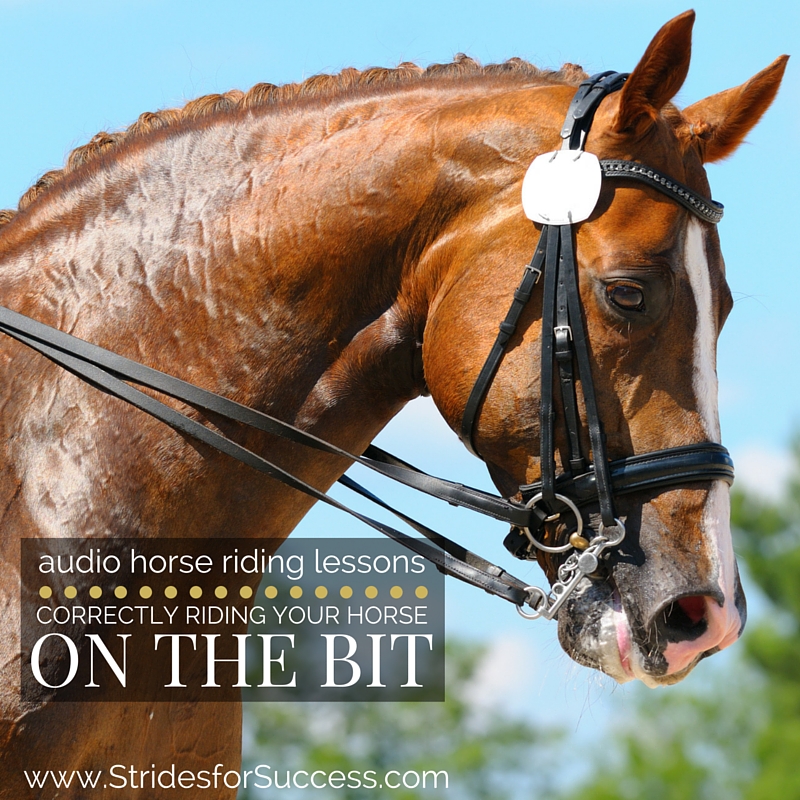
    Assessing ‘On The Bit’ While Riding

    [fusebox_track_player url=”https://op3.dev/e/traffic.libsyn.com/secure/dailystridespodcast/576-Correctly-Riding-Your-Horse-On-The-Bit.mp3″ title=”Correctly Riding Your Horse ‘On the Bit’” social_linkedin=”true” social_pinterest=”true” social_email=”true” ]

    Left – Right – Left – Right – Left – Right…  The horse’s head turning one way and then back the other.  Every single stride.  A misguided attempt by the rider to achieve ‘on the bit’.  Have you ever seen this?   The horse looks like he is auditioning for the role of the bobblehead in the back window of someone’s car.  The rider looks like they are trying to get a ‘swinging’ upper body workout in with their riding… Left – Right – Left – Right – Left – Right…

    On the bit is a little like the holy grail of horse riding.  It is an ideal that most riders aspire to.  However, because it is more a result that is achieved through the culmination of hours of consistent riding; many riders will never truly achieve it because they are not willing to put the work in.

    Unfortunately, just like most highly desired outcomes, the eagerness to obtain it leaves the door wide open for endless counterfeit reproductions being passed off as the real thing.  One of those being that many riders are merrily sawing away at their horse’s mouths thinking they are indeed ‘on the bit’.

    What is ‘On The Bit’?

    It almost becomes easier to define ‘on the bit’ by what it is not, rather than what it is.  However I think we should always try to see the correct picture first and then hold those above-mentioned ‘counterfeits’ against it so we can see the differences.

    ‘On The Bit’ is when your horse is creating energy with his hind quarters, that is being funnelled along, through his back to the front end of his body, where it is ‘channelled’ into the contact with the reins and bit.

    What is vitally important to note is that the reins and bit part can only happen after the energy has been correctly manifested.  After it has been connected through the back.  Reins and bit are the final pieces of the puzzle rather than the starting points. This is what generally trips many riders up.

    No Sawing Required!

    Being ‘On The Bit’ has nothing to do with sawing your horse’s mouth, or pulling his head in (or up, or down, or anywhere for that matter!).

    It has everything to do with your horse using himself to the best of his ability and learning to carry both himself and you.

    The Pre-Requisites for ‘On the Bit’

    So before we even begin discussing how to achieve this contact and connection, let’s first begin by making sure all the prerequisites are in place. This will ensure both you and your horse have the best possible chance of correctly working on the bit.   It goes without saying that your horse must be moving forward.  However, moving forward correctly off your leg, rather than just running aimlessly around the arena is also a vital disparity to make.

    Moving off your leg will ensure that your horse is responsive to your aids and traveling with rhythm and balance.

    You ask, he responds.  If you are having to push for every stride, or if your horse has a little ‘think’ about actually doing what you want each time you ask, I would highly suggest working on his responsiveness first, before you begin anything else in your training.

    Connecting the Energy

    Once you have established forwardness, you can then begin working on allowing that same energy to connect through from the back to the front.  

    Horses should work in rear wheel drive, meaning that they push from behind rather than pull from the front

    However, this energy then needs to connect or move through the horse in order to ‘lift’ and carry the front half of his body along with him.  What a lot of riders don’t realize is that they are the actual cause or reason that connection or transference of energy is not happening.  Simply sitting heavily in the saddle, or slouching through your shoulders or upper body, is enough to shut down that flow of energy.

    Correctly Working Your Horse On the Bit

    Self Carriage for Riders First…

    To prevent this, I want you to think about sitting up through your waist and ribs.  Think of trying to elongate your torso.  Use your muscles to carry your upper body so it does not collapse on your pelvis and hips.

    Once you are carrying yourself, I also suggest paying attention to the distance between the point of your shoulders across your chest.  Notice how when you draw your shoulders together – and shorten this distance – it affects your whole body.  Be aware of keeping your chest open all through your riding.

    Many instructors will teach this as ‘Shoulders Back’, but I find that simply pushing your shoulders back rather makes your body rigid.  Opening your chest is a softer and more flexible movement.

    The Final Piece of ‘On the Bit’

    Once you have your horse moving forward in a responsive fashion, and the energy flowing underneath you connecting the hindquarters to the front end of your horse, you’re ready.

    The final piece of the puzzle is gathering or channelling that energy to where you want it to go. You do this using your contact

    Establishing and maintaining consistent contact with your horse is key to riding on the bit.  The contact should be elasticized and ‘stretchy’; your elbows being pliable and supple enough to literally hold your horse’s mouth in your hands.  Pulling, forcing, sawing or any other use of physical force will not allow the correct use of the contact.

    Developing Over Time

    Through working correctly, your horse will begin to become stronger through his body, and assuming you are carrying yourself while in the saddle, he will begin to lift his back as he works.  This lifting of his back will allow him greater connection from the back-end through to the front end.

    It will also begin to free up his shoulders a little more.  The less the shoulders are ‘pulling’ the more they can begin ‘swinging’ and from here your horse will begin seeking out the connection with your contact.

    It will feel like holding a one end of a skipping rope with another person.  Not gripping or pulling.  There is a mutual understanding. Both are willing to do the necessary to maintain the connection and move the rope where they want it to go

    Don’t make the mistake of becoming obsessed with your horse’s head carriage.  Remember, being on the bit is the result of working correctly over time in order to build and develop the necessary strength and trust with your horse.  Where and how he carries his head will be the result of both of you carrying yourselves correctly.

    Reestablishing On the Bit when Necessary

    Also remember to use your half-halt, both to set up your transitions or different movements.  And also to rebalance and regroup when things fall apart, which they will quite often initially.

    Be consistent with your contact through the outside rein, and soft – almost offering – of your contact through the inside rein.

    As your horse begins to spend more time working on the bit, you can use your inside rein to see his he is truly carrying himself.  Does he continue to move forward when you soften your inside rein?  If so, he is truly moving and working ‘On The Bit’.

    Happy Riding
    Lorna

    Connection for Equestrians

    I have created 5 audio horse riding programs on this subject.  They will take you step by step through working your horse correctly in order to achieve a consistent ‘On the Bit’.

    If you are interested in listening to these programs (and hundreds more) you can visit https://stridesforsuccess.com/join/ to find out more.

    Other Info On this Topic

    Additional Resources To Help Equestrians:-

  • Trotting Without Running

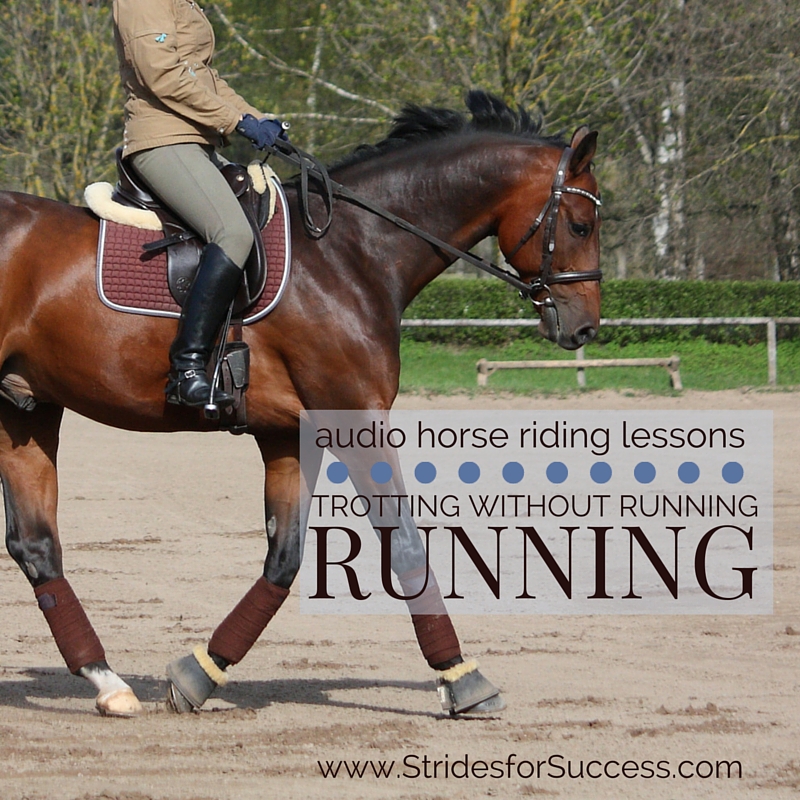
    Trotting Without Running


    Do you find that when you ask your horse for a more expressive trot, he just seems to begin running onto his forehand with you, becoming heavier and heavier with each stride? You’re not alone!

    Many riders set out looking to achieve an active, working trot… But due to lots of different factors, this can end up just ‘running’ around the arena. The horse resembling an arrow of sorts!

    The front end getting lower and lower with each passing stride, while the back end is getting completely left behind!

    Unfortunately, what usually happens next is the one thing that exasperates this ‘effect’ even further and that is hauling on the reins; dropping an anchor if you will.

    The reason this just makes the whole situation worse is by doing this, you and your horse begin to engage in a ‘tug of war’ of sorts. And, quite frankly, being involved in such a game with a 600 kg animal is an exhausting endeavor!

    Trotting Without Running | Audio Horse Riding Lessons


    Speed Versus Impulsion

    Often, as riders, we can confuse speed with impulsion…  We think that by asking for the trot to go 100 mph around the arena, we are really working our horses… Pushing forward with each passing stride.  The truth however is that while we may be creating energy, we are letting it all ‘fall’ out the front end of our horse, never contained and put to use in any form conductive ‘good’ work.

    The first part of mastering trotting without running is imagining in your mind that your horse’s back end is coming more and more underneath him… While his front end is becoming slightly higher and more elevated, as well as light in your hand.

    This is the picture you should work towards continually as you ride.  What is important to remember with this picture, is the ‘lightness in the hand’ part.  This cannot be achieved by hauling on the reins in the eternal tug of war.

    I challenge you to not only change how you think of working trot but also what you are physically doing with your body to ask your horse to begin using himself more.

    Happy Riding
    Lorna

    Additional Links to Help You:-

  • Riding on the Bit

    Riding on the Bit

    [fusebox_track_player url=”https://op3.dev/e/traffic.libsyn.com/secure/dailystridespodcast/576-Correctly-Riding-Your-Horse-On-The-Bit.mp3″ title=”Riding On the Bit” social_linkedin=”true” social_pinterest=”true” social_email=”true” tweet_text=”Struggling with On the Bit? This will help…” hashtag=”horsepodcast, #equestrianpodcast” twitter_username=”strides_success” ]

    So, we’ve all been there, riding around the arena on our horse, desperately seeking the elusive ‘On the Bit’.   Pumping with our legs, ‘sponging’ with our hands; doing our level best to achieve what is beginning to feel like the holy grail of riding a horse!

    All the while hoping, praying, wishing (hey, when you are desperate you will resort to anything!) that a lightning bolt will just shoot out of the sky and, **Poof**, your horse is ‘on the bit’!

    The sad part is that the more we pump with our legs, push with our seat and plead with the Good Lord to show us mercy and deliver us from this agony that is our desperation… The less and less likely we actually are of achieving our goal!

    For many trainers, it can feel like there is a fine line when explaining this concept.  I am taking the brave (or stupid, depending on where you see the line) step of trying to decipher this massive mystery.  A feat by which so many riders define themselves.

    Riding on the Bit - Daily Strides Podcast - Strides for SuccessWhat Is ‘On the Bit’?

    The term ‘on the bit’ is an extremely misleading one as rather than focusing on your horse’s head, neck, and mouth.

    Your focus as the rider should be on what you are staying to your horse through your aids.  And then noticing how your horse is then using his body in response to this.

    The key to truly having your horse accepting your contact is the reason behind wanting him to do so.  So you can collect and then channel the energy that is being created in his hindquarters as it passes through his body to his front end.

    Developing On the Bit in Your Riding

    As this energy is then gathered and channelled, you will find both you and your horse on the bit.  You may only see glimpses at first; but over time this will develop.  you will both learn to establish on the bit earlier in the ride.  And also, maintain this contact and connection for longer periods as you both develop.

    The rider needs to begin making small adjustments. Not only their body, but their mind, so as they can become ‘feather riders’ and allow the horse to actually use his back underneath them.

    I discuss this topic in far more detail in the following blog and episodes posts:-

    Happy Riding
    Lorna

    Additional Resources To Help Equestrians:-