Tag: connection

  • Getting Back in the Saddle: Overcoming Mental Blocks & Old Identities

    [fusebox_track_player url=”https://dts.podtrac.com/redirect.mp3/pdcn.co/e/traffic.libsyn.com/dailystridespodcast/1354_Getting_Back_In_The_Saddle_Overcoming_Mental_Blocks_and_Old_Identities.mp3″ social_linkedin=”true” social_pinterest=”true” social_email=”true” permalink=”Getting Back in the Saddle; Overcoming Mental Blocks & Old Identities” ]

    Riders stop riding for all sorts of reasons. Sometimes, it’s a conscious choice; an injury, a change in circumstances, or a loss of confidence for example. Other times, life simply gets in the way. But whatever the reason, it doesn’t have to define your riding journey going forward.

    You’re maybe like many other riders, the reason that you’ve stopped was just a season of life—a temporary chapter, not the whole story. And yet, it’s easy to take that reason and make it mean something about who you are. You, intentionally or not, weave it into your entire identity, convincing yourself that you’re no longer a “real rider.”

    But here’s the truth: “The reason you stopped riding is just that—a reason, not a definition. It’s a chapter that’s now ending – not the whole story! 

    Getting back in the saddle can feel uncomfortable, even when you want it more than anything. And I’m not just talking about physical discomfort. Often the mental challenges are even more real. This can be because your mind has grown used to its old story. The one where riding is no longer a part of your life. But that story isn’t set in stone. You can rewrite it—starting today…

    Is The Reason Still Valid?

    Start with assessing if your reason for stopping riding is still something that impacts and affects your situation now. If it’s an injury, it might still do that. Or if the reason you stopped riding was to do with confidence, again, this might still be a factor that needs to be considered when thinking about coming back to riding.

    For many riders, the reason they stopped riding will not be an influential presence in their life now that they are considering returning to riding. Their situation or circumstances will have changed. 

    Suppose you are going to make riding a regular occurrence in your life again. In that case, I think that identifying the reason and then assessing if that reason is still valid are important factors to consider. This will allow you to create realistic plans for your riding going forward. And help you to avoid hitting the same roadblocks that put an end to regular riding in the past.

    Back in the Saddle; How Will You Feel?

    Start with thinking about your own energy and how your body feels when it comes to riding again. I’m going to suggest finding somewhere quiet to do this work. Where you know you won’t be interrupted and you can really become present with what’s going on in your physical body. First, just take a moment to settle in and become comfortable. From here, notice areas where you might be holding onto some tension. Intentionally release it and let it go.

    When we use energy to begin re-connecting with riding and our horse again, it’s important to figure out what energy we are bringing to the conversation to begin with.

    From this ‘neutral’ place, think about riding again. Maybe imagine your first ride, or if there is something specific you want to work towards, think about that. As you develop the thought, let your awareness come back to your body – what changes can you feel?  There are no ‘rights’ or ‘wrongs’ in this process; just you being aware of your body and any potential patterns for tension that are being held there.

    I would suggest practicing this a few times alone, without your horse initially. Notice how those thoughts feel in your body. What you find out about yourself here can be really useful when you actually work with your horse. 

    Taking This To Your Horse

    From here, set a date for this coming week to go to your horse. Obviously, if you don’t have your own horse, this may require asking someone you know and trust if you can work with their reliable, safe, and trustworthy horse. Or you may have to make an appointment at a reputable riding school. The key is to get a date and time for the coming 7 days in the books!

    Take a few minutes BEFORE you approach your horse doing some internal, personal work. Get present with your physical body. And then set an intention for the interaction as well. 

    Your intention can be as simple as ‘spend 5 minutes together just being in each other’s presence without anxiety or excess tension’. Or it could be ‘spend 15 minutes doing some fun and simple groundwork exercises together’. Getting back into the saddle after a break does not have to start and end with riding. There are lot’s of other ways to work with and connect with your horse. And if your intention is to do something specific, have the exercises planned out in advance!

    Your intention for the interaction or session with your horse will help to anchor you. Returning to it regularly during your time with your horse will help you to stay on track and move towards your bigger vision for your riding journey from this point.

    Creating Connection With Your Horse

    When you feel like you have a teammate or that you’re part of something bigger than you, it helps to keep you accountable. Being intentional about creating a solid connection with your horse is a key way you can do this for both of you; especially if you’re working alone without a regular instructor, trainer, or coach.

    By deepening your connection with your horse through energy work, you will be more likely to show up for both of you; even on days when it feels challenging to do so.

    And if you’re getting back in the saddle after a break, those days will definitely happen! Work on basic ‘syncing’ exercises together both in a smaller space such as a stable. And then in bigger areas like an arena, paddock, or round pen. Your horse wants to connect with you, it’s just up to you to be open to both feel and respond to their invitations. And keep in mind your horse is probably far more subtle than you are when communicating!

    Building The Energy Connection

    From here, you can begin to expand your intention for each interaction with your horse to suit your goals or vision for your riding going forward. Especially useful if you are getting back in the saddle after a break. Maybe it will be to mount up and walk for 15 minutes. Or to work on the lunge together in a responsive and rhythmic way for 15 minutes.

    The key is to use the initial connections to really begin rewiring the old identity that you’ve built for yourself around riding and being a ‘rider’. Begin creating a new story for your mind to believe about you as an equestrian

    This new identity will allow you to accept that, yes, you did take time away from riding for a specific period of your life. But that was then and this is now. You are now moving towards building something new with your horse. Together. A team that is there to support each other and help each other be accountable.

    Happy Riding
    Lorna

    The Energy Connection Webinar

    If you want to go deeper with this for you and your horse, register for my upcoming free live training on how you can use your presence and energy to move both you and your horse from tension to trust.

    This is a great, practical training you can use to help you get back in the saddle after a break. I will give you 3 specific exercises you can use the next time you’re with your horse to connect with him or her on a deeper level.

    You can find all of the details about The Energy Connection Webinar HERE at https://stridesforsuccess.com/energy 

    More on This Topic:-

    Online Training to Help Your Riding

    Connect with Lorna online:-

  • Building a Connection with Your Horse

    Building a Connection with Your Horse

    [fusebox_track_player url=”https://op3.dev/e/traffic.libsyn.com/dailystridespodcast/1342-Building-A-Connection-With-Your-Horse.mp3″ title=”Build Connection with Your Horse” social_linkedin=”true” social_pinterest=”true” social_email=”true” ]

    As a rider, I bet that part of what you love about being an equestrian is the bond that you have with your horse. However, this bond, for many riders, takes time to develop and strengthen.

    This is because building a connection with your horse takes more than just time in the saddle. It requires attention. As well as understanding, patience, and a deep respect for the unique partnership you’re creating.

    In this episode of the Daily Strides Podcast, I want to give you some practical steps you can use to strengthen the connection with your horse.  I think that the beginning of building a connection with your horse starts with understanding your own expectations. From there, you can begin to create a clearer plan for deepening the bond.

    1. Understanding Your Expectations First

    It seems like such a cliché, however in order to really understand your horse, you must first get to know yourself better. When you can take a step back and assess your own expectations, it allows you to become much clearer about what you’re truly looking for when it comes to your connection with your horse. .

    What do you hope to achieve with your horse? Is your focus on competitive performance, building a trusting partnership, or simply enjoying your time together? Every ‘goal’ or desire will require a different approach.

    As we know, horses are incredibly intuitive animals. And they often respond to the energy and emotions we bring into our interactions. In fact, many of the ‘issues’ or challenges we come across with our horses can actually be traced back to this.

    Before you begin each interaction with your horse, take the time to first become self-aware about how you’re feeling and what thoughts, emotions, and beliefs you’re bringing to the conversation. 

    I find that setting a clear intention for each interaction helps to keep things on track. Use your intention throughout each session to keep you present and focused on your horse.

    2. Trust Through Consistency

    Once you’re clear on your expectations, your horse can also begin to trust and rely on what he can expect when you’re working with him. This builds trust. Trust is the foundation of any strong relationship, and it’s no different with your horse. Horses are creatures of habit, and they thrive on routine and consistency. So by becoming intentional about developing consistent aids or a consistent riding schedule, you will build your horse’s trust in you.

    Simple, consistent actions—like grooming, leading, and even how you tack up—can have a huge impact. Your horse will start to feel secure in knowing what to expect, which leads to a more relaxed and willing partner.

    3. Your Horse’s Feedback

    Connection is a two-way street. Just as you have expectations, your horse has their own way of communicating what they need or feel. When you’re open and attentive to your horse’s feedback, you are able to make the small tweaks in your approach that make all the difference. These can be physical cues like ear position, tail movement, or changes in gait, but can also show up as resistance, behavioral issues, or a reluctance to engage.

    Horse riding is a team sport. Part of that means that it’s your responsibility to listen when your horse is trying to tell you something and then respond accordingly. Knowing that he’s being heard builds trust. 

    4. Ground Work

    Groundwork is absolutely essential when we are working with and training horses. There are always things to be done before you mount up and then after you dismount. However, so many riders only want to focus on their connection in the saddle; the irony is that groundwork will actually improve that as well. So, whether you’re leading your horse, lunging, or practicing liberty exercises, once you and your horse are aware of the other presence, the conversation has begun.

    Become intentional with your body language. When you listen to your horse’s feedback, you can improve your aids immediately through tweaking your body language.  Groundwork also helps to earn your horse’s trust and encourages him to respect your leadership

    Groundwork also helps to clarify expectations, explain and reinforce boundaries, and learn how to communicate using slight, subtle cues. Many of which you can then take into the saddle with you. 

    5. Consistency, Patience,  & Time

    Finally, while immediate ‘ah-ha’ moments will happen and are possible, building a connection with your horse will take time. It’s rarely a ‘one and done’ thing! Practice patience… Especially when approaching something new and different. Just like you, your horse needs time to grow in trust and understanding. If you rush the process, you may end up with a horse that feels stressed or disconnected from you.

    Take the time to enjoy the journey. Be present for each ride, groundwork session, and interaction with your horse. And extend your patience to yourself as well. You and your horse are learning and growing together.

    Building a Connection with Your Horse

    For many riders, building a strong connection with your horse is the most fulfilling aspect of being an equestrian. If you have not invested time and focus into doing this, I strongly suggest that you begin today.  I will link to other groundwork posts below this article. And you can also check out the Connection Partnership Program to help you with this.

    You and your horse will only train to the level that you trust each other. Begin taking time today to build and grow your connection with your horse in a meaningful way and experience the changes in your well-being, and in your riding and training.

    Happy Riding
    Lorna

    Other Episodes on This Topic

    Online Training to Help Your Riding

    Connect with Lorna online:-

  • Simple Tips to Improve Your Hands & ‘Fixes’ for Those Habits…

    Simple Tips to Improve Your Hands & ‘Fixes’ for Those Habits…

    [fusebox_track_player url=”https://op3.dev/e/traffic.libsyn.com/dailystridespodcast/1271_Simple_Tips_To_Improve_Hands_and_Fixes_for_Bad_Habits.mp3″ title=”Simple Tips to Improve Your Hand Aids and Correct Bad Habits” social_linkedin=”true” social_pinterest=”true” social_email=”true” tweet_text=”Better hand aids for riding with this podcast episode” hashtag=”horsepodcast” twitter_username=”strides_success” ]
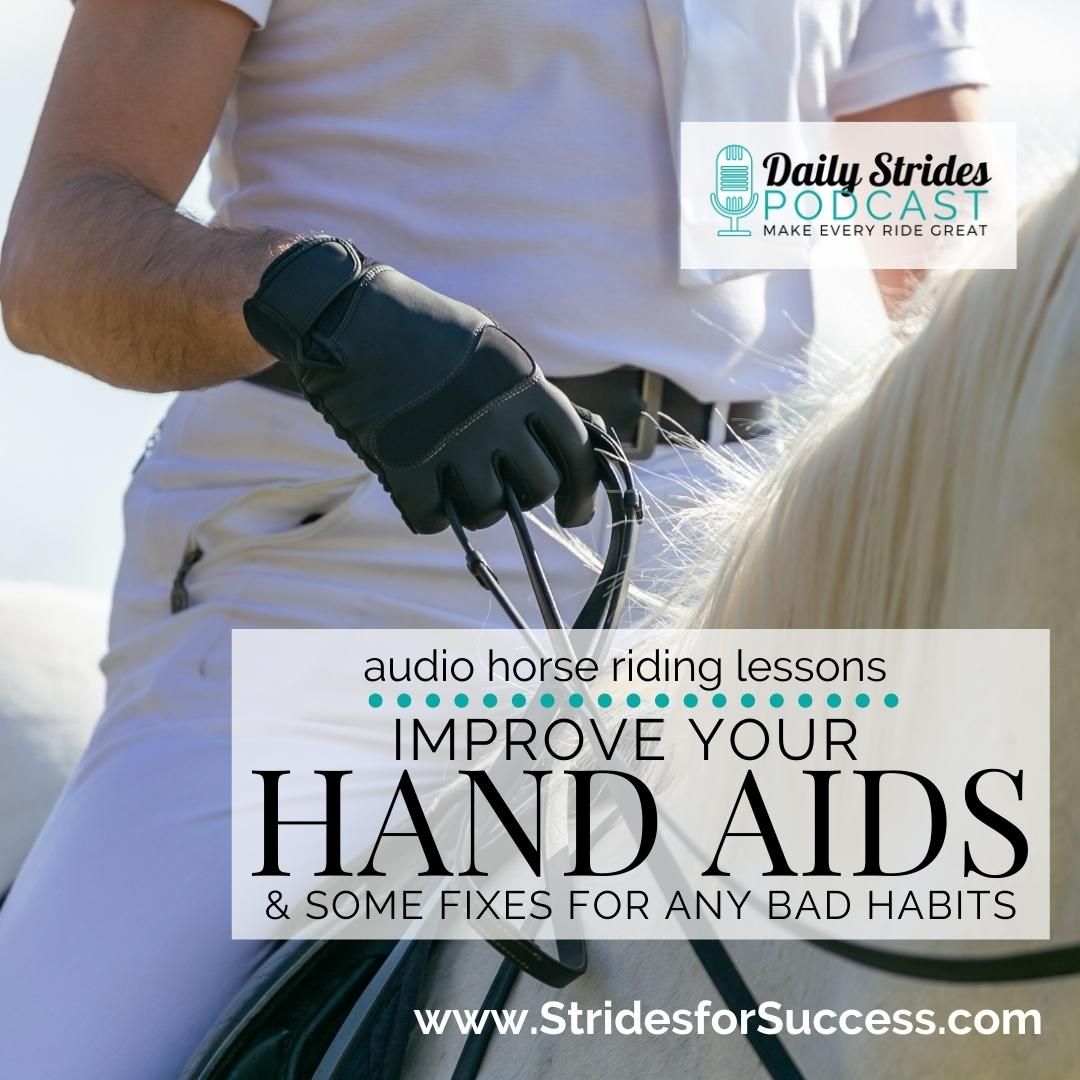
    Your hands are an aid in your riding. So understanding why the way you hold your reins and how to judge the height of your hands when riding is important. And realizing how much your hand aids are impacting and affecting your riding can change everything.
    As riders, one of the first things we learn is how to ‘hold’ the reins.  However, often the ‘why’ behind all of this is never really explained to us.

    Your Hands Connect

    So, it’s obvious that your hands are the connection between you and your horse’s mouth through the reins.  And it would be an awful pity if that connection ended there! As riders, one of our greatest responsibilities is to refine communication.
    When you refine your hands and how you use them with your horse, you can truly help to enhance the whole conversation between you and your horse.
    So just like with all of your aids, a great place to begin when refining your hands is their position. Being in the ‘right place’ will allow you to give more precise aids to your horse. And when we can create more clarity in our communication, it shows in our riding.

    What to Aim for with Your Hands

    Before we go any further it is worth mentioning that each horse and rider combination is a unique and individual blend.  However, there are a number of basic guidelines you can follow to really begin refining your hand aids.  And of course, develop better contact and connection with your horse.

    Thumbs on Top

    This is one of those really small details that makes a MASSIVE difference to your riding.  Holding the reins while in the saddle should feel like carrying two cups of tea (or coffee, hot chocolate, etc.).  If you were to carry the cups or mugs with your knuckles on top, there wouldn’t be anything left to drink when you finally go to take a sip.

    A great experiment is to literally pretend you’re riding and both carry your hands with your thumbs on top. Your hands will be around your belly button height in front of you.  Now, from this place, turn your wrists so that your knuckles are on top.  And feel the difference down and through your arms.

    Turning your hands so that your knuckles or the back of your hand is on top will create instant tension down through your arms.  When riding, this tension is passed through the reins to your horse’s mouth.  Not good! 

    Side View – Elbow, Wrist, Thumb, Rein, Mouth

    The first thing to look for is a relatively straight line from your elbow to your horse’s mouth when viewed from the side.  Now, I get that this can be difficult to really ‘see’ when you’re the one riding the horse!  However, if you don’t have mirrors, there are other options available.  Review some photos or videos of yourself while riding.
    The important thing to note here is that this ‘line’ should be there regardless of what gait you’re working in, or what moment of that gait your horse is currently in when the photo was captured. 
    This will indicate if your hands are truly fluid, elastic, and supple.  Your ability to ‘follow’ your horse or ‘stay with’ your horse through your hand aids is vital to really developing true and lasting contact.

    Overhead View – Wrist, Thumb, Rein, Mouth

    This second ‘view’ is one you can do all the time when riding.  The key is to ‘glance’.  Not LOOK! Looking will create a whole host of other habits that you don’t want to fall into habits with! Okay, so to check this you will, as you ride your horse, glance down at your hands.

    Notice how straight the line is from your wrist through to your thumb and then on down the reins to your horse’s mouth.  If you notice any ‘curling’ or ‘twisting’ simply straighten things out. 

    This particular ‘line’ is very much dependent on your thumbs being ‘on top’ as you ride.  If your hands have turned so that your knuckles are on top (like riding a motorbike) or your fingernails are on top, revert back to thumbs on top.  It will look and feel like you’re carrying two cups of tea :)

    If Your Hands Are Too Low

    This is the most common challenge I see with riders when it comes to their hands. Riders are trying to work their horses and improve the overall way of going, but literally ‘blocking’ their success!  Riding with your hands too low can be caused by a few different things.  Often it is a habit that was created due to holding onto the pommel or a neck strap.
    Another reason riders tend to carry their hands too low comes down to a lack of understanding regarding contact and ‘on the bit’.
    Many riders feel that when they lower their hands and then apply pressure quickly from each alternative rein, their horse will magically go ‘on the bit’.  And yes, the horse might tuck their head in to try and get away from the discomfort of the rider’s hands.  But this is definitely not being ‘on the bit!’.
    Hands that are too low can be corrected by simply bending the elbows and ‘carrying’ the hands more. Doing this will allow for greater elasticity and suppleness. Both are essential for correct contact. 

    If Your Hands Are Too High

    This is, thankfully, not as common as the low hands. And I say thankfully because this particular habit can often lead to a lot of needless discomfort for the horse.  High hands really change how the bit interacts with your horse’s mouth – and usually not in a great way.  Especially if not intentionally done.
    I think the big reason riders can develop this habit is due to a lack of balance. Very often, when the rider carries their hands too high to be effective as an aid, they are doing so to try to either remain balanced – or stay on!
    Excess tension in the rider’s body due to nerves or fear can cause them to raise their hands higher than what would be normal when riding.  The irony of doing this is that the horse usually becomes hollow through the back, which causes the rider to experience more bumps, wobbles, and bangs as the horse moves.

    If Your Wrists Are ‘Twisted’

    This is when you ‘glance down’ (important to emphasize – we are not LOOKING; just glancing) and you see that the line from your lower arm to the rein is not straight.  This lack of straightness can vary from anything like a slight ‘kink’ to a complete ‘lightning bolt’ shape!  True story!  The key to changing this is to first identify it.
    If you glance down and things are less than straight, focus on thinking about your lower arm (hand to elbow) as being an extension of the rein. Then just ‘straighten’ that rein out. 

    By creating that ‘straightness’ from the elbow, through the wrist and thumb, and then onto the rein, you create clarity with your questions. Clarity with your aids. This issue often comes up when a rider doesn’t want to necessarily ‘pull’, but they still feel the need to apply a lot of pressure with their hands. It can be a difficult habit to break, but one that is worth persevering with.

    If Your Knuckles Are On Top

    Ohhhh, this is something I personally resonate with.  I spent a couple of years doing ‘work riding’ for a racing yard.  This was coupled with teaching and actively eventing.  It did not all blend well.  I’m pretty sure that there are so many riders who can make this work – and let’s be honest, I did at the time.  But if I knew then what I know now… A completely different approach would have been taken!
    For me, this particular habit developed in my left hand.  I’m right dominant, so perhaps this was the reason? Either way, it became a MASSIVE issue for me later in my riding. 
    My left hand would just, on its own, revert to ‘knuckles on top’ when riding.  This, obviously, affected the contact between me and, well, any horse! And yet, it took me quite a few ‘seasons’ in my riding for this to be noticed. And a far few longer for it to be corrected!
    Trust me; knuckles on top changes EVERYTHING between you and your horse when riding. From how you move your arm, to how it feels in his mouth… EVERYTHING 
    If you find yourself with this habit, one or both hands (mind was just the left hand), focus on this first.  Think of carrying cups of tea and not allowing an ounce to fall… There is a certain way we move our bodies when we’re carrying cups of tea (or whatever). If we put that same fluidness into our riding… #Winning!

    Your Hands as Your Aids

    We connect with our horses on so many levels.  Our legs, our seats, our hands, our mood, our attitude, our intentions, our focus… And on and on it goes.  Yet, if we don’t develop our hand aids past what we learn in that very first lesson, we are doing both ourselves and our horse a disservice
    Your hands are your connection to something your horse NEEDS; his mouth
    His mouth is an absolutely essential part of his health, life, and experience every single day.  So it makes sense to spend time refining this aid… Maybe to the point where it becomes ‘feather light’ and ‘feather soft’.
    And in between, do all you can to remove any excess tension will definitely help :)
    Happy Riding
    Lorna

    More on This Topic:-

    More Training & Support

  • Why Improving Your Accuracy Will Improve Your Engagement in Your Riding

    Why Improving Your Accuracy Will Improve Your Engagement in Your Riding

    [fusebox_track_player url=”https://op3.dev/e/traffic.libsyn.com/dailystridespodcast/1239_Using_Accuracy_to_Improve_Engagement_in_Your_Riding.mp3″ title=”How Accuracy Can Help Develop Engagement in Your Riding” social_linkedin=”true” social_pinterest=”true” social_email=”true” tweet_text=”Accuracy… It really can help improve your horses engagement…” hashtag=”horseriding” twitter_username=”strides_success” ]

    Accuracy can seem like a dull and boring concept when riding horses.  Sure, if you are going to compete in dressage or show jumping, accuracy can become really important.  But what about if you are simply a rider, working alone with your horse, trying to improve your overall skills?  Is accuracy still as important?

    I’m going to say yes, accuracy is important. And it is an excellent way of actually establishing and building engagement with your horse.

    Now, granted, accuracy and engagement might seem like they have nothing to do with each other initially.  How could do something at a specific point in the arena or in the conversation help with engagement?  And the answer is “more than you can even begin to realize”.

    What Is Accuracy?

    Accuracy is about doing a specific thing at a designated time or space when you ride. So, for example, picking up a canter at a specific marker in your arena, perhaps A or C.  Or riding a certain number of strides within a certain measured distance.

    However, in order for you to achieve true accuracy with your horse, the energy that goes into the preparation and, subsequent, follow-through is equally as important as doing the ‘exact’ thing.  

    This means that, as a rider, your attention to detail must include what happens before the transition, during the transition, and then after the transition. Realizing accuracy is about how well you can maintain what is established as you also allow the desired outcome to happen at the right endpoint.

    What Accuracy is Not…

    Contrast this with a rider who roughly kicks or pulls their horse in order to achieve the desired outcome at a specific point.  The overall ride lacks softness, consideration, knowledge of energy, and flow.  It is doing something with the sole purpose being to get a specific result.

    True accuracy is when the result adds to the overall performance and conversation between horse and rider.

    Being accurate, if it is merely to get something done, is not true accuracy.  It must play into the bigger picture of horse and rider.  Working on being accurate must incorporate the energy of what comes before and after the specific ‘point’.  And, in doing this, you can begin to build both engagement and true accuracy with your horse.

    What is Engagement?

    For many riders, when they hear the word ‘engagement’ in relation to horses and riding, the mind jumps to collection.  And, for most of those riders, true collection is not somewhere they visit regularly in their riding. And yet, engagement starts much earlier.  At the beginning in fact.

    Would your perception of engagement change if you began seeing it as a connection, rather than a collection, in your riding?

    If we think of the word ‘engage’ outside of horses and riding, it means that you occupy or attract someone’s interest or attention.  It can also mean entering into an agreement with someone. If we applied both of these to your conversation with your horse, can you see how engagement is a far more basic concept than we might first allow ourselves to imagine?

    And developing accuracy is an excellent way to attract your horse’s interest or attention a little more. To increase your horse’s focus on what you are saying or asking… On your desired outcome. 

    Engagement as an Agreement

    Once your horse has begun to focus a little more on you and what you are saying (or trying to say), you can begin to develop the conversation a little more.  This is where using accuracy can help to begin developing more contact and connection between you and your horse.

    Developing contact is often the point in your horse’s training where he agrees to begin taking on some of the responsibilities for your work together. An agreement. Engaged. 

    And this is also the point in training where energy can begin to truly be recycled through both of your bodies as you work together.  Rather than the energy falling out or leaking out somewhere, it remains within the container.  Part of the responsibility your horse engages with is to ‘hold’ that energy inside of his body.

    Accuracy and Engagement

    Hopefully, from this explanation, you can begin to see the link between improving accuracy and encouraging engagement when working with your horse.  It all begins with understanding that true accuracy requires a holistic approach.

    Attention to detail on the preparation, the doing, and the following through of what you intend to be accurate about. 

    As you become more consistent with this, your horse’s interest in what you are trying to achieve becomes heightened; engagement.  And at this point, you can begin to allow your horse to carry some of the responsibilities regarding your work together.

    Contact and connection.  Which, inevitably, begin to lead to the sort of engagement that will eventually, if you continue to develop and work on it, lead to collection.

    Happy Riding
    Lorna

    More on this Topic:-

    Join Our Online Communities for Equestrians

  • 7 Circles, 5 Serpentines, 4 figures of eight; on repeat…? What’s Your Riding Routine?

    7 Circles, 5 Serpentines, 4 figures of eight; on repeat…? What’s Your Riding Routine?

    [fusebox_track_player url=”https://op3.dev/e/traffic.libsyn.com/secure/dailystridespodcast/1219_Whats_Your_Riding_Routine_and_is_It_Helping_or_Hindering_Your_Riding.mp3″ title=”7 Circles on Repeat? What’s Your Riding Routine with Your Horse?” social_linkedin=”true” social_pinterest=”true” social_email=”true” tweet_text=”Listen to this episode of the Daily Strides Podcast if your riding routine is feeling a little ‘meh’ with your horse!” hashtag=”horsepodcast” twitter_username=”stridesforsuccess” ]

    What does your average ride or training session with your horse look like?  Do you have a riding routine that you follow? If yours is leaning towards, or if it already is, a little too predictable; maybe it’s time for a change?  While riding the same sequence often can sometimes be beneficial to your riding and training (more on that later), for the most part, it will only help habits to creep in.  And usually not the greatest of habits.

    Doing anything the same way, on repeat, almost always has the same effect.  Your body (and your horse) will look for the easiest, most efficient way of doing it; which probably won’t truly serve you!

    This is because, usually, the ‘easiest’ or ‘most energy saving’ way is not the best way; particularly when we are focused on developing and training.  So, why do we fall into the trap of riding 7 circles, 5 Serpentines, 4 figures of eight (or whatever your ‘go to’ routine?  And why do we continue to repeat it over and over again?

    If It Worked Once…

    For most riders, their version of the riding routine is born out of a series of exercises that they rode once or twice that produced a certain outcome. 

    Now, the outcome it produced might not necessarily have been the one they truly desired.  It could just have been a thought, which produced a certain feeling or emotion in your body.  Like ‘satisfaction’ or ‘accomplishment.  This is particularly true for riders who, in the past, have struggled to ‘find things to do’ with their horse.

    The fact that they continued to ‘work’ their horse for 30 minutes or so makes them feel successful.  This feeling is based on the quantity of the work, not the quality. 

    Another way a riding routine can work once, and in doing so quickly become the ‘go to’ routine is to do with behavior.  The horse may have responded or understood what the rider wanted that particular ride.  Sometimes the riding routine itself can be the catalyst for this happening.  However, more often than not, it has more to do with the specific circumstances of the individual ride.

    So ‘No’ to a Riding Routine Then?

    Not necessarily… I do believe in routines to help set the tone for the conversation.  I am also a fan of developing specific routines to achieve specific outcomes.  But these are more foundational.  I believe that routines help to develop the rhythm for the session or work you are focusing on with your horse. And that is the key.

    A routine can help to set the tone for the schooling session with your horse.  However, it’s the intention or focus that then guides the conversation forward.  

    By creating a specific intention for each movement, you can begin to make your riding routine work for you.  And I think that each intention should be a stepping stone of sorts towards a specific goal or desire.  The type of goal is not really important; it’s your commitment to achieving it that counts.

    Riding a circle for the sake of riding a circle will not help you or your horse in the long run.  However, that same circle, if used to increase suppleness, establish a rhythm, develop contact, gather energy, or any number of things you can focus on in your riding – is where the power of riding the circle lies. 

    Setting an Intention

    So, if the riding routine itself is not really the issue.  Rather the lack of intention with how we repeat it that is, how do you develop intention. I have many previous episodes and articles on goal setting (I will link to some below this article). However, there is also a quick way to figure this out…

    A quick and simple way is to ask yourself the question “If I could achieve one training outcome today with my horse, what would that be?

    Once you have the answer to this question, the next step is to identify what needs to be in place for this to occur.  For example.  If your answer is ‘riding a clean upward transition into the canter’, I would suggest basing the first few movements of your regular riding routine around responsiveness.

    Use your version of the “7 Circles, 5 Serpentines, 4 figures of eight” to work on the elements you need in place in order to reach your desired outcome or result for the ride. 

    The Positive Aspects of a Riding Routine

    Okay, so you can probably tell that I am not completely against having a riding routine for you and your horse.  A go-to, tried and tested set of exercises that you can ride to help you get a specific result.  And there are other ways that your individual riding routine can help you develop your skills and train your horse.

    By riding a specific riding routine regularly, you can begin to see the results of your training. You will feel (and see if you take regular videos) the differences as you and your horse improve. 

    A regular riding routine will also allow you to make strategic changes to your methods, training, equipment or anything else that can have an impact on your riding. By creating a baseline with your regular routine, you can then see the results of any changes you make.

    Click here to subscribe

    A Plan For Each Ride

    If you are still feeling uninspired or bored in your regular riding routine, perhaps having someone else create the plan will help?  Every week, I help riders all over the world to work towards specific outcomes with their horse using my guided audio horse riding lessons.

    Simply mount up, press play, and work through the movements and exercises with your horse; all focusing on developing or improving a specific outcome in your riding

    Knowing that each ride, or groundwork session, or lunging session, will now help you to improve your skills will turn your riding around.  You can find all the details about Connection HERE.  And if you are going to ride your horse later, what will your intention for your version of “7 Circles, 5 Serpentines, 4 figures of eight” be?

    Happy Riding
    Lorna

    Extra Links to Help Equestrians


  • [Training Scale Series] Part 4 – Creating True Impulsion

    [Training Scale Series] Part 4 – Creating True Impulsion

    [fusebox_track_player url=”https://op3.dev/e/traffic.libsyn.com/secure/dailystridespodcast/1208.Creating_True_Impulsion.mp3″ title=”Creating True Impulsion in Your Riding” social_linkedin=”true” social_pinterest=”true” social_email=”true” tweet_text=”How to create impulsion; without being run away with in your riding…” hashtag=”equestrianpodcast” twitter_username=”strides_success” ]

    How do you know if you have actually achieved true impulsion? What makes this ‘real’ impulsion different from simply running around the arena like the energizer bunny with your horse?

    This post is the fourth in a series I have created about the training scale.  I suggest also checking out the previous posts on rhythm, suppleness, and contact.  At ‘Step 4’, impulsion is in the ‘top tier’ of the training scale.  I really do believe that the final 3 steps, impulsion, straightness, and collection, need to have the solid foundation of the first three in place if they are to be worked on and mastered.

    What is impulsion?

    Impulsion is the harnessing of the energy that your horse creates and that is inside of the ‘container’ that you and your horse create when working together.  Working together is an important part of impulsion; it occurs when both horse and rider are working towards a shared outcome.

    Make sure that you do not confuse impulsion with speed. It actually has nothing to do with speed, it is the energy and the focus.  Like a laser beam! 

    In step 3, Connection, the focus is on how the energy is connected through the horse and rider, from back to front.  In order to establish and maintain true impulsion, the energy must first be there and remain connected throughout the movement.

    There is little point in creating energy if it is all going to fall out the front of your horse.  Similarly, if you are constantly losing energy through a shoulder or hip falling in or out, there won’t be any energy there to effectively channel and create impulsion.

    Creating from Behind

    True energy will be created in the back end, the hindquarters, of the horse. That is why when we are riding, we are always making sure that the hindquarters are working and that the horse is not dragging himself along using his shoulders or front end; the horse equivalent of being in front-wheel drive.

    Ideally, we want our horses to propelling themselves along from the back end, like a vehicle with rear-wheel drive.

    In order to be able to do this, there has to be a certain amount of self-carriage in the horse. A certain amount of lightness. Self-carriage is important for both horse and rider.  I believe that we can really develop and improve it through the filter of contact and connection.

    Developing Self Carriage

    I have mentioned how all the steps of the training scale work together to achieve a better conversation with your horse.  So, for example, suppleness is when the energy can move and flow within you and your horse.  But it also means that there is a certain symmetry to your horse.  That your horse is developing equally on both sides.

    In fact, I believe that suppleness is the key to straightness (the step after impulsion). However, you can begin working on it today in order to develop and work towards straightness.

    And this symmetry is important when considering impulsion; your horse must be pushing himself forward equally from both hind legs. 

    As that energy moves through his body, it is ‘engaged’ through contact and connection. This connection is due, in part, to your horse engaging his core.  Which will allow him to begin to carry himself a little more.

    This self-carriage creates lightness in the front end of your horse, which in turn, helps to sustain the impulsion (or focused energy) in the ride. 

    Driver, not Passenger

    Think of impulsion as you becoming the true driver, and not just the passenger. Obviously, I don’t mean driving him from the seat or driving him forward.  By driver,  I mean that you are directing the situation. And, you are confident that your horse is doing his part in order to create the desired outcome.  When you drive a car, you don’t physically turn the wheels yourself.  You trust that the wheels will turn when you put them into gear.

    When you are riding and working at this level, it is a similar approach.  You trust that your horse will show up with a similar level of responsibility and ownership towards the outcome you’re both working towards.

    The horse is creating it, and you are allowing it to come forward, and then you are directing it where you want it to be. All while your horse remains engaged and part of the conversation. That is impulsion. But again, as I mentioned earlier it requires relaxation, rhythm, suppleness, contact, and connection. This is because they are all intermingled and mix together – they cannot just be alone without the others.

    Working on Creating Impulsion

    Firstly, invest time in truly understanding and implementing the earlier principles of the training scale. They must be understood by both you and your horse.  Once you have those in place on a fairly consistent basis, one of the most useful ways to work this into your horse’s training is through transitions.

    With transitions, you are moving up and down the gears. These can be transitions between actual gaits – from trot to canter or walk to trot.

    Or it can transitions within the gait itself – lengthening and shortening of the stride.

    By asking for and riding these transitions, the hindquarters become more engaged in the work that is happening. And both you and your horse have an opportunity to ‘tune in’ to each other a little more, which helps create the focus of thought and energy between you.

    Impulsion is not Speed

    A lot of riders make the mistake of trying to ask for impulsion too early in both or either their own or their horses training.  What ends up happening is the horse will try to answer the question.  However, you run a big risk of either causing damage with an injury, or teaching your horse to work incorrectly.

    This is often the point where riders confuse speed for impulsion.  With just pure speed, there is little controlled, directed energy.  There is also a complete lack of lightness and self-carriage.  The connection is missing. 

    When you use transitions as a way to develop impulsion, you allow your horse to develop both mentally and physcially.  Keep in mind that he has to understand impulsion as well, before you can move on.

    Using well ridden and practiced transitions will help both you and your horse do just that.

    Your goal is to make sure your horse is listening to you and is responsive.  And, that both you and your horse have a good working relationship with the rest of the steps of the training scale.

    Happy Riding
    Lorna

    More, More, More… To Help You :)