Tag: forwardness

  • Why ‘Forward’ is Essential for Contact

    Why ‘Forward’ is Essential for Contact

    Why 'Forward' is Essential for Contact

    What this episode is all about & how it can help you:-

    • Realise that contact is a result of other things
    • Understand what ‘forwardness’ is and why it is so important
    • See the role you play in the forward and the contact
    • See how it should be present in every element of the ride, even halt

    Contact.  You know how important it is to your overall conversation with your horse.  However, for many riders, contact can be elusive!  It comes and goes without any real impact being made from it.

    Time and again I see riders in the arena, sawing the mouth off their poor horse in a desperate misguided attempt to achieve ‘on the bit’.  However, if ‘on the bit’ is the goal, it is important that we go back to the drawing board first.

    [smart_track_player url=”https://op3.dev/e/traffic.libsyn.com/dailystridespodcast/1103-Forwardness-is-Essential-for-Contact.mp3″ title=”Why ‘Forwardness’ is Essential for Contact” social_linkedin=”true” social_pinterest=”true” social_email=”true” tweet_text=”Is contact between you and your horse feeling a little elusive? This will help…” hashtag=”equestrian #horseriding” twitter_username=”strides_success” ]

    It is important that we first understand what is necessary in order for contact to be present between horse and rider. 

    In this episode of the Daily Strides Podcast you will learn why forwardness is key to creating a consistent contact with your horse.  How, without forwardness, there can’t be a contact.  And without true contact, the conversation will stall. 

    Contact Is a Result of Other Things Being Present

    I want to deal with this first.  There is a common misconception surrounding contact, which tends to make achieving it all the more difficult for riders.  Contact is not just the reins.  It is not just you holding the reins.  Contact is the result that happens when the other necessary pieces are in place.

    When you focus on making sure everything is ‘ready’, the contact will appear as if by magic.  Similarly, if the necessary parts are not in place, contact will remain elusive.  

    The first piece that is necessary to have in place in order to achieve true contact, is forwardness.  It is the foundation of it all. However, it is also the piece that is most often overlooked and missing.  If forwardness is missing, contact in the true sense of the word, cannot occur.

    What is Forwardness?

    Simply put, forwardness is you and your horse moving and thinking with a sense of purpose.  It is both a mental and a physical element in your riding.  Horse and rider must be thinking forward in order to move or actively engage in forwardness. 

    Forwardness is the energy inside the container that is you and your horse.  It is the difference between ‘dilly dallying’ and ‘focused’ movement. 

    I speak a lot about the importance of having an intention with each ride and each interaction with your horse.  Forwardness is the energy that moves you towards that intention.

    Failing to engage in ‘forwardness’ is like forgetting to turn on the engine.  

    What is Contact?

    Contact is also both physical and mental when it comes to your riding.  Many riders only focus on the physical element.  The reins.  Your hands.  The mouth and bit.  However, in order for true contact to be achieved, the mental element must also be engaged.

    Contact is like an unwritten mutual agreement between you and your horse, to move forwards on the journey together.  It is the relationship.  

    Contact is not a stand alone event.  It happens because other things are in place and present.  When all the conditions are present, contact will occur naturally.  When it is forced or when one side is not completely happy or confident in the contact, it is not true.

    Your Alignment in the Saddle

    I have already spoken about forwardness.  It is the foundation for your contact with your horse.  However, from there, the next element you can begin working on is… You!  What are you doing in the saddle?  How are you doing it?  

    How is your alignment?  Both physical and mental.  Position and thoughts. If you can remain aligned, contact becomes so much easier for you and your horse. 

    Physical alignment is your lines; head, shoulder, hip, heel and elbow to bit.  Mental alignment is having an intention that you allow to guide you throughout the ride.

    Relaxation, Rhythm and Suppleness

    The next pieces necessary for true contact is the proceeding steps of the traditional training scale.  Relaxation or, said differently, managing the tension for both you and your horse throughout the ride.

    Rhythm is the sequence of hoofbeats.  I find that trot is a great place to work with this. It has an energy to it and it also, usually, has a great natural rhythm to it as well.  The forwardness and the rhythm are easier to achieve. Suppleness is also essential.  The ‘loosey gooseyness’ of both horse and rider.

    Suppleness is also your approach.  It is a mental as well as physical element to riding.  It is both you and your horses ability to bend and flex, physically and mentally, depending on what shows up.

    Consistency is Another Key Element

    Once you understand all that is required for contact to be present, you job is to begin showing up consistently.  Your focus on the basics will result in your developing the more intricate aspects of your riding.

    If you lead by example, your horse will begin to align with you – and contact will occur!

    The goal is to develop both you and your horse enough that the contact is ever present.  Initially it may feel ‘touch and go’, however, over time if you are consistently practicing the basics, you will be able to maintain contact for longer periods.  Even in the halt.

    Consistent Contact; Even in Halt

    I said earlier that forwardness is essential in everything in riding.  It is the foundation.  However, many riders think that the halt is the exception to this.  It is not!  Forwardness must be present even in the halt.  And this can be seen through the contact when in the halt.

    Imagine a horse that is asked to halt without any attention being paid to ‘forwardness’ through the transition.  The horse will usually look hollow.  Collapsed through his body.  This is where you see riders furiously sawing at the mouth, hoping to get him back ‘on the bit’.

    Now, imagine a horse that is correctly ridden into the halt.  Even though he is stationary, he is thinking forward.  His core is also engaged.  His body contains the forward energy, which is engaged with the rider through the contact. 

    A halt that was achieved through working forward will result in a horse standing with a sense of purpose.  If the halt lacks forwardness, the horse will be almost slouching, hoping for a snooze!

    Engaging the Energy

    My hope is that, going forward, you begin looking at contact from a slightly different perspective.  Think of getting all the small dominos lined up so that, when activated, you can ‘knock’ the big domino that is contact.

    Focus on your intention and allow it to help you create positive energy in your ride. 

    This energy will help you to connect and engage all the necessary elements to allow true contact to happen.

    Happy Riding

    Lorna

    Other posts, episodes and resources that relate to this topic:-

    Daily Strides Premium

    Each and every month inside of Daily Strides Premium I host a live ‘Review and Planning’ call.  In there, you will go step by step through the month that was.  You then take that information and begin planning out the coming month.  When you will ride.  What you will work on.  And of course all aligned with your goals for you and your horse.

    Do you need to be competing? No!  Do you need to have competitive goals or ambitions? No again!

    In fact, I love working with riders who just ‘enjoy’ their horse; helping them to build and strengthen their relationship.  No competitions necessary ;) 

    Couple this with the live Q&As and the members only private group ~ we are here to help you remain accountable as team leader for you and your horse.

    All of the trainings are easily accessed using your phone, meaning that you can take them with you where ever you are going.  These trainings and so much more are available for you immediately when you join Daily Strides Premium. Find out more HERE
  • Riding a Horse Who ‘Won’t Listen’

    Riding a Horse Who ‘Won’t Listen’

    Riding a Horse who 'Won't Listen'

    This episode will explain how:-

    • Looks can be deceiving this type of a horse
    • And why I suggest bringing the whole conversation back to basics
    • To create a channel for the ‘forwardness’
    • You can identify any ‘weak spots’ in your channel

    [smart_track_player url=”https://op3.dev/e/traffic.libsyn.com/dailystridespodcast/1061-Dealing-with-the-Horse-Who-Won’t-Listen.mp3″ title=”Riding a Horse Who ‘Won’t Listen’” social_linkedin=”true” social_pinterest=”true” social_email=”true” tweet_text=”Are you having trouble getting your horse to listen to you? This episode of the Daily Strides Podcast can help…” hashtag=”Podcast #Equestrian” twitter_username=”strides_success” ]

    We all know one… The horse who makes you question everything about your riding abilities and knowledge.  The horse who, when you get on, just seems to invite you to ride as though you began yesterday!

    It can be such a frustrating place to be for any riders trying to improve themselves.  It can cause a confidence crises.  However, rather than just giving up and accepting it, I want to give you a few ideas on how to begin making this more positive.  Positive for you and positive for the horse as well.  

    This episode of the Daily Strides Podcast is about how you can begin reframing the conversation with this horse, so you can both walk away feeling good afterwards.

    Looks Can Be Deceiving with a Horse who ‘Won’t Listen’…

    If you are currently working with a horse like this, you might feel even worse because of how the horse ‘seems’ to be.  He is calm. People might even comment that he is ‘easy’.  This of course only adds to your frustration, and negative self talk, because you know first hand that he is anything but!

    Very often a horse who is ‘easy and safe’ can be a huge struggle to get going forward.  And if, by some miracle, you get them going forward it is exhausting to keep them going!

    You might notice how issues that you corrected years ago, or lessons ago, in your riding are now all of a sudden cropping up again.  Things which you thought were put on that all important ‘autopilot’ have, as if by magic, been brought back into play.

    This of course only compounds the whole problem.  Now, you have to deal with ‘fixing’ yourself, as well as dealing with the horse who ‘won’t listen’.

    Often, because your position or basics have reverted to an earlier version, you end up not even asking the correct question any more!  All of this gives your horse a great excuse to ignore you further…

    This is where I am going to suggest you stop what you are doing, and bring everything back to the absolute basics.

    Bringing the Conversation Back to the Basics

    In my experience, usually the big missing piece in this sort of situation is forwardness.  I think that if you can focus on just that one thing initially, it can have the power to change everything else.

    Work on consistent forwardness in the walk and trot.  Don’t worry about the canter right now.  If you can lay down a few ‘rules’ in the slower gaits, they will carry over to everything else. 

    Another reason I suggest leaving canter out of your schooling initially is due to it being a big contributing factor to this issue.  Have you noticed that the trot to canter transition is often the one that causes everything to come apart at the seams?!

    Forwardness is Both Physical and Mental

    You and your horse must ‘think’ forward as well as ‘go’ forward.  If the mental forwardness is missing, there will be no consistency in the ride later. 

    When a horse is thinking forward, he is open to listening to what you are saying.  He is actively part of the conversation that is happening between both of you.  A lack of forwardness can often be the physical manifestation of a lack of basic respect.  He literally ‘won’t listen’ to you.

    There are some links to past episodes and blog posts that deal with this problem at the bottom of this episode.  I strongly suggest having a read or listen if you are struggling with this in your riding.

    Creating a Channel for that Forwardness

    Now, you’re possibly wondering what is a channel?  Think of it like a river flowing.  The banks create the channel that keeps the water inside and, well, flowing in a particular direction.  You can also think of it like train tracks.  Anything that dictates where the ‘thing’ is travelling to.

    If your channel is weak, or has weak parts or areas, it will be very difficult to put more energy in there without it leaking or bursting out somewhere. The horse we are chatting about right now is a master at figuring out those weak spots. 

    When he can figure out where there are those weak spots or areas, he will try to take advantage of them.  Why?  Well, because he can then distract you and not have to worry about applying himself too much to doing what you are asking him to do!

    If he can make the energy ‘leak out’, there is less engagement, less carriage and less ‘working’ all round required from the horse.  There is also a lot of ‘managing’ required from the rider – which is why you feel so exhausted and frustrated! 

    Identifying Any ‘Weak Spots’ in Your Channel

    If this is all sounding familiar, great!  It means that now you can begin identifying those weak spots and actively ‘reinforcing’ them where necessary.

    A stronger channel, coupled with a horse who respects you and goes forward are the keys to turning things around when in this situation. 

    I want you to think about something you do with your horse, where it ends up being a battle of wills.  Perhaps it is the transition I mentioned earlier, from trot to canter.   Think of how you normally get everything up the right way.  In this case, half halts and asking for a little flexion.  However, when you ask for the transition itself, that is where things begin to break down.

    Where do you find yourself three or four strides out from this? Are you remaining centred?  How does your contact look?  What about noticing how the ‘flexion’ is looking now?  Things were probably great when you initially ‘asked’.

    However, as more pressure was applied – that is where those leaks begin showing up. Being open and honest with yourself as to how far away from the ideal you are, is the key to begin identifying the weak points in your channel. 

    Bracing or Resisting can also mean ‘Won’t Listen’

    For many riders, this is where they begin to feel that their horse is really bracing against them.   This is another reason I am suggesting that you keep things in walk and trot initially.  Work on asking for a little flexion from your horse.

    Make sure you are correct in how you are asking – and remain correct even if he ignores or braces against you.  Horses can brace through their barrel, their shoulder or their neck.

    I would suggest making sure you are correcting him, while making sure you are focused on what you want to do and where you want to go. 

    Notice when it is happening and, then be quick to correct him.  You will begin to notice the difference between him being a little stiff and him becoming a little defiant and ‘rude’ in response to your questions.

    Now, obviously it goes without saying, but let’s just add it here anyway, that you want to make sure your horse is physically able to do what you are asking…

    Your Forward Thinking Can Change Everything

    We have already covered how forwardness is a mental as well as physical aspect for your horse.  But many riders fail to see that this is also true of them, the riders.

    Your ‘thinking forward’ plays a huge part to resolving this issue for both you and your horse.  Allowing yourself to become ‘stuck’ on the issue is not thinking forward. 

    Yes, you must notice what is happening, but don’t allow it to derail you regarding to what you want to achieve.  This is one of the biggest factors in overcoming this ‘battle of wills’ for many riders.

    You must ‘think’ forward all the time.  I also strongly suggest having a theme or a specific goal or topic for each ride which you can come back to when you find things are getting a little ‘off track’.

    Remember, this horse is literally inviting you to ride badly – don’t give in and RSVP to him! 

    Final Piece of Advice

    The final piece of advice I’m going to give you today is to focus on becoming more supple.  both you and your horse.  Yes, bending and flexion is part of it, but it is not the whole picture.   Work on moving the shoulders or the hind quarters.

    Become incredibly accurate in your head about what you want to happen.  Then see how close to perfect you can get to it when actually making it happen. 

    When both you and your horse are finally ‘thinking forward’ everything else becomes so much easier.  He will literally be waiting for your next input to your conversation together.  You will become more relaxed and able to ‘feel’ more, which will also only add to the over all experience for both of you.

    Happy Riding

    Lorna

    Links mentioned in the episode:-
    
  • Understanding ‘Establishing’ and ‘Maintaining’ in Your Riding

    Understanding ‘Establishing’ and ‘Maintaining’ in Your Riding

    Understanding Establishing and Maintaining in Your Riding

    What this episode is all about & how it can help you:-

    • Your greatest responsibility as a rider
    • How it all begins on the ground
    • The number 1 mistake riders make
    • Working it in to each and every exercise and movement

    [smart_track_player url=”https://op3.dev/e/traffic.libsyn.com/dailystridespodcast/1041-Establishing-and-Maintaining-in-Your-Riding.mp3″ title=”Understanding Establishing and Maintaining in Your Riding” social_linkedin=”true” social_pinterest=”true” social_email=”true” tweet_text=”The ‘rinse and repeat’ of horse riding – a way to fix any ‘speed wobbles’…” hashtag=”horses #equestrian” twitter_username=”strides_success” ]

    Isn’t it strange how as riders we expect things to be push button when it comes to our riding?  We expect to be able to jump in the saddle, and that everything is just going to work out.  Then we get so disappointed when it doesn’t happen.

    Today I am going to give you the plan, so you can begin to make that happen every time you get into the saddle.

    Your Greatest Responsibility as a Rider

    Do you, like a lot of riders, tend to forget that there is a responsibility on your part to establish something first and foremost in your riding?  Perfect harmony and connection often isn’t something that just happens.  It is our job, as team leaders, to work at establishing it.

    Yes, over time it becomes easier and easier; quicker to establish.  Maybe later you will even get to the point where it does turn into a push button situation.  But initially it is not going to be that.  I will require your focus and attention to establishing a certain way of going in your rides.

    But the challenge does not end there; this is a ‘two part’ series.  Once you have successfully established this harmony, this contact, this connection; it then has to be maintained. 

    Part of maintaining is first, making sure that everything is going as it should be, and secondly noticing when you need to go back to the establishing phase again.  It is a little like breaking something down, in order to then build it back up again.  Building it back to exactly what you want each time.

    Again, this is something that over time will become almost like a ‘rinse and repeat’.  It becomes easier, it becomes quicker, it becomes a lot more ‘yes, you can sit back and allow it to happen’.  But not when we are first starting out.

    Why It All Begins on the Ground

    Ground work, I believe, really and truly starts when you are fetching your horse from the paddock or in the stable with your horse. Establishing and maintaining starts right there, during those first initial interactions each day.

    Firstly, it establishes boundaries.   It establishes the way that your relationship is going to be going forward for that day.  You can establish your rhythm here.  You can establish relaxation. You can establish the intention for whatever it is that the ride is going to be.  Focus on what you are doing during this time.  The ground work element is where it all begins.

    A lot of riders might be establishing certain rhythms on the ground, but they fail to maintain them throughout the process.   So many problems in the saddle can be traced back to this lack of establishing and maintaining on the ground.  You can find out more about groundwork HERE

    So, if you are feeling that there is some disconnect going on with you and your horse in the saddle, look to your ground work first.  Look at the basics.  You, on the ground, working with your horse.  What is the conversation that is happening?

    The Number 1 Mistake Riders Make?

    They fail to set and follow through on their intention for each ride.  Let’s say, for example, that you want to establish and maintain a good quality working trot.  A lot of riders will get on and expect the push button solution.  They climb into the saddle, without spending any time being intentional when on the ground.

    I suggest that you begin setting that intention on the ground.  The rhythm, the relaxation and the energy required for a good quality, forward going, working trot.  Then carry that intention across into your warm up.  The same principles.  Then bring the same intention with you as you begin to work through your actual schooling session with your horse.

    Your intention is all the time building.  It is layering.  It is becoming part of every aspect of your ride for that day.

    Coupling Your Intention with Actual Energy

    One of the essential elements when establishing anything is having energy present.  Energy or action.  Forwardness.  There simply must be forwardness there in order for anything to happen in your riding.

    A big part of establishing, is that you are putting energy into the funnel, or channel that is you and your horse going forward.  There must be energy present in order to have anything to maintain. 

    That is where I would begin with the establishing; make sure your horse is moving forward.  That he is thinking forward; and that you are thinking forward.  You are all the time bringing it back to your intention for that day, and then moving your horse along into that.

    Using the example again of establishing and maintaining a good quality working trot.  Let’s say you have established a good quality trot.  Many riders then make the mistake of thinking that they can just then just sit there and the horse can, well, just ‘continue’.  In an ideal world, yes perhaps that will happen.

    However for most riders this is not going to happen, because unless your horse is extremely developed mentally, physically and emotionally, he is not going to be able to continue carrying himself in that. 

    He may lose rhythm or tempo.  It could be that there is no longer any energy being put into the funnel.  Remember, every step your horse takes, he is dissipating some of that energy.  So, the energy needs to be continuously replenished.

    Maintaining what You have Established

    This is were maintaining comes into your riding.  Think of the banks of a canal or a river.  Ideally, the banks are maintained.   Anything that flows, electricity, water etc., needs to have the channel it flows through maintained.

    Your job as the rider is to maintain the channel or funnel.  This allows you to best direct that energy to where it needs to go.

    Let’s go back to our working trot example again.  You have established this lovely, forward going, working trot.  Your job is to now maintain it.

    Maintain it against what?   Oh, the normal day-to-day ‘speed wobbles’ that show up when something is moving!  The loss of balance, the loss of rhythm or tempo.  A loss of impulsion or energy.  A loss of focus or intention.  What is important is to understand that through these ‘speed wobbles’, the cycle starts again.  Rinse and repeat.

    Sometimes, the re-establishing can be transitioning into a different gait.  Or it could be transitioning from going perhaps in a straight line, to riding a circle.  Remember, a transition is a change.

    Change is the ‘breaking it down’ I spoke of earlier, in order to put it back together as you want it to be. 

    If you notice that you can no longer maintain, and it feels like everything is beginning to fall apart, change it.  Why?  Because it is so much more difficult to try to fix that from where you are.  The maintenance becomes too high!

    Rather take it all apart, change or transition.  Then from that place, being building up again.  That is the cycle of establishing and maintaining coming full circle in your riding. 

    Working It In to Each and Every Exercise and Movement

    Horse riding involves a lot of moving parts.  Anyone with a mechanical background will tell you that the more moving parts you have, the more maintenance it will require!

    Establishing and maintaining is a cycle that must continuously be repeated in your riding.  Every time there is a transition, or you ask your horse to do something different, it starts all over again.  Even the transition itself must be established and then maintained throughout the transition.

    It sounds exhausting, doesn’t it?  However twenty minutes of good quality focused work will far outweigh double that time in mediocre muddling around an arena.   A little something to think about the next time you are in the saddle.

    Happy Riding

    Lorna

    Links mentioned in the episode:-


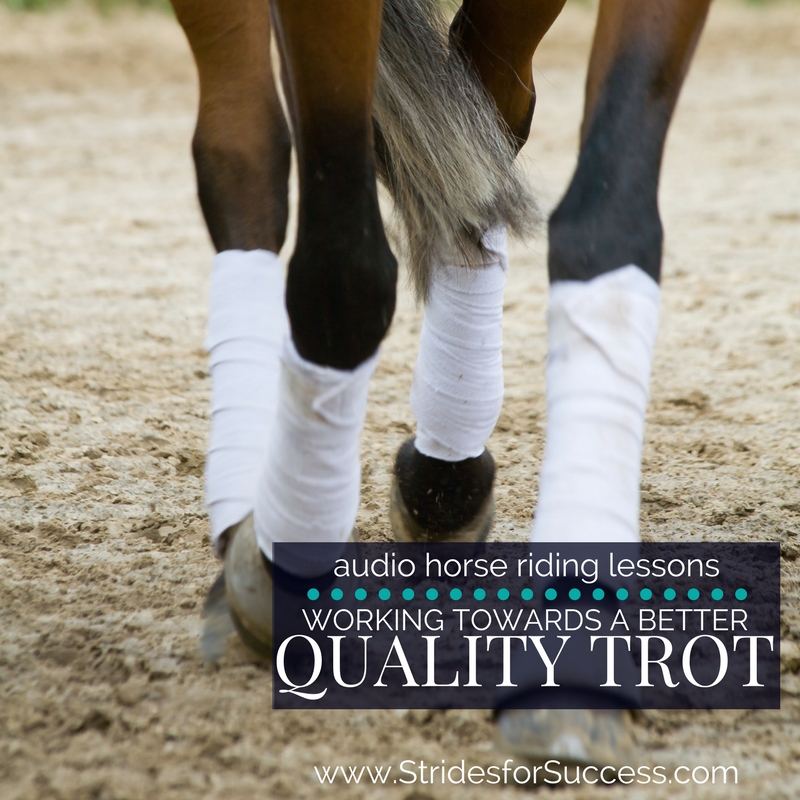
  • Working Towards a Consistently Better Quality Trot

    Working Towards a Consistently Better Quality Trot

    Working on a Consistently Better Quality Trot

    What this episode is all about & how it can help you:-

    • The importance of establishing Forwardness in the Trot
    • How you can begin encouraging more responsiveness
    • Why you must Activate the Inside Hind Leg & outside hind leg
    • How you will know when it is ‘working’

    [smart_track_player url=”https://op3.dev/e/traffic.libsyn.com/dailystridespodcast/1025-Working-Towards-a-Consistently-Better-Quality-Trot.mp3″ title=”Working Towards a Consistently Better Quality Trot” social_linkedin=”true” social_pinterest=”true” social_email=”true” tweet_text=”Trotting – we do it most times we’re in the saddle; here’s how you can make it better…” hashtag=”equestrian #horseriding” twitter_username=”strides_success” ]

    When was the last time you went out riding with the sole intention of improving your trot?  Trotting is a gait we spend a lot of time in when in the saddle.  Yet, for many riders it is an afterthought in their schooling plan…

    I think the reason for this is due to most riders feeling like they have ‘mastered’ the trot when they can managed a few ‘up-downs’ without being bounced out of the saddle!  It tends to get put on auto-pilot after that point; and promptly forgotten about it!

    If this has been the case for you and your horse, today is the day we take the trusty trot off of auto-pilot and begin consciously working on establishing and maintaining a better-quality gait.

    The Trouble with Auto-Pilot Too Soon

    As I said a lot of riders put their trot onto auto-pilot.  They get into the saddle and the auto-pilot part comes from the fact that they allow the horse to dictate the posting.  The ‘Up-Downs’.  The Rising.  The horse will move the rider, rather than the rider moving with or influencing the horse if necessary.

    Becoming stronger through your position, particularly where core strength is concerned, will allow you to hold or carry yourself.   This will in turn place you in a good position, which will allow you to easily communicate with your horse.

    As you become stronger in your position, particularly in trot, you will soon see how you can begin to influence the horse as opposed to the other way around.

    The Importance of Establishing Forwardness in the Trot

    It is easy to become lulled into a false sense of ‘purpose’ when it comes to the trot.  In fact, one of the most common challenges many riders face in trot is the is a lack of forwardness.  Forwardness is essential to developing a good quality trot, so start here.

    I realise that ‘forwardness’ has the potential to scare a lot of riders.  But rather than seeing forwardness as speed, see it as moving with a sense of purpose.

    Our aids help us channel the horse’s energy from the back to where we want to go.  You cannot channel anything, if it not there to begin with.  Make sure that your horse is working forward and that you are thinking forward as well.

    How Your Posting Can Influence the Overall Trot

    Once you have established forwardness in your trot, you can then begin to turn your attention towards ‘tidying’ things up a little.   This starts will encouraging responsiveness, in both you and your horse.

    I suggest working with your half halt and transitions.  While you are shifting up and down gears, become aware of how you are posting or rising in the trot.  You should be balancing yourself and moving your own body, rather than using the horse’s energy and momentum to ‘bump’ you up and down.

    In order to begin working on a better quality trot you must be able to positively influence your horse, rather than the other way around…

    Allowing your horse’s energy to bump you up out of the saddle, followed with allowing gravity to assist your ‘coming down’ is not posting.  That is bobbing along!  Focus on moving with your horse.  Meeting him half way. Think of dancing – you are moving together, but each person is responsible for their own part of the dance.

    When you learn to take responsibility for your own movement in the saddle, you can then begin influencing your horses movements.  A small ‘stretching out’ of the ups or downs to steady things.  A quickening of your movement to energize things.  There are so many things you can do when posting correctly to influence your horses way of going.

    Working on Encouraging Responsiveness

    I recommend using basic half halts and transitions to fine tune the communication between you and your horse.  Stick to basic transitions between walk and trot initially.

    Work on refining the transitions so much, that your horse feels like he is just waiting to do what you ask. 

    Depending on both your level of riding skill and your horses training, you can refine this exercise to the point where there are two strides of walk and then trot.  Maintaining the quality of the transition from the trot to walk is important here.  So too is are the two strides of the walk.  Finally, ensuring that the trot is pushing it forward again, forwardness…

    Why you must Activate the Inside Hind Leg & outside hind leg

    Activating your horse’s hind quarters is a vital part of a good quality trot.  The hind quarters are made up of the inside leg and the outside leg of your horse.  Depending of which way your horse is flexed, or bending, you have an inside and an outside.  When thinking about the hind quarters, it is important to also think about straightness.

    Straightness is, when speaking about the hind quarters, both hind quarters using the same amount of thrust as they are pushing your horse forward. 

    Many riders focus their attention on the inside back leg, but it is important not to forget about the outside back let.  Don’t allow it to just do its own thing.   In order for there to be a good quality trot, both hind legs must be present and pushing forward.

    Trot is a fantastic gait to work on this because, in trot, all things are equal.  Your horses legs move in diagonal pairs, and each diagonal is moving the same as the opposite pair.  This gives you a good opportunity to really develop this equal push.

    You can use your half halt to connect both back hooves to the ground.  The hoof on the ground is important to think about here, because this is where your horse pushes from.  Each stride sees his hoof is landing on the ground. This is followed by his leg (and body) moving over that hoof and then being propelled forward by his hoof pushing off the ground.

    If your horse is not pushing equally from both hind legs, he will not be straight through his movements.  Learning to tell which hind leg is on the ground and which is moving through the air at any given time is the start of influencing one or the other.  When you can do this, you can begin to truly influence the trot.

    How will You Know when the Trot Starts to Improve?

    Many riders begin with experiencing these wonderful ‘moments’.   Fleeting glimpses of how things should feel all the time.  It often feels like you are both ‘pausing’.  It does not feel like you are going faster, or slower.

    A good quality trot feels like there is more room in it.  More space available for you and your horse to use yourselves more each stride.

    You will also notice that your horse will begin to strengthen and develop more behind; his hind quarters.  This in turn feels like he can lighten the front end a little bit more, which in trot gives you that lovely expressive movement from the front legs; the ruler many riders hold their horses trot up against!

    All of this requires your position to be as correct as possible.  You will also have to develop an awareness for what you are doing in the saddle.   As you are posting, working on using each post as an area where you can start to influence the trot.

    Improving your trot is really and truly something that will have an impact on both your walk and your canter.  It also allows the rider to experience an almost instant change in how their horse is going, which helps inspire them to work on it more.

    Happy Riding

    Lorna

    Links mentioned in the episode:-

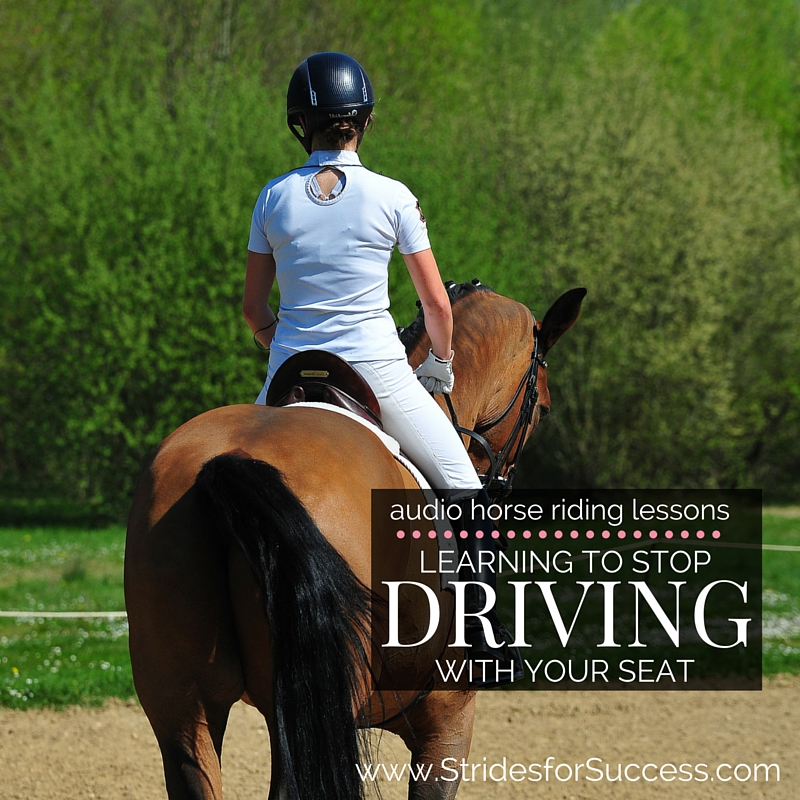
  • Learning to Stop Driving with Your Seat

    Learning to Stop Driving with Your Seat

    Do you often hear the term ‘electric backside’ being used to describe you when you ride?  Perhaps you have found that usually docile and ‘laid back’ horses become a little more, well, lively when you are in their saddle?  Have you ever considered that perhaps you don’t realise just how much you are communicating to your horse through your seat…

    When I first heard the term electric backside I had visions of lightning bolts shooting out of a riders backside, through the saddle and straight into the horse!  Now as strange as this sounds, the reality of having an ‘overactive seat’ has a very similar effect on how your horse behaves while being ridden.

    [smart_track_player url=”https://op3.dev/e/traffic.libsyn.com/dailystridespodcast/686-Learning-to-Stop-Driving-with-Your-Seat.mp3″ title=”Learning to Stop Driving with Your Seat in the Saddle” social_linkedin=”true” social_pinterest=”true” social_email=”true” tweet_text=”Struggling to ‘quiet’ your seat in the saddle? This will help…” hashtag=”equestrian #horseriding” twitter_username=”strides_success” ]

    When we learn to ride, we very quickly begin to notice that how we sit and move influences the horse and how he goes. This awareness is one of the most important parts of developing ‘feel’ and becoming a good rider. however merely knowing this is not enough. Controlling this important aid in the saddle is, for most riders, a little more difficult to master.

    Being able to influence your horse using your seat is one thing, but knowing how to shift between ‘stop, go and neutral’ and all the important subtleties in between, is quite another.

    For many riders this is where the problems begin to arise.  Riders discover that they are ‘over sharing’ when it comes to communicating with their seat aids.  The result is often that the rider is driving with their seat all the time.

    Before we go any further, it is important to recognise that there are certain situations and scenarios where, yes indeed, you will have to drive your horse forward with your seat.However we are speaking here about riders who have incorporated the habit of scrubbing with their seat, like they are trying to polish the saddle or rub a hole in their horses back with their backside, as the status quo.  It becomes their modus operandi or ‘go to’ method for riding their horse.

    This can result in a few things happening. Usually their horse becomes increasingly hot and lively, or their horse begins to ignore their aids completely.

    After all it’s not much fun being shouted at all the time, and constant driving with your seat is the equivalent of roaring at your horse – the whole ride!

    Think of your seat as being similar to the gears of a car.  You can transition up and down gears, however there is also the all important neutral. And to begin really seeing results in riding you need to be able to do all three of the above.

    Knowing how to disengage your seat or, in the case of the car gears, find neutral is vitally important to becoming more quiet and subtle in how you communicate with your horse.

    In my experience, the canter is very often the easiest place to being noticing if you are indeed being a little over enthusiastic with your seat when in the saddle. When you are really driving your horse with your seat in the canter, the horse may begin to hollow his back out from underneath you. This can often be felt rather than seen when in the saddle. However, unfortunately the tendency is there to only focus on what you see in front of you –  your horse bracing against your hand.  But if this is looked at from the ground, it quickly becomes very obvious that the horse is bracing his whole body away from the rider.

    Constant driving with the seat leads to an often epic battle between horse and rider.  Your horse does not have to be galloping or even cantering for this to happen.  It occurs in all gaits, however (as mentioned above) it is usually easiest to spot in the canter.  The overuse of the seat, hips and pelvis in the canter often causes the riders shoulders to begin to ‘swing’ in the canter as well.

    Another way this can show up is when the horse begins to hollow out from underneath the rider through the actual trot to canter transition itself.  We often hear about ‘scooping’ the horse into canter using the inside seat bone.  If you are prone to being a little heavy-handed with your seat to begin with, that same ‘scooping’ can quickly become uncomfortable for you horse.  The result is often that the horse will strike on the incorrect lead.

    However, perhaps the most obvious, is the horse who starts out quite relaxed in the canter, however due to the riders continuous driving, soon becomes tense and rushed.  What began as a good quality canter rather quickly turns into something resembling the final furlong at Aintree!

    Learning to Stop Driving with Your Seat

    Now, we know that we cannot effectively communicate and ride our horses if we just sit in the saddle completely stationary.  We realise that we have to move with our horse when in the saddle.

    But moving with the energy and driving the energy are two very different things.

    When we learn to canter, we are often told that we must ‘roll’ our hips with the motion of the horse. When I am explaining this in the arena I will often use my wrist and hand to demonstrate the movement.  The normal canter will be, from the elbow, my lower arm horizontal to the ground moving up and back, followed by forward and down in an almost circular rotation.  As my arm completes the ‘down and forward’ part of the circle, my wrist will flex slightly down, causing the back of my hand to become a little more upright. Then as my arm begins to lift up, in order to come back closer to my body, my wrist will flex up, allowing my hand to become more horizontal again.

    When a person drives with their seat, the circuit is the same, however as my arm is moving forward and down, the heel of my hand is pushing forward as well.  This causes the back of my hand to strain at an almost 90 angle to my wrist. Then as my arm raises up to come back, the action is no longer fluid as my wrist relaxes again.

    I mentioned earlier how an overactive seat is a little like shouting at your horse all the time.  Good riding is an holistic practice; all aids are involved when communicating with your horse.  In order for your horse to hear and understand all the different aids, they must be subtle.

    So what can you do if you in fact have lightning bolts shooting from your backside when you are in the saddle. Well the first thing is you need to start learning to follow.  Now you are probably saying, “Yes, I do follow – I just follow awfully well!”

    If this is the case I would hazard a guess that you are doing less following and more leading.  I suggest going back a few steps initially with your riding and focus on allowing your horse to move.  Let any movement happening in your seat to be guided by your horse.

    Start with walk initially and think about doing as little as possible, while still allowing everything to happen underneath you.  This is neutral.  When you can find neutral and begin getting used to how this feels, you can then begin working on shifting to first gear and so on.

    It is important to keep in mind that neutral and ‘heavy’ are two very different things.  Heavy does not ‘allow’, it rather blocks the flow of energy underneath you.  Neutral is being carried along, understanding that you still have the responsibility of carrying your own body.

    Unfortunately a lot of riders, once they commit to becoming more ‘quiet’ with their seat, begin slouching through their upper body.  Doing this will definitely cause less movement with your seat, but it will also make things uncomfortable for your horse and cause you to become even less effective in the saddle!

    Rather think of elongating or lifting your upper body off of your hips.  This does not mean that you ride with your shoulders around your ears, but rather carrying your ribcage, so to lengthen the space between it and your pelvis.   Doing this will result in your hips and seat being able to move with your horse, in neutral.  From neutral, you can begin experimenting with how you can use your seat to encourage your horse to move forwards.

    From here, you can begin to work on this ‘allowing’ in both trot and canter. Keep in mind that doing nothing is one of the most difficult things to do on a horse, but in order to break that ‘driving’ habit, it is often the very thing you need to learn!

    Your seat is possibly the most important and effective tool you have when riding your horse, however cultivating that all important ‘feel‘ will take time.  Learning the difference between enough and too much is important – and very often you have to go right back to basics in order to do so.

    Happy Riding
    Lorna

    If you are interested in taming your seat in the saddle, there are a few resources I have that may help you.  Firstly, you can join the FREE 30 Day Rider Fitness Challenge.  Over the course of the 30 days, you will strengthen your core, which will allow you better control over your body in the saddle.

    You can also join Daily Strides Premium, where you will find a whole ‘collection’ of audio horse riding lessons on the seat aids, as well as lots of other collections to help you with your riding.  All the lessons are available for you immediately when you join, and it’s as simple as downloading them to your phone, popping your phone in your pocket and off you go!  A riding instructor with you in the arena.   You can find out more when you visit www.StridesforSuccess.com/join/

    [wp-tiles post_type=”post” orderby=”date” order=”DESC” grids=”Simple”]

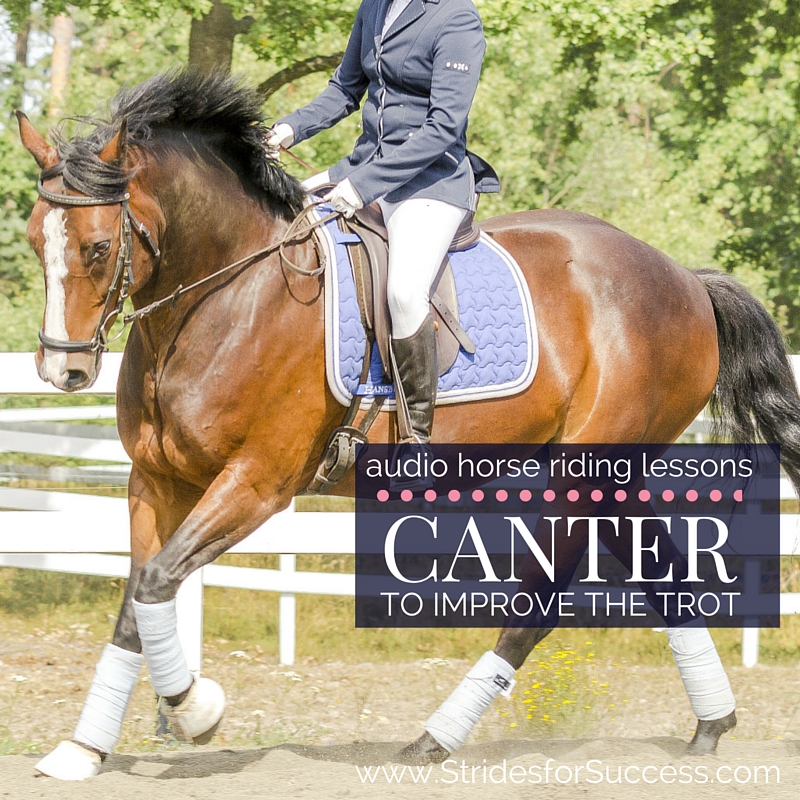
  • Canter to Improve the Trot

    Canter to Improve the Trot

    🌟🐴  Get the Improve Your Canter Program TODAY and transform your riding – and your training 🐴🌟

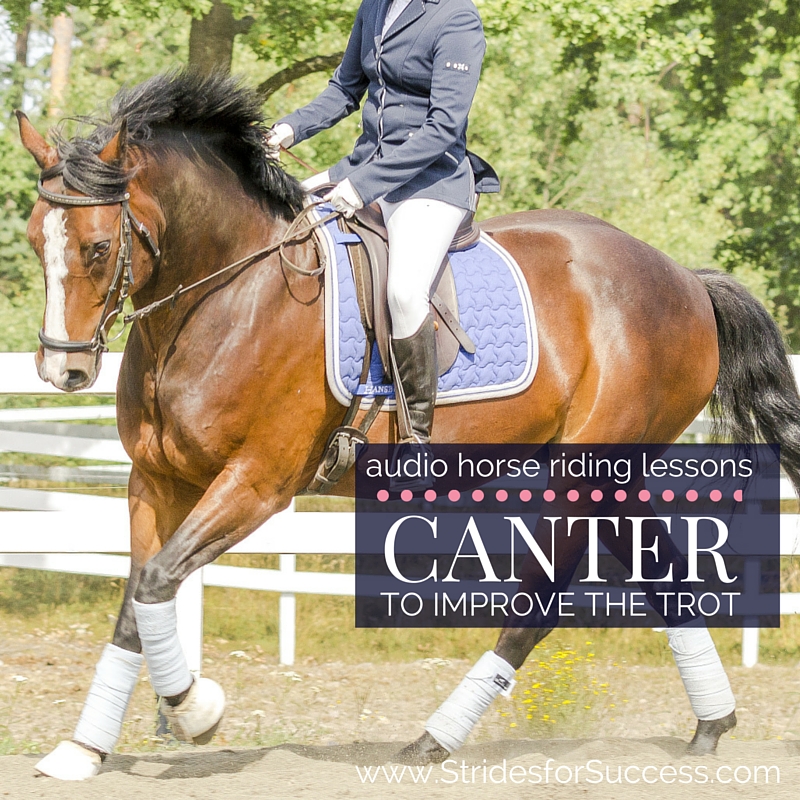
    Have you noticed how, very often, there are only two ‘gears’ when trotting; a good, forward trot or a bland, shuffle trot? However, changing from the latter to the former can often be one of the more difficult aspects of trotting.  If so, have you ever considered using the canter to improve the trot?

    Sounds too good to be true, but very often a good, forward canter can be the simple catalyst from that mediocre flat shuffle, to that wonderful springy and engaged trot.

    [fusebox_track_player url=”https://op3.dev/e/traffic.libsyn.com/dailystridespodcast/676-Using-the-Canter-to-Improve-the-Trot.mp3″ title=”Canter to Improve the Trot” social_linkedin=”true” social_pinterest=”true” social_email=”true” ]

    However, like everything worth doing in life, the canter must be of good quality, and the transitions both into and out of the canter from the trot will often dictate just how effective this technique will be to your horse’s schooling.

    What Makes a Good Trot?

    So, before we go any further, let’s chat quickly about what exactly makes a good trot.  The trot itself is usually quite easy to establish a rhythm, the 1.. 2.. 1.. 2.. almost setting itself up each stride.  The trouble for many riders is then regulating the tempo of that rhythm.

    If the rhythm is the 1.. 2.. 1.. 2.. the tempo is how often that 1.. 2.. rhythm occurs in any set period of time or distance.  

    For example, take the long side of a 60m arena.  By adjusting the tempo of the trot rhythm, you can either have a lot of ‘quick’ 12121212s occurring, or you can have fewer 1…… 2…… 1…… 2……. happening in the same distance.

    So when many riders begin trotting, establishing the rhythm and tempo is often not a problem.  But as soon as they begin to make adjustments to the trot, one (usually the tempo) or both can very quickly become erratic.   Those adjustments can be half halts, shortening the stride, lengthening the stride, or asking for a transition either up or down to a different gait, or within the gait itself.

    In fact, even just beginning to activate the hind quarters and connect the horse a little more very often results in a loss of rhythm and tempo.  This is where we see many horses either begin to run in the trot, or become heavy and lean on the rider’s hand.

    Canter to Improve the Trot

    Riding the canter to improve the trot will help riders to firstly become more quiet in the saddle. It also improves the riders skills in noticing if the gait itself is a quality one to begin with

    Because of the transitions between trot and canter, riders may want to rather ride in a sitting trot when riding the trot.  However, I strongly suggest just using the sitting trot for the actual transition.  Post or rise to the trot when working in the trot.  The reason I say this is because, in order to improve the quality of the trot, the horse must first engage his hindquarters.

    For this to happen, the energy being created there must be allowed to connect through, underneath the rider and saddle, from the back to the front

    Using Your Energy Wisely

    However, it has been my experience that when working between trot and canter for any length of time, riders tire quickly.  This causes them to begin ’slouching’ through their upper body and this, in turn, results in them ‘shutting down’ that flow of energy necessary for the horse to truly work in a quality trot.

    So, for the duration of this exercise, I suggest working in rising or posting to the trot where you can, to give both yourself and your horses back a little break!

    Start with ‘Forward’

    Start by asking your horse to work in what you would consider a forward-going ‘working trot’.  Focus on the rhythm and then the tempo, particularly as you work through corners or change rein.  Can your horse remain to maintain consistency in both?  Many riders wonder if the trot is indeed a ‘working trot’.

    The next part of the exercise will quickly tell you either way if your trot is working, or shuffling!

    Using Canter to Improve the Trot

    Using Half Halts to Prepare

    Begin to prepare your horse for canter.  Use your half halts, but all the while paying close attention to the aforementioned rhythm and tempo.  I also think noticing how straight your horse remains through the transition is important.  Do his hindquarters swing or drift?  Does he ‘curl’ around your inside leg?  Or perhaps he is bracing against your inside leg…?  If you notice any of the above, take this as your cue to begin working through these more basic evasions, before you allow your horse to canter.

    You may find maintaining the rhythm and, in particular, tempo as your horse transitions into canter from the trot rather difficult.  This is what your focus should be on throughout the schooling session.

    Think of ‘you ask – he responds’

    Working Forward in the Canter

    Once in the canter, firstly make sure the canter is moving forward and actually taking you somewhere.  One of the reasons we can use the canter to improve the trot is because the canter often has naturally more energetic and rolling energy with it.  Having to push and kick at every stride is not forward.  But it is important to note that allowing your horse to run like a wild thing around the arena is also not a forward canter.

    The canter can be classed as ‘forward’ if the energy is taking  you somewhere and that somewhere is dictated by you.  You can influence where it goes and how much is allowed ‘out’ at any give time in the gait

    The Canter to Trot Transition

    Once you have indeed established a forward canter, you can begin thinking about transitioning back into the trot.  Again, maintaining the rhythm and tempo is vitally important.  What is also important is the fact that you ‘allow’ your horse to trot.

    There is a split second, that you will feel, when your horse actually takes that step that transitions him from the canter into the trot.  In order to do this he must ‘land’ into the trot. And you must ‘allow’ or ‘soften’ through your hand so he can indeed move forward into the trot

    This is also where I suggest posting or rising from the first step.  This way, when you have ‘allowed’ him to continue to move forward, that energy in his hind quarters can indeed connect with the front end.  It will feel like he is ‘swinging’ underneath you.

    Feeling the Difference to the Trot

    Many riders find that the first time they really ride a good trot with their horse, the bounce is a little too much for them.  Again, rising or posting will help you initially.  Then, later, as you become more supple and allowing through your body, you can start moving with your horse and this new energy in sitting trot.

    You can use the canter to improve the trot both in the saddle and on the ground.  The same principles can be applied when lunging your horse with the added bonus of actually being able to see the results, rather than feel them

    Keep in mind that in order for your horse to improve and develop himself, it is your responsibility to establish and maintain that straightness, rhythm, and tempo.  Work towards being able to move up and down, through your horse’s gears, without losing any of the above.

    It is also vital that your horse continues to ‘move forward’ at all times; taking you somewhere.

    Happy Riding
    Lorna

    Improve Your Canter Program

    4 weeks of self-study with easy-to-follow audio horse riding lessons that will help you to transform your canter – and your aids in your riding. Suitable for riders who are just getting started with canter, and riders who want to improve both their abilities and their horse’s canter.

    And with lifetime access, you can dip in and out of the program again, and again… All of the details are HERE

    Connection; The Online Resource for Riders

    This podcast is the first in a series of five on this specific topic which were created for Daily Strides Premium, now know as Connection.  Every month you will get audio horse riding lessons to listen to as you work your horse. Connection is created to help riders working alone, without a trainer or coach, to continue to both improve their riding AND train their horse.

    All of the audio programs are step-by-step instructions for you to follow while riding your horse.  All of your lessons are available, on your phone, using a Private Podcast Feed. 


    All of the details are available at https://stridesforsuccess.com/join.  The membership is risk free, with no contracts.  You can cancel any time. I would love to have you on a lesson soon :)